
Small-Cap Investing Mistakes to Avoid
PC Jeweller used to seem much less risky than it actually was. The stock attracted a lot of retail investors because it appeared cheap and was receiving media attention. Investors jumped in without further research because of the low price, which gave the impression of a deal, and the thrill of making quick profits. PC Jeweller
But reality soon hit. The poor fundamentals, high debt levels, and other operational issues made it rather challenging for the company to perform consistently. Within a short period, the stock price collapsed, resulting in massive losses for those who had been enticed by the hype surrounding this company.
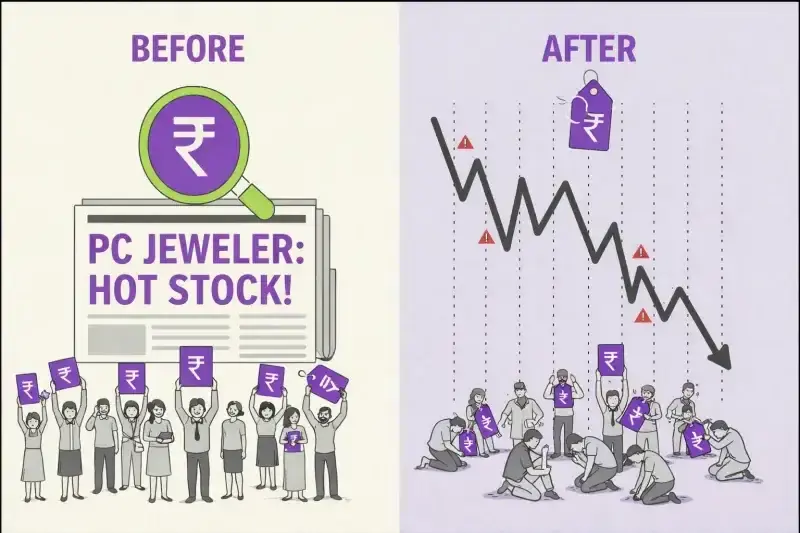
This particular story underlines the fact that small-cap investment will pay off only after patience and, of course, caution. Jumping in blindly can turn opportunity into regret. Understanding the mistakes others have made can save you both money and stress.
The PC Jeweller episode shows that even promising small-cap stocks can go wrong if investors act on hype without understanding the risks. Such cases are also common and highlight the importance of being aware of pitfalls that may arise prior to investing. Thus, despite its own sets of interesting aspects, stock investment through small-cap stocks should also be conducted with care.
Introduction: Why Small-Cap Investing Is Exciting but Risky

Small-cap stocks are also known as the “high-risk, high-reward” playgrounds of the stock market. Unlike larger companies, these companies possess the ability to experience rapid expansion and can help deliver “life-changing” investment gains. It’s no wonder why these investment options are highly appealing to both novice and experienced financial market participants.
To understand how small-caps compare with bluechips in wealth creation, check out our Link: Multibagger Stocks vs Bluechip Stocks – Which Builds More Wealth?
Small-caps are attractive for many because of their apparent cheapness. To “catch the next big thing” sounds appealing. The publicity in the media determines urgency. This excitement often leads investors to buy before doing proper research.
However, small-caps come with hidden risks. When there is insufficient feedback, it becomes very challenging to evaluate their true potential. Operational issues, excitement in the marketplace, or regulatory issues may create extreme volatility in pricing.
Too often, both operational challenges and regulatory hurdles attract the best-thinking financial capital into these situations.
If you’re investing for the first time, especially in small-cap stocks, these are some common mistakes to avoid.
Mistakes to Avoid when Investing As a first-time investor
1. Chasing Cheap Stocks – The Illusion of a Bargain
It’s easy to get excited when a stock is trading at ₹70 and think, “This is so cheap—I can grab a lot of shares.” That thrill often has more to do with the number on the screen than what you’re actually paying for.
Take Zomato’s IPO. The issue price was around ₹72–₹76 per share — a number that felt affordable to many first‑time investors. On listing day, the stock jumped to around ₹116. But the valuation tells a different story: at the upper end of the price band, Zomato’s IPO was priced at about 25–30 times enterprise value to sales, significantly higher than global peers in food delivery and other consumer services. That means investors were paying a premium for future growth that wasn’t yet proven, even though the share price looked “cheap.”
Now compare this with companies like Eicher Motors or Apar Industries when they were still small‑cap stocks. Eicher’s earnings were already strong and visible, and its PE ratio for much of the past decade sat in mid‑20s to low‑30s — a valuation supported by growing profits rather than just promise. Apar, too, traded at reasonable PE levels as its earnings became more consistent, reflecting underlying business strength instead of just future hope. In both cases, the price looked “high” at first, but valuation told you what you were paying for — profit‑earning capacity — not just optimism.
That’s the heart of the mistake: beginners often think ₹70 is cheaper than ₹1,000, simply because of the number. But price doesn’t matter by itself — valuation does. Instead of asking “How cheap is this stock?”, seasoned investors ask: What am I actually paying for this business?
They look at :
- Earnings
- Sales
- Cash flows
- Multiples like EV/sales or PE
Because once you start viewing a stock as a business instead of just a price tag, chasing cheap‑looking stocks loses its appeal.
As Warren Buffett says, “Price is what you pay; value is what you get.”
The mistake isn’t buying a ₹70 stock. The mistake is thinking ₹70 is cheaper than ₹1,000—because price doesn’t matter, valuation does.
For a deep dive into how debt affects small-cap investing, see Link: What is Debt to Equity Ratio? Why it Matters for Small Cap Investing.
2. Diversification
Many beginners believe that buying 20–30 small-cap stocks automatically reduces risk. On paper, it sounds sensible. In reality, it often creates a different problem altogether—too many stocks, and too little understanding of what you actually own.
This is similar to a situation where you need to keep a number of eggs balanced at once. While some of these eggs may still be intact (i.e., not broken), without some sort of indication as to which ones will eventually break, you will not know until after the fact whether or not your original suspicion was correct.
In investing, weak businesses, poor governance, or struggling sectors can quietly drag down returns while hiding inside an overcrowded portfolio.
This played out clearly during the 2025 small-cap correction. Investors holding large baskets of loosely researched stocks discovered that even when a few names performed well, the gains barely showed up.
Underperformers steadily pulled the portfolio lower. Tracking earnings, management commentary, sector risks, and news across so many companies became overwhelming. Important warning signs were easy to miss—not because investors didn’t care, but because there was simply too much to monitor.
But swinging to the opposite extreme doesn’t help either.
Under-diversification—putting most of your capital into one or two ideas—can be just as damaging, especially in small-caps. When too much depends on a single company, any negative surprise stops being a stock-level issue and becomes a portfolio-level problem.
Many retail investors learned this the hard way with Yes Bank. Confident in the brand and its earlier growth story, some investors allocated a large portion of their portfolio to the stock. When governance concerns and capital stress surfaced in 2019–20, the collapse was swift.
Those who were heavily concentrated had no cushion elsewhere. What could have been a manageable setback turned into serious damage simply because there was nowhere else to lean on.
According to Warren Buffett, "Diversification only makes sense if you don't understand what you're doing."
It’s not about avoiding diversification, it’s about doing it on purpose.
An ideal investment portfolio tends to mirror who the investor is, whether the investor is a risk taker, an experienced investor, or whether he is capable of holding on in times of uncertainty.
A well diversified portfolio provides stability in large cap stocks, growth in mid cap stocks, and selected small cap stock exposure, and it diversifies in terms of sectors rather than stocks.
This thinking sits at the core of our SPRINT investment philosophy, which focuses on building portfolios that are structured, purposeful, and aligned with long-term goals—rather than spreading capital thin or chasing too many ideas at once. (Link the SPRINT philosophy page here.)
At the end of the day, diversification works best when every holding has a role.
Owning fewer stocks you genuinely understand—and spreading them sensibly across market caps and sectors—does far more for risk management than owning many stocks you can’t keep track of.
For a deeper breakdown, read our article- Portfolio Diversification – How Many Stocks Should You Hold?
3. Panic Selling – Fear During Volatility

The stock markets experienced their most dramatic decline ever in March 2020, at the peak of concerns over COVID-19. On March 23, 2020, the Sensex was down nearly 13%, and the Nifty fell about 13% as well.
Throughout that period, major index levels fell sharply: on other key days in mid-March, Sensex and Nifty both suffered multiple double-digit percentage falls over just days, reflecting panic and systemic risk concerns rather than changes in individual companies’ fundamentals.
This stress wasn’t limited to large indices. Data from March 2020 shows that by mid-month, small-cap and mid-cap indices in India were down roughly 26–31% year-to-date, far exceeding the broader market fall.
Such dramatic actions were largely fueled by fear, unknowns, and forced sales from investors seeking to raise money or unwind holdings, as opposed to the deterioration of the underlying business.
Although some listed shares eventually regained ground as conditions stabilized, a number of investors who sold near the troughs were able to realize losses that could have been averted with a longer-term perspective.
Prices fell sharply not because every business suddenly became weak, but because fear and the need for liquidity took over decision-making.
Many investors sold simply to “get out,” even when long-term fundamentals had not changed overnight.
"Be Fearful when others are greedy, and greedy when others are fearful,” Warren Buffet said.
Those investors who hit the pause button and kept their composure were able to weather the storm.
The message here clearly emerges: too much alarm for the short term can be misleading about danger, but adding a long-term strategy to that alarm can convert a crisis into an opportunity.
4. Ignoring Market Cycles – Timing Matters
The stock market's small caps have a tendency to have many ups and downs, which can create excitement or despair among investors.
However, just as you might buy a gym membership in January and be very enthusiastic about it, your enthusiasm eventually fades and you think about how difficult the gym may actually be for you to use.
Graphite India is a perfect example. When global steel production surged, electrode demand soared, and the stock rallied sharply. Investors assumed those peak earnings would continue forever. But as steel cycles cooled and electrode prices normalised, profits fell, and the stock corrected—yet the company itself remained operationally strong.
The lesson? Cyclical highs don’t last, and prices can swing even when the business is healthy.
Smart investors analyze cycles, analyze long-term trends, and analyze businesses from a long-term perspective of earnings power rather than looking at the peak points.
5. Ignoring Margin of Safety – Leaving No Buffer
Even strong companies can hit rough patches. That is why experienced investors always look for a margin of safety when making investments. Investors prefer to purchase shares at a price lower than what they consider to be the true value of the company (intrinsic value).
When you consider a bridge designed to carry a maximum weight of 10,000 kg, if a truck weighs 9,900 kg, it can be safely driven across the bridge, however, there is very little room for margin of error. That, on the other hand, a 7,000kg truck moves across with extreme ease, even under pressure. Investing works the same way: buying with a cushion helps you stay calm during corrections or unexpected challenges.
Read our article: LINK - 10 stock market terms every beginner must know
Instead of chasing “cheap-looking” stocks, focus on the business behind the number. Examine value in proportion to earnings, debt, and cash flow, and choose firms with stable earnings, good cash flow, and effective managers.
Use very conservative models for growth and make sure to diversify because a single poor performer shouldn’t impact the whole portfolio.
Warren Buffett is still right when he says: "Rule No. 1: Never lose money. Rule No. 2: Never forget rule No. 1.”
When you start thinking about a stock as a business and leave room for error, you naturally make calmer, smarter investment decisions.
6. Following Hype – Tips Aren’t Truth
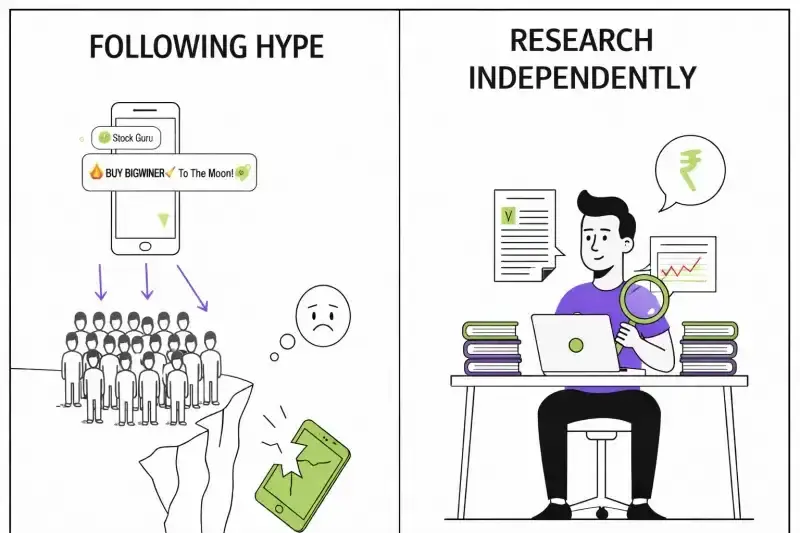
You scroll through your phone and see everyone talking about a stock that’s ‘the next big thing.’ Small-caps are magnets for buzz—WhatsApp tips, social media posts, flashy headlines, friends boasting about gains. It’s hard not to feel the pull. This isn’t just about one story; hype comes in many forms:
Brand Hype: Big names make investors feel safe. The Reliance Power IPO seemed irresistible because of the brand alone.
News Hype: Media reports about “massive growth” or “industry boom” can exaggerate reality.
The perception of your friends and/or colleagues hitting it rich (winning) in the stock market generates a "Fear of Missing Out" or "FOMO," which puts pressure on you to also become a millionaire.
Momentum: When stocks rise dramatically in price, they attract substantial interest from investors who believe the stock will continue to rise indefinitely, creating momentum hype and the temptation for late-to-the-party investors to jump in.
The Reliance Power IPO illustrates this perfectly. Everyone was excited—the brand was huge, marketing was aggressive, and retail investors feared missing out. Yet underneath, earnings were weak and most growth relied on projects that hadn’t even started. When the stock finally listed, prices corrected sharply, punishing those who bought into the story instead of checking fundamentals. Reliance Power
As Warren Buffett reminds us, “Investing is simple, but not easy.”
The true talent isn't identifying trends; it's understanding what the trends mean.
Before making an investment, take a moment to analyse the company's financials and determine if you believe the narrative surrounding this company is supported by its history of profits, ability to generate cash flow, and its likelihood of reaching its projected growth rate.
Use tips as starting points for your research rather than hard rules, and make sure that your decisions are based on objective data rather than subjective enthusiasm.
7. Short-Term Thinking – Chasing Quick Gains
All beginners get trapped in thinking that small-caps would skyrocket overnight. Yes, volatility can create sudden spikes, but real gains usually come in with patience.
Mid-caps, however, strike a balance between growth and stability— LINK: learn why in Why Mid Cap Stocks are the Sweet Spot for Long-Term Investors.
The best example of patience leading to success is seen in the example of Warren Buffett himself.
When Warren Buffett invested in Coca-Cola, it was back in the late 1980s, and Warren Buffett did not attempt to ride the fluctuations of the stock prices but held the stock for several years and allowed the result of growth and the dividends of the stock to compound and do the trick. Coca-Cola became one of the most successful investments of Berkshire Hathaway, not because of the incrementing stock prices but because of the consistency.
This shows why reacting to every price swing often works against investors. Real wealth comes from giving strong businesses time to grow.
According to Buffett, “The stock market is designed to transfer money from the impatient to the patient.”
To apply this principle, concentrate on multi-year growth, maintain proper expectations, and ride out both good and bad times with patience instead of acting in panic.
8. Ignoring Corporate Governance – Hidden Red Flags
In fact, the hotter the deal, the closer everyone needs to look. Even when the paper looks good, the danger of hidden risks looms. The key, of course, is good governance.
Take, for example, the Satyam Computer Services scandal. The company looked good for several years, with positive revenues and profits. The investors thought that everything was right because the figures were looking healthy.
But behind the scenes, accounting irregularities and opaque management decisions were piling up. When the truth came out, the stock collapsed almost overnight, and investors who hadn’t looked beyond the financials were left reeling.
These issues may manifest through unexpected leadership transitions, a lack of transparency within audits, or inconsistencies within disclosures— warning signs that are often overlooked by small-cap stocks. Experienced investors recognize that warning signs should be acknowledged well before issues affect the bottom line.
Warren Buffett sums it up neatly: “Honesty is a very expensive gift. Don’t expect it from cheap people.”
Evaluating governance isn’t about predicting fraud—it’s about identifying reliability and stability.
Instead of just trusting the numbers, research deeper into how the company is run. Check management credibility, board independence, and audit quality. Well-governed companies are better at absorbing shocks, giving you a finer sense of safety even in tumultuous markets.
9. Neglecting Liquidity – Difficult to Exit
Even fundamentally strong small-cap stocks can become a trap if liquidity is low. Trading thinly doesn’t just slow down buying and selling—it can amplify losses when things go wrong.
Vakrangee Ltd. in 2018 illustrates this perfectly. After governance concerns surfaced, the stock started declining. Many retail investors rushed to sell, but there simply weren’t enough buyers in the market. Prices slipped sharply, and some investors had to exit at steep losses, while others were stuck for months, unable to sell at a fair price.
What looked like a minor correction on paper became a painful experience in real life.
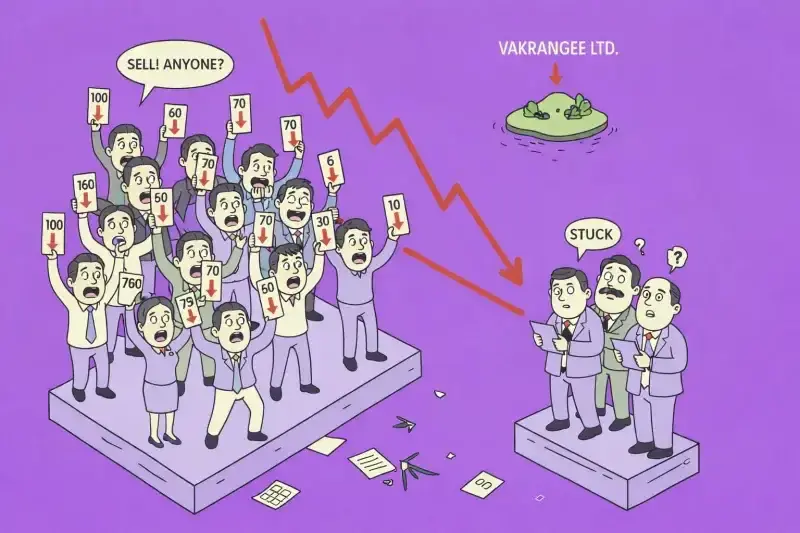
Liquidity isn’t just a number; it’s a measure of flexibility. Even if a company’s fundamentals are solid, low liquidity can turn small market movements into significant losses.
Buying a stock without understanding how easily you can exit is like parking a car in a tight alley—you might not be able to move when you need to.
Warren Buffett’s advice still holds: “Never invest in a business you cannot understand—including whether you can get your money out when required.”
Rather than making an investment decision without knowledge, make sure to determine the average number of stock trades before making a stock investment. A liquid stock enables you to respond to changes in the markets whereas a stock with a low number of trades can lead to short-term changes resulting in long-term trouble.
10. Lack of Proper Research – Blind Investing
Excitement can be contagious, but when it replaces careful analysis, it can also be dangerous. Some beginners invest simply because a stock sounds interesting, is being discussed by friends, or is trending on social media. Without research, red flags can hide in plain sight until it’s too late.
DHFL (Dewan Housing Finance Ltd.) provides a stark example. For years, it seemed like a solid player in the booming housing finance sector. Retail investors assumed growth and stability were guaranteed. But behind the scenes, large portions of its loan book were questionable or even fake, directed to related entities.
Financial irregularities masked mounting stress, and by 2019, DHFL began defaulting on payments. Regulators stepped in, bankruptcy proceedings started under the NCLT, and shareholders faced total losses.
Its promoters received market bans and penalties for misrepresentation and fund diversion. What looked like a growing, safe investment turned catastrophic—simply because research was skipped.
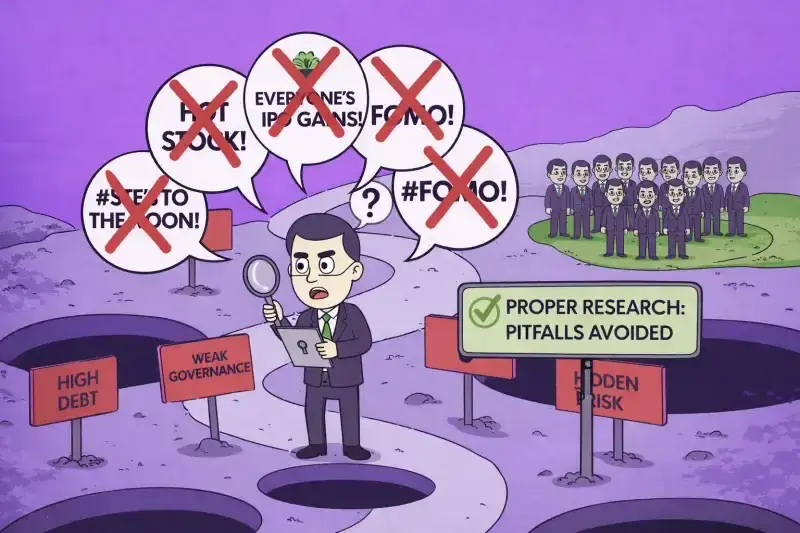
As Benjamin Franklin said, "An investment in knowledge pays the best interest."
Instead of investing after hearing the story, trend, or hype, take the time to understand the business, review the financial statements, review the level of debt, and assess the level of governance. Research is not exciting, but it is what distinguishes an impulsive investment from an informed one. Researching for even a few minutes will save your hard-earned money from costly errors.
Choosing the right approach is critical—read our LINK: Technical vs Fundamental Analysis – Which One Should You Follow?
11. Emotional Bias – When Feelings Drive Investments
Savvy investors, no matter how smart, can easily go wrong when emotions take control. Biases of familiarity, overconfidence, and FOMO can easily creep into their decision-making processes, pushing it towards intuition rather than reason.Familiarity Bias: It’s natural to trust what you know. Maybe you work at a company, use its products every day, or see it constantly in the news. That comfort can be misleading. An employee buying shares of their own company without analyzing debt, growth potential, or competition is taking on unseen risk—because familiarity doesn’t guarantee fundamentals.
Overconfidence: Believing you’re always right can be dangerous. Surveys show over 60% of retail investors think they can beat the market, even though historical data suggests otherwise. This can lead to concentrated bets, ignoring warning signs, or holding positions too long simply because you “know” the stock will rise.
FOMO (Fear of Missing Out): The rush of social media hype, trending stocks, or peer chatter can push investors to act impulsively. Beginners often jump on the latest hot stock, paying inflated prices and ignoring fundamentals, just to avoid “missing out.” This rarely ends well.
Rather than acting on emotion, identify the stimuli that cause emotional investments and base investments on researched and disciplined approaches. Diversify investments by sector and market capitalization and emphasize fundamentals such as revenue, earnings, and indebtedness.
Comfort, conviction, or hype should never substitute for analysis—logic thoughts before everything helps you invest wisely when the whole world is-after something.
Error-making in small-cap investments is commonplace—but mistake repetition doesn’t have to be. A proper strategy can easily sidestep all these pitfalls.
Step-by-Step Approach to Avoid Small-Cap Investing Mistakes
Start Small
Small-cap stocks can be very lucrative but can also be volatile. Instead of going all-in, allocate only a portion of your portfolio. This way, even if things go wrong, the damage stays limited—and your confidence stays intact.
Beginners can even start with a minimal amount—learn how in our LINK: How to start investing in stock market with just ₹1,000
Research Thoroughly
A stock isn’t just a price on a screen. Look beyond headlines and study financials, business models, sector trends, and management quality. As Peter Lynch famously said, “Know what you own, and know why you own it.”
If you want a quick, structured approach, check out our LINK: A fundamental checklist: How to research a stock in 1 hour.
Have a Plan Before You Invest
Plan your entry and exit points as well as your analysis timeline prior to investing. Without one, emotions rule the markets—fear to sell and greed to buy.
Diversify Smartly, Not Blindly
Diversification works best when it’s done across sectors and business models, not by owning too many random stocks. The goal is balance, not chaos.
Staying Disciplined in Volatility
Small-cap stocks can be quite volatile as they react to news or rumors or short-term earnings reports. It is best not to panic when there's a market correction and not buy into hype when there's a market rally. Small-cap stocks need patience that distinguishes winners from traders.
Understand Market Cycles
Corrections and rallies are part of the market’s rhythm. Investors who understand this history are less likely to overreact. As Howard Marks puts it, “You can’t predict, but you can prepare.”
Markets often teach their toughest lessons not through textbooks, but through real money lost.
The examples illustrate how common small-cap errors occur in real life—and the importance of understanding the underlying principles behind each common error rather than just memorising the ratios.
Explore our Products
Research Framework

Emerging Titans
Combination of quantitative analysis, industry tailwinds, and management assessment - SPRINT investment philosophy

Tiny Titans
Heavy emphasis on scuttlebutt research, plant visits, and early on-ground signals
Conclusion – Turning Mistakes into an Edge
Most investors don’t lose money in small-caps because they choose the wrong stocks—they lose money because they repeat the same preventable mistakes across cycles. Knowing ratios or spotting narratives is not enough; what truly matters is having a disciplined process that controls behaviour when prices, headlines, and emotions pull in opposite directions.
If this breakdown helped you recognise patterns you’ve seen—or experienced—in real markets, comment “DISCIPLINE” below. Like the post to support research-driven investing, share it with investors navigating small-caps, and comment with one mistake you’ve learned to avoid over time.
The strongest investing edge often comes not from doing more—but from doing fewer things wrong, consistently.
FAQs ( Frequently Asked Questions )
What is the biggest mistake that a beginner can commit when it comes to small cap investing?
+Should I invest in small-caps if I'm just starting out?
+Risk Analysis before Small Cap Investment, how important it is?
+Can past winners repeat their performance?
+What is a margin of safety and why does it matter?
+
High growth stock specialist, Value Educator
Shashank Mahajan is an equity research professional with over 12 years of experience in identifying high-potential SME and micro-cap stocks at an early stage. He follows a rigorous scuttlebutt research–driven approach, combining on-ground insights with deep financial analysis. Shashank specializes in uncovering under-researched and under-owned companies with strong management quality and long-term growth potential. Through disciplined research and early identification, he focuses on spotting tomorrow’s market leaders before they enter the mainstream investor radar.

Zen Technologies: Revenue Fell After a Big Win




PNG Jewellers: A 194-Year-Old Name Goes National

Explore our Products
Research Framework
Emerging Titans
Combination of quantitative analysis, industry tailwinds, and management assessment - SPRINT investment philosophy
Tiny Titans
Heavy emphasis on scuttlebutt research, plant visits, and early on-ground signals


 Orders
 Subscription
 Share with friends
 Logout


Required Details
₹23999.00
(12 month subscription)
As per SEBI regulations, all users are mandated to complete the KYC that is validated for 1 year. Post payment, you will be redirected to the KYC screen


No comments yet. Be the first to comment!