
NTPC vs JSW Energy: Better Power Stock?
Is India still a power deficient country, or has it silently emerged as an energy powerhouse in transition?
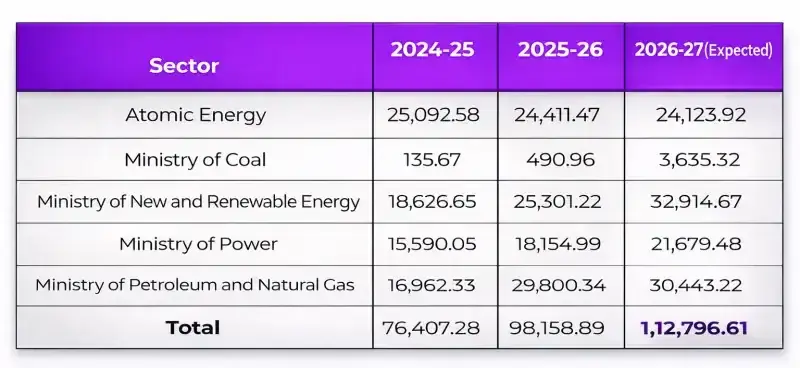
The answer lies in the numbers. In the last four years, i.e., since 2009, the growth in power generation has been at an average of 5.42 percent annually, and this year too, the sector's spending is growing by almost 15 percent.
POWER & ENERGY SECTOR EXPENDITURE ( Values In Crores)
There was a point of time when there was an energy deficit of almost 10%. The energy requirement was more than the energy supply. However, with the passage of time, this energy deficit has decreased with the addition of more capacities.
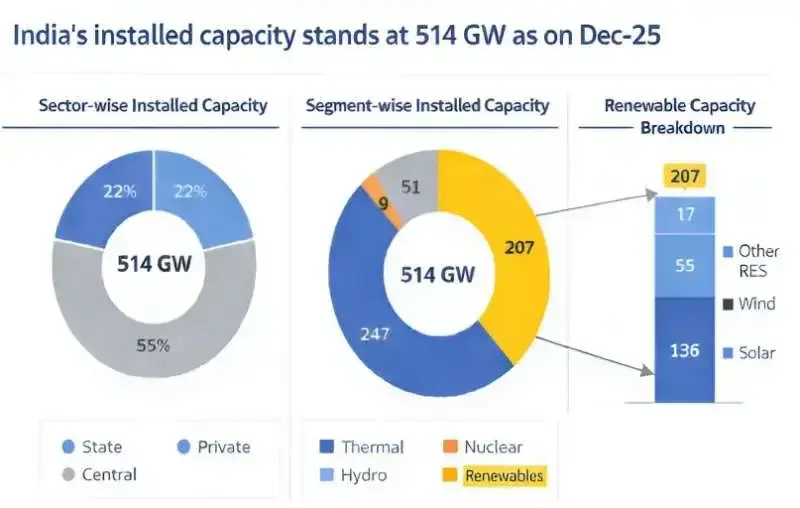
India has achieved a total of over 500 GW in terms of total installed capacity, with more than half of this being non-fossil in nature. This is because of the high growth rates of renewable energy, with solar power contributing to a quarter of the total capacity, along with wind power.
The structural growth of the sector is explained in detail in Why Power Sector Stocks are Booming – Data & Trend Analysis, where we break down the long-term demand drivers behind India’s energy expansion.
As factories increase, cities expand, and people use digital technologies, the need for energy continues to increase. For a country that is growing this rapidly, energy is not just a necessity to power the lights; it is a necessity to power growth and growth plans.
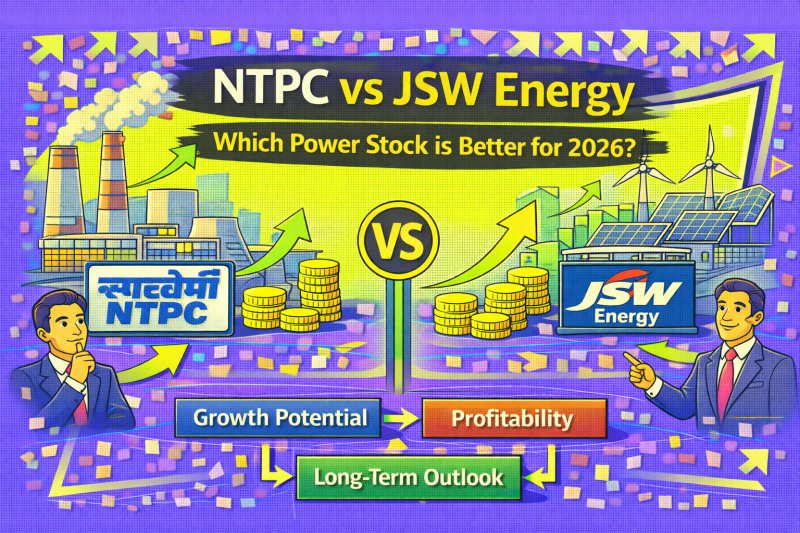
Two major players leading this growth are NTPC Limited and JSW Energy. Let us analyse both companies to understand which one is better positioned to benefit from India’s rising energy demand.
If you want to evaluate companies like NTPC or JSW Energy on your own, our guide A Fundamental Checklist: How to Research a Stock in 1 Hour walks through the exact process analysts use.
NTPC
NTPC Limited is a public sector company owned by the government. It is the largest electricity company in India. The main work of NTPC is to generate and distribute electricity. NTPC was established in 1975. It ensures India's energy security by producing electricity through different sources, including coal, gas, hydro, solar, and wind.
NTPC has an established presence across the country. It has long-term power purchase agreements. The company is looking towards the future by rapidly growing its use of renewable energy as the country is moving towards cleaner and greener electricity.
NTPC is not just participating in India’s power growth. It is leading it. In Q3 FY26 alone, the company added 2,212 MW of capacity, taking total additions this year to 6,615 MW. Management has called this the highest capacity addition achieved in ten months.
Power demand itself is rising steadily. In December 2025, demand grew by 6.3 percent, and in January 2026, it grew again. Peak demand even touched 245 GW in January. As Warren Buffett says, “The best businesses grow when demand is real.” That demand is clearly visible in India’s power sector.
NTPC’s generation is also keeping pace. The group’s power generation increased by 8.8 percent in December and by around 4 percent in January 26 compared to last year. Importantly, NTPC’s coal plants are running more efficiently than the national average, showing better operational strength.
Fuel security is another strong point. NTPC currently holds around 15 million tonnes of coal, enough for about 18 days of generation at high operating levels. Its captive coal mines recorded dispatch growth of 4.34 percent year on year, giving the company greater control over its fuel supply.
The company is also investing heavily for the future. Group capital expenditure stood at INR 33,466 crore in the first nine months of FY26, higher than last year. Its total plant and machinery base has grown 17.4 percent year on year, showing visible expansion on the ground.
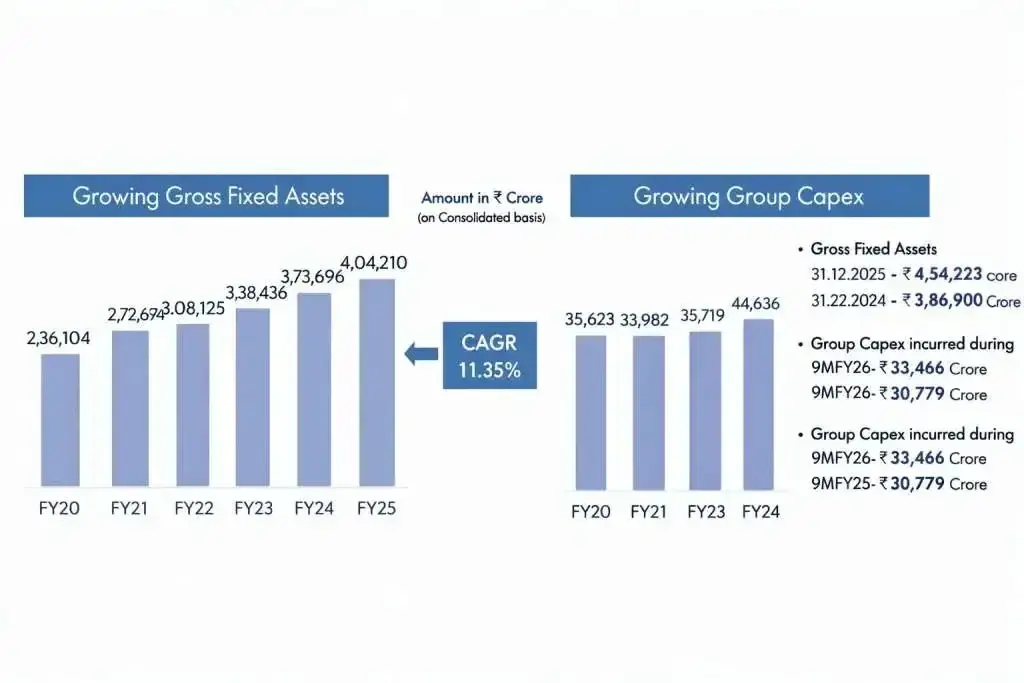
NTPC today has over 33,000 MW of capacity under construction across coal, hydro, and renewable projects. Thermal additions are clearly planned for the next three years, providing strong visibility of growth.
It is also open to strategic acquisitions such as the 1,350 MW Sinnar plant, which comes with additional land for expansion.
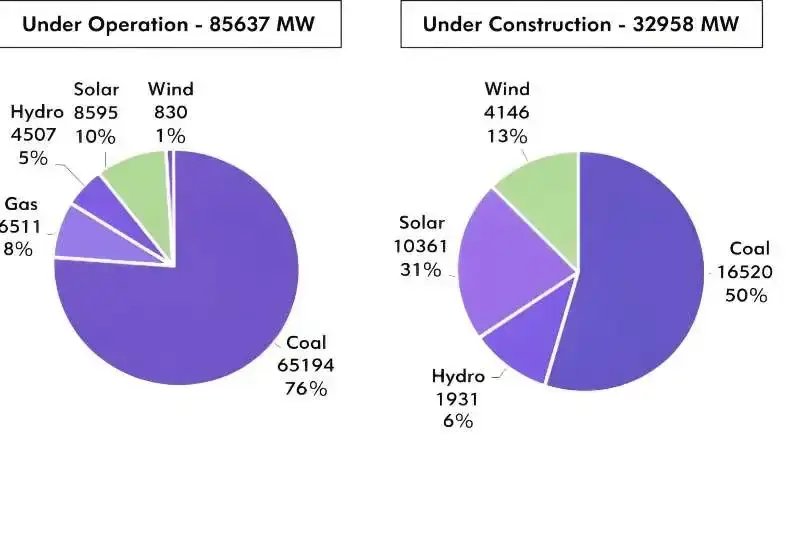
NTPC is not just a coal-based organization. It has been diversifying into other fuels, including gas, hydro, solar, wind, and the latest, storage. According to the organization itself, the diversity in traditional and non-traditional fuels helps them provide affordable, reliable, and sustainable energy.
Energy storage has also become the new big thing. NTPC has launched India’s first large-scale vanadium flow battery project. This has been followed by plans for a 5,000 MWh rollout across many stations. This will also be helpful for the coal-based plants.
On the other side, the SHANTI Nuclear Act has also helped the organization’s plans for the future. This act has already paved the way for NTPC to increase its nuclear capacities, which has also been supported by the organization itself. This has also helped the organization’s plans for the long-term future.
NTPC is shifting towards a greener future through its new venture, NTPC Green Energy Limited. This new venture is based on the idea of green, clean, and sustainable energy.
NTPC has a good financial position too. In the latest quarter, the profits have slightly increased compared to the same quarter last year. Interest rates have been reduced to 6.05%. An interim dividend of 2.75 rupees has been announced for the shareholders.
Investors analysing companies like NTPC should always understand the balance sheet structure, which we explain step-by-step in How to Read a Balance Sheet Like a Professional Investor.
Looking at the stock price, it does not seem overly expensive. Its P/E is 15.4 compared to around 26 for the sector, and its P B is 1.94 versus 2.04 for the industry. For a large and steady company like NTPC, the valuation looks reasonable.
If you're new to valuation metrics like P/E, our guide The P/E Ratio Decoded: Trailing vs Forward, and What is a “Good” P/E? explains how investors use this ratio to judge whether a stock is expensive or cheap.
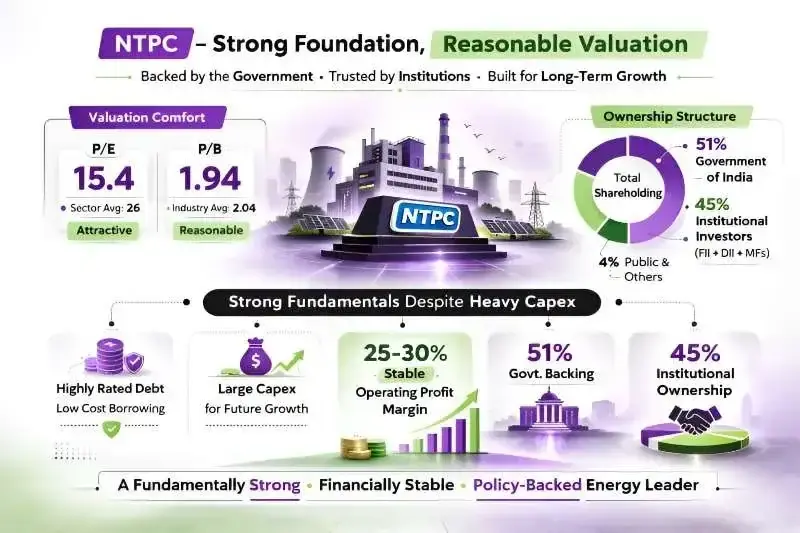
NTPC is owned mainly by the Government of India which holds 51 percent of the company. A large part is also held by mutual funds and other big investors. When such investors stay invested it usually shows trust in the company’s stability.
Because of its strong position NTPC can borrow money at reasonable interest rates. Even after spending heavily on new projects it keeps operating margins of around 25 to 30 percent. This shows the business is managed in a steady and careful way.
In simple terms NTPC is solid and dependable. It may not grow very fast but it has scale support and consistent earnings. For investors who prefer stability over high risk it offers comfort and balance.
Jsw Energy
JSW Energy is one of the top private power generating companies in India and is part of the JSW Group. The company has thermal, hydro, and renewable energy projects, with a focus on solar and wind energy.
In the last few years, JSW Energy has expanded its renewable energy projects through the acquisition of other projects and the development of new projects, matching the pace of the clean energy drive in India. With firm long-term power purchase contracts, operational efficiency improvements, and a strategy to increase green energy capacities, JSW Energy is looking to establish itself as a significant player in India’s dynamic power landscape.
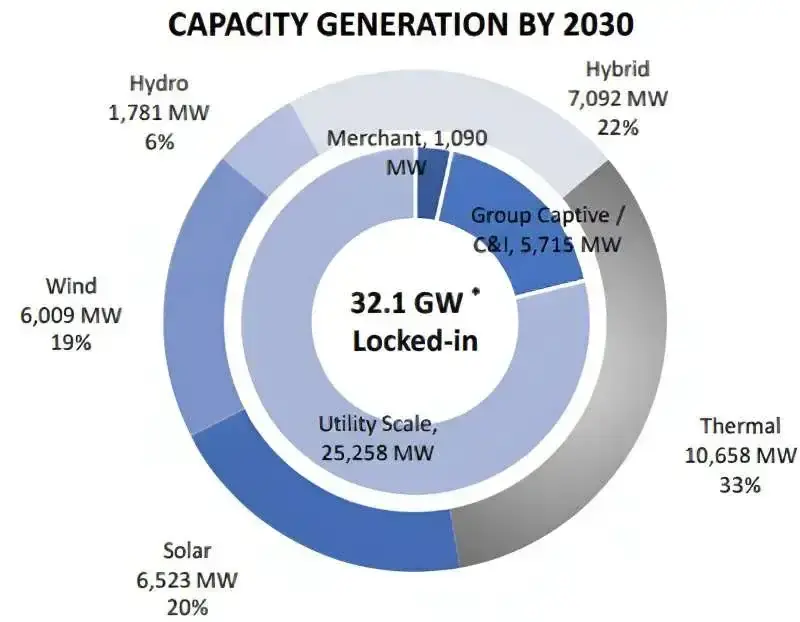
JSW Energy is positioning itself exactly for this transition. The company has locked in 18.7 GW of additional generation capacity and 29.6 GWh of storage capacity. Storage capacity refers to battery systems that store electricity and release it when demand is high. Management remains confident of reaching 30 GW generation capacity and 40 GWh storage by 2030.
Right now the company operates 13.3 GW of power capacity. In just the last twelve months it added 5.2 GW, which is a meaningful jump in a short span of time. Out of this, 3.1 GW came from renewable projects and 2.1 GW from thermal power. Even during the recent quarter, it added another 125 MW of renewable capacity, showing that expansion is happening step by step and not just on paper.

JSW Energy benefits from selling nearly 25 percent of its power to industrial customers who pay higher tariffs of over ₹3.65 per unit, strengthening revenue quality. The company is also reducing open market sales by signing long-term agreements, lowering merchant exposure from 8 percent to about 5 percent. This improves stability and supports steady future growth.
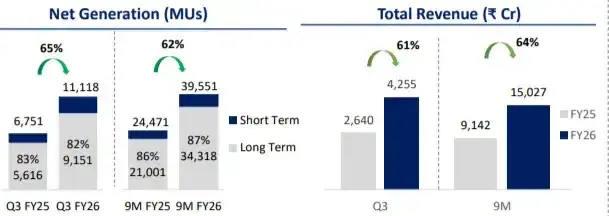
Operational performance has been strong. The Q3 sales were 11.1 billion units, up from 6.8 billion units last year, an increase of 65 percent. The nine-month generation was 39.6 billion units, up 62 percent. Around 82 percent of total sales came from long-term power purchase agreements.
Renewable generation grew 149 percent year on year. Thermal generation increased 55 percent. Hydro generation rose 27 percent, higher than the national hydro growth rate. The Kutehr hydro plant has now stabilised and generated around 130 million units in Q3.
On the thermal side, Salboni in West Bengal is becoming the company’s largest asset at 3.2 GW after signing an additional 1,600 MW agreement. The first unit is expected in 48 months, and the second six months after that. The company also has its goals set for the upcoming years, with a target of 32 GW of Capacity Generation by 2030.
To reduce execution risk, the company secured ultra-supercritical turbine generators from Toshiba JSW Power Systems and will manufacture boilers internally after acquiring the Durgapur boiler division of GE Power India. This improves supply chain certainty at a time when equipment shortages are common.
The company has begun operations at India's largest green hydrogen plant located at Vijayanagar. This plant is capable of producing 3,800 tonnes of hydrogen annually. This growth has resulted in a reduction of 14 to 15 million tonnes of carbon dioxide emissions during the nine months of FY26.
Financial Results: The financial results of the third quarter were quite strong. The revenues were up by 61 percent to 4,255 crore rupees. EBITDA almost doubled to 2,202 crore rupees
The profits after tax were quite high at 420 crore rupees. Although a portion of this is because of deferred tax assets of 746 crore rupees, which is basically a simple recognition of tax benefits being taken now. The cash profits were at 570 crore rupees.
JSW Energy has a net debt of ₹63,771 crore with leverage of 4.9 times. It has cash of over ₹7,100 crore. The debt costs have reduced to 8.68 percent. The receivable days have reduced from 96 to 73. This is an indication that the company is paying its dues faster.
The P/E ratio is 37.9, and the P/B ratio is 3.05. This is higher than the industry averages of 26.16 and 2.03. This is an indication that the company is being traded at a premium. This is because the investors are expecting high growth and are confident that the expansion plans can be executed.
The promoters have around 69 percent of the company. The institutions have around 25 percent. This shows confidence from both the owners and large investors. At its core, JSW Energy’s story rests on steady capacity expansion towards 30 GW, a growing share of long-term contracted power, and a clear push towards being part of India’s future energy system.
Which stock should be in your Watchlist?
India’s economy continues to do well when there is volatility in the world. The real Gross Domestic Product of India went up by 8.2 percent in the quarter of the financial year 26. This shows that things are going well in India. For the year, India's economy is expected to grow by around 6.8 percent.
Economic growth plays a direct role in electricity demand and corporate profits, something we explain in How GDP Growth Impacts Corporate Earnings and Stock Markets.

As businesses expand operations and production levels rise, power demand naturally follows. This means that companies like NTPC and JSW Energy will do well as the energy requirements keep growing.
NTPC gets its strength from its size, the fact that the government owns it, and a way of operating that has worked over time. Over the past ten years, its earnings have grown at around 15 percent every year. The return on equity has been 12 percent. This shows that the company has been good at getting things done and has been careful with its investments. The management signals a continuous rise in dividend income as well for the shareholders.
Its PSU framework and supportive regulatory environment add further stability, pointing toward measured and sustainable growth over the long term.
NTPC is the safe bet for investors who want capital protection with compounding returns. It is the ballast that helps stabilize the portfolio, which otherwise can be volatile with market swings. Though the returns are not spectacular, they are stable and based on solid fundamentals.
JSW Energy, on the other hand, is more focused on growth. In the last one year, the sales have increased by almost 50%. In the last ten years, the company has averaged a growth rate of 23% annually, though the ROE remains at 8%.
The high valuation in the market indicates that investors are betting on higher growth for the company. The idea is to increase the capacities from the current 13.3 GW to around 33 GW by 2030, almost tripling the size. If the execution is good, the profits could be boosted.
JSW suits investors with a higher risk appetite and a long-term outlook. It is positioned as a growth play rather than a defensive stock. If its expansion plans are executed effectively, it has the potential to outperform peers over time.
If this guide helped you understand the Power/Energy sector and, most importantly, the companies, then comment “ENERGY” below. If the analysis shifted your perspective, share this with someone learning equity analysis, and tell us which company you find most interesting.
Explore our Products
Research Framework

Emerging Titans
Combination of quantitative analysis, industry tailwinds, and management assessment - SPRINT investment philosophy

Tiny Titans
Heavy emphasis on scuttlebutt research, plant visits, and early on-ground signals
FAQs ( Frequently Asked Questions )
Is the Indian power sector a long-term investment opportunity?
+India is growing. As the economy grows, we need electricity. More factories, homes, and digital use mean we need power. This steady demand for electricity makes the sector very important, for a time. India needs a lot of power to keep growing. The country will need electricity as more people start using digital things and more factories open. This is why electricity is and will be very important.
What makes power companies different from other sectors?
+Power is not a short-term business. It requires heavy investment upfront, and most earnings come from long-term contracts or regulated returns. This makes the business more structured and less dependent on sudden demand swings.
How does economic growth impact power companies?
+When the economy expands, industries produce more, and infrastructure activity increases. All of this requires electricity. So higher GDP growth usually supports higher power demand and stronger revenues for generating companies.
How is clean energy influencing the future of the power sector?
+The power sector is getting a lot of energy from solar and wind. Clean energy is really changing the future of the power sector. We are also using less of the fuels like coal and gas to make electricity. Clean energy is the future of the power sector.
Is the power sector suitable for conservative investors?
+It can be, depending on the company. Businesses with stable cash flows and long-term agreements may suit conservative investors. At the same time, companies focused on rapid expansion may offer higher returns but also come with higher risk.

High growth stock specialist, Value Educator
Shashank Mahajan is an equity research professional with over 12 years of experience in identifying high-potential SME and micro-cap stocks at an early stage. He follows a rigorous scuttlebutt research–driven approach, combining on-ground insights with deep financial analysis. Shashank specializes in uncovering under-researched and under-owned companies with strong management quality and long-term growth potential. Through disciplined research and early identification, he focuses on spotting tomorrow’s market leaders before they enter the mainstream investor radar.

Zen Technologies: Why Revenue Fell After Its Biggest Win

Data Patterns: India's Radar Designer and Its Waiting Orders
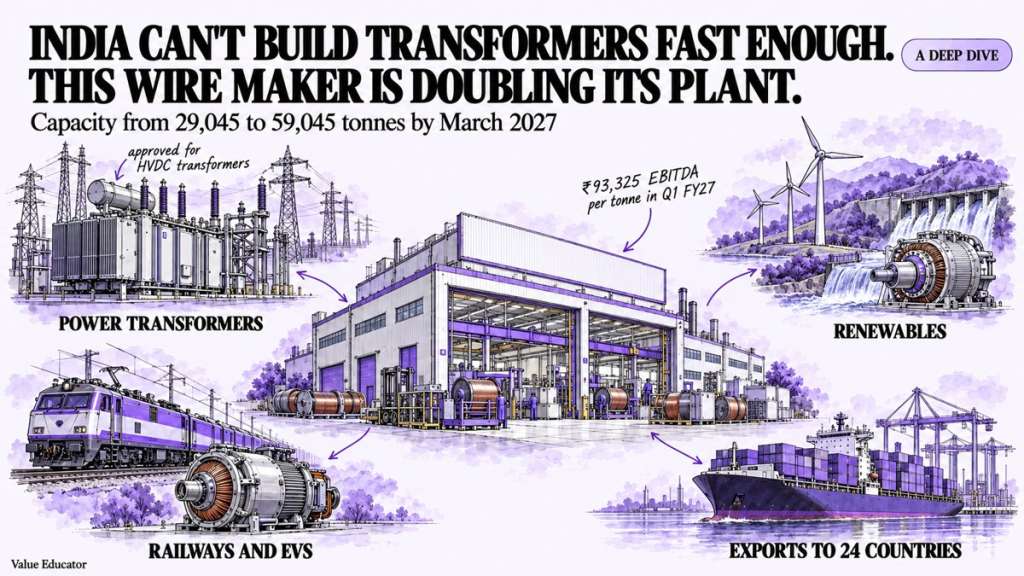
KSH International: The Wire Inside India's Transformers

Krishna Defence: The Steel Behind India's Warship Hulls

PNG Jewellers: A 194-Year-Old Name Goes National
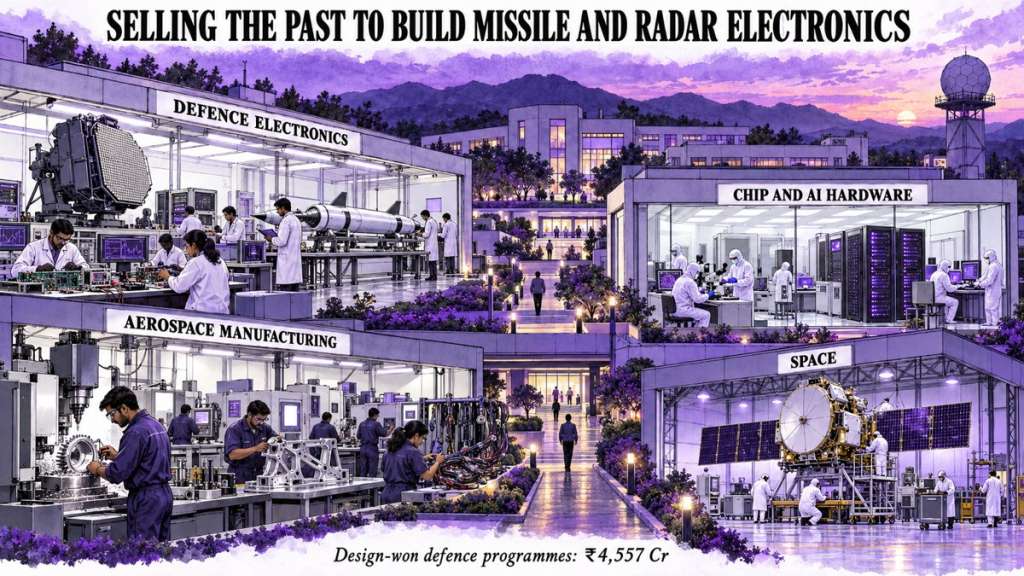
Axiscades: From Services to Missile and Radar Electronics
Explore our Products
Research Framework
Emerging Titans
Combination of quantitative analysis, industry tailwinds, and management assessment - SPRINT investment philosophy
Tiny Titans
Heavy emphasis on scuttlebutt research, plant visits, and early on-ground signals


 Orders
 Subscription
 Share with friends
 Logout


Required Details
₹23999.00
(12 month subscription)
As per SEBI regulations, all users are mandated to complete the KYC that is validated for 1 year. Post payment, you will be redirected to the KYC screen


No comments yet. Be the first to comment!