
The Rule of 72 Explained

You check your investment app after a few months, and the numbers have barely moved. It doesn’t feel like progress. It feels slow. Almost disappointing.
You start doing the mental math. Is this even working? Should I switch funds? Try something “faster”? The green arrows don’t look very exciting when the actual gain feels small.
Then someone says, “Just give it time.”
But how much time?
Five years? Ten? Twenty? Half of your working life?
That’s the part nobody clearly answers. We’re told to “stay invested,” “think long term,” and “trust compounding.” But how long does this long-term actually mean for you?
You must have heard of Rakesh Jhunjhunwala several times. However, have you ever wondered how quickly his money would double at the kind of returns he generated? His money would double in just over a year, with a CAGR of 60%.
The Rule of 72 is a straightforward method for estimating how long it takes for your money to double at a given annual return. You divide 72 by the return you expect to earn on your investment, and the answer gives you the approximate number of years needed to turn your investment into twice its original invested value. So if your money grows at 8 per cent, it takes about 9 years to double; at 12 per cent, roughly 6 years, and so on.
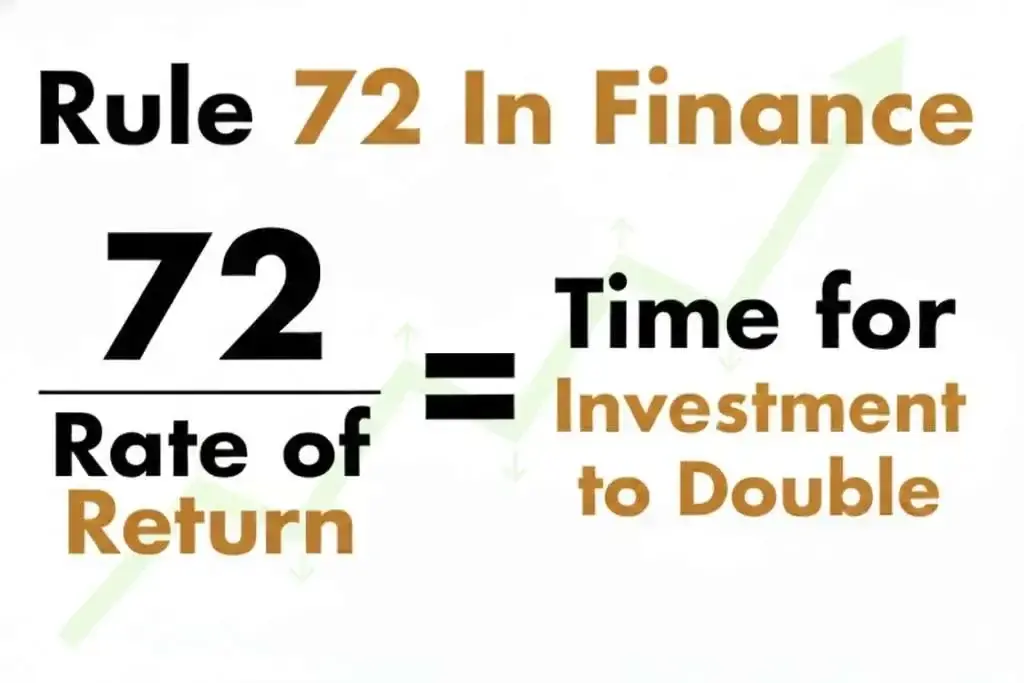
The Rule of 72 isn’t about clever math. It’s about exposing how time, not talent, decides who stays invested long enough to see compounding work.
And once you start thinking in terms of years instead of returns, the idea of doubling money begins to feel very different.
Why Doubling Your Money Sounds Easier Than It Actually Is
The word double does something strange to our brain.It sounds quick. Almost immediate. Like something that should happen in a couple of smart decisions or one good market phase. We hear “2×” and subconsciously imagine a short journey, not a long one.
But the Rule of 72 quietly dismantles that illusion.

Let's see a real-world example to make things even clearer.
Parag Parikh Flexi Cap Fund – A Rule of 72 Reality Check
Parag Parikh Flexi Cap Fund has built a reputation for disciplined, valuation-driven investing backed by global diversification and patient capital allocation. Over long investment horizons, the fund has delivered approximately 12%–15% CAGR, which sits comfortably in the mid-teens return bracket many long-term investors aim for, but few consistently stay invested to achieve.Read more about diversification in our article Portfolio Diversification – How Many Stocks Should You Hold?
When viewed through the Rule of 72, these returns tell a very realistic wealth-creation story. At a roughly 12% CAGR, investments double every 6 years (72 ÷ 12). At 15% CAGR, the doubling timeline shortens to about 4.8 years (72 ÷ 15). This means a ₹1 lakh investment growing at 12% CAGR becomes approximately ₹2 lakh in 6 years, ₹4 lakh in 12 years, and nearly ₹8 lakh in 18 years. The growth looks modest in the early years, but the compounding curve steepens dramatically over time.
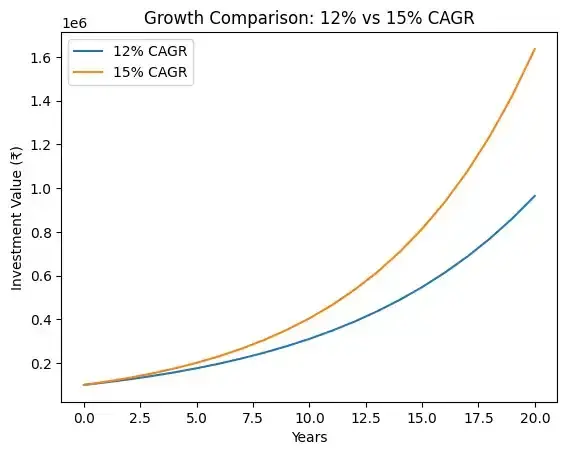
What really makes compounding interesting is how your mindset changes after that first doubling. The initial phase feels painfully slow because the absolute gains appear small despite steady percentage returns. However, once the base capital expands, the same CAGR begins producing significantly larger rupee gains.
For instance, earning 12% on ₹1 lakh generates ₹12,000 annually, but the same return on ₹4 lakh generates ₹48,000 per year. The Rule of 72, therefore, highlights an overlooked truth: wealth acceleration is less about chasing higher returns and more about allowing consistent CAGR to operate uninterrupted over expanding capital bases.
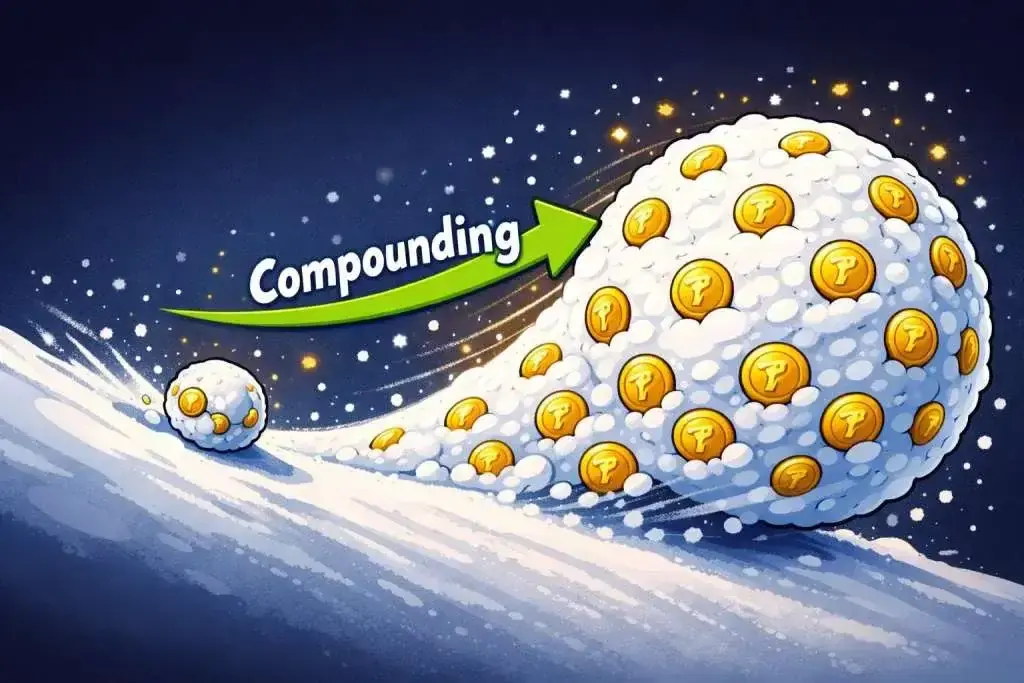
That’s compounding. The same rate of return, working on a larger amount, starts delivering results that finally feel visible and more quickly.
Read more about compounding in our article The Power of Compound Interest: How to Create Wealth in the Stock Market.
How the Rule of 72 Changes the Way You Look at Returns
Warren Buffett once said, “Time is the friend of the wonderful business, the enemy of the mediocre.” The Rule of 72 explains why. A return is not just a percentage. It is a timeline. At 6 per cent, your money needs about twelve years to double. At 12 per cent, it needs six. Same market exposure. Same patience. Radically different outcomes.This is why average returns can feel deceptively comfortable. A bank deposit at 5 or 6 per cent doesn’t look terrible on paper. But through the Rule of 72 lens, it quietly reveals its cost. You’re signing up for a doubling that may take more than a decade. Miss one cycle, and you’ve lost not just returns, but time you can never recover.
Charlie Munger framed it bluntly: “The big money is not in the buying and selling, but in the waiting.” The Rule of 72 turns that waiting into something measurable. It allows you to compare investments on a common, intuitive scale. Not which fund looks exciting this year, but which one gives compounding enough to match your goals.
Let's try to understand this with an example of a person using this same rule to invest in a Fixed Deposit with 6% return. On the other hand, he has an opportunity to invest in stocks of companies that have high growth potential. Let's see what the rule of 72 tells us :
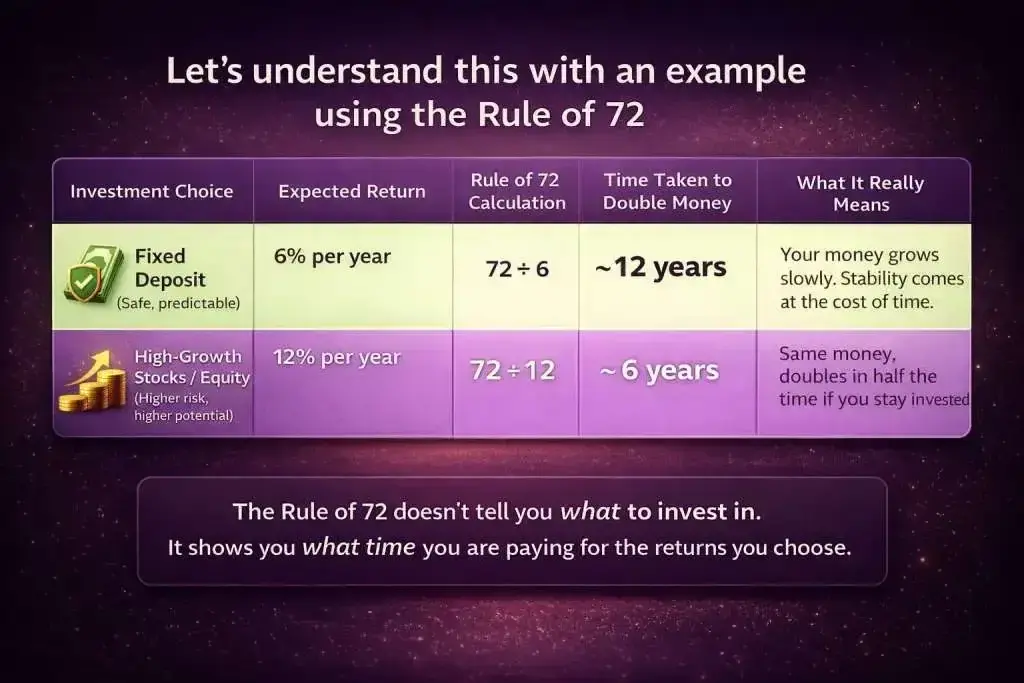
This is the real cost of low returns. They don’t fail loudly. They fail quietly, by consuming years.
Once you start viewing returns this way, numbers stop being abstract. Every percentage point carries a time consequence. Every decision either speeds up or delays your next doubling.
And from that point on, you never look at returns the same way again.
But now the real question arrives: if the rule of 72 is such an eye-opener, then how would you use it before making any investments?
Using the Rule of 72 in Real Life (Not Just on Paper)
The Rule of 72 becomes truly powerful when you stop treating it like a formula and start using it as a decision filter as per your own goals.Peter Lynch once said,
“The real key to making money in stocks is not to get scared out of them.”
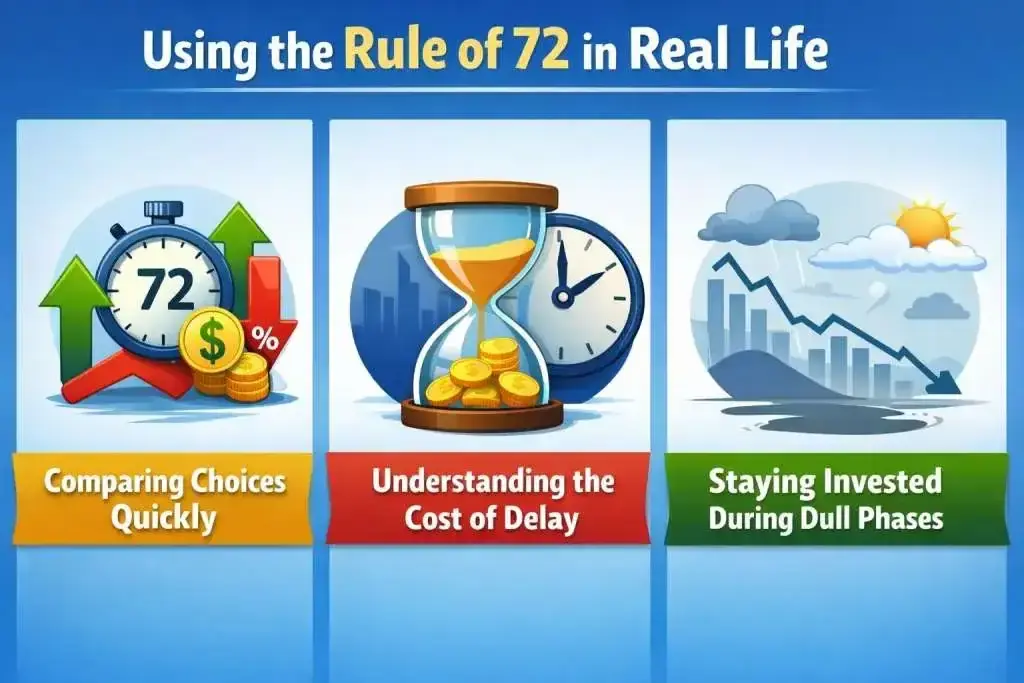
Now lets see how you are going to apply this rule in reality :
1) Comparing choices quickly:
Instead of getting lost in features, ratings, or past charts, use the Rule of 72 to compare how fast different options allow your money to double. The faster the doubling, the more compounding cycles you capture over time.Honestly, things are not just about how fast money doubles; this rule could be seen as an angle of a tool to compare similar securities that might differ in their returns.
2) Understanding the cost of delay:
The rule makes postponement visible. Even a short delay can eliminate an entire doubling cycle. Once you see decisions in terms of lost or gained doublings, procrastination becomes an expensive habit.Instead of waiting for the right opportunity to put that money in markets, you must think about the power of compounding. Even a missed return as low as 2% counts when you compound for a long-term basis. Starting today gives your money a benefit to compound more and grow quickly.

3) Staying invested during dull phases:
When markets feel slow and progress looks invisible, the Rule of 72 reminds you that time is still working. Even when returns don’t excite you, the clock toward the next doubling keeps ticking. It's all about having a balance of patience and compounding. Markets will often test you with poor returns but staying invested is what the rule suggests to us.Read more about market phases in our article Bull Market vs Bear Market – How Investors Should React
Peter Lynch put it bluntly:
“Time is your friend; impulse is your enemy.”
That’s why the Rule of 72 is so practical. It doesn’t ask you to predict markets. It asks you to respect time.
Instead of asking, “Is this return good?”
You start asking, “How many years does this steal or save?”
Instead of obsessing over short-term performance, you must focus on staying invested long enough for multiple doublings/compoundings to occur.
That mental shift is what separates investors who constantly lag from those who let compounding quietly work in their favour.
The Rule of 72 isn’t about doing complex math.
It’s about making sure your money gets enough time on the field.

The Rule of 72 and Inflation: The Uncomfortable Mirror
Using the Rule of 72, inflation at 6 per cent doubles prices in about 12 years. At 8 per cent, it takes just 9. The same shortcut that excites investors quietly explains why life keeps getting expensive.Inflation doesn’t arrive like a shock. It seeps in quietly, like air slipping out of a tyre while you keep driving, unaware that anything is wrong.
Each year feels harmless on its own. Prices rise a little, you adjust a little, and life moves on.
But the Rule of 72 reveals what intuition misses. That “low” rate doesn’t stay small. One day, you look up and realise that doing nothing now costs nearly twice as much.

This is exactly how your safe money becomes “unsafe”. If your savings earn less than inflation, the Rule of 72 says prices will double while your purchasing power quietly shrinks. The number grows, the lifestyle doesn’t.
Here’s the part most people miss: inflation compounds against your future. It doesn’t steal today’s money; it steals tomorrow’s choices, like where you live, how you travel, and when you retire.
As the quote goes, “Compound interest is the eighth wonder of the world. He who understands it, earns it. He who doesn’t, pays it.” Inflation ensures everyone pays attention eventually.
Where the Rule of 72 Works Well and Where It Can Mislead
The Rule of 72 shines brightest in calm, boring environments. When returns are steady and sit in the moderate range, the math works beautifully. Long-term equity funds, stable stocks, diversified portfolios, and mature businesses tend to live here.As Charlie Munger once said, “The big money is not in the buying or selling, but in the waiting.” The Rule of 72 rewards patience when returns are consistent and time does most of the heavy lifting. It’s a reminder that wealth is often built quietly, not dramatically.
Where the Rule of 72 starts lying is in chaotic environments. Markets don’t always move in neat straight lines. Returns come unevenly, sometimes front-loaded, sometimes delayed, sometimes violently interrupted.
A portfolio that delivers 20 per cent one year and minus 15 per cent the next does not compound the way this rule assumes. Volatility bends the math, and the Rule of 72 doesn’t adjust for that emotional and mathematical drag.
This is why treating it as a forecasting tool can be dangerous. It was never meant to predict outcomes with precision. It was meant to guide expectations. Howard Marks puts it well when he said, “You can’t predict, but you can prepare.”
Used correctly, the Rule of 72 is just like a compass, not a calendar. It tells you the direction compounding moves in, not the exact day you’ll arrive. It keeps investors grounded when returns feel slow and cautious, and when returns feel euphoric. Most importantly, it stops people from confusing short-term performance with long-term progress.
The Rule of 72 helps you ask the right question of not just how fast your investment can grow, but is growing steadily enough for the long term. In investing, asking the right question is often more valuable than chasing the perfect answer.
Explore our Products
Research Framework

Emerging Titans
Combination of quantitative analysis, industry tailwinds, and management assessment - SPRINT investment philosophy

Tiny Titans
Heavy emphasis on scuttlebutt research, plant visits, and early on-ground signals
Conclusion
Most investors fail because they underestimate time, rates and compounding itself. Without understanding this, investors chase flashy returns, misjudge risk and lose patience long before compounding has a chance to work for their investments.Simply investing isn’t enough; understanding how fast your money can realistically grow is what keeps expectations, discipline, and strategy aligned.
If this guide helped you see how compounding actually behaves and why return assumptions matter more than hype, comment “72” below. Like if the doubling-time examples surprised you, share this with friends building long-term equity, debt, or SIP portfolios, and tell us what return rate you’re currently targeting and why.
The real edge in long-term wealth creation isn’t predicting the next multibagger. Read more about multibagger stocks in our article Top Multibagger Stocks of the Last 10 Years – What We Can Learn. It’s respecting the mathematics of time and compounding. The Rule of 72 is not a shortcut to provide additional returns. When correctly, it anchors expectations, sharpens decision-making and keeps investors focused on steady, repeatable growth instead of impatience-driven mistakes.
FAQs
Does the Rule of 72 work in reverse?
+How can the Rule of 72 change the way you view risk?
+What is the Rule of 73?
+Can the rule of 72 help you avoid unrealistic expectations?
+Is the Rule of 72 only for investors?
+
High growth stock specialist, Value Educator
Shashank Mahajan is an equity research professional with over 12 years of experience in identifying high-potential SME and micro-cap stocks at an early stage. He follows a rigorous scuttlebutt research–driven approach, combining on-ground insights with deep financial analysis. Shashank specializes in uncovering under-researched and under-owned companies with strong management quality and long-term growth potential. Through disciplined research and early identification, he focuses on spotting tomorrow’s market leaders before they enter the mainstream investor radar.

Zen Technologies: Revenue Fell After a Big Win




PNG Jewellers: A 194-Year-Old Name Goes National

Explore our Products
Research Framework
Emerging Titans
Combination of quantitative analysis, industry tailwinds, and management assessment - SPRINT investment philosophy
Tiny Titans
Heavy emphasis on scuttlebutt research, plant visits, and early on-ground signals


 Orders
 Subscription
 Share with friends


Required Details
₹23999.00
(12 month subscription)
As per SEBI regulations, all users are mandated to complete the KYC that is validated for 1 year. Post payment, you will be redirected to the KYC screen


No comments yet. Be the first to comment!