
GPIL: An Iron Ore Miner's ₹30,000 Cr Plan
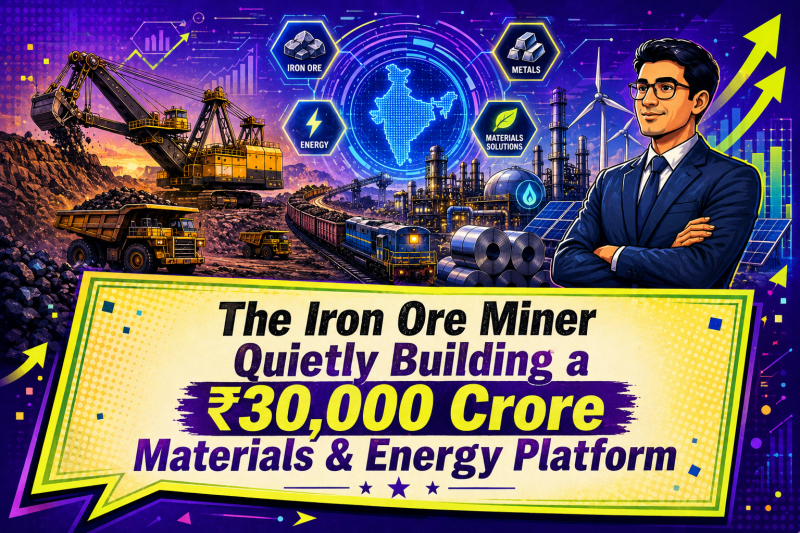
Steel is everywhere.
It is in the buildings we live in, the bridges we drive over, the railway tracks that connect cities, and the transmission lines that carry electricity across the country. Steel is in many ways one of the most important materials powering modern civilization. But as important as it is, the steel business has never been easy.

For decades steel has been treated by investors as a commodity industry. After all, most companies sell a similar product, operate in the same market and face the same demand-supply situation. When steel prices increase, everyone profits. Everyone loses when prices fall. At least that’s usually how the story goes.
But a closer look at it reveals something interesting.
Imagine two steel companies in the same year. They both see the same steel prices. Both are fighting for the same customers. Both are making similar products. And yet, one company always produces better margins, greater cash flows, and higher returns on capital than the other.
How can that be possible?
The answer has often little to do with steel in itself. No, it’s about something much more important. Control. Control of raw materials. Control of power costs. Process control. And, ultimately, control over profitability.
"The essence of strategy is choosing what not to do." – Michael Porter
Think of a bakery.
The baker goes to the market for flour each day. The other has its own wheat farm, and mill and makes its own flour, before baking the final product. Both sell bread, but their economics are fundamentally different. One bakery feels the pinch right away when its input costs go up. The other is much more in control of its own destiny.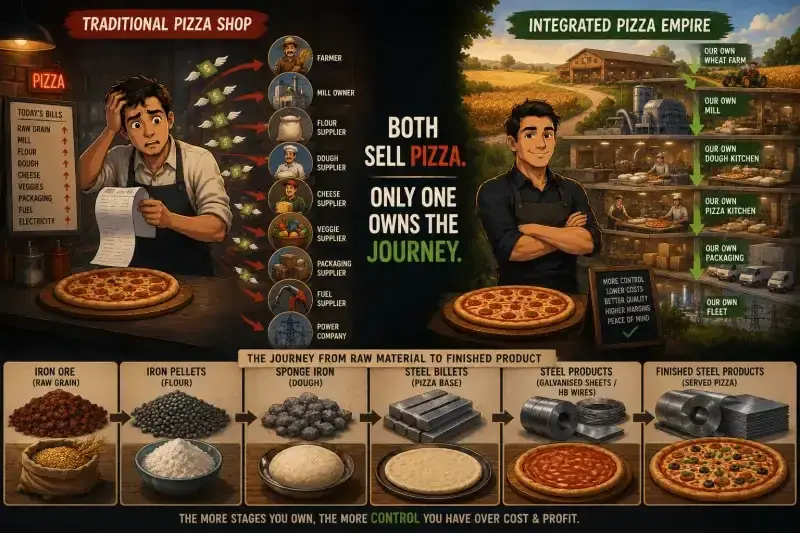
The steel industry works the same way.
Some companies buy iron ore, coal and power from outside suppliers and then turn them into steel. Others own important parts of the value chain themselves. They mine the ore, pelletize it, make it into steel and produce some of their own power. The more layers of integration they have, the more control they have over cost and profit.
This is where Godawari Power & Ispat begins to stand out.
At first glance GPIL seems to be another integrated steel producer. But look a little closer and a different picture begins to emerge. The company has iron ore mines and converts it into pellets, further processes it into sponge iron, billets and finished steel products. The company also has captive power assets which support its manufacturing operations.
And that is not the full story.
In the last few years, management has begun to lay the foundation for the next phase of growth. Not only is the company expanding its steel ecosystem, but is also looking at opportunities in battery energy storage systems, a business that sits at the intersection of renewable energy and grid modernization.
This makes GPIL way more than just a steel price play.
It is instead a story of integration. A story of moving down the value chain, capturing more value from every tonne produced and using today's cash flows to build tomorrow's opportunities.
Before we can understand whether that strategy can continue to create value over the next decade, we need to understand the industry GPIL operates in. Because in steel, the biggest winners aren’t always the companies that sell the most steel.
They are the companies that control most of the journey before that steel is sold.
The Industry Most Investors Misunderstand
Ask most people what drives the profits of a steel company and the answer is almost always the same: steel prices. Seems logical. If the price of steel goes up, the profits should go up. If the price of steel falls profits will fall. But steel is pretty much a commodity business. Unlike consumer brands or software companies, steel producers have very little control over the prices at which they sell their products. That is what the market says.This is a basic problem. If you have little control over selling prices, how do you protect profit? The answer is somewhere else. The best steel companies focus on things they can control. Things like raw material costs, power costs and operational efficiency. Two companies could sell steel at exactly the same market price but one could make much higher profits by simply producing that tonne at a lower cost.
That is why integration matters. Raw material inflation is not a threat to companies with iron ore mines. Companies with captive power assets are less vulnerable to rising electricity prices. And companies that are involved in multiple stages of production capture value that would otherwise go to suppliers and intermediaries.
This is where GPIL shines. The company operates in almost the entire steel value chain from iron ore mining and pellet production to sponge iron, billets, wire rods and finished steel products. In addition to this, the company has captive power facilities that provide power for production; therefore, GPIL is not just a player in the steel cycle; it is attempting to control as many segments of the steel cycle as possible.
This fact is very important because within the steel industry, typically the largest winners are not necessarily the companies that sell the most amount of steel at the highest price per ton. The largest winners within the steel industry typically are those companies that manufacture the largest amount of steel at the lowest unit production costs possible. To fully appreciate how GPIL has built this large advantage, one must first understand the process for producing one tonne of iron ore.
The Steel Value Chain Explained Like a Story
To understand what GPIL is all about; we must first learn that the process that turns iron ore into steel goes through several stages and takes time before it produces any of the many different types of products we see every day such as an electricity transmission tower, a railroad track or another building!
To illustrate this, think of how we buy a loaf of bread from a store. When we buy that loaf of bread we only see the bread sitting on the shelf in the store. A long process has occurred before we see that loaf! There were people who grew the wheat; processed the wheat into flour; made the dough; baked the loaf; etc. Each of these steps adds value, and all of these activities will make a profit.
Similarly, iron ore is the starting point and iron ore will once it has been processed into pellets become sponge iron; after that it will be formed into billets; after that it will be formed into wire rods; and ultimately the wire rods will be used to produce finished steel products for use in construction, infrastructure and manufacturing. The following chart illustrates this value chain:
Iron Ore -> Pellets -> Sponge Iron -> Billets -> Wire Rods -> Finished Steel Products
In terms of investing, the importance of this is that many steel companies will just do one or two steps in this process. Some produce and sell iron ore; some produce and sell pellets; some produce and sell sponge iron; some produce and sell only finished products. Very few companies operate across multiple stages of the steel value chain, largely because doing so demands substantial capital, deep operational expertise, and years of disciplined execution.
GPIL stands out as one of those rare exceptions. The company owns iron ore mines, converts that ore into pellets, processes it further into sponge iron, manufactures billets and wire rods, and ultimately produces finished steel products. At each step of this journey, additional value is added to the material. Rather than allowing that value creation to be distributed across several independent businesses, GPIL retains a significant share of it within its own ecosystem.
At first glance, this may appear to be a modest advantage. In reality, its impact is far more meaningful. A company that operates only at the final stage of the chain is often at the mercy of input costs and the pricing decisions of upstream suppliers. Its margins can fluctuate depending on factors largely outside its control. By contrast, a company that controls multiple stages of production enjoys greater visibility across the value chain, tighter control over costs, and multiple avenues to generate value at different points in the cycle. This is precisely why vertical integration forms the foundation of the GPIL investment story.
The significance of this advantage becomes even greater when the company owns the very first link in the chain itself.
And that brings us to what is arguably GPIL's strongest competitive advantage: its captive iron ore mines.
GPIL's captive mining advantage is a classic example of what investors often describe as an economic moat. If you're unfamiliar with the concept, read our guide on Economic Moat Explained: Why Some Companies Stay Dominant for Decades.
The Real Moat: Captive Mines
If there is one factor that truly differentiates GPIL from many other steel companies, it is not steel itself. It is iron ore.Investors often focus on steel prices, production volumes, and capacity expansion plans. While those factors certainly matter, the story begins much earlier in the value chain. Before a single tonne of steel is produced, everything depends on access to a critical raw material. In the steel industry, the availability and cost of iron ore frequently determine which companies prosper and which struggle through industry cycles.
A simple analogy helps illustrate this. Imagine running a bakery that purchases wheat from the open market every day. If wheat prices rise, your costs increase immediately. If supplies become scarce, margins come under pressure. Now imagine owning the farm that grows the wheat. The economics change dramatically. You are no longer dependent on the market for your most important input because you control the starting point of the entire value chain.
That is exactly the position GPIL enjoys.
The company operates two captive iron ore mines in Chhattisgarh: Ari Dongri and Boria Tibu. Ari Dongri's capacity is being expanded from roughly 2.35 MTPA to 6 MTPA by FY28, while Boria Tibu is expected to scale from around 0.7 MTPA to 4 MTPA by FY30. Together, these mines form the raw material backbone of GPIL's integrated steel ecosystem, ensuring a reliable supply of ore for its downstream operations.
However, the real advantage goes beyond simply owning the mines. The manner in which these assets were acquired is equally important.
Today, most mining assets in India are allocated through competitive auctions, where companies often commit to substantial premiums over and above royalties and other statutory levies. These additional costs become embedded in the economics of the business for years, and often decades. GPIL's mines, however, were secured under the pre-auction regime, giving the company what many investors refer to as a legacy mining lease advantage.
At first glance, this may seem like a minor detail. In reality, it represents a significant structural advantage.
"The key to investing is not assessing how much an industry is going to affect society, but rather determining the competitive advantage of any given company."
– Warren Buffett
While newer entrants begin operations with higher mining costs due to auction-related premiums, GPIL largely avoids these additional burdens and benefits from a lower cost of ore extraction. This advantage becomes particularly valuable during weaker steel cycles, when even a modest cost difference can have a meaningful impact on profitability.
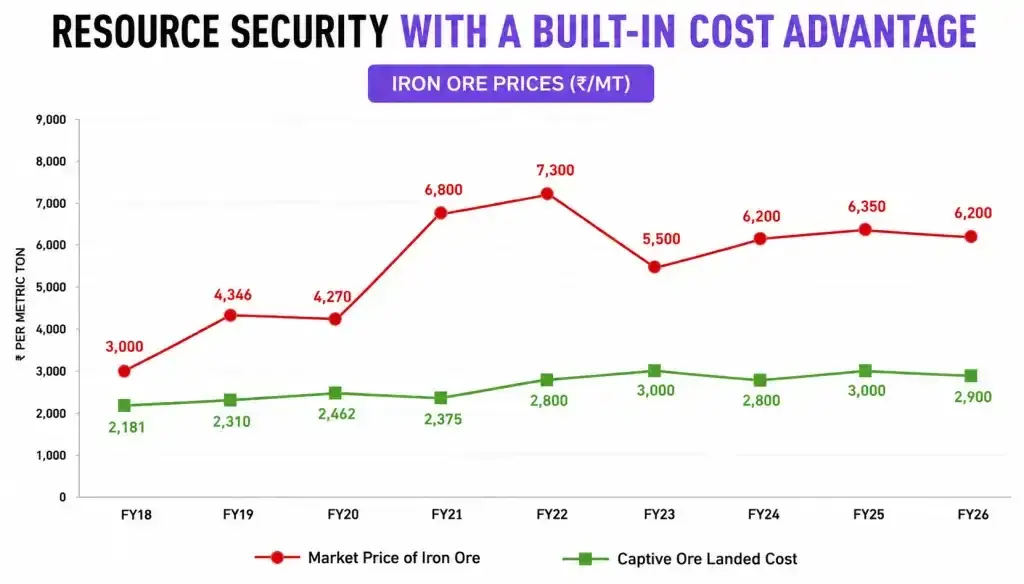
The numbers illustrate this clearly. Over the years, market iron ore prices have fluctuated between roughly ₹5,000 and ₹7,300 per tonne, while GPIL's captive ore landed cost has remained significantly lower at around ₹2,200–3,000 per tonne. This gap creates a built-in margin cushion that helps the company navigate commodity cycles more effectively than many of its peers.
This is why GPIL's mines should be viewed as far more than standalone mining assets. They supply raw material to the company's pellet plants, sponge iron facilities, and steel operations, while simultaneously shielding margins from fluctuations in external ore prices. In a commodity industry where most participants are price takers, ownership of the very first step in the value chain can become one of the strongest and most enduring competitive advantages a company can possess.
How GPIL Makes Money
At this stage, it may be tempting to view GPIL simply as a steel company. However, that description does not fully capture the nature of the business. In reality, GPIL operates as a collection of interconnected businesses housed within a single integrated ecosystem. This distinction is important because every stage of the value chain represents an opportunity to generate revenue, earn margins, and capture value that might otherwise accrue to external participants.The company's largest earnings engine today is its pellet business. During FY26, GPIL sold approximately 18.8 lakh tonnes of pellets, generating nearly ₹1,828 crore in revenue. This made pellets the single largest contributor to the company's revenue, accounting for roughly 34% of total revenue. The strength of this segment is not difficult to understand. Pellets occupy an attractive position within the steel value chain, benefiting from access to captive iron ore while commanding a higher realization than raw ore. Recognizing this advantage, management has continued to invest aggressively in the segment, with total pellet capacity recently expanded to 4.7 MTPA.
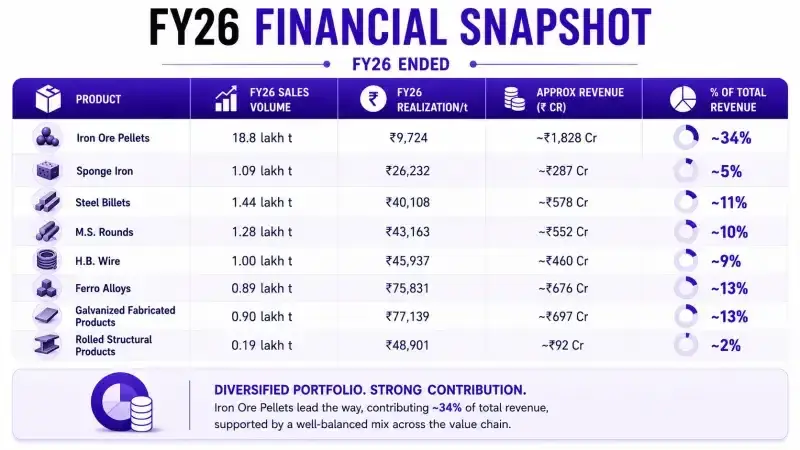
The value chain does not stop there. GPIL further processes its raw materials into sponge iron and billets, adding another layer of value creation. In FY26, sponge iron contributed around ₹287 crore in revenue, while billets generated roughly ₹578 crore. Although these segments are smaller than the pellet business in terms of revenue contribution, their strategic significance is substantial. By producing these intermediate products internally, GPIL is able to retain value that would otherwise be captured by third-party processors and downstream manufacturers.
Moving further downstream, the company manufactures wire products and long steel products that find applications across construction, infrastructure, and industrial projects. During FY26, M.S. Rounds generated around ₹552 crore in revenue, while H.B. Wire contributed approximately ₹460 crore. These businesses strengthen GPIL's presence closer to the end customer and provide direct exposure to India's long-term infrastructure development and construction activity.
GPIL's revenue streams extend beyond conventional steel products. The company also has meaningful operations in ferro alloys and galvanized fabricated products, both of which play an important role within the broader business portfolio. In fact, after pellets, these segments were among the largest contributors to revenue during FY26. Ferro alloys generated approximately ₹676 crore, while galvanized fabricated products contributed around ₹697 crore. Together, these two businesses accounted for nearly 26% of total revenue. Their presence not only broadens the company's earnings base but also provides exposure to transmission infrastructure, industrial construction, and a range of value-added steel applications.
This leads to a key insight that is often overlooked. GPIL should not be viewed as a single business.
This is precisely why serious investors often study segment-wise performance instead of looking only at consolidated revenue numbers. Learn more in Segment-Wise Revenue Analysis: How to Find a Company's True Growth Engine.
Instead, it is a network of complementary businesses layered across the steel value chain. From iron ore mining and pellet production to sponge iron, billets, wires, ferro alloys, and galvanized structures, the company participates in multiple stages of the manufacturing process and captures value at each step along the way.
This diversified structure creates an additional advantage. If one segment faces cyclical pressure, weakness can be partially offset by strength elsewhere within the portfolio. The benefits of integration therefore extend beyond cost control and operational efficiency. They also contribute to a more balanced and resilient earnings profile.
In essence, GPIL is not merely generating revenue from steel production. It is earning revenue from multiple stages involved in transforming iron ore into finished and value-added products. Each layer contributes its own margins, economics, and growth opportunities. When these layers operate together within an integrated ecosystem, the result is a business model that is often more durable and resilient than it may initially appear.
And this brings us to another competitive advantage that many investors tend to overlook entirely: power.
The Hidden EBITDA Machine: Captive Power
When investors analyze steel companies, they usually focus on iron ore, steel prices and production volumes. But there is another factor that quietly determines profitability across the industry: power. Steel manufacturing is extremely energy-intensive, and even small fluctuations in electricity costs can have a meaningful impact on margins.GPIL chose a different path. Instead of depending entirely on external suppliers, the company has built a captive power ecosystem comprising 165 MW of solar power capacity, 42 MW of Waste Heat Recovery Boilers (WHRB) and a growing renewable energy portfolio. In total, GPIL has access to over 300 MW of captive power capacity, helping it control one of the largest costs in steel manufacturing.
Perhaps the most interesting part of this setup is WHRB. During steelmaking, a large amount of heat is generated as a by-product. Most companies simply lose this energy. GPIL captures it. Through waste heat recovery systems, the company converts otherwise wasted heat into electricity, effectively generating low-cost power from processes that are already running. The raw material has already been consumed, the heat already exists and the infrastructure is already in place. GPIL is simply extracting additional value from it.
Alongside thermal generation, the company is also expanding its renewable energy footprint. GPIL currently operates solar assets and plans to increase renewable capacity as part of its long-term sustainability strategy. While renewables may not yet be the largest contributor to the power mix, they help reduce dependence on conventional energy sources and improve cost competitiveness over time.
Viewed together, the strategy becomes clear. GPIL controls its iron ore through captive mines, controls a significant portion of its manufacturing chain through integration and controls a meaningful share of its power requirements through captive generation.
"A business that can control its costs has a tremendous advantage over a business that cannot."– Charlie Munger
Each layer reduces dependence on external suppliers and strengthens margins during difficult periods.
This is why captive power often goes unnoticed. It doesn't generate headlines like a new steel plant or mine expansion. Yet every unit of low-cost electricity consumed internally quietly flows through the income statement and strengthens EBITDA. In many ways, GPIL's power assets are not just supporting the business—they are helping power its profitability.
Why Management Is Spending ₹10,000+ Crore
At first glance, GPIL's expansion roadmap can appear daunting. The company is committing more than ₹10,000 crore toward new capacities, downstream steel products, and even an entirely new line of business.Large expansion plans often look risky on the surface, but they are common in capital-intensive industries where scale and integration matter. For a deeper understanding, see Capital-Intensive Businesses Explained: Risks, Economics, and Investor Insights.
For investors, this naturally raises an important question: why would an already profitable steel company embark on such an ambitious capital expenditure program?
The straightforward answer is growth. The more nuanced answer is resilience.
"The future is never clear; you pay a very high price in the stock market for a cheery consensus."
– Peter Lynch
What management appears to be pursuing is not merely an increase in production capacity. Instead, it is building a business that is less reliant on any single commodity cycle. The broader strategy seems focused on strengthening existing strengths, moving further down the value chain, and creating additional earnings streams that can support growth over the long term.
The first pillar of this strategy is the pellet business. GPIL recently commissioned its pellet expansion, taking total pellet capacity to approximately 4.7 MTPA. Given the company's captive iron ore advantage, pellets continue to be one of its most profitable segments. By increasing capacity in a business where it already enjoys a structural cost advantage, management is effectively reinforcing one of the company's most important earnings drivers. Rather than entering unfamiliar territory, it is scaling a segment where the economics are already proven.
The second pillar is downstream integration. Through the proposed 1 MTPA Integrated Steel Plant (ISP) and 0.75 MTPA Cold Rolling Mill (CRM), GPIL is extending its presence beyond intermediate products such as billets and wire rods and moving into higher-value steel products. The rationale is clear. The further a company moves down the value chain, the greater its ability to capture value from each tonne of steel produced. At the same time, greater exposure to value-added products can help reduce dependence on commodity-grade steel, where pricing tends to be more cyclical and competitive. In many cases, higher-value products offer stronger margins and lower earnings volatility than basic steel intermediates.
The most intriguing component of the expansion plan, however, is Battery Energy Storage Systems (BESS). Unlike pellets, CRM, or ISP, BESS is not directly linked to the traditional steel value chain. Instead, it represents GPIL's first meaningful entry into a sector associated with renewable energy, grid stability, and India's broader energy transition. Although the business is still at an early stage, the investment provides an important signal about management's thinking. It suggests that the company is actively exploring growth opportunities beyond conventional steel manufacturing and positioning itself for emerging industrial trends.
When viewed individually, these initiatives can appear disconnected. A pellet expansion in one area, a new steel plant in another, and a battery storage business alongside them may seem like separate projects pursuing different objectives. However, when examined collectively, a consistent pattern begins to emerge. Each investment is designed to achieve at least one of three goals: strengthen integration, increase value addition, or create an additional source of earnings.
This is where the market may be overlooking the bigger picture. Many investors see a series of capex announcements and expansion projects. Management, on the other hand, appears to be building a business that is gradually becoming less dependent on steel cycles while developing multiple engines of growth capable of supporting the company over the next decade.
The BESS Bet: Looking Beyond Steel
Among all of GPIL's ongoing expansion initiatives, Battery Energy Storage Systems (BESS) may be the most intriguing. Not because it is expected to contribute meaningfully to earnings today, but because it offers valuable insight into how management is thinking about the company's future. Expansions in pellets, CRM, and ISP are logical extensions of GPIL's existing steel ecosystem. BESS, however, takes the company into a completely different arena, one that is closely tied to renewable energy, grid stability, and India's long-term energy transition.Many investors tend to evaluate this opportunity from a relatively narrow perspective. The first question that usually arises is whether the business can generate attractive margins. While profitability is undoubtedly important, that may not be the most relevant lens through which to view the investment. A more useful question is why GPIL wants exposure to this sector at all. The answer becomes clearer when one considers how financial markets tend to value different kinds of businesses.
Steel companies, including highly integrated players, are generally classified as cyclical businesses. Their earnings are influenced by commodity prices, industry demand cycles, and fluctuations in raw material costs. As a result, even companies that generate strong cash flows often trade at relatively modest valuation multiples. Businesses linked to the energy transition, by contrast, are frequently assigned higher valuations because investors view them as beneficiaries of long-term structural trends such as electrification, renewable energy adoption, energy storage, and grid modernization.
When viewed through this framework, GPIL's proposed 20 GWh BESS project, with an estimated investment of approximately ₹1,025–1,400 crore, begins to look less like a simple diversification exercise and more like a strategic evolution of the business model.
It is not the strongest of the species that survives, nor the most intelligent. It is the one most adaptable to change." – Charles Darwin
The objective may not necessarily be to earn substantially higher margins than the steel business. Rather, management appears to be positioning the company within a sector that could benefit from more durable demand drivers, longer growth runways, and potentially stronger market valuations over time.
Put differently, the opportunity may be less about maximizing margins and more about improving the quality and predictability of future earnings while gaining exposure to businesses that are often rewarded with higher valuation multiples.
That said, it is important to recognize that BESS remains an early-stage opportunity. Execution risks cannot be overlooked. The industry is evolving rapidly, technological developments continue to reshape the competitive landscape, and competition is likely to intensify as more participants enter the sector. Success is by no means guaranteed, and investors should approach the opportunity with an appropriate degree of caution.
Even so, the strategic significance of the move is difficult to ignore. GPIL is not attempting to move away from its core steel business. Instead, it appears to be building additional pillars of growth so that its future is not entirely tied to the fortunes of the steel cycle. If management executes successfully, the company could gradually transition from being perceived purely as a steel producer to being viewed as a broader materials, manufacturing, and energy platform.
And if that transition takes shape over the coming years, the market may eventually value GPIL very differently from the way it values a traditional steel company today.
Financial Performance: Does The Strategy Reflect In The Numbers?
So far, we've examined GPIL's business model, its integrated operating structure, and the long-term vision management is working toward. However, regardless of how compelling a story may sound, every investment thesis eventually faces the same test: do the financials support the narrative?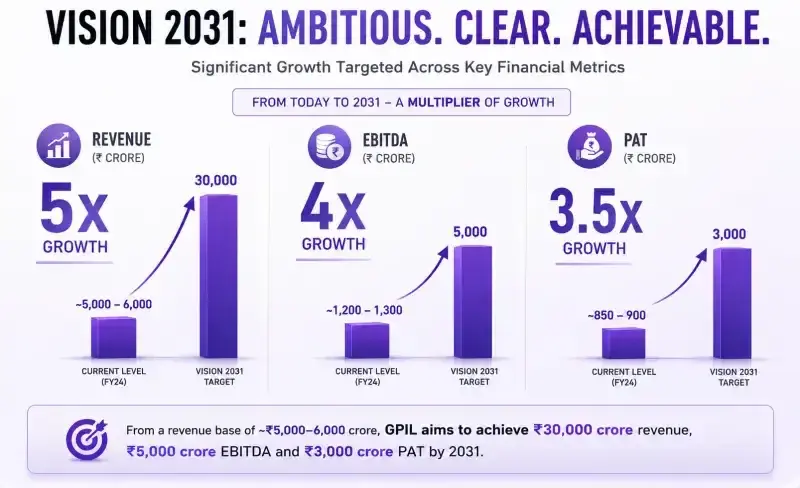
In GPIL's case, the evidence appears broadly encouraging. Under its Vision 2031 roadmap, management has outlined targets of ₹30,000 crore in revenue, ₹5,000 crore EBITDA, and ₹3,000 crore PAT. These ambitions are being pursued from a current revenue base of roughly ₹5,000–6,000 crore. While the targets are undeniably ambitious, they provide useful insight into both the scale of management's aspirations and its confidence in the company's integrated business model.
The underlying economics of the business help explain that confidence. Pellets continue to benefit directly from GPIL's captive iron ore advantage and remain one of the most profitable stages of the value chain. More importantly, the company is not dependent on a single product category for earnings generation. Instead, it participates across multiple stages of the steel ecosystem, allowing value to be captured at different points along the manufacturing process.
Cash flow generation has historically been another important strength. Unlike many capital-intensive businesses that frequently depend on external financing to support expansion, GPIL has largely relied on internal accruals to fund projects, including the ₹600 crore Pellet 2.0 expansion. This has helped reduce dependence on outside capital while preserving greater control over the pace of growth. Consistent operating cash flows have enabled the company to reinvest in captive mines, power infrastructure, and downstream expansion projects without materially compromising financial flexibility.
One financial metric that naturally attracts investor attention is ROCE. Although GPIL has generated attractive returns over time, its ROCE is not necessarily the highest within the industry. Understanding the reason behind this is important. Management's capital allocation approach has historically prioritized long-term strategic positioning over short-term optimization. Rather than maximizing near-term profitability, the company has repeatedly chosen to reinvest cash flows into deeper integration, captive assets, and future growth opportunities.
That philosophy is evident across several major investments. Mine expansions, captive power assets, the ₹7,000 crore Integrated Steel Plant, CRM facilities, and BESS initiatives all require substantial capital commitments today. The expected payoff lies in the advantages these investments may create over the coming years through greater integration, improved value addition, and stronger competitive positioning.
This distinction often gets overlooked. GPIL's strategy has never been centered on maximizing the next quarter's earnings or delivering the highest possible short-term return metrics. Instead, management appears focused on gaining control over larger portions of the value chain and building a business that can remain competitive across multiple commodity cycles.
Ultimately, the financial performance reflects the same theme that has emerged throughout this discussion. GPIL is not merely attempting to increase steel production volumes. Its objective is to capture a larger share of value at every stage of the process, beginning with the iron ore beneath the ground and extending all the way to the finished products delivered to customers. Based on the company's historical performance and capital allocation decisions, the financials suggest that this strategy has worked reasonably well so far.
The Hidden Growth Drivers
So far, we've focused on understanding what GPIL looks like today. However, for long-term investors, the more important question is what the company could become over the next five to ten years. The answer depends not only on management's ability to execute but also on a number of structural trends that are gradually reshaping India's industrial and energy landscape.This is a good example of how investors combine company analysis with broader economic and industry trends. To understand this framework better, read Top-Down vs Bottom-Up Investing: Understanding Two Core Investment Strategies.
The first and most obvious growth driver is steel demand itself. India is already the world's second-largest steel producer, with output of roughly 144 MTPA in FY25. Despite this scale, the country's per-capita steel consumption remains relatively low at just 97 kg, compared with the global average of around 230 kg. This gap highlights the significant room for future growth. To support rising demand, India is targeting 300 MTPA of steelmaking capacity by 2030, creating a long-term runway for iron ore, pellets, and a broad range of steel products across the value chain.
Infrastructure development is expected to be one of the largest contributors to that demand. Government-led initiatives such as PM Gati Shakti and the ₹111 lakh crore National Infrastructure Pipeline are driving investment across highways, logistics parks, industrial corridors, ports, and urban infrastructure projects. These sectors consume substantial quantities of steel and related products, directly supporting demand for wire rods, structural steel, and fabricated products, all areas in which GPIL already has an established presence.
Another opportunity lies in the transmission sector. As India's renewable energy capacity continues to expand, significant investments will be required in transmission towers, substations, and power evacuation networks to connect new generation capacity with demand centers. This trend is particularly relevant for GPIL because the company already manufactures galvanized fabricated structures and has secured approval as a supplier to infrastructure EPC players operating within this ecosystem. Management is targeting galvanized structure volumes of approximately 30,000 tonnes per quarter, positioning the business to participate in India's ongoing grid expansion.
Pellets could emerge as another important and perhaps underappreciated growth driver. GPIL's pellet capacity has already expanded to 4.7 MTPA, and management continues to view the segment as a key earnings contributor. As steelmakers increasingly shift toward higher-grade raw materials that improve operational efficiency and help reduce emissions, demand for pellets is expected to remain strong. GPIL's ability to manufacture pellets using captive iron ore provides a structural advantage that could become increasingly valuable as industry demand grows.
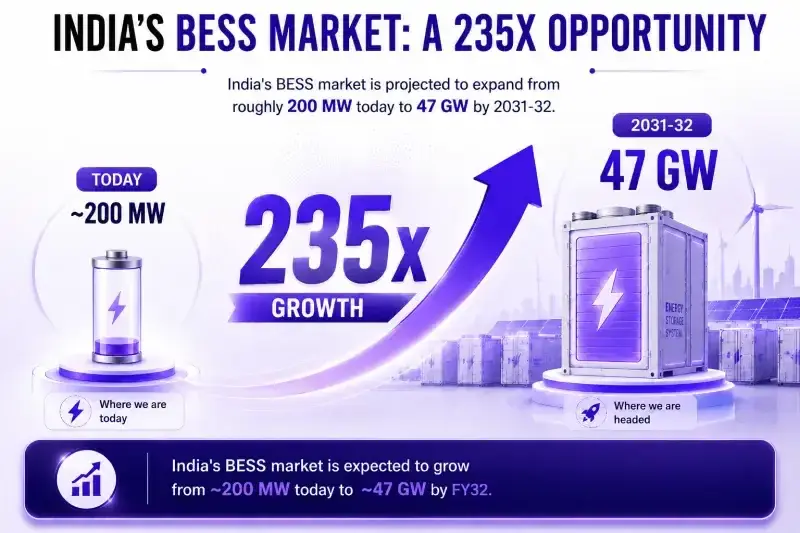
Beyond the traditional steel ecosystem, renewable energy and battery storage represent a potentially new avenue for growth. India's BESS market is projected to expand from roughly 200 MW today to 47 GW by 2031-32, while the CEA's National Electricity Plan targets BESS capacity of 236 GWh over the same period. Against this backdrop, GPIL's planned 20 GWh BESS capacity becomes particularly noteworthy. If executed successfully, it would represent nearly 8-9% of India's projected requirement, giving the company meaningful exposure to one of the fastest-growing segments within the energy transition landscape.
Each of these trends is significant in its own right. Taken together, however, they create a particularly compelling backdrop for future growth. Rising steel consumption, sustained infrastructure spending, transmission network expansion, growing pellet demand, and the increasing deployment of energy storage solutions are all themes that could unfold over the coming decade.
And that may be one of the most compelling aspects of the GPIL story.
The company is not relying on a single growth driver to shape its future.
Instead, it is positioning itself at the intersection of several long-term trends, each of which has the potential to play a meaningful role in transforming both India's industrial economy and its evolving energy landscape.
Risks Investors Must Understand
Every investment story tends to look compelling when industry conditions are favorable. The more important exercise is identifying the factors that could go wrong and assessing how the business might respond under pressure. While GPIL has built meaningful competitive advantages through vertical integration, captive iron ore mines, and captive power assets, the company is not insulated from risk. There are several areas that investors should continue to monitor closely.The first and most visible risk remains the steel cycle itself. Despite the benefits of integration, GPIL still operates within a commodity industry where selling prices are ultimately influenced by market forces. Steel prices, pellet realizations, and end-market demand can fluctuate materially depending on economic growth, infrastructure activity, and broader global supply-demand conditions. Integration provides a degree of protection by lowering costs and improving operational control, but it cannot completely remove the cyclical nature of the business.
Raw material costs represent another important source of uncertainty. Although GPIL benefits from a structural advantage in iron ore through its captive mining operations, coal remains a key input for both sponge iron production and power generation. If coal prices rise sharply, margins can come under pressure, particularly in periods when steel prices do not increase at a similar rate. This is a common challenge across commodity industries, where input costs and product realizations often move on different timelines and at different magnitudes.
Global competition also deserves attention, especially from China. During periods when Chinese domestic demand weakens, excess steel production often finds its way into international markets. This additional supply can be exported at highly competitive prices, putting pressure on steel markets across multiple regions. India has experienced similar situations in the past, and sustained periods of dumping can weigh on realizations even for relatively efficient and integrated producers such as GPIL.
Execution risk is becoming increasingly relevant as the company enters a major investment cycle. GPIL is currently pursuing one of the largest expansion phases in its history, including the ₹7,000 crore Integrated Steel Plant, the 0.75 MTPA CRM project, ongoing mine expansions, and the proposed 20 GWh BESS project. Large-scale projects inevitably carry execution challenges. Delays, cost overruns, regulatory hurdles, or slower-than-anticipated ramp-ups could affect returns and delay the benefits that investors may already be incorporating into their expectations.
The BESS initiative introduces a separate layer of uncertainty. Unlike steel manufacturing, where management possesses decades of operational experience, battery energy storage is still an emerging industry characterized by evolving technologies, shifting regulatory frameworks, and growing competitive intensity. The long-term opportunity may be substantial, but the path to success remains uncertain, and execution risks should not be underestimated.
Debt is another area worth watching. Historically, GPIL has maintained a relatively healthy balance sheet and has funded a meaningful portion of its growth through internal cash generation. However, executing more than ₹10,000 crore of planned investments will require significant capital commitments. If a larger share of future expansion is financed through additional borrowings, leverage levels could increase and reduce financial flexibility during periods of industry weakness.
There is also the broader risk of overexpansion. Management's vision is ambitious, and many of the individual projects appear strategically sound when evaluated independently. Nevertheless, corporate history is filled with examples of capable companies encountering difficulties when multiple large-scale projects are pursued simultaneously. As investment commitments increase in size and complexity, capital allocation discipline and execution quality become increasingly important.
None of these risks necessarily undermine the broader investment thesis.
Successful investing is rarely about finding companies with no risks. It is about weighing potential rewards against identifiable risks. We explore this idea further in Risk vs Reward: Why Investor Psychology Matters More Than Returns.
In many respects, they are the same risks faced by most participants operating within the steel and industrial sectors. The key question for investors is whether GPIL's competitive advantages, including its captive mines, integrated manufacturing platform, and emerging growth opportunities, are strong enough to compensate for these challenges over the long term.
Ultimately, that balance between opportunity and risk will play a decisive role in determining whether the coming decade can deliver results comparable to, or even better than, those achieved over the previous one.
Explore our Products
Research Framework

Emerging Titans
Combination of quantitative analysis, industry tailwinds, and management assessment - SPRINT investment philosophy

Tiny Titans
Heavy emphasis on scuttlebutt research, plant visits, and early on-ground signals
The Big Question
For many years, GPIL created value by executing a strategy that few steel companies have been able to replicate consistently: gaining control over the most important parts of the value chain. The company secured access to iron ore through captive mines, converted that ore into pellets, moved further downstream into steel products, and strengthened its cost position through captive power generation. Over time, this approach helped GPIL build one of the most integrated steel businesses in the country.Today, however, management appears to be working toward something far more ambitious. Alongside expanding pellet capacity to 4.7 MTPA, developing a 1.0 MTPA Integrated Steel Plant, establishing a 0.75 MTPA Cold Rolling Mill, and pursuing a proposed 20 GWh BESS business, the company is doing more than simply adding new capacity. It is attempting to shape a future that extends beyond the boundaries of traditional steel manufacturing.
Viewed from that perspective, the central investment question is not whether India will consume more steel over the coming decade. The long-term demand opportunity for steel is relatively easy to understand. The more important question is whether GPIL can successfully evolve from being an integrated steel producer into a broader materials and energy platform with multiple engines of growth.
That is ultimately where the investment debate becomes most interesting.
Can the company leverage its experience in integration, execution, and capital allocation to build meaningful businesses beyond steel while preserving the advantages that made it successful in the first place?
Or will the next decade demonstrate that even the strongest steel companies create the most value by remaining focused on their traditional core business?
That is the question investors need to answer.
Conclusion
When we began this article, we started with a relatively simple question.How can two steel companies operating within the same industry produce dramatically different outcomes for shareholders over time?
As we've seen throughout this analysis, the answer has surprisingly little to do with steel prices alone and far more to do with control.
Over the years, GPIL has quietly built an integrated ecosystem that spans the entire value chain, from iron ore mines and pellets to sponge iron, steel products, and captive power generation. Each additional layer of integration has enabled the company to capture a greater share of value, reduce dependence on external suppliers, and strengthen its competitive position within an industry that is inherently cyclical.
What makes the story particularly compelling today, however, is not simply what GPIL has already built. It is the direction in which management appears to be taking the business. Through investments in downstream steel products, structural steel, large-scale capacity expansion, and its planned entry into Battery Energy Storage Systems, the company seems to be positioning itself for a future that extends beyond the traditional boundaries of steel manufacturing.
Most steel companies focus on producing and selling steel. GPIL, by contrast, has spent years building something that may ultimately prove even more valuable: control. Control over raw materials through captive mining. Control over energy through captive power generation. Control over manufacturing through vertical integration. And increasingly, control over the segments and industries in which it chooses to participate as India's industrial and energy landscape continues to evolve.
Naturally, the path ahead is not without risks. Steel cycles will continue to influence industry profitability. Commodity prices are unlikely to become any less volatile. Large expansion projects will inevitably carry execution challenges. Yet these are the very variables that investors must evaluate when assessing whether GPIL's next decade will resemble its previous one or mark the beginning of a fundamentally different phase of growth.
Ultimately, the future of GPIL may not be determined by steel prices alone. It may depend on how effectively the company can transform an already integrated steel business into a broader materials and energy platform capable of creating value across multiple industries. If management succeeds in executing that vision, investors may eventually look back and conclude that the most important product GPIL was building was never steel itself.
It was control.
If you enjoyed this deep dive and would like us to analyze more companies that are helping shape India's industrial future, feel free to like this article and comment "STEEL" below. Your feedback helps us understand which sectors, industries, and businesses you would like us to explore in future deep dives.
FAQs
Why do some steel companies consistently earn higher margins than others?
+Not all steel companies operate in the same way. Some rely heavily on external suppliers for raw materials and power, while others control key parts of the value chain through captive mines, processing facilities, and power generation. This greater level of control can reduce costs, improve profitability, and provide better resilience during industry downturns.
What is the biggest advantage of owning captive iron ore mines?
+Captive iron ore mines can significantly reduce raw material costs and improve supply security. Instead of purchasing ore at prevailing market prices, companies with captive mines often benefit from lower extraction costs, creating a structural cost advantage that can support margins across commodity cycles.
Why is vertical integration important in the steel industry?
+Vertical integration allows a company to participate in multiple stages of production, from raw materials to finished products. This helps capture value at each step of the manufacturing process, reduces dependence on third-party suppliers, and creates greater control over costs and operations.
How can Battery Energy Storage Systems (BESS) benefit a traditional industrial company?
+Battery Energy Storage Systems provide exposure to fast-growing themes such as renewable energy, grid modernization, and energy transition. For industrial companies, BESS can create an additional growth engine beyond their core business while potentially offering access to industries with long-term structural demand drivers.
What should investors watch most closely over the next few years?
+Investors should closely monitor the execution of major expansion projects, capacity ramp-ups, capital allocation decisions, debt levels, and the company's ability to maintain profitability across different commodity cycles. Strong execution often determines whether large growth plans ultimately create shareholder value.

High growth stock specialist, Value Educator
Shashank Mahajan is an equity research professional with over 12 years of experience in identifying high-potential SME and micro-cap stocks at an early stage. He follows a rigorous scuttlebutt research–driven approach, combining on-ground insights with deep financial analysis. Shashank specializes in uncovering under-researched and under-owned companies with strong management quality and long-term growth potential. Through disciplined research and early identification, he focuses on spotting tomorrow’s market leaders before they enter the mainstream investor radar.

Zen Technologies: Why Revenue Fell After Its Biggest Win

Data Patterns: India's Radar Designer and Its Waiting Orders
KSH International: The Wire Inside India's Transformers

Krishna Defence: The Steel Behind India's Warship Hulls

PNG Jewellers: A 194-Year-Old Name Goes National
Axiscades: From Services to Missile and Radar Electronics
Explore our Products
Research Framework
Emerging Titans
Combination of quantitative analysis, industry tailwinds, and management assessment - SPRINT investment philosophy
Tiny Titans
Heavy emphasis on scuttlebutt research, plant visits, and early on-ground signals


 Orders
 Subscription
 Share with friends
 Logout


Required Details
₹23999.00
(12 month subscription)
As per SEBI regulations, all users are mandated to complete the KYC that is validated for 1 year. Post payment, you will be redirected to the KYC screen


No comments yet. Be the first to comment!