
Top-Down vs Bottom-Up Investing
Imagine you are just starting in the stock market, and you feel totally confused: Should I first study the whole economy, GDP, interest rates, government policies, and then pick stocks? Or should I straightaway hunt for super-strong companies and mostly ignore all the big macro noise?
This one doubt keeps most beginners awake at night when they begin their investing journey. It is probably the biggest confusion new investors face right at the start.
In real life, the answer usually depends on which investing style you choose. In the stock market, there are two main ways to select stocks: top-down and Bottom-Up investing.
What makes this so important is that once you clearly understand the difference between these two, it can totally change how you think and make decisions. The approach you pick actually shapes the kind of opportunities you see (or miss) in the market.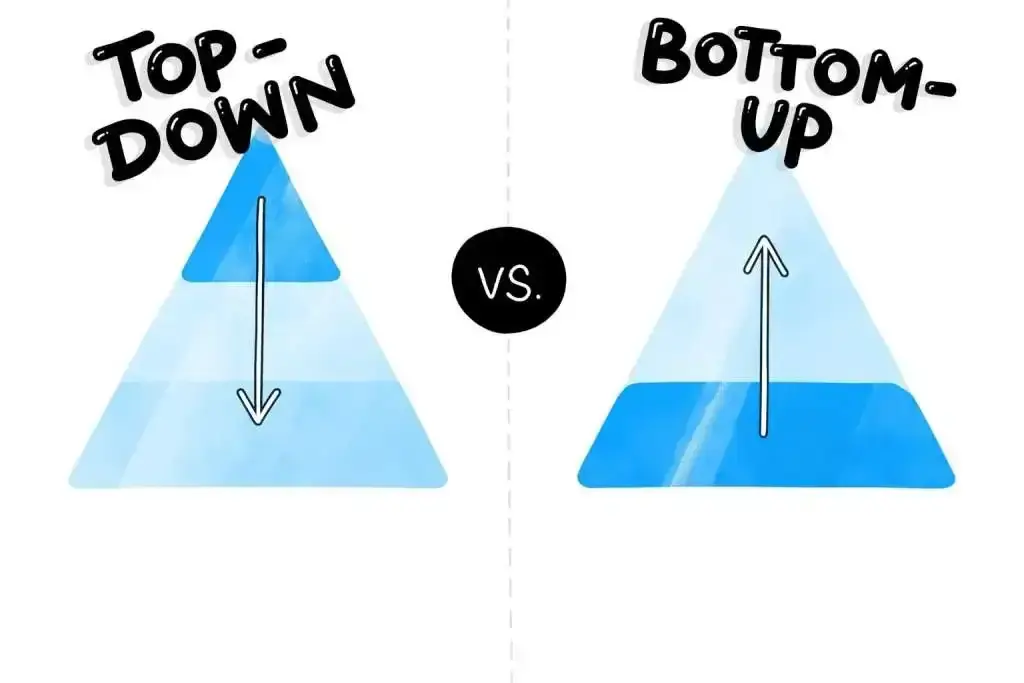
Many investors spend their time searching for stock tips. Surprisingly, very few actually think about the process behind selecting a stock. In reality, successful investing rarely comes from a single good idea.
More often, it comes from following a structured approach consistently over time, and that makes a difference. This is something experienced investors understand very well.
Professional investors never buy stocks just like that randomly. Instead, they usually follow clear frameworks. These things help them decide which sectors to study properly, which companies to check deeply, and finally, when is the right time to invest. Over the years, this clear and structured way of thinking slowly become the strong base for doing consistent and successful investing.
In investing, two approaches, as we discussed earlier, are frequently used. Top-Down investing and Bottom-Up investing. In practice, these methods are used by mutual funds, portfolio managers, analysts, and long-term investors to make disciplined decisions rather than emotional ones. The key difference lies in where the analysis begins.
One approach begins with the economy and gradually moves down to individual stocks. The other way works in the opposite direction, starting first with the company itself and then looking at the bigger economic picture later. Both approaches can give good results, but they make investors think about opportunities and decide in very different ways.
Understanding these two approaches helps investors avoid random buying and build a more structured portfolio, and that matters more than most investors realize. It also helps them understand why they actually own a particular stock. In the absence of a clear method, many investors get influenced by market noise, daily news, or tips from others.
“The stock market is filled with individuals who know the price of everything, but the value of nothing.” — Philip Fisher
This article explains what Top-Down and Bottom-Up investing mean and how they differ. The difference between them is subtle, but important. It also looks at when each approach tends to work best and how Indian investors can apply them in practice.
What is Top-Down Investing?
In the Top-Down investing approach, investors generally start by studying the overall economy first and then slowly move towards individual stocks. In easy words, instead of looking at companies from the start, the investor first tries to get the big picture, like how the economy is performing right now and which sectors seem ready to grow strongly in the future.
They may also look at which industries could benefit from current conditions. Only after this analysis do investors begin selecting specific companies. This way, the company selection happens within a broader economic context.
The basic flow of Top-Down investing looks like this: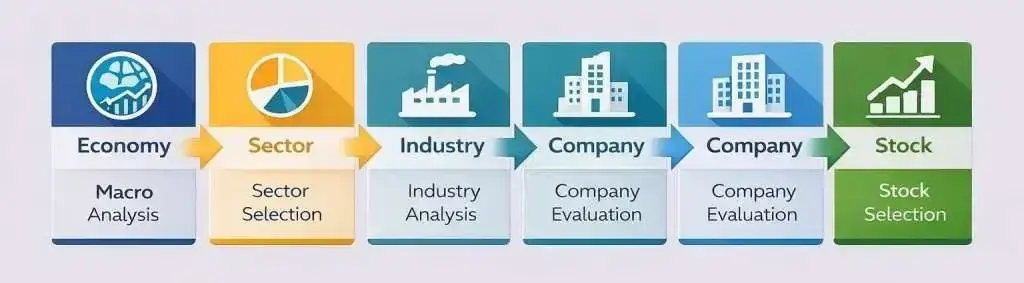
In simple terms, the investors usually start by looking at the macro environment. From there, they pick out sectors that are likely to do well in the future, and then they focus on strong and good companies inside those selected sectors.
The main idea behind this approach is quite simple and clear. When the economic trend is good and favourable, some sectors usually grow much faster than others. Companies working in those sectors get extra benefits and push from this big positive tailwind in the economy.
Top-Down investors usually focus on factors such as GDP growth, interest rates, government policies, inflation, and sector cycles. Changes in these macro factors often impact different industries in different ways. Understanding these changes properly helps investors figure out where the real opportunities are likely to come up and which areas to focus on.
Since GDP growth finally pushes up company revenues in almost all sectors, understanding this connection properly becomes very important for macro-driven investing. If you want to see in real practical terms how GDP growth turns into higher corporate earnings, you may find this detailed explanation quite useful.
Consider a situation where the government suddenly increases spending on infrastructure and construction work. This extra spending leads to more roads being built, new housing projects, and faster industrial development. All this creates a higher demand for cement and steel. Because of that, the cement sector usually benefits a lot from this positive cycle in the economy.
After identifying this trend, the investor looks for strong companies within the sector, such as UltraTech Cement, Shree Cement, or ACC, and then decides which stock offers the best combination of business strength and valuation.
This approach is used by mutual funds, macro investors, sector-focused investors, and portfolio managers who need to decide not only which stock to buy, but also which sectors to allocate more capital to. The key idea behind Top-Down investing is simple. When the macro trend is right, the chances of finding good stock opportunities in the right sector become much higher.
“In the short run, the market is a voting machine, but in the long run, it is a weighing machine.” — Benjamin Graham
When Should You Use Top-Down Investing?
Top-Down investing works best when the overall economic environment is changing, and certain sectors are likely to benefit more than others. In such situations, understanding macro trends becomes very important because different industries react in different ways to changes in interest rates, government policies, inflation, and business cycles. By first spotting the bigger trend correctly, investors can put their research effort only on those sectors that are more likely to do well and perform strongly.
This approach is especially useful during times when the interest rate cycle is changing, when the government makes big new policy decisions, or when the economy is starting a new phase of growth or slowdown. Commodity cycles, big infrastructure spending by the government, and important regulatory changes can also create strong opportunities in specific sectors. These things are much easier to spot and use properly with a Top-Down approach.
read more on: Technical vs Fundamental Analysis – Which One Should You Follow?
For example, when the government increases spending on infrastructure, sectors like construction, cement, and capital goods usually get good benefits. During a real estate upcycle, companies in housing finance and building materials see much higher demand and business growth. Similarly, when global demand for technology services increases, the IT sector may outperform, and during strong government reforms or disinvestment activity, PSU stocks may rally.
Top-Down investing is therefore very useful for deciding sector allocation, timing economic cycles properly, and changing portfolio exposure when macro conditions keep shifting. Investors who handle big diversified portfolios, like mutual funds and professional portfolio managers, often use this approach. It helps them decide which sectors should get more money or less money at different points of the economic cycle.
What Is Bottom-Up Investing?
Bottom-Up investing is a method where investors first look at individual companies instead of starting with the whole economy. The main focus here is on how strong the business is, its financial results, and its growth chances over a long time. The investor studies the company properly first, then thinks about a bigger economic situation later, not the other way round, like in Top-Down.
The basic flow of Bottom-Up investing looks like this: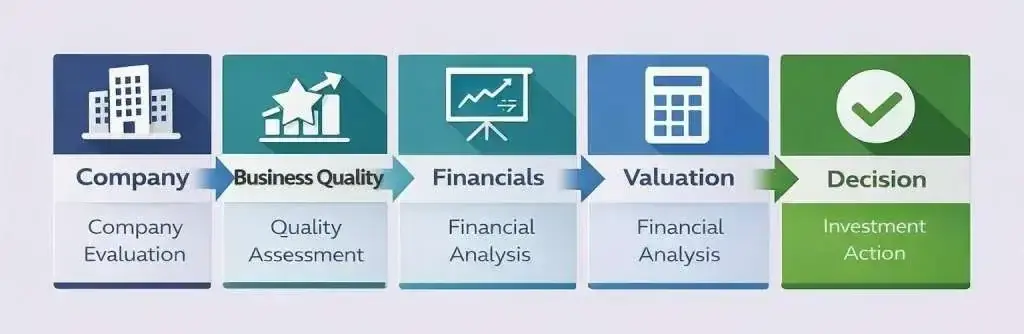
In simple words, the investor first searches for a strong company, studies its business model properly, checks how financially strong it is, and then sees if the stock price is reasonable or not. He does not ignore the big macro environment, but it is not where he starts his analysis. The main idea behind this approach is that really good quality companies can do well over the long term even when short-term economic conditions are not so good.
Bottom-up investors mostly look at things like brand power, competitive edge, strong balance sheet, good return ratios, and steady earnings growth over the years. They like companies with solid management, high return on capital employed, and stable demand because these businesses have a better chance to keep growing and compounding money steadily for a very long time.
Finding strong and lasting competitive advantages is very important for long-term compounding of money. If you want a simple step-by-step way to check business moats properly, with real examples from Indian companies, then you can read our detailed guide on Comparable Company Analysis (Comps): A Relative Valuation Method
For example, companies like Titan Company, HDFC Bank, Asian Paints, and Nestlé India are usually studied with a Bottom-Up approach. These businesses have very strong brands, solid balance sheets, high return on capital, and steady growth year after year for a long time. Instead of trying to guess what the economy will do next, the investor mainly checks if the company itself is strong enough to keep growing properly even when market cycles go up and down.
This method is commonly used by long-term investors, value investors, and those who focus on quality companies. It is also very close to the investing style of Warren Buffett, who likes to put money in strong businesses that have lasting competitive advantages and then hold them for many years without selling. The key idea behind Bottom-Up investing is simple.
Start straight with the stock, understand the business very deeply and properly, and let the company’s long-term performance give you your returns instead of trying to guess short-term macro changes or economic ups and downs.
“It’s far better to buy a wonderful company at a fair price than a fair company at a wonderful price.” — Warren Buffett
When Should You Use Bottom-Up Investing?
Bottom-Up investing is most effective when your primary objective is long-term wealth creation rather than short-term cycle timing. This approach works particularly well when you are willing to hold businesses through different economic phases and focus on their structural strengths instead of temporary macro fluctuations.
It is especially useful during market corrections or bear markets. When overall sentiment is negative, strong companies often trade at more reasonable valuations. A bottom-up investor uses this phase to accumulate high-quality businesses rather than trying to predict when the economy will fully recover. Market volatility, in this case, becomes an opportunity rather than a threat.
This approach works very well when really strong companies are available at good, attractive prices. If a business has strong, lasting competitive advantages, steady earnings growth every year, high return ratios, and a healthy balance sheet, then short-term macro uncertainty or economic ups and downs usually do not hurt its long-term path much. The main focus stays on business quality and strict valuation discipline instead of trying to forecast the economy all the time.
Bottom-Up investing is therefore very suitable for compounding strategies, quality-focused portfolios, and holding stocks for long periods. Investors who want to take advantage of steady earnings growth over many years usually prefer this method. It focuses on owning really strong businesses and then giving enough time for the growth to work in their favour.
The Hybrid Approach — What Most Smart Investors Actually Do
In practice, very few professional investors follow a purely Top-Down or purely Bottom-Up approach. Most combine elements of both. They use macro analysis to narrow the opportunity set and then apply deep company-level research before committing capital. This hybrid method reduces the risk of being right on the sector but wrong on the company or owning a strong company in a structurally weak environment.
The typical framework looks like this:
- Step 1 → Check macro trend
Understand the broader economic direction, such as growth momentum, interest rate cycle, policy environment, and demand trends.
- Step 2 → Identify a strong sector
Now, let us find out which sectors are likely to get good benefit from this macro situation of big government infrastructure spending and rising construction activity.
- Step 3 → Select the best company
Inside that sector, check business quality, how strong it stands against competition, financial health and strength, and whether management is reliable and trustworthy.
- Step 4 → Wait for an attractive valuation
Even strong companies must be purchased at reasonable prices to generate satisfactory returns.
Valuation discipline determines long-term return outcomes. For a deeper understanding of how to interpret P/E ratios correctly including trailing vs forward earnings, you may refer to our detailed valuation guide.
For example, if consumption demand is improving, the investor may focus on the FMCG sector and then evaluate companies such as Britannia Industries. If infrastructure spending is rising, the cement sector becomes relevant, and companies like UltraTech Cement may be analyzed. If credit growth and economic activity are strengthening, private sector banks such as HDFC Bank could come into focus.
This mixed approach is used widely by mutual funds, PMS managers, buy-side analysts, and disciplined long-term investors. It helps make better decisions on where to put money while still keeping a strict check on company details. In simple words, the hybrid method accepts that big macro trends affect sectors, but in the end, long-term returns come from good business quality and proper valuation discipline.
“Investing is simple, but not easy.” — Rakesh Jhunjhunwala
Practical Case Study — Top-Down vs Bottom-Up in the Indian Market
To properly understand the difference between these two approaches, let us take one real example from the Indian market situation that happens often.
Situation
Suppose the government suddenly announces a big increase in spending on infrastructure. They are pushing hard for more houses, better roads, new railways, and industrial growth. Because of this, people expect construction work to grow a lot in the coming years. Now, let us see how a Top-Down investor and a Bottom-Up investor would look at and handle this same situation differently.
How a Top-Down Investor Thinks
Step 1 — Macro View
The investor sees that the capex cycle is now turning positive. The government is spending more money, and economic activity linked to construction is expected to get better in the coming time.
Step 2 — Sector Selection
Within these sectors, the investor identifies cement as a direct beneficiary because higher construction activity increases cement demand.Step 3 — Industry Selection
Within these sectors, the investor identifies cement as a direct beneficiary because higher construction activity increases cement demand.Step 4 — Company Selection
The investor then checks leading cement companies like UltraTech Cement, Shree Cement, and ACC to find out which one is strongest in size, low cost of production, and solid balance sheet strength.Logic: If the sector is expected to grow due to macro tailwinds, selecting the strongest company within that sector increases the probability of benefiting from the cycle.
How a Bottom-Up Investor Thinks
Step 1 — Study the Company First
Instead of beginning with macro trends, the investor studies individual cement companies in detail. The main focus is on business quality, like a strong balance sheet, low cost structure, plans for adding more capacity, a competitive edge, and how well management executes. For example, UltraTech Cement may look better because of its big size advantage, very efficient cost control, and strong distribution network across the country.Step 2 — Check Valuation
The investor then assesses whether the stock is trading at a reasonable valuation relative to earnings growth and return on capital.Step 3 — Buy for the Long Term.
If the business is strong and the valuation is acceptable, the investor buys with a long-term perspective, believing that even if the cycle is slow initially, a quality company will benefit when demand improves.
Logic: Own a strong company first. Economic cycles will eventually support good businesses over time.
Lesson from the Case Study
This example highlights a clear distinction:- Top-Down investing helps you choose the right sector.
- Bottom-Up investing helps you choose the right company.
- A hybrid approach helps cut down mistakes by mixing macro awareness with strong discipline at the company level.
In the end, good investing is not about predicting the future perfectly every time. It is about following a clear, structured process that gradually improves your decisions over the long run.
Common Mistakes Investors Make When Using Top-Down and Bottom-Up Investing
Knowing both Top-Down and Bottom-Up ways is important, but using them wrongly can lead to very bad investment choices. Here are the most common mistakes investors usually make when they wrongly use the Top-Down approach or Bottom-Up approach.
Using Top-Down Without Understanding the Sector Properly
Some investors correctly identify a macro trend but fail at the company-selection stage. For example, they may recognize that an infrastructure cycle is improving but end up investing in weak or highly leveraged companies within the sector.
Top-Down investing does not finish just by finding the right sector. It also needs a deep check of industry structure, how much competition there is, cost benefits, and the quality of the balance sheet. The big macro picture helps to shortlist sectors, but in the end, how well you pick the actual stocks decides your returns.
Using Bottom-Up While Ignoring Economic Cycles
Bottom-Up investing does not mean ignoring the macro environment entirely. A common mistake is buying a fundamentally strong company at the peak of a cycle.
For example, purchasing a commodity or cement company when earnings are at cyclical highs can result in poor returns if the cycle turns. Even strong businesses are affected by demand slowdowns, pricing pressure, or interest rate changes.
Good Bottom-Up investing requires awareness of where the business stands within its cycle.
Mixing Both Approaches Without a Clear Framework
Some investors shift their reasoning depending on market movement. They may buy a stock citing macro strength, but when the price falls, they defend it by saying the company is fundamentally strong.This kind of inconsistency creates a lot of confusion. Before putting money in, you should be very clear in your mind: Am I investing based on macro trends or something else? Or am I investing based on business quality? A defined framework prevents emotional decision-making.
Changing Strategy in Every Market Cycle
Many investors switch between approaches based on market mood. During bull markets, they focus on company growth stories. During corrections, they suddenly start analyzing macro risks.Changing strategy too often kills discipline and makes your performance very inconsistent. Good investors stick to one stable framework and adjust their positions carefully and thoughtfully, not just reacting to every market move or news.
Doing Top-Down Only at the News Level
Top-Down investing is not reacting to headlines. Buying sectors simply because of budget announcements, interest rate cuts, or short-term news flow is not structured macro investing.True Top-Down analysis requires understanding how policy changes translate into earnings growth, demand expansion, or margin improvement over time. Without this link, decisions become speculative.
Doing Bottom-Up Without Valuation Discipline
Another common error is assuming that a good company automatically makes a good investment. High-quality businesses purchased at excessive valuations can deliver weak returns for long periods.Bottom-Up investing must combine business quality with valuation discipline. Price paid determines return earned.
read more on: 7 Early Signals That a Stock Can Turn Multibagger
Not Knowing When to Use Top-Down vs Bottom-Up
Each approach works better in certain environments. Top-Down is more useful when economic cycles are turning or policy shifts are significant. Bottom-Up is more effective when focusing on long-term compounding in stable or correcting markets.Using the wrong method in the wrong situation can make your investing less effective. The real key is understanding the current market context properly, instead of blindly sticking to just one approach all the time.
Explore our Products
Research Framework

Emerging Titans
Combination of quantitative analysis, industry tailwinds, and management assessment - SPRINT investment philosophy

Tiny Titans
Heavy emphasis on scuttlebutt research, plant visits, and early on-ground signals
Conclusion — Strategy Matters More Than Stock Tips
There is no one “best” way of investing that works all the time. Both Top-Down and Bottom-Up methods have their own good points, and each one can give good results if used at the right time. What really makes some investors successful and others not so consistent is not which method they pick, but how clearly and regularly they follow it without changing every now and then.
Professional investors rarely rely on one extreme. They combine macro awareness with company-level discipline. They understand economic cycles well, but they also study company fundamentals very deeply. Most important thing is they stick to a clear process instead of getting disturbed by every small news or market noise.
For new investors, mixing both methods is often the easiest and most practical way to begin. Understanding major macro trends helps you escape big structural errors, while checking business quality and proper valuation deeply gives you strong long-term belief in your stock choices. This kind of balance prevents emotional buying or selling and helps you stay more consistent in investing over the years.
In investing, process matters more than prediction. Discipline matters much more than excitement. Markets will always keep rising and falling, cycles will keep changing, and news will always bring short-term confusion and noise. Only a proper, structured approach helps investors stay calm and clear-headed while passing through all these ups and downs without losing direction.
If this article helped you understand why following a clear process (Top-Down, Bottom-Up or Hybrid) matters more than chasing random tips or hot stocks, comment “PROCESS” below. Share it with someone who still thinks investing success comes only from finding the next multibagger or following WhatsApp forward tips.
“The four most dangerous words in investing are: ‘This time it’s different.’” — Sir John Templeton
Investors who follow a method survive cycles. Investors who follow tips survive only until the next mistake.
FAQs
Can a Top-Down approach outperform Bottom-Up investing over the long term?
+Performance depends on how the market works and correct timing. In economies that go up and down a lot or during big changes (like interest rate cycles, commodity booms, or major policy changes), the Top-Down method can do better. But over a very long time, steady growth from good quality companies usually makes the Bottom-Up approach give better returns with less risk. The main difference is whether profits come from moving between sectors or from companies growing earnings year after year.
How do institutional investors quantitatively measure macro trends in Top-Down investing?
+Professional investors never depend only on their own feelings or opinions. They keep checking real numbers like GDP growth, credit growth, PMI numbers, inflation changes, yield curve shifts, fiscal deficit figures, and demand signals for different sectors. Many big institutions also watch earnings upgrade trends and ROCE improvement at sector level as extra confirmation before putting money into any area.
Is Bottom-Up investing suitable for cyclical sectors like metals, cement, or real estate?
+Bottom-up investing can also succeed in cyclical sectors, but you need a very good understanding of the cycle. In these industries, keeping strict discipline on valuation is very important because earnings go up and down a lot. Investors should always use normalised earnings (average earnings over the full cycle) and not peak earnings. If they use peak earnings, they will end up paying a very high price at the top of the cycle.
How should portfolio allocation differ between Top-Down and Bottom-Up investors?
+Top-down investors may focus capital in industries with significant tailwinds and frequently actively change sector weights based on the macro picture. Bottom-Up investors may own companies in a variety of industries and build their portfolios around the quality of businesses, reallocating them less frequently until the fundamentals worsen. The difference lies in allocation flexibility versus conviction-driven holding.
How do you decide the weight of macro vs company analysis in a hybrid approach?
+The market environment determines the weight. Company fundamentals may be more significant during periods of economic stability. Macro analysis should be given more weight during regime shifts (interest rate reversals, policy reforms, commodity shocks). Rather than permanently adjusting this balance, seasoned investors make dynamic adjustments.

High growth stock specialist, Value Educator
Shashank Mahajan is an equity research professional with over 12 years of experience in identifying high-potential SME and micro-cap stocks at an early stage. He follows a rigorous scuttlebutt research–driven approach, combining on-ground insights with deep financial analysis. Shashank specializes in uncovering under-researched and under-owned companies with strong management quality and long-term growth potential. Through disciplined research and early identification, he focuses on spotting tomorrow’s market leaders before they enter the mainstream investor radar.

Zen Technologies: Why Revenue Fell After Its Biggest Win

Data Patterns: India's Radar Designer and Its Waiting Orders

KSH International: The Wire Inside India's Transformers

Krishna Defence: The Steel Behind India's Warship Hulls

PNG Jewellers: A 194-Year-Old Name Goes National

Axiscades: From Services to Missile and Radar Electronics
Explore our Products
Research Framework
Emerging Titans
Combination of quantitative analysis, industry tailwinds, and management assessment - SPRINT investment philosophy
Tiny Titans
Heavy emphasis on scuttlebutt research, plant visits, and early on-ground signals


 Orders
 Subscription
 Share with friends
 Logout


Required Details
₹23999.00
(12 month subscription)
As per SEBI regulations, all users are mandated to complete the KYC that is validated for 1 year. Post payment, you will be redirected to the KYC screen


No comments yet. Be the first to comment!