
Macpower CNC: A Rajkot Machine Maker With ₹476 Cr of Orders
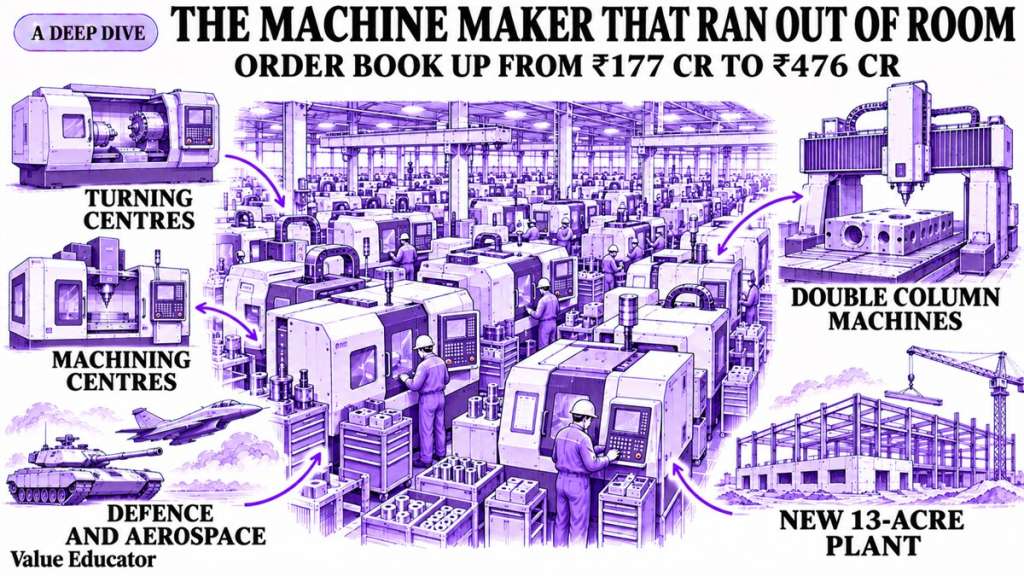
On 27 October 2026, a machine tool maker from Rajkot told its investors that it was now refunding advances on 10 to 20 machines a month. It was not short of buyers. It was short of space. Its order book had just reached ₹476 Cr, and its plant was close to its yearly limit of 2,500 machines.
So what are these machines, and who keeps ordering them? A CNC machine tool is a machine that cuts metal into a part by following a computer program. CNC stands for computer numerical control. You load a steel bar or a casting, and the program moves the cutting tools along exact paths, often to within a few microns, or thousandths of a millimetre. Almost every metal part you can think of, from a gear and a pump body to a tank engine part, is cut on such a machine.
India uses far more of these machines than it makes. The company puts Indian consumption at about ₹38,000-40,000 Cr a year, against production of about ₹16,000 Cr. Much of the rest is imported, especially the high-end machines. The industry body IMTMA expects consumption to cross ₹50,000 Cr by 2030.
Those machines go mostly to small factories. A typical buyer is a job shop that makes auto parts, valves or farm equipment parts for larger companies. It buys a machine with a bank loan and often a state subsidy, so it pays a deposit first and the balance when the bank releases the money. The machine maker builds to that order, installs the machine and then earns from spares and service for years. That is how the business works: a large catalogue, a wide sales network and enough factory space to deliver on time.
That machine maker is Macpower CNC Machines Ltd (NSE: MACPOWER). It was set up in 2003 at Metoda GIDC near Rajkot, and it listed in 2018. It makes turning centres, machining centres, vertical turret lathes and large double column machines, in more than 388 models and variants. A machining centre is a CNC machine in which the cutting tool spins and moves over a fixed part, for drilling, milling and shaping. A double column machine is a very large machining centre, built like a bridge, for parts that are too big for a normal machine.

Its customers are mostly those small factories, but its list also includes 35 defence factories, HAL and ISRO.
Macpower CNC in five numbers
- Q2 FY27 revenue of ₹120.33 Cr, up 40.4% year on year
- An order book of ₹476 Cr in September 2026, up 36% in a year
- Capacity of 2,500 machines a year, now running close to full
- More than 200 machines supplied to defence factories
- Revenue guidance raised to about 35% growth for FY27
So a Rajkot company set up in 2003 has more orders than it can build. How did the latest quarter look when the factory was this full? Let's first understand the company, and then look at the latest quarter.
Macpower CNC Machines: Company Overview
Macpower CNC Machines Ltd was established in 2003 and makes CNC machine tools at a plant of about 8 acres in Metoda GIDC, near Rajkot in Gujarat. It listed in 2018 and has no subsidiaries, so its standalone results cover the whole business. Rupesh Mehta, the chairman and managing director, has more than 29 years in the machine tool industry, and Nikesh Mehta is the whole-time director and CEO. The company makes turning centres, vertical and horizontal machining centres, vertical turret lathes, double column machines and 5-axis machines, in more than 388 models and variants. It has more than 995 employees and a capacity of 2,500 machines a year. Revenue was ₹333.18 Cr in FY26 and profit after tax ₹33.87 Cr, and the promoter family held 73.22% of the shares in September 2026. Borrowings were only about ₹158 lakh in September 2026, against cash of ₹2,719.57 lakh. Read this Best Defence Stocks in India for 2026
"Behind every stock is a company. Find out what it's doing."
— Peter Lynch
What Macpower does is simple to describe: it builds metal-cutting machines for small factories, defence plants and aerospace units, and it now sells more of them than its plant can make. The rest of this article follows what that means.
The Quarter the Factory Ran Close to Full
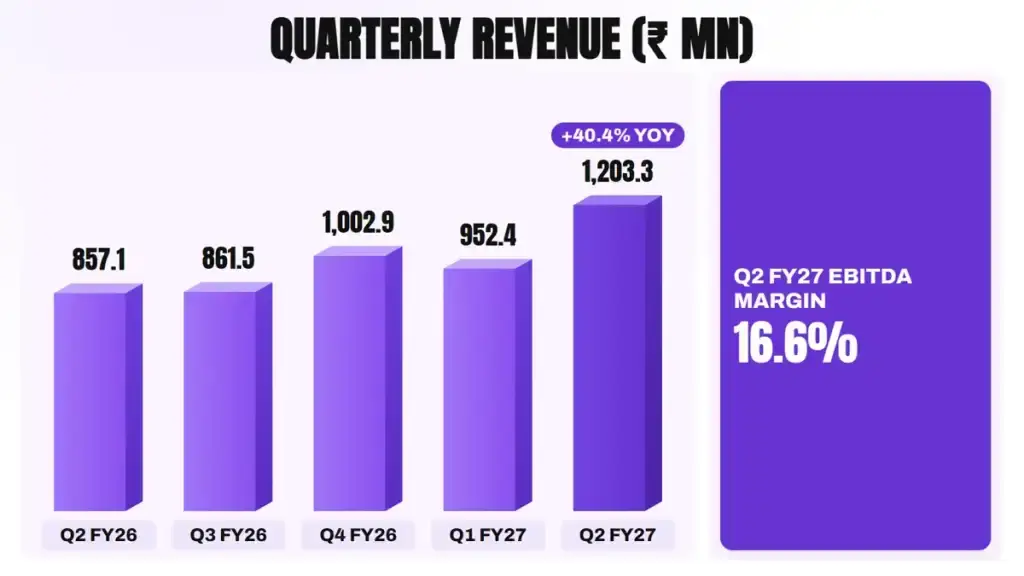
Let's look at Q2 FY27, the July to September quarter, when the factory ran close to full. The company reported it on 26 October 2026. Revenue was ₹120.33 Cr, up 40.4% from a year ago. It was the highest quarterly revenue, EBITDA and profit in the company's history.
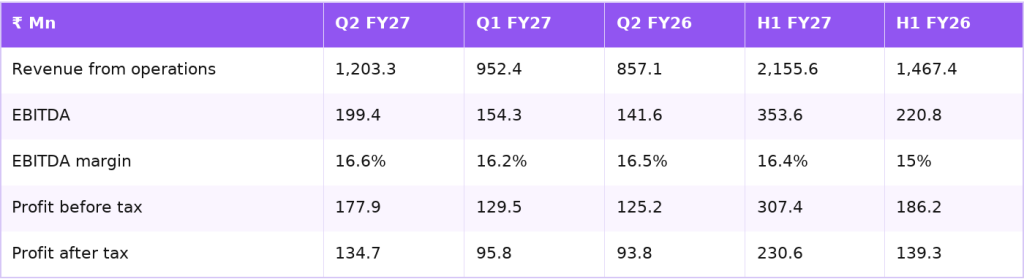
That revenue came almost entirely from more machines. Management put the average price at about ₹20.36 lakh a machine in the quarter. At that price, ₹120.33 Cr of revenue works out to about 591 machines. The plant's capacity is 2,500 machines a year, or about 625 a quarter. So the factory ran at about 95% of its limit.
That gain came from volume, and prices have not yet done much of the work. Management raised its prices two to three months before its October 2026 results, but this quarter's machines were built from older orders and older stock. So the higher prices should start to show in Q3. All orders received in the last two months were at the new price.
That growth also lifted profit faster than revenue. Profit after tax rose 43.7%, and for the half year it rose 65.5% to ₹230.6 Mn. You can see why in the cost lines. Employee costs rose about 25% in the quarter, to ₹1,158.13 lakh, while revenue rose 40.4%. So each machine carried a smaller share of salaries. Materials stayed at about 62% of revenue in both years, so the gain did not come from cheaper steel.
But the EBITDA margin itself barely moved, at 16.6% against 16.5%. Other expenses grew about 58%, to ₹1,462.32 lakh, as the company spent on new branches, exhibitions and sales staff. Management says it is building that network now, ahead of the new plant, so that the extra machines have buyers waiting.
That profit also turned into cash, and the cash side of the quarter was even stronger. In H1 FY27, operating cash flow was ₹2,997.19 lakh, against just ₹82.27 lakh in H1 FY26. Read this Cash Flow Statement Explained Trade receivables came down from ₹4,626.68 lakh in March 2026 to ₹2,289.12 lakh in September. Cash rose to ₹2,719.57 lakh. Management gives a simple reason: it stopped dispatching machines against short-term assurance letters from a finance company and now waits for the money. Larger buyers such as Hero, Kirloskar and Graphite India pay most of the price before delivery and the last 10-20% after installation.
The Orders Behind the ₹476 Cr Book
Now let's look at the orders, because they decide the next few quarters. The order book stood at ₹4,767 Mn in September 2026, against ₹3,500.94 Mn a year earlier. Management says every order in it comes with an advance, except those from its own distributors and from government buyers.
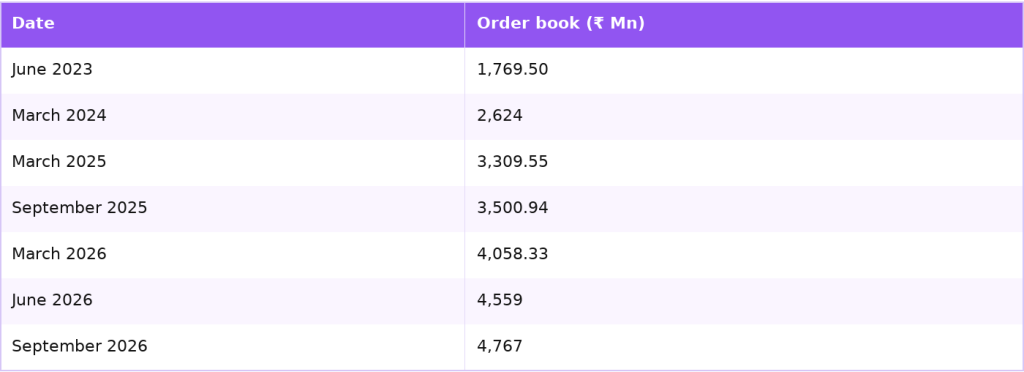
So the book has grown about 2.7 times in a little over three years. It also grew while the company was shipping more. At the Q2 FY27 run rate of ₹1,203.3 Mn a quarter, the book covers about four quarters of work. That is a full year of output already sold, before the new plant adds any space.
"Does the company have products or services with sufficient market potential to make possible a sizable increase in sales for at least several years?"
— Philip Fisher
Macpower's answer sits in two numbers: India uses far more machine tools than it makes, and the company's own book already covers about a year of output.
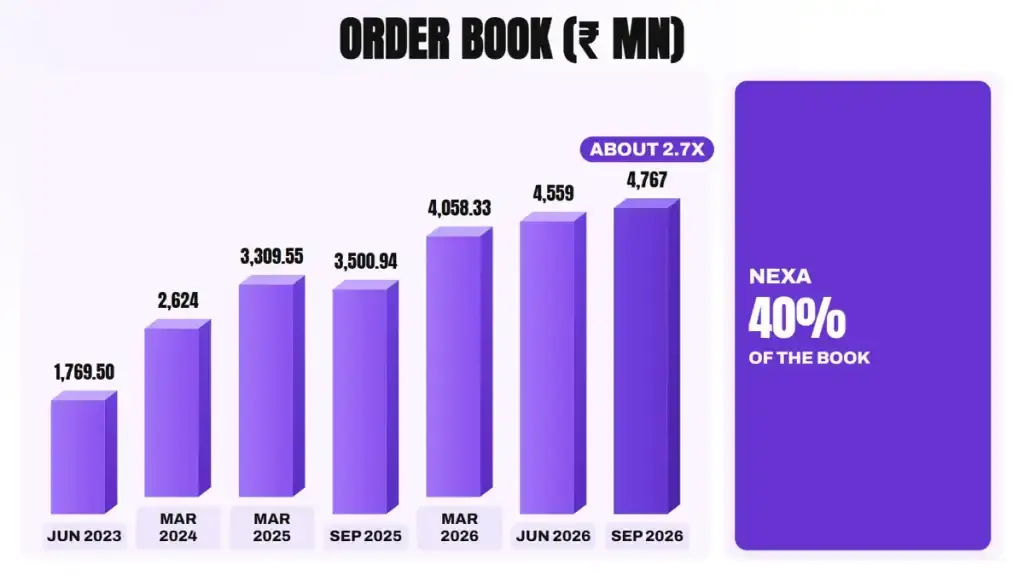
The mix inside the book is also moving up. The NEXA series is Macpower's range of larger and more costly machines. It made up about 40% of the pending book by value in September 2026. Two years earlier, in September 2024, it was 35.5%, and in March 2025 it was 28%. Management's aim is to take that share to 50% by 2028-29.
Behind that order book we also see a pipeline of bids. In September 2026 the company had ₹7,451 Mn of domestic bids submitted and ₹1,942 Mn of government tender bids under evaluation, for a total of ₹9,393 Mn.

What the order book says: ₹476 Cr is about four quarters of output at the Q2 FY27 run rate. With the plant at about 95% of its limit, the next jump in revenue depends on space and parts, not on finding buyers.
How a Lathe Maker Reached 2,500 Machines a Year
Now that we have seen the quarter, let's go back and see how the company reached 2,500 machines a year. Before its 2018 listing, Macpower made basic lathes under the "Turner" brand, mostly for small firms. Its capacity was about 600 machines a year. Its EBITDA margins were in single digits, because it bought many sub-assemblies from outside.
That listing money went into making its own parts. Between 2018 and 2021 it set up sheet metal, spindle and powder coating lines, and capacity roughly doubled to about 1,300 machines a year. It also launched the NEXA range, and its research team grew to more than 30 people. Later it built its own CNC controller, Macatrol.
Then came the next step. On 10 November 2025, the company finished a 40,000 sq ft assembly unit and added 500 machines a year, taking capacity to 2,500. It had announced that addition in September 2024, so it took a little over a year from plan to output.
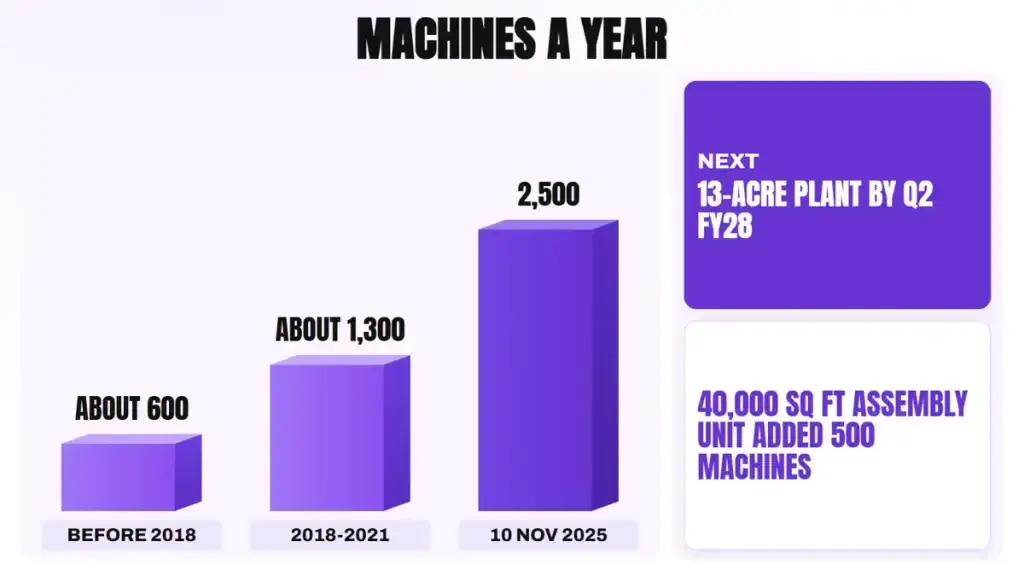
That build-out shows up in five years of numbers.
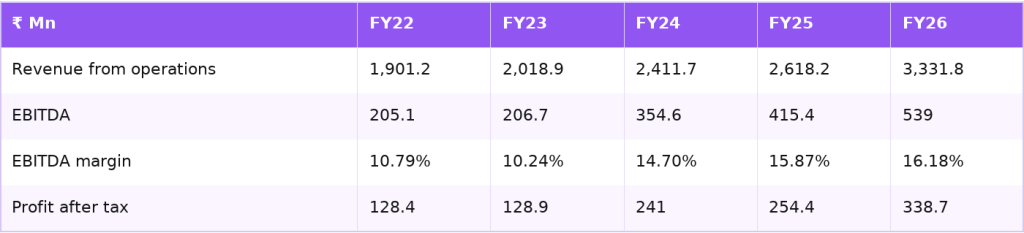
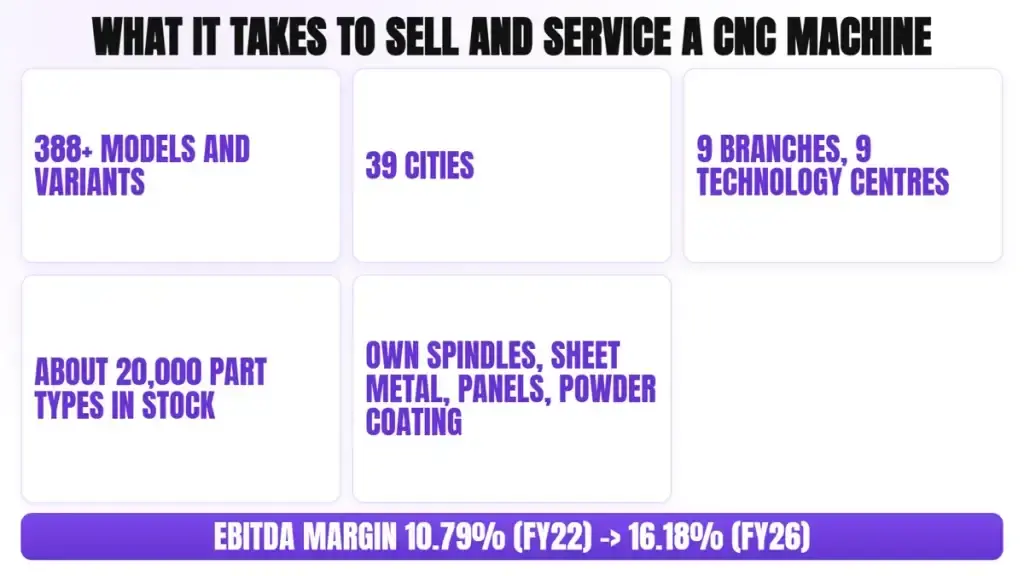
So revenue grew at about 15% a year from FY22 to FY26, while EBITDA and profit both grew at about 27% a year. Most of that gap came from two changes. The company made more of its own parts, and it sold more of the larger NEXA machines. The EBITDA margin rose from 10.79% in FY22 to 16.18% in FY26.
Those margins peaked in FY26, the strongest year so far. Revenue was ₹333.18 Cr, up 27.26%, and profit after tax was ₹33.87 Cr. At about ₹20 lakh a machine, that revenue equals about 1,666 machines. In FY25 the company had sold 1,382 machines and taken orders for 1,655 machines, so orders were running ahead of output well before the new unit opened.
That output needed more people too. The company had more than 995 employees in its latest presentation, against more than 950 in March 2026. Management says its sales, service and branch teams will double by the end of FY27. It also expects to add about 2,000 more people over the next two to three years, so staff costs will rise before the new plant adds output.
That growth was also paid for without new shares or much debt. It spent ₹91.6 Mn on capex in FY24, ₹124.2 Mn in FY25 and ₹153.6 Mn in FY26, and management says the FY26 spend came from its own funds. Its borrowings were about ₹158 lakh in September 2026, against equity of about ₹19,685 lakh. The promoter family held 73.22% of the company in September 2026.
"I am controlling the operating cost. I am not paying the interest cost." - Rupesh Mehta, Chairman and Managing Director, October 2026
Three Machine Families and One Customer List
Now let's split the business into its machine families. The company reports a single segment, the making of machines. So it does not give revenue for each family every year. Read this Segment-Wise Revenue Analysis Explained The last product split it published was for FY23, and it shows how the business started out.
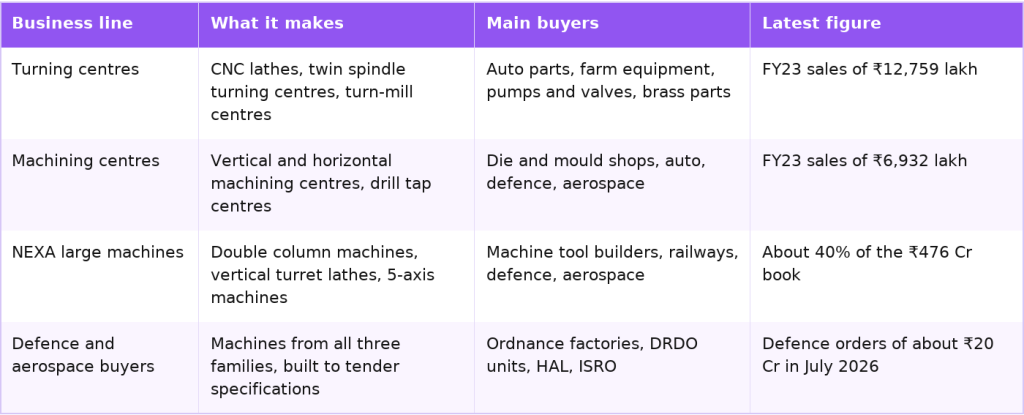
These lines can sound alike, so let's be clear on how they differ. A turning centre spins the part and holds the tool still, so it makes round parts like shafts and flanges. A machining centre does the reverse: it spins the tool over a fixed part, so it makes flat and boxy parts like housings and moulds. The NEXA machines are bigger and more complex versions of both, and they sell for more. The defence line, as you will see, is a group of buyers who order from all three families through tenders.
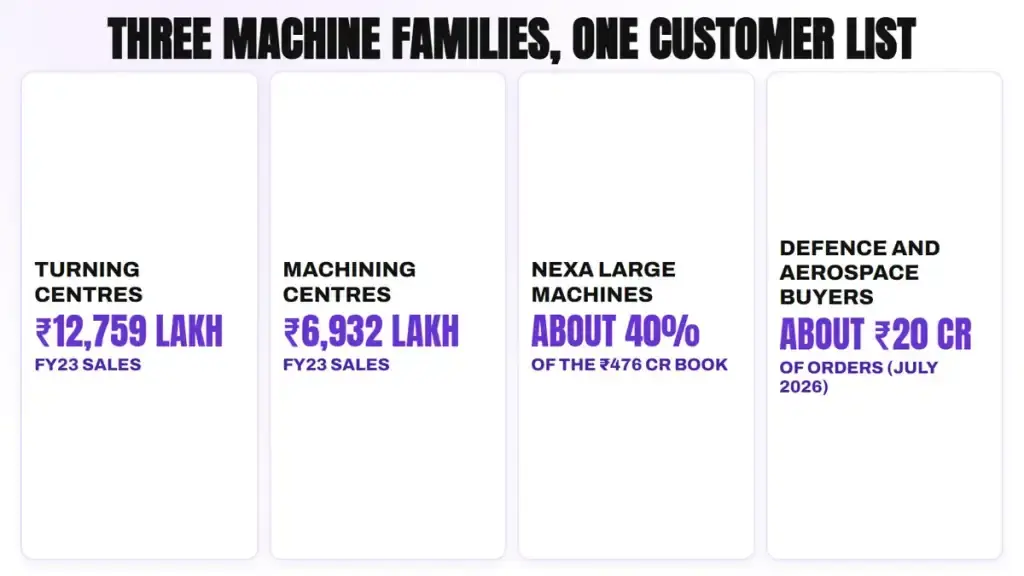
Turning Centres
Let's start with turning centres, the base of the business. In FY23 they made up about 64% of product sales, at ₹12,759 lakh. Their buyers are the auto and engineering job shops that make up most of Macpower's customer list. That list includes more than 1,250 auto and auto parts customers and more than 775 engineering and capital goods firms.
Those buyers, as you might expect, are growing with Indian manufacturing. Management says manufacturing is about 15% of India's GDP, and the government wants it to reach 25%. New auto part, pump and valve plants all need turning centres. Management says automobiles are still the fastest-growing group in its customer base, followed by die and mould, medical and agriculture. India ranks ninth in the world in machine tool production, while China ranks first, so Indian makers still have a long way to grow at home.
That customer base is wide as well as large. Beyond auto and engineering, it includes more than 87 farm equipment makers and more than 22 public-sector and education buyers. No single customer made up 10% or more of revenue in FY25 or FY26.
Those buyers pick Macpower's machines on range and price. A buyer can choose from twin spindle machines that make two parts together, turn-mill centres with a Y-axis that can also drill and mill, and long-bed machines for shafts. The TOM 200 turn-mill centre with a Y-axis was launched in Q1 FY27, and the LX 1000 joined it.
Machining Centres
Next, let's look at machining centres, the second family. In FY23 they brought in ₹6,932 lakh, about a third of product sales. A vertical machining centre holds the tool upright and is the workhorse of die and mould shops. A horizontal machining centre holds the tool sideways and can work on four faces of a part in one setting, which suits engine blocks and gearbox housings.
That second type is where defence work begins. Macpower supplied a horizontal machining centre to the Engine Factory Avadi to machine engine parts for the T-90 Bhishma battle tank. That machine is one of the company's proof points when it bids for other ordnance work.
Its buyers in this family are more varied than in turning. They include 157 die and mould shops and makers of electronic parts. Management says it has won many good orders from electronics manufacturing firms. These buyers need fast drilling and tapping, which is why the company has added high-speed drill tap centres.
NEXA Large Machines
Now let's move to the NEXA range, the fastest-growing family. Some of these machines sell for about ₹1 Cr to ₹2 Cr each, against about ₹20 lakh for an average Macpower machine. The DCM 4222 double column machine, for example, weighs about 30 tonnes and sells for about ₹2 Cr. In Q2 FY27 the company launched a 5-metre double column machine, the DCM 5227, along with the V500 G and the VTX 1200 L.
These big machines are built for big parts. A vertical turret lathe turns heavy round parts that stand on a rotating table, such as valve bodies, motor bodies and engine liners. Railway workshops and their suppliers use such machines, and the DCM 2618 double column machine is also aimed at railway and heavy parts. The global machine tools market is projected to grow from about $123.7 bn in 2026 to about $183.5 bn by 2033. That growth is driven mainly by demand for high-precision parts in autos, aerospace and electrical equipment.
Macpower is also working on 5-axis machines, which move the tool along five axes together to cut complex shapes. Management estimates that India buys only about 150-200 of these a year, and most are imported. It sells about one 4+1 axis machine a month and recently won a single 5-axis order of about ₹2 Cr. It plans to show a new 5-axis machine for aerospace and defence at IMTEX in January 2027.
That NEXA push is what moves the average price. The NEXA share of the book stood at 40% in September 2026, and an order for 160 NEXA machines worth ₹42 Cr came at IMTEX 2025 alone. Management expects the average price to rise a little each year as these machines take a larger share.
Defence, Aerospace and Railways
Finally, let's look at the defence buyers, who are small in revenue but large in what they could become. Management says defence buyers have large budgets right now, and the big tender issuers include the Heavy Vehicles Factory, the Engine Factory, HAL and BHEL. The tenders released each year average more than ₹1,000 Cr.
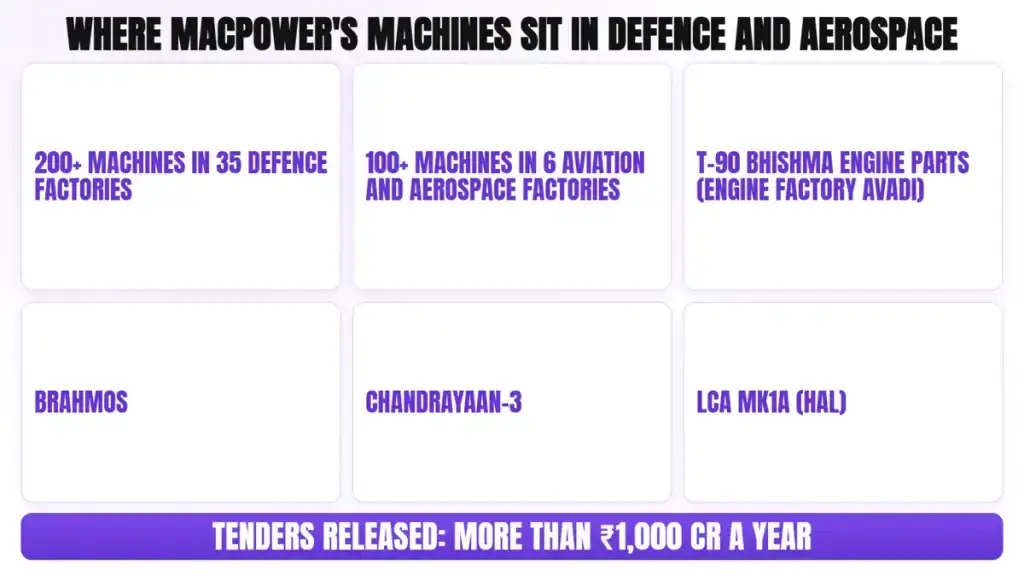
That defence market is one Macpower has supplied for years. It has delivered more than 200 machines to 35 defence factories, including DRDO units and ordnance factories. It has also delivered more than 100 machines to six aviation and aerospace factories, including HAL and ISRO. Its machines have worked on parts for the BrahMos missile programme, the Chandrayaan-3 mission, the Heavy Vehicles Factory and makers of medium machine guns for the BSF.
HAL, which builds the LCA Mk1A fighter, appears in the company's presentation next to that programme. In May 2026 the company had a ₹3 Cr machine order from HAL, which takes about six months to build. In October 2026 management said it had good orders from HAL, rifle factories and ordnance factories, and that it would deliver all of them this financial year.
Today this work is still a small part of revenue. Management says defence is a single-digit share of sales, with about ₹20 Cr of defence orders in hand in July 2026. Those machines are custom-built and take five to six months in assembly, so they block floor space that standard machines could use. That is one reason the company bids on only about 25-30% of the tenders it sees.
That should change with the new plant. Management says the 13-acre site will have a separate defence assembly shop. It also says the margin on defence work is the highest of any of its lines. On average, about 10% of the tenders it bids for turn into orders, close to the 10-12% that other makers win.
Why Macpower's Network Is Hard to Copy
Now that we have seen the machine families, let's understand Macpower's moat, which starts with its network. A machine tool is not bought off a shelf. A job shop runs one machine for years, and it needs a service engineer within a day when the machine stops. So a buyer chooses a maker that has a centre close by, spare parts in stock and a model that fits its part.
That is where Macpower has spent its money. It sells and services machines in 39 cities through 9 branch offices and 9 technology centres. Four more technology centres, at Kolhapur, Mumbai, Chennai and Aurangabad, are due in Q3 FY27. Behind them sit more than 388 models and variants and about 20,000 types of parts in stock. Management says it can predict about 70% of what customers will order from that range, so most machines can be built quickly.
That range is also its own design. Every one of those models was designed in-house, without a foreign partner or a paid design. It also has its own controller, Macatrol, for some machines, and its own automation, from gantry loaders to robot cells. A new entrant would need years to build a range that wide and a service network that deep.
"The key to investing is not assessing how much an industry is going to affect society, or how much it will grow, but rather determining the competitive advantage of any given company and, above all, the durability of that advantage."
— Warren Buffett
For a machine tool maker serving small factories, the advantage is reach and range: a service engineer close by and a model that fits the part. That takes years to build and is hard to copy quickly.
Then there is cost, which we can see in its parts list. Macpower makes many of its own parts, including sheet metal, spindles, control panels and powder coating. Management calls it the lowest-cost producer among its Indian peers. Read this Economic Moat Explained It does not try to make everything. Ball screws, guideways and CNC controls come from a few large global makers, and management says those parts only make sense at very large scale.
Then there is the defence record. Defence tenders ask for technical pre-qualification, so a record of past supply counts. More than 200 machines in 35 defence factories give Macpower that record, and it took years to build.
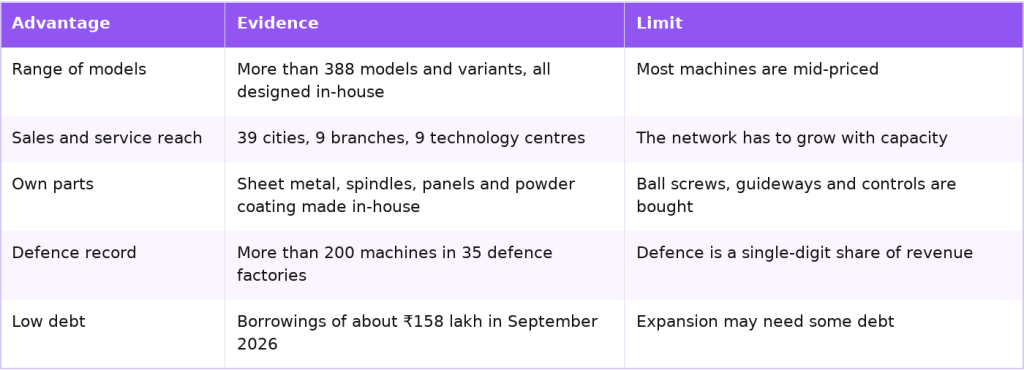
That table also shows us where the moat gets tested next. The margin is the test. Macpower's EBITDA margin rose from 10.79% to 16.18% over four years as it made more of its own parts. If the new plant brings more parts in-house, that margin should keep rising.
Financials: Five Years of Growth, Margins and Cash
One strong quarter can mislead, so let's look at five full years together. All figures are standalone, which is the whole company, and EBITDA is the company's own measure of operating profit.
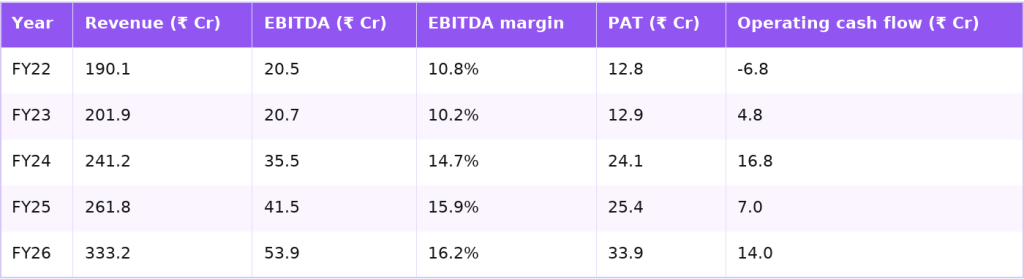
Revenue grew about 15% a year from FY22 to FY26, while EBITDA and profit grew about 27% a year. The margin rose from about 10.8% to 16.2% as the company made more of its own parts and sold more of its larger NEXA machines.
Cash has lagged profit in most of these years. Over the five years, operating cash flow added up to about ₹35.8 Cr, against about ₹109.1 Cr of profit after tax. The reason is stock: the company holds about 20,000 part types for its range, and inventories stood at ₹14,555.07 lakh in March 2026.
That changed sharply in the first half of FY27. Operating cash flow was ₹2,997.19 lakh, more than the half-year profit, as receivables came down and the company stopped dispatching machines before the money arrived. Borrowings stayed at about ₹158 lakh, so the balance sheet is almost free of debt.
"Beware of little expenses; a small leak will sink a great ship."
— Benjamin Franklin
Macpower's management talks about controlling operating cost and interest more than chasing EBITDA. In a business that carries a lot of stock, that watch on small leaks is what keeps the cash flow positive.
What FY28 Could Look Like on Management's Numbers
So where does the company go from here? Management's growth target has moved up twice in five months, so let's lay it out in order. In May 2026 it guided for 28-30% revenue growth in FY27. In July it raised that to more than 30%. In October it raised it again, to about 35%.
"I think in last first quarter we committed 30% growth and I think we delivered that growth in quarter 2 and now I am increasing our guidance for this year growth is nearly 35%." - Rupesh Mehta, Chairman and Managing Director, October 2026
Now let's put that 35% target against the year so far. FY26 revenue was ₹333.18 Cr, so 35% growth means about ₹450 Cr in FY27. The first half brought in ₹215.56 Cr. So the second half needs about ₹234 Cr, against about ₹186 Cr in H2 FY26, a rise of about 26%. Management says it can deliver about 2,300-2,400 machines in FY27, and it plans to make about 250 machines a month in Q4.
That growth needs the new plant. In July 2026 the company took about 13 acres on a 30-year lease near its existing plant. About 9 acres can be built on, and the rest is a green zone. The plan is a centrally air-conditioned shop floor of about 1,50,000-2,00,000 sq ft and about ₹50 Cr of investment, paid from internal cash and debt. Under the Viksit Gujarat Industrial Policy 2026, the project can get up to a 25% capital subsidy and a 7% interest subsidy.

That plant is already under way. The compound and borewell are done, the architect and contractors are appointed, and the building contract has a six-month deadline with a penalty clause. About 20% of the machinery orders, those with lead times of five to six months, are already placed, for spindle, sheet metal and telescopic cover capacity. Management expects the site to run by the end of Q2 FY28 and will give the new capacity figure with its Q3 FY27 results.
Until the new plant runs, it is stretching the old one. It has rented about 40,000 sq ft next to its factory. It says growth of 25-30% a year in the next three years is visible with this land alone.
"So, my first priority is to capture the minimum 10% market share in coming 3, 4 years" - Rupesh Mehta, Chairman and Managing Director, October 2026
Beyond that sits a much larger plan. The company has paid a token amount for about 60 acres from the Gujarat government, and more than 32 department clearances are done. It is waiting for the state's new defence policy before it takes the land. On that site, the plan is a first phase of 2,000 machines for about ₹100 Cr, with half of the new plant reserved for defence work. Management says the two sites together could support 10,000 machines a year, and that margins above 20% are possible at that scale.
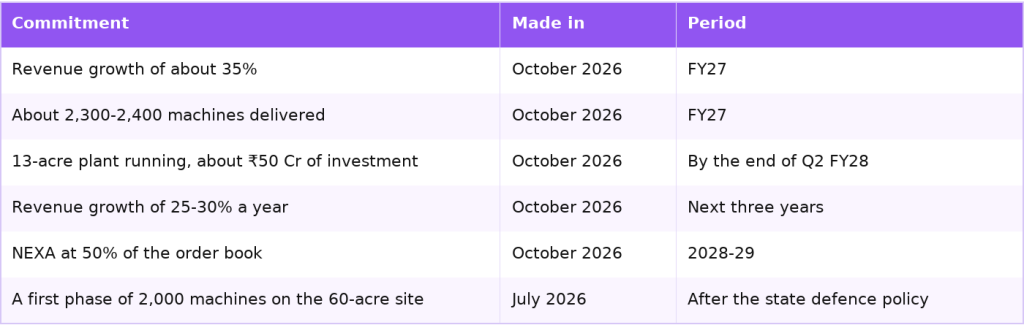
Those commitments are easier to judge against the past. So let's check what management has said before against what happened.

That record is mixed, as you can see. The factory targets the company controls have been met, and the growth guidance has been raised twice. The plans that depend on the government's land have slipped.
Key Risks
Now let's look at what could go wrong for Macpower CNC, because a full factory has its own risks.
- Lost orders: management says it refunds advances on 10-20 machines a month because it cannot deliver in time. Every refund is a buyer who may go to another maker, and it will stay this way until the new plant runs in the second half of FY28.
- Parts bottlenecks: in-house spindle capacity is about 1,400-1,500 a year, so the company buys about 1,500 more. In May 2026 its sheet metal line could serve about 110 machines a month. Growth depends on adding these lines on time.
- Plant delays: the 13-acre plant has to be built and equipped within about a year. The 60-acre plan has already waited more than a year for a state policy, and there is no date for it.
- Tender bids shrinking: government tender bids under evaluation came down from ₹3,760.11 Mn in March 2026 to ₹1,942 Mn in September 2026. The company has not said how much of that turned into orders and how much lapsed.
- Small, loan-funded buyers: most customers are small firms that buy with bank loans and state subsidies. A tighter credit cycle or a cut in subsidies would hit new orders first.
- Inventory: inventories rose to ₹17,002.26 lakh in September 2026, from ₹14,555.07 lakh in March. The company holds about 20,000 part types for its range, and a slower year would leave a lot of cash in stock. Read this Inventory Turnover Ratio Explained
- Imported parts: ball screws, guideways, bearings and CNC controls come from a few foreign makers. Foreign exchange outgo was ₹24,14,04,081 in FY26. A supply problem or a weak rupee would raise costs.
- Export controls on 5-axis machines: these machines need a Siemens control and long end-use agreements. A machine that reaches a restricted buyer could cut off the supply of controls, which is why management keeps this line small.
- Margin: the EBITDA margin was 16.6% in Q2 FY27, close to 16.18% for FY26. Management expects new fixed costs from staff and the new plant before the gains arrive, so margins above 20% are a later goal, not a near-term one.
"Our struggle with the customer is about deliveries." - Rupesh Mehta, Chairman and Managing Director, October 2026
"Invert, always invert."
— Charlie Munger
For Macpower, inverting means asking what would stop a full factory from growing: a late plant, missing parts, buyers who cannot get loans, or tender bids that do not turn into orders. The tracking list below follows exactly those points.
Explore our Products
Research Framework

Emerging Titans
Combination of quantitative analysis, industry tailwinds, and management assessment - SPRINT investment philosophy

Tiny Titans
Heavy emphasis on scuttlebutt research, plant visits, and early on-ground signals
What to Track Next
If you follow Macpower CNC, these are the signals that will show where it goes next.
- Q3 FY27 results, with the capacity figure for the 13-acre plant
- The order book after ₹476 Cr, and the NEXA share after 40%
- Revenue in H2 FY27 against the roughly ₹234 Cr needed for 35% growth
- Progress on the 13-acre building and machinery orders against the Q2 FY28 date
- The Gujarat defence policy and the 60-acre land
- New defence orders and the tender bids after ₹1,942 Mn
Conclusion
Let's put it all together. Macpower CNC has grown from a 600-machine lathe maker into a 2,500-machine company with 388 models, a network in 39 cities and a record in defence factories. In Q2 FY27 its revenue rose 40.4%, its cash flow turned strongly positive and its order book reached ₹476 Cr. The cautious thread is execution: the 13-acre plant has to run by the end of Q2 FY28, the parts lines have to grow with it, and the government tender bids under evaluation have come down. The capacity figure in the Q3 FY27 results and the second-half revenue will be the first tests.
So the limit now is space, not demand. The plant is close to full, and buyers are being turned away every month. What happens next depends on whether the 13-acre plant runs on time, and whether the defence work it is meant to house turns into a larger share of sales.
FAQs
What does Macpower CNC Machines do?
+Macpower CNC Machines makes CNC machine tools at Metoda GIDC near Rajkot: turning centres, vertical and horizontal machining centres, vertical turret lathes, double column machines and 5-axis machines. It offers more than 388 models and variants and has a capacity of 2,500 machines a year. Revenue was ₹333.18 Cr in FY26.
How did Macpower CNC do in Q2 FY27?
+Revenue rose 40.4% to ₹120.33 Cr, its highest for any quarter, and profit after tax rose 43.7%. The EBITDA margin was 16.6%. In H1 FY27 operating cash flow was ₹2,997.19 lakh, against ₹82.27 lakh a year earlier.
What is Macpower CNC's order book?
+The order book was ₹476 Cr in September 2026, up 36% in a year. The larger NEXA machines made up about 40% of it by value. The company also had ₹7,451 Mn of domestic bids and ₹1,942 Mn of government tender bids under evaluation.
What defence and aerospace work does Macpower CNC do?
+It has supplied more than 200 machines to 35 defence factories and more than 100 machines to aviation and aerospace units, including HAL and ISRO. One horizontal machining centre machines T-90 Bhishma tank engine parts at the Engine Factory Avadi. Defence orders in hand were about ₹20 Cr in July 2026, a single-digit share of sales.
What is the new 13-acre plant?
+Macpower took about 13 acres on a 30-year lease near its existing plant in July 2026. The plan is an air-conditioned shop floor of about 1,50,000-2,00,000 sq ft and about ₹50 Cr of investment, with up to a 25% capital subsidy. Management expects it to run by the end of Q2 FY28.
What are the main risks for Macpower CNC?
+The plant is close to full, and the company refunds advances on 10-20 machines a month because it cannot deliver in time. Growth depends on the 13-acre plant and new parts lines arriving on time. Most buyers are small firms using bank loans, and government tender bids under evaluation came down to ₹1,942 Mn in September 2026.

High growth stock specialist, Value Educator
Shashank Mahajan is an equity research professional with over 12 years of experience in identifying high-potential SME and micro-cap stocks at an early stage. He follows a rigorous scuttlebutt research–driven approach, combining on-ground insights with deep financial analysis. Shashank specializes in uncovering under-researched and under-owned companies with strong management quality and long-term growth potential. Through disciplined research and early identification, he focuses on spotting tomorrow’s market leaders before they enter the mainstream investor radar.
KSB: The Pune Pump Maker With ₹1,235 Cr of Reactor Orders

Kilburn Engineering: The Dryer Maker With ₹470 Cr of Orders

Rossell Techsys: Boeing and Lockheed Wiring From Bengaluru
Unimech Aerospace: From Engine Tools to Flying Parts
Taneja Aerospace: The Airfield With ₹161 Cr of Rent Signed

Dynamatic Technologies: Airbus Doors, Flap Beams and Pumps
Explore our Products
Research Framework
Emerging Titans
Combination of quantitative analysis, industry tailwinds, and management assessment - SPRINT investment philosophy
Tiny Titans
Heavy emphasis on scuttlebutt research, plant visits, and early on-ground signals



Modern Warfare to Multibaggers
Key Trends. Strategic Shifts. Opportunities Ahead.
Don't Miss This Exclusive Webinar!
Join Value Educator to decode the key trends shaping India's defence sector and learn how to identify tomorrow's potential leaders in the space.
- In-depth research on India's defence sector
- Live Q&A session
- Actionable takeaways for long-term investors

 Orders
 Subscription
 Share with friends


Required Details
₹23999.00
(12 month subscription)
As per SEBI regulations, all users are mandated to complete the KYC that is validated for 1 year. Post payment, you will be redirected to the KYC screen


No comments yet. Be the first to comment!