
Kalpataru Projects: ₹71,846 Cr of Orders, Almost No Net Debt

In September 2025, an Indian construction company owed its lenders ₹3,169 Cr more than it held in cash. A year later, in September 2026, that gap was just ₹72 Cr. Over the same twelve months its order book grew 11% to ₹71,846 Cr, the highest it has ever reported, and it booked ₹23,934 Cr of new orders between April and early November 2026.
That company builds things that most of us see every day but rarely think about. The tall steel towers that carry high-voltage power lines across fields and hills. The substations where that power is stepped down. Gas pipelines in the Gulf, metro tunnels under Indian cities, water schemes for villages and housing towers for real-estate developers.
All of this work is done under one kind of contract, called EPC, short for engineering, procurement and construction. The EPC contractor designs the project, buys the materials and equipment, and builds it, and then hands it over to the owner. The owner pays as the work moves forward. So an EPC company earns a thin margin on a very large amount of work, and its real skill lies in finishing large projects on time and on budget.
That company is Kalpataru Projects International Ltd (NSE: KPIL). It was incorporated in 1981 and started as a transmission company, known for most of its life as Kalpataru Power Transmission. Today it works in six businesses: power transmission and distribution (T&D), buildings and factories, oil and gas, water, railways and urban infrastructure. It is present in 75 countries, has more than 250 projects under execution and makes its own transmission towers at two plants in Gandhinagar and Raipur.

So in the power value chain, Kalpataru's place is in the middle. It does not make electricity and it does not sell it to homes. It builds the lines and substations that carry power from the plants to the cities, in India and abroad, and that part of the chain is now where much of the grid spending is going.
Kalpataru Projects in five numbers
- Q2 FY27 profit before tax of ₹398 Cr, up 24%
- An order book of ₹71,846 Cr in September 2026, about 2.6 times FY26 revenue
- New orders of ₹23,934 Cr so far in FY27, plus about ₹5,000 Cr of L1 positions
- Net debt of ₹72 Cr in September 2026, against ₹3,169 Cr a year earlier
- FY27 order inflow guidance raised to ₹35,000-36,000 Cr, from ₹30,000 Cr
So a company that carried ₹2,591 Cr of net debt as recently as FY24 is now close to having none, with more work booked than ever. How did that show up in the latest numbers? Let's first understand the company, and then look at the latest quarter.
Kalpataru Projects International: Company Overview
Kalpataru Projects International Ltd was incorporated in 1981 as a transmission company and was known for most of its life as Kalpataru Power Transmission; its registered office is in Gandhinagar, Gujarat, and its corporate office is in Mumbai. Mofatraj P. Munot founded the business and is its non-executive chairman, Manish Mohnot is managing director and CEO, and the promoters held 33.6% in September 2026. After merging its listed subsidiary JMC Projects, with an appointed date of 1 April 2022, it now works as an EPC contractor in six businesses: power transmission and distribution, buildings and factories, oil and gas, water, railways and urban infrastructure. It makes its own transmission towers at two plants in Gandhinagar and Raipur, with 2,40,000 MT a year of capacity, and owns about 65.9% of Linjemontage, a Swedish grid contractor listed on Nasdaq Stockholm. It has more than 11,000 employees and a footprint in 75 countries. Consolidated revenue was ₹27,143 Cr in FY26, and net debt was down to ₹72 Cr in September 2026. Read this Transrail Lighting: A Line Builder With Its Own Tower Plants
"Know what you own, and know why you own it."
— Peter Lynch
Kalpataru is six EPC businesses under one roof, and each one earns and collects money differently. Knowing which of them drives the order book, the margin and the cash is the first step to reading its results.
The Quarter Profit Grew Faster Than Revenue
Let's look at Q2 FY27, the July to September quarter that the company reported on 5 November 2026. Consolidated revenue was ₹7,004 Cr, up 7% from ₹6,529 Cr a year ago. That number hides a base effect, though. A year ago the figure included revenue from road projects and from a Brazilian subsidiary that have since been sold or wound down. Leaving those out, revenue grew 13%, from ₹6,215 Cr to ₹6,995 Cr.

As we can see, profit grew much faster than revenue. Profit before tax rose 24% to ₹398 Cr, and profit after tax rose 23% to ₹292 Cr. The PBT margin went up to 5.7% from 4.9%. The core EBITDA margin, the profit from the projects before interest and depreciation, actually slipped to 8.3% from 8.6%. Management says that was mainly a one-off cost of about $2 million for the share sale of its Swedish subsidiary, which went straight into the profit and loss account.
So the gain came from lower down the income statement. Finance cost fell to ₹90 Cr from ₹136 Cr a year ago, as debt came down. Management says interest cost has fallen from about 2.5% of revenue five years ago to 1% to 1.25% now. That is why it guides on PBT margin rather than EBITDA margin. Read this Operating vs Net Profit Margin Explained
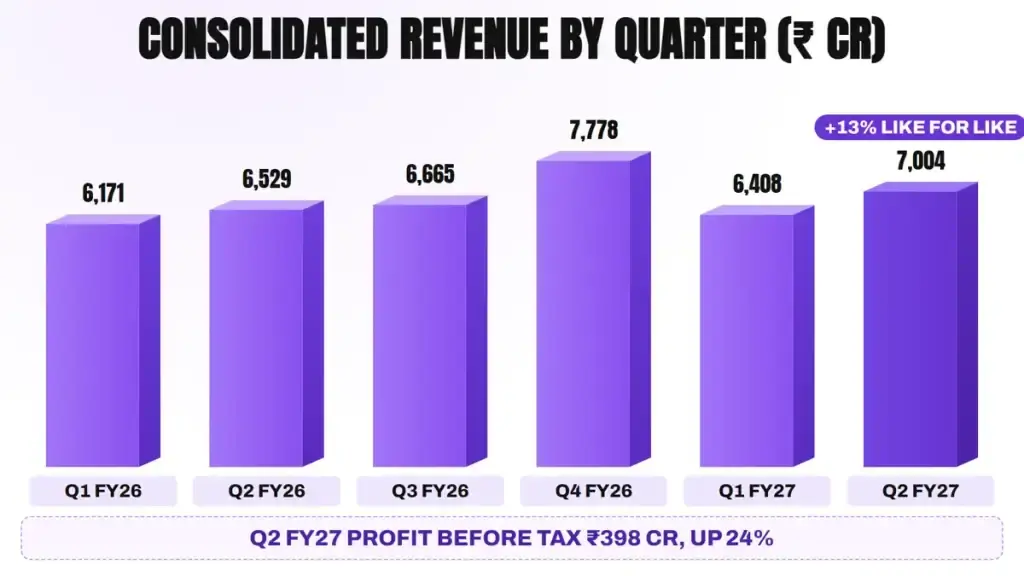
That same pattern shows in the first half, at a larger scale. H1 FY27 revenue was ₹13,412 Cr, or ₹13,391 Cr without the road and Brazil businesses, up 11%. Profit before tax rose 34% to ₹818 Cr, at a margin of 6.1%, against 4.8% a year ago. Profit after tax rose 34% to ₹603 Cr. At the start of the year, management had promised a PBT margin about 75 basis points higher than in FY26. The first half came in 130 basis points higher than the first half of last year.
Beyond the profit, we also see a very different balance sheet. Consolidated net debt was ₹3,169 Cr in September 2025, ₹917 Cr in June 2026 and ₹72 Cr in September 2026. Three things brought it down: tighter working capital, cash from the projects, and about ₹650 Cr received from the share sale in Linjemontage, the Swedish subsidiary. That gain went into equity, not into profit, so the quarter's profit has no one-off gain in it.
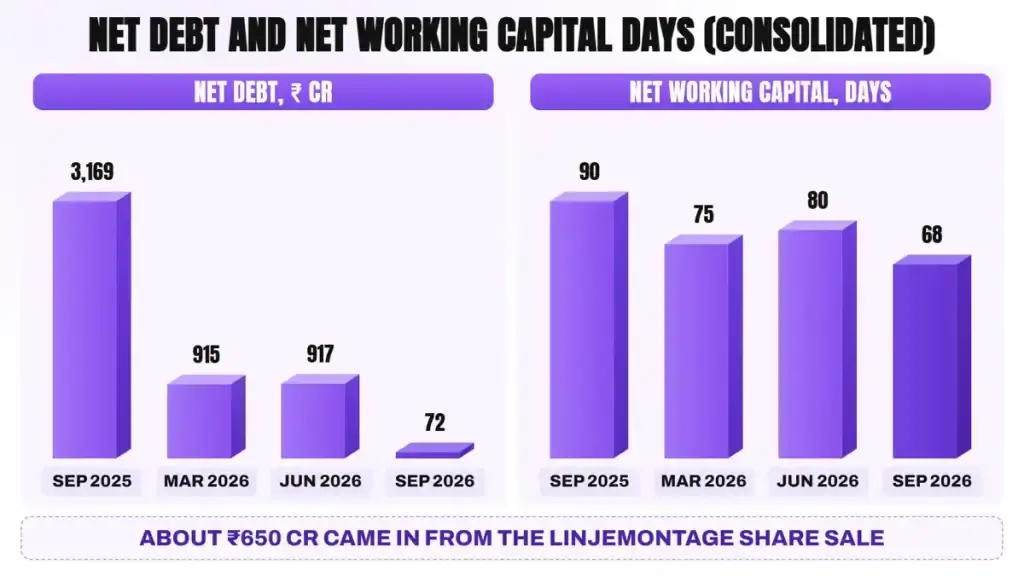
Working capital tells us how this happened. Net working capital days is the number of days of revenue tied up in receivables and inventory, after subtracting what the company owes its suppliers and the advances it has received. At the consolidated level, the figure fell to 68 days in September 2026, from 90 days a year earlier. Management says more of its new orders now come from private clients and funded projects that pay as soon as the work is billed, often with large advances at the start.
That change also reached the credit rating. In October 2026, CRISIL upgraded the company's long-term rating to AA+/Stable, and the company says India Ratings did the same. The return on capital employed was about 21% on a trailing twelve-month basis in September 2026. Even so, capex is not slowing yet: the company spent nearly ₹600 Cr on capex in H1 FY27, and expects about ₹500 Cr more in the second half.
The Orders Behind the Next Three Years
Now let's look at the orders, because in EPC they are the clearest guide to the next few years of revenue. The order book is the value of signed work not yet done. L1 means a tender where the company was the lowest bidder, so the order is likely but not yet signed.
At the end of September 2026 the order book was ₹71,846 Cr, up 11% from a year earlier. Between April and early November 2026 the company won new orders of ₹23,934 Cr: ₹17,940 Cr in the first half, and ₹5,994 Cr more in the third quarter so far. That is more than 60% higher than a year ago. It is also L1 or favourably placed in about ₹5,000 Cr of further projects.

That book has grown much faster than revenue. It was ₹32,761 Cr in March 2022 and ₹65,457 Cr in March 2026. In September 2026, the largest single addition was a letter of award for a gas pipeline project in the United Arab Emirates. The company classed it as a major order, which by its own definition means a value of over ₹4,000 Cr.
What the order book says: ₹71,846 Cr is about 2.6 times the ₹27,143 Cr of revenue in FY26. Management puts it at about two and a half years of revenue visibility, before counting the L1 positions.
That book's mix also matters. T&D was 41% of it in September 2026, at ₹29,389 Cr, and buildings and factories was 30%, at ₹21,659 Cr. Oil and gas was ₹8,196 Cr, water ₹6,702 Cr and railways and urban infrastructure ₹5,900 Cr. About 62% of the book is in India and 38% abroad. Management says close to 50% of the book is variable priced, which means the contract price moves with the cost of key materials. That shields part of the margin when steel, zinc or fuel prices rise.
Because new orders came in so fast, management raised its FY27 order inflow guidance on 6 November 2026, from ₹30,000 Cr to between ₹35,000 Cr and ₹36,000 Cr. In the third quarter so far, the company says it has bids of more than ₹15,000-20,000 Cr to submit in T&D in India within two months.
How a Tower Maker Became a Six-Business EPC Group
Now that we have seen the quarter, let's go back and see how a tower maker became a six-business EPC group. Kalpataru was set up by Mofatraj P. Munot, who is still its founder and non-executive chairman. Manish Mohnot is the managing director and CEO. For decades the company was known for transmission lines and towers. It built its own tower plants and set up a tower testing station in Gandhinagar that can test towers up to 800 kV.
That changed with JMC Projects, a civil construction company that was already its listed subsidiary. JMC built residential, commercial and institutional buildings, industrial projects and government infrastructure. It was merged into the company with an appointed date of 1 April 2022, and in 2023 Kalpataru Power Transmission changed its name to Kalpataru Projects International. That is how a transmission company ended up building housing towers and metro tunnels as well.
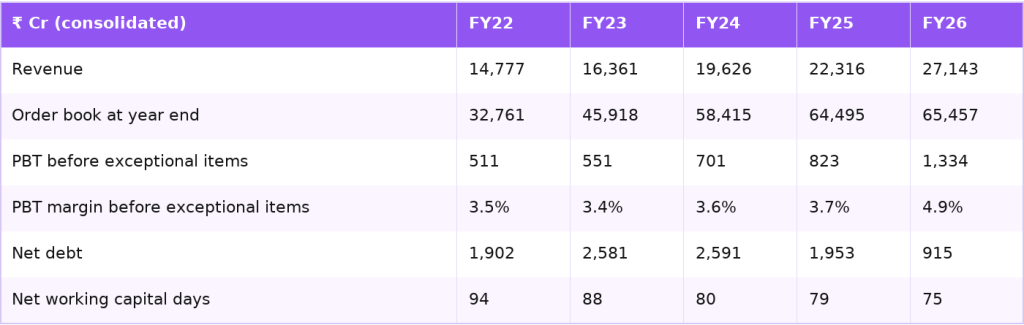
That merger made the company larger, but not more profitable at first. The PBT margin stayed between 3.4% and 3.7% from FY22 to FY25, and net debt rose to ₹2,591 Cr in FY24. Water projects under the Jal Jeevan Mission, the government's tap-water scheme for rural homes, tied up cash when payments from some states slowed. The company also took hits from its Brazilian subsidiary Fasttel, a Saudi project and its road assets.
"Only when the tide goes out do you discover who's been swimming naked."
— Warren Buffett
For Kalpataru, the tide went out in FY25, when water payments slowed and the projects abroad lost money. Those years showed which parts of the group needed fixing before the margin could rise.
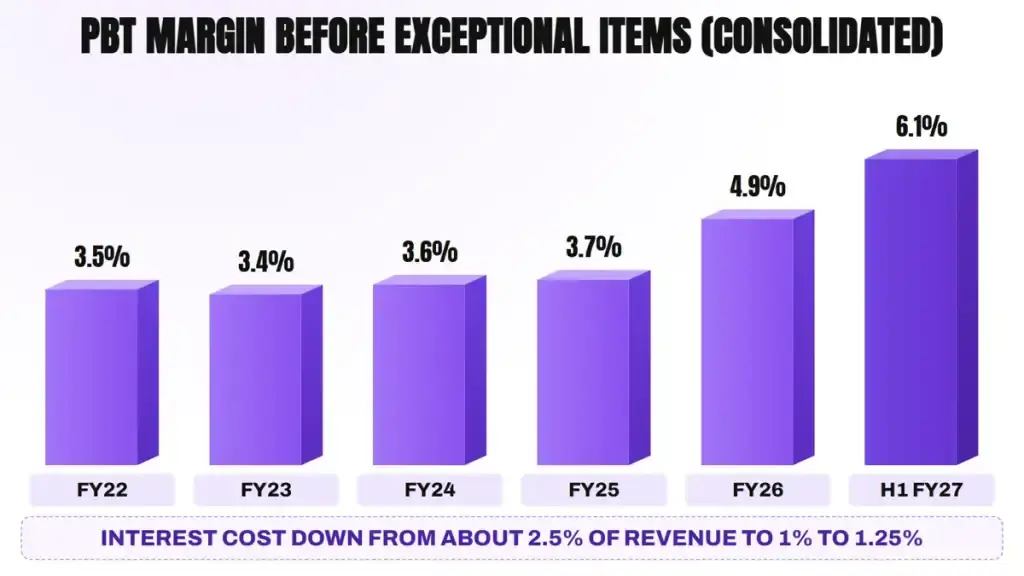
Then FY26 became the turning point. Revenue grew 22% to ₹27,143 Cr. The PBT margin before exceptional items rose to 4.9%, and profit after tax rose to ₹1,031 Cr from ₹567 Cr. Part of that clean-up was painful: the company closed all of Fasttel's projects and wrote off its investment there, a charge of ₹90.50 Cr in the consolidated accounts. Against that, it booked a gain of ₹156.56 Cr on selling the Vindhyachal Expressway, one of its road assets.
Also in that period, the balance sheet changed. In December 2024 the company raised about ₹1,000 Cr from investors through a share placement. Net debt fell to ₹915 Cr in March 2026, and to ₹72 Cr by September 2026 after the Linjemontage listing.
"Our focus is primarily on PBT because, from a leveraging perspective, we have very different philosophy as compared to the larger industry." - Manish Mohnot, Managing Director and CEO, November 2026
Six Businesses With One Construction Engine
Now let's split the business into its parts, because each one has a different client, margin and cash cycle. Read this Segment-Wise Revenue Analysis Explained The company reports six businesses, though from FY27 it shows railways and urban infrastructure together as infrastructure.

As we can see, these lines share one engine: the same engineering teams, the same owned equipment fleet and the same balance sheet. But as you will see, three of them are growing and two are being run more for cash. Management calls T&D, buildings and factories, and oil and gas its growth engines.

T&D, the Original Business
Let's start with T&D, still the largest business. It brought in ₹12,501 Cr of revenue in FY26, up 25%, which was about 46% of the total. That figure included ₹358 Cr from Fasttel in Brazil, which has now closed its projects. In H1 FY27, T&D revenue without Brazil grew 8% to ₹5,993 Cr.
That business covers transmission lines and substations, in India and abroad. The company has built more than 38,000 km of transmission lines and delivered 2.8 million tons of towers around the world. Its two plants have an installed capacity of 2,40,000 MT a year. Abroad, it is building a 600 kV HVDC line from Kimal to Lo Aguirre in Chile. HVDC, or high-voltage direct current, is the technology used to send very large amounts of power over long distances with less power lost on the way.
Its new orders have been strong too. T&D won ₹10,122 Cr of orders so far in FY27, and is favourably placed in about ₹5,000 Cr more. Management says nearly 65% of the T&D orders came from large Indian clients. In India, it expects the transmission market to be worth ₹1 trillion to ₹1.25 trillion a year for at least the next five years, including one or two HVDC projects each year.
Beyond India, part of this business is in Sweden. Linjemontage builds substations and power lines in Sweden and Norway, up to 400 kV. In H1 FY27 it had revenue of ₹1,472 Cr and an order book of ₹4,154 Cr. On 25 September 2026 it listed on Nasdaq Stockholm at SEK 46 a share, which valued the whole company at SEK 2,357 million. Kalpataru kept about 65.9% of it. Management expects little growth at Linjemontage in FY27, after a strong FY26, and says its EBITDA margin is around 8%.
So the company is also adding capacity to support this business. It announced a rolling mill at its Raipur plant in August 2026, as part of a wider push to make more of what it uses in-house.
Buildings and Factories, the Fastest Growing Business
Next, let's look at buildings and factories, the business that came from JMC. Revenue was ₹6,958 Cr in FY26, up 19%, and it grew 17% in H1 FY27 to ₹3,619 Cr. Its share of consolidated revenue rose to 27% in the first half. The business won about ₹8,000 Cr of orders so far in FY27, a record for it.
Those orders are large, as you can see from the sizes. Management says most of its building orders are now in the range of about ₹1,000 Cr each, and its bids are for housing projects of 8 to 12 million square feet. In FY26 it won its single largest order, a housing project of 14 million square feet. Nearly 50% of this portfolio is design-build, where the contractor also does the design, which gives it more control over cost and time.
These projects come from real-estate developers, industrial companies and airports. The company finished an airport in the Maldives, is working on Bagdogra airport, and is building data centres. It also won an industrial plant order in the metal sector in Q2 FY27, and management says state-owned metal companies and private steel makers are tendering more such work.
Oil and Gas, the Middle East Engine
Now let's move to oil and gas, the smallest of the three growth engines but the fastest-growing one. Revenue was ₹2,723 Cr in FY26, up 55%, and rose 58% in Q2 FY27 alone. The company lays cross-country pipelines and builds processing facilities, and has laid more than 12,200 km of pipelines. A large part of the recent growth came from a pipeline project in Saudi Arabia for Aramco.
Then the September 2026 award in the UAE took the oil and gas order book to ₹8,196 Cr. Management says it is now qualified in four or five large Middle East countries. That region is now 14% of the total order book, mostly oil and gas, with some T&D and a small water order.
Water, the Business Being Run for Cash
Next comes water, which has been the hardest business of the last two years. Revenue fell 8% to ₹2,112 Cr in FY26 and 5% in H1 FY27. Most of the work is Jal Jeevan Mission projects, where payments from several states have come in late.
Still, collections are now improving. The company collected close to ₹1,100 Cr in water between April and October 2026. It still has about ₹1,500 Cr to collect, billed and unbilled, and management says about two-thirds of that is overdue. Of the ₹6,700 Cr water order book, about ₹2,000 Cr is maintenance work spread over five to seven years. The company won its first water project in the Middle East in FY27 and says its new water growth will come mostly from abroad.
Railways and Urban Infrastructure
Finally, let's look at railways and urban infrastructure. In FY26 railways revenue was ₹1,113 Cr and urban infrastructure ₹1,158 Cr, up 49%. In railways the company is mostly finishing old projects. In urban infrastructure it builds elevated and underground metro lines, and all six of its tunnel boring machines are at work. The combined order book was ₹5,900 Cr in September 2026, and management sees it as a growth business over three years rather than right away.
Where Kalpataru Sits in the Power Value Chain
Now let's place Kalpataru in the wider power chain. Power is made at a coal, solar, wind, hydro or nuclear plant. It then has to travel, often hundreds of kilometres, over high-voltage lines to substations near cities, where it is stepped down for the local distribution network. Kalpataru's place is that middle part: it designs, supplies and builds the transmission lines and substations.
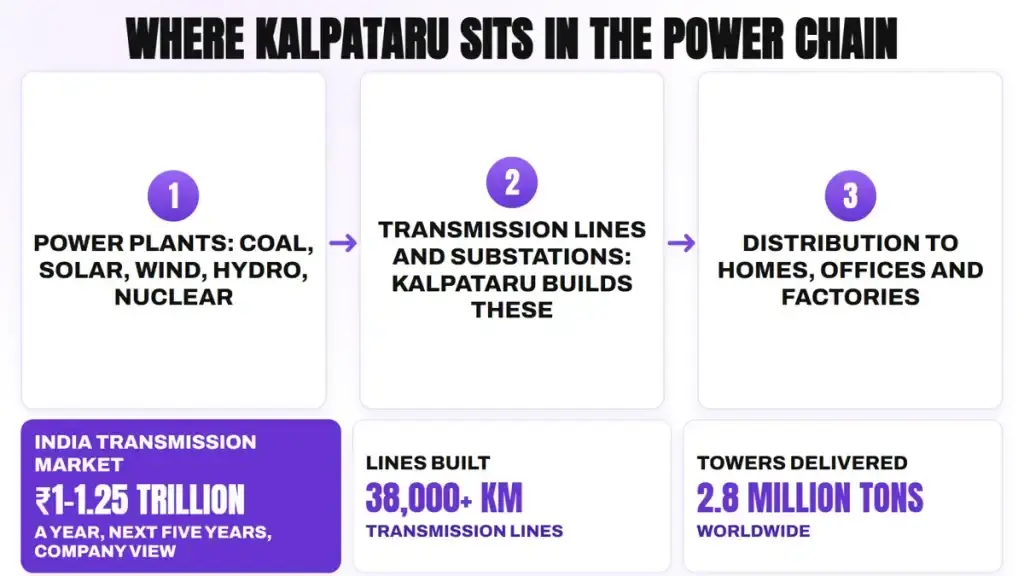
That part of the chain is getting more work because of how India's power mix is changing. Solar and wind plants are often built far from the cities that use the power, so each new renewable park needs new lines to carry its power. Management expects the Indian transmission market to stay at ₹1 trillion to ₹1.25 trillion a year for at least five years. It also says lack of grid capacity is now a bottleneck in Europe, the Middle East and parts of South America.
So in this chain, Kalpataru both buys and makes. It makes its own towers and steel structures, and tests them. It buys conductors, transformers, insulators and other equipment from other makers. Its clients are the owners of the lines: state and central transmission utilities, private companies that win transmission projects through tariff-based bidding, and utilities abroad such as those in the Nordics and Latin America.
Beyond lines, the T&D business also reaches into newer areas of the grid. Its offerings now include solar EPC, battery energy storage systems (BESS), underground cabling and green hydrogen works. And outside power, its buildings business is building data centres, which themselves need large and reliable power connections.
Why Kalpataru's Moat Is Hard to Copy
Now that we have seen the businesses, let's understand the moat. Many companies can build a building or lay a line. So the question is why a utility or a developer should hand a ₹1,000 Cr project to Kalpataru and not to a smaller, cheaper contractor. Read this Economic Moat Explained
One part of the moat is the record. Large EPC tenders, in India and abroad, ask bidders to show similar projects they have already finished. Kalpataru has built more than 38,000 km of lines, more than 12,200 km of pipelines and more than 9,000 track km of railway electrification. That record lets it qualify for tenders that newer firms cannot bid for, and it is now qualified for large oil and gas projects in several Middle East countries.
Another layer comes from owning the means of production. The company makes its own towers, with an installed capacity of 2,40,000 MT a year, and tests them at its own station. It owns a large fleet of equipment, including tunnel boring machines and horizontal drilling machines, and has invested close to ₹3,000 Cr in capex over the five years to FY26. That gives it more control over the time and cost of each project, which matters most on a fixed-price contract.
Beyond the record and the assets, size adds a third layer. Management says its average project is now worth more than ₹500 Cr, which has doubled in two years. Nearly 50% of the orders booked in FY26 were above ₹1,000 Cr each. In large, complex projects there are fewer bidders, and clients care more about delivery than price.
"In business, I look for economic castles protected by unbreachable moats."
— Warren Buffett
An EPC contractor's castle is its record of finished projects, its own tower plants and its equipment fleet. The question for Kalpataru is whether that record keeps winning large orders at prices that hold the margin.

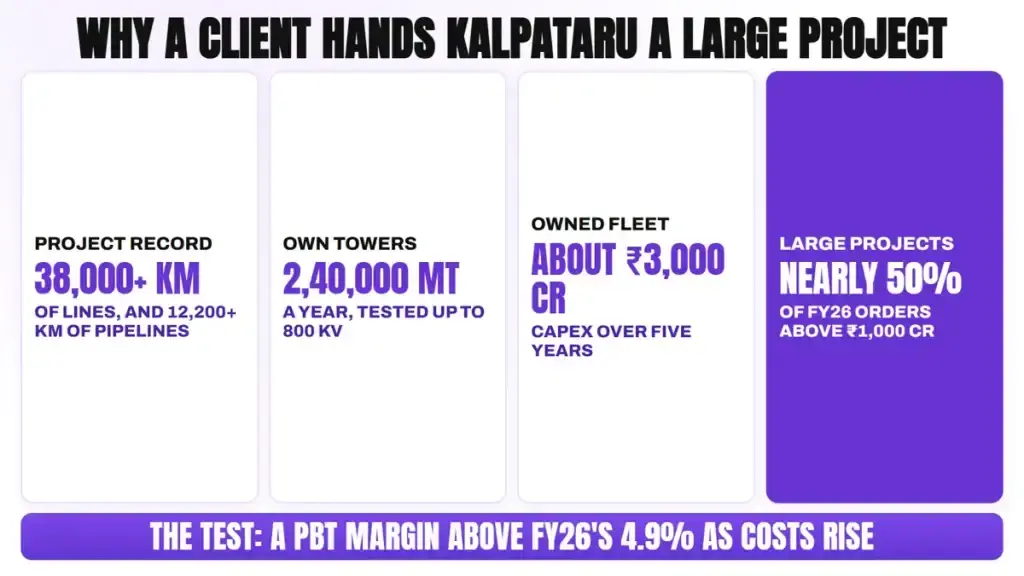
That table also shows the limits of the moat. EPC is still a business of thin margins. Even after the recent gains, the core EBITDA margin was 8.3% in Q2 FY27. Management itself says it does not expect the EBITDA margin of its three growth businesses to rise much from about 9.5% to 12%. So the moat shows up less in a wider margin and more in steadier orders, better cash flow and fewer problem projects.
Financials: Five Years of Revenue, Margins and Cash Flow
One quarter can mislead in a business where projects run for two to three years, so let's look at the full years together. All figures are consolidated, as reported in the company's latest annual report; EBITDA here is the company's core EBITDA, before other income.

Revenue grew about 1.8 times in four years, from ₹14,777 Cr in FY22 to ₹27,143 Cr in FY26, and profit after tax grew about 1.9 times, from ₹535 Cr to ₹1,031 Cr. The EBITDA margin barely moved, staying between 8.2% and 8.6%. So the profit gain came from below the EBITDA line: lower interest cost, fewer losses in problem projects, and in FY26 a gain on selling a road asset that more than covered the Fasttel write-off.
Cash flow has run ahead of profit. From FY22 to FY26, operating cash flow added up to about ₹4,661 Cr, against ₹3,084 Cr of profit after tax, or about 1.5 times. It was lowest at ₹656 Cr in FY23 and highest at ₹1,534 Cr in FY26, when net working capital came down to 75 days.
The balance sheet followed the cash. Net debt was ₹1,902 Cr in FY22 and peaked at ₹2,591 Cr in FY24, before falling to ₹915 Cr in FY26 and ₹72 Cr in September 2026. Return on capital employed rose from 16.4% in FY22 to 21.4% in FY26. The next test is whether that cash discipline holds while capex runs above ₹1,000 Cr a year.
"The first rule of compounding: Never interrupt it unnecessarily."
— Charlie Munger
For an EPC company, the things that interrupt compounding are bad projects, stuck payments and heavy debt. Kalpataru's last two years have been about removing all three.
What FY27 and FY28 Could Look Like on Management's Numbers
So where does the business go from here? On 6 November 2026 management repeated its target of 15% revenue growth for FY27 and said it expects consolidated revenue of close to ₹28,000-30,000 Cr for the year. It also said that, over the next three to four years, reaching revenue of about ₹50,000 Cr should not be a challenge with the capacity it has built.
Now let's put that range against the first half. H1 FY27 revenue was ₹13,412 Cr. Reaching ₹28,000 Cr needs about ₹14,588 Cr in the second half, roughly the same as the ₹14,443 Cr of H2 FY26. Reaching ₹30,000 Cr needs about ₹16,588 Cr, about 15% more. So the lower end of the range looks easy on this order book, and the upper end needs the second half to grow at the same pace as the first half's comparable revenue, or faster.

Beyond revenue, management gives several other markers. It expects net working capital to stay around 65 to 68 days at the consolidated level, and around 80 to 82 days on a standalone basis at year end. It expects FY27 capex of more than ₹1,000 Cr, and lower capex from FY28 onwards. And it says the PBT margin for FY27 should beat its guidance of a 75 basis point rise, though it has not raised that number.
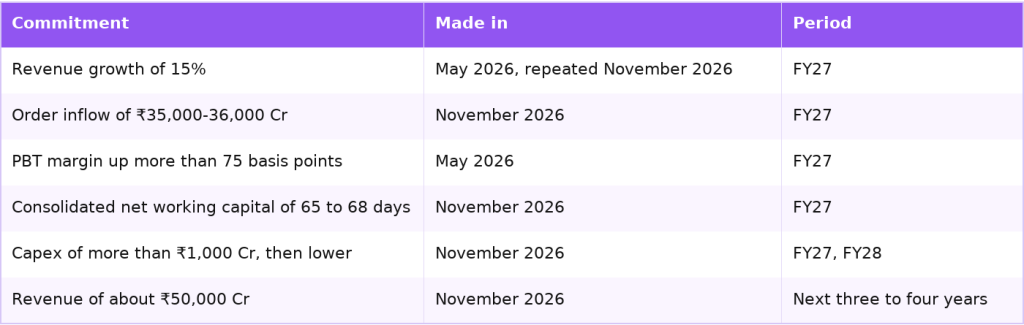
Those commitments are easier to judge against the past. So let's check what management said before against what it delivered.
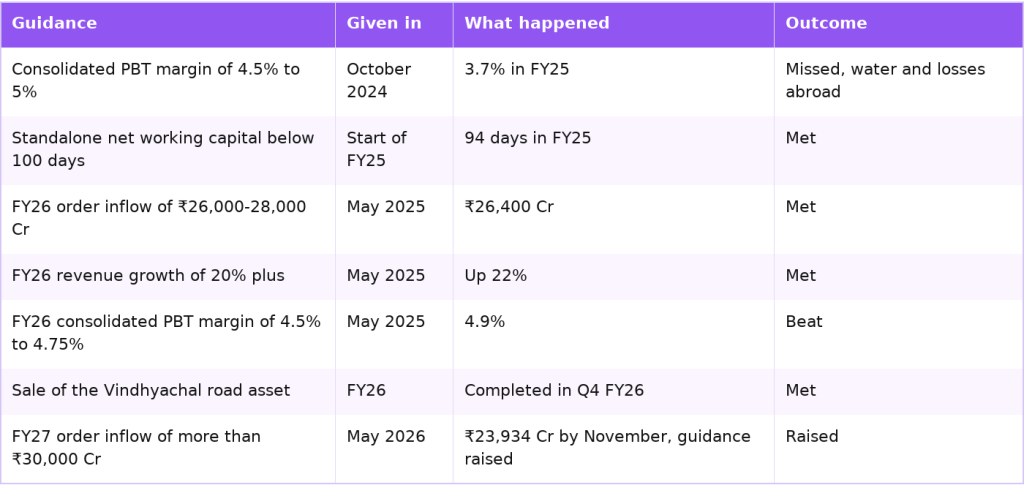
That record shows us a clear pattern, and you can see it in the table. FY25 was a miss, mainly because of water and the problem projects abroad. Since then management has met or beaten each number it gave for FY26, and it has already raised one FY27 number. The margin and the water collections are the two places where the record is still being built.
Key Risks
Now let's look at what could go wrong for Kalpataru, because some of these risks have already shown up in the last two years.
- Water receivables: about ₹1,500 Cr is still to be collected in water, and about two-thirds of it is overdue. If state payments slow again, cash and working capital would suffer.
- Middle East conflict: the company says the conflict has raised freight and fuel costs and caused supply-chain problems and some delays in Saudi Arabia. The Middle East is 14% of the order book, and the new UAE pipeline adds to that.
- Fixed-price contracts: about half the order book is variable priced, so the other half is not. A sharp rise in steel, zinc, fuel or labour costs would hit those projects. Management says a further rise of 20% to 30% in costs from here would change that picture.
- Thin core margin: the core EBITDA margin was 8.3% in Q2 FY27. Much of the PBT gain has come from lower interest cost, and that lever gets smaller as debt nears zero.
- Capex and working capital: capex is set to be more than ₹1,000 Cr in FY27. Management says debt may rise again with working capital needs and capex payments, and that working capital days could be a little higher in Q3.
- Projects abroad: 38% of the order book is outside India. The Fasttel write-off in FY26 showed what a bad foreign venture can cost.
- Tax and legal claims: disputed demands from tax and other authorities stood at ₹170.01 Cr in March 2026, against ₹315.92 Cr a year earlier. A road joint venture is also appealing a court order that partly set aside an arbitration award.
- Linjemontage: management expects a flat year for its Swedish subsidiary in FY27 and an EBITDA margin of about 8%, with growth coming back later.
"There are issues on supply chain, there are issues on increased freight costs, which a lot of clients are ready to reimburse." - Manish Mohnot, Managing Director and CEO, November 2026
"The essence of investment management is the management of risks, not the management of returns."
— Benjamin Graham
Kalpataru's returns depend on thin margins over very large projects, so a few bad contracts or slow payments can undo a lot of good work. The list below sets out where that could happen.
Explore our Products
Research Framework

Emerging Titans
Combination of quantitative analysis, industry tailwinds, and management assessment - SPRINT investment philosophy

Tiny Titans
Heavy emphasis on scuttlebutt research, plant visits, and early on-ground signals
What to Track Next
If you follow Kalpataru, these are the signals that will show where it goes next.
- FY27 revenue against the ₹28,000-30,000 Cr range, and the comparable growth against 15%
- The PBT margin against FY26's 4.9%, and the core EBITDA margin after 8.3%
- New orders against the ₹35,000-36,000 Cr guidance, and the order book after ₹71,846 Cr
- Net debt after ₹72 Cr, and net working capital against 65 to 68 days
- Water collections against the ₹1,500 Cr still to be received
- Execution of the UAE pipeline and the Saudi projects, and new HVDC awards in India
For the other listed power companies, from generation to transmission and distribution, see Power Sector Stocks in India 2026: List by Value Chain.
Compare: see how it measures up against its peers in Kalpataru Projects vs KEC International: T&D EPC Compared, a side-by-side look at order books, margins and balance sheets.
Conclusion
Let's put it all together. Kalpataru Projects has grown revenue from ₹14,777 Cr in FY22 to ₹27,143 Cr in FY26, and its order book from ₹32,761 Cr to ₹71,846 Cr in September 2026. In the last year it has cut net debt from ₹3,169 Cr to ₹72 Cr and lifted its first-half PBT margin to 6.1%, as interest cost fell and working capital improved. The cautious thread is the core EBITDA margin, still about 8.3%, and the ₹1,500 Cr of water money still to come in. The next two quarters will show whether the PBT gains hold as costs rise in the Middle East.
Still, the next step depends on how well that book is built and run. What happens next depends on whether the growth businesses keep winning large orders at good prices, whether the water money comes in, and whether the margin holds as the Middle East and fixed-price projects face rising costs.
FAQs
What does Kalpataru Projects International do?
+Kalpataru Projects is an EPC contractor: it designs, buys the materials for and builds large projects for their owners. It works in six businesses: power transmission and distribution, buildings and factories, oil and gas, water, railways and urban infrastructure, in India and abroad. FY26 consolidated revenue was ₹27,143 Cr.
How did Kalpataru Projects do in Q2 FY27?
+Consolidated revenue was ₹7,004 Cr, up 7%, or up 13% leaving out the road and Brazil businesses that have been sold or wound down. Profit before tax rose 24% to ₹398 Cr and profit after tax rose 23% to ₹292 Cr, helped by a fall in finance cost to ₹90 Cr from ₹136 Cr.
What is Kalpataru Projects' order book?
+The consolidated order book was ₹71,846 Cr in September 2026, up 11% from a year earlier and about 2.6 times FY26 revenue. T&D made up 41% of it and buildings and factories 30%. The company had won ₹23,934 Cr of new orders in FY27 by early November, with about ₹5,000 Cr more in L1 positions.
Where does Kalpataru fit in the power value chain?
+Kalpataru builds the transmission lines and substations that carry power from power plants to cities, in India and abroad. It makes its own transmission towers at two plants with 2,40,000 MT a year of capacity, and owns about 65.9% of Linjemontage, a Swedish grid contractor. It does not make or sell electricity.
What has Kalpataru guided for FY27?
+Management targets 15% revenue growth and expects consolidated revenue of close to ₹28,000-30,000 Cr in FY27. It raised its FY27 order inflow guidance to ₹35,000-36,000 Cr from ₹30,000 Cr, and expects the PBT margin to rise by more than 75 basis points over FY26.
What are the main risks for Kalpataru Projects?
+About ₹1,500 Cr is still to be collected in the water business, and about two-thirds of it is overdue. The Middle East conflict has raised freight and fuel costs, and about half the order book is fixed price. The core EBITDA margin was 8.3% in Q2 FY27, and 38% of the order book is outside India.

High growth stock specialist, Value Educator
Shashank Mahajan is an equity research professional with over 12 years of experience in identifying high-potential SME and micro-cap stocks at an early stage. He follows a rigorous scuttlebutt research–driven approach, combining on-ground insights with deep financial analysis. Shashank specializes in uncovering under-researched and under-owned companies with strong management quality and long-term growth potential. Through disciplined research and early identification, he focuses on spotting tomorrow’s market leaders before they enter the mainstream investor radar.
More about Shashank Mahajan →
PCBL Chemical: Carbon Black Margins and Battery Materials

KEC International: Record Orders, Weak Margin, High Debt

Sona BLW: EV Revenue Now Tops Half of Its Auto Sales

HPL Electric & Power: Smart Meters, Wires and Two Engines

Kaynes Technology: EMS, Chip Plants and ₹10,563.5 Cr Orders

Sterlite Technologies: Glass Rods to Hyperscaler Deals
Explore our Products
Research Framework
Emerging Titans
Combination of quantitative analysis, industry tailwinds, and management assessment - SPRINT investment philosophy
Tiny Titans
Heavy emphasis on scuttlebutt research, plant visits, and early on-ground signals



India's Aerospace Opportunity
Global Demand. Supply Bottlenecks. Opportunities Ahead.
Don't Miss This Exclusive Webinar!
Join Value Educator to decode the key trends shaping India's aerospace sector and learn how to identify tomorrow's potential leaders in the space.
- How the aircraft value chain works, layer by layer
- Indian companies supplying global aircraft makers
- A framework to judge any aerospace company

 Orders
 Subscription
 Share with friends


Required Details
₹23999.00
(12 month subscription)
As per SEBI regulations, all users are mandated to complete the KYC that is validated for 1 year. Post payment, you will be redirected to the KYC screen


No comments yet. Be the first to comment!