
Kirloskar Oil Engines: Data Centres, Nuclear and the Navy
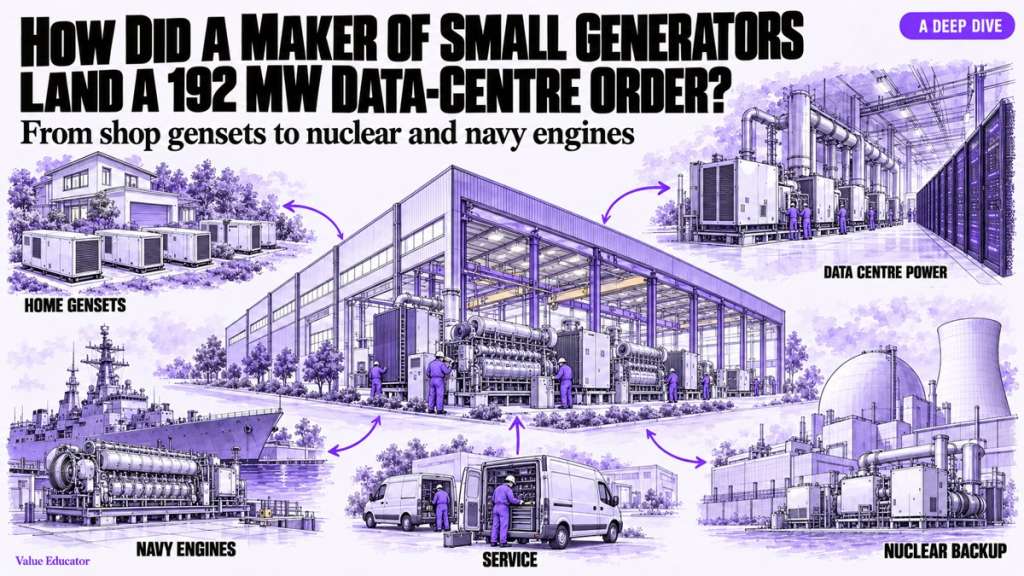
In the April to June quarter of 2026, a Pune company that has made diesel engines since 1946 won its first order from a hyperscale data centre, for about 192 MW of backup power. That is a big step for a company best known for the generators that stand outside Indian shops, homes, hospitals and offices. It came as India's demand for backup power keeps rising. In FY26, the country's diesel generator market grew 18% to about 1,79,000 units, including telecom towers.
A genset is a generator set: an engine joined to an alternator, which makes electricity when the grid fails. Its size is given in kVA, which stands for kilo-volt-amperes, a unit of electrical capacity. The smallest sets, below 30 kVA, serve shops and homes and form India's largest genset segment. A data centre, by contrast, needs rows of large sets of 1,500 kVA or more, ready to start within seconds.
Those large sets run on engines called HHP, or high-horsepower, engines. They are harder to make and harder to sell, because buyers such as data centres and utilities test a supplier for years before trusting it with critical power. That is where this company has been pushing hardest, and where you can see its market share grow fastest.
That company is Kirloskar Oil Engines Ltd (NSE: KIRLOSENG), or KOEL. It makes engines and gensets for power generation, engines for construction, railway, marine and defence equipment, and spare parts and service for all of them. Through subsidiaries, it also makes water pumps and runs a lending business called Arka. In FY26, its consolidated revenue rose 22% to ₹7,701 Cr.
Its customer list now reaches well beyond shops and offices. KOEL is building ten 6.3 MW gensets for the Nuclear Power Corporation of India (NPCIL), and it is developing a marine propulsion engine for the Indian Navy. It sold upwards of 50,000 gensets in FY26, and its management wants the group to reach $2 billion of revenue by FY30.

Kirloskar Oil Engines in five numbers
- Q1 FY27 standalone sales of ₹1,461.4 Cr, up 16% from a year ago
- A first hyperscale data-centre order of about 192 MW
- FY26 standalone EBITDA of ₹737 Cr, at a 13.1% margin
- Standalone net cash of ₹485 Cr at the end of June 2026
- ₹1,400 Cr of new engine capacity planned at Kagal, after ₹700 Cr already under way
So the big order arrived in a quarter when the margin moved the other way. Let's first understand the company, and then look at that latest quarter.
Kirloskar Oil Engines: Company Overview
Kirloskar Oil Engines Ltd, or KOEL, is a Pune company in the Kirloskar Group, whose engine business was set up in 1946 to make diesel engines. Rahul C. Kirloskar is chairman, Gauri Kirloskar is vice chairperson and managing director, and Rahul Sahai is chief executive. It makes engines and gensets for power generation, engines for construction, rail, marine and defence equipment, and spare parts and service for all of them. Through subsidiaries, it also makes pumps and runs a lending business, Arka Fincap. Its factories are at Pune, Kagal, Nashik and Bhare, and the company had 2,298 permanent employees in FY26. In FY26, standalone net sales were ₹5,604 Cr and group revenue ₹7,701 Cr, and the engine company carried only ₹104 Cr of loans against ₹3,354 Cr of shareholders' funds. Read this TD Power: 93% of New Orders Now Come From Abroad
"Behind every stock is a company. Find out what it's doing."
— Peter Lynch
For KOEL, what it is doing has changed. The maker of small shop and home gensets now also builds large engines for data centres, a nuclear plant and the Navy.
A Strong Quarter at Home, a Slower One Abroad
Let's look at Q1 FY27, the April to June quarter. Standalone sales, which cover the engine business without pumps or lending, rose 16% to ₹1,461.4 Cr from ₹1,262 Cr a year ago. Every domestic business grew by double digits at home: power generation by 18% to ₹720 Cr, industrial by 19% to ₹368 Cr, and distribution and aftermarket by 20% to ₹268 Cr.
International sales were the exception. They came in at ₹106 Cr against ₹120 Cr a year ago, as fighting in West Asia clogged shipping routes to the Middle East, the company's largest export region. Management said that even where it had orders, some deliveries could not be completed in the quarter.

But profit moved the other way from sales. EBITDA was ₹165.5 Cr against ₹171.6 Cr, so the margin came in at 11.2% against 13.5% a year ago, and profit from continuing operations was ₹99.3 Cr against ₹109.5 Cr. Its management named three causes: lower export volumes, higher commodity costs, and the gap between paying higher costs now and collecting higher prices later.
Those costs show up clearly when we do the arithmetic. Raw materials took about 66.1% of sales against about 65.5% a year ago, so the gross margin was about 33.9% against about 34.5%. The larger change was in people. Employee costs rose to ₹111 Cr from ₹79.8 Cr, about ₹31 Cr more, which the CFO put down to annual raises, stock options for high performers and new hires for future programmes. He said some of that cost is permanent and some is a matter of timing.
Why the margin moved the other way from sales: costs rose first and prices follow later. Raw materials took about 66.1% of sales against about 65.5%, employee costs rose by about ₹31 Cr, and export volumes were lower. Management expects its price increases to flow through over the coming quarters.
Those price increases are now catching up. Management said it has raised prices across nearly all its businesses, but each one resets at a different pace. Its products sold through dealers take the increase quickly, while industrial customers have contracts and tenders of their own.
"The single most important decision in evaluating a business is pricing power."
— Warren Buffett
For KOEL, Q1 FY27 tests that power. Dealer prices reset quickly, and the coming quarters will show how fast contract customers accept the higher costs. It expects profitability to improve as these increases flow through over the coming quarters, and it said it remains committed to its EBITDA delivery for the full year.
At the group level, revenue from operations rose 13% to ₹1,999.5 Cr, and profit from continuing operations was ₹111.1 Cr against ₹134.2 Cr. The engine business (B2B) earned a segment result of ₹114.6 Cr on revenue of ₹1,488.4 Cr. Pumps (B2C) earned ₹25.8 Cr on ₹301 Cr, and Arka ₹9.4 Cr on ₹210.2 Cr.

That group picture also shows a strong balance sheet. Its standalone net cash, after debt and including treasury investments, was ₹485 Cr at the end of June, against ₹552 Cr in March. Its inventory rose to ₹820 Cr from ₹603 Cr over the same three months, as the company stocked up for growth. Read this Inventory Turnover Ratio Explained
FY26 Was a Record Year
Let's step back to the year before, FY26, a record year for KOEL. Standalone net sales rose 25% to ₹5,604 Cr, EBITDA rose 33% to ₹737 Cr, and the EBITDA margin improved to 13.1% from 12.2%. Profit from continuing operations, before one-off items, rose 35% to ₹464 Cr.
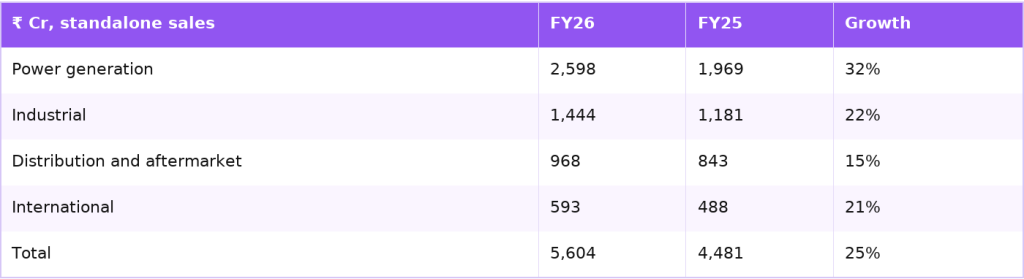
That growth came mainly from India. Its domestic sales were ₹5,047 Cr, or 90% of the total, and exports ₹557 Cr. The fourth quarter alone brought standalone sales of ₹1,522 Cr, the highest in the company's history, with power generation up 30% on the same quarter a year earlier.
That growth is part of a steady climb over a longer stretch. Standalone net sales rose from ₹2,614 Cr in FY17 to ₹5,604 Cr in FY26, even though the FY26 figure no longer includes the pumps business, which moved into a subsidiary in October 2025. Profit after tax rose from ₹174 Cr to ₹441 Cr over the same years.

From a 1946 Engine Company to a $2 Billion Goal
That long climb began well before FY17, so let's go back to where KOEL started. The Kirloskar Group traces its start back more than 137 years, to a bicycle repair shop in Belgaum that Laxmanrao Kirloskar turned into a workshop making iron ploughs. That group's engine company was set up in 1946 to make diesel engines.
Its present shape took form much later. The Kagal plant, now the centre of its expansion, started in 2010. At the start of FY23, the company set out a three-year plan to double in size, which it called 2X-3Y. In 2023, it moved its gensets to the stricter CPCB IV+ emission norms and bought the pump maker La-Gajjar Machineries.
Those steps sped up after that. In 2024, KOEL launched its Optiprime gensets, won the NPCIL order and bought Wildcat Power Gen of Wichita, Kansas, through its US arm, Kirloskar Americas. In 2025, it set up a subsidiary in the UAE, developed a 6 MW marine diesel engine for the Indian Navy and announced ₹700 Cr of new capacity at Kagal.
That pace has carried into 2026. KOEL moved its pumps business into a subsidiary, KOEL Fluid Dynamics, and set up a defence subsidiary, Kirloskar Advanced Systems. It also announced a further ₹1,400 Cr for a new engine building at Kagal.
That doubling plan is worth checking, and management has been open about how it went. At its end, managing director Gauri Kirloskar said the biggest gap was international business, which the plan had expected to reach 30% of revenue. International sales almost doubled over those three years, she said, but she had underrated how little buyers abroad knew the brand. In FY26, international made up 11% of standalone sales.
"I have always believed that growth must be sustainable. It cannot come at a cost of profitability or for the sake of short-term benefits." - Gauri Kirloskar, Kirloskar Oil Engines
Even so, the next plan is bigger. Called 2B, it aims for $2 billion of revenue by FY30, which the CFO put at close to ₹16,600 Cr. Against FY26 consolidated revenue of ₹7,701 Cr, that target is about 2.2 times, or growth of about 21% a year for four years by our arithmetic. Its lending arm, Arka, has a separate goal of its own, which is not part of this figure.
That plan is run by a team built over the last few years. Gauri Kirloskar has been managing director through the doubling plan and became vice chairperson in April 2026, when Rahul C. Kirloskar took over as chairman. Alongside her, Rahul Sahai is chief executive and Sachin Kejriwal is chief financial officer, and both present the results every quarter.
Four Engine Businesses, Plus Pumps and Lending
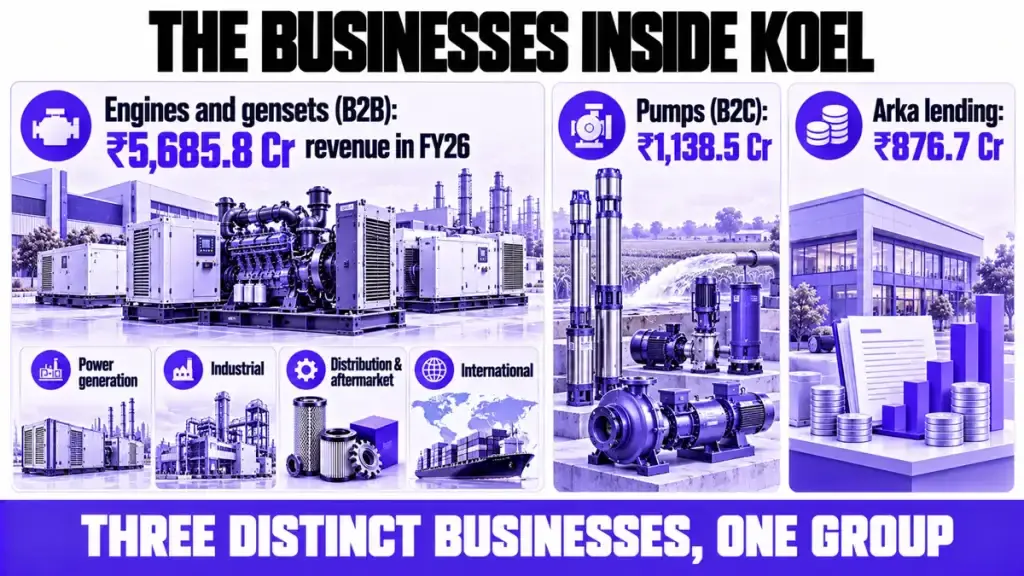
Now let's see how the businesses fit together. KOEL reports three segments in its group accounts: the engine business (B2B), the pumps business (B2C) and Arka's lending. Read this Segment-Wise Revenue Analysis Explained Inside the engine business, it tracks four units: power generation, industrial, distribution and aftermarket, and international.
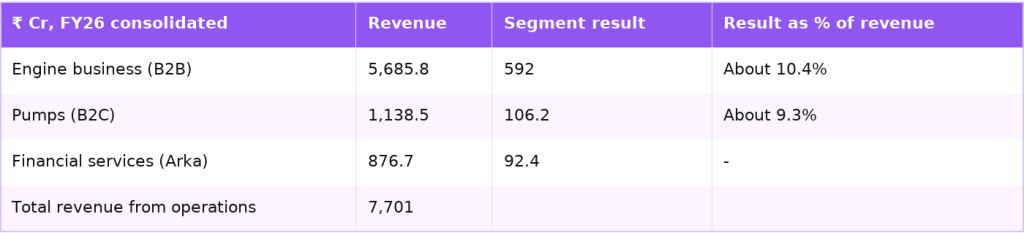
The engine business carries the group. It gave about 74% of FY26 revenue by our arithmetic, and its segment result, before interest and tax, rose 28% to ₹592 Cr. Arka's result is shown after its own interest cost, so its margin is not comparable with the other two.
Power Generation
Let's start with power generation, the largest unit, with FY26 sales of ₹2,598 Cr, up 32%, and 49% of standalone sales in Q1 FY27. It sells gensets from the smallest home sets to large units for hospitals, factories, data centres and infrastructure.
Most of its volume still comes from the small end. Over the last year, KOEL has redesigned its range below 30 kVA, India's largest genset segment, into a family covering several customer types, technologies and price points. Management says this has strengthened its position in that segment and helped its domestic share rise.
The larger nodes are newer for KOEL. Its share of the HHP market was negligible a couple of years ago and is now approaching double digits, management says. In the October to December 2025 quarter, its HHP sales grew 235%, and domestic power generation sales rose 44% to ₹603 Cr.

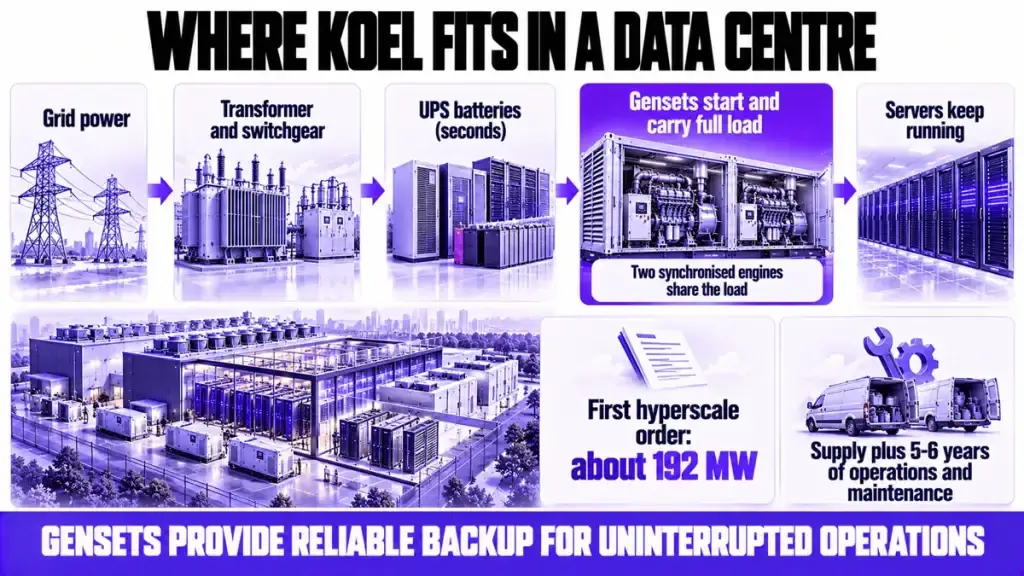
That push depends on one product above all. Optiprime is KOEL's patented twin-hybrid genset, which joins two synchronised engines inside one compact enclosure and shares the load between them. If one engine is being serviced, the other carries the critical load, which is what data centres and hospitals want. Its sales reached a few hundred Optiprime units in FY26, with sets of up to 3,000 kVA.
Those orders show that range in use. In the July to September 2025 quarter, the business won several 1,500 kVA orders and orders of 2,000 kVA and 2,500 kVA. Power generation sales reached a then-record ₹678 Cr that quarter, up 41%. KOEL's engineers also built a 1,250 kVA product family for premium, mission-critical power.
Data Centres
Now we come to data centres, and the order that made news in Q1 FY27. KOEL won its first order from a hyperscale data centre, for about 192 MW of backup power. The CFO called it a reference point rather than an endpoint, and said the first job is to execute it well.
That contract has two parts. KOEL will supply the gensets, with that revenue recognised within FY27, and it will run operations and maintenance for at least five to six years. That second part gives it a stream of service revenue after the sale.
That order did not come out of nowhere. Its management says it has already supplied gensets to many edge and enterprise data centres and is in talks with most data-centre operators in India. For data centres, its largest single engine today is rated at 1,650 kVA, and it plans to go higher.
That market is still young in India. By KOEL's count, India hosts less than 5% of the world's data centres, even as companies invest heavily in new capacity. A data centre cannot go dark when the grid trips, so it needs backup sized for its full load, and every new building is also a genset order.
Its pitch to these buyers covers more than one product. Its list includes behind-the-meter power, hybrid solutions and Optiprime. It said Optiprime, though designed for AI data centres, also suits microgrids, industrial prime power and utilities, where loads change quickly.
Industrial
Next, let's look at the industrial unit, which sells engines that go inside other companies' machines, from excavators and compressors to rail vehicles, ships and defence equipment. Its FY26 sales rose 22% to ₹1,444 Cr, and in Q1 FY27 it grew 19% at home.
Its construction business shows how sticky this work is. In January 2025, construction equipment moved from the CEV BS-IV to the CEV BS-V emission standard. Each such change lets equipment makers switch engine suppliers, and winning one takes site approvals and prototype tests that often run for 18 months or more. KOEL's construction sales grew 44% in Q4 FY26 under the new standard.
Beyond construction, rail and marine are newer growth lines. In Q1 FY27, marine sales grew 125% and railway sales 62%. Management said both depend on how programmes are billed, and that once an engine is qualified, these customers stay for a long product life and buy spares and service. KOEL also launched a 400-horsepower engine for railway track-maintenance vehicles.
After them, oil and gas is the newest line. In Q1 FY27, KOEL won what it called a landmark order from the oil and gas segment for natural-gas gensets of up to 500 kVA. Management says it has one of the largest ranges of gas gensets that meet CPCB IV norms, running on biogas, wellhead gas, piped natural gas and, in smaller sizes, LPG.
Beyond oil and gas, defence is the longest-term bet. KOEL submitted the detailed design for the Indian Navy's Make 1 programme in 2025, and its marine propulsion prototype is on schedule. It is the company's largest and most technically demanding naval work so far, management says. Success could lead to a long supply relationship for the Navy's main propulsion engines, and KOEL set up Kirloskar Advanced Systems to focus on defence and systems integration.
The Nuclear Order
Within industrial, we should look closely at the nuclear order, the clearest sign of how far KOEL has moved up. It covers ten gensets of 6.3 MW each, or about 8,000 kVA a set, for the Kudankulam nuclear plant. The order was worth ₹768 Cr when it was won in 2024, with a 68-month execution programme, and the latest annual report puts its value at ₹798 Cr.
These are not ordinary gensets. They may sit idle for years, then must start within seconds and carry full load. KOEL makes them at a Nashik facility certified for nuclear-grade manufacturing, with records that trace every part from raw material to commissioning.
That work is billed on milestones. There was no revenue from the order in Q1 FY27, some will come in FY27 and the rest in later years, and management says it is on track to finish by 2029.
Distribution and Aftermarket
Now let's turn to distribution and aftermarket, the unit that sells spares, service contracts, oil, batteries and replacement engines to the owners of KOEL's installed base. Its FY26 sales rose 15% to ₹968 Cr, and it grew 20% in Q1 FY27. It has grown by double digits in every quarter for the last 12 quarters, management says.
This business grows only where machines are already installed. Gauri Kirloskar called it the truest measure of the franchise, because it depends on a large base and customers choosing to come back. Service requests reached an all-time high of about 92,000 in the July to September 2025 quarter, and in several cases KOEL now offers a 2-hour service response guarantee.
That base keeps growing with every set sold. Each of the 50,000-plus gensets KOEL sold in FY26 will need oil, filters, batteries and service for years, so today's genset sales become tomorrow's aftermarket revenue.
That aftermarket unit is also moving into larger work. In Q1 FY27, it completed its first turnkey repowering of a high-horsepower installation, a 1,010 kVA set won in direct competition. Its management describes the shift as moving from a parts supplier to a manager of the whole life of each machine, with more customers on annual maintenance contracts.
International
Let's look abroad next. International sales rose 21% to ₹593 Cr in FY26 on a standalone basis, and the group's gross international business crossed ₹1,000 Cr. The Middle East and North Africa gave about 60% of international sales in the July to September 2025 quarter.
Management draws a line between exports and being international. Exporting means making goods in India and shipping them to an agent, while being international means hiring locally, setting up offices and, where it pays, assembling locally. KOEL has subsidiaries in the US and the UAE, and set up one in the Netherlands in 2026 to hold its overseas business.
That push hit a slower patch in Q1 FY27, when shipping queues to the Middle East backed up. Management said the queues were opening again and that three to six months was a reasonable time for things to return to normal.
The Pumps Business
The pumps business, now KOEL Fluid Dynamics, makes engine-driven and electric pumps for farms, homes and buildings. KOEL sold over 1 million pumps in FY26. Segment revenue rose 12% to ₹1,138.5 Cr, and the segment result rose 63% to ₹106.2 Cr from ₹65.3 Cr.
That business has been rebuilt over two years. Five plants near Ahmedabad were folded into one site at Sanand, and in Q4 FY26 it launched eight new products. In Q1 FY27, revenue grew 3% to ₹301 Cr as exports eased, but borrowings were cut from ₹167 Cr to ₹77 Cr, working capital improved by 11 days and its credit rating was raised to AA.
Arka, the Lending Arm
Finally, we come to Arka Fincap, KOEL's lending business. Its assets under management stood at ₹7,651 Cr at the end of June 2026, and its revenue rose 9% to ₹210 Cr in Q1 FY27. Its parent, KOEL, has invested ₹1,053 Cr in it.
That lender is now shifting towards secured retail loans. It went from 34 to 137 branches in FY26, and had about 1,800 employees across about 136 branches by June 2026. Its FY26 profit after tax was ₹67.7 Cr. Gross bad loans were 1.2% and net bad loans 0.3% at the end of March 2026. Its management plans to separate Arka from KOEL over time, in steps.
What Rivals Find Hard to Copy
Now that we have seen each business, let's look at what rivals find hard to copy at KOEL. One answer is reach. A genset is bought once but serviced for years, and a buyer wants a supplier whose engineers can reach the site quickly when the grid fails.

That reach is backed by scale. KOEL says it is now among the top 10 makers in the world by volume in industrial and power-generation engines. In FY26, while India's diesel genset market grew 18%, KOEL's genset volumes grew 41%. Most of that share gain came below 750 kVA, management says, with smaller gains above it from a lower base.
Its engineering is the second layer. The HHP engines are designed by KOEL's own teams and are fully localised, and the company spends about 2% of revenue on R&D. It had 410 R&D employees and applied for 8 patents in FY26, including one for the Optiprime twin-hybrid design.
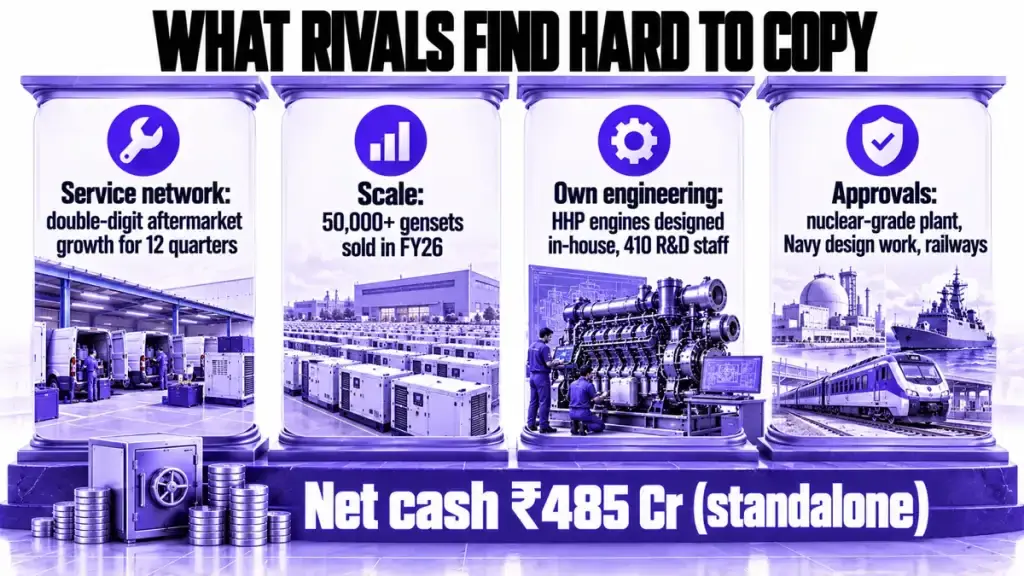
That engineering depth also shows in approvals. A nuclear operator, a navy and the railways each test a supplier for years before they rely on it. Those approvals are slow to win, which is also why a rival cannot copy them quickly. Read this Economic Moat Explained
"We view that as a reference point rather than endpoint." - Sachin Kejriwal, Kirloskar Oil Engines, on the first hyperscale order
Its balance sheet is the last layer. The engine company had ₹104 Cr of loans at the end of FY26 against shareholders' funds of ₹3,354 Cr, and it paid a dividend of ₹6.50 a share. That leaves room to fund the Kagal expansion without straining the core business, even though Arka carries debt of its own.
Financials: Profit Backed by Cash
We have already seen the latest quarter and FY26. Now let's look at five years of the engine company on its own, without Arka's lending, using standalone figures; FY26 sales and profit cover continuing operations only, as the pumps business moved to a subsidiary in October 2025.
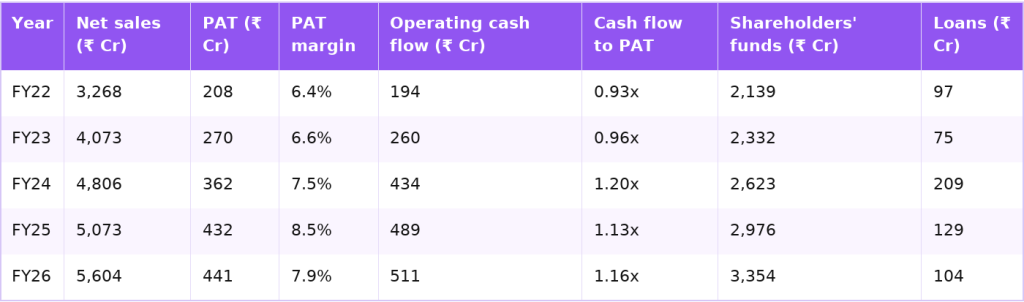
Net sales rose about 1.7 times in four years, from ₹3,268 Cr in FY22 to ₹5,604 Cr in FY26, even though FY26 no longer counts pumps. Without pumps in both years, FY26 sales rose 25% from ₹4,481 Cr. Profit after tax more than doubled, from ₹208 Cr to ₹441 Cr, and the profit margin rose from about 6.4% to about 7.9%.
That profit has turned into cash. Operating cash flow was a little below profit in FY22 and FY23, but above it in each of the last three years. Over the five years, it added up to about ₹1,889 Cr against profit of about ₹1,713 Cr, or about 1.1 times.
Debt stays small for the engine company. Loans peaked at ₹209 Cr in FY24 and were ₹104 Cr in FY26, while shareholders' funds grew from ₹2,139 Cr to ₹3,354 Cr. The group picture is different, because Arka carries debt of its own, which is why the engine business is best read on a standalone basis. The number to watch is working capital, as inventory rose to ₹820 Cr in June 2026 from ₹603 Cr in March.
"Beware of little expenses; a small leak will sink a great ship."
— Benjamin Franklin
For KOEL, the leaks to watch are small ones that add up: employee costs that rose about ₹31 Cr in a year, and inventory built ahead of growth.
What the Next Two Years Look Like on Management's Numbers
So what could all of this add up to for you as a reader following KOEL? The plan centres on two expansions at Kagal. The first, worth ₹700 Cr, adds lines inside the existing plant for 50,000 more engines a year, and management expects it to come online by April 2027.
Then comes a larger project. KOEL will invest about ₹1,400 Cr over two years in a new building at Kagal for 20,000 engines a year, mainly high-horsepower engines for power generation in India and abroad. It is all new spending, with no replacement, the CFO said, and it should be capitalised within two years.
These two projects are large for KOEL. Together, ₹2,100 Cr of new spending compares with a gross block of ₹2,390 Cr at the end of FY26, so the company's fixed assets would nearly double. On the CFO's numbers, the new HHP plant could earn about four times its cost in a year, or close to ₹5,000-6,000 Cr of revenue, once it is running.
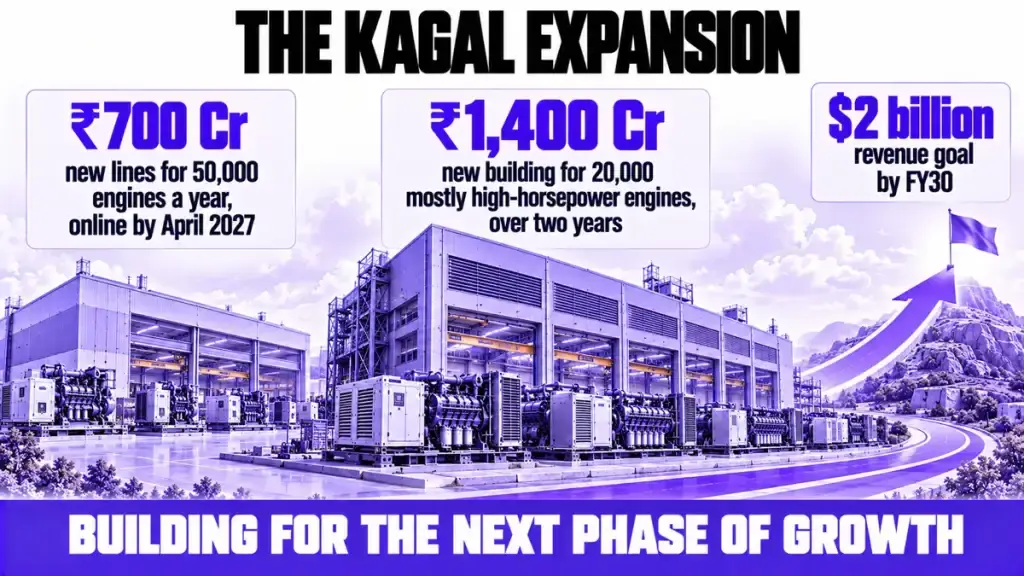
What ₹2,100 Cr buys: lines for 50,000 more engines inside the existing Kagal plant by April 2027, then a new building for 20,000 mostly high-horsepower engines over the next two years. At the CFO's asset turn of about four, the second plant alone could support ₹5,000-6,000 Cr of yearly revenue.
Beyond Kagal, several other items should start to show in FY27. The NPCIL order will begin billing on milestones, the data-centre genset supply will be recognised as revenue, and price increases should flow through in the coming quarters. Its management also expects export queues to the Middle East to clear within three to six months of August 2026.
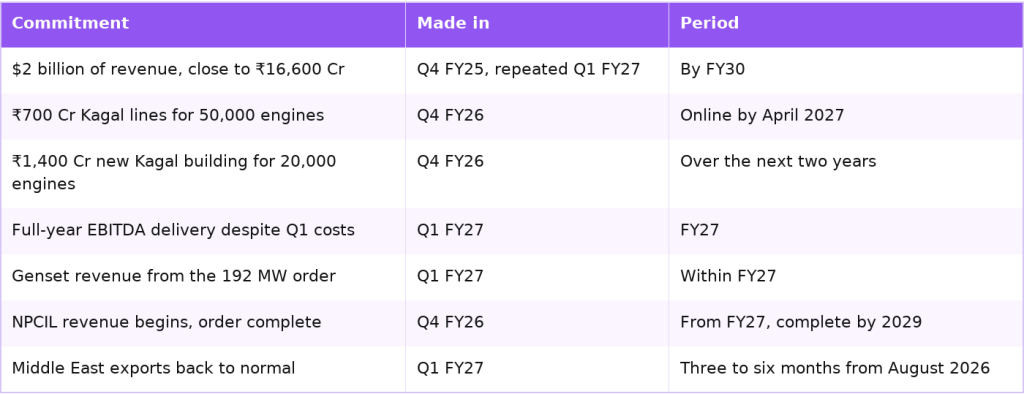
These commitments come with a record we can check. The 2X-3Y plan, announced at the start of FY23, aimed to double revenue in three years. Standalone net sales rose from ₹3,268 Cr in FY22 to ₹5,073 Cr in FY25, or about 1.55 times by our arithmetic. Its international share stayed well short of its target.
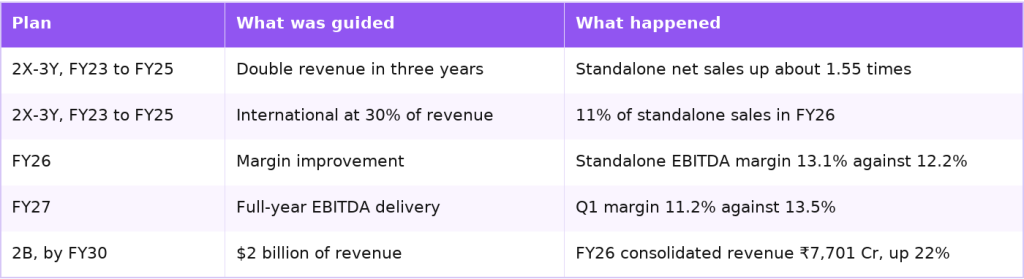
That record matters for how you read the 2B plan. KOEL grew strongly under 2X-3Y but did not double, and management itself called the international target its biggest gap.
"We are stubborn on vision. We are flexible on details."
— Jeff Bezos
For KOEL, the vision of a much larger engine company has stayed, while the route abroad has changed from exporting to building local teams and offices. The new target needs about 21% growth a year, close to the 22% the group delivered in FY26.
Key Risks
No business grows in a straight line, so let's look at what could go wrong for KOEL.
- Margin pressure: the standalone EBITDA margin fell to 11.2% in Q1 FY27 from 13.5% as commodity costs rose faster than prices. Employee costs rose about ₹31 Cr in a year, and management says part of that increase is permanent.
- Middle East exposure: the Middle East and North Africa gave about 60% of international sales, and international sales fell 11% in Q1 FY27 as shipping queues backed up. A longer conflict would keep exports low.
- Data-centre execution and competition: the 192 MW order is KOEL's first hyperscale job. Analysts have questioned the customer's experience in building data centres, and KOEL's share of large gensets is still small against a strong incumbent.
- Arka's debt: Arka had total debt of ₹5,033 Cr and a debt-to-equity ratio of 3.7 at the end of June 2026. Its Q1 FY27 profit was ₹6.9 Cr against ₹10.1 Cr a year earlier, and KOEL has ₹1,053 Cr invested in it. The group's consolidated cash flow includes this lending.
- Capacity ahead of demand: about ₹2,100 Cr of new capacity at Kagal assumes strong demand for large engines at home and abroad. If HHP orders or exports grow slower than planned, the new plant would earn less than four times its cost.
- Uneven large orders: NPCIL billing follows milestones, marine sales depend on when programmes are billed, and railway revenue moves with programme timing. Quarterly numbers can swing because of this.
- Emission and tax changes: each new emission standard lets customers switch engine suppliers. The FY26 annual report also lists unresolved disputes, including ₹26.34 Cr of excise duty and ₹11.20 Cr of customs duty, both pending at the appellate tribunal.
"It takes 20 years to build a reputation and five minutes to ruin it."
— Warren Buffett
For KOEL, the first hyperscale order and the nuclear gensets carry that weight. A delay or failure on either would cost more than the revenue of one order.
Explore our Products
Research Framework

Emerging Titans
Combination of quantitative analysis, industry tailwinds, and management assessment - SPRINT investment philosophy

Tiny Titans
Heavy emphasis on scuttlebutt research, plant visits, and early on-ground signals
What to Track Next
If you follow KOEL, these are the signals that will show whether the plan is on track.
- The EBITDA margin in Q2 FY27 (July to September quarter results, not yet filed) as price increases flow through
- Genset revenue from the 192 MW data-centre order, and any second hyperscale order
- The first NPCIL milestone revenue in FY27
- Export sales to the Middle East over the next two quarters
- The ₹700 Cr Kagal lines coming online by April 2027, and progress on the ₹1,400 Cr building
- Steps to separate Arka from KOEL
Conclusion
Let's step back and put it all together. KOEL has spent eight decades making diesel engines, and for most of that time it was known for small gensets. Over the last three years it has moved up into large engines, winning a nuclear order, Navy design work and now its first hyperscale data-centre order, while its domestic businesses grew by double digits.
So the next two years will test whether that move can lift profits as well as sales. Q1 FY27 showed the strain of rising costs, with the margin at 11.2%, and Middle East exports waited on shipping queues. If price increases flow through, the large orders bill on time and the Kagal capacity fills, KOEL could keep growing at about 21% a year, as its 2B plan needs. If costs stay high or large-engine orders come slower than planned, sales will grow faster than profit for a while. The next few quarters, starting with the Q2 FY27 margin and the first billing on the data-centre and NPCIL orders, will show which way it goes.
FAQs
What does Kirloskar Oil Engines do?
+Kirloskar Oil Engines (KOEL) is a Pune company that has made diesel engines since 1946. It makes engines and gensets for power generation, engines for construction, railway, marine and defence equipment, and spare parts and service. Through subsidiaries it also makes pumps and runs a lending business, Arka. Its FY26 consolidated revenue rose 22% to ₹7,701 Cr.
What is KOEL's hyperscale data-centre order?
+In Q1 FY27, KOEL won its first order from a hyperscale data centre, for about 192 MW of backup power. It will supply the gensets, with that revenue recognised within FY27, and run operations and maintenance for at least five to six years. Its largest single data-centre engine today is rated at 1,650 kVA.
How did KOEL perform in Q1 FY27?
+Standalone sales rose 16% to ₹1,461.4 Cr, with every domestic business growing by double digits. EBITDA was ₹165.5 Cr, and the margin fell to 11.2% from 13.5% because of higher commodity and employee costs and lower exports. International sales were ₹106 Cr against ₹120 Cr a year ago.
What is KOEL's nuclear order?
+KOEL is building ten gensets of 6.3 MW each for NPCIL's Kudankulam nuclear plant. The order was worth ₹768 Cr when won in 2024, and the latest annual report puts it at ₹798 Cr. It is billed on milestones, some revenue comes in FY27, and management expects to finish by 2029.
What is KOEL's 2B plan and capacity expansion?
+The 2B plan aims for $2 billion of revenue by FY30, close to ₹16,600 Cr, which needs about 21% growth a year from FY26. KOEL is spending ₹700 Cr on lines for 50,000 more engines at Kagal by April 2027, and about ₹1,400 Cr on a new building for 20,000 mostly high-horsepower engines.
What are the main risks for Kirloskar Oil Engines?
+The main risks are margin pressure from costs rising faster than prices, exposure to the Middle East, execution on its first hyperscale order, and Arka's debt of ₹5,033 Cr. New capacity built ahead of demand and uneven billing on large orders could also make results swing from quarter to quarter.

High growth stock specialist, Value Educator
Shashank Mahajan is an equity research professional with over 12 years of experience in identifying high-potential SME and micro-cap stocks at an early stage. He follows a rigorous scuttlebutt research–driven approach, combining on-ground insights with deep financial analysis. Shashank specializes in uncovering under-researched and under-owned companies with strong management quality and long-term growth potential. Through disciplined research and early identification, he focuses on spotting tomorrow’s market leaders before they enter the mainstream investor radar.
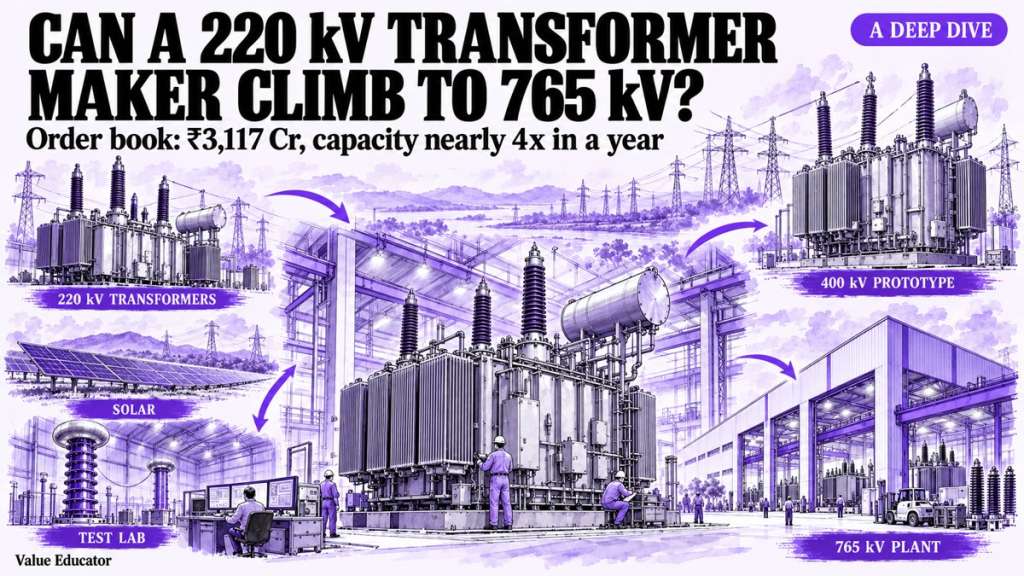
Atlanta Electricals: Capacity Nearly Quadrupled in a Year
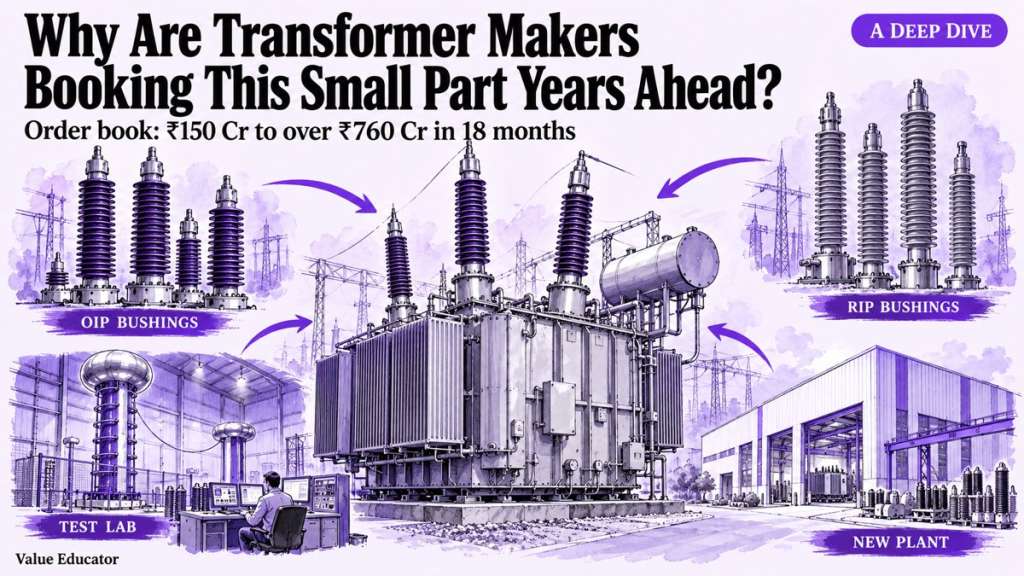
Yash Highvoltage: Bushing Maker With ₹760 Cr of Orders
Quality Power: Reactor Maker With a ₹1,945.5 Cr Order Book
Azad Engineering: Turbine Blades, Jet Engines and Orders
Cyient DLM: Aircraft Electronics and a Record Order Book

Zen Technologies: Revenue Fell After a Big Win
Explore our Products
Research Framework
Emerging Titans
Combination of quantitative analysis, industry tailwinds, and management assessment - SPRINT investment philosophy
Tiny Titans
Heavy emphasis on scuttlebutt research, plant visits, and early on-ground signals


 Orders
 Subscription
 Share with friends


Required Details
₹23999.00
(12 month subscription)
As per SEBI regulations, all users are mandated to complete the KYC that is validated for 1 year. Post payment, you will be redirected to the KYC screen


No comments yet. Be the first to comment!