
The Platform Behind Every Stock Trade

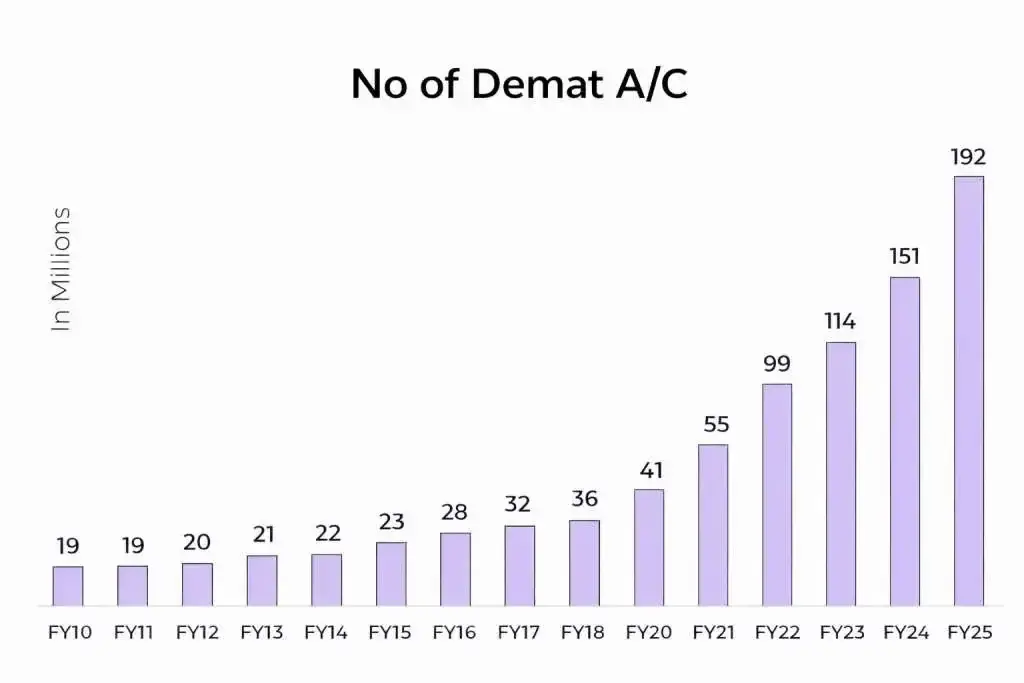
India added over 4 crore new demat accounts in a single year, taking the total to nearly 20 crore investors. Millions of first-time participants entered the stock market, trading apps exploded in popularity, and equity investing started feeling almost normal.
If you’re new to how this entire ecosystem works, understanding the basics is essential → A Beginner's Guide to Investing in the Indian Stock Market (2026 Edition)
For the first time, the market wasn’t just for a few; it was everywhere.
On the surface, this looks like the perfect setup for a high-growth business. More investors should mean more revenue. More accounts should mean more profits. The math seems simple.
But that’s exactly where the story starts to break.
Because what if the company sitting at the center of this entire boom doesn’t actually control its own growth? What if its earnings don’t depend on how well it executes, but on how millions of investors behave?
“The stock market is a device for transferring money from the impatient to the patient.” — Warren Buffett
And what if a business that looks like a monopoly on paper, quietly behaves like a cyclical stock underneath?
Every time you place a trade, check your portfolio, or receive shares in an IPO, something invisible is happening in the background.
There’s a layer of infrastructure, silent, regulated, and deeply embedded, that makes the entire system work.
“Systems tend to be invisible until they fail.” — Clayton Christensen
Most investors never think about it. But without it, nothing moves.
And at the heart of that layer sits a company that benefits from every wave of participation without ever creating the wave itself.
That company is CDSL.
The Business That Powers Every Trade
At its core, CDSL is not a brokerage, not an exchange, and not a platform you directly interact with. It is part of the core market infrastructure that enables the entire equity ecosystem to function.
Think of it like this: when you buy a stock, you don’t actually “hold” it inside your app. That share is stored electronically in a demat account, and CDSL is one of the entities responsible for maintaining that record and ensuring the transfer of ownership happens securely.
This entire system revolves around demat accounts, which act as the foundation of equity ownership → How to Open a Demat Account: A Step-by-Step Guide for Beginners
Just like a bank holds your money, CDSL holds your financial assets.
Every time you open a demat account, buy or sell shares, receive allotment in an IPO, or participate in corporate actions like dividends, bonuses, or voting, CDSL is involved somewhere in that process. And at each of these touchpoints, it earns a small fee.
Individually, these fees are negligible. But at scale across crores of investors and millions of transactions every day, they compound into a highly profitable and scalable business model.
The scale itself is significant. India now has nearly 20 crore demat accounts, and CDSL services roughly 80% of these accounts, making it the dominant depository on the retail side. Its network, through depository participants (brokers and intermediaries), reaches almost every pin code in the country.
This effectively means a large portion of India’s equity ownership flows through this system.
From an investor’s perspective, this sounds like a near-perfect setup.
At first glance, CDSL looks like the ideal business. It operates in a duopoly with high entry barriers due to regulatory requirements. It is asset-light, requiring minimal capital expenditure. And once the infrastructure is in place, incremental growth comes with relatively low additional cost, leading to strong margins and cash generation.
Such structures are often referred to as economic moats, where entry barriers protect long-term dominance → Economic Moat Explained: Why Some Companies Stay Dominant for Decades
The figures have actually begun to add up over the past few years. The revenue increased to approximately 500 -600 crore to more than 1,100 crore, and the operating margin is maintaining a steady value of more than 50%- just all that indicates that the model can be scaled.
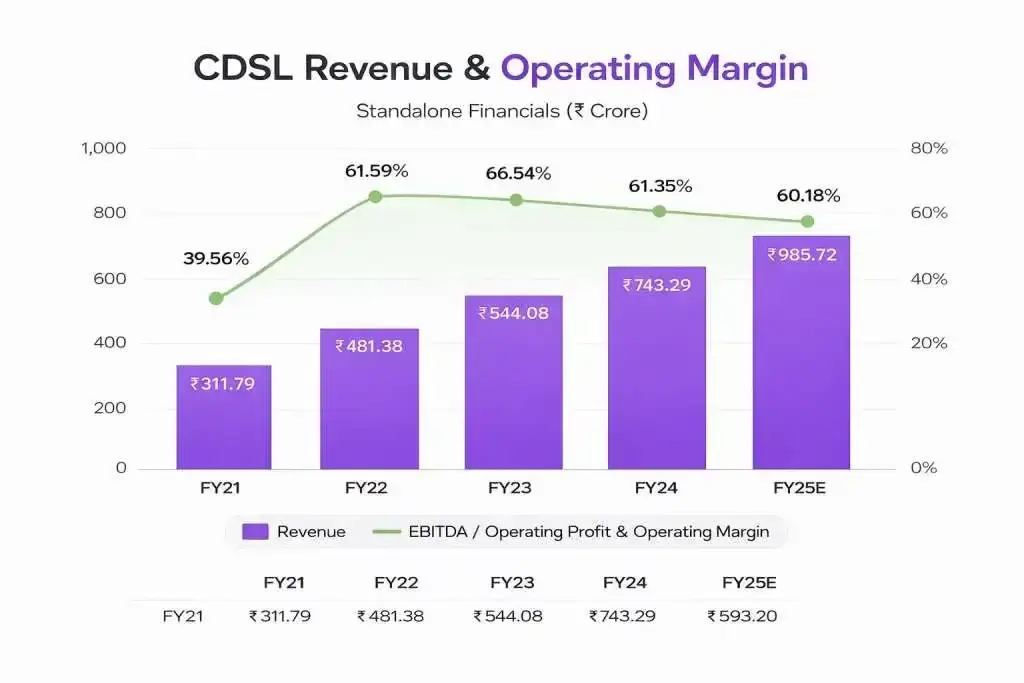
Having good margins, a good cash flow, virtually no capital requirements, and a good grip on a market that is expanding, that is precisely the type of business that investors are seeking.
The reality is somehow more complex.
How the Business Actually Works
Let’s strip this down to the simplest possible level.
Breaking down a business into simple moving parts is the first step of serious stock analysis → A Fundamental Checklist: How to Research a Stock in 1 Hour
You open a trading app and buy a stock. From your side, it feels instant, a few taps, and you own a share. But behind the scenes, something important happens. That share needs to be stored, recorded, and legally transferred in a secure system. This is where CDSL comes in.
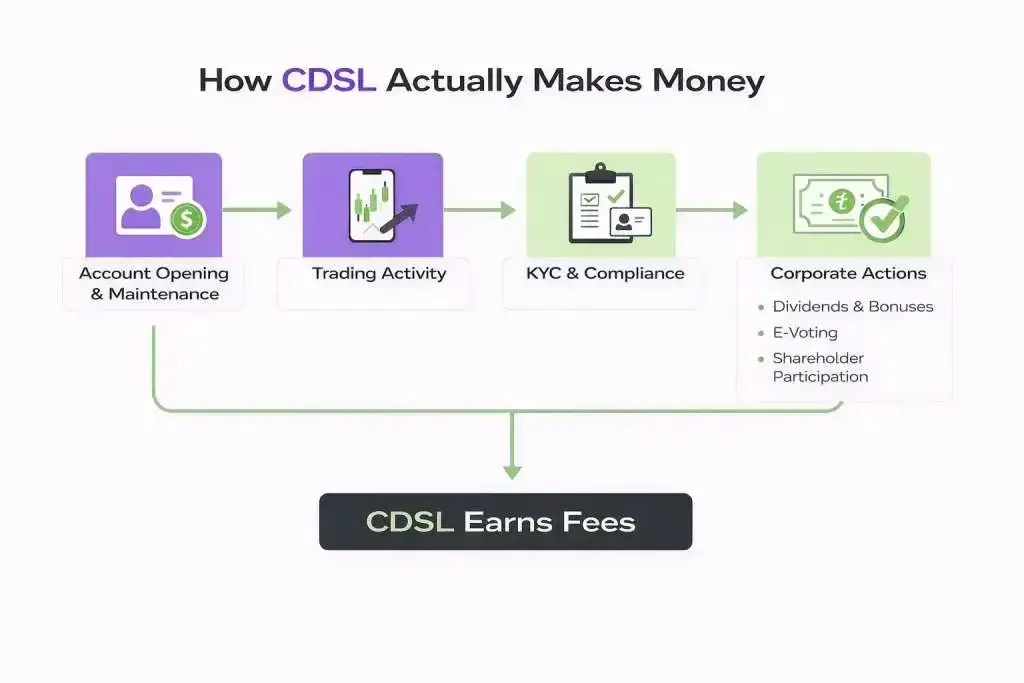
When you buy a stock, it gets credited to your demat account, and that account sits within CDSL’s infrastructure. When you sell, it gets debited. When you receive shares in an IPO, they are allocated and credited through the same system. In simple terms, CDSL is the digital vault where your investments actually live, and it ensures ownership is accurately recorded across the market.
Now the interesting part is how it makes money. At first glance, it may look like a simple storage business, but the economics are layered and activity-driven.
CDSL earns small fees at multiple points across the lifecycle of an investor. It earns from account opening and maintenance as new demat accounts are created through brokers. It earns transaction charges every time securities are bought, sold, pledged, or transferred, and this is the most important revenue driver because it scales directly with market activity. It also generates income through KYC and compliance services via its subsidiary (CVL), which acts as a critical identity verification layer for onboarding investors into the financial system. In addition, it earns revenue from corporate actions and e-voting, facilitating dividend payments, bonuses, and shareholder participation for listed companies.
Individually, none of these fees is meaningful. But at scale across nearly 20 crore demat accounts and millions of daily transactions, they compound into a powerful and highly scalable revenue engine. This is why the business has been able to deliver strong margins and consistent cash generation over time.
And this leads to one simple but critical realization: CDSL doesn’t earn because people have accounts, it earns because people use them.
The First Insight Most Investors Miss
At this point, the business can seem straightforward. More accounts, more activity, more revenue.
But this is where a subtle and important distinction comes in
CDSL doesn’t create demand. It only benefits from it.
It doesn’t decide how many people enter the market. It doesn’t influence how frequently investors trade. It doesn’t control whether IPO activity is strong or weak. All of that is driven by external forces, market sentiment, liquidity conditions, regulatory changes, and investor behavior.
CDSL simply sits at the center of this ecosystem and earns a fee every time activity happens.
And that changes how you should think about the business.
Most companies grow because they push growth through expansion, innovation, pricing, or execution. CDSL doesn’t do any of that in the traditional sense. Its growth is pulled by the ecosystem, not driven internally.
In that sense, it is less of a traditional growth engine and more of a mirror reflecting market participation.
Or put differently, CDSL is not a growth company. It is a derivative of market activity.
The Bigger Picture: India’s Financialization
To really understand CDSL, you have to zoom out beyond the company itself and look at what’s happening in the system around it.
Over the last few years, India has gone through a structural shift in how people save and invest. Traditionally, savings were concentrated in fixed deposits, gold, and real estate. These were familiar, tangible, and perceived as safe.
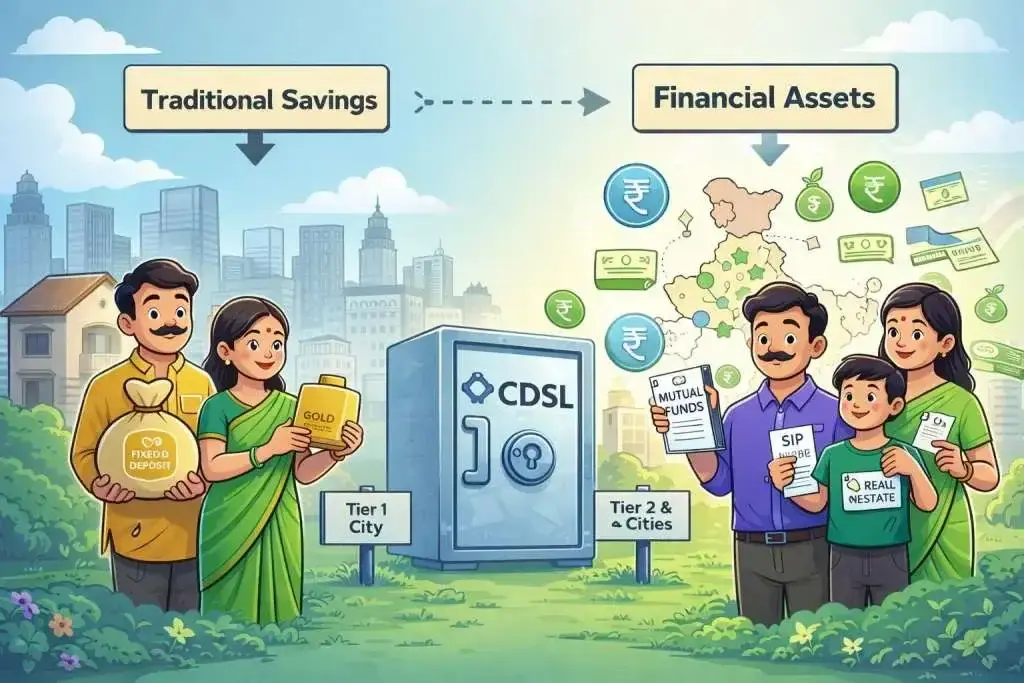
But that behavior is changing.
More individuals are moving towards financial assets. Equity participation is rising. Mutual funds, SIPs, and direct stock investing are becoming part of everyday financial behavior. What was once limited to a small segment is now spreading across income groups and geographies.
This shift is visible in the numbers. Demat accounts have grown from just a few crores to nearly 20 crore accounts, with participation expanding beyond metro cities into Tier 2 and Tier 3 regions.
This is not just cyclical growth. This is a structural transition.
This is financialization.
And CDSL sits right at the center of this shift.
It doesn’t initiate this change. It doesn’t accelerate it. It simply captures it.
That’s why it’s important to view the business differently. CDSL is not a growth company in the traditional sense.
It is a reflection of India’s financialization.
What Actually Drives Revenue
At first glance, it’s easy to assume that CDSL’s growth is directly linked to the number of demat accounts. More accounts should mean more revenue, right?
That assumption is only partially true.
The real driver of revenue is not how many accounts exist, but how actively they are used.
A demat account that sits idle contributes almost nothing. But an active investor, especially a frequent trader, generates multiple revenue events. Every buy, sell, pledge, or transfer flows through the system, and each interaction carries a fee.
This is why trading intensity matters far more than account growth.
In fact, if you look at how the business behaves, revenue tends to move more closely with market turnover and trading volumes than with the sheer number of accounts. Periods of high activity often see revenue growth accelerate even faster than account additions.
When markets are bullish, participation increases. Investors trade more frequently, new money flows in, IPO activity rises, and overall turnover expands. In such phases, CDSL’s revenue tends to spike because the entire ecosystem becomes more active.
What is on the other side of the coin is equally important.
Once the markets have a day off, volatility shoots or sentiment drains. Reduced number of trades occurs, IPO pipelines are chilled, and retailers become somewhat cautious. Although there might be continued growth in demat accounts, this may not increase revenue since there is reduced use.
This creates a dynamic that many investors overlook.
Accounts are vanity. Activity is reality.
“Price is what you pay. Value is what you get.” — Warren Buffett
And for a business like CDSL, it is activity, not ownership, that ultimately drives earnings.
The Big Misunderstanding
This is where most investors get the story wrong.
At first glance, CDSL checks every box of a “perfect business.” It operates in a duopoly, faces virtually no new competition, and sits at the core of market infrastructure. Naturally, it gets labeled as a stable, predictable, long-term compounder.
But that perception misses a critical layer of reality.
While the structure of the business is stable, the earnings are not.
CDSL’s revenue is tightly linked to trading volumes, investor participation, and overall market sentiment. When markets are active and optimistic, activity surges, with more trades, more IPOs, and more transactions, and earnings expand rapidly. But when sentiment weakens, volumes fall, participation drops, and revenue can slow down just as quickly.
And this is where the illusion breaks.
Because a business that depends on behavior cannot deliver perfectly predictable outcomes.
Regulation adds another layer of uncertainty. Changes in settlement cycles, KYC norms, or transaction processes can directly impact how the business operates and earns, often in ways the company does not fully control.
So despite operating in a protected, high-barrier industry, CDSL’s earnings profile behaves very differently from what most people expect.
It doesn’t grow in a smooth, linear fashion. It moves with the market.
“Markets are never wrong; opinions often are.” — Jesse Livermore
CDSL is a monopoly in structure, but not in earnings.
The Operating Leverage Myth
Operating leverage has always been one of the best points that CDSL supporters have to make. The concept is easy to understand when the infrastructure has been established; all the extra transactions should be of near-zero incremental cost so that the margin can increase as the volumes rise.
And for a long time, this was a perfect play. Revenue grew as trading activity grew, and costs did not change dramatically; hence, this is a good sign of a highly scalable, asset-light platform that enhances the growing margin argument.
However, this is where the story starts to change.
Recent management commentary indicates that costs are not that fixed to be the case that investors think. Increasing technology expenditure is occurring with a significant motive due to the need to scale the system, provide uptime, and ensure cybersecurity as more transactions occur across the ecosystem. Simultaneously, regulatory expectations are increasing, which drives the compliance costs up.
This brings about a slight yet significant shift in the operations of the business.
Rather than a pure fixed-cost structure, the cost structure is slowly becoming increasingly dynamic. Despite the scale, the requirements of constant investment on infrastructure, monitoring, and compliance with regulations also grow.
This does not mean the disappearance of operating leverage but it is possible that operating leverage is not as strong and linear as it used to be. The margin growth may cool and the anticipations that had been made on previous trends might require adjustment.
Normalization of the cost structure is the greatest threat and not competition.
The Moat But With a Twist
On the face of it, CDSL does possess one of the most difficult moats in India.
It competes with NSDL in a duopoly, and the barriers to entry are harsh in terms of regulatory approvals, huge infrastructure, and a complex ecosystem that is difficult to substitute.
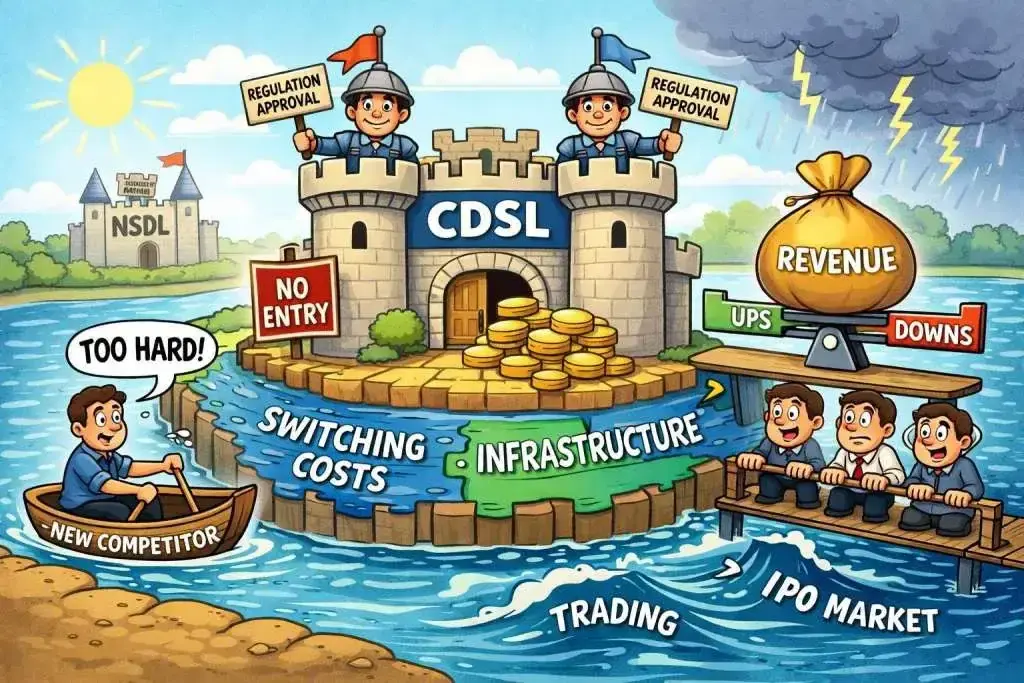
Establishing a new depository is not simply a matter of throwing money at it but having trust, green lights in the regulations, and getting the entire system on board.
This also has a strong switching-cost layer. The broker, custodians, and institutions are too connected to depositories with their daily operations, and a switch to the other is not an easy one. It is a technological nightmare, it has an operational risk, and it requires coordination of regulators.
The patchwork has all the businesses pretty locked in. The market share remains consistent, the competition in the market is thin, and the financial ecosystem position is firmly embedded.
That’s where the majority of investors stop, and that is where the real insight will come in.
This moat retains your market share, but it does not tie in the amount of cash you will be drawing in.
The ability to remain an essential component of the system means that CDSL will not ensure smooth or constant profits, however. The amount of revenue remains dependent on the activity of the market- on the frequency of trading by the investors, on the fervor of the IPO market, and on the mood swings.
Therefore, the moat seals it in, but it does not protect it against the ups and downs of the ecosystem.
The following is the actual truth: the risks that matter.
Most risk sections tend to sound the same: competition, macro slowdown, execution. But in a business like CDSL, the real risks are more subtle, and more importantly, they are external.
This is not a business where execution risk dominates. It’s a business where ecosystem risk dominates.
Market Dependency
CDSL’s earnings are not driven by strategy in the traditional sense. They are driven by market activity. When sentiment is strong, trading volumes rise, IPO activity increases, and participation expands, all of which boost revenue. But when sentiment weakens, activity drops and earnings follow. The business is less about what the company does and more about how investors behave.
Regulatory Overhang
CDSL operates within a tightly regulated framework. Changes in SEBI policies, settlement cycles (like T+1 or future shifts), or compliance structures can directly impact how the business functions. The potential evolution toward centralized KYC systems such as CKYC also introduces structural uncertainty, especially for its KYC-related revenue streams. In this case, regulation is both a moat and a moving variable.
Revenue Concentration
A significant portion of revenue is linked to transactions. This makes the business highly sensitive to trading volumes rather than benefiting from stable, recurring income streams. If market activity slows, the impact on revenue is immediate. There is limited insulation from this core driver.
Cost Inflation
The assumption of a largely fixed cost structure is gradually changing. Technology investments are rising to ensure scalability, uptime, and cybersecurity in a high-volume environment. At the same time, compliance costs are increasing as regulatory expectations evolve. This can compress margins over time and reduce the strength of operating leverage that the business historically enjoyed.
Retail Cycle Risk
A large part of the growth narrative is tied to rising retail participation. But retail behavior is inherently cyclical. Participation surges in bull markets and tends to fade during corrections or prolonged volatility. If retail activity stabilizes or declines, growth can moderate even if the broader market structure remains intact.
The Financial Character of the Business
CDSL’s financial profile looks exceptional at first glance. It operates with high margins often in the 50%+ range because once the infrastructure is built, incremental transactions come at very low cost. It requires minimal capital investment, with no need for heavy capex or physical assets. And as a result, it generates strong and consistent free cash flows.
This is why experienced investors focus more on cash flow than just reported profits → Cash Flow Statement Explained: The Most Honest Financial Report
This combination of high margins, low capital intensity, and strong cash generation is what defines a high-quality business.
But the way these earnings behave is very different from what most investors expect.
Revenue does not grow in a straight line. It expands sharply when market activity rises and slows down when participation cools off. In some periods, even with rising account additions, earnings growth can moderate due to lower trading intensity.
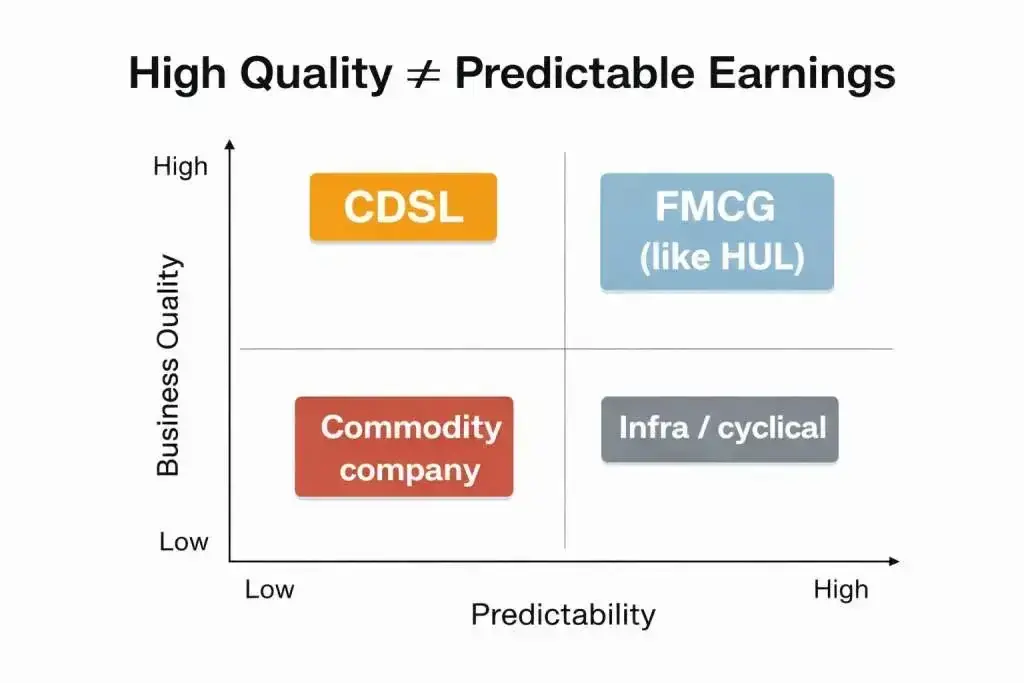
This creates an important distinction. The quality of the business remains high, but the predictability of earnings does not.
Growth is not linear. It is uneven, cyclical, and closely tied to investor behavior and market activity.
This is a high-quality business with low predictability.
Peer Comparison More Than Just Competition
At first glance, comparing CDSL with NSDL looks straightforward. Both operate as depositories, both are governed by the same regulatory framework, and together they form a duopoly at the core of India’s market infrastructure.
But the difference between the two is not really about pricing or direct competition.
Competition is not about pricing; it’s about ecosystem positioning.
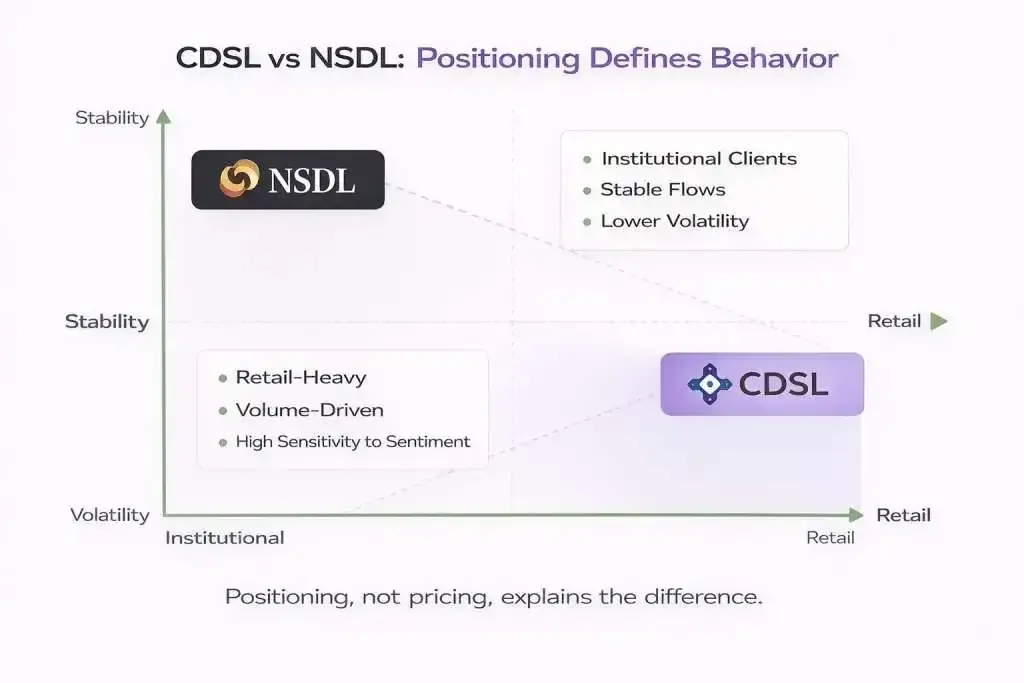
NSDL has historically been more aligned with institutional clients, large investors, custodians, banks, and complex financial entities. Its business is built around depth, long-term relationships, and relatively stable transaction flows.
CDSL, on the other hand, has positioned itself around the retail ecosystem. It has benefited disproportionately from the rise of discount brokers, the expansion of online trading platforms, and the surge in individual participation. Today, it services roughly ~80% of India’s demat accounts, making it the dominant player on the retail side.
This creates two very different business dynamics.
NSDL tends to exhibit more stability, with revenue linked to institutional activity, which is relatively less volatile and more predictable. CDSL, being deeply tied to retail participation, experiences sharper growth during periods of high market activity but also faces greater sensitivity when sentiment weakens.
In other words, NSDL is positioned around stability.
CDSL is positioned around activity.
And activity, by nature, is far more volatile.
That’s why the difference between the two is not who charges more or who has a better product. It’s about where each sits in the financial ecosystem and what drives that part of the ecosystem.
CDSL sits at the heart of retail-driven market activity, while NSDL is more aligned with institutional flows.
The Future Structural Growth, Cyclical Reality
To understand where CDSL is headed, you have to separate what is structural from what is cyclical.
On the structural side, the tailwinds are strong. India is still in the early stages of financialization, with a gradual shift of savings from physical assets like gold and real estate toward financial assets. Digital adoption continues to lower entry barriers, making it easier for new investors to access markets.
Despite the rapid growth to nearly 20 crore demat accounts, overall equity participation in India is still relatively low compared to developed markets. This suggests a long runway for expansion as awareness, access, and income levels improve.
These are long-duration, structural drivers that support the growth of the entire ecosystem in which CDSL operates.
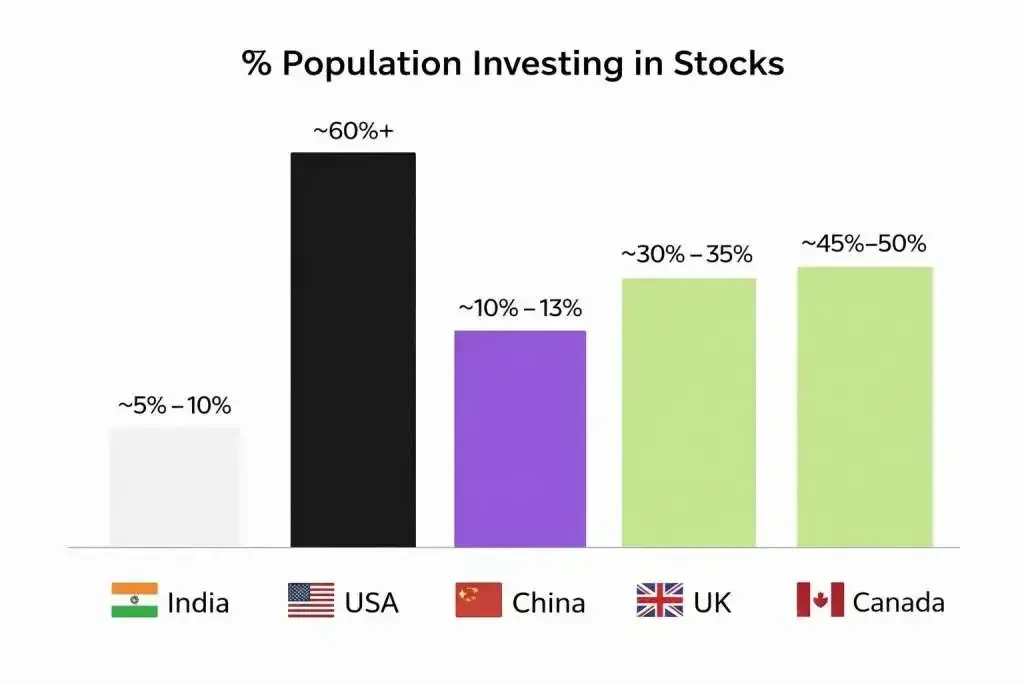
But alongside this, there is a cyclical layer that cannot be ignored.
Trading activity does not move in a straight line. Periods of high enthusiasm are often followed by phases of slowdown. Market corrections, lower volatility, or shifts in sentiment can reduce participation and transaction intensity. When that happens, the impact on revenue is immediate.
This creates a dual nature in the business.
The long-term direction is supported by structural growth.
The short-term performance is driven by cycles in market activity.
In the long run, growth is structural. In the short run, earnings are cyclical.
The Real Question for Investors
After everything, the moat, the margins, the scale, the growth, the story comes down to one uncomfortable question.
Are you buying a monopoly infrastructure business, or are you buying a proxy for market sentiment?
Because CDSL sits in a very unusual position. On the surface, it looks stable with high margins, a dominant market share, and strong cash generation. The kind of business investors instinctively label as predictable.
But look one layer deeper, and the reality shifts.
Its earnings don’t follow the strategy.
They follow behavior.
When participation rises, earnings surge. When activity slows, growth fades. The business doesn’t control this cycle; it exists within it.
And this is where most investors get it wrong.
They see the structure, but miss the driver.
“The most important thing is to understand what you don’t know.” — Charlie Munger
The best investors don’t just ask what a business is. They ask what actually moves it. Because sometimes, what drives returns is not visible on the surface.
In CDSL’s case, it’s not expansion, not pricing power, not even execution. It’s an activity. It’s sentiment. It’s the collective behavior of millions of investors showing up or stepping back.
That’s what makes it powerful.
And that’s exactly what makes it unpredictable.
If India’s financialization story continues, the opportunity is real. But the path won’t be smooth, and assuming it will be is where most mistakes begin.
So the real question is, are you prepared for both sides of that story?
Because in markets, the most stable-looking businesses often carry the most hidden volatility.
And the biggest opportunities are often the ones that force you to think beyond the obvious.
If this made you rethink the business, comment “demat.” I’ll share more such breakdowns that go beyond surface-level investing.
Explore our Products
Research Framework

Emerging Titans
Combination of quantitative analysis, industry tailwinds, and management assessment - SPRINT investment philosophy

Tiny Titans
Heavy emphasis on scuttlebutt research, plant visits, and early on-ground signals
FAQs
What is the main purpose of a depository?
+A depository exists to hold financial assets in electronic form and ensure safe ownership transfer. Think of it like a bank, but instead of money, it stores shares, bonds, and other securities.
The real way to understand its purpose is to track what happens when you buy a stock. The moment a trade is executed, ownership has to be recorded somewhere securely. That’s where a depository comes in — it ensures that the asset moves from seller to buyer without fraud, duplication, or error.
So instead of thinking “storage,” think trust + record-keeping + settlement system. That’s the core function.
What are the types of depositories and how do you identify them?
+Instead of memorizing types, think in terms of who they serve and how the ecosystem is structured.
In any country, depositories usually exist as part of a regulated financial infrastructure, often limited in number because trust and scale are critical. You identify them by checking:
- Who holds electronic securities
- Who maintains demat accounts
- Who is authorized to handle ownership records
The key idea is:
Depositories are not many, they are few and system-critical
So rather than types, focus on role + regulation + scale.
What is the difference between a depository and a repository?
+The easiest way to understand this is through function, not definition.
A repository is simply a storage place for information or assets, it does not necessarily ensure ownership transfer or legal settlement.
A depository, on the other hand, is part of a financial system with legal responsibility. It doesn’t just store assets, it:
- Tracks ownership
- Enables transfer
- Ensures settlement happens correctly
So the real difference is:
Repository = passive storage
Depository = active financial infrastructure
How does a depository actually make money?
+To figure this out, don’t start with revenue lines. Start with user activity.
Ask yourself:
- When does an investor interact with the system?
- At what points does ownership change or get recorded?
You’ll notice revenue comes from:
- Account creation and maintenance
- Transactions (buy/sell/transfer)
- Corporate actions
- Compliance/KYC layers
The key insight is:
Revenue is not driven by existence, but by activity frequency
So always analyze:
“What triggers usage?” → that’s where revenue comes from
Why can a monopoly-like financial infrastructure still have volatile earnings?
+This is where most people make mistakes.
To answer this, separate two things:
- Structure (moat, dominance)
- Driver (what actually generates revenue)
A business can have:
- High entry barriers
- Strong market share
- Regulatory protection
But if its revenue depends on:
- Trading activity
- Investor behavior
- Market sentiment
Then earnings will fluctuate.
So the way to figure this out is:
Always ask: “What actually drives revenue — internal execution or external activity?”
If the answer is external →
Even a strong business can behave cyclically

High growth stock specialist, Value Educator
Shashank Mahajan is an equity research professional with over 12 years of experience in identifying high-potential SME and micro-cap stocks at an early stage. He follows a rigorous scuttlebutt research–driven approach, combining on-ground insights with deep financial analysis. Shashank specializes in uncovering under-researched and under-owned companies with strong management quality and long-term growth potential. Through disciplined research and early identification, he focuses on spotting tomorrow’s market leaders before they enter the mainstream investor radar.

Zen Technologies: Revenue Fell After a Big Win



PNG Jewellers: A 194-Year-Old Name Goes National

Explore our Products
Research Framework
Emerging Titans
Combination of quantitative analysis, industry tailwinds, and management assessment - SPRINT investment philosophy
Tiny Titans
Heavy emphasis on scuttlebutt research, plant visits, and early on-ground signals


 Orders
 Subscription
 Share with friends


Required Details
₹23999.00
(12 month subscription)
As per SEBI regulations, all users are mandated to complete the KYC that is validated for 1 year. Post payment, you will be redirected to the KYC screen


No comments yet. Be the first to comment!