
Frontier Springs: Riding Rail Expansion
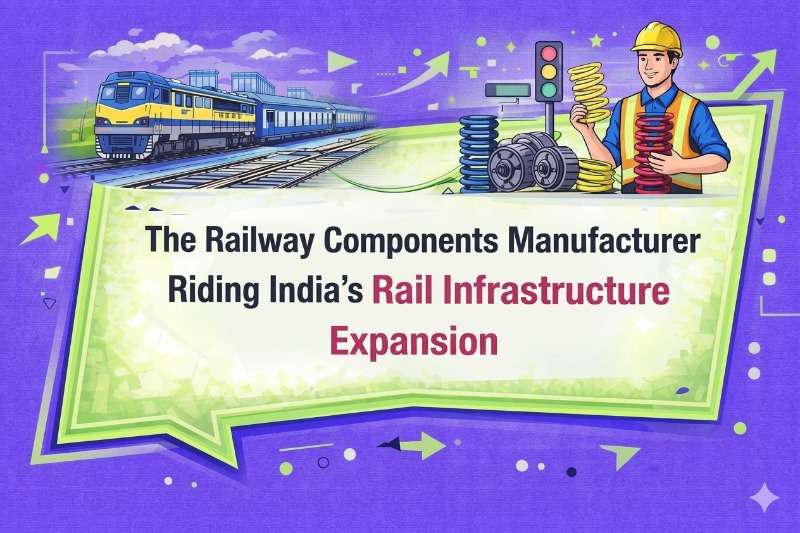
The railway industry in India is no longer merely a transportation business of the people and goods, but it is silently turning into the workhorse in the economic powerhouse of India. As freight corridors are nearly finished, electrification is speeding up, and trains such as Vande Bharat are being brought into scale, something much larger is happening under the surface. It is not a normal upgrade, but a structural change in the way the country operates. And historically, such changes have generated enormous but invisible opportunities throughout the supply chain.
The only difference between this cycle and the previous ones is not necessarily the scale, but the regularity of purpose and expenditure. The 2.65 lakh crore is not a single push 1 time but a long term blue print to cut down logistics costs and increase efficiency.
When done properly, this would remodel the competitiveness of India in international manufacturing and exports. More to the point, it generates a predictable demand environment, as opposed to a cyclical one, where long term wealth creation stories tend to start.
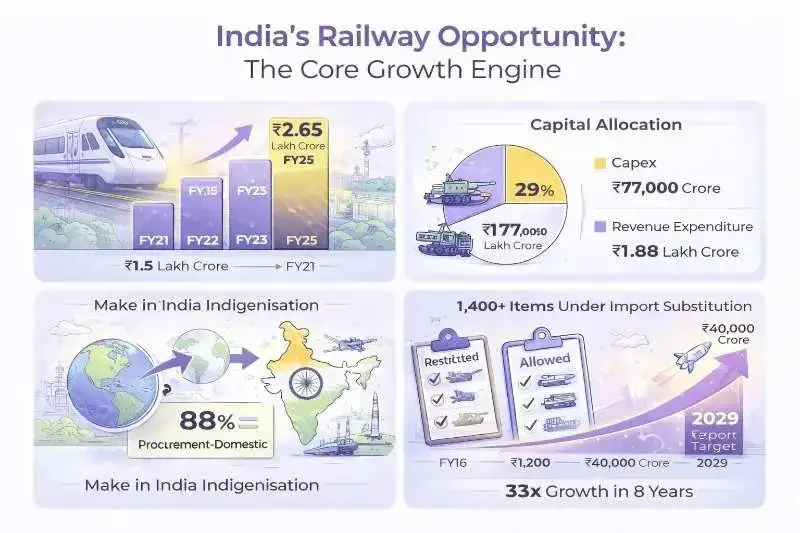
The largest winners in such a set up are not always the ones you see, but the ones who are busy in the background. Whereas EPC players are concerned with the risk of execution and the time lag, component suppliers expand with volumes, not with time. Their revenues increase with each wagon manufactured and each upgrade applied. This results in improved visibility, easier growth and in many cases better margins in the long term, making it a strong but poorly recognized model.
Frontier Springs is right at the centre of this invisible opportunity. It works at the bottom of the railway supply chain, in an area where approvals are difficult, competition is low, and relationships count. Meanwhile, it is slowly shifting towards the value chain with new product lines. This stability coupled with evolution is not common in smaller companies and makes the story much more interesting.
The big money is not in the buying or selling, it is in the waiting as Charlie Munger once said. Such silent businesses are not noticeable by the markets since they do not create noise and hype at the initial phase. However, in the long run, it is these companies that turn out to be the biggest surprise to the investors. What is really needed, then, is not what Frontier Springs is now, but what it might be were everything to come together.
Curious to learn more about mid-cap companies? Read our article: How to Analyze a Mid-Cap Company – A Complete, Practical Framework
With the bigger railway opening now evident, the centre now moves to Frontier Springs itself. A good sector generates tail winds, but it is implementation that does the returns. The interesting aspect is how well the company is placed in this cycle and whether it can actually enjoy it. Now, we can have a closer look at the business and see what makes it grow as an investor.
Business Model & Structural Strength of the Core Engine
The business model of Frontier Springs seems to be an easy one on the surface and hard to reproduce within its structure. The springs and forged parts produced by the company are vital to the operation of trains since they are vital in the railway rolling stock. These parts are not optional, but safety-critical, load distribution-critical, and operation efficiency-critical. This is so that demand is correlated with structural railway activity and not optional spending cycles.
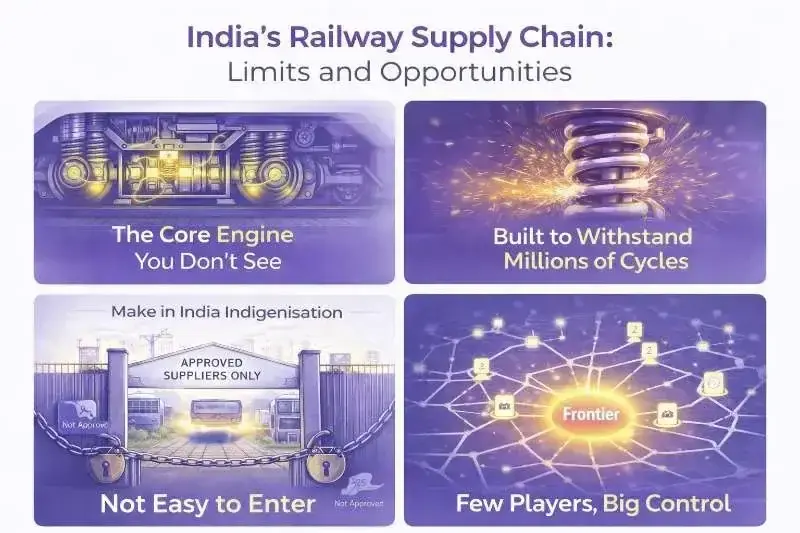
The springs division that has been the mainstay of the company through a 30 year history, is in a niche business where precision in engineering is much more important than size. The springs in locomotives and in wagons should have the ability to survive in one cycle of stress, heavy loads, and other environmental changes over an extended period. A small flaw will result in a big operational risk, and quality and reliability are the bargaining power. This inherently creates a wall towards commoditization and price competition.
The primary technical strength of the company is the materials and manufacturing processes. High durability and fatigue resistance are achieved by use of chrome silicon and chrome moly steel with controlled heating, quenching, and epoxy coating. These are activities that take special knowledge, control and years of experience in order to achieve perfection. Consequently, these capabilities cannot be easily imitated by new entrants unless they invest heavily and take a long period to learn.
The forging division also adds strength to the business model, as it allows the integration of value chains and the diversification of products. The company has ceased to be restricted to springs to provide various parts that are utilized in assembling wagons. It generates higher revenues on each unit of rolling stock and decreases reliance on one type of product. In the long-term, this type of integration can help to increase margins and add strategic value to the company in the supply chain.
Balance between standardization of products and customization is another minor yet significant aspect of the business. Although the components of railways are highly specified and regulated, there are still certain engineering adjustments needed to be made in every application. This brings a sense of individualisation which enhances the relationship with the vendors and minimises the chance of switching suppliers on a regular basis. Within this kind of environment, incumbents have an inherent advantage.
Lastly, structural entry barriers and competitive moats exist in the form of regulatory approvals such as RDSO and certifications such as IRIS. These approvals are associated with intense testing, compliance, and time-consuming, which restricts the number of qualified players within the ecosystem. After a company is accepted, it will be included in a comparatively closed supplier network. This goes a long way in improving the stability of the business and visibility of demand in the long term.
If you are interested in knowing about penny stocks and understanding how they work, then read our article: What are penny stocks? The complete beginner's guide: pros & cons
Demand Visibility & Multi-Layered Growth Drivers
The various structural drivers present the growth opportunity of Frontier Springs, which is more resilient than a business that relies on one trigger. This is a multi-layered demand structure, which means that in case one segment is sluggish, other segments can still sustain the growth. This diversification of sources of demand is one of the main features of sustainable business models. It also offers improved earnings visibility in the medium and long-term perspective.
Macro level Indian Railways is experiencing massive capacity expansion with the aim of increasing freight share. Freight loading is aimed at achieving 3,000 MT in 2027, and this means that it should be substantially higher than the present rates. This target will entail a heavy investment in infrastructure and rolling stock. Such an increase in freight carrying capacity would not be possible without increasing the wagon fleet.
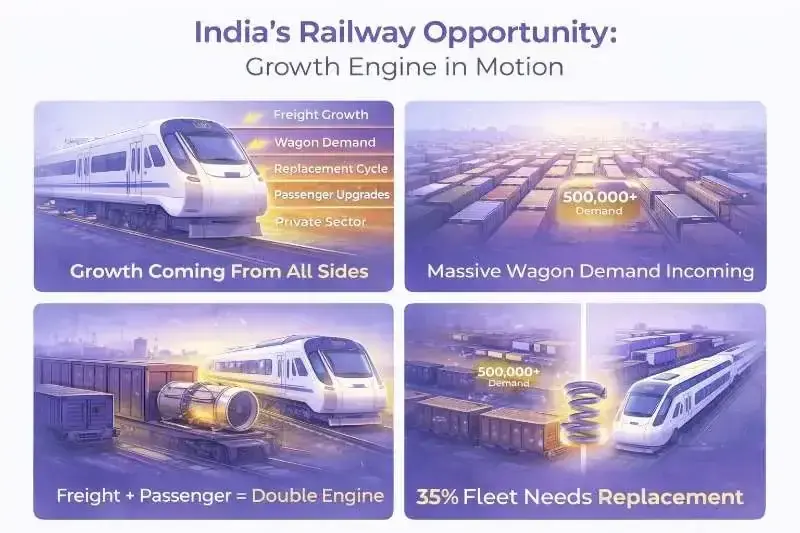
To facilitate this growth, the system will need close to 500,000 wagons in the long run. The 72,000 wagons orders that are currently in place and the 40,000 more that are projected to be ordered in the future suggest that the expansion process has already started. In three years, the procurement would be almost 90,000 wagons, which will give suppliers long-term demand visibility. This gives it a good order pipeline to component manufacturers such as Frontier Springs.
Modernization efforts are creating a need to use superior and more sophisticated components on the passenger side. Trains such as Vande bharat, and metro extensions and speed improvement projects need better suspension systems. These systems are directly dependent on high-performance springs and air suspension systems. This forms another plane of demand on top of growth in freight.
The other factor is the growing involvement of the private sector in the logistics of railways. Industries like cement, steel, and automobiles are investing in their own logistics infrastructure with the encouragement of policies which promote the ownership of wagons privately. This makes it less reliant on government procurement and opens up new demand streams. In the long run, this change can diversify and enliven the ecosystem.
Bullish on steel industry? Read our article: Steel Demand Boom: 5 Stocks Benefiting from India’s Infrastructure Push
Another demand trigger that is underestimated but strong is the Dedicated Freight Corridor (DFC). The efficiency gains are already being felt with 96 percent of the corridor commissioned and more than one lakh trains being run. Increased usage of assets normally causes components to wear and tear at a rate. This, in its turn, raises replacement demand, and, in the long run, this serves the interests of suppliers such as Frontier Springs.
Air Springs: A Potential Inflection Point, Not Just a New Segment
The air springs segment should be given particular consideration since this is not an incremental addition to the business quality and positioning of the company. As much as traditional products are stable, air springs act as a factor of adding a level of technology and value addition. This shift can have far reaching consequences on the long term growth trend of the company. This may be in most senses the segment that reinvents the business profile.
The traditional coil springs, although needed, are in a fairly mature and standardized market. In modern LHB coaches and high-speed trains, however, air springs are deployed, which provide a better ride and efficiency. They offer superior shock absorption, load balancing and less maintenance needs. With the modernization of railway systems, the use of such highly developed components will probably grow considerably.
In the case of Frontier Springs, there are two key benefits of this transition. First, it will create the possibility to increase margins, since air springs usually fetch better realizations than traditional products. Second, it will enable the company to join the wave of modernization instead of mere expansion of volumes. This movement to value-based growth as opposed to volume-based growth can be very beneficial to the earnings profile of the company.
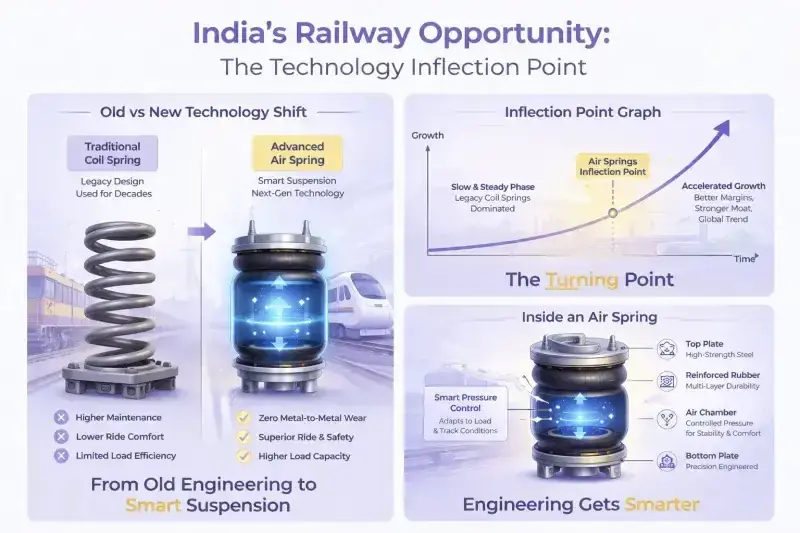
The company has already increased its production capacity and intends to increase it further in FY26. The progresses such as the FIBA system and the anticipated regulatory approvals show that the segment is gradually getting into commercialization. These initial measures play a vital role in building credibility and gaining early market share.
Curious about what market cap actually means when it comes to stocks? Read our article on: What is Market Capitalization? Large, Mid, Small Cap Explained with Examples
When properly implemented, the air springs would transform into a minor source of revenues and profitability. This segment stands a chance to alter the perception of the market towards the company with time. Rather than being perceived as a conventional provider of components, Frontier Springs might be considered a technology-based engineering participant.
Financial Evolution: Signs of Operating Leverage and Scale Benefits
The financial trajectory of Frontier Springs indicates a clear transition from a steady-state business to a scaling business with operating leverage. Revenue growth from ₹77.9 crore in FY21 to ₹231.3 crore in FY25 reflects a strong CAGR, driven by increasing demand and capacity utilization. This kind of growth suggests that the company is successfully capturing opportunities within its sector. However, revenue growth alone does not tell the full story.
The more important signal lies in the expansion of profitability over the same period. EBITDA has grown from ₹13.7 crore to ₹49.6 crore, while margins have improved from around 17.6% to approximately 21.5%. This indicates that the company is benefiting from economies of scale and better cost management. As volumes increase, fixed costs are spread over a larger base, improving overall efficiency.
The operating leverage is very important in the manufacturing business such as this. After a certain amount of capacity utilization is attained, then the incremental revenue will have a disproportionate contribution to profits. This brings a compound effect of increasing profits at a higher rate than the increase in revenues. It seems that Frontier Springs is in this stage and this is where substantial value creation normally occurs.
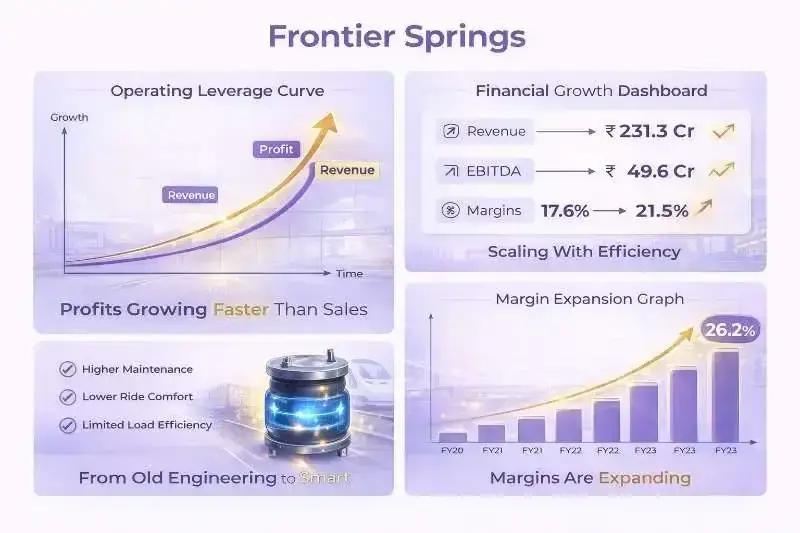
The latest financial numbers further strengthen this thesis. Revenue for 9MFY26 has already reached ₹239.5 crore, surpassing the full-year revenue of FY25. EBITDA margins have expanded to around 26.2%, indicating that the company is extracting higher profitability from incremental growth. This trend suggests that operational efficiencies are improving over time.
This improvement is further confirmed by return ratios. The ratio of RoCE is approximately 35.3% which means that the company has high capital efficiency and profitability of invested capital. Good businesses with sustainable competitive advantages are likely to have high return ratios.
Curious to find what debt signifies for a company and how it can impact your long-term returns? Read our article: What is Debt to Equity Ratio? Why it Matters for Small Cap Investing.
Balance sheet is conservative and there is a low amount of long term debt and the cash flows are improving. This gives the business an economic leeway to invest in other avenues of growth without taking unnecessary risks. A good balance sheet is also used to cushion in times of uncertainty.
Management Strategy: Capital Allocation and Timing the Cycle
One of the most critical factors in cyclical and infrastructure-linked industries is management’s ability to allocate capital at the right time and in the right segments. Frontier Springs’ historical decisions suggest a pattern of strategic alignment with industry trends. This ability to anticipate change rather than react to it is a key differentiator. Over time, such decisions compound into significant competitive advantages.
The transition from leaf springs to coil springs aligned with the modernization of railway technology. This move ensured that the company remained relevant as industry requirements evolved. Similarly, entry into forgings in 2011 expanded the product portfolio and increased participation in the value chain. Each of these decisions reflects an understanding of where the industry is heading.
Capex decisions further reinforce this perspective. Investments such as the installation of a 6-tonne forging hammer and expansion of production capacities indicate preparedness for future demand. Rather than waiting for demand to materialize, the company is positioning itself in advance. This approach allows it to capture opportunities more effectively.
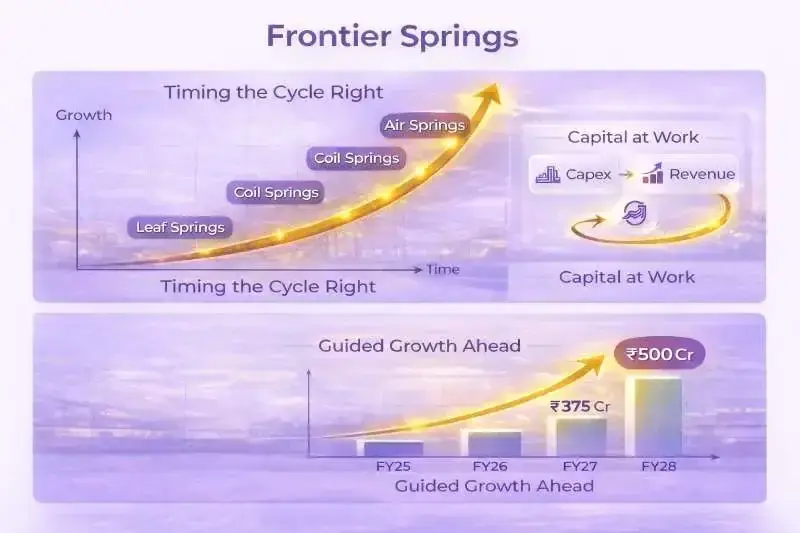
This proactive strategy is particularly important in supply-driven industries, where capacity constraints can limit growth. Companies that invest ahead of the curve are often able to gain market share during expansion phases. Frontier Springs appears to be following this approach.
Revenue guidance of approximately ₹375 crore and ₹500 crore reflects confidence in execution capabilities. However, achieving these targets while maintaining margins will be the real test of management effectiveness. Sustained profitability will determine long-term value creation.
Competitive Positioning & Hidden Moats
Frontier Springs operates in a niche segment where competition is limited not just by capital requirements but by qualification processes, technical expertise, and long-standing relationships. This creates a relatively protected environment for established players. New entrants face significant challenges in breaking into this ecosystem. As a result, incumbents enjoy a degree of stability.
RDSO approvals and IRIS certifications create a closed ecosystem where only qualified vendors can participate. These certifications involve rigorous testing, compliance, and time-consuming processes. This significantly reduces the threat of new entrants and ensures that only capable players operate in the market. Over time, this acts as a strong competitive moat.
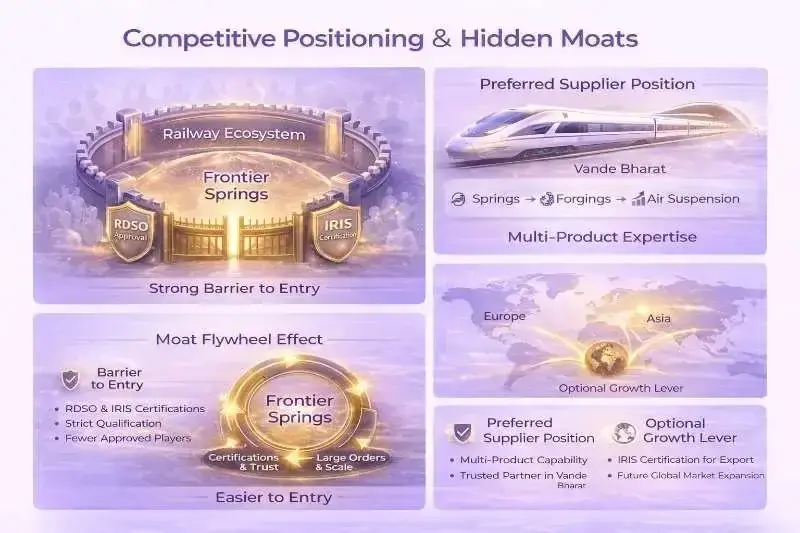
Another important advantage is the company’s multi-product capability. By operating in both springs and forgings, Frontier Springs increases its share of wallet per customer. This makes it a more valuable and reliable supplier. Customers often prefer vendors who can supply multiple components, as it simplifies procurement and ensures consistency.
Export potential enabled by IRIS certification is another growth lever. While currently underutilized, it provides optionality for future expansion into global markets. This diversification can reduce dependence on domestic demand over time.
Risks, Sensitivities & What Can Go Wrong
No investment thesis is complete without a clear understanding of potential risks and downside scenarios. For Frontier Springs, one of the most immediate risks is raw material volatility, particularly in steel prices. Since steel is a key input, any significant increase can impact margins if not passed on to customers. This makes cost management critical.
Customer concentration remains another important risk factor. Indian Railways continues to be the dominant client, which means revenue visibility is closely tied to government spending. Any slowdown in procurement or policy changes can impact growth.Diversification of customer base will be important over time.
Execution risk in the air springs segment is also significant. While the opportunity is large, delays in approvals or slower adoption can impact growth timelines. The success of this segment will depend on both technical execution and market acceptance.
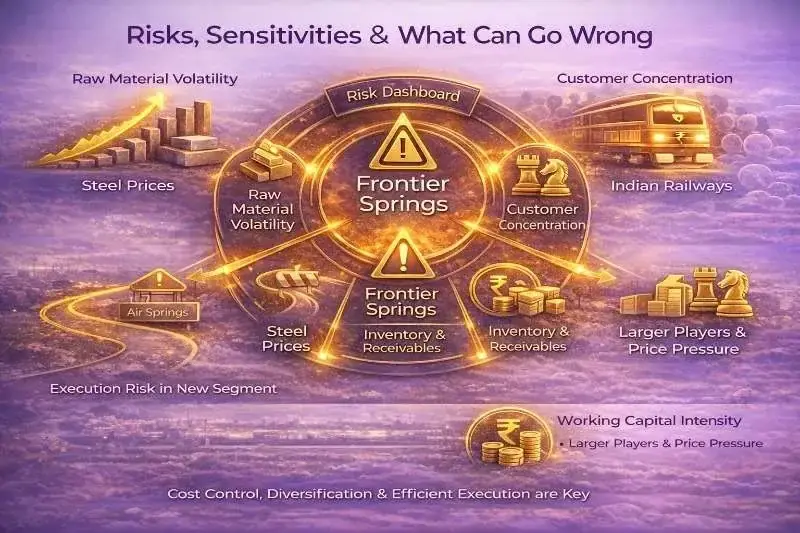
Finally, as the opportunity becomes more visible, competition could increase. Larger players may enter the segment, leading to pricing pressure. Maintaining technological edge and customer relationships will be key to sustaining competitive advantage.
Explore our Products
Research Framework

Emerging Titans
Combination of quantitative analysis, industry tailwinds, and management assessment - SPRINT investment philosophy

Tiny Titans
Heavy emphasis on scuttlebutt research, plant visits, and early on-ground signals
Conclusion
Frontier Springs is not the kind of stock that dominates headlines or attracts immediate retail attention. It operates quietly in the background, supplying essential components to a critical sector. But often, it is these low-visibility businesses that create the most meaningful long-term wealth.
If you step back and analyze the bigger picture, the story becomes more compelling. The company operates in a sector with strong structural tailwinds, backed by government spending and long-term policy support. Demand visibility appears strong for the next 5–10 years, which is a key factor for sustained growth.
The business itself is showing clear signs of improvement. Operating leverage is kicking in, margins are expanding, and return ratios are strong. These are indicators of a company moving towards a higher-quality earnings profile.
At the same time, it is important to remain realistic about the risks. Dependence on a single sector, sensitivity to raw material prices, and execution challenges in new segments are all factors that need to be monitored. Ignoring these risks can lead to poor investment decisions.
So how should an investor approach this opportunity? Instead of making an aggressive one-time bet, it may be more prudent to adopt a “monitor and accumulate” strategy. This involves tracking execution, observing how new segments evolve, and gradually building exposure.
If the company successfully executes its plans and achieves its ₹500 crore revenue target while maintaining margins, the market could re-rate the business significantly. This is typically where early and patient investors benefit the most.
However, if execution falls short, the same market can quickly lose interest. This highlights the importance of continuous monitoring and disciplined investing.
In simple terms, this is a story where patience matters more than timing. You don’t need to rush into it, but you also should not ignore it completely. Because if everything falls into place, Frontier Springs has the potential to quietly compound into a meaningful wealth creator over the coming years. Comment down “SPRINGS” if you loved our article and share it with your friends who are bullish on the railway industry.
FAQs
How sensitive is Frontier Springs to changes in railway policy or budget allocation?
+While the company benefits from long-term railway spending, short-term fluctuations in budget allocation or policy priorities can impact order flow. However, the presence of replacement demand and private participation provides some cushion. Over the long term, structural investments in railways tend to be sticky and less volatile. This reduces the risk of sudden demand collapse.
Can Frontier Springs benefit from opportunities beyond Indian Railways?
+Yes, this is an important but often overlooked aspect of the story. With certifications like IRIS, the company has the potential to tap into global railway markets. Additionally, segments like metro rail, urban transport systems, and even defense mobility could open up over time. This creates optionality beyond its current core market.
What role does technology play in the company’s future growth?
+Technology is becoming increasingly important, especially with the shift toward advanced components like air springs. As railways move towards higher speeds and better passenger comfort, the demand for technically superior products increases. Companies that can adapt to these changes tend to capture higher-value opportunities. Frontier Springs’ evolution into such segments will be key to watch.
How scalable is the business over the next 5–10 years?
+The business has strong scalability potential due to operating leverage and expanding capacity. As demand increases, incremental revenue can translate into disproportionately higher profits. However, scalability will also depend on timely capacity expansion and execution efficiency. Monitoring how the company manages growth without compromising margins will be crucial.
Is this a cyclical play or a structural growth story?
+While the business is linked to the railway sector, which has cyclical elements, the current phase appears more structural than cyclical. Long-term government commitment and infrastructure push provide sustained demand visibility. However, short-term fluctuations may still occur due to execution delays or procurement cycles. Investors should view it with a medium to long-term horizon.

High growth stock specialist, Value Educator
Shashank Mahajan is an equity research professional with over 12 years of experience in identifying high-potential SME and micro-cap stocks at an early stage. He follows a rigorous scuttlebutt research–driven approach, combining on-ground insights with deep financial analysis. Shashank specializes in uncovering under-researched and under-owned companies with strong management quality and long-term growth potential. Through disciplined research and early identification, he focuses on spotting tomorrow’s market leaders before they enter the mainstream investor radar.

Zen Technologies: Revenue Fell After a Big Win



PNG Jewellers: A 194-Year-Old Name Goes National
Explore our Products
Research Framework
Emerging Titans
Combination of quantitative analysis, industry tailwinds, and management assessment - SPRINT investment philosophy
Tiny Titans
Heavy emphasis on scuttlebutt research, plant visits, and early on-ground signals


 Orders
 Subscription
 Share with friends
 Logout


Required Details
₹23999.00
(12 month subscription)
As per SEBI regulations, all users are mandated to complete the KYC that is validated for 1 year. Post payment, you will be redirected to the KYC screen


No comments yet. Be the first to comment!