
RR Kabel: The Business Behind Every Wall

Every modern building has a secret.
Before a single light switches on, before the elevator moves, before the Wi-Fi router blinks green, someone has already run kilometres of copper and aluminium through its walls. You'll never see it. You'll probably never think about it. But if it fails, nothing else in that building works. Much of it is made by companies like RR Kabel.
For decades, wires and cables were the definition of a commodity business. Little differentiation. Limited pricing power. Few investors paid attention. The cheapest product often won.
Then the rules began to change.
Data centres demanded cables that could deliver uninterrupted power. Solar farms needed products that could survive decades under harsh weather. Metro networks, factories and high-rise buildings required safer, more specialised electrical systems. The industry stopped competing on metal alone and started competing on engineering, quality and execution.
Among the companies riding this transformation is one that has quietly built one of India's largest distribution networks, a meaningful export business, and an ambitious roadmap to move further up the value chain.
This is the story of RR Kabel.
From Wires to a Full Electrical Empire
Since its founding in 1995, RR Kabel has grown from a manufacturer of safe, reliable electrical wires for Indian homes into one of India's leading consumer electrical solutions providers, with a portfolio spanning wires, cables and fast-moving electrical goods (FMEG). Over three decades, what started as a wiring business now touches nearly every point where electricity meets everyday life from residential homes to industrial infrastructure."We embraced the 21st century by entering such cutting-edge industries as brick, carpet, insulation and paint." — Warren Buffett
At its core, the company operates across two product categories. The first is Wires & Cables, comprising house wires, industrial wires, power cables, specialty cables and solar cables. Complementing this is its FMEG portfolio, which includes fans, lighting, switches, switchgear and household appliances. Together, these businesses allow RR Kabel to participate across a broader spectrum of electrical consumption rather than remaining solely a wire manufacturer.
Scale is where the story gets interesting. RR Kabel's products move through a distribution network of over 7,200 distributors and dealers and more than 2,15,000 retailers spread across India reaching into towns and neighborhoods most consumers never think about until a switch stops working. Backing this network is a loyalty base of 6.65 lakh enrolled electricians, and this is a detail worth pausing on: in this industry, professional recommendation often decides which brand ends up inside the wall. Beyond India, the company's reach extends to 66+ countries, supported by 42 international certifications that open doors to markets with some of the world's strictest quality standards.
Manufacturing sits at the heart of how RR Kabel sustains this scale. The company produces critical inputs in-house PVC, XLPE and Low Smoke Zero Halogen (LS0H) compounds, along with aluminium rods giving it greater control over product quality, consistency and certification standards. For a business where reliability is often non-negotiable, manufacturing isn't just about capacity it's about maintaining the confidence of customers across both domestic and international markets.
Where RR Kabel's Revenue Actually Comes From
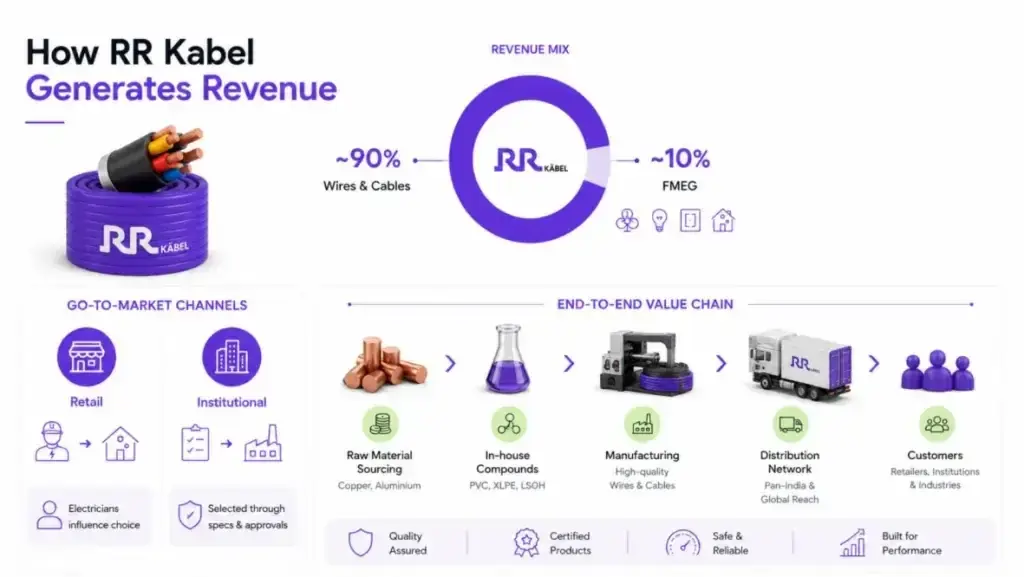
Electricity needs a path to travel and wires and cables are exactly that path. Every home, factory, office, solar park or metro project needs a safe way to carry power from source to switch. This simple, unavoidable need is what RR Kabel builds its business around.
Wires & Cables form the heart of the company, contributing close to 90% of its revenue. The remaining 10% comes from Fast-Moving Electrical Goods (FMEG) fans, lighting, switches and appliances. Within Wires & Cables itself, the business spreads across housing wires, power cables, industrial cables, specialty cables and solar cables. Housing wires bring in the most revenue today, but the other categories matter too they connect RR Kabel to factories, commercial buildings, renewable energy projects and infrastructure. This spread means the company isn't betting its fortunes on just one type of customer or one end market.
RR Kabel sells through two distinct channels. The first is retail, which reaches homeowners and electrical contractors and here, electricians often have the final say on which brand gets used. The second is institutional, which supplies developers, industries and infrastructure projects. This is a more technical buyer: products are chosen based on strict specifications and approved vendor lists, not brand preference. On the geography side, about 70% of revenue comes from India, and the remaining 30% from exports with Europe as the largest overseas market, and the US and Australia gradually growing in importance.
None of this runs on a simple buy-and-sell model. RR Kabel sources raw materials like copper and aluminium from a range of suppliers, manufactures key compounds such as PVC, XLPE and LS0H in-house, and turns them into finished products before sending them out through its distribution network. It also keeps pushing into higher-value products like FireX LS0H-EBXL safety wires and BLDC motor-based fans as customer needs evolve. This explains how RR Kabel makes money. The more interesting question is why demand for these products keeps climbing and that answer lies beyond the company, in the industry it operates in.
Before investing in any company, it's important to understand how different business segments contribute to growth. Our guide on Segment-Wise Revenue Analysis: How to Find a Company's True Growth Engine explains exactly how investors identify a company's real earnings drivers.
Why "Boring" Wires Became a ₹1.8 Trillion Opportunity
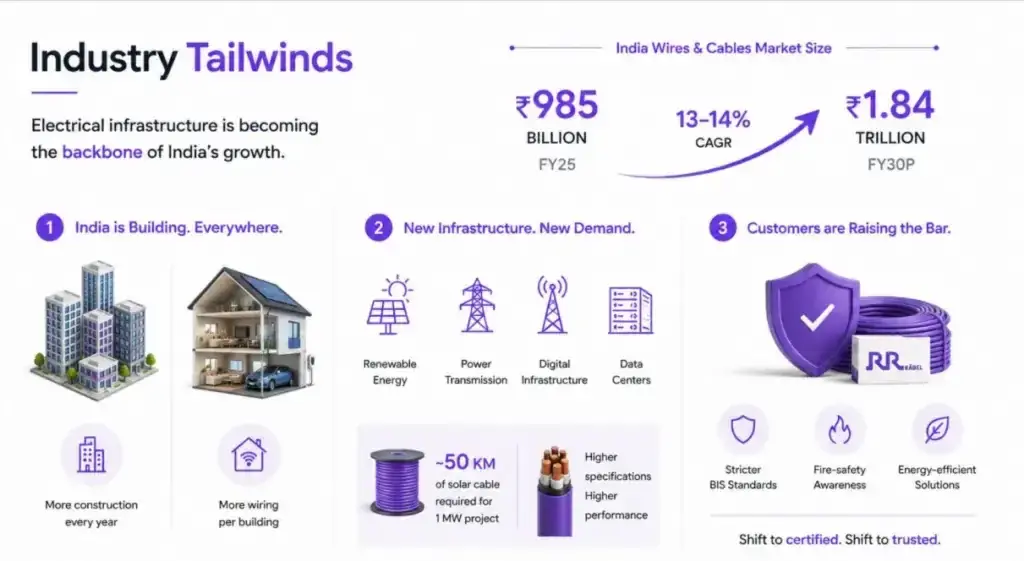
For decades, wires and cables didn't excite anyone. They were the products hidden behind walls bought only when something broke, never thought about otherwise. That perception is now changing fast.
As India becomes more urban, more electrified and more digitally connected, electrical infrastructure has quietly turned into something bigger than a construction input. It's becoming the backbone of how homes, industries and cities actually function. The numbers reflect this shift: India's wires and cables industry was worth nearly ₹985 billion in FY25, and it's expected to almost double to ₹1.84 trillion by FY30 growing at a strong 13–14% CAGR.
So what's driving this growth? Three forces stand out.
The first is simple: India is building, everywhere. Every new apartment, office tower, factory or warehouse needs kilometres of wiring before a single light can switch on. Government housing programmes, rising urbanisation and steady residential demand keep adding new construction every year and each new building needs its own wiring from scratch. But there's a second layer to this story: buildings themselves are becoming more electricity-hungry. Smart homes, home automation and EV charging points all need far more wiring than a conventional building did a decade ago. So it's not just more buildings it's more wiring per building.
The second driver lives outside buildings altogether. India's push into renewable energy, power transmission and digital infrastructure is creating an entirely new appetite for specialised cables. Consider this: a single 1 MW solar project alone needs nearly 50 kilometres of solar cable. Add to that the cables needed to expand power transmission networks, plus the ones powering 5G towers, fibre-optic lines and data centres and you get a segment where demand isn't just growing, it's getting more technical. These aren't ordinary wires; they're built to tighter specifications, which raises the bar for manufacturers who can actually deliver them.
The third shift is happening inside the customer's head. Buyers are steadily moving away from cheap, unbranded products and toward certified, trusted names. Stricter BIS safety standards, rising fire-safety awareness, and demand for energy-efficient products like BLDC fans and smart switchgear are all pushing the market in the same direction toward organised, quality-focused players.
Put these three together, and a bigger story emerges. India isn't just going to consume more electrical products the kind of products it consumes is changing too. And that raises the real question: how is RR Kabel positioning itself to capture this shift?
The ₹1,200 Crore Bet on the Future
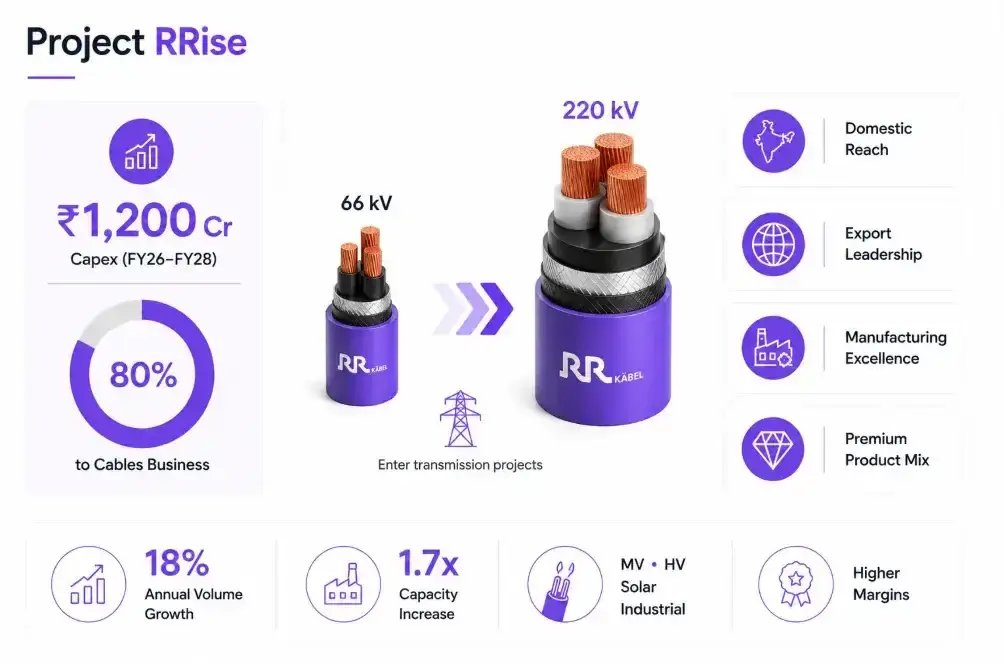
A growing market doesn't hand out free wins. It rewards the companies with the capacity, product portfolio and execution to capture a larger share of demand. For RR Kabel, that roadmap is called Project RRise a three-year strategy spanning FY26 to FY28, designed not just to expand the business, but to improve its quality.
At the centre of RRise is a ₹1,200 crore capital expenditure programme, with nearly 80% of the investment directed towards the cables business. The reason is simple: while housing wires remain RR Kabel's largest category today, cables open the door to faster-growing markets infrastructure, renewable energy, industrial projects and exports. The expansion is expected to lift the company's manufacturing capacity by nearly 1.7x. More importantly, it upgrades RR Kabel's capabilities from producing cables up to 66 kV today to 220 kV allowing it to bid for higher-voltage transmission projects that were simply out of reach before.
Capacity, however, is only one part of the strategy. Project RRise rests on four complementary pillars: expanding into underpenetrated domestic markets, strengthening export leadership, enhancing manufacturing capabilities, and steadily shifting the product mix towards higher-value products. That includes medium- and high-voltage cables, solar cables, industrial specialty cables and fire-safety solutions such as LS0H wires categories where technology, certification and engineering capability create a stronger edge than price alone.
The ambition shows up clearly in the targets management has laid out: 18% annual volume growth in the Wires & Cables business, alongside steady improvement in profitability through better product mix, operating leverage and scale. Whether those targets are met will come down to execution, not guidance. The more immediate question is where this growth is likely to show up first and that becomes clearer once we look inside RR Kabel's individual business segments.
Why Copying RR Kabel Isn't That Easy
In the wires and cables industry, products often look similar on the shelf. But beneath that similarity lies a business built on trust, consistency and execution. Once a contractor, developer or industrial customer gains confidence in a particular brand, switching isn't as simple as choosing a cheaper alternative. For RR Kabel, that trust has been built over years through manufacturing capability, distribution reach and product reliability not pricing alone.
Its distribution network is one of the strongest pillars of that advantage. RR Kabel reaches the market through more than 7,200 distributors and dealers, supplying over 2.15 lakh retailers across the country. Just as importantly, it has enrolled over 6.65 lakh electricians under its loyalty programme. This matters because in the housing wire segment, the purchase decision is often influenced by the electrician rather than the homeowner. And this is precisely why the moat is hard to buy rather than build: a well-funded competitor could open a warehouse and hire a sales team overnight, but it can't manufacture years of dealer trust or electrician loyalty on the same timeline. Relationships like these are earned transaction by transaction, not purchased with a bigger budget.
The second layer of the moat sits inside the factory. RR Kabel manufactures critical inputs such as PVC, XLPE and Low Smoke Zero Halogen (LS0H) compounds in-house, along with aluminium rods. This backward integration gives the company greater control over quality, consistency and product formulation, while reducing dependence on third-party suppliers. It also enables faster development of specialised products such as LS0H fire-safety wires and electron beam cross-linked cables categories where performance standards are becoming increasingly important across infrastructure, industrial and export markets.
The final advantage comes from combining this manufacturing depth with global acceptance. RR Kabel exports to over 66 countries and holds 42 international certifications, allowing its products to meet some of the world's most demanding technical standards. These certifications aren't earned overnight they require rigorous testing, consistent manufacturing processes and years of compliance history. A new entrant could, in theory, copy RR Kabel's product specifications on paper. What it can't copy is the decade of manufacturing discipline, dealer relationships and regulatory track record standing behind them. That gap between what's visible on a spec sheet and what's actually defensible on the ground is the real moat.
Turning Fans and Switches into a Brand People Want
Winning in FMEG isn't about selling more electrical products it's about building a consumer brand. Nobody chooses a ceiling fan or a designer switch the way they choose the wiring hidden behind their walls; design, aesthetics, energy efficiency and brand perception matter far more than raw functionality. Recognising this shift, RR Kabel created RR Signature its premium sub-brand to move beyond functional electrical products and into aspirational consumer electricals.The strategy revolves around premiumisation rather than scale alone. Today, fans contribute nearly half of the FMEG business, followed by lighting at around 30%, with switches, appliances and other categories making up the rest. But the more telling number is this: premium and mid-premium products already make up close to 20% of segment revenue, and management is steadily pushing that mix higher because differentiated design, technology and features allow these products to command stronger pricing power than commodity offerings. The shift is already visible in fans, where RR Signature now accounts for nearly 60-65% of category revenue, driven by premium launches and a growing presence in modern retail.
The ambition extends beyond expanding the product catalogue. RR Signature is gradually building a broader consumer electrical ecosystem. Alongside designer fans and decorative lighting, the portfolio now includes kitchen appliances and the company is selling these through its existing dealer network, which means it can cross-sell across categories without having to build a new distribution system from scratch. Dedicated field sales teams are strengthening retail visibility in underpenetrated markets, while the business simultaneously builds its footprint across e-commerce and organised retail.
This push is backed by a broader shift across the FMEG industry itself. As energy-efficiency regulations tighten and disposable incomes rise, consumers are steadily upgrading to BLDC fans, smart lighting and premium electrical accessories. Rather than compete on price, RR Signature is positioning itself where technology, design and brand preference increasingly decide the sale. If Project RRise is about strengthening RR Kabel's industrial and infrastructure franchise, RR Signature is its parallel bet building a premium consumer electrical franchise that can become a meaningful second growth engine alongside its dominant wires and cables business.
"The bulk of the billions in Berkshire Hathaway has come from the better businesses." — Charlie Munger
Two Businesses, Two Different Winning Stories
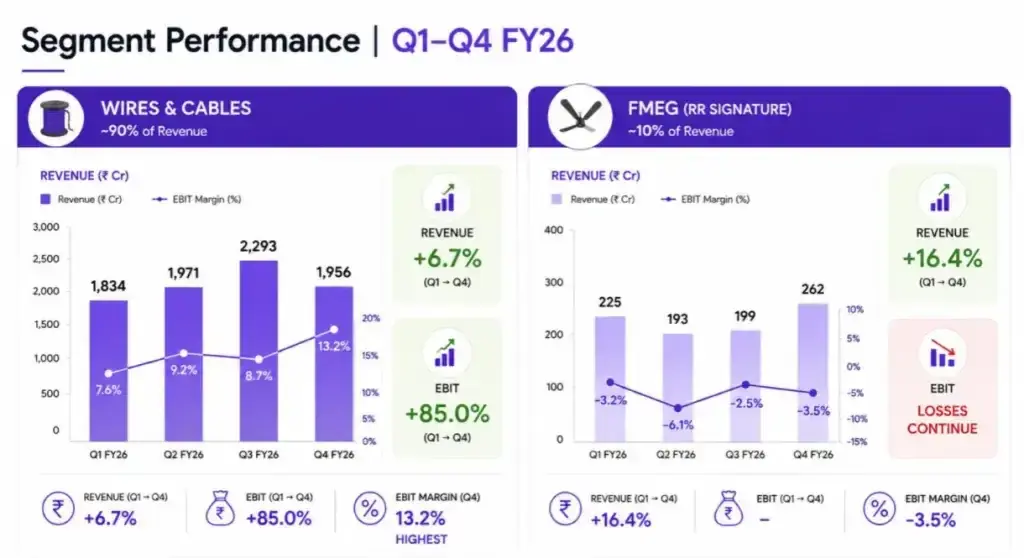
FMEG tells a different kind of story, but one that matters just as much. Quarterly revenue stayed broadly flat, in the ₹200–260 crore range on its own, an unremarkable number. But look below the revenue line, and something more interesting emerges: EBIT losses narrowed from ₹7.1 crore in Q1 to ₹4.9 crore in Q3, even as revenue barely moved. That combination flat revenue, shrinking losses is the real signal. It means the improvement isn't coming from selling more; it's coming from selling better, through premiumisation, tighter cost discipline and a healthier product mix under RR Signature. In other words, unit economics are improving, not just the product catalogue.
Together, the two segments are pulling in the same direction from different starting points. Wires & Cables is proving that scale and profitability can grow together; FMEG is proving that profitability can improve even before scale does. If both trends hold, RR Kabel isn't just growing its revenue it's steadily improving the quality of every rupee that revenue generates.
"The ideal business is one that earns very high returns on capital." — Warren Buffett
Revenue growth alone never tells the complete story. Learn how investors separate quality growth from weak growth in Operating Profit Margin vs Net Profit Margin: Which Tells the True Story?
RR Kabel Financials: Selling More, and Selling Smarter
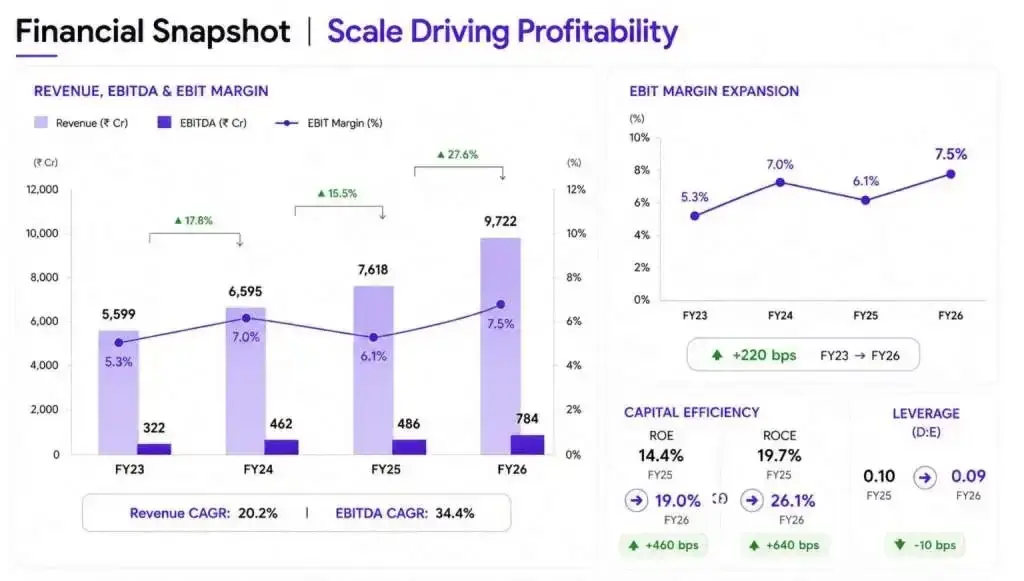
Revenue growth alone rarely tells the full story margins reveal whether that growth is actually creating value. On that front, RR Kabel's numbers stand out. Revenue climbed from ₹5,599 crore in FY23 to ₹9,722 crore in FY26, a three-year CAGR of nearly 20%. Part of this reflects copper and aluminium price movements, which are largely passed through to customers rather than absorbed. But strip that out, and the more telling driver is steady volume growth across both domestic and export markets with management consistently pointing to healthy demand from housing, infrastructure, industrial projects and exports. In short, this is a company selling more, not just benefiting from pricier raw materials.
The more revealing number sits below revenue. EBIT nearly doubled from ₹297 crore in FY23 to ₹729 crore in FY26 while EBIT margins widened from 5.3% to 7.5% over the same period. That's not something higher revenue alone can produce; it takes a richer product mix, better operating leverage, and a growing share of higher-value offerings like specialty, solar and industrial cables. Put simply: RR Kabel isn't just selling more, it's selling better. And that pairing volume-led growth with expanding margins is a far higher bar to clear than revenue growth on its own. It's also precisely the bar Project RRise is designed to keep clearing, as the company shifts from building capacity to putting it to work.
Looking beyond margins, experienced investors also evaluate how efficiently a company generates profits from shareholder capital. Read Return on Equity (ROE) Explained: A Step-by-Step Guide for Investors to understand one of the market's most important quality metrics.
"A great company keeps working after you are not; a mediocre one won't do that." — Charlie Munger
Key Risks: What Could Go Wrong on the Way Up
Project RRise gives RR Kabel a clear roadmap, but execution never happens in a vacuum. The most immediate risk is commodity price volatility copper and aluminium make up a significant share of production costs, and while RR Kabel generally passes these price movements on to customers, that pass-through isn't instant. A lag between rising input costs and revised prices means a sharp swing in copper can distort a single quarter's margins, even if the full-year picture evens out; dealers add to this noise too, stocking up ahead of expected price hikes and holding back when a fall looks likely.The second risk sits in RR Kabel's export business, which contributes roughly 30% of revenue, with Europe as its largest overseas market. Exports carry a dependency the domestic business doesn't on global shipping routes, freight costs and geopolitical stability. The Red Sea crisis made this concrete, causing shipment delays, container shortages and temporary volume disruptions. Freight conditions have since improved, but the episode is a reminder that a quarter can wobble for reasons that have nothing to do with the company's own execution. The final and more consequential risk is execution itself: Project RRise rests on a ₹1,200 crore expansion meant to lift capacity by nearly 1.7x while shifting the business toward higher-value cable segments a bet that assumes demand stays strong enough to absorb the new capacity and that the premium product mix builds at the pace management expects.
Together, these risks point to three things worth tracking in the quarters ahead: how quickly margins recover after commodity price swings, whether export growth holds up as global freight and trade conditions shift, and how capacity utilisation trends as RRise's expansion comes online. None of these risks are unique to RR Kabel what will separate its outcome from its peers is how well it manages each of them, one quarter at a time.
Every investment comes with uncertainty. Understanding how to balance opportunity against downside is equally important our article Risk vs Reward: Why Investor Psychology Matters More Than Returns explores this in detail.
"It's not whether you're right or wrong that's important, but how much money you make when you're right and how much you lose when you're wrong." — George Soros
Explore our Products
Research Framework

Emerging Titans
Combination of quantitative analysis, industry tailwinds, and management assessment - SPRINT investment philosophy

Tiny Titans
Heavy emphasis on scuttlebutt research, plant visits, and early on-ground signals
The Real Test Is Still Ahead
The direction of RR Kabel's business will continue to be shaped by the structural tailwinds already discussed throughout this article. India's ongoing investment cycle across housing, infrastructure, renewable energy and industrial manufacturing continues to expand the addressable market, while the industry's shift towards higher-specification products aligns closely with RR Kabel's increasing focus on specialty, solar and industrial cables.Management has laid out ambitious but measurable targets under Project RRise: 18% annual volume growth in the Wires & Cables business and EBIT margins of around 10.5% by FY28, driven by capacity expansion, a richer product mix and operating leverage. Achieving those targets, however, will depend on the same variables discussed in the risk section commodity price volatility, export demand, and the company's ability to absorb its expanded capacity while continuing to move up the value chain.
For investors, the more useful question isn't whether these targets sound ambitious it's whether the underlying business continues moving in the right direction. Sustained volume growth, improving margins, rising contribution from higher-value cables, better capacity utilisation, and the path to FMEG profitability under RR Signature will be the clearest indicators of whether RR Kabel is successfully translating its ₹1,200 crore investment programme into long-term value creation.
If you'd like to evaluate companies like RR Kabel using a structured approach, start with A Fundamental Checklist: How to Research a Stock in 1 Hour—a practical framework every long-term investor should know.
FAQs
What does RR Kabel actually make?
+RR Kabel makes wires and cables (house wires, industrial wires, power cables, specialty cables, solar cables) plus a smaller FMEG portfolio — fans, lighting, switches, switchgear and appliances. Wires & Cables account for nearly 90% of revenue.
Why is a "boring" industry like wires and cables suddenly interesting to investors?
+Because demand is shifting from generic commodity products to specialized, certified ones driven by data centres, solar farms, metro rail and stricter safety standards. India's wires and cables market is projected to nearly double from ₹985 billion in FY25 to ₹1.84 trillion by FY30.
What is Project RRise, and why does it matter?
+It's RR Kabel's three-year (FY26–FY28) strategy backed by a ₹1,200 crore capex plan, with 80% going into the cables business. It aims to expand manufacturing capacity by ~1.7x and upgrade capability from 66 kV to 220 kV cables, opening the door to higher-value transmission projects.
What actually protects RR Kabel from competitors undercutting it on price?
+Its distribution network (7,200+ dealers, 2.15 lakh+ retailers, 6.65 lakh enrolled electricians) and in-house manufacturing of key inputs like PVC, XLPE and LS0H compounds — both of which take years to replicate and can't simply be bought.
What are the biggest risks to the RR Kabel growth story?
+Three main ones: commodity price volatility (copper/aluminium costs with lagged pass-through), export exposure to global shipping and freight disruptions (~30% of revenue, Europe being the largest market), and execution risk on whether the ₹1,200 crore capacity expansion gets absorbed by real demand.

High growth stock specialist, Value Educator
Shashank Mahajan is an equity research professional with over 12 years of experience in identifying high-potential SME and micro-cap stocks at an early stage. He follows a rigorous scuttlebutt research–driven approach, combining on-ground insights with deep financial analysis. Shashank specializes in uncovering under-researched and under-owned companies with strong management quality and long-term growth potential. Through disciplined research and early identification, he focuses on spotting tomorrow’s market leaders before they enter the mainstream investor radar.

Zen Technologies: Revenue Fell After a Big Win




PNG Jewellers: A 194-Year-Old Name Goes National

Explore our Products
Research Framework
Emerging Titans
Combination of quantitative analysis, industry tailwinds, and management assessment - SPRINT investment philosophy
Tiny Titans
Heavy emphasis on scuttlebutt research, plant visits, and early on-ground signals


 Orders
 Subscription
 Share with friends


Required Details
₹23999.00
(12 month subscription)
As per SEBI regulations, all users are mandated to complete the KYC that is validated for 1 year. Post payment, you will be redirected to the KYC screen


No comments yet. Be the first to comment!