
Happy Forgings: The Quiet Forging Champion
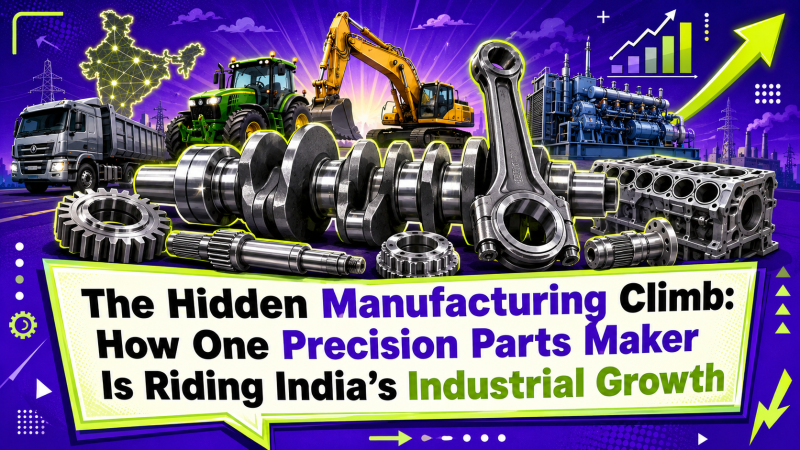
We usually notice growth only when it becomes visible.
A new highway, a new factory, a new tractor in a farmer’s field, a new truck fleet on the road, a new wind project outside the city and a new industrial plant is coming up on the edge of town.
But the truth is, none of these things move on their own.
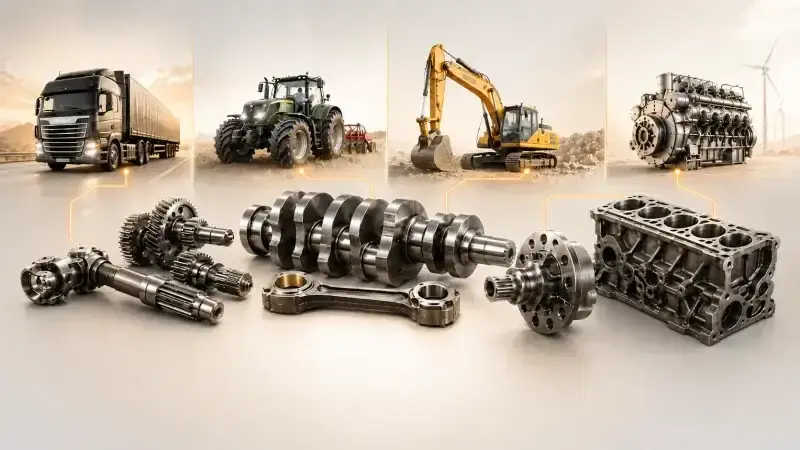
Every large machine depends on small, hidden components that most people will never see. These parts do not get attention. They do not carry a brand name that consumers remember. They do not appear in advertisements.
Yet they carry pressure every day.
They carry the weight of goods moving across India. They carry the strength of tractors used by farmers.
They carry the reliability of industrial engines. They carry the performance of heavy machinery used in roads, mining, energy, and manufacturing.
That is why some of the most interesting companies are not always the ones selling the final product. They are the ones quietly sitting inside the product, making sure it does not fail.
“Quality means doing it right when no one is looking.” — Henry Ford
One such company is Happy Forgings Limited.
The Company's core business
Happy Forgings is a manufacturer of forged and precision made parts.That seems like a technical term, but it's a very simple concept.
If a truck, tractor, heavy equipment system, wind application, oil and gas machine or similar heavy equipment requires a heavy part, it must be robust or substantial and not flimsy or superficial. It needs to be able to withstand pressure, heat, vibration, weight, movement and long usage cycles. Failure in such components can halt the machine, or pose safety hazards.
Forging is now important.
The process of forging is a manufacturing process which involves shaping a metal under pressure to give it strength. Once forged, the part is frequently further processed by machining to get the correct size, surface and tolerances. That's why the final part is ideal for applications such as use in engines, axles, shafts, gears, crankshafts and other critical systems.
Simply put, Happy Forgings doesn't simply bend or shape metal. It produces parts which require strength, precision and reliability.
A manufacturing firm that produces crude metal components operates on the basis of providing the lowest costs. A complex, safety critical, precision machined parts manufacturer is at a competition for capability, quality, approvals, relationships, and consistency.
Why This Business Is Not as Simple as It Looks
One error many investors make with manufacturing companies is assuming that they are only suitable for the manufacturing sector. They examine products and take it for granted that they're commodities.
The outside of a forged component might appear like the component it is forged from. For the customer, however, it's more than that. It is an approved and tested component designed to be a mission-critical element that will work correctly over the course of time.
Original equipment manufacturers don't just swap out such suppliers willy-nilly. Prior to integration into the system it is typical for a supplier to be required to complete lengthy approval cycles, quality checks, testing and production validation.
This provides a significant business benefit.
It can take time to win over a customer. Approval of the product can take time. However, after the company is approved and it begins to supply regularly the relationship can become sticky.
Hence the business should not be assessed based on the quarterly earnings alone. It must be understood across product approvals, customer relationships, through new orders, in growth of capacity, segment mix, quality of margins and execution over the long-term.
Economic Moat Explained: Why Some Companies Stay Dominant for Decades
The Big Shift: Forging to Precision Engineering
Happy Forgings is looking to transform itself from a forging business into a precision engineering business.
There is a difference between the two.
A basic forging company is a business that offers shaped metal components. A precision engineering company provides more finished, more accurate, more complex, and more critical higher value parts to the final machine.
The change is significant as the value added elements can help enhance the realization, margin and strengthen customer relationships.
A different level would be forging and selling basic components. Basic forged components would be a different level of selling. A higher value type of sell is to sell precise-machined, safety-critical parts.
Happy Forgings is attempting to penetrate into that more expensive space.
This can be seen by the high machining share of the company. For Q1 and Q2 FY26, management emphasized that the machining revenue is approximately 88% of their total revenue. That's significant because the company has been able to keep its margins solid despite volatile raw material prices and sluggish global demand, in part due to the machining segment.
The Segment Mix: A Business Slowly Becoming More Diversified
Happy Forgings serves multiple end-user industries. This is one of the key strengths of the business.
The company is not dependent on just one sector. Its revenue comes from commercial vehicles, farm equipment, passenger vehicles, off-highway equipment, and industrial applications.
Commercial vehicles remain a major contributor. This segment of business includes component used in trucks and heavy vehicles. Demand is linked to infrastructure activity, cement, steel, construction, logistics, and broader economic growth. When India builds more roads, moves more goods, and sees higher infrastructure activity, the commercial vehicle ecosystem benefits.
Farm equipment is another major segment. This includes tractor and agriculture machinery components. India’s tractor demand is supported by rural income, monsoon conditions, crop output, and farm mechanization. This segment provides domestic stability, although export-linked demand in regions such as the US and Europe can remain cyclical.
Passenger vehicles are currently a smaller but growing part of the business. The company has been ramping up dedicated production lines for key SUV and passenger vehicle platforms. Management has indicated that this segment can scale meaningfully over the next two years.
Industrials is the segment that can change the way investors look at the company. This includes applications in wind energy, power generation, oil and gas, railways, digital infrastructure, data center-related engines, and heavy engineering. If this segment grows, Happy Forgings may gradually move away from being viewed as only an auto ancillary company.
The bigger point is this: the company’s future mix may look very different from its past mix.
Management has indicated that over time, commercial vehicles and farm equipment together may move closer to around half of the business, while the balance could come from passenger vehicles, industrials, off-highway, and other segments. That would make the business more diversified and potentially less dependent on one cycle.
Segment-Wise Revenue Analysis: How to Find a Company's True Growth Engine
Domestic Demand Impact on the Business
Domestic business was up nearly 7% YOY in Q1 FY26 and exports were affected by sluggish demand for farm equipment, off-highway, and commercial vehicles, as well as due to tariff uncertainty.
Domestic sales continued as the driver of growth in the second quarter of FY26, bolstered by commercial vehicles, farm equipment, industrials and passenger vehicles. Global demand continued to be low, customers were destocking and tariff uncertainty was a concern for export markets.
Domestic business grew well in Q3 FY26 driven by good demand across key segments including commercial vehicles and farm equipment. The export linked revenue was the first to stabilize, but the global recovery was not yet visible, when direct and indirect exports were combined.
That's important as the company is being supported by India's domestic economy until the international markets bounce back.
Financial performance: FY26 reflects strong earnings quality
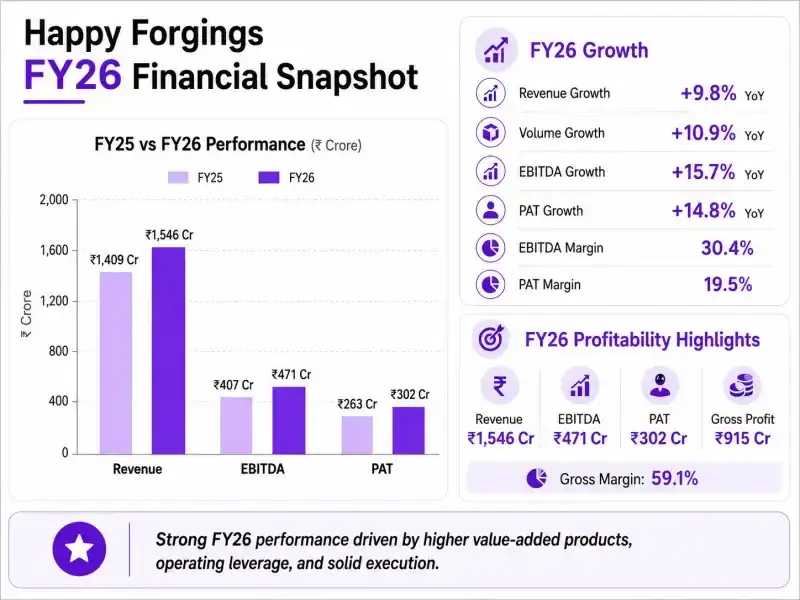
In the FY26, Happy Forgings has posted a healthy performance, not just in terms of revenue growth, but also profitability. Revenue from operations grew to approximately 1,546 crore for the whole year, representing 9.8% year-on-year growth. Continued growth in volume by approximately 10.9% complemented the company's operations in a mixed environment where the domestic market demand was still strong but exports were also still facing pressures.
The more prominent highlight was margin growth. EBITDA rose to approximately 471 crore, rising 15.7% year-on-year, ahead of revenue growth. EBITDA margin benefited from a more diversified product mix, from operating leverage and from execution and was now at 30.4%. This is significant for a manufacturing company because it basically implies that the company is growing without compromising on profits.
PAT for FY26 stood at around 302 crore, growing 14.8% year-on-year, while PAT margin improved to 19.5%. This means that the company's revenue growth is now translating into a robust bottom-line. Gross profit also stayed strong at approximately 915 crore with gross margin at 59.1%, indicating sustainable strong revenue from value-added products and machining.
From FY26 financial we can understand that Happy Forgings performed well in a balanced manner. Revenue increased moderately while Profit increased briskly. It signifies the company's emphasis on precision-machined components, focus on higher value added products, operating efficiency and focused execution. The company has given good results to its shareholders in the most uneven year of global demand with recording its highest annual profitability in the company's history making FY26 an important year in the company's long-term growth journey.
Why Margins Matter More Than Headline Growth
Many investors get attracted to revenue growth. In manufacturing, looking at revenue alone can be misleading.
A company may grow revenue by selling more products that have low margin. It can expand through this process and still fail to create value if margins are weak, debt is high, or working capital is stretched.
“Costs do not exist to be calculated. Costs exist to be reduced.” — Taiichi Ohno
Happy Forgings’ story is different because the company has protected margins even during a difficult operating period.
There are five reasons behind this.
First, the company has a high value-added machining share. Machining allows it to move beyond basic forging and earn better realization.
Second, the company manufactures complex and safety-critical components. These are not easy commodity parts.
Third, the company has a diversified product mix. It serves commercial vehicles, farm equipment, passenger vehicles, industrials, and off-highway.
Fourth, the company has operating discipline. Management has repeatedly highlighted working capital efficiency, cash generation, and balance sheet strength.
Fifth, higher-value segments are expected to scale over time. Passenger vehicles, industrials, heavy components, wind, oil and gas, and export-linked businesses can improve the business mix.
Revenue growth tells us the company is moving. Margins tell us whether the movement is valuable.
EBITDA Explained: Why Investors Use It — And When It Misleads
The ₹650 Crore Capex: The Most Important Future Trigger
The biggest long-term trigger for Happy Forgings is its ₹650 crore capex plan.
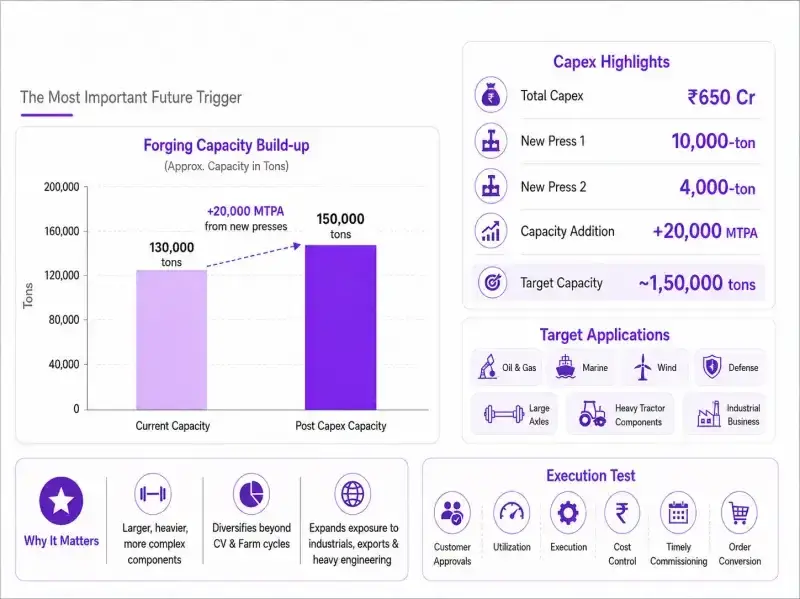
This capex is aimed at building best-in-class forging infrastructure for heavyweight precision components. The company plans to serve complex and high-value-added parts for sectors such as oil and gas, marine, wind, and defense.
Management has also spoken about commissioning a 10,000-ton press and a 4,000-ton press, which together can add approximately 20,000 MTPA capacity. With this, the company’s total forging capacity is expected to move close to 1,50,000 tons.
This capex is important because it can move the company into larger, heavier, and more complex components.
The company has also mentioned opportunities in large axles, wind sector components, heavy tractor components, industrial business, and heavy programs. Management believes these investments can diversify the complete business over the next few years.
This is not a small point.
If Happy Forgings executes this capex properly, it can reduce its dependence on traditional commercial vehicle and farm equipment cycles. It can increase exposure to industrials, passenger vehicles, exports, heavy engineering, wind, oil and gas, and possibly defense-related opportunities.
But there is one important caution.
Capex does not automatically create value.
Machines do not create wealth by themselves. Customer approvals, utilization, execution, cost control, timely commissioning, and profitable order conversion create wealth.
So the capex is a big opportunity, but it is also the biggest execution test.
Capital-Intensive Businesses Explained: Risks, Economics, and Investor Insights
The Export Challenge
For FY26, exports remained the softer part of Happy Forgings’ growth story, even though the overall business delivered a strong year. The company’s domestic business continued to provide the main support, while export-linked demand was affected by weak global conditions in commercial vehicles, farm equipment, and off-highway segments.
However, FY26 also showed early signs that the export picture may be stabilizing rather than worsening. By the later part of the year, management commentary and market updates indicated initial signs of recovery in exports, supported by improving visibility and a better mix of direct and indirect export-linked revenues. This is important because export recovery can add another growth lever on top of the already strong domestic base.
The long-term export opportunity should not be ignored. Happy Forgings is not only trying to export more of its existing products; it is also preparing to enter heavier, more complex, and higher-value components through its ongoing CAPEX. As the company scales industrial, passenger vehicle, and heavy precision component businesses, exports can become more meaningful over the next few years.
In simple terms, FY26 exports were a challenge. Domestic demand carried the business, while exports remained weak but showed signs of bottoming out. If global commercial vehicle, farm equipment, off-highway, and industrial demand improves in FY27 and beyond, exports can again become an important contributor to growth.
Segment Outlook
The commercial vehicle segment remains important for the company. Domestic demand is supported by infrastructure spending, freight activity, GST-related affordability benefits, and replacement demand. However, global commercial vehicle markets remain soft, especially in North America and Europe.
Farm equipment has been supported by domestic tractor demand, favorable rural conditions, and better agricultural output. Indian tractor demand has remained healthier than global farm equipment demand. The US and European markets have been weak or range-bound, but domestic farm equipment demand provides stability.
Passenger vehicles are a small but promising growth area. The company has gained traction through SUV platform ramp-up and expects this segment to contribute more meaningfully over the next few years. Passenger vehicles can become an important diversification lever.
Industrials are the most interesting long-term segment. Demand from wind energy, power generation, oil and gas, railways, data centers, and digital infrastructure can support the company’s move toward a broader precision engineering platform. If industrials scale well, the market may stop viewing Happy Forgings only as an auto ancillary stock.
Off-highway has been weak, both domestically and globally. Slower project awards, infrastructure delays, and global equipment demand weakness have affected this segment. However, over the medium term, construction, mining, infrastructure, and heavy equipment demand can support recovery.
What Makes the Stock Worth Tracking
Happy Forgings is a company to watch because the company is not just expanding but enhancing the quality of its earnings in FY26.
The company reported revenue from operations of approximately 1,546 crore for the full financial year (FY26), despite facing a mixed demand climate and demonstrating healthy growth. More significantly, the profitability profile grew even better. EBITDA was approximately 471 crore and the margin increased to approximately 30.4%. PAT margin increased to around 19.5% from around 16.6% and PAT was at ₹302 crore.
It does not just mean that the company is after growth. It is transforming revenues into good operating profit and bottom line profit. This is key in any manufacturing company, where a lot of businesses expand their sales, but fall short of their margins.
The main reason for this is the company's commitment to more profitable products. Machined and forged were the two largest categories and accounted for almost 89% of revenue in FY26, highlighting Happy Forgings' shift from being a simple forging supplier to a more value-added business. This helps to achieve better realization, higher customer stickiness and better profitability.
The company is also making investments on the next growth leg of its business with its ₹650 crore heavy components capex. This growth could lead to new parts of the industry in larger, more sophisticated components used in industrial, wind energy, oil and gas, marine, mining, defense and heavy engineering applications. With proper implementation, over time this can contribute to decreasing the need for traditional commercial vehicle and farm equipment cycles for Happy Forgings.
With good financials in FY26, decent margins, high machining share, balance sheet ease, some diversification and a solid capex growth trajectory the stock is definitely worth a watch.
How to Analyze a Mid-Cap Company – A Complete, Practical Framework
Key Risks
The first risk is the cyclical risk. Economic activity declines can lead to slowdowns in commercial vehicles, farm equipment and off-highway equipment. Revenue growth may be impacted if there's a slowing of domestic or global demand.
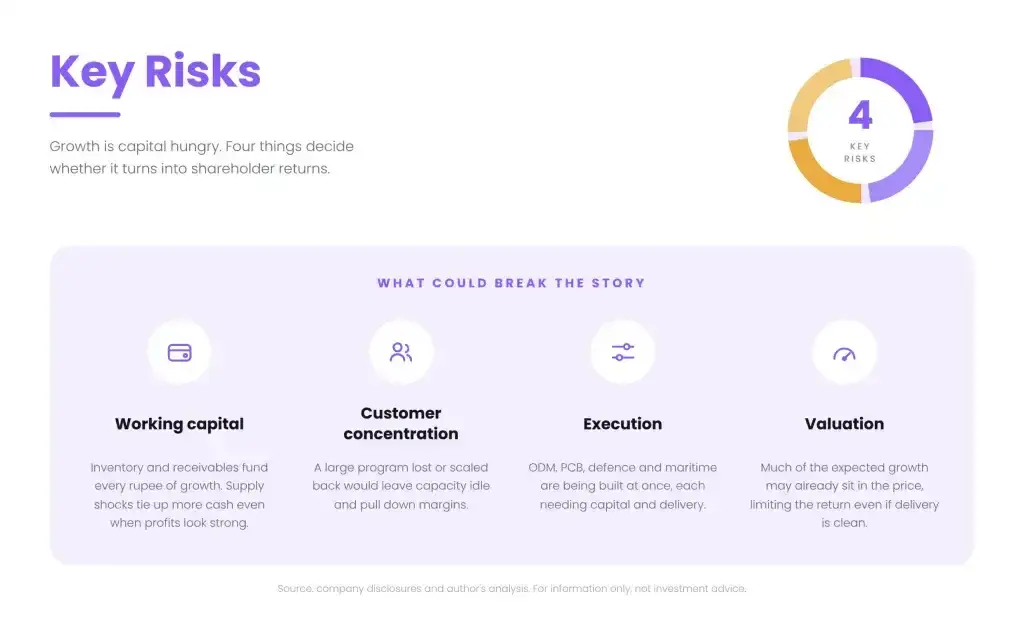
The second risk is the weakness in exports. Business has continued to be tough in Europe and North America for commercial vehicles, farm equipment and off-highway equipment. However, in the event of global weakness, recovery in exports could be delayed.
The third risk is capex execution. The capex of ₹650 crore is a big opportunity as well as a great challenge. However, delayed, overspending, slower rates of approval or weak utilization rates can lower returns.
Customer concentration and OEM dependence is the fourth risk. The volume, schedules and pricing can be influenced by large OEM customers. Stickiness is a result of long approval cycles, but so is dependence.
The fifth risk is "margin fluctuation". Margins are subject to changes in raw material prices, energy costs, forex, business mix and utilization. The margins are good today, but investors shouldn't think that margin can only rise.
“Risk comes from not knowing what you’re doing.” — Warren Buffett
Explore our Products
Research Framework

Emerging Titans
Combination of quantitative analysis, industry tailwinds, and management assessment - SPRINT investment philosophy

Tiny Titans
Heavy emphasis on scuttlebutt research, plant visits, and early on-ground signals
Areas Where Investors Should Keep an Eye On
Investors should track revenue growth, but should not rely on it entirely. They should check where exactly is the growth coming from volume, new businesses, better realization, or only price changes.
They should track realization per kg because this indicates whether the company is moving toward higher-value products.
They should track machining share because it is a key margin lever.
They should track EBITDA margin and whether the company can sustain the 29% to 31% range over the medium term.
They should track the industrial and passenger vehicle mix because these segments can reduce dependence on commercial vehicles and farm equipment.
They should track the ₹650 crore capex timeline, especially commissioning of new presses, customer approvals, utilization, and revenue ramp-up.
“Know what you own, and know why you own it.” — Peter Lynch
They should track export recovery because global demand can become a meaningful growth lever if conditions improve.
They should track balance sheet strength because manufacturing growth funded with discipline is far better than growth funded with excessive debt.
Conclusion
Happy Forgings is a precision engineering and forging firm which is slowly stepping up to increasingly complex, diversified, higher-value components. Commercial vehicles and farm equipment represent its current business and future growth may be from passenger vehicles, industrials, heavy components, exports, wind energy, oil & gas, marine and defense.
“The big profits I have made were through very long planning, waiting and watching.” — Philip Fisher
Happy Forgings is not only a forging company, it's beginning to shift its focus to higher-value precision engineering. In FY26, despite weak export demand, revenues were positive, margins were healthy, value-added machining share was good and profitability had improved.
The major trigger coming in the near future is the capex of ₹650 crore. A successful implementation of this expansion could enable the company to venture into thicker, more complex components in industrials, exports, wind energy, oil and gas, marine, and defence-related business.
Nevertheless, investors will need to continue keeping an eye on risks like cyclical demand, export slowdown, customer concentration, margin fluctuations, and capex execution. The share is a stock to keep an eye on but the actual decision comes down to investors' value comfort, progress with execution and their individual risk appetite.
Want to understand more such hidden manufacturing and industrial growth stories before they become obvious? Comment Hidden
FAQs
What does this company actually manufacture?
+The company manufactures forged and precision-machined components used in heavy-duty applications. These components go into areas such as commercial vehicles, farm equipment, passenger vehicles, off-highway equipment, industrial engines, wind energy, oil and gas, and other engineering applications. In simple terms, it makes strong and critical metal parts that help machines perform reliably.
Why are forged components important?
+Forged components are important because they are used in machines that face pressure, heat, vibration, load, and continuous movement. A weak component can affect the performance of the entire machine. Forging gives metal greater strength, and machining gives it the required precision. That is why these parts are used in engines, axles, shafts, gears, crankshafts, and other critical systems.
Why did margins remain strong even when exports were weak?
+Margins remained strong mainly because of the company’s value-added product mix, high machining share, operating efficiency, and focus on precision components. Even when export demand was weak and raw material prices were volatile, the company was able to protect profitability because it was not only selling basic commodity-type components.
Is this a short-term trading story or a long-term execution story?
+This is more of a long-term execution story. The business depends on customer approvals, capacity ramp-up, product development, industry cycles, and order conversion. The opportunity can be meaningful, but it will likely play out over several years rather than in one or two quarters.
Why is the ₹650 crore capex important?
+The ₹650 crore capex is important because it can help the company enter heavier, more complex, and higher-value precision components. This can open opportunities in industrials, oil and gas, wind, marine, defense, mining, and other heavy engineering applications. However, capex alone does not guarantee growth. The real value will come from timely commissioning, customer approvals, utilization, and profitable revenue conversion.

High growth stock specialist, Value Educator
Shashank Mahajan is an equity research professional with over 12 years of experience in identifying high-potential SME and micro-cap stocks at an early stage. He follows a rigorous scuttlebutt research–driven approach, combining on-ground insights with deep financial analysis. Shashank specializes in uncovering under-researched and under-owned companies with strong management quality and long-term growth potential. Through disciplined research and early identification, he focuses on spotting tomorrow’s market leaders before they enter the mainstream investor radar.

Zen Technologies: Revenue Fell After a Big Win



PNG Jewellers: A 194-Year-Old Name Goes National
Explore our Products
Research Framework
Emerging Titans
Combination of quantitative analysis, industry tailwinds, and management assessment - SPRINT investment philosophy
Tiny Titans
Heavy emphasis on scuttlebutt research, plant visits, and early on-ground signals


 Orders
 Subscription
 Share with friends
 Logout


Required Details
₹23999.00
(12 month subscription)
As per SEBI regulations, all users are mandated to complete the KYC that is validated for 1 year. Post payment, you will be redirected to the KYC screen


No comments yet. Be the first to comment!