
Mid Cap Stocks With Strong Earnings (2026)

Let’s be honest, 2025 was a brutal reality check for most investors. While many hoped for a bull run, portfolios mostly saw red as the market ruthlessly punished companies that were just "stories" without real profits.
Think of the recent market drop as a necessary detox. It cleared out the gamblers and the weak companies that didn't belong here. The days of making 'easy money' by accident are over. In 2026, you can't rely on luck anymore. The only way to win now is to find the solid businesses that kept their heads down and worked hard, even while everyone else was panicking.
“You make most of your money in a bear market, you just don’t realize it at the time.”— Shelby Cullom Davis
This is the exact environment where the next generation of market leaders is born. Think back to companies like Titan or Bajaj Finance a decade ago. They weren't always the safe, massive giants they are today; they were once volatile mid-sized companies that simply kept growing their profits year after year, even when the market was flat. We are looking for that same pattern now. The goal isn't to chase a quick 10% gain, but to find the solid mid-cap businesses today that have the fundamental power to become the large-cap titans of tomorrow.
What exactly is a Mid-Cap?
Before we start picking stocks, we need to define the playground. In the Indian market, companies are generally categorized by their size, or "Market Capitalization", which is just a fancy term for the total price tag of the company.For our strategy in 2026, we are focusing on the Mid-Cap universe. These are companies with a value roughly between ₹6,000 Cr and ₹40,000 Cr.
Why this specific range? Because this is the "Goldilocks" zone of the stock market. These companies aren't too small to be dangerous, but they aren't too big to be stagnant. To understand why this is the best place for your money right now, let’s look at the alternatives.
The 3 Stages of a Company's Life

Think of stocks like humans at different life stages. This comparison will tell you exactly what you are signing up for:
1. Large Caps (> ₹40,000 Cr): The "Retirees."
These are your Reliance, TCS, or HDFC Bank. They are massive, safe, and stable. Like a retiree, they have already made their money. They will pay you steady dividends and won't vanish overnight, but they are too big to sprint. They might grow 10-12% a year, but they likely won't double your money quickly.
2. Small Caps (< ₹6,000 Cr): The "Toddlers."
These are the tiny, exciting, but chaotic companies. They have massive energy and could become the next big thing, or they could trip and fall flat on their face. They are risky, volatile, and often lack the cash to survive a bad economic year.
3. Mid Caps (₹6,000 Cr – ₹40,000 Cr): The "Teenagers."
This is where the magic happens. A mid-cap company has survived the dangerous toddler phase; it has a proven product, real customers, and steady cash flow. But unlike the large caps, it hasn't stopped growing. It is in its peak growth phase. It has the stability to survive a recession but the agility to double its size in a few years.
In 2026, we want "Teenagers." We want companies that are hungry for growth, not companies that are just trying to protect what they already have.
Large caps are safe, small caps are risky, but mid-caps balance both worlds. They have survived the danger phase and are now ready to scale. Now let’s see how to separate the future leaders from the average players.
The "Quality First" Checklist
Now that we know where to look (Mid-Caps), we need to know what to look for. In 2026, you cannot afford to buy a company just because a YouTuber mentioned it. You need a strict filter.
We use a "Quality First" screener. This isn't about finding the cheapest stock; it's about finding the healthiest business. Here is the exact formula we use to separate the future giants from the stagnant traps:
1. The Growth Engine (Sales > 18% & Profit > 20%)
This is the heartbeat of the company. We demand that a company grow its Sales by at least 18% and its Profit by 20% every year for 3 years.
Sales growth proves customers love the product (Popularity). Profit growth proves the company is actually making money on those sales (Efficiency). If a company sells more but earns less, it’s bleeding. We want companies where profit grows faster than sales, which shows they have pricing power and aren't just discounting to survive.
2. The "Lie Detector" (Cash Flow > Net Profit)
This is the ultimate test to see if a company’s profits are real or just "paper magic."
"Profit" is an opinion; "Cash" is a fact. A company can claim it made ₹100 Cr profit by sending out invoices, but if the customers haven't actually paid, that money isn't in the bank.
Over 3 years, Cash Flow from Operations (CFO) should be roughly equal to or greater than Net Profit. If a company consistently shows high profits but zero or negative cash flow, it means they are struggling to collect money. This is often the first sign of a business about to collapse. In 2026, we want businesses that print cash, not just invoices.
3. The Efficiency Test (ROE > 18% & ROCE > 22%)
Think of this as the "Interest Rate" the business earns on its own money.
If you put money in a Fixed Deposit, you get ~7%. If a business takes your money, invests it in factories or inventory, and only makes 10%, it’s barely beating the bank.
We demand an ROE (Return on Equity) of 18% and ROCE (Return on Capital Employed) of 22%. This means for every ₹100 the company invests in itself, it generates ₹22 in pure return. This is the mark of an elite "Compounder."
4. The Safety Net (Debt to Equity < 0.5)
In a high-interest-rate environment, debt is the silent killer.
We want companies with a Debt-to-Equity ratio below 0.5. This means their debt is less than half of their own money.
When hard times hit (and they always do), debt-free companies survive. Heavily indebted companies get crushed by interest payments. We want companies that own their future, not ones that owe it to the bank.
5. The "X-Factor" – The People Behind the Paper
You can have a Ferrari of a business (great numbers), but if the driver (Management) is reckless, you will crash.
We want management teams with zero history of fraud and a proven track record of treating small shareholders with respect. If the owners are paying themselves massive salaries while the business suffers, or if their accounting looks too complex to understand, we stay away. In 2026, trust is the most valuable asset a company can have, often worth more than the profits themselves.
Read more: How to Analyze a Mid Cap Company – Complete Framework
This checklist filters hype and keeps only real businesses on the table. It ensures we buy companies that grow, generate cash, and survive shocks. With the rules clear, let’s meet the stocks that fits them perfectly.
The "Survivors" – 3 Mid-Cap Picks for 2026
We started with a universe of over 500 mid-cap companies. We ran them through our "Growth Engine" filter, applied the "Efficiency Test," and stripped away anything with dangerous debt or shaky management. After this brutal elimination process, only a handful of companies remained standing.
“Time is the friend of the wonderful company, the enemy of the mediocre.” — Warren Buffett
These aren't just stocks; these are market leaders in niche sectors that have the power to grow regardless of what the Nifty 50 does. Here are the three high-conviction picks that pass our 2026 test with flying colors.
1. Tips Music Ltd. - The Factory That Never Sleeps
Imagine owning a factory that requires no electricity, no raw materials, and no manual labor, yet it runs 24 hours a day, 365 days a year. Even better, every time someone in a remote village opens YouTube or a teenager in Mumbai scrolls through Instagram, this factory prints cash. This isn't science fiction; this is the business of music rights. While other companies fight wars over cement prices or oil costs, Tips Music sits comfortably on a goldmine of intellectual property that gets more valuable the more people use the internet.

The Business Model:
Think of Tips Music not as a traditional company, but as an Intellectual Property (IP) Bank. They own the permanent copyright to over 30,000 songs, ranging from 90s cult classics (like Raja Hindustani or Pardes) to modern blockbusters.
Digital Inventory: Unlike a car manufacturer that has to worry about unsold inventory rusting in a lot, Tips' "inventory" is digital. It never spoils, never needs storage, and can be sold a million times over without vanishing.
The "Streaming" Royalty: Every time you play a song on Spotify, watch a Reel on Instagram, or stream a video on YouTube, platforms pay Tips a royalty fee. They effectively tax the internet’s entertainment consumption.
Future Growth (2026): The story for 2026 is "Operating Leverage." As high-speed internet reaches deeper into Tier 2 and Tier 3 cities, millions of new users are starting to stream music. For Tips, this surge in revenue comes with zero extra cost. It costs them the same amount to stream a song to one person as it does to one billion people. This means almost every new Rupee of revenue flows straight to the profit line.
The Checklist Deep Dive:
This company is a financial fortress that checks every single box of our "Business Owner" screener.
1. Profitability (The Money Machine): The numbers here are almost hard to believe. Tips boasts an Return on Equity (ROE) of 80%+ and a Return on Capital Employed (ROCE) of 108%.
2. Growth (The Momentum): They have consistently delivered Sales Growth above 20%, but the real magic is in the margins. Because their costs are so fixed and low, they operate at 70%+ EBITDA margins. This is unheard of in almost any other industry. For every ₹100 they earn, they keep ₹70 as operating profit.
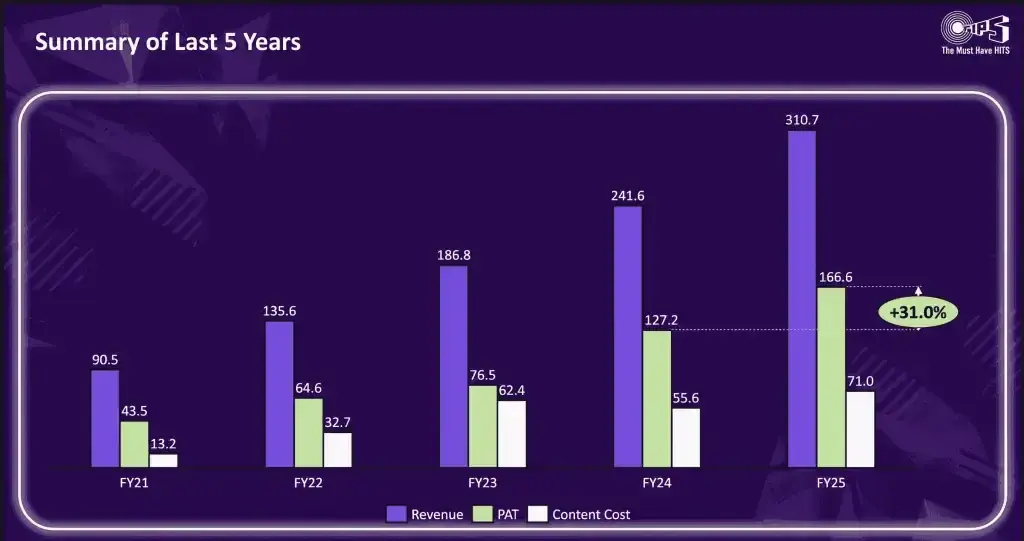
3. Safety (The Fortress): In a high-interest world, debt kills growth. Tips is virtually debt-free (Debt/Equity < 0.02). They don't owe the bank anything, which means they are immune to interest rate hikes.
Read more: 7 powerful Traits of Every Multibagger Stock – Data-Based Study
The "Risk": The Valuation Trap
"It’s too expensive!" You will often see Tips trading at a high Price-to-Earnings (P/E) ratio. Many investors look at this and skip the stock, thinking they missed the bus.
But in reality, high valuations here are a feature, not a bug. You cannot value a "Royalty Company" the same way you value a steel plant. A steel plant needs to constantly suck cash in to repair machines and build new furnaces.
Tips throw cash out. Because they don't need the money to grow, they pay out massive dividends (often 50-60% of their profits) back to shareholders. You are paying a premium price today to own a machine that will likely pay you a growing "pension" of dividends for the next decade. The risk isn't the valuation; the risk is ignoring the power of royalty cash flows.
2: Jeena Sikho Lifecare - The "Underdog" Revolution
If you told most investors a few years ago that an Ayurveda company would outperform top tech stocks, they would have laughed. We often ignore traditional sectors because they feel "old-fashioned." But while the market was busy chasing AI and EVs, this company was quietly building an empire.
This isn't just about selling herbal powders; it is about "Corporatizing Ancient Science." Jeena Sikho is doing for Ayurveda what Apollo did for modern medicine, turning a scattered, unorganized market into a professional, high-margin hospital chain. This is the classic underdog story that is just starting to roar.
The Business Model:
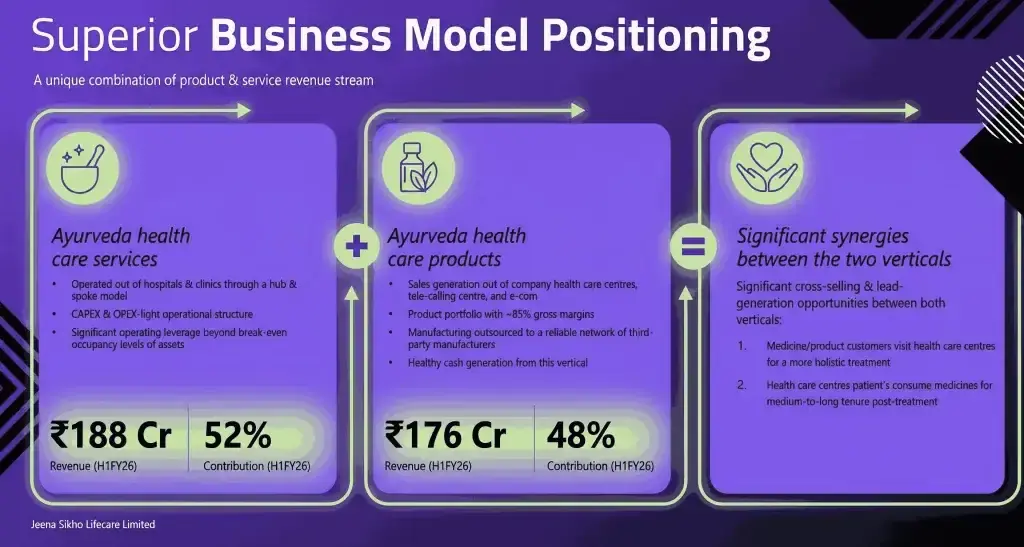
Operating under the famous brand "Shuddhi", Jeena Sikho has evolved from a small chain of clinics into a full-scale hospital network. They are unique because they have cracked a Dual-Revenue Model that most healthcare companies envy:
The Service Engine (Hospitals): Patients are admitted for chronic lifestyle diseases (like kidney or liver issues), where modern medicine often suggests transplants or expensive surgeries. They use traditional Panchakarma therapies but deliver them in modern, clean infrastructure.
The Product Engine (FMCG): Once a patient trusts the treatment, they become lifelong customers of the "Shuddhi" medicines and wellness products. This creates a recurring income loop.
The 2026 Trigger: The company is currently in a "Land Grab" phase. They have moved from the SME exchange to the main league and are aggressively scaling up their bed capacity, aiming for 10,000+ beds in the coming years. This massive expansion is the key volume driver for 2026.
The Checklist Deep Dive:
The numbers here are staggering because the company is currently in its "adolescent growth spurt"—the most profitable phase of a stock's life.
1. Growth (The Rocket Ship): Recent quarters have witnessed a financial explosion: Revenue up 66% and Net Profit up 121%.
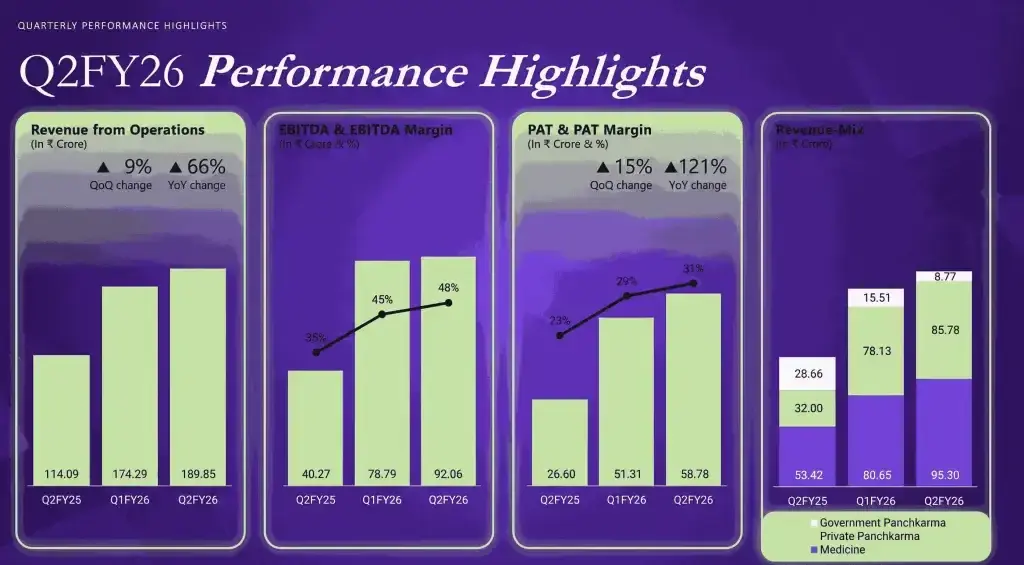
When profits grow twice as fast as sales, it proves the company has incredible pricing power. As they open more hospitals, their fixed costs (marketing, management) get spread out, making every new patient more profitable than the last.
2. Efficiency (The Money Magnet): Hospital businesses are usually cash-guzzlers that take years to break even. Jeena Sikho defies this gravity. They maintain a Return on Capital Employed (ROCE) greater than 50%.
Most top-tier modern hospitals struggle to cross 20% ROCE. Jeena Sikho’s ability to set up centers cheaply and fill them quickly makes their capital efficiency elite.
3. Safety (The Self-Funded Beast): Usually, when a company expands this fast, they drown in debt. Jeena Sikho’s debt is negligible (Debt/Equity ~ 0.04).
This means their massive growth is funded entirely by their own internal profits. They don't answer to bankers, and they aren't at risk of bankruptcy if interest rates rise.
The "Risk": The Perception Gap
"Regulatory & Reputation Risk." The Ayurveda sector often faces skepticism regarding medicinal claims, and investors worry about sudden regulatory crackdowns on advertising.
This fear is exactly why the stock is still affordable. Jeena Sikho is actively "de-risking" itself by professionalizing. They are securing NABH Accreditation for their hospitals—the gold standard for healthcare quality in India. They are moving from "magic remedies" to "evidence-based treatments." As this shift happens, the market will stop viewing them as an "Ayurveda player" and start valuing them as a "Specialty Hospital Chain." When that perception changes, the valuation gap between them and giants like Apollo will close, creating massive wealth for early believers.
3: International Gemmological Institute Ltd (IGIL) - The "Trust" Monopoly
In a gold rush, the smart money doesn't buy the gold mine; it buys the company selling shovels. In the diamond rush of 2026, IGIL is that shovel seller.
Whether a diamond is dug from the earth or grown in a lab, it is worthless to a customer without a certificate proving it is real. IGIL is the gatekeeper of that trust. While jewelers fight price wars and manage expensive inventory, IGIL sits in the middle, collecting a fee on almost every stone sold, with zero inventory risk.
The Business Model:
IGIL is the world's second-largest certification body and the undisputed leader in Lab-Grown Diamonds (LGD) with a massive 65% global market share.
They don't sell diamonds. They grade them. A jeweler sends a stone to their lab, IGIL tests it for the "4Cs" (Cut, Clarity, Color, Carat), issues a certificate, and charges a fee.
The price of Lab-Grown Diamonds has crashed, making them affordable for the masses. This sounds bad, but for IGIL, it is perfect. Lower prices mean higher volume. Instead of 1,000 people buying expensive natural diamonds, 100,000 people are now buying affordable LGDs. IGIL charges per certification, so when volumes explode, their profits explode.
The Titan Effect (The "X-Factor")
For years, big players like Titan (Tanishq) avoided Lab-Grown Diamonds, calling them "artificial." That changed recently with Titan launching its LGD brand, "beYon."
When a trusted giant like Titan enters the space, it "normalizes" the product. It tells the Indian consumer, "It's okay to buy lab-grown." This will trigger a massive shift in consumer behavior in 2026. As Titan and others aggressively expand their LGD inventory, they will need someone to certify those millions of new stones.
The Checklist Deep Dive:
IGIL is a rare "High Growth + High Dividend" candidate.
1. Profitability (Tech-Like Margins): IGIL operates with EBITDA margins of ~50-60%.
Their biggest cost is skilled gemologists. They don't have raw material costs. Once a lab is set up, every extra diamond graded is pure profit. This gives them an ROCE of ~45-53%, which is double our screener's requirement.
2. Growth (The LGD Wave): The company is growing Sales at ~21% and Profits at ~18%.
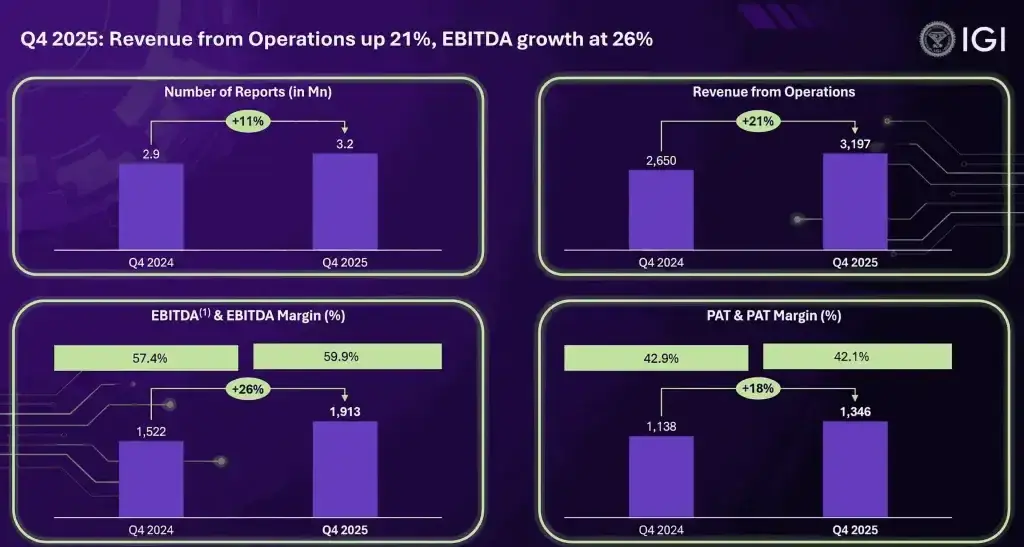
The Driver: India is becoming the global capital for cutting and polishing LGDs. As exports rise, IGIL (which dominates the Indian market with a 50% share) captures all that upside
3. Safety (Blackstone Backing): The company has Zero Debt and is backed by Blackstone, one of the world's shrewdest private equity firms. This ensures high corporate governance standards, a rarity in the gem sector.
The Risk:
"Falling Diamond Prices." Investors worry that if LGD prices keep falling (now 70-80% cheaper than natural), IGIL's fees will drop.
But in reality, IGIL is a Volume Play, not a Value Play. IGIL charges based on the work involved (grading the stone), not just a percentage of the stone's final price. Even if a diamond costs ₹20,000 instead of ₹1 Lakh, the buyer still demands a certificate to prove it's not glass. In fact, as diamonds become "fashion accessories" (bought multiple times a year), the sheer number of certificates issued will dwarf any drop in fees per stone.
Read more: Top Mid Cap Stocks with Zero Promoter Pledge
These three stocks highlight the power of earnings-led growth in mid-caps. They represent opportunity, but opportunity without discipline becomes dangerous. So, now let’s look at the traps that can destroy returns even in good companies.
The Risk Zone: 5 Traps to Avoid
In 2025, markets showed a clear pattern: they rise slowly but fall very fast. Mid-cap stocks can generate strong returns, but they also carry higher risk. Gains take time to build, while losses can happen suddenly. A 20% rise can be wiped out in just two days of bad news.
“The goal of investing is not to be right often, but to be wrong less.” — Howard Marks
Here are the 5 specific traps that will kill your returns in 2026, and exactly how to shield yourself against them.
1. The "Story Stock" Trap
In 2025, many investors got burned buying "Defense" or "Railway" stocks simply because everyone was talking about them. They bought the story (e.g., "India is building trains!") without checking if the specific company was actually making money from it.
Ignore the Narrative, Trust the Numbers. Before you buy, ask one question: "Is the profit already visible in the P&L?" If a company says, "We will get a big order next year," wait. Only buy companies that are already showing growth today. In mid-caps, promises are cheap; performance is rare.
2. The Liquidity "Quicksand".
Mid-cap stocks don't trade as freely as HDFC Bank or Reliance. When the market panics, buyers disappear. You might see your stock hitting the "Lower Circuit" for days, meaning you literally cannot sell even if you want to.
The "Allocation Rule." Never put money into a mid-cap that you might need in the next 12 months. Treat this capital as "locked in" for 3 years. Also, never put more than 7-10% of your portfolio into a single mid-cap stock. If one ship sinks, it shouldn't drag down your entire fleet.
3. The "Guidance" Gamble
Mid-cap managements are often optimistic. They might promise 30% growth to boost their stock price, but if they deliver only 15%, the market will punish them brutally. We saw this in 2025 when stocks crashed 20% in a single day after missing earnings estimates by a small margin.
Watch the "Cash Conversion." Don't just look at Net Profit; look at Operating Cash Flow (OCF). If a company claims high profits but has zero cash coming into the bank, they might be "stuffing the channel" (forcing distributors to buy unsold goods) to meet targets. If OCF is consistently lower than EBITDA, run away.
4. The Valuation "Gravity"
“Valuation is not about what a company did, but what it can do.” — Aswath Damodaran
A stock trading at a P/E of 80x needs to grow at 40% every year to justify that price. If growth slows down to even 20%, the P/E will "de-rate" (crash) down to 40x. This is how you lose money even in a good company: you simply paid too much for it.
The PEG Ratio (Price/Earnings-to-Growth). This is your safety belt. Divide the P/E ratio by the Growth Rate.
Example: P/E is 40, Growth is 20%. PEG = 2.0 (Expensive).
Example: P/E is 20, Growth is 20%. PEG = 1.0 (Fair). Try to buy stocks where the PEG is below 1.5. This ensures you aren't paying a "hype tax."
5. The "Boredom" Risk (The Silent Killer)
This is psychological. After you buy a good mid-cap, it might do absolutely nothing for six months. It just goes sideways. In 2025, many investors sold good stocks out of boredom, only to watch them double three months later.
The "Quarterly Review" Ritual. Delete your trading app from your phone's home screen. Stop checking prices daily. Instead, set a calendar reminder for the quarterly results date. If the business fundamentals (Sales/Profit) are good, ignore the stock price. In the mid-cap game, patience is the only edge you have over the algorithms.
Read more: Beyond Revenue Growth: 10 Mid-Cap Stocks Where Profits Compound
We have filtered the market, chosen quality, and mapped the dangers. Now the final question remains: how should an investor act from here? Let’s bring everything together into one simple strategy.
Explore our Products
Research Framework

Emerging Titans
Combination of quantitative analysis, industry tailwinds, and management assessment - SPRINT investment philosophy

Tiny Titans
Heavy emphasis on scuttlebutt research, plant visits, and early on-ground signals
Conclusion: The Path Forward
“The first rule is to avoid permanent loss of capital.” — Seth Klarman
We have moved from the chaos of 2025 to the clarity of 2026. The era of blind betting is officially over; now, the game is about partnering with real businesses that actually print cash. Whether it is the royalty machine of Tips Music, the rapid expansion of Jeena Sikho, or the trust monopoly of IGIL, the winning formula remains the same: Quality + Growth + Patience = Wealth. Your job this year isn't to chase every ticker that flashes green, but to find these "Business Owners," sit tight, and let the boring magic of compounding do all the heavy lifting for you.
If this deep dive helped you see the market more clearly, hit that Like button. It tells us to keep bringing you this level of research. Subscribe so you don't miss our next quarterly review, where we will track these picks live. And if you are ready to stop gambling and start building, drop a comment below with the word "COMPOUND". Let’s see how many of us are here for long-term wealth.
FAQs ( Frequently Asked Questions )
What makes a mid-cap stock worth buying in 2026?
+Why should cash flow match reported profit?
Should I avoid expensive-looking stocks completely?
+Not always, but valuation must match growth. A high P/E stock is safe only if earnings are growing fast and consistently. Overpaying for slow growth is one of the most common ways investors lose money.
What is the biggest mistake investors make with mid-caps?
+Buying based on stories instead of numbers is the biggest error. Trends change, but profit growth is measurable and reliable. Successful investors ignore excitement and follow financial data.
What is the simplest screening rule for beginners?
Start with companies showing sales growth above 15%, profit growth above 20%, and low debt. Add cash flow and ROCE filters to improve quality. This removes weak businesses before emotions get involved.

High growth stock specialist, Value Educator
Shashank Mahajan is an equity research professional with over 12 years of experience in identifying high-potential SME and micro-cap stocks at an early stage. He follows a rigorous scuttlebutt research–driven approach, combining on-ground insights with deep financial analysis. Shashank specializes in uncovering under-researched and under-owned companies with strong management quality and long-term growth potential. Through disciplined research and early identification, he focuses on spotting tomorrow’s market leaders before they enter the mainstream investor radar.

Glenmark: The USD 700 Mn Cancer Deal and Its Brands

Pharma Stocks in India 2026: Generics, APIs and CDMOs

Granules India: From Paracetamol to a 65% Gross Margin

Natco Pharma: After Revlimid, 29 Patent Challenges

Shilpa Medicare: Cancer APIs, Films and Biosimilars

Alembic Pharma: US Plants Pay Back, Margin Hits 22.2%
Explore our Products
Research Framework
Emerging Titans
Combination of quantitative analysis, industry tailwinds, and management assessment - SPRINT investment philosophy
Tiny Titans
Heavy emphasis on scuttlebutt research, plant visits, and early on-ground signals



Modern Warfare to Multibaggers
Key Trends. Strategic Shifts. Opportunities Ahead.
Today at 7:00 PM IST. Room opens 30 minutes before.
Don't Miss This Exclusive Webinar!
Join Value Educator to decode the key trends shaping India's defence sector and learn how to identify tomorrow's potential leaders in the space.
- In-depth research on India's defence sector
- Live Q&A session
- Actionable takeaways for long-term investors

 Orders
 Subscription
 Share with friends


Required Details
₹23999.00
(12 month subscription)
As per SEBI regulations, all users are mandated to complete the KYC that is validated for 1 year. Post payment, you will be redirected to the KYC screen


No comments yet. Be the first to comment!