
Mid Cap Stocks With Zero Promoter Pledge

Why the Best Leaders Don’t Need Emergency Funding
Leadership doesn’t really show when everything is working. In good times, most people look capable. Money is available, demand is strong, and even bad decisions don’t hurt immediately.
What actually separates strong leaders is what they do before things get uncomfortable — when there’s no urgency forcing their hand. The quiet decisions. The restraint. The willingness to prepare when it feels unnecessary.

By the time pressure shows up, the window to prove foresight is usually already closed.
“The best investment decisions are made when you are not forced to make them.”— Howard Marks
Strong leaders don’t panic when things get tight. They don’t wait for emergencies to start thinking.
They look at cash early, keep some margin for error, and give themselves room to breathe. So when pressure shows up — and it always does — it doesn’t control their decisions.
In the stock market, promoter pledging is often the financial equivalent of an emergency call. When promoters pledge their shares, it is rarely because something suddenly broke overnight. More often, it reflects gaps that existed in earlier capital structures stretched too far, working capital misjudged, or risks taken without enough margin of safety. Pledging is usually not a strategy. It is a reaction.
This is why the zero promoter pledge matters, but not for cosmetic reasons. It is not about governance scores or moral purity. It is about how a business is funded when conditions stop being friendly. It reflects how management thinks about control, cash discipline, and downside risk when growth slows, and capital becomes expensive.
If this distinction between numbers and behaviour feels subtle, it’s because most investors are trained to look at outcomes, not processes. We break this difference down in detail in What is Value Investing? Complete Guide for Beginners, where valuation is treated as context, not conclusion.
In good times, this difference barely shows. In difficult cycles, it becomes decisive. Over long periods, businesses led by promoters who don’t rely on pledging tend to compound quietly, while fragile funding structures force hard and often value-destructive trade-offs. The companies discussed here fall into the first category because nothing can go wrong, but they planned as if something eventually would.
What Promoter Pledge Actually Signals (No Fluff)
Promoter pledging is simple. Promoters borrow money by keeping their shares as collateral. If the share price holds, nothing breaks. If it falls sharply, lenders demand more collateral or trigger forced selling. That’s where problems begin.Promoters usually pledge shares for a few simple reasons. Sometimes the business needs money to grow, and internal cash isn’t enough. Sometimes cash gets stuck in inventory or receivables, and they need a temporary bridge. And sometimes it’s to support another group company that can’t raise money on its own.
Any one of these can look harmless in isolation. The problem is that they often happen together — and that’s when the risk builds up quietly, without drawing much attention.
This risk gets worse in mid-cap companies. There’s less liquidity, prices move faster, and sentiment can flip quickly. What starts as a small or temporary problem can turn into a sharp fall in the stock.
And once prices drop, margin calls kick in fast. That’s when promoters are pushed into decisions they never intended to make in the first place.
This risk is bigger in mid-caps. There isn’t much liquidity, prices move fast, and mood shifts quickly. Even small problems can hit the stock hard. Once prices fall, margin calls come quickly and force promoters into choices they never planned for.
This is why pledging is rarely about intent; it’s about structure. A business that depends on pledged shares has far less room for error. One bad quarter, one delayed cash cycle, or one macro shock can turn a manageable loan into a control-threatening situation.
Markets rarely punish bad intentions first. They punish fragile structures.
“More money has been lost reaching for yield than at the point of a gun.”-— Ray Dalio
To be clear, promoter pledging is neither illegal nor unethical. Many strong businesses have used it at some point. But persistent or rising pledging is rarely a long-term strategy. It is usually a symptom of stretched capital, misjudged cash flows, or inadequate buffers.
Zero promoter pledge doesn’t mean a company will never face stress. It means that when stress arrives, promoters are not forced into defensive decisions at the worst possible time.
Why “Zero Pledge” Matters More in Mid-Caps Than Large Caps
This is where promoter pledging needs to be judged in context because not all companies operate with the same financial flexibility.Large-cap companies have options. They can raise bonds, do institutional placements, tap global lenders, or fund growth through internal accruals. Their scale gives them credibility, access, and time. Even if something goes wrong for a few quarters, they usually have multiple levers to pull before control or ownership is threatened.
Mid-cap companies don’t have that luxury. Scarcity of options changes behaviour in business as much as in investing.

This structural gap is why mid-caps reward discipline far more than aggression. When funding choices are limited, how a business manages cash and risk matters more than how fast it grows. We explore this dynamic in Why Mid Cap Stocks are the Sweet Spot for Long-Term Investors, where resilience consistently beats speed across cycles.
“Risk comes from not knowing what you’re doing.”— Warren Buffett
For most mid-caps, capital access is narrower and more expensive. Institutional funding is selective. Bond markets are largely closed. Internal accruals matter far more because external buffers are thin. When something goes wrong, a delayed receivable cycle, a capex overshoot, or a demand slowdown, the margin for error is small.
That is why promoter pledging becomes more dangerous more quickly in mid-caps.
A falling stock price doesn’t just hurt sentiment. It triggers margin calls. Those margin calls force selling, which pushes prices down further. What starts as a manageable funding decision can quickly turn into a control risk, even if the underlying business remains viable.
When a mid-cap promoter runs the business without pledging shares, it usually means one of three things: the business throws off enough cash on its own, growth is being kept sensible, or management is deliberately staying away from structures that can blow up under stress.
None of this guarantees success. Zero pledge is not a promise of superior returns.
But it does remove one of the fastest and most destructive failure paths in mid-cap investing, where capital is lost not because the business collapsed, but because financing decisions left no room for things to go slightly wrong.
That reduction in fragility is what makes the zero-promoter pledge far more meaningful in mid-caps than it ever is in large caps.
The Filter: How These Stocks Were Selected
Before looking at individual names, it’s important to be clear about what this list is and what it is not.This is not a screen to find the cheapest stocks, the fastest growers, or the most exciting stories. It is a filter designed to reduce fragility. The goal isn’t to eliminate business risk, that’s impossible, but to avoid avoidable capital-structure risk, especially in mid-cap companies where mistakes compound faster.
Every stock discussed here meets a simple but demanding checklist:
- It sits firmly in the mid-cap universe, not microcaps with weak liquidity and disclosures, and not large caps with easy access to capital markets.
- The promoters have kept their shares unpledged for years, not just this quarter. Discipline only matters when it’s consistent, not when it’s done for show.
- The business has a clear operating model with visible cash flows. Profits convert into cash through operations, not accounting adjustments.
- There is no pattern of repeated equity dilution to fund survival. Capital raises, if any, are measured and purposeful.
- Growth has been funded largely through internal accruals or conservative, manageable debt, not leverage layered on volatility
This filter doesn’t guarantee success. Markets are unpredictable, cycles turn, and execution always matters.
But even if you disagree with individual names, the logic of the filter itself is hard to argue with. It deliberately avoids the most common ways mid-cap wealth gets destroyed, not by bad businesses, but by fragile funding decisions made at the wrong time.
This approach fits into a broader framework for evaluating companies beyond ratios and short-term performance. For readers who want a repeatable way to assess cash flows, balance sheets, and capital behaviour, How to Analyse a Mid Cap Company – Complete Framework lays out the full process step by step.
What follows are businesses where this specific risk has already been kept in check by design, not by luck.
Stock Deep-Dives (Each With a Different Angle)
This section should not read like four versions of the same story. If every company is explained using identical ratios and language, the signal gets diluted. Zero promoter pledge can come from very different forms of discipline; the goal here is to show how and why it appears in each case.Each business below earns its place for a different reason.
1. Apar Industries Discipline in a Working-Capital Heavy Business
Apar Industries operates in businesses that naturally consume a lot of working capital — conductors, cables, and speciality oils. These require upfront spending on copper, aluminium, and oil, while cash often comes back late because receivables are long and inventory sits on the books.In this kind of setup, many competitors lean on heavy borrowing or promoter pledging just to keep expanding.
Apar has taken a different path. Over the past several years, the company has delivered sustained operating performance, reflected in a five-year profit CAGR of over 43%, not the kind of episodic growth that usually precedes balance-sheet stress.
The last few quarters tell the same story. Revenue has hovered between ₹5,100 and ₹5,700 crore, margins haven’t slipped much, and profits stayed positive even as the business got bigger. This growth came from cash the business generated, not from stretching the balance sheet.
Crucially, promoter pledge stands at 0%. In a mid-cap operating with limited external financing options and higher volatility, this matters. It signals that growth has been aligned with internal cash flows and manageable leverage, not dependent on mortgaging promoter equity.
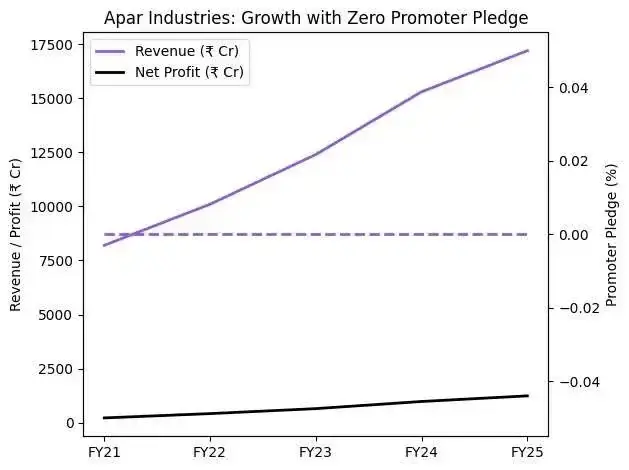
Cash-flow data supports this discipline. Operating cash flows have remained consistently positive, including approximately ₹1,237 crore in FY2025, while leverage remains restrained. Debt relative to capital is not stretched, reducing the need for reactive funding decisions during volatile phases.
Management is choosing to stay financially strong rather than grow fast. In businesses that soak up a lot of cash, that decision often decides who keeps compounding and who later runs into funding trouble.
What to monitor:
- Copper and aluminium price volatility and its impact on working capital
- Receivable and inventory cycle expansion
Even if cycles turn, the absence of forced financing routes like promoter pledging gives Apar and its stakeholders far more room to respond rationally.
2. Force Motors Surviving Cycles Without Financial Shortcut
Why This Stands Out in a Cyclical Business
Auto and commercial vehicle businesses move in cycles. Demand picks up fast in good times and drops just as quickly when things slow down. That’s usually when promoters feel pressure to use leverage or pledge shares just to keep earnings steady and avoid looking weak in the short term.
Force Motors has chosen not to.
Despite operating in one of the most volatile segments of the auto industry, the company has consistently avoided promoter pledging, even during downturns when cash flows were under pressure and volumes softened.
What the Balance Sheet Reveals
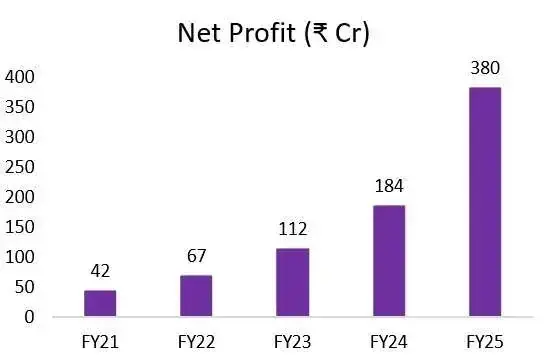
In FY25, Force Motors posted revenue of ₹8,071.7 crore, up 15.4% year on year. Profits more than doubled. What matters is how it happened — this turnaround wasn’t the result of accounting tricks or financial engineering, but a real improvement in the business.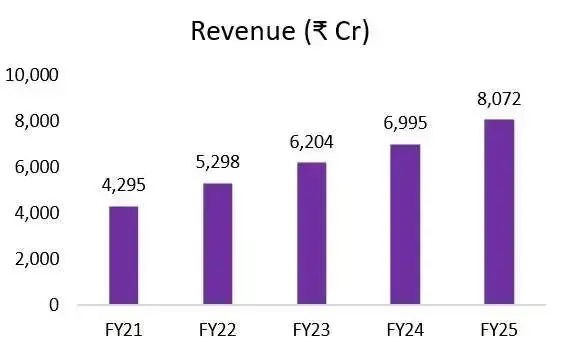
Leverage has remained conservative through the cycle. There has been no aggressive balance-sheet expansion, no equity dilution to mask volatility, and no dependence on pledging equity to bridge weak phases.
Selective Strategy, Not Empire Building
Force Motors has repeatedly shown a willingness to shrink before stretching. In FY25, it exited the tractor and three-wheeler businesses, reallocating capital only to areas where it has durable advantages: vans, specialised mobility platforms, defence vehicles, and contract manufacturing for global OEMs.This discipline shows up in outcomes:
- Record four-wheeler sales and exports in FY25
- A confirmed order of 2,978 Light Strike Vehicles for defence applications
- Long-standing manufacturing partnerships with Mercedes-Benz, BMW, and Rolls-Royce Power Systems, providing stable, non-cyclical cash flows alongside the core CV business
None of this needed emergency funding. That matters.
What Zero Promoter Pledge Signals Here
In Force Motors’ case, a zero promoter pledge is not about optimism. It reflects acceptance of cyclicality rather than an attempt to smooth it with leverage. Management has chosen to live with earnings volatility instead of risking loss of control during downcycles.It’s a deliberate decision to protect the business for the long run, even if the short term feels uncomfortable. In cyclical industries, that mindset usually decides who makes it through multiple cycles, not who looks best at the top.
History shows that most long-term winners weren’t stars every year. They just stayed out of trouble when the cycles turned.
What needs watching:
This is not a low-risk business. Two variables deserve close attention:- CV cycle recovery and demand durability, especially in institutional and shared-mobility segments
- Product refresh and compliance costs as emission norms and platform upgrades tighten margins
Force Motors will never look smooth quarter to quarter. But its refusal to take financial shortcuts, even when the cycle turns against it, is precisely what makes the zero promoter pledge meaningful here.
3. HBL Engineering Cash Visibility Reduces Funding Stress
HBL Engineering is a rare case where zero promoter pledge feels natural rather than intentional. The business model itself reduces the need for financial shortcuts.Over the last few years, HBL has steadily shifted away from commoditised industrial batteries toward defence electronics and railway signalling systems. This matters because these segments come with multi-year orders, milestone-based payments, and predictable execution cycles very different from volume-driven, price-sensitive businesses.
In FY24–FY25, revenues moved into a higher orbit, crossing the ₹2,000–2,200 crore range. Management has highlighted a structural step-up driven by railway safety systems (Kavach), defence electronics, and niche ammunition components. Operating margins improved as the mix tilted toward higher-value products, while return ratios strengthened without leverage-driven optics.
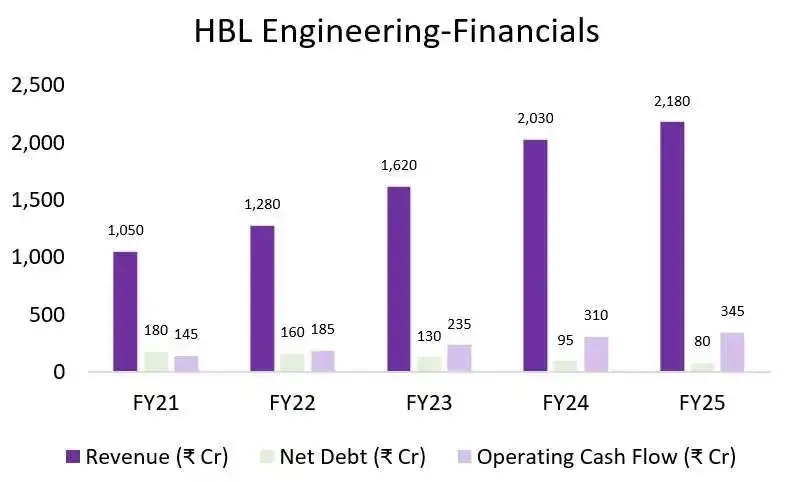
What stands out here is cash visibility, not just profitability.
Railway and defence orders typically come with defined delivery schedules, advance or milestone-linked payments, and long execution visibility (often 2–3 years). This reduces the classic mid-cap problem of funding uncertainty. HBL doesn’t need to bridge cash gaps through promoter pledging because the business itself generates predictable operating cash flows.
The balance sheet reinforces this discipline. Despite rising scale, net debt remains low relative to operating profits. Capex has been funded largely through internal accruals, and promoters have maintained zero pledged shares even during expansion phases, a rare combination in capital-intensive engineering businesses.
The deeper signal is restraint. Management has prioritised profitability and survivability over headline growth. While many peers chased capital-heavy lithium-ion or commodity bets, HBL chose narrow, defensible niches with better economics.
When cash inflows are visible and execution is controlled, pledging becomes unnecessary. HBL’s zero pledge is not a governance slogan; it’s a consequence of how the business is structured.
What to monitor going forward:
- Execution timelines on large railway and defence orders
- Working-capital intensity, especially receivables from government entities
- Margin sustainability as the order book scales
HBL shows that in mid-caps, the cleanest balance sheets don’t come from optimism. They come from businesses designed to fund themselves.
4. Gravita Recycling, Cash Cycles, and Capital Control
Recycling is a business where capital discipline decides survival. Margins move with commodity prices, inventory must be financed upfront, and even a small execution slip can lock up cash quickly. In such setups, growth funded through shortcuts often reappears later as balance-sheet stress.Gravita operates across lead, aluminium, plastics, and newer recycling verticals, all working-capital-intensive segments. Yet despite this inherent cyclicality, the company has scaled without resorting to promoter pledging. That discipline is visible in how expansion has been funded.
In recent years, growth has been driven largely through internal accruals. In FY24, Gravita generated operating cash flows of around ₹280 crore, which funded capacity additions, maintenance capex, and overseas expansion without equity dilution or promoter-level borrowing. This allowed the company to reinvest steadily rather than chase leverage-driven growth.

Capital allocation has been equally measured. Management typically targets projects with ~25%+ return on invested capital and a payback period of about three years. Most expansions are brownfield, using existing infrastructure to keep capital costs low and reduce risk during commodity downturns. The focus is on return on capital, not headline capacity.
The balance sheet reflects this restraint. Net debt has remained controlled even as scale increased, and expansions have been paced to internal cash generation. As of FY25, Gravita operates 13 recycling facilities across India, Africa, Europe, and Sri Lanka, with an installed capacity of roughly 3.3 lakh tonnes per annum and a clear roadmap to scale further without promoter pledging.
Zero promoter pledge here is not about optics. It reflects management’s understanding of cyclicality. Instead of masking volatility with leverage, the business absorbs it through operational efficiency, geographic diversification, and conservative funding choices. That materially reduces the risk of forced decisions when metal prices turn unfavourable.
What to monitor:
- Commodity price swings and margin sensitivity
- Execution risk in overseas expansions and working-capital intensity
In cyclical businesses like recycling, this difference often separates long-term compounders from short-term survivors.
What Zero Promoter Pledge Does Not Protect You From
Zero promoter pledge is a useful signal, but it is not a seal of quality. Treating it as one is how investors get complacent.A business can have zero pledged shares and still be a poor investment. Promoters can overpay for acquisitions, chase growth at the wrong point in the cycle, or allocate capital into low-return projects. None of that requires pledging. Value can be destroyed quietly even when the shareholding structure looks clean. A clean balance sheet does not compensate for poor judgment.
“It’s not supposed to be easy. Anyone who finds it easy is stupid.”— Charlie Munger
Zero pledge is also not permanent. Funding needs change. Cycles turn. A company that does not need to pledge today may choose to do so tomorrow if cash flows weaken or expansion plans get aggressive. The absence of a pledge is a snapshot, not a lifetime badge.
It also offers no protection from execution risk. Projects can slip. Working capital can stretch. Margins can compress. In the end, management quality still matters far more than any single metric on a screener.
The right way to think about zero promoter pledge is simple.
It is a seatbelt, not an airbag.
It reduces one of the fastest ways capital gets destroyed, forced selling, margin calls, and loss of control during downturns. But it does not prevent accidents. You still have to judge the driver, the road, and the speed.
Used correctly, zero pledge is a risk filter, not an investment thesis.
When you step back and look at these businesses together, a clear pattern emerges. It has very little to do with sector or valuation.
Growth is paced to cash flows, not ambition. Expansion happens when the balance sheet allows it, not when markets are euphoric. These companies are willing to grow more slowly if that is what preserves control and flexibility.
There is also no obsession with headline numbers. No urgency to chase market share at any cost. No need to impress with sudden scale or flashy capacity announcements. Growth is treated as a consequence of execution, not a goal in itself.
Most importantly, there is a willingness to say “no.” No to aggressive leverage. No to stretching working capital beyond comfort. No to expansion that would require mortgaging promoter equity just to keep momentum alive. That restraint rarely shows up in quarterly results, but it compounds quietly over time.
What ties all of this together is a clear preference for resilience over speed. These promoters are not trying to win the next cycle. They are trying to survive every cycle.
That is where the leadership theme comes full circle. Good leadership is not about reacting well under pressure. It is about structuring the business so that pressure does not force bad decisions in the first place.
Closing: Leadership Shows Up in Capital Decisions
Anyone can look disciplined when conditions are easy. Cheap money hides mistakes. Rising demand forgives poor planning. In those phases, almost every balance sheet looks healthy.The real test comes when conditions tighten, cash cycles stretch, growth slows, and capital becomes expensive. That’s when leadership shows up, not in words or presentations, but in how growth is funded. Businesses that never need promoter pledging are often sending a quiet signal. They are built to absorb pressure, not react to it. The structure was thought through long before stress arrived.
This focus on structure over speed sits at the heart of durable compounding. The Multibagger Framework: A Step-by-Step Guide to Finding 10x Stocks is built around this exact idea: capital decisions, execution quality, and staying power before returns ever show up on the screen.
That kind of durability rarely comes from brilliance. It comes from temperament.
“The first rule of compounding: never interrupt it unnecessarily.”
— Charlie Munger
This doesn’t make such businesses risk-free. But it does tell you something important about intent, discipline, and control qualities that matter far more over long periods than short bursts of growth.
Before you move on, try this once.
Look at one mid-cap you already own.
Check the promoter pledge history over the last 5–7 years.
Ask a simple question: was growth funded through operating cash flows or through crisis decisions made under pressure?
If you want to explore more ideas built around capital discipline, balance-sheet behaviour, and long-term resilience, comment “ZERO PLEDGE”, and we’ll share more along this line.
Explore our Products
Research Framework

Emerging Titans
Combination of quantitative analysis, industry tailwinds, and management assessment - SPRINT investment philosophy

Tiny Titans
Heavy emphasis on scuttlebutt research, plant visits, and early on-ground signals
FAQs
What is the zero promoter pledge?
+Zero promoter pledge means promoters have not pledged their shares as collateral to raise money. In practical terms, it tells you that the business is not dependent on emergency funding routed through promoter equity. When share prices fall, pledged shares can trigger margin calls and forced selling zero pledge removes that specific risk entirely.
Is the zero-promoter pledge good?
+Zero pledge does not make a business great by default, but it does reduce one of the fastest paths to capital destruction in mid-cap stocks. It usually reflects better cash-flow planning, conservative growth pacing, and less dependence on market conditions to stay in control.
How much promoter pledge is acceptable?
+<p><span style="font-weight: 400;">There is no perfect number, but ranges matter:</span></p>
<ul>
<li style="font-weight: 400;"><strong>0–5%</strong><span style="font-weight: 400;"> → Generally manageable</span></li>
<li style="font-weight: 400;"><strong>5–20%</strong><span style="font-weight: 400;"> → Requires close monitoring and clear explanation</span></li>
<li style="font-weight: 400;"><strong>20%+</strong><span style="font-weight: 400;"> → High risk in mid-caps, especially during volatile markets</span><span style="font-weight: 400;"><br /><br /></span></li>
</ul>
<p><span style="font-weight: 400;">More important than the percentage is the direction. Rising pledges over time usually signal stress, not strategy.</span></p>
Why focus on zero-pledge mid-cap stocks?
+Because mid-caps lack the safety nets of large companies. They can’t easily issue bonds, raise institutional capital, or absorb shocks. When promoters avoid pledging despite volatility, it often means growth is being funded through internal cash flows or conservative balance-sheet choices, not crisis decisions.

High growth stock specialist, Value Educator
Shashank Mahajan is an equity research professional with over 12 years of experience in identifying high-potential SME and micro-cap stocks at an early stage. He follows a rigorous scuttlebutt research–driven approach, combining on-ground insights with deep financial analysis. Shashank specializes in uncovering under-researched and under-owned companies with strong management quality and long-term growth potential. Through disciplined research and early identification, he focuses on spotting tomorrow’s market leaders before they enter the mainstream investor radar.

Glenmark: The USD 700 Mn Cancer Deal and Its Brands

Pharma Stocks in India 2026: Generics, APIs and CDMOs

Granules India: From Paracetamol to a 65% Gross Margin

Natco Pharma: After Revlimid, 29 Patent Challenges

Shilpa Medicare: Cancer APIs, Films and Biosimilars

Alembic Pharma: US Plants Pay Back, Margin Hits 22.2%
Explore our Products
Research Framework
Emerging Titans
Combination of quantitative analysis, industry tailwinds, and management assessment - SPRINT investment philosophy
Tiny Titans
Heavy emphasis on scuttlebutt research, plant visits, and early on-ground signals



Modern Warfare to Multibaggers
Key Trends. Strategic Shifts. Opportunities Ahead.
Today at 7:00 PM IST. Room opens 30 minutes before.
Don't Miss This Exclusive Webinar!
Join Value Educator to decode the key trends shaping India's defence sector and learn how to identify tomorrow's potential leaders in the space.
- In-depth research on India's defence sector
- Live Q&A session
- Actionable takeaways for long-term investors

 Orders
 Subscription
 Share with friends


Required Details
₹23999.00
(12 month subscription)
As per SEBI regulations, all users are mandated to complete the KYC that is validated for 1 year. Post payment, you will be redirected to the KYC screen


No comments yet. Be the first to comment!