
Spotting Genuine Penny Stocks Early

Imagine a company sitting quietly in the shadows while the entire country prepared for a solar revolution. A few years ago, Waaree Renewable Technologies was the classic "Turnaround Story", a small player that the market had largely written off due to low visibility and earlier struggles. But smart investors noticed something else: massive "Sector Tailwinds" as the government aggressively pushed for green energy. While the crowd ignored it, the company restructured and positioned itself right in the path of this government spending, waiting for the spark that would ignite its growth.
“Fortunes are made by seeing what others overlook.”— Peter Lynch
That spark was an "Order Book Explosion." Suddenly, the company’s contracts to build solar projects grew faster than its share price, signaling that the business was changing fundamentally. This wasn't luck; it was a visible shift where earnings and orders outpaced the stock chart. The company returned to profitability with a vengeance, and the stock price eventually had no choice but to follow. It transformed from a forgotten penny stock into a market leader, rewarding those who looked at the business reality rather than just the price ticker.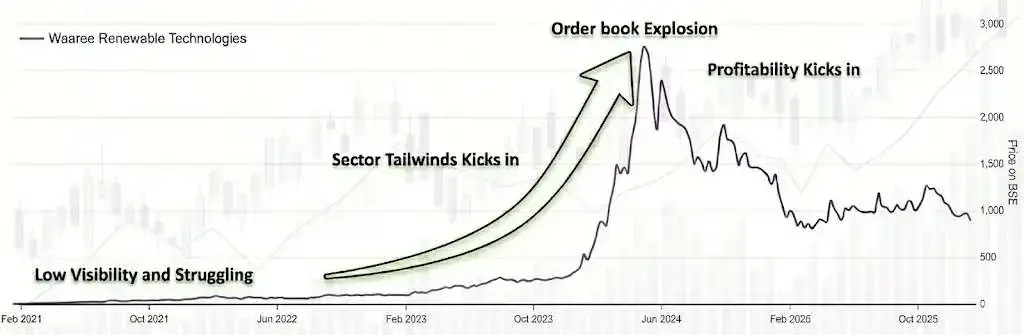
This story is the perfect foundation for our article, "How to Identify Genuine Penny Stocks." Waaree proves that multibaggers aren't just lottery tickets; they leave specific clues, like sector support and order book growth, long before they explode. Stories like Waaree are inspiring,but they are rare. Before chasing the next multibagger, you must first learn how to avoid the traps that destroy most penny stock investors.
Genuine Penny Stocks vs Bad Penny Stocks: Know the Difference Early
Many new investors fall for a simple trap. They believe a ₹5 stock is "cheaper" than a ₹500 stock. But in the stock market, a low price often hides low quality. Think of it like a flea market, most cheap items are broken junk that nobody wants but occasionally, you may find a rare antique selling for pennies just because the seller doesn't know its real value. Your goal is simple: you must learn to spot the difference between a "sleeping giant" that will make you rich and a "sinking ship" that will sink your portfolio.Genuine Penny Stocks are companies that are temporarily mispriced, not fundamentally broken. They often look "boring" to the average investor because they don't spike in price every day. These businesses usually have real factories, growing sales, and owners who are actively fixing solvable problems like high debt or low efficiency.
A classic example is Symphony in its early days; it was trading for pennies not because the business was fake, but because it was quietly restructuring. These stocks require patience because the business improves first, and the stock price follows later.
On the other hand, Bad penny stocks are "sinking ships" that look cheap but are actually expensive mistakes. These companies often have permanent issues like unpayable debt, no clear business model, or management that constantly pledges shares. They might feel exciting because they see sudden, unexplained price spikes, but they usually trap retail investors at high levels. Stocks like GTL Infra or HCC often attract buyers due to their low prices, but without strong fundamental recovery, they often remain "dead money" for years.
Once you know how to separate opportunity from danger, the real edge comes from spotting change before the crowd does. Now, we break down the 7 Golden Signals, because true multibaggers never make noise early.
The 7 Golden Signals: How to Spot a Multibagger Penny Stock Before the Crowd
harts only tell you what has happened in the past, but fundamentals tell you what will happen in the future. . You don’t need a finance degree to find the next big winner, you just need to spot change before the market prices it in.
Genuine multibaggers send out quiet signals long before they turn your pennies into lakhs. If you see these 7 clues flashing together, pay attention, you might be looking at a life-changing opportunity.
“In the short run, the market is a voting machine but in the long run, it is a weighing machine” – Benjamin Graham
Read More : Penny Stocks vs Small Caps – What’s the Difference and Which Is Better?
1. The Growth Engine – Strong Revenue & Profit
This is the most basic yet most important check. Forget the stock price for a moment and look at the "Top Line" (Sales). Is the company selling more products this year than last year? A genuine penny stock must show consistent double-digit growth in Sales and Net Profit. If a company is not growing its business, no amount of hype can sustain its stock price for long. Growth is the fuel that drives the stock upward.
A classic example is: Deepak Nitrite. In 2010-2011, this stock was trading around ₹10-15 (adjusted for splits and bonus). It wasn't famous, but its chemical sales were growing every single year. The company wasn't just hoping for luck; it was executing a plan to become a market leader in "Phenol" and other chemicals. The stock price didn't jump overnight, but it followed the profit growth, eventually turning that ₹15 into over ₹2,000.
2. The Reality Check – Positive Cash Flow & CFO
There is an old saying on Dalal Street: "Profit is opinion, Cash is fact." It is easy to manipulate Net Profit on paper, but you cannot fake Cash Flow from Operations (CFO). Always check if the company is actually generating cash from its core business. If a company reports a profit of ₹100 Crore but has negative operating cash flow, stay away. It means they are struggling to collect money from clients.
A perfect example is Symphony Ltd. In the early 2000s, it was a bankrupt penny stock trading below ₹5. The turnaround didn't happen because of a rumor; it happened because the management fixed the cash flow. They stopped manufacturing themselves and moved to an "asset-light" model, generating massive cash with zero debt. That cash flow discipline turned a ₹5 stock into a ₹1,000+ giant.3. The "Smart Money" Move – Promoters & Management Change
Who knows the company better than anyone else? The owner. If Promoters are increasing their stake, or if a new, capable management team takes over a struggling company, take notice. This is often the strongest signal that the bad days are over. When "Smart Money" (Institutions or strong business groups) buys a "junk" stock, they usually have a plan to fix it.
A classic example is CG Power. It was a penny stock trading under ₹10 a few years ago due to fraud and debt. The market had written it off. But then, the Murugappa Group (owners of TI India) acquired it. This "Change in Management" was the golden signal. Investors who realized that the new owners would clean up the mess made a fortune as the stock rallied from ₹10 to over ₹700.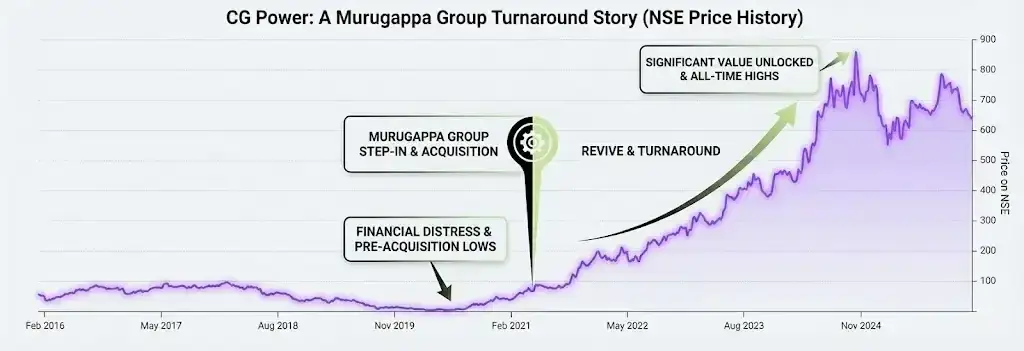
4. Swimming with the Tide – Sector Tailwinds & Govt Waves
Never fight the government. If the Government of India announces a massive budget for a specific sector like Defense, Railways, or Green Energy, even average companies in that sector will fly. This is called a "Sector Tailwind." When an entire industry is being pushed by policy, the order inflows become automatic. You want to buy companies that are swimming with the tide, not against it.
Read More : Why 95% Penny Stock Investors Lose Money (And How to Avoid It)
5. The Health Score – High ROE, Low Debt
This is your quality filter. A genuine multibagger usually has a high Return on Equity (ROE > 15%) and Return on Capital Employed (ROCE > 20%). These numbers prove the management is efficient at using your money. Ideally, you also want Low Debt because high debt kills small companies during tough times. Finding a high-growth company with zero debt available at a low price is the ultimate sweet spot.
A classic example is Caplin Point Laboratories. It was once a tiny, unknown penny stock trading in single digits. However, unlike other risky penny stocks, it had almost zero debt and very high ROE and ROCE numbers. It was a "financial fortress" disguised as a penny stock. The market eventually recognized this quality, and the stock became a massive wealth creator, multiplying hundreds of times over.6. The Future Revenue – Order Book Explosion
For manufacturing or infrastructure companies, the "Order Book" is a crystal ball. It tells you exactly how much money the company will make in the next 2-3 years. If a small company with a market cap of ₹200 Crore suddenly wins orders worth ₹1,000 Crore, the stock is mathematically undervalued. "New Order Wins" are the spark that usually ignites the price explosion.
A perfect example is Olectra Greentech. It was trading at ₹10-20 around 2014-15 and was small and unnoticed. But then, it started winning massive orders for Electric Buses from state governments. The order book grew larger than the company's entire value. Investors who tracked these "Order Wins" saw the stock rise from ₹20 to over ₹1,500.
7. The "Moat" – Building Goodwill & Brand
The longest-lasting multibaggers are companies that build "Goodwill", a brand that customers trust blindly. This allows them to charge a premium price without losing customers. This is called a "Moat." When a company becomes a household name or the "go-to" brand in its niche, it stops competing on price and starts compounding wealth purely on reputation.
A classic example is Eicher Motors (Royal Enfield). In the early 2000s, it was a struggling stock trading around ₹2-5 (adjusted for splits). The company decided to shut down other businesses and focus purely on the "Royal Enfield" brand. They built a cult-like following. This "Brand Power" allowed them to sell bikes at a premium, turning a tiny penny stock into one of India's most expensive shares.
At this point, you might be wondering how these signals look before a stock actually takes off. Let’s apply them step by step to a real-life case study of Avanti Feeds.
Read More : What are penny stocks? The complete beginners guide pros & cons
Case Study: The Art of Holding a Multibagger Penny Stock
"Everyone has the brainpower to follow the stock market. If you lack something, it’s patience." – Peter LynchThe biggest secret to multibaggers isn't finding them; it's keeping them. This is the law of Delayed Gratification. Real wealth builds like a bamboo tree: years of invisible root-building followed by sudden, massive growth. Most investors fail because they panic-sell quality companies when the market turns red. But remember, if the business fundamentals are strong, a price drop is noise, not a signal to exit; it is merely the market asking if you have the conviction to hold for the long term.
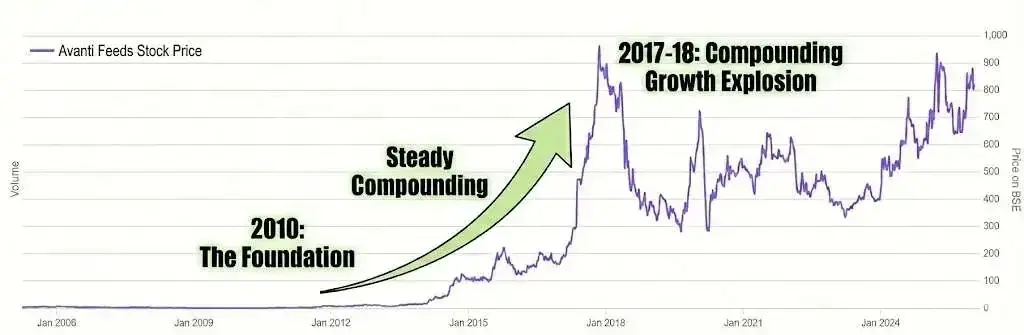
In 2009-2010, Avanti Feeds was trading at a penny level of ₹2-3 (adjusted). To the average investor, it looked like a risky company in a disorganized "shrimp" industry. But if you had applied our checklist, the 7 Golden Signals were already flashing.
The Sector Tailwind, was massive as the Indian government aggressively pushed the "Blue Revolution" to boost seafood exports. Simultaneously, the company was reviving its Growth Engine; while the stock price was flat, their sales were growing double digits annually as they partnered with global giant Thai Union, signaling a major Management/Strategy Shift.
While the crowd ignored the stock, Avanti was silently building a Moat by winning the blind trust of farmers with superior feed quality. Investors who checked the Health Score saw a debt-free balance sheet with skyrocketing ROCE, proving the business was efficient. Those who lacked conviction sold early for a quick 2x profit.
But the few who trusted these signals and held through the volatility witnessed history. They didn't just get a profit; they saw a life-changing 300x return as the stock eventually touched ₹900+. The wealth wasn't in the trading; it was in identifying the signals and sitting tight while the business matured.
After understanding the art of holding a multibagger, it’s time for a healthy reality check. This isn’t to discourage you, but to help you understand why most penny stocks fail, so you can spot the few that truly succeed.
The Reality Check: Why Some Penny Stocks Pass Every Test and Still Collapse
Even with the perfect checklist, investors often lose capital because of "Confirmation Bias", the tendency to ignore red flags because the green signals look so good. In the dark world of penny stocks, unethical promoters know exactly what you hunt for: high sales growth and strong margins. They often use "Financial Engineering" to manufacture these numbers, creating a mirage of a multibagger. They inflate invoices and fake profits to make the stock look attractive on a screener, trapping investors who trust the data without verifying the source.
A classic example of this "Perfect Trap" was Manpasand Beverages. On paper, it was a dream investment: it showed consistent 20%+ revenue growth, had huge investments from top Mutual Funds and FIIs, and owned a visible brand, "Mango Sip," sold in railway stations everywhere. It ticked almost every box on our checklist. Yet, the stock crashed to zero because the numbers were largely false; the sales invoices were fake, and the growth was a lie designed to boost the share price for the promoters' benefit.
To protect yourself from such frauds, you must look beyond the Excel sheet. Always check the quality of the "Auditor", if a company claims to have thousands of crores in revenue but uses a tiny, unknown auditor, be very suspicious. Furthermore, look for "Cash Tax Paid" in the cash flow statement; a company can fake profits, but it will rarely pay real tax on fake money. Finally, pay attention to "Resignations", if a CFO or Auditor quits suddenly without a valid reason, it is often the first and only warning you will get before the ship sinks.
Now that you’ve seen both the opportunity and the risks, one truth stands out clearly. Multibaggers are not about excitement or shortcuts, they are about discipline, patience, and doing the simple things right.
Read More : Small-Cap Investing: Mistakes That Cost Investors Money
Explore our Products
Research Framework

Emerging Titans
Combination of quantitative analysis, industry tailwinds, and management assessment - SPRINT investment philosophy

Tiny Titans
Heavy emphasis on scuttlebutt research, plant visits, and early on-ground signals
Conclusion: The Quiet Road to Multibaggers
Genuine multibaggers are rarely loud or obvious in their early days. They emerge quietly from improving businesses, strong sector tailwinds, disciplined management, and the patience of investors who focus on fundamentals rather than price noise. Penny stocks are not shortcuts to wealth; most fail, and only a few succeed for very specific reasons. The real skill lies in identifying those reasons early and then having the discipline to wait. When you treat investing like owning a business instead of playing a game, outcomes change dramatically. In the long run, boring processes produce extraordinary results.If you want more practical frameworks on finding genuine penny stocks and future multibaggers, without hype or shortcuts consider subscribing. And if this article helped you see penny stocks more clearly, drop a "CLARITY” in the comments as a reminder to always invest with a business-first mindset. Let’s focus on building wealth the patient, disciplined, and repeatable way.
Investor FAQs & Screening Tips
What defines a genuine penny stock?
+A genuine penny stock is cheap due to temporary neglect, not because the business is broken. It has real operations, improving numbers, and a clear path to growth. The price is low, but business quality is rising. That gap is where multibaggers are born.
How important is cash flow when selecting penny stocks?
+Extremely important. Positive or improving cash flow from operations confirms earnings quality. Profits without cash usually signal trouble and weak business fundamentals.
Do sector tailwinds really matter for multibaggers?
+Yes. Strong government policy or industry demand acts as a growth accelerator. Sector tailwinds reduce execution risk and improve order visibility, especially for small companies.
How can I use order books while screening penny stocks?
+Compare order book size with market capitalization. If future orders are multiple times the company’s size, the stock may be undervalued. Orders indicate visibility, not speculation.
When should I not invest in a penny stock?
+Avoid companies with rising debt, frequent promoter dilution, unclear business models, or unexplained price spikes. If the stock moves before the business improves, it’s usually a trap.
How long should I hold a genuine penny stock?
+Hold as long as the business performs and the original thesis remains intact. Multibaggers take years, not months. Selling early is the most common reason investors miss life-changing returns.

High growth stock specialist, Value Educator
Shashank Mahajan is an equity research professional with over 12 years of experience in identifying high-potential SME and micro-cap stocks at an early stage. He follows a rigorous scuttlebutt research–driven approach, combining on-ground insights with deep financial analysis. Shashank specializes in uncovering under-researched and under-owned companies with strong management quality and long-term growth potential. Through disciplined research and early identification, he focuses on spotting tomorrow’s market leaders before they enter the mainstream investor radar.

Zen Technologies: Why Revenue Fell After Its Biggest Win

Data Patterns: India's Radar Designer and Its Waiting Orders

KSH International: The Wire Inside India's Transformers

Krishna Defence: The Steel Behind India's Warship Hulls

PNG Jewellers: A 194-Year-Old Name Goes National

Axiscades: From Services to Missile and Radar Electronics
Explore our Products
Research Framework
Emerging Titans
Combination of quantitative analysis, industry tailwinds, and management assessment - SPRINT investment philosophy
Tiny Titans
Heavy emphasis on scuttlebutt research, plant visits, and early on-ground signals


 Orders
 Subscription
 Share with friends
 Logout


Required Details
₹23999.00
(12 month subscription)
As per SEBI regulations, all users are mandated to complete the KYC that is validated for 1 year. Post payment, you will be redirected to the KYC screen


No comments yet. Be the first to comment!