India's Energy Transition: A Once-in-a-Generation Tailwind
The numbers are not projections - they are engineering requirements. India must build renewable capacity at an unprecedented pace to meet industrial, residential, and data economy demand.
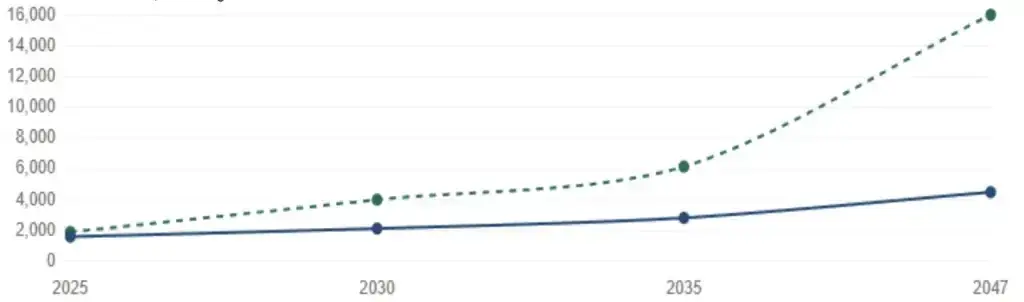
India stands at an energy inflection point that has no modern parallel. Power demand is projected to reach 4,490 TWh by 2047 - nearly triple current levels. Renewable energy capacity must expand from 190 GW today to 1,600 GW, a near-tenfold increase.
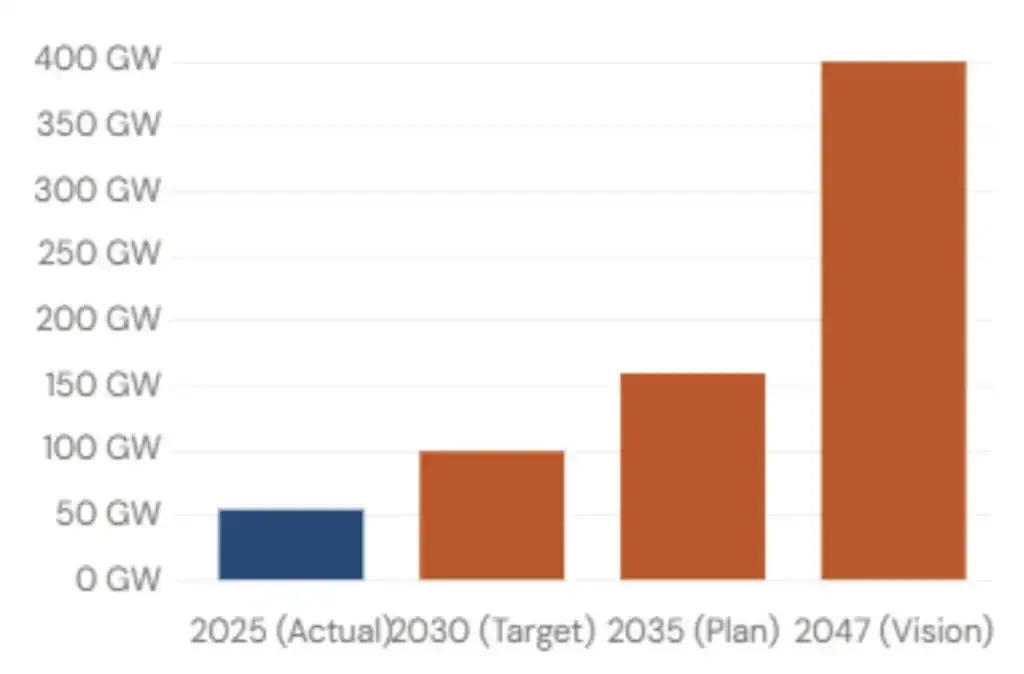
Wind alone must grow from 55 GW to 400 GW at a 10% CAGR. India Wind Capacity Trajection:
These are not aspirational targets. They are derived from hard constraints: a 500 GW non-fossil target by 2030 under Panchamrit, mandatory RE quotas for industry, and an exploding data centre buildout requiring 24/7 clean power. The demand is structural, not cyclical.
Solar and wind are not competitors. They are biological complements. Wind peaks in the evening when solar falls. During monsoon months, when solar Capacity Utilisation(CUF) collapses, wind Capacity Utilisation(CUF) surges. Essentially, since wind and sun work at different times of the day and year, they’re the perfect pair. Any smart grid operator knows they need both to keep the lights on, and they’ll pay extra for a wind partner they can actually count on.
If you are interested in knowing about penny stocks and understanding how they work, then read our article: What are penny stocks? The complete beginner's guide: pros & cons
Business Architecture: The Four Revenue Engines
Suzlon has evolved far beyond being just a turbine manufacturer. Today, it operates as a vertically integrated renewable energy platform where four distinct business units work together in a flywheel effect. This strategic setup ensures that while the company captures the massive upside of new installations, it remains anchored by steady and recession-proof cash flows.
At the heart of the operation is the wind turbine manufacturing division, which acts as the primary volume driver for the group. With a 4.5 GW capacity, this unit is currently dominated by the S144 platform, representing nearly 90% of the current order book. While manufacturing scales up toward 18% margins, the real stability comes from the Operations and Maintenance Services unit.
This service division manages a massive 15.5 GW installed base and functions as a high-margin annuity engine for the business. It delivers consistent profits with predictable annual fee hikes and enjoys near-zero customer churn across its portfolio. Supporting this core is SE Forge, the company’s foundry arm, which is seeing a significant turnaround in both utilization and global export revenues.
To ensure projects move from paper to reality, the company is aggressively expanding its EPC and project execution capabilities. This is further bolstered by DevCo, a proactive development vertical that identifies sites and secures grid connectivity years in advance. By integrating site development, manufacturing, and long-term servicing, Suzlon has built an architecture designed for maximum execution velocity.
The Order Book: The Most Misunderstood Asset
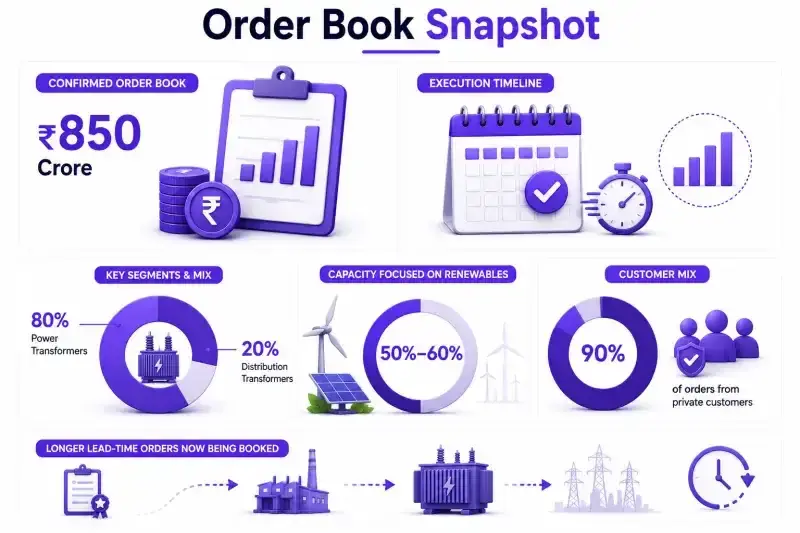
Suzlon’s 6.4 GW order book is often viewed simply as a backlog, but it actually represents nearly three years of clear revenue visibility. What makes this impressive is that the book-to-bill ratio remains at 1.9x, meaning for every megawatt delivered, almost two new megawatts are added. This constant growth despite record deliveries reflects a level of market demand and leadership rarely seen in the capital goods sector. Order Book-
The quality of this order mix is equally critical, with over half the book coming from Commercial and Industrial clients who offer premium pricing and faster decision-making. The remainder is split between secured auction bids with signed power purchase agreements and high-credit government entities like NTPC and SECI. This diverse base ensures that the company is not only growing rapidly but is also shielded from the typical risks associated with long-term infrastructure projects.
Beyond the numbers, Suzlon has built a competitive moat that is nearly impossible for new entrants to replicate. Their 29% cumulative market share is the result of thirty years of operational depth and an integrated supply chain that keeps them immune to global disruptions. Their 29% cumulative market share is the result of thirty years of operational depth and an integrated supply chain that keeps them immune to global disruptions. Every new turbine they install feeds into a twenty-year service contract, creating a high-margin annuity engine that keeps the business stable regardless of market cycles.
Perhaps the most underestimated advantage is Suzlon's proprietary database of wind and geospatial intelligence across India. With decades of data on over 1,100 GW of potential sites, the company knows exactly where the next generation of wind farms should be built. This unique knowledge base allows their development arm to identify 25+ GW of potential years in advance, effectively controlling the future pipeline of the Indian wind industry.
Like this analysis? Get powerful insights like this every week. No spam.
OMS: The Hidden Value Factory
The Operations and Maintenance Services (OMS) division is arguably the most undervalued part of Suzlon’s business because it is often overlooked as part of a capital goods story. In reality, it functions more like a high-growth software company or a toll road, providing recurring revenue with contractually locked 4–5% annual fee hikes. With near-100% contract renewal rates and almost zero working capital needs, this segment offers a level of financial stability and margin protection that is rare in the industrial sector.
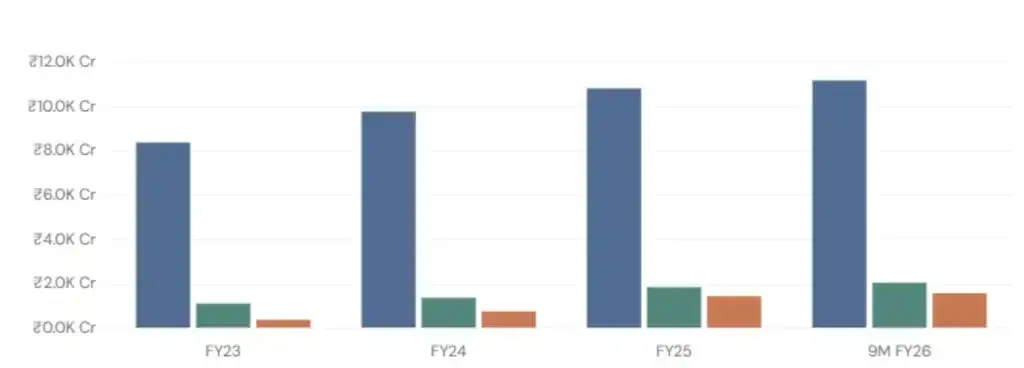
Based on current performance, the OMS business generates approximately ₹1,970 crore in annualized revenue at a robust 37.5% EBITDA margin. This results in roughly ₹740 crore of operating profit which, when valued at an industry-standard 15x multiple for high-quality annuities, implies an enterprise value of ₹11,100 crore for this division alone. This standalone value is a massive pillar of support for the company's overall valuation that the market is only beginning to fully appreciate. OMS Revenue & EBITDA Trend (₹ Cr) -
Beyond the core fleet, Suzlon’s multi-brand arm, Renom, is rapidly becoming a powerhouse in its own right by servicing over 3,500 MW of third-party turbines. Growing at more than 15% annually, Renom diversifies the revenue stream and creates a competitive moat by capturing the service market for fifteen different global brands. This allows Suzlon to profit from the growth of the entire wind industry, not just from the machines they manufacture themselves.
Operationally, the OMS team maintains a world-class machine availability rate of over 95%, with aggressive targets to reach 97–98% in the coming years. This metric is vital because every percentage point of improvement directly increases both Suzlon’s fee income and the profitability of the customer’s wind farm. By consistently hitting these benchmarks, Suzlon secures its reputation as a reliable long-term partner, ensuring the "OMS flywheel" continues to spin for decades.
Revenue & Margin Architecture
Suzlon’s financial trajectory has reached a major turning point with revenue crossing ₹11,000 crore in just nine months. This growth is powered by a strong operating leverage effect where fixed costs like employee expenses and corporate overheads remain stable even as production volumes double. Consequently, every new megawatt delivered adds significantly more to the bottom line than previous units. Revenue, EBITDA & PBT — Historical & 9M FY26 (₹ Cr) -
The profitability of the turbine manufacturing division is also on the rise with contribution margins currently at 25.6 percent. This margin profile is expected to expand further as the company shifts toward a higher mix of full service EPC projects. By using the DevCo vertical to secure land and connectivity in advance, Suzlon can front load essential costs and capture more value during construction. EBITDA Margin Expansion (%) -
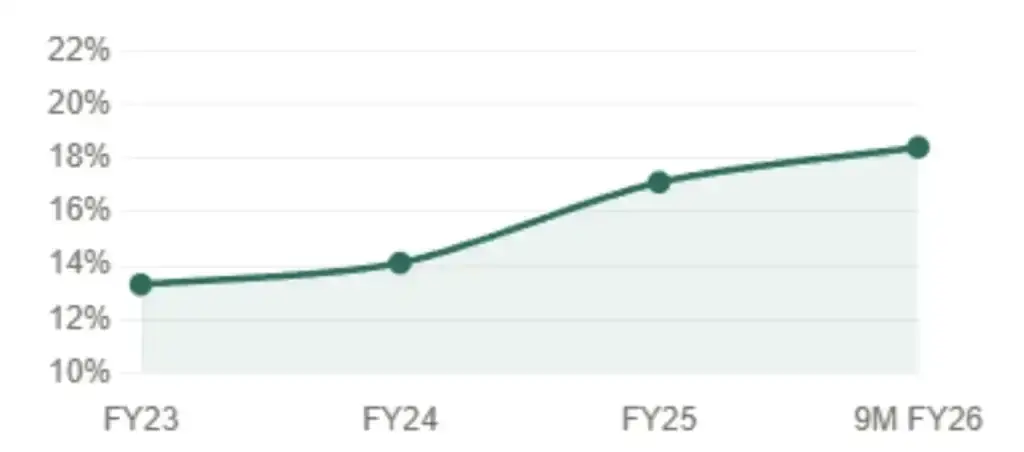
Ultimately the absorption of fixed costs through growing volumes is creating a more efficient and profitable enterprise. As the execution pace accelerates and the high margin service business scales alongside it, the blended group margin is set for sustained expansion. This architecture ensures that Suzlon is becoming more profitable with every new gigawatt added to the grid.
Be part of the
Value Educator
community
Get exclusive insights tailored to
sharpen your investment decisions.
Balance Sheet Transformation: A Story of Redemption
Suzlon's journey from near-bankruptcy in 2013 to its current financial strength is one of the most dramatic turnarounds in Indian corporate history. The company has completely wiped out its once-massive debt of ₹14,000 crore, transitioning to a net cash position of ₹1,556 crore and a net worth of over ₹8,300 crore. This shift changes the investment calculus entirely, moving the company from a story of survival to one of aggressive strategic growth.
This net cash position is far more than just a healthy number on a ledger; it acts as a strategic war chest for the future. These funds allow Suzlon to finance its DevCo land pipeline, invest in research and development for the next-generation 5 MW turbine platform, and explore potential acquisitions without needing to dilute shareholder value. Having this liquidity on hand ensures the company can move quickly to capture new market opportunities as they arise.
A major hidden asset in this recovery is the deferred tax treasure chest, stemming from over ₹8,000 crore in carry-forward losses. Because of this tax shield, the company is unlikely to pay significant cash taxes for the next five to seven years. Management estimates that approximately ₹4,400 crore of additional profits can be earned before this benefit is exhausted, directly boosting free cash flow that can be reinvested into the business.
The EPC Pivot and DevCo Strategy
Suzlon is undergoing a fundamental business model transformation by moving from pure turbine supply to a more comprehensive approach. This strategic pivot into project development and EPC services is designed to structurally solve long-standing execution challenges. In a typical supply-only model, the company often waits for developers to handle land and civil work, leading to delays and payment risks. By taking direct control, Suzlon can manage project timelines and grid connectivity while earning higher revenue per megawatt.
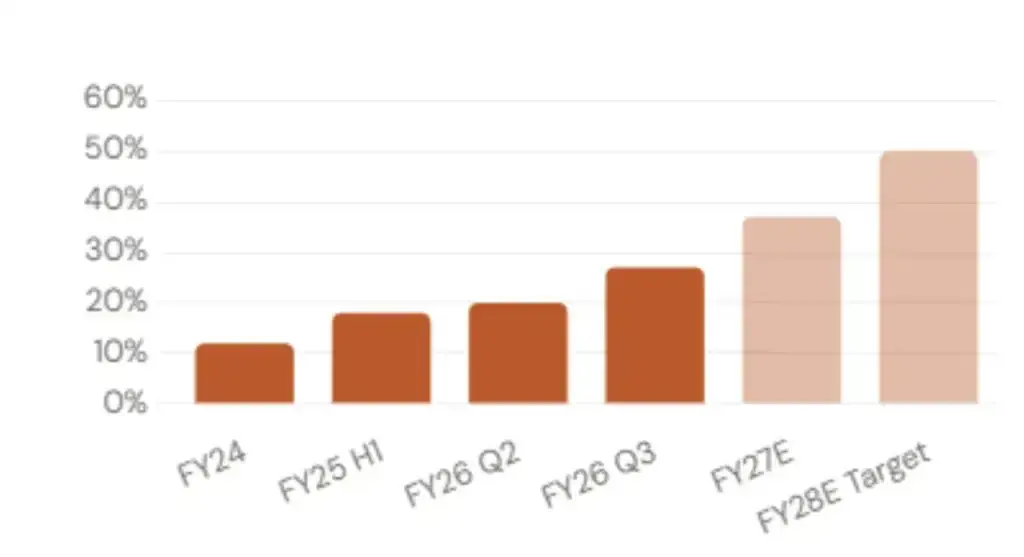
The shift toward EPC contracts has already shown momentum, with their share of the order book jumping from 20 percent to 27 percent in a single quarter. Management aims to have half of all projects under this model by 2028 to ensure a more predictable and efficient workflow.
While these contracts have slightly lower margins than pure turbine sales, the dramatic improvement in the working capital cycle significantly boosts overall returns on capital. This transition ensures that the company is paid in milestone tranches, reducing financial stress and increasing execution velocity. EPC Share Expansion (% of Order Book) -
Supporting this transformation is the DevCo vertical, which acts as a long-term funnel for the entire business. By identifying high-wind sites and securing land and grid access three to five years in advance, DevCo creates a pre-sold pipeline that keeps the execution calendar full. This proactive strategy requires only minimal seed capital and avoids adding stress to the balance sheet. Ultimately, this integrated approach allows Suzlon to offer a seamless solution to clients while securing its own growth for years to come.
Join 1,45,000+ investors discovering under-researched small caps before they rerate.
The Export Opportunity: Scaling Beyond Borders
Suzlon is strategically positioning itself to capture the global wind energy resurgence, particularly as India formalizes key trade deals with the EU and the United States. With the appointment of experienced leadership for the European market, the company is preparing for a new wave of international orders expected to materialize in the coming years.
These export markets, including Australia, South Africa, and the Middle East, are highly attractive because they offer significantly higher selling prices per megawatt than the domestic Indian market, which will provide a powerful boost to consolidated margins.
A critical lever for this international growth is SE Forge, the company’s dedicated foundry and forging arm. This division is already exporting high-quality castings to global giants like GE, and the easing of trade tariffs is expected to accelerate these volumes.
Currently operating at only 31 percent capacity, SE Forge has massive room to grow; every additional ton of export production effectively translates into pure margin addition for the group. This internal supply chain depth gives Suzlon a distinct pricing advantage that pure-play assemblers simply cannot match.
SE Forge: Quietly Building a Second Engine
SE Forge is often misunderstood as merely a captive unit for wind components, but it is rapidly evolving into a standalone industrial powerhouse. By diversifying its customer base and improving its internal efficiencies, the division has seen its profit margins more than double in a very short period.
This profitability inflection is a direct result of rising utilization rates, which allow the business to absorb fixed manufacturing costs more effectively as volumes grow.
The economics of the forging and foundry business are highly sensitive to how much of the factory is being used. Currently, the unit is operating at only 31 percent capacity, yet it has already reached a 20.5 percent margin.
As utilization moves toward 50 percent, margins could realistically climb even higher, transforming SE Forge into a high-quality industrial business in its own right. This growth represents pure operating leverage, as the existing 120,000 MT capacity requires no additional capital expenditure to scale.
Beyond wind energy, the division is aggressively entering the non-wind sector by qualifying its castings for high-value industrial equipment and injection molding machines. While the certification process for these specialized parts is rigorous and lengthy, it creates incredibly sticky and recurring revenue once established.
This expansion into new verticals is expected to begin scaling meaningfully by 2027, providing a stable second engine of growth that complements Suzlon’s core wind business.
Market Cap focus
No. of ideas in a year
Holding period
Pricing

Emerging Titans
Combination of quantitative analysis, industry tailwinds, and management assessment - SPRINT investment philosophy
Multi Cap
20-25
3+ Years
Rs. 23,999/year

Tiny Titans
Heavy emphasis on scuttlebutt research, plant visits, and early on-ground signals
Exclusively for SME's
15-20
3+ years
Rs. 31,999/year
Conclusion
The future of India’s energy landscape hinges on a massive transition, and the question is no longer whether the country will build 400 GW of wind capacity, but who will be the one to build it.
Suzlon stands as the clear answer, supported by five distinct pillars that create a powerful compounding loop. With a structural demand tailwind requiring a three-fold increase in annual installations, Suzlon's dominant market position ensures it is the primary beneficiary of this inevitable acceleration.
This growth is anchored by a compounding order book and a high-margin service engine that provides rare stability in a capital-intensive sector. For every megawatt delivered, almost two new megawatts are added, providing multi-year revenue visibility that far exceeds industry norms.
Simultaneously, the massive 15.5 GW installed base functions as an annuity factory, generating significant recurring revenue that protects the company’s earnings through any potential downturn in the new order cycle.
Suzlon has also undergone a fundamental business model transformation, moving toward an integrated EPC and site development strategy that solves long-standing execution delays.
This shift, combined with a debt-free balance sheet and a massive tax shield, allows the company to fund its own growth and R&D without diluting shareholders. This financial strength moves the company from a narrative of survival to one of aggressive, self-sustained expansion.
Comment below “Wind” if you liked the article and share it with your frinds who might find the analysis useful. Check out other articles to gain more insights on other stocks.
FAQs
How does wind power help the electricity grid when the sun isn't shining?
+
Wind and solar are natural partners because they peak at different times. Wind often blows strongest in the evening and during the monsoon months when solar energy is low. This balance makes the power grid much more stable and reliable.
What is "Machine Availability" and why does it matter?
+
This is a measure of how often a wind turbine is actually ready to generate power. Suzlon keeps its turbines running over 95% of the time. High availability means the customer makes more money from their investment and Suzlon earns its full service fees.
Why is having a "net cash" position a big deal for Suzlon?
+
In the past, Suzlon had a lot of debt which limited its growth. Being "net cash" means they now have more money in the bank than they owe in loans. This gives them the freedom to invest in new technology and land without having to borrow money.
Does Suzlon only fix and maintain its own turbines?
+
No, through their brand Renom, they maintain turbines made by 15 different companies. This allows them to make money from the entire wind market in India, even from projects where they didn't originally sell the equipment.
What happens if a project gets delayed by land or permit issues?
+
Suzlon’s new "DevCo" strategy involves securing land and grid connections years in advance. By doing this homework early, they can hand over a "ready-to-go" project to the customer, which avoids the typical delays that used to slow down their revenue.
About the author

Shashank Mahajan
High growth stock specialist, Value Educator
Shashank Mahajan is an equity research professional with over 12 years of experience in identifying high-potential SME and micro-cap stocks at an early stage. He follows a rigorous scuttlebutt research–driven approach, combining on-ground insights with deep financial analysis. Shashank specializes in uncovering under-researched and under-owned companies with strong management quality and long-term growth potential. Through disciplined research and early identification, he focuses on spotting tomorrow’s market leaders before they enter the mainstream investor radar.
Join 1,45,000+ investors discovering under-researched small caps before they rerate.







 Orders
 Subscription
 Share with friends


No comments yet. Be the first to comment!