
REITs and InvITs in India: A Guide

Imagine sitting in your living room in Jaipur or Pune, watching India rapidly transform — new office hubs, expanding metro lines, wider highways, stronger power networks. It is hard not to think, “I wish I could own a small piece of this growth.”
But the moment the idea feels exciting, the obstacles show up. Commercial property needs deep pockets, often crores. Trust is another concern — real estate is not exactly known for transparency. And even if you could invest, how would you evaluate a tech park in Bengaluru or a highway project hundreds of kilometres away?
Ownership brings its own headaches, too. Tenants, legal paperwork, maintenance, vacancies — what looks like an investment can quickly turn into a full-time responsibility.
Now, picture a simpler route.
You open your investing app, click a few buttons, and become a part-owner of income-generating assets — maybe a premium office park leased to global companies, or infrastructure projects that produce steady cash flows.
Also refer to our article on: A Beginner's Guide to the Indian Stock Market
No brokers. No stamp duty chaos. No tenant management.
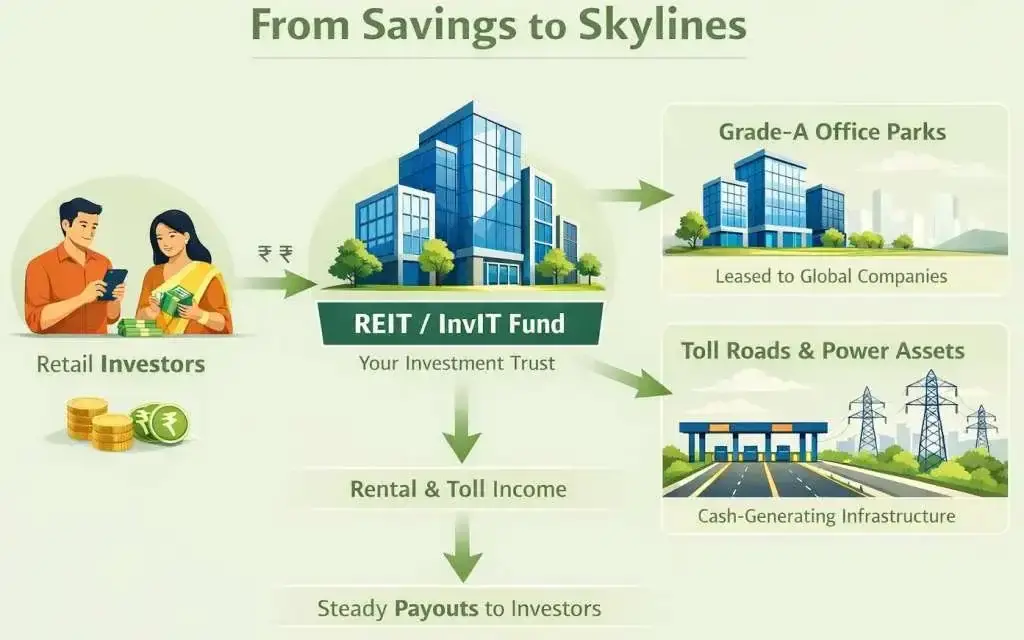
This is where REITs and InvITs come in. Think of them as mutual funds for real assets. They are professionally managed, regulated, listed on stock exchanges, and built to help everyday investors participate in India’s real estate and infrastructure story — without the traditional barriers.
Here is your step–by–step breakdown, jargon–free guide to understanding them.
Big Picture: Why REITs and InvITs Matter in Today’s India
India is building at an extraordinary pace — expressways, metros, office parks, warehouses, data centres, and power networks are rapidly reshaping the country’s economic landscape. This momentum is backed by a sharp rise in public investment, with capital expenditure growing from ₹2 lakh crore in FY2014–15 to a proposed ₹12.2 lakh crore for FY2026–27, underscoring infrastructure as a long-term national priority.For decades, owning these high-quality, income-generating assets was largely limited to institutions and the ultra-wealthy. REITs and InvITs change that by pooling money from everyday investors to acquire large real estate and infrastructure assets. Listed on stock exchanges and regulated by SEBI, they allow investors to participate in India’s physical growth story without committing enormous capital.
As the government increasingly uses REIT-like structures for asset monetisation and encourages private participation through measures such as the proposed Infrastructure Risk Guarantee Fund, these vehicles are becoming central to how India finances its expansion.
Simply put, REITs and InvITs are turning the country’s infrastructure boom into an accessible investment opportunity for ordinary investors.

Foundations: What Exactly Are REITs and InvITs?
A REIT, or Real Estate Investment Trust, is all about owning real estate that churns out income—mostly commercial spots like offices, malls, logistics parks, and yeah, sometimes hotels or data centres too.An InvIT, that’s Infrastructure Investment Trust, focuses on ready-to-go infrastructure: think roads, power transmission lines, renewable energy projects, gas pipelines, telecom towers.
Neither one’s an operating company; they’re trusts holding assets directly or through Some Special purpose vehicle (Think of an SPV like a dedicated container for one project — everything related to that asset, from income to risk, stays inside it without mixing with the parent company) banking on reliable cash from leases, tolls, or tariffs.
Regulations require a big chunk of the portfolio to be fully built and generating revenue already, which cuts down on those risky construction phases for folks investing.
What do investors like us get?
These Investment trusts are required to pass along most of the cash they collect—usually about 90%—straight back to unit holders.
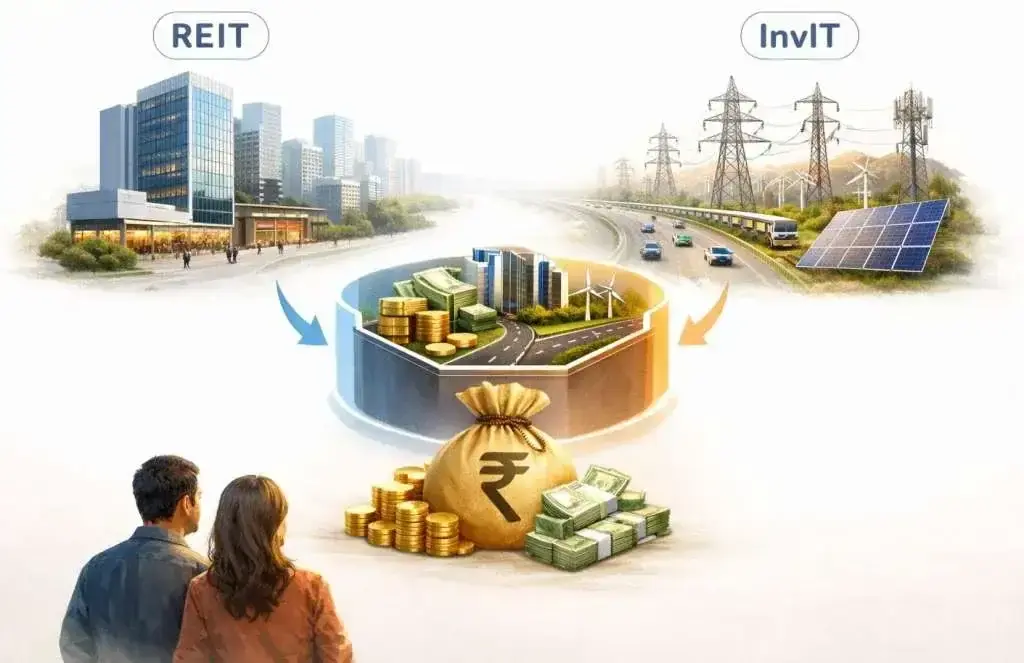
Structure of REITs and InvITs
The trust sits at the very top, pumping out units to investors and getting listed on the exchanges.Right below are the SPVs—special purpose vehicles—that hold the real properties or projects, complete with approvals, contracts, and any loans attached.
The sponsor, often a developer or infra firm, brings in the starter assets and tends to keep a solid stake going forward.
A trustee ensures everything stays within the rules and looks out for unitholders' rights. At the same time, the investment manager juggles the day-to-day activities, including snapping up new assets, refinancing, handling leases, and sorting distributions.
SEBI’s got strict rules covering leverage limits, related-party transactions, what needs disclosing, minimum public holdings, and exactly how much income has to flow out.
We've got the basic understanding of the structure.
Now, let's move on to the main question of how these trusts generate income.
How do these REITs and INVITs Generate Income?
REITs pull in rental cash from tenants filling up offices, malls, warehouses, or data centres, on top of things like parking, common-area fees, and occasionally rents linked to revenue.They grow that through built-in rent hikes, bumping up occupancy, mixing in better tenants, or grabbing and developing more properties.
On the other hand, InvITs bank on infrastructure users—tolls on roads, transmission charges, power plant tariffs, or telecom folks renting towers.
A lot of that cash flows in through long-term deals or regulated tariffs, making revenues way more predictable than your average business out there.
Once they cover operating costs, interest, SPV-level taxes, and any capex, the leftover distributable cash heads out to unitholders.
REITs vs. InvITs – Practical Comparison
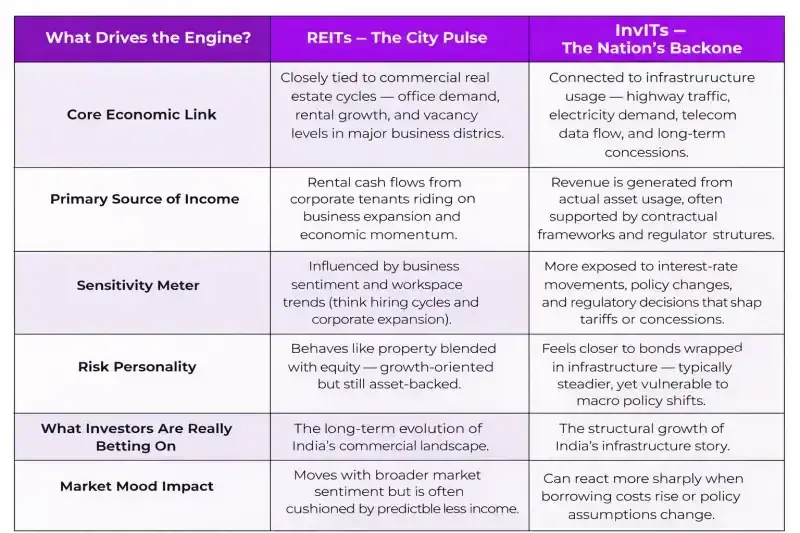
What makes them Popular?
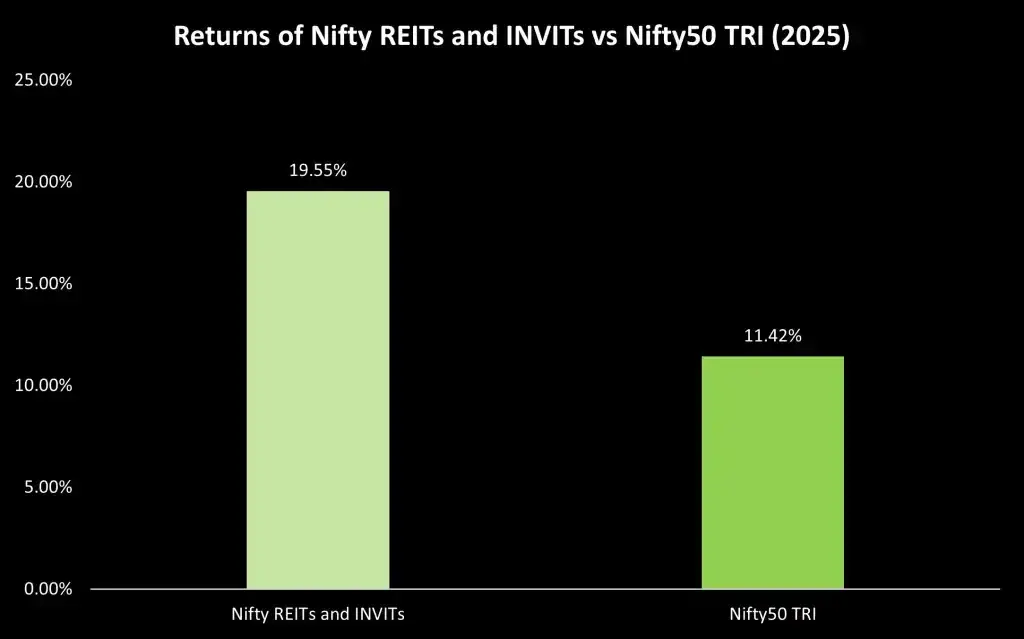
Do you know that in 2025, India’s listed REITs and InvITs quietly outpaced the broader market?They delivered a solid 19.55% return, comfortably beating the Nifty50 TRI’s 11.42%, while REITs alone surged an eye-catching 29.68%, according to ICRA Analytics. For many investors, that performance was a wake-up call — real assets were no longer just stable; they were competitive.
But returns are only part of the story.
One of the biggest drivers of REIT and InvIT popularity is their ability to generate steady cash flows — something Indian investors have long valued for meeting everyday financial needs and strengthening retirement plans.
Access has widened, too. Falling minimum investment sizes mean retail investors can now participate in commercial real estate and infrastructure — opportunities that once demanded massive capital.
Liquidity makes them even more appealing. Since these trusts are exchange-listed, investors can enter or exit far more easily than with physical property, avoiding drawn-out sale cycles.
Credibility has also improved. SEBI’s regulatory framework, with its focus on disclosures, valuations, governance, and leverage, brings a level of transparency many traditional real estate investments lacked.
Supporting all of this is India’s infrastructure push. As mature assets are monetized, REITs and InvITs create a steady pipeline for investors.
Their rise is no coincidence — they combine income visibility, liquidity, regulatory comfort, improving access, and structural growth in a way that is increasingly difficult to overlook.
Look Beyond Returns — Risks & Taxes Matter
You can’t dodge market risk: cash flows might hold steady, but unit prices yo-yo hard on pure investor mood swings.Interest rate risk packs a punch too—rates go up, and the yields folks demand climb, dragging unit prices down.
Operational snags lurk at the assets themselves: vacancies hitting office towers, toll collection lags, plant breakdowns, surprise maintenance blowouts.
For InvITs, regulatory and policy shifts loom large—tweaks to toll policies, power tariffs, or concession details can really mess with cash flows.
Liquidity? Smaller or fresh trusts might struggle, with wide bid-ask gaps making it pricey.
Now, let's understand the tax bit of this investment.
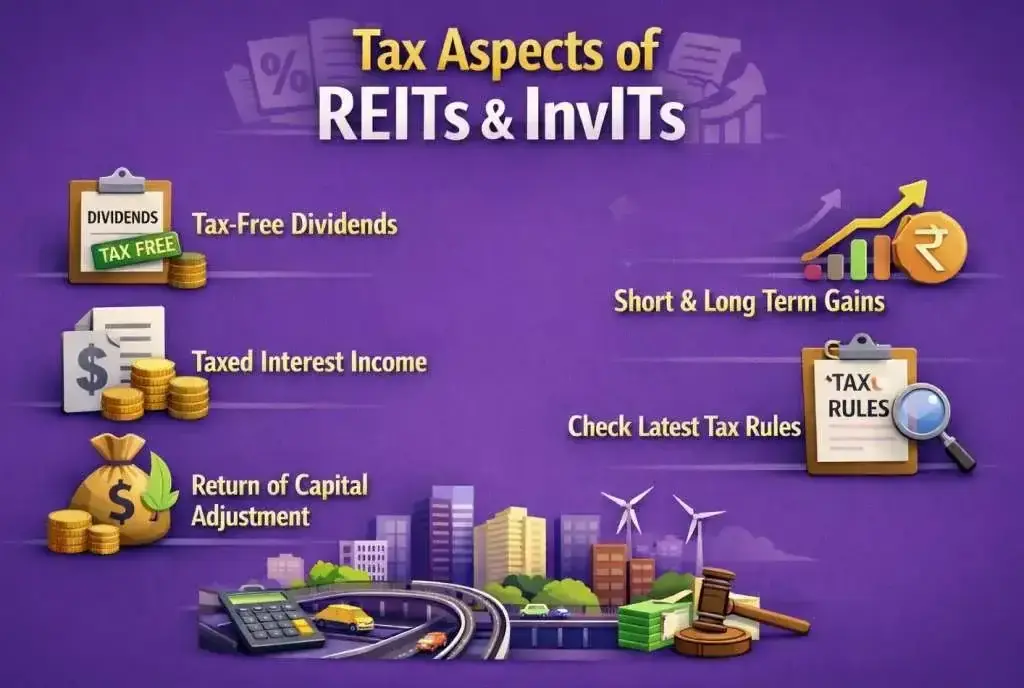
The income REITs and InvITs distribute might blend interest, dividends, and principal repayments, and each piece gets taxed a bit differently when it lands in your pocket.
Dividends tend to stay tax-free for investors as long as the SPVs don’t opt for certain tax perks, but interest bits get slapped with your personal slab rate.
That return of capital—principal payback—actually lowers your original cost base, which plays into capital gains calculation when you sell later. Selling listed units? Short-term gains kick in for quick holds, but long-term—past the holding cutoff—get a nicer concessional rate, often with an exemption cap.
Explore our Products
Research Framework

Emerging Titans
Combination of quantitative analysis, industry tailwinds, and management assessment - SPRINT investment philosophy

Tiny Titans
Heavy emphasis on scuttlebutt research, plant visits, and early on-ground signals
Global and Indian Examples
REITs have been around globally for decades in places like the US, Singapore, Australia—covering everything from offices and malls to warehouses, healthcare, data centres, and beyond.India’s REIT and InvIT world is newer but picking up steam, with listings in offices, retail, logistics, roads, and power transmission.
Famous Indian office REITs control premium business parks packed with blue-chip tenants on long-haul leases, right in spots like Bengaluru, Mumbai, and Delhi-NCR.
InvITs here juggle toll road bundles or power lines across states, spreading out those cash flow sources nicely.
It shows how sponsors recycle mature assets for cash while handing investors access to these battle-tested portfolios.
Presented below is a visual timeline outlining the major milestones in India’s REIT and InvIT landscape:

REITs & InvITs in India: How to Invest for Smart Diversification
Easiest way: grab units straight on the stock exchanges with your standard trading and demat setup, same as equities.You can also read our article on: Circulation vs. Consumption Stocks: Which Type is More Recession-Proof?
Catch the initial offers too when fresh trusts launch, just watch the minimum application amounts.
Mutual funds or themed portfolios zeroed in on REITs/InvITs offer a bundled path, mixing multiple listed ones or even sponsor companies. Wealth platforms throw in structured products or unlisted options geared toward high-net-worth crowds.
But heads up—liquidity, fees, and openness differ wildly, so dig into those offer docs and get the fee breakdown.
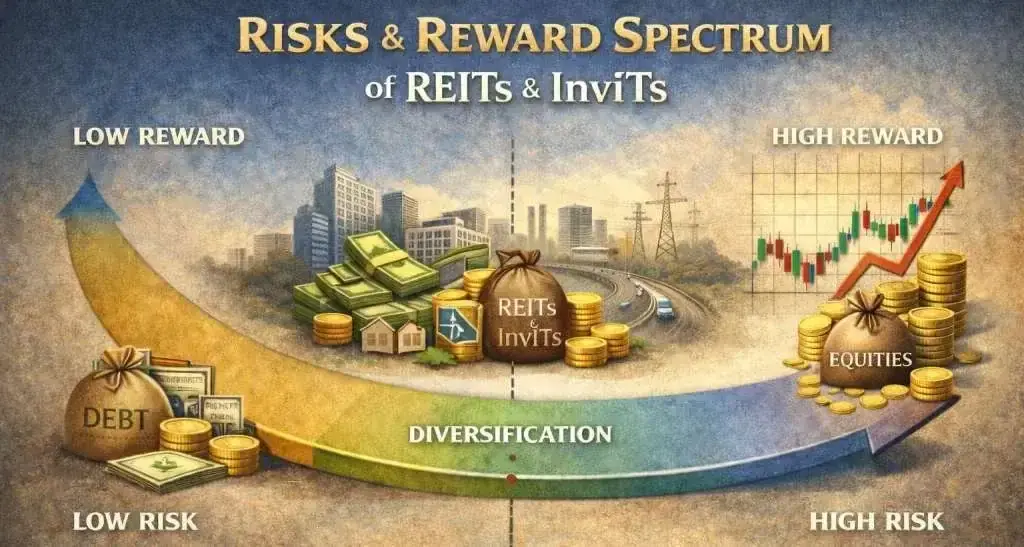
These financial instruments offer great diversification benefits if included in the portfolio smartly. REITs and InvITs land somewhere between equities and debt on the risk-reward ladder.
To know more about portfolio diversification, you can read our article on: Portfolio Diversification – How Many Stocks Should You Hold?
They toss in a whole new asset type past stocks, bonds, gold—bringing income rooted in tangible stuff. Since rents, tolls, and tariffs drive the returns, they don’t always march in lockstep with big stock indexes.
For the cautious crowd, a small slice amps up your yield without diving headfirst into wild small-caps or themes.
Where This Market Is Headed Next
India’s REIT and InvIT story is still in its early innings. With penetration at just 19% versus roughly 57% globally, the runway for growth is hard to ignore.The market is projected to expand from about $18 billion today to nearly $25 billion by 2030, while combined market capitalization has already crossed ₹4 lakh crore, with assets under management at ₹9.25 trillion. Backed by rapid urbanization and a massive infrastructure buildout, these trusts are increasingly seen as dependable, yield-focused investments in an otherwise volatile return environment.
What’s changing is the breadth. Beyond office parks, future listings are expected to lean into logistics, warehousing, data centres, healthcare, and renewables, deepening the opportunity set.
Growth could be sharp from here — REIT assets alone may rise nearly fivefold to ₹10.8 trillion by 2029, with combined REIT–InvIT AUM potentially touching ₹25 lakh crore by 2030. Returns in the 8–12% range remain a realistic expectation as the market matures.
For portfolios, a measured 10–15% allocation is increasingly viewed as sensible for balancing income and diversification. Wider mutual fund participation, possible index inclusion, and tighter regulations should further improve liquidity, transparency, and investor confidence.
Put simply, as India builds more real assets, REITs and InvITs are steadily moving from “alternative exposure” toward becoming a core part of everyday portfolios.
Conclusion: A Simpler Way to Ride India’s Growth
Step outside today, and it is impossible to miss the change. New flyovers appear where traffic once crawled, glass offices reshape city skylines, and infrastructure keeps pushing deeper into parts of the country that once felt far removed from economic activity.
For years, benefiting from these assets meant writing very large cheques or dealing with the everyday hassles of ownership. Most investors simply stayed on the sidelines.
REITs and InvITs made this story far less complicated.
They offered a way to participate in real, working assets — the kind that people use every single day — without worrying about tenants, paperwork, or managing properties from hundreds of kilometres away. It is infrastructure and real estate investing, but stripped of much of the traditional friction.
That does not mean they are perfect. Prices will fluctuate, interest rates will matter, and some trusts will inevitably perform better than others.
You can also refer to our article on: Bull Market vs Bear Market – How Investors Should React
But for investors willing to think long term, they introduce something valuable into a portfolio: a return stream that is not entirely tied to stock market mood swings.
You do not need to go overboard. Even a measured exposure can add balance while opening the door to income that feels a little more predictable.
And perhaps that is the real shift underway — these instruments are no longer niche ideas discussed only in institutional circles. They are slowly finding their place in everyday portfolios.
India’s growth story is unfolding in concrete, steel, fibre cables, and energy grids. Owning a part of that story no longer requires extraordinary wealth — just informed participation.
Sometimes, investing well is not about chasing the next big thing. It is simply about finding practical ways to grow alongside the country itself.
👉Comment “GROWTH” below if you agree that investors should participate in India’s real asset boom, not just watch it from the sidelines.
FAQs
Are REITs and InvITs suitable for first-time investors?
+They can be — but not as a starting point for your entire investing journey. Think of them as a supporting actor rather than the lead. If you already have some exposure to equities or index funds, adding REITs or InvITs can bring balance through income visibility.
What kind of investor usually appreciates these instruments the most?
+Investors who value predictability over thrill. If you like the idea of seeing periodic cash flows instead of relying purely on price appreciation, these trusts often feel psychologically comforting, especially during choppy markets.
Should you focus more on yield or growth while evaluating them?
+Neither in isolation. A very high yield can sometimes signal stress, while a very low yield may defeat the purpose of owning income assets. Look for consistency — trusts that demonstrate the ability to distribute cash steadily while gradually expanding their asset base.
Do REITs and InvITs help you stay invested during volatile markets?
+Surprisingly, yes. Regular distributions can act like a behavioral anchor. When money actually hits your account, it becomes easier to ignore short-term price swings and think long term.
How much tracking do they really require?
+Far less than owning property — but not zero. A quick quarterly check on occupancy levels, debt, new acquisitions, and distribution trends is usually enough. You are outsourcing management, not attention.

High growth stock specialist, Value Educator
Shashank Mahajan is an equity research professional with over 12 years of experience in identifying high-potential SME and micro-cap stocks at an early stage. He follows a rigorous scuttlebutt research–driven approach, combining on-ground insights with deep financial analysis. Shashank specializes in uncovering under-researched and under-owned companies with strong management quality and long-term growth potential. Through disciplined research and early identification, he focuses on spotting tomorrow’s market leaders before they enter the mainstream investor radar.

Zen Technologies: Why Revenue Fell After Its Biggest Win

Data Patterns: India's Radar Designer and Its Waiting Orders

KSH International: The Wire Inside India's Transformers

Krishna Defence: The Steel Behind India's Warship Hulls

PNG Jewellers: A 194-Year-Old Name Goes National

Axiscades: From Services to Missile and Radar Electronics
Explore our Products
Research Framework
Emerging Titans
Combination of quantitative analysis, industry tailwinds, and management assessment - SPRINT investment philosophy
Tiny Titans
Heavy emphasis on scuttlebutt research, plant visits, and early on-ground signals


 Orders
 Subscription
 Share with friends
 Logout


Required Details
₹23999.00
(12 month subscription)
As per SEBI regulations, all users are mandated to complete the KYC that is validated for 1 year. Post payment, you will be redirected to the KYC screen


No comments yet. Be the first to comment!