
Action Construction Equipment: Cranes, Defence and KATO
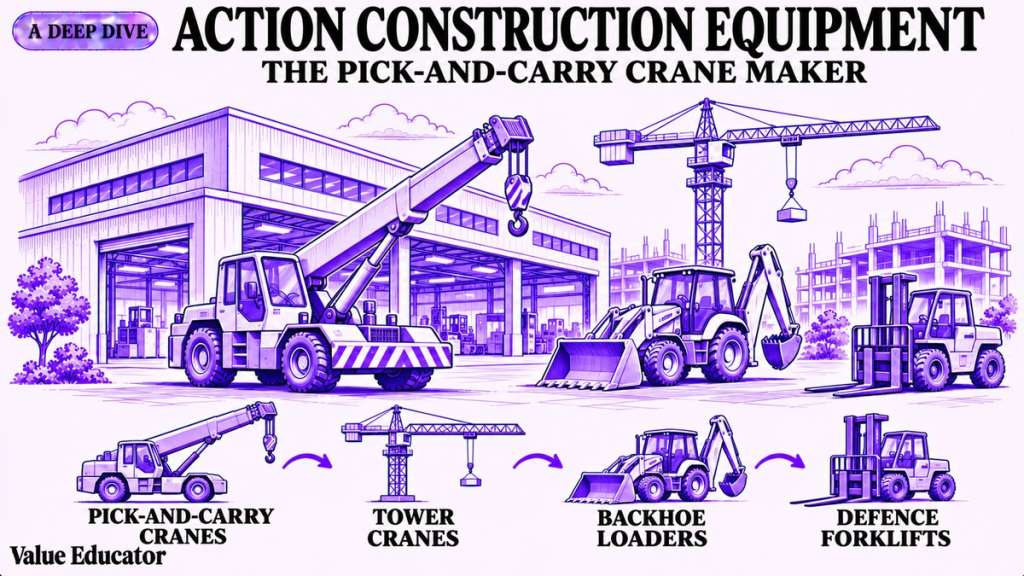
In FY25, an Indian equipment maker sold 13,360 cranes, construction machines and forklifts. In FY26 it sold 10,853. New emission rules had raised the price of most of its machines, and buyers had bought early before the change. Its revenue slipped 1.4%. Yet its profit after tax still rose a little, to ₹415.1 Cr. Then, in the July to September quarter of 2026, it sold 2,812 of those machines, about 20% more than a year earlier, in what it calls its best-ever second quarter.
Most of those machines are cranes, and one kind of crane above all. A pick-and-carry crane is a crane on wheels that can lift a load and then drive with it across a site. So one machine does the work of a crane and a truck. On Indian roads, factories and building sites it is often called a "Hydra". Contractors, factories, ports and crane-rental companies buy these cranes in large numbers.
The second kind of crane is the tower crane, which is the tall crane fixed next to a building as it rises. Then come the machines that dig and level the ground. A backhoe loader is a digging machine with an arm at the back and a loading bucket at the front. Motor graders and road rollers level and press the roads. Forklifts, telehandlers and aerial work platforms lift goods and people inside factories and warehouses. Tractors and harvesters go to farms.
That equipment maker is Action Construction Equipment Ltd (NSE: ACE). Vijay Agarwal, a technocrat, set it up in 1995, and it builds its machines in Palwal, Haryana. The company calls itself the world's largest pick-and-carry crane maker. It says it holds over 63% of India's mobile crane market and around 60% of the tower crane market. It sells through more than 125 locations in India and exports to over 37 countries.

So ACE sits at a simple point in India's building chain. It does not build roads, metros or factories. It makes the machines that lift, dig and move things while others build them. And it now makes some of those machines for the armed forces too.
Action Construction Equipment in five numbers
- Q2 FY27 revenue from operations of ₹886.1 Cr, up about 19.1%
- Normalised EBITDA of ₹180.0 Cr, a margin of 19.31% on total income
- Over 63% share of India's mobile crane market
- Defence orders of a little over ₹500 Cr to deliver over the next one and a half to two years
- FY27 revenue growth guided at 18% to 20%
So a company whose sales went down in FY26 grew by about a fifth in the latest quarter. How did that show up in the numbers? Let's first understand the company, and then look at the latest quarter.
Action Construction Equipment: Company Overview
Action Construction Equipment Ltd was set up in 1995 by Vijay Agarwal, a technocrat who is its Chairman and Managing Director, and is based at Dudhola in Palwal, Haryana; the promoter group held 65.42% in September 2026. It makes pick-and-carry and tower cranes, backhoe loaders, motor graders, road rollers, forklifts, telehandlers, aerial work platforms, tractors and harvesters; in 2026 its heavy truck and crawler crane business moved into ACE KATO, a 50:50 venture with KATO Works of Japan. It has 8 plants in India, six of them at Dudhola, research and development centres in Faridabad and Dudhola, and about 1,500 employees in March 2026. It sells through more than 125 locations and 13 regional offices in India and exports to over 37 countries. It says it holds over 63% of India's mobile crane market. Revenue from operations was ₹3,280.4 Cr in FY26, and in September 2026 it held ₹894.3 Cr of long-term and ₹596.9 Cr of short-term investments, against ₹143.9 Cr of short-term borrowings. Read this Defence Stocks in India 2026: List by Segment and Order Book
"Know what you own, and know why you own it."
— Peter Lynch
ACE looks like a crane maker, but its numbers move with India's rental firms, its steel bill and, more recently, its defence orders. Knowing which of these drives a quarter is the first step to reading its results.
The Quarter Crane Volumes Rose About 20%
Let's look at Q2 FY27, the July to September quarter in which ACE's crane and equipment volumes rose about 20%. ACE reported it on 12 November 2026. Revenue from operations was ₹886.1 Cr, up about 19.1% from ₹744.2 Cr a year ago and about 12.8% above the ₹785.7 Cr of Q1 FY27. Total income means revenue from operations plus other income. It was ₹932.2 Cr, up 20.5%.

Volumes did the work. ACE sold 2,812 cranes, construction and material handling machines in the quarter, against 2,348 a year ago and 2,740 in Q1 FY27. Management says it gained share in its new-generation pick-and-carry cranes, and that backhoe loaders and forklifts also sold well.
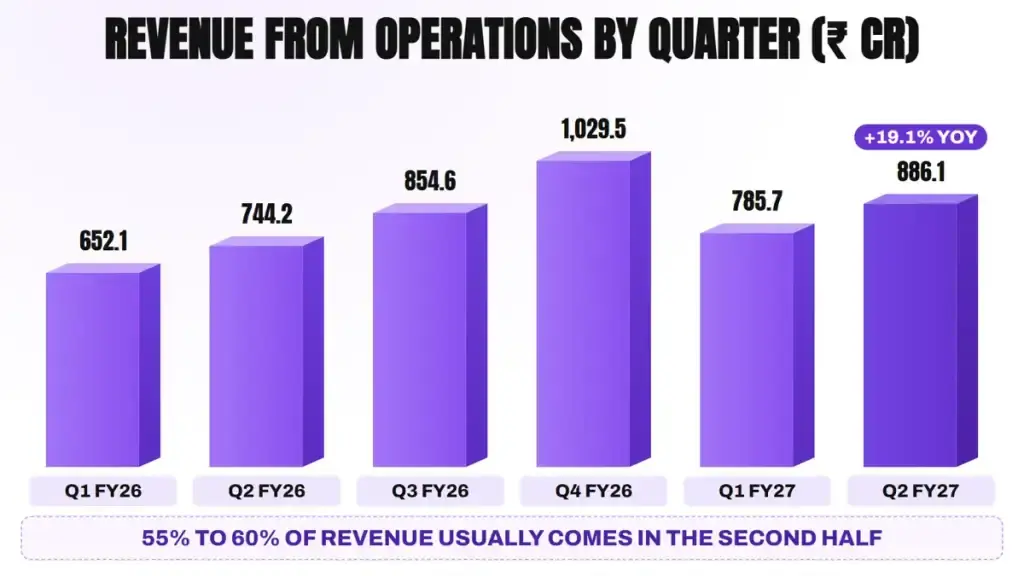
That chart also shows how seasonal the business is. Revenue was ₹652.1 Cr in Q1 FY26, then rose every quarter to ₹1,029.5 Cr in Q4 FY26, its best fourth quarter so far. Management says 55% to 60% of its revenue usually comes in the second half of a year.
Margins rose with the volumes too. Normalised EBITDA means EBITDA without the one-time gain of the quarter. It was ₹180.0 Cr, up 30.2%. ACE works out its margin on total income, and on that basis it was 19.31%, against 17.88% a year ago.
That margin includes ₹46.1 Cr of other income in the quarter, against ₹29.3 Cr a year ago. If we leave other income out, EBITDA was about 15.1% of revenue from operations, against about 14.6% a year ago. So the operating business also improved, but by less than the headline margin suggests. Read this EBITDA Explained: Uses and Limits
Below the EBITDA line, one item lifted the profit. Profit after tax rose 82.4% to ₹164.3 Cr. But that includes a ₹50.0 Cr gain from moving the heavy-crane business into a joint venture with KATO Works of Japan. Profit before that gain and tax was ₹166.9 Cr, up 34.9%, which is the cleaner number to compare.
The quarter also had a cost problem that the profit hides. Steel is the largest raw material, and management says its price went from about ₹48 to ₹50 a kg early in the year to ₹63 to ₹64 before it eased below ₹60. By October it was ₹66 to ₹67 a kg. Input costs rose by 10% to 12% in all.
To cover those costs, ACE raised prices by 7% to 8% by the end of September, but only a little over 3% showed up as higher prices across the first half, because the last increase reached customers only in September.
That same pattern of growth shows in the first half. H1 FY27 revenue from operations was ₹1,671.8 Cr, about 19.7% more than the ₹1,396.3 Cr of H1 FY26. Normalised EBITDA was ₹352.5 Cr at a margin of 19.89%, and profit before exceptional items and tax grew 29.4% to ₹325.3 Cr.
The Inventory Built for Defence
Now let's look at the balance sheet, because it moved more than the profit. Inventory was ₹832.2 Cr in September 2026, against ₹605.4 Cr in March. Management says about ₹100 Cr of that is for defence orders, because the forces inspect raw material and finished machines in large batches and ACE has to hold the stock until they do. It expects inventory to return to its usual ₹500 Cr to ₹600 Cr range by December or March.
To carry that stock, ACE used short-term bank credit. Current borrowings were ₹143.9 Cr in September 2026, against ₹0.1 Cr in March. At the same time it held ₹894.3 Cr of long-term and ₹596.9 Cr of short-term investments. The company shows a net debt to equity ratio of minus 0.60 times, which means it holds more cash and investments than debt. Read this Debt to Equity Ratio Explained
Those investments are kept apart from working capital on purpose, management says. It borrows at about 7% and says its investments earn about 3% to 4% more than that. ICRA reaffirmed ACE's long-term rating at AA (Stable) in January 2026. Return on capital employed was 33.81% on an annualised basis in the first half.
How a 1995 Crane Maker Grew Into a Multi-Product Company
Now that we have seen the quarter, let's go back and see how this crane maker grew. Vijay Agarwal founded the company in 1995 and is its Chairman and Managing Director. Sorab Agarwal, an Executive Director, leads the results discussions, with Vyom Agarwal as President. The promoter group held 65.42% of the company in September 2026.
Before that growth, the company was known for one machine, the Hydra-type pick-and-carry crane. It then added tower cranes, construction equipment, forklifts and farm machinery. More recently it began to make machines for the armed forces. Its revenue has doubled in four years.
"Time is the friend of the wonderful business, the enemy of the mediocre."
— Warren Buffett
For ACE, the years since FY22 doubled revenue and lifted the margin from 9.89% to 18.11%. The question is whether that holds through a year like FY26, when volumes went down.

That table shows two different periods. From FY22 to FY25, revenue roughly doubled and the margin almost doubled. India's roads, metros, factories and warehouses all needed more lifting equipment in those years.
Then FY26 broke that run. New emission rules for construction machines, known as CEV Stage V, raised machine prices. Buyers had bought ahead in the second half of FY25, and a long monsoon held up building work. Units sold went down about 18.8%. Prices held.
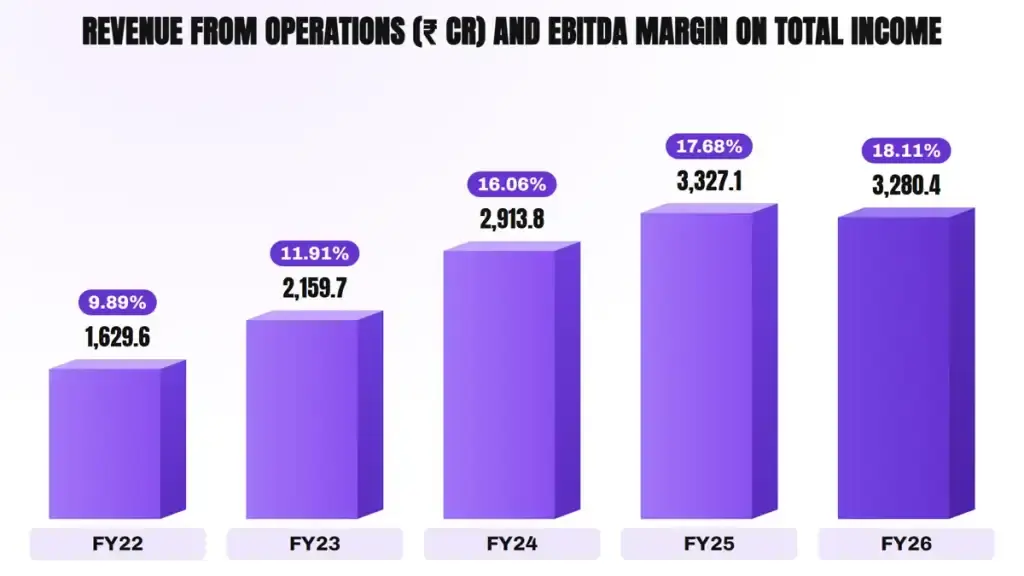
But the margin did not follow the volumes down. The EBITDA margin on total income went up to 18.11% in FY26 from 17.68%, and profit after tax rose from ₹409.2 Cr to ₹415.1 Cr. Management says operating EBITDA, without other income, was a little over 15% of revenue in FY26. That shows us the price increases held, even in a soft year.
"Our first priority in the whole of this year, starting from April onwards, was to maintain profitability and sustain profitability." - Sorab Agarwal, Executive Director, November 2026
Cranes, Farm Machines and Others
Now let's split the business into its parts, because each one sells to a different buyer. ACE reports three segments: cranes, material handling and construction equipment; agriculture equipment; and a small one called others, which management says is mostly exports of parts and similar items.
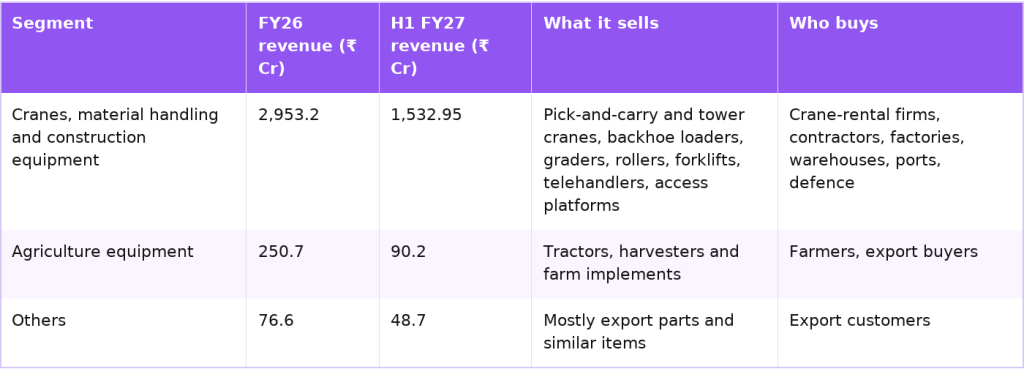
As you can see, cranes and construction equipment are most of the business. They made about 90.0% of FY26 revenue, and about 89% in Q2 FY27. In the quarter that segment brought in ₹790.6 Cr, up about 13.4%. Its segment result, the profit before shared costs, was ₹148.2 Cr, against ₹126.4 Cr a year ago.

Pick-and-Carry Cranes
Let's start with pick-and-carry cranes, the core product and the heart of the mobile crane market that ACE leads. In November 2024 management said it wants 70% of the pick-and-carry market. Its newer cranes include a clutch-less transmission, which the company calls India's first, and AI-integrated safety systems.
That crane market was soft in FY26, when the emission change raised prices. In July 2026 management said the Hydra-type crane market had started to improve. Q2 FY27 volumes, up about 20%, are the first full sign of that.
Tower Cranes
Next, let's look at tower cranes, the second market where ACE is the leader in India. These cranes are used on high-rise and industrial building sites. The company has added larger flat-top tower cranes of 10 and 16 tons. Tower cranes cannot be made on the lines used for mobile machines. So this is the one product where ACE plans a separate, larger expansion.
Construction Equipment and Material Handling
Now let's turn to construction equipment and material handling, the machines for roads and factories. Management says backhoe loader sales in Q2 FY27 were better than in Q1 and a year ago, and it expects a stronger Q3. It calls backhoe loaders one of its most promising lines, after several years in which it did not do much there.
Alongside them, material handling machines such as forklifts, telehandlers and aerial work platforms serve factories, warehouses and logistics parks. ACE plans to add container reach stackers and piling rigs too. Management sees each new line reaching at least ₹150 Cr to ₹200 Cr of revenue within two to three years of launch.
Agriculture Equipment
Now let's look at agriculture equipment, the soft spot of the business. ACE sold 436 tractors and harvesters in Q2 FY27, against 526 a year ago. Segment revenue was ₹50.5 Cr, and the segment made a loss of ₹3.7 Cr, against a loss of ₹1.3 Cr a year ago.
That loss comes from the domestic farm market. Management says domestic demand for farm machinery has been subdued this year and that passing on price increases has become difficult, so it is putting more weight on export orders. Its agri plant runs at only about 25% to 30% of capacity.
Defence and Exports
Finally, let's look at defence and exports, the newest lines. In February 2025 the Ministry of Defence ordered 1,868 rough terrain forklift trucks. These are forklifts that load and unload supplies on uneven ground for the Army, Air Force and Navy. ACE won 60% of that order, 1,121 forklifts worth ₹420.00 Cr, the largest order in its history.
Another order came in September 2026, when the Border Roads Organisation ordered 74 backhoe loaders. Management values them at about ₹20 Cr to ₹25 Cr, for delivery in Q4 FY27.

Those orders are now turning into deliveries. Management says deliveries of rough terrain cranes, telehandlers and heavy recovery cranes began in Q2 FY27. It put the defence order book at about ₹575 Cr in May 2026, and in November it said the book was a little over ₹500 Cr, to be delivered over the next one and a half to two years.
That book is still small next to the crane business. Defence made up about 5% of revenue in Q1 FY27, and management expects 5% to 6% for FY27, with exports at about 6%. So cranes for India's builders and factories will still decide how ACE's numbers move.
Where ACE Sits in India's Building Chain
Now let's place ACE in India's wider building chain. A road, metro line or factory needs land, money, designs and contractors before the first machine arrives. Then come the machines that dig, lift and move. ACE buys steel, engines, hydraulics and tyres, designs and builds the machines in Palwal, and then sells them through its dealers and services them for years after the sale.
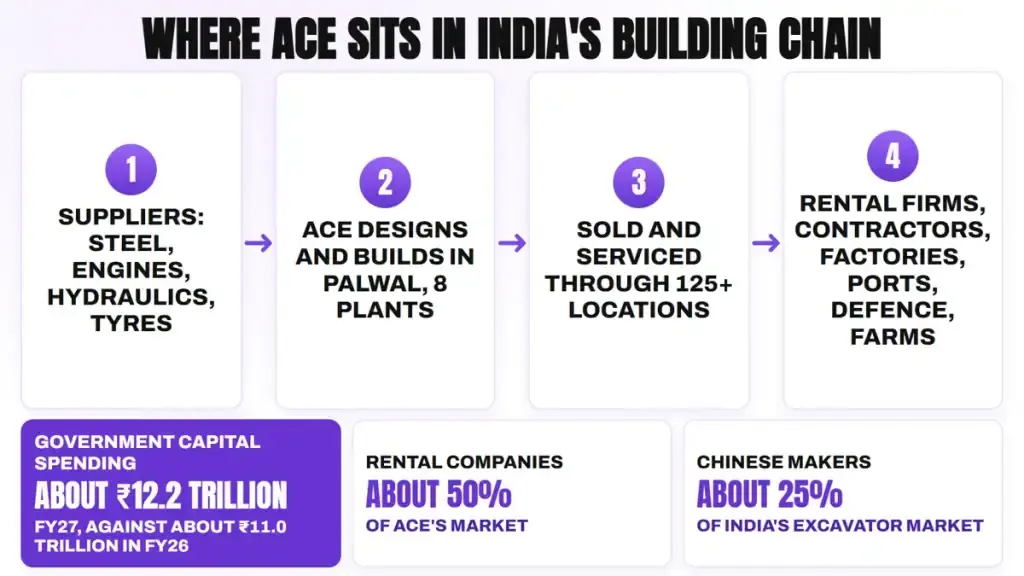
That demand comes from more places than roads. ACE says manufacturing and logistics make up about 45% of its end-user demand, and construction and infrastructure about 35%. Real estate adds about 13% and agriculture about 7%. So a new warehouse, steel plant or port needs its forklifts and cranes as much as a highway does.
Another layer of that demand is the rental market. Management says rental companies are about 50% of its market. They buy cranes and hire them out by the day or month to contractors. So ACE's sales follow how busy the rental firms are. That is also one reason management is careful about raising prices too fast.
That chain is also getting public money. The company's deck says India has budgeted about ₹12.2 trillion of capital spending for FY27, against about ₹11.0 trillion in FY26. Roads and railways are the largest parts of it. The same deck notes a new scheme in the 2026-27 Budget to support Indian construction and infrastructure equipment makers.
Beyond public money, China is the other part of the picture. Management says Chinese makers took about 25% of India's excavator market in the last five or six years, through low prices and long credit. ACE does not make excavators or large mining trucks. But Chinese heavy cranes compete with its larger cranes, and an anti-dumping case on these imports is still pending. Management expects some clarity within one or two months.
Why ACE's Moat Is Hard to Copy
Now that we have seen the parts, let's understand the moat. A pick-and-carry crane is not a secret design. So the question is why buyers keep picking ACE, and not a new Indian maker or a cheaper import. Read this Economic Moat Explained
One part of the moat is scale in one product. With over 63% of mobile cranes, ACE makes and sells more of these machines than anyone else in India, which lowers the cost of each machine and spreads its research spending. The scale also shows in the margin: an EBITDA margin on total income of 18.11% in FY26, in a year when sales went down.
Another layer of the moat is the network. A crane that stops on a site costs the rental company money every hour, so service matters as much as the price. ACE has more than 125 sales and service locations in India, backed by 13 regional offices. It has 8 plants in India, six of them at Dudhola in Palwal, and research and development centres in Faridabad and Dudhola.
Beyond the plant and the network, the balance sheet adds a third layer. Customers often pay margin money in advance. Trade payables were ₹826.5 Cr in September 2026, against trade receivables of ₹246.6 Cr. So suppliers fund much of the stock, and customers pay fast. Operating cash flow was ₹417.3 Cr in FY26, about the same as profit after tax.
"In business, I look for economic castles protected by unbreachable moats."
— Warren Buffett
ACE's castle is its share of India's crane market and the service network behind it. Its moat is tested each time steel prices rise and it has to pass the cost on.
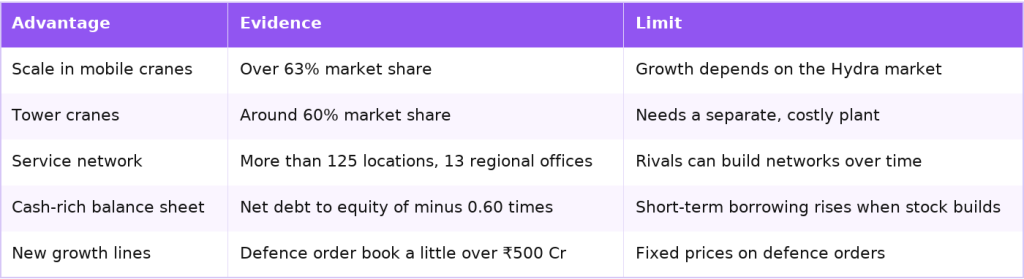
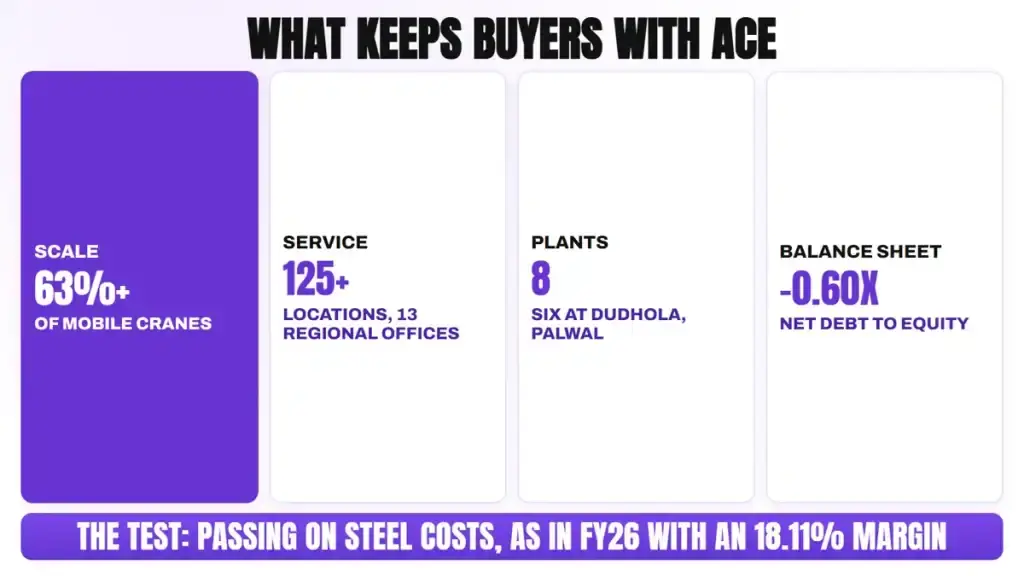
That table shows us why the steel price is the real test of the moat. If buyers accept ACE's price increases as steel rises, the moat holds. In FY26 and the first half of FY27 they largely did, and the margin went up.
Financials: Revenue Doubled and Cash Kept Pace
One quarter can mislead in a seasonal business, so let's look at the full years together. EBITDA here is as the company reports it, including other income, and the margin is on total income; the first half of FY27 is shown for comparison, and its profit includes the ₹50.0 Cr one-time gain.

Revenue grew about 2.0 times in four years, from ₹1,629.6 Cr in FY22 to ₹3,280.4 Cr in FY26, and profit after tax grew about 4.0 times, from ₹105.0 Cr to ₹415.1 Cr. The margin did most of that work: EBITDA on total income went from 9.89% to 18.11% as volumes grew and price increases held, and it kept rising in FY26 even though revenue slipped 1.4%.
Cash flow has kept pace with profit. From FY22 to FY26, operating cash flow added up to about ₹1,640.5 Cr, against about ₹1,430.5 Cr of profit after tax, or about 115%. Customer advances and supplier credit fund much of the stock, so profit turns into cash quickly.
The balance sheet holds more cash and investments than debt, with a net debt to equity ratio of minus 0.60 times in September 2026. Short-term borrowing rose to ₹143.9 Cr in the first half as defence stock built up, and management expects that to unwind by March.
"An investment in knowledge pays the best interest."
— Benjamin Franklin
Reading ACE's cash flow next to its profit shows how much of each rupee of profit reaches the bank, which matters more in a year like FY27, when inventory has grown.
What FY27 and FY28 Could Look Like on Management's Numbers
So where does the business go from here? On 13 November 2026 management said it expects 18% to 20% revenue growth in FY27. It aims to keep its EBITDA margins through cost cuts, a better product mix and higher volumes. For the longer term, it says it is on track for ₹6,000 Cr to ₹6,200 Cr of revenue by FY29, or by FY30 at the latest.
That plan depends on three new pieces beyond the core cranes. One is the joint venture with KATO Works of Japan, a maker of heavy truck and crawler cranes. In Q2 FY27 ACE moved its heavy-crane business into ACE KATO Private Limited, which the two own 50:50. It booked the ₹50.0 Cr gain on that move.
That heavy-crane business is small today. ACE was earning about ₹50 Cr to ₹60 Cr a year from bigger cranes. Management expects at least ₹150 Cr from them in FY28, once machines upgraded with Japanese inputs reach customers. It sees ₹300 Cr to ₹400 Cr within two and a half to three years.
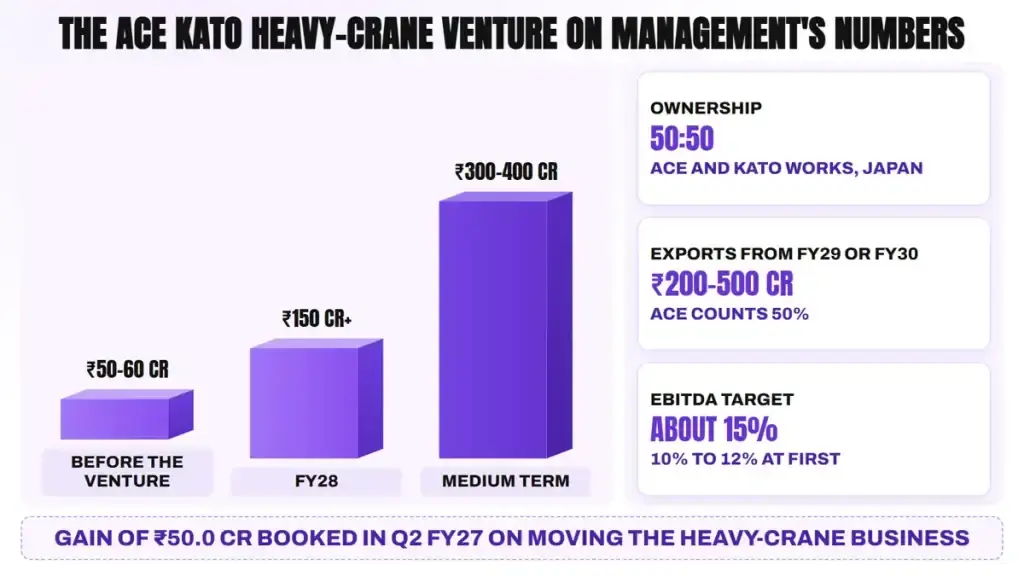
Beyond India, KATO also plans to buy export models made by the joint venture and sell them abroad from FY29 or FY30. Management sees ₹200 Cr to ₹500 Cr or more of such exports, of which ACE would count 50%. It targets an EBITDA margin of about 15% for the venture, starting at 10% to 12%. In December 2025 ACE also signed an agreement with Sanghvi Movers, a large crane-rental company that plans to add Indian-made heavy cranes from ACE to its fleet over time.
Next to the joint venture, capacity is the next piece. Management says its crane and construction equipment plants ran at about 55% at the end of Q2 and close to 70% to 75% by November, and that its present capacity can support ₹5,500 Cr to ₹6,000 Cr of revenue.
That capacity still needs spending. In FY27 ACE plans ₹40 Cr to ₹50 Cr on a new plant for defence and new products, and ₹30 Cr to ₹40 Cr on robotics and automation. About ₹20 Cr goes to maintenance, plus about ₹130 Cr for land if the purchase is completed. A tower-crane expansion of at least ₹400 Cr more, on land already bought for about ₹50 Cr, waits for a decision by December.
Beyond capacity, acquisitions are the last piece. Management says it is looking at companies with revenue of about ₹400 Cr to ₹500 Cr, or smaller or larger. It wants businesses it can scale up and make more profitable, and it says it "will never go overboard". No deal has been announced.
Now let's put the FY27 guidance against the first half. FY26 revenue from operations was ₹3,280.4 Cr. Growth of 18% to 20% would mean about ₹3,871 Cr to ₹3,937 Cr in FY27. H1 FY27 brought in ₹1,671.8 Cr, so the second half needs about ₹2,199 Cr to ₹2,265 Cr.
What the guidance needs: about ₹2,199 Cr to ₹2,265 Cr of revenue in H2 FY27. That is about 16.7% to 20.2% more than the ₹1,884.1 Cr of H2 FY26, close to the about 19.7% growth of the first half.


Those commitments are easier to judge against the past. So let's check what management said before against what it delivered.

That record shows us a clear pattern. Margin guidance has been met, but revenue targets have moved when the market turned, as they did with the emission change in FY26. The ₹4,400 Cr target first set for FY26 now sits beyond FY27. That makes the second half of FY27 the first real test of whether the growth targets are back on track.
Key Risks
Now let's look at what could go wrong for ACE, because the last two years have already shown some of these risks.
- Steel prices: steel rose to ₹66 to ₹67 a kg in October, and management expects to raise prices again around January. If buyers resist, margins could fall, and management calls frequent price increases "a very painful activity".
- Demand shocks: FY26 showed how a rule change, a long monsoon or a slowdown in building work can cut volumes by about 18.8% in a year. Rental companies, about 50% of the market, feel these shocks first.
- Revenue targets that slip: the ₹4,400 Cr target first set for FY26 is out of reach in FY27 too, where 18% to 20% growth would mean about ₹3,871 Cr to ₹3,937 Cr. The FY27 guidance needs the second half to grow about as fast as the first.
- Farm machinery: the agri segment made a loss in Q2 FY27, its volumes fell, and its plant runs at about 25% to 30% of capacity.
- Defence orders at fixed prices: defence contracts are fixed once signed, so a rise in steel prices during a one- or two-year delivery period comes out of ACE's margin. Defence inventory also raised stock to ₹832.2 Cr and short-term borrowing to ₹143.9 Cr in September 2026.
- Government receivables: ACE provides in full for government dues older than 180 days, and those provisions rise as defence sales grow.
- Chinese competition: Chinese makers took about 25% of the excavator market, and their heavy cranes compete with ACE's larger cranes. The anti-dumping case is still undecided.
- Large spending ahead: a tower-crane expansion of at least ₹400 Cr, land of about ₹130 Cr and possible acquisitions would use part of the cash the company has built up.
- Tax disputes: claims by tax authorities that ACE does not accept as debts came to about ₹107.1 Cr in March 2026, including interest and penalties. Most of it, about ₹90.3 Cr, comes from West Bengal VAT disputes from FY07 to FY14.
"It is a very painful activity because it is very unsettling for the customers, especially repeat customers." - Sorab Agarwal, Executive Director, on price increases, November 2026
"The essence of investment management is the management of risks, not the management of returns."
— Benjamin Graham
No one can say where steel prices or building activity will be next year. What a reader can do is watch the margin, the inventory and the second-half revenue each quarter, which is what the list below sets out.
Explore our Products
Research Framework

Emerging Titans
Combination of quantitative analysis, industry tailwinds, and management assessment - SPRINT investment philosophy

Tiny Titans
Heavy emphasis on scuttlebutt research, plant visits, and early on-ground signals
What to Track Next
If you follow ACE, these are the signals that will show where it goes next.
- H2 FY27 revenue against the 18% to 20% growth guidance, or about ₹2,199 Cr to ₹2,265 Cr
- The EBITDA margin after the January price increase, against 19.31% in Q2 FY27
- Inventory after ₹832.2 Cr, against the ₹500 Cr to ₹600 Cr range management expects by March
- Defence deliveries against the book of a little over ₹500 Cr, and the 74 backhoe loaders due in Q4
- The tower-crane expansion decision, due by December
- The first ACE KATO-branded cranes, expected in early FY28, and the outcome of the anti-dumping case
For the other listed makers of cranes, gears, pumps, machine tools and process equipment, see Capital Goods Stocks in India 2026: The Capex Cycle.
Conclusion
Let's put it all together. Action Construction Equipment has grown from ₹1,629.6 Cr of revenue in FY22 to ₹3,280.4 Cr in FY26, and its EBITDA margin on total income has gone from 9.89% to 18.11% over those years. After a year in which volumes went down about 18.8%, Q2 FY27 brought volumes up about 20% and revenue up about 19.1%. Defence deliveries and the KATO venture are now adding to the core cranes. The cautious thread is steel, which reached ₹66 to ₹67 a kg in October, and the defence stock that lifted inventory to ₹832.2 Cr. The next two quarters will show whether price increases and deliveries can carry the growth management has guided.
Still, the next step depends on more than one good quarter. What happens next depends on whether ACE can pass rising steel costs on to its buyers, whether the second half delivers the growth it has guided, and whether the defence stock turns back into cash by March.
FAQs
What does Action Construction Equipment do?
+Action Construction Equipment, or ACE, makes cranes, construction equipment, material handling machines and farm machinery in Palwal, Haryana. Its main products are pick-and-carry cranes, tower cranes, backhoe loaders, forklifts and tractors. FY26 revenue from operations was ₹3,280.4 Cr.
How did Action Construction Equipment do in Q2 FY27?
+Revenue from operations rose about 19.1% to ₹886.1 Cr, and ACE sold 2,812 cranes, construction and material handling machines, about 20% more than a year earlier. Normalised EBITDA was ₹180.0 Cr at a 19.31% margin on total income. Profit after tax was ₹164.3 Cr, including a ₹50.0 Cr one-time gain.
What is ACE's share of the crane market?
+ACE says it holds over 63% of India's mobile crane market and around 60% of the tower crane market. It calls itself the world's largest maker of pick-and-carry cranes, the wheeled cranes often called Hydras in India.
How large is ACE's defence business?
+In February 2025 ACE won an order for 1,121 rough terrain forklifts worth ₹420.00 Cr, the largest in its history, and in September 2026 it won an order for 74 backhoe loaders. Its defence order book was a little over ₹500 Cr in November 2026, and management expects defence to be 5% to 6% of FY27 revenue.
What is the ACE KATO joint venture?
+ACE KATO is a 50:50 venture with KATO Works of Japan that took over ACE's heavy truck, crawler and rough terrain crane business in Q2 FY27. ACE earned about ₹50 Cr to ₹60 Cr a year from these cranes, and management expects at least ₹150 Cr in FY28 and ₹300 Cr to ₹400 Cr within two and a half to three years.
What are the main risks for Action Construction Equipment?
+Steel is the largest raw material, and its price rose to ₹66 to ₹67 a kg in October, so ACE has to keep raising prices. Demand can swing, as in FY26, when units sold went down about 18.8%. Defence orders carry fixed prices, and inventory rose to ₹832.2 Cr in September 2026.

High growth stock specialist, Value Educator
Shashank Mahajan is an equity research professional with over 12 years of experience in identifying high-potential SME and micro-cap stocks at an early stage. He follows a rigorous scuttlebutt research–driven approach, combining on-ground insights with deep financial analysis. Shashank specializes in uncovering under-researched and under-owned companies with strong management quality and long-term growth potential. Through disciplined research and early identification, he focuses on spotting tomorrow’s market leaders before they enter the mainstream investor radar.
More about Shashank Mahajan →
Azad Engineering vs MTAR vs Unimech: Aerospace Parts
Subros vs Lumax Auto vs Sona BLW: EV Auto Parts Compared
Jyoti CNC vs Macpower CNC: Machine Tool Makers Compared
Data Patterns vs Astra Microwave vs Apollo Micro

Himadri vs PCBL: Carbon Black and Battery Materials

Inox Wind vs Suzlon: Wind Turbine Makers Compared
Explore our Products
Research Framework
Emerging Titans
Combination of quantitative analysis, industry tailwinds, and management assessment - SPRINT investment philosophy
Tiny Titans
Heavy emphasis on scuttlebutt research, plant visits, and early on-ground signals



India's Aerospace Opportunity
Global Demand. Supply Bottlenecks. Opportunities Ahead.
Don't Miss This Exclusive Webinar!
Join Value Educator to decode the key trends shaping India's aerospace sector and learn how to identify tomorrow's potential leaders in the space.
- How the aircraft value chain works, layer by layer
- Indian companies supplying global aircraft makers
- A framework to judge any aerospace company

 Orders
 Subscription
 Share with friends


Required Details
₹23999.00
(12 month subscription)
As per SEBI regulations, all users are mandated to complete the KYC that is validated for 1 year. Post payment, you will be redirected to the KYC screen


No comments yet. Be the first to comment!