
The Auto Parts Maker Riding Premium Cars

A few years ago, thousands of Indians upgraded from hatchbacks to SUVs. They chose larger touchscreens, chrome finishes, illuminated logos and premium interiors. They paid extra for what felt like sophistication and technology. The vehicles they bought began depreciating the moment they left the showroom.

What almost no one noticed was that while cars were losing value, certain small companies supplying those very premium components were quietly multiplying in value. The SUV became a lifestyle upgrade. The stock behind its aesthetic and digital layers became a wealth upgrade. One asset depreciated predictably. The other compounded structurally.
That contrast explains how SME multibaggers are often born. If you want to understand the structural patterns behind such outsized returns, you may also explore “The Multibagger Framework: A Step-by-Step Guide to Finding 10x Stocks.”They do not sit in the spotlight. They operate in expanding value pools that look ordinary on the surface. By the time the broader market recognises the shift, much of the wealth has already been created.
Over the last three years, India’s SME space has produced several such examples. Krishna Defence transformed from a niche fabricator into a meaningful defence supplier just as indigenisation spending accelerated. More recently, similar early signals are visible in names like Yash Highvoltage Ltd, where strong demand in power T&D and transformer exports is translating into improved execution visibility, and Infollion Research Services Ltd, which continues to scale its expert network platform with consistent client additions and operating leverage kicking in.
In each case, the inflection point was visible in the business before it was visible in the stock price. Rising order books, expanding margins, adjacency-led product additions and disciplined capital allocation were the real triggers. The market noticed only later.
As Warren Buffett once said, “Price is what you pay. Value is what you get.” In SME multibaggers, value creation begins long before price reflects it. Investors who focused on structural shifts rather than short-term noise captured that gap.
In this article, we uncover one such company. A business that has already delivered strong returns by consistently outperforming its underlying industry growth. More importantly, it is a company whose journey appears to be entering a new phase, where expanding content, premiumisation and digital integration may open fresh avenues of growth.
The story is not about what the stock did.
It is about what the business quietly became.
To understand that transformation, we need to step back and examine what was changing around it.
When Cars Changed, The Real Winners Changed With Them
For decades, India’s automotive industry was a volume game. Monthly dispatch numbers dominated headlines. Growth was measured in units sold. Entry-level hatchbacks defined the market.
But over the last ten years, something fundamental shifted.
Passenger vehicles steadily increased their dominance within the four-wheeler ecosystem and now account for more than eighty percent of total volumes. For a broader understanding of how economic growth influences sectoral shifts like this, see “How GDP Growth Impacts Corporate Earnings and Stock Markets.”More importantly, the mix inside passenger vehicles transformed. SUV share expanded from roughly one quarter of total passenger vehicle sales less than a decade ago to well above fifty percent today.
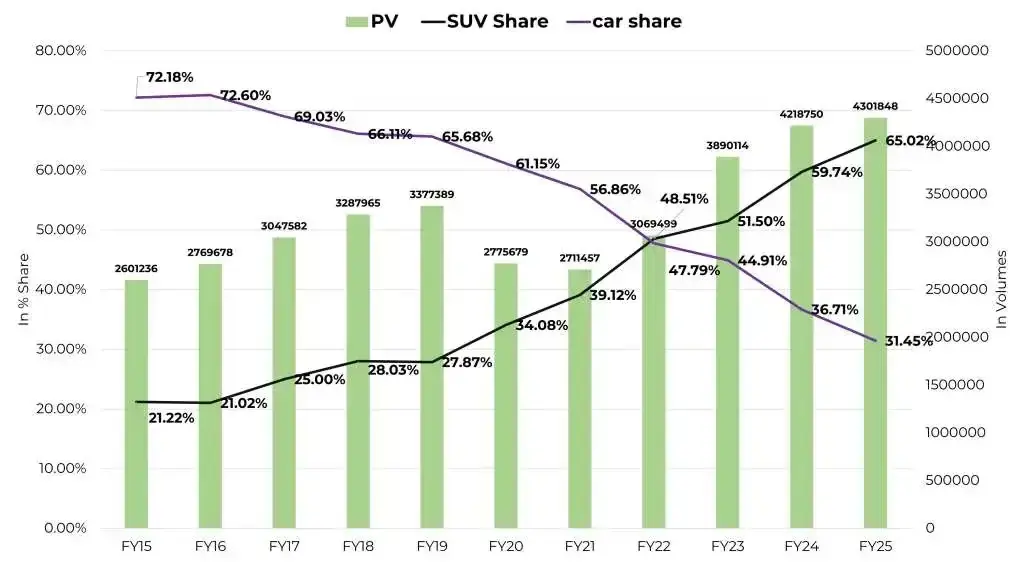
This is not merely a body style preference. It is a redefinition of value.
SUVs carry larger digital screens, integrated instrument clusters, illuminated logos, chrome trims, textured panels, 3D interior appliqués and higher aesthetic intensity. Even compact SUVs priced in the seven to twelve lakh range now include ten-inch infotainment systems that were once limited to luxury vehicles.
Industry leaders themselves acknowledge this pivot. Mahindra has repositioned its portfolio around SUV platforms such as Scorpio, Thar and XUV. Tata Motors has publicly stated that SUV growth has exceeded overall industry growth, driven by feature upgrades and consumer preference. Maruti Suzuki’s leadership has admitted that India is structurally moving from small cars to higher-segment vehicles.
What changed was not just volume.
What changed was content.
Howard Marks once wrote, “You can’t predict the future, but you can prepare for it.” The companies that prepared for premiumisation before it became visible in industry headlines are now embedded inside this expanding value pool.
Which brings us to the real question.
When vehicles become more premium and more digital, who benefits the most?
The instinctive answer is the manufacturer assembling the car. But the incremental value often flows elsewhere. It flows to suppliers whose content per vehicle rises every time a consumer chooses a higher trim, a larger screen or a more aesthetic finish.
Every additional inch of display increases optical cover glass value.
Every chrome finish increases decorative component intensity.
Every illuminated badge increases integration complexity.
Every 3D moulded interior surface expands value capture.
Premiumisation expands value per vehicle even if industry volumes grow at a moderate pace.This is a classic example of why focusing only on revenue growth can be misleading — something we explore deeper in “Beyond Revenue Growth: 10 Mid-Cap Stocks Where Profits Compound.”
Charlie Munger once observed, “The best businesses are the ones that can keep adding more value to what they already do.” In a premiumising automotive ecosystem, the winners are suppliers who deepen their relevance with each design upgrade.
Now, here is where history meets opportunity.
While the industry was transitioning from volume to value, one company was quietly expanding from decals to dials, from chrome plating to in-mould forming, and now into optical cover glass and display integration.
It did not reinvent itself overnight.
It evolved in alignment with the industry’s premiumisation curve.
That company is SJS Enterprises.
And to understand how it became a structural beneficiary of this silent upgrade inside every new car, we need to trace its journey from a modest decorative supplier to an integrated content-led platform positioned at the heart of automotive premiumisation.
The Evolution: From Surface Graphics to Structural Content Expansion
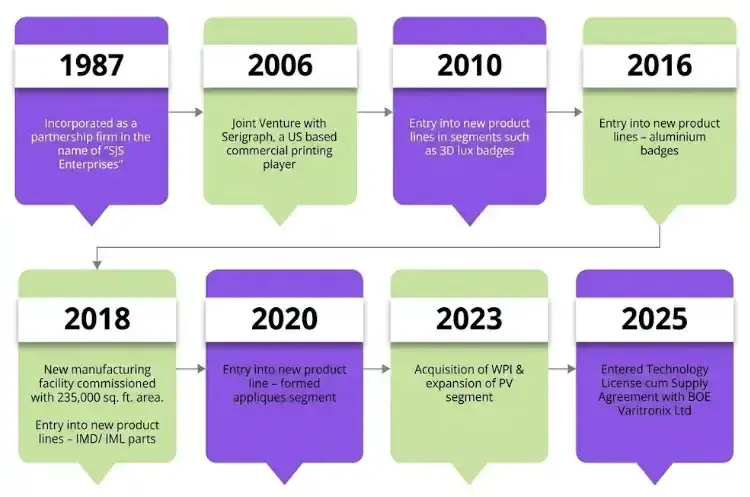
SJS was founded in 1987 as a manufacturer of reflective stickers and surface graphics. It was not positioned at the core of the automotive value chain. It operated on the periphery, supplying branding and decorative layers. But even in those early years, it focused on precision manufacturing and import substitution, particularly in operator panels and overlays. That phase built tooling discipline, quality control processes and OEM integration capabilities long before scale arrived.
The first meaningful automotive milestone came with instrument dials. When Hyundai launched the Santro in India, SJS supplied the instrument cluster dials. This was more than a product contract. It marked entry into the validation-intensive automotive ecosystem. Once a component clears tooling approvals and endurance testing inside a vehicle platform, supplier relationships deepen and switching is less likely.
For years, the company expanded gradually within adjacent categories. Decals evolved into 2D and 3D appliqués. Aluminium badges and domes enhanced branding presence. In-mould labelling improved durability and finish. Each move increased content per vehicle incrementally.
Two-wheelers formed a significant share of revenue during this phase. That was aligned with India’s vehicle mix. And within two-wheelers, premiumisation was already underway. Higher displacement motorcycles, digital clusters and feature-rich scooters required more sophisticated aesthetic components. SJS built deep OEM relationships and operational scale here.
Then came the first real stress test.
The slowdown during COVID impacted two-wheeler volumes sharply. For many suppliers, that became an excuse. For a few, it became a pivot point.
Multibaggers are often built not in boom cycles but in downturns. As Morgan Housel has written, “The most powerful force in finance is time.” Time rewards businesses that adapt during adversity.
Instead of waiting for two-wheeler volumes to normalise, SJS accelerated diversification toward passenger vehicles, where premiumisation was gathering pace.
The Chrome Expansion: Enter Decoplast
In April 2021, SJS acquired Exotech, later renamed SJS Decoplast. This move marked its entry into chrome-plated and painted exterior components such as wheel covers, radiator grilles and monograms.
At acquisition, Exotech operated at roughly 11% EBITDA margins. Under SJS’s integration and operational control, margins improved toward the mid-teens.
But the real shift was in kit value.
Historically, SJS’s passenger vehicle exposure through dials was roughly ₹80 per vehicle. Chrome integration expanded that exposure into the ₹1,100 to ₹1,500 range per vehicle. That single move altered the economics of growth.
This was the first structural jump in value density.
The Interior Leap: Walter Pack
In July 2023, SJS acquired a majority stake in Walter Pack India. This introduced IMF and IMD technologies into the portfolio, enabling high-quality three-dimensional interior components used in premium passenger vehicles.
Walter Pack operated at nearly thirty percent EBITDA margins at acquisition, with return on capital exceeding fifty percent. It was both technologically complementary and financially accretive.
With IMF integration, passenger vehicle kit value expanded again, rising into the ₹3,000 to ₹4,000 range per vehicle.
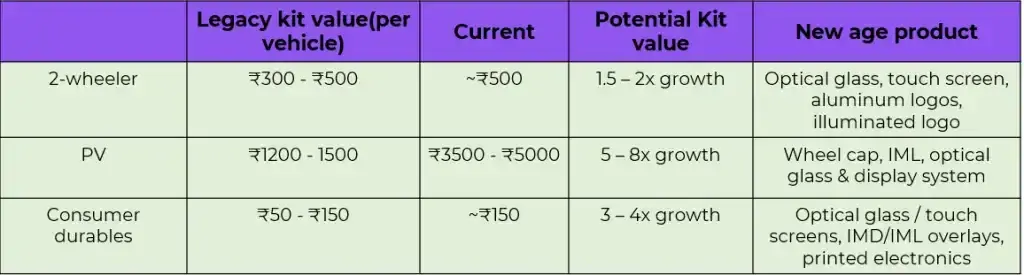
At this stage, the business had structurally transformed.
Revenue was no longer tightly correlated to how many vehicles were sold. It was increasingly tied to how much value SJS supplied per vehicle.
That is a fundamental difference.
As the passenger vehicle segment premiumised and SUV share expanded, SJS’s content per platform rose meaningfully.
Diversification as Strategy, Not Reaction
Earlier, two-wheelers had contributed close to seventy percent of revenue. Over time, as passenger vehicle programs expanded and kit value deepened, that concentration reduced significantly.
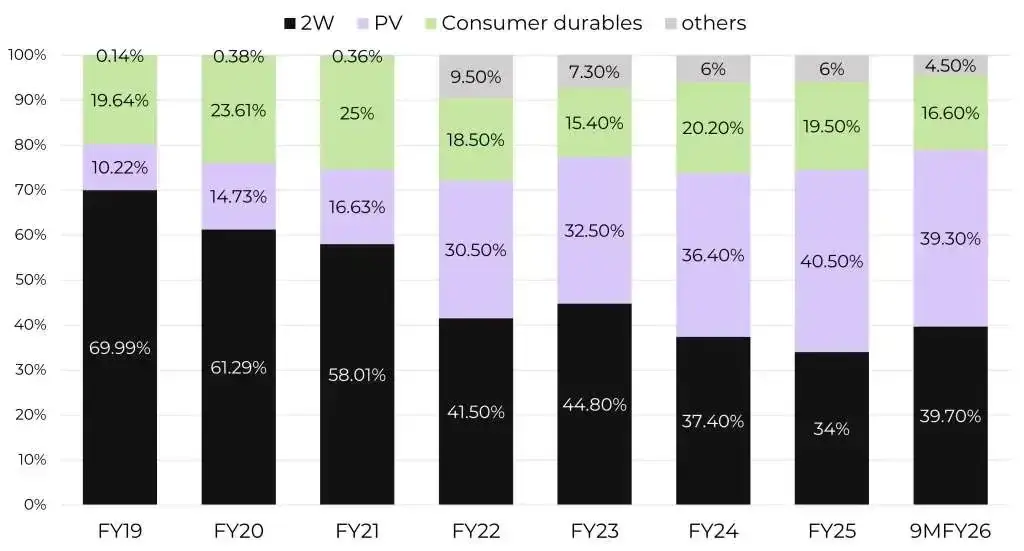
This was not abandonment. It was deliberate diversification. Passenger vehicles brought higher kit value and faster premiumisation intensity. The mix shift amplified growth without requiring explosive industry volumes.
Over multiple periods, SJS’s revenue growth exceeded the combined growth of the two-wheeler and passenger vehicle industry.
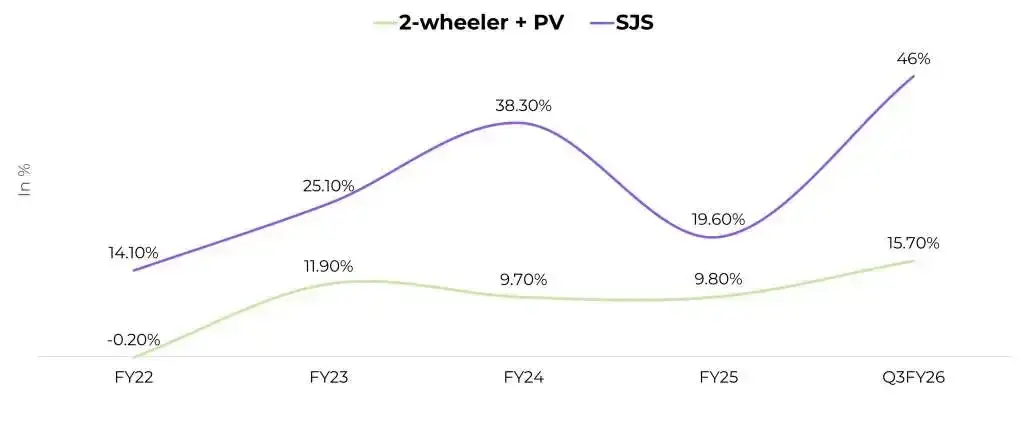
The outperformance was not driven by volume spikes. It was driven by structural repositioning.
Content per vehicle increased.
Adjacent technologies were added.
Acquisitions expanded the value stack.
Howard Marks once observed, “You can’t predict where the economy is going, but you can position yourself for structural change.” SJS positioned itself inside premiumisation rather than waiting for volume recovery.
Innovation and Capital Discipline
Another indicator of transformation was innovation intensity. Contribution from new products rose from single digits to roughly a quarter of total revenue over subsequent years.
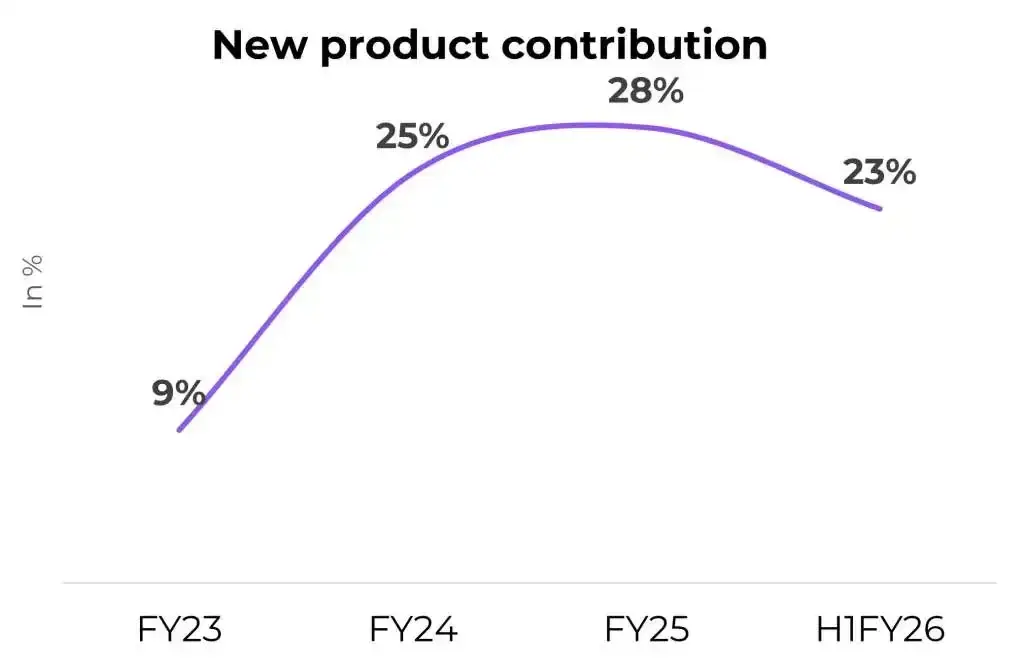
This demonstrated that growth was not dependent on legacy categories. The portfolio was being refreshed and upgraded.
Importantly, this expansion did not dilute financial discipline. Return on capital employed remained above twenty percent across cycles and reached into the low thirties in certain years. EBITDA to operating cash flow conversion frequently exceeded seventy percent and, in some years, crossed eighty percent. If you want to learn how to evaluate such capital efficiency metrics properly, read “How to Read a Balance Sheet Like a Professional Investor.”
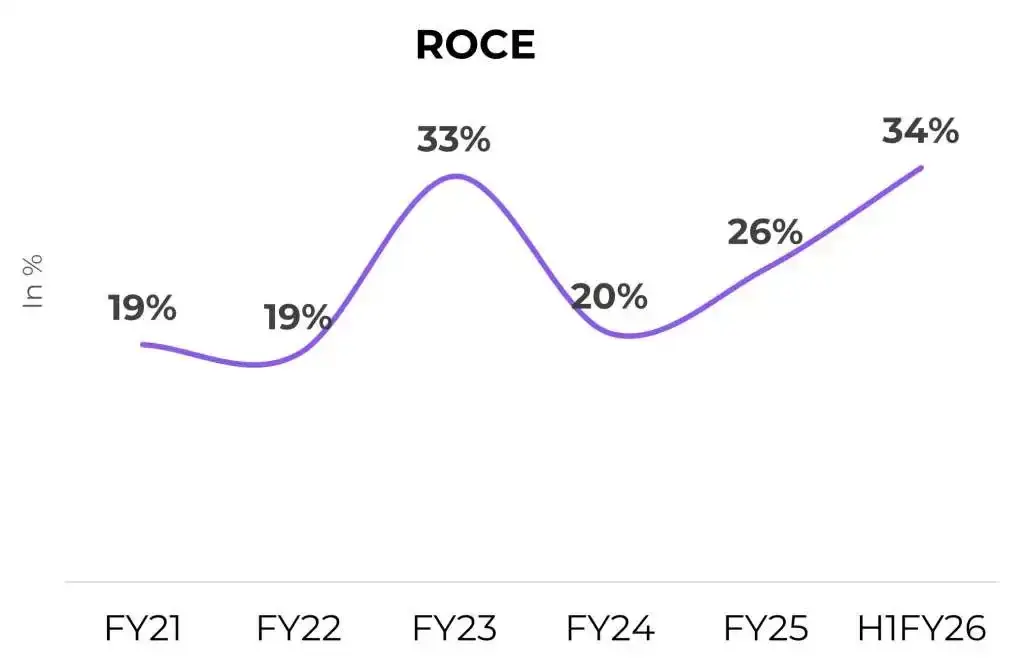
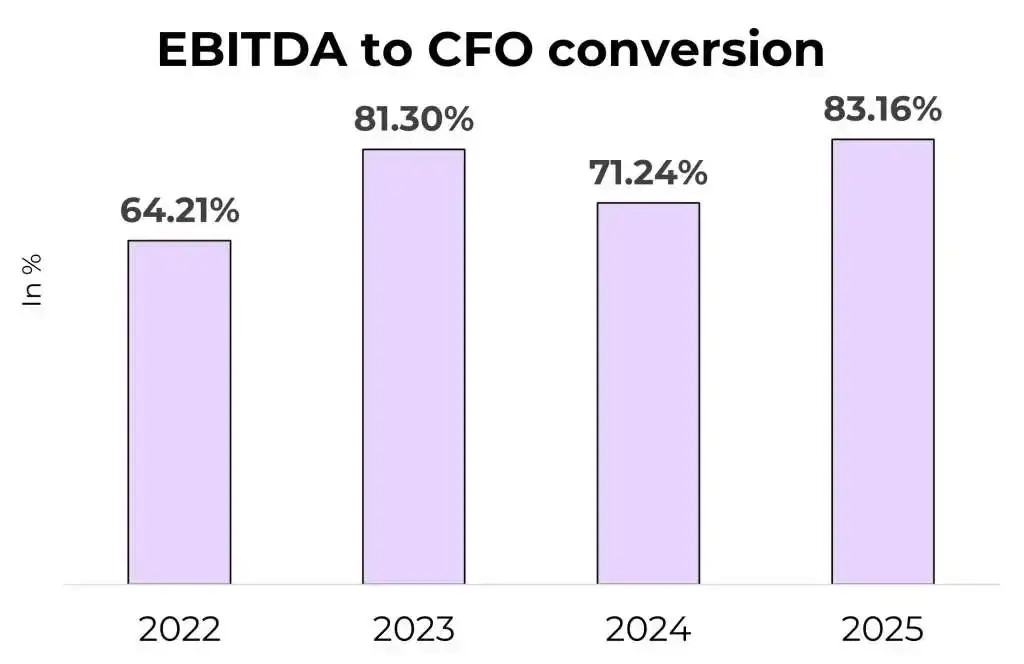
Many companies pursue growth at the cost of returns. SJS expanded both revenue and kit value while preserving capital efficiency.
James Clear once wrote, “You do not rise to the level of your goals. You fall to the level of your systems.” The multibagger was not created by ambition alone. It was created by systems. Process discipline. Capital allocation clarity. Adjacency-led expansion.
From decals to dials.
From dials to chrome.
From chrome to IMF interiors.
From interiors to display-linked integration.
Each step increased value per vehicle.
Each move reduced single-segment dependence.
Each phase aligned with industry premiumisation.
That is how the wealth was built.
Not through speculation.
But through structural evolution aligned with a changing industry.
The Structural Formula of the Multibagger
The journey of SJS Enterprises is not a story about one acquisition or one good year. It is a case study in how economic architecture evolves quietly inside a business before the market fully recognises it.
If we strip away the stock chart and look only at the underlying transformation, a clear structural formula emerges.
And that formula explains why wealth was created.
1. Rising Content Per Vehicle: The Real Growth Engine
For years, SJS participated in passenger vehicles at roughly ₹80 per vehicle through instrument dials. That level of exposure limits scalability. Even if industry volumes expand, revenue per vehicle remains capped.
The decisive shift came when content per vehicle multiplied.
The acquisition of Decoplast lifted passenger vehicle kit value into the ₹1,100 to ₹1,500 range. The subsequent acquisition of Walter Pack expanded that further into approximately ₹3,000 to ₹4,000 per vehicle.
That progression changed the mathematics of growth.
Revenue was no longer dependent purely on how many vehicles were sold. It became linked to how much aesthetic and interface value was embedded inside each vehicle.
When SUVs gained share and premium trims expanded, SJS did not merely ride the wave. It captured more value per unit of that wave.
Peter Lynch once said, “Behind every stock is a company. Find out what it’s doing.” During this phase, SJS was increasing value density inside every vehicle platform it touched.
That is where the multibagger began.
2. Mix Improvement Toward Passenger Vehicles
Two-wheelers were historically a large contributor to revenue. That reflected the structure of the Indian automotive market. But over time, as passenger vehicle programs expanded and kit value deepened, revenue mix evolved.
This was not the abandonment of two-wheelers. It was diversification toward segments with higher content intensity and faster premiumisation.
Passenger vehicles offered larger surface area for aesthetic components, greater integration complexity, and higher per-unit value.
As SUV share moved beyond fifty percent of passenger vehicle volumes, the structural tailwind strengthened.
Howard Marks has written, “You can’t predict the future, but you can prepare for it.” SJS prepared for the shift toward higher-segment vehicles by embedding itself deeper inside that category.
Mix improvement amplified growth without requiring extreme volume expansion.
3. Adjacency-Led Product Expansion
What differentiates durable compounding from speculative expansion is adjacency.
Chrome plating was not a random diversification. It extended the company’s presence from interior surfaces to visible exterior styling. IMF technology was not unrelated experimentation. It deepened interior integration into higher-value components.
Each expansion layer was built on existing capability.
From decals to dials.
From dials to chrome.
From chrome to IMF interiors.
The stack was logical. Not opportunistic.
Warren Buffett has often said, “The most important quality for an investor is temperament.” The same applies to corporate strategy. Discipline in choosing where to expand matters more than speed of expansion.
SJS grew laterally across aesthetic layers rather than vertically into unrelated industries. That preserved strategic coherence.
4. Margin Resilience During Expansion
Growth in manufacturing can often dilute margins, especially during acquisition phases. That did not happen here.
Decoplast improved margins post integration. Walter Pack entered with structurally high profitability. The combined portfolio maintained healthy operating margins even as the product mix upgraded.
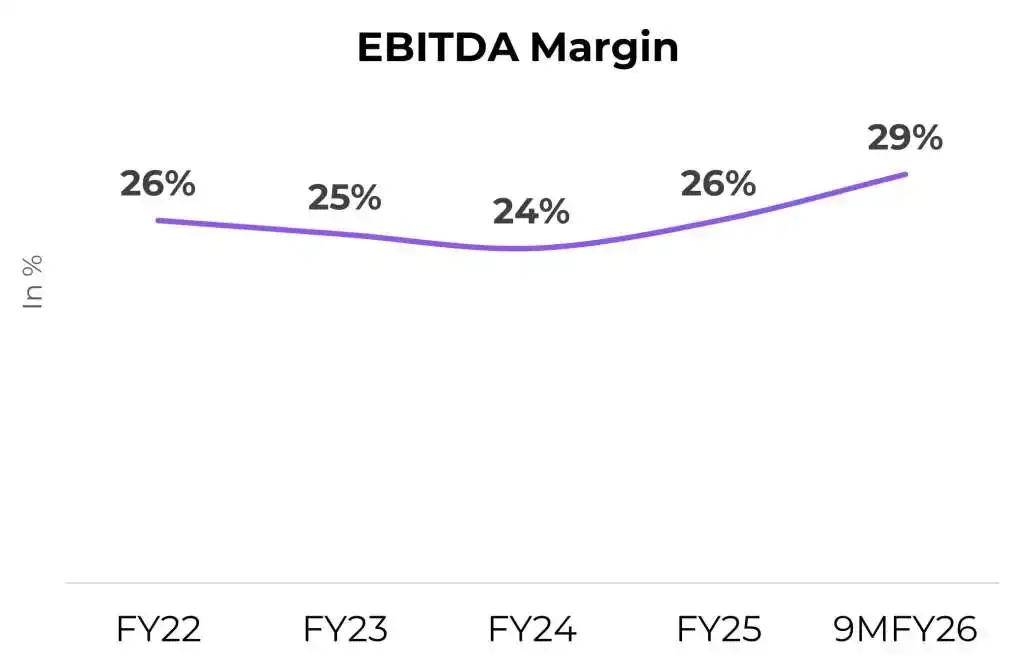
This suggests pricing power rooted in product differentiation rather than commoditised supply.
Charlie Munger once observed, “The best businesses are the ones that can keep adding more value to what they already do.” When value per vehicle increases and the product becomes more integral to design architecture, margin stability becomes more defensible.
SJS did not chase revenue at the expense of economics.
It preserved economics while expanding revenue.
5. Capital Discipline and Return Preservation
Perhaps the most underappreciated driver of the multibagger phase was capital discipline.
Return on capital employed remained above twenty percent across cycles and touched the low thirties in certain periods. That is significant, especially during acquisition and integration phases.
Equally important was cash conversion. EBITDA translated into operating cash flow consistently, often above seventy percent and in some years above eighty percent.
This means reported earnings were not abstract. They were backed by real cash generation.
Benjamin Graham famously said, “The essence of investment management is the management of risks, not the management of returns.” SJS expanded while preserving risk parameters. Leverage did not spiral. Working capital did not erode efficiency.
In the SME universe, that combination is uncommon.
6. Innovation Intensity and Portfolio Refresh
Another subtle but powerful driver was product refresh.
New product contribution rose meaningfully over recent years, moving from single-digit levels to roughly a quarter of revenue.
That signals forward alignment with industry trends rather than dependence on legacy SKUs.
In automotive supply chains, technological stagnation can quickly turn into irrelevance. Continuous portfolio refresh ensures long-term embedment within OEM platforms.
James Clear once wrote, “You do not rise to the level of your goals. You fall to the level of your systems.” The systems inside SJS — engineering discipline, adjacency-led expansion, capital allocation clarity — supported sustained innovation
The Next Growth Engine: Expanding Beyond Aesthetics
The transformation phase repositioned SJS inside higher-value layers of the automotive ecosystem. That shift has already altered its revenue architecture. The current phase is about scaling and monetising that upgraded platform.
The question is no longer whether the business evolved. That is visible.
The more relevant question is where incremental value will now originate.
If the first chapter was about surface graphics, and the second about chrome and interior integration, the next chapter sits at the intersection of aesthetics and electronics.
Optical Cover Glass and Display Integration: Entering the Digital Cockpit Layer
Automobiles are no longer mechanical products with decorative enhancements. They are becoming digital interfaces on wheels.
Instrument clusters are turning fully digital. Central infotainment screens are growing larger. Touch panels are replacing physical buttons. Integrated cockpit displays are merging navigation, telemetry and entertainment into unified interfaces.
Approximately 30% of passenger vehicles in India currently incorporate advanced display systems. By FY30, penetration is expected to move 100% as digital cockpits become standard even in mid-segment vehicles.
The Indian automotive display market is estimated to reach roughly ₹3,000 to ₹4,000 crore by the end of the decade. The shift from four to eight-inch screens toward ten to twelve-inch integrated displays significantly increases optical cover glass value and bonding complexity.
This is where SJS’s latest strategic step becomes important.
Through its technology partnership with BOE Varitronix, a global automotive display solutions provider, SJS is moving beyond decorative layers into optical cover glass manufacturing, optical bonding and progressive display module assembly.
This is not a cosmetic adjacency. It represents entry into a higher-value integration layer that sits at the centre of vehicle digitalisation.
Historically, SJS multiplied passenger vehicle kit value from approximately ₹80 to ₹1,100–1,500 through chrome expansion, and further to ₹3,000–4,000 with IMF integration. Display systems introduce another structural expansion potential in the value stack.
Unlike decorative parts that sit on the surface, display systems are integrated into vehicle architecture. Validation cycles are longer. Design engagement begins earlier.
That alters competitive positioning.
Peter Lynch once remarked, “Behind every stock is a company. Find out what it’s doing.” What SJS is doing here is not chasing a trend. It is embedding itself inside the fastest growing interface layer of modern vehicles.
Production scale-up is expected to follow validation cycles, with the Hosur facility positioned to support this transition over the coming years.
This move does not replace the decorative business. It extends it into electronic integration.
Growth Alignment: Outpacing Industry Without Overstretching
Automotive industry growth in India is broadly estimated in the mid to high single-digit range, roughly 7 - 9% annually in medium-term projections. SJS has historically grown at 1.5x to 2x industry growth across cycles.
Management has articulated an ambition to sustain growth at approximately 2x industry levels over the medium term. The drivers are structural rather than cyclical.
- Content per vehicle continues to expand.
- Passenger vehicle mix remains favourable with SUV premiumisation intact.
- Cross-selling across OEM platforms deepens.
- Export programs are scaling.
Export contribution, currently in single digits, is guided toward approximately 1% to 15% of revenue over the next few years. Long-term global programs, including multi-region mandates, enhance revenue visibility and geographic diversification.
Exports serve two purposes. They diversify customer concentration risk and extend program longevity beyond domestic cycles.
Howard Marks once wrote, “You can’t predict where the economy is going, but you can position yourself for structural change.” SJS is positioned in areas where structural change is visible: premiumisation, digital cockpit adoption and localisation of previously imported components.
What This Case Really Demonstrates
If we step back from quarterly numbers and stock charts, the journey of SJS Enterprises illustrates something broader about SME wealth creation.
Multibaggers in the SME universe are rarely born from speculative narratives. For investors exploring this segment further, you may also find “Micro-Cap Investing – Where Extraordinary Wealth Is Built (and Tested)” insightful. They are born from structural repositioning that precedes market recognition.
In this case, the sequence is clear:
An initially peripheral decorative supplier builds OEM validation discipline.
It expands into adjacent exterior components that increase visible value per vehicle.
It integrates into high-margin interior technologies aligned with premiumisation.
It preserves return ratios while scaling.
It maintains cash conversion discipline.
It diversifies the mix without losing focus.
It enters the digital cockpit layer before penetration becomes universal.
Each step compounded quietly inside the business before it reflected visibly in valuation.
Charlie Munger once observed, “The big money is not in the buying or the selling, but in the waiting.” Waiting works only when the underlying business architecture is improving.
Where the Real Multibaggers Take Shape
The most meaningful wealth creation stories rarely begin with excitement. They begin with businesses quietly strengthening their economic foundations while the broader market remains distracted. In the case discussed here, the shift was visible in rising content per vehicle, disciplined adjacency expansion, improving mix and preserved return ratios long before valuation adjusted. The architecture of the business changed first. The stock price responded later.
That is the recurring pattern behind many of the millionaire-creating stocks of the last three years. The transformation happens beneath the surface, inside the business model, inside the economics, inside the industry structure. Investors who focus on those shifts early often look uncomfortable before they look right. If you believe structural industry shifts are where the next wave of outsized wealth will emerge, comment SHIFT below.
Explore our Products
Research Framework

Emerging Titans
Combination of quantitative analysis, industry tailwinds, and management assessment - SPRINT investment philosophy

Tiny Titans
Heavy emphasis on scuttlebutt research, plant visits, and early on-ground signals
FAQs
What are SME multibagger stocks in India?
+SME multibagger stocks are small and medium enterprise (SME) companies listed on exchanges that deliver exceptionally high returns over a period of time, often multiplying investor capital several times. These companies usually operate in niche segments, benefit from structural industry shifts, and grow faster than their underlying industry due to innovation, capacity expansion, or rising value capture within the supply chain.
What makes SJS Enterprises a structural beneficiary of automotive premiumisation?
+SJS Enterprises benefits from rising content per vehicle in modern automobiles. As cars become more premium with larger screens, chrome components, 3D interior surfaces, and digital displays, the value of aesthetic and interface components supplied by companies like SJS increases significantly.
How does content per vehicle impact auto ancillary companies?
+Content per vehicle refers to the value of components supplied by a company in a single vehicle. When vehicles adopt more technology, aesthetic elements, and electronic interfaces, suppliers capture higher value per unit even if overall vehicle volumes grow slowly.
Are SME stocks riskier than large-cap stocks?
+SME stocks generally carry higher risk due to lower liquidity, smaller balance sheets, and limited diversification. However, they can also offer higher growth potential when backed by strong business models, structural industry tailwinds, and disciplined management.

High growth stock specialist, Value Educator
Shashank Mahajan is an equity research professional with over 12 years of experience in identifying high-potential SME and micro-cap stocks at an early stage. He follows a rigorous scuttlebutt research–driven approach, combining on-ground insights with deep financial analysis. Shashank specializes in uncovering under-researched and under-owned companies with strong management quality and long-term growth potential. Through disciplined research and early identification, he focuses on spotting tomorrow’s market leaders before they enter the mainstream investor radar.

Glenmark: The USD 700 Mn Cancer Deal and Its Brands

Pharma Stocks in India 2026: Generics, APIs and CDMOs

Granules India: From Paracetamol to a 65% Gross Margin

Natco Pharma: After Revlimid, 29 Patent Challenges

Shilpa Medicare: Cancer APIs, Films and Biosimilars

Alembic Pharma: US Plants Pay Back, Margin Hits 22.2%
Explore our Products
Research Framework
Emerging Titans
Combination of quantitative analysis, industry tailwinds, and management assessment - SPRINT investment philosophy
Tiny Titans
Heavy emphasis on scuttlebutt research, plant visits, and early on-ground signals



India's Aerospace Opportunity
Global Demand. Supply Bottlenecks. Opportunities Ahead.
Don't Miss This Exclusive Webinar!
Join Value Educator to decode the key trends shaping India's aerospace sector and learn how to identify tomorrow's potential leaders in the space.
- How the aircraft value chain works, layer by layer
- Indian companies supplying global aircraft makers
- A framework to judge any aerospace company

 Orders
 Subscription
 Share with friends


Required Details
₹23999.00
(12 month subscription)
As per SEBI regulations, all users are mandated to complete the KYC that is validated for 1 year. Post payment, you will be redirected to the KYC screen


No comments yet. Be the first to comment!