
Micro-Cap Investing: Where Wealth Is Built

Most investors get attracted to micro-caps because they look like “the next big success story.” A tiny ₹20 stock that someday becomes ₹2,000 — the dream is powerful. And yes, a few rare businesses truly grow that way. They learn discipline, strengthen cash flows, survive mistakes, and slowly move from fragility to resilience. That’s what early investors in companies like Astral really discovered — not a stock, but a business growing up.
But the other side of the story is harsher.
Many investors once felt the same confidence in companies like Vakrangee and 8K Miles. The narrative looked unstoppable, growth looked exciting, everything felt promising — until weak cash flows and governance cracks surfaced. The fall wasn’t slow. It was sudden, painful, and irreversible for many investors who mistook momentum for strength.

That is the real truth about micro-caps — they don’t just test returns, they test emotional discipline.
As Howard Marks reminds us, wealth doesn’t come from being right every time — it comes from staying alive long enough for the right bets to compound.
Micro-caps aren’t just high-risk, high-reward opportunities. They are high-responsibility investments. A few evolve into disciplined compounders. Many only look strong in the beginning — and reveal fragility as they scale.
The real edge lies in spotting which ones are built to survive.
What Are Micro-Caps — A Business Stage, Not a Market Cap
Most people think a micro-cap is simply a very small company or a potential early-stage multibagger. Yes — micro-caps are typically companies with a low market capitalisation at the bottom end of the listed universe.
But their true identity is not defined by size — it is defined by their stage of evolution as a business.
At this stage, the company is still in validation mode — trying to prove whether its business model can survive, scale, and repeat across cycles. Cash flows are unstable. Revenue may grow fast in some years and stall in others. The customer base is concentrated, execution discipline is still developing, and working-capital control is evolving. In this fragile phase, one aggressive expansion, a poorly-timed acquisition, or a debt-funded gamble can destabilise the entire business.
We’ve seen this in companies like Suzlon (early years) and Ruchi Soya before restructuring — growth looked impressive, but financial resilience lagged behind. The problem wasn’t ambition — it was fragility. When the cycle turned, the balance sheet could not absorb the shock.
In simple terms:
A micro-cap isn’t a smaller version of a large company
it’s a business still proving whether it even deserves to exist at scale.
If you want to understand how business-maturity stages shape long-term returns, you may also explore Common Traits of Every Multibagger Stock – A Data-Based Study
Why Micro-Caps Feel Exciting - But Often Fail
Micro-caps attract investors because they look exciting in the early stages. Revenue suddenly jumps, quarterly results look impressive, and the company appears to be “scaling fast.” On the surface, this feels like strength — but many times, it is only the illusion of stability. In reality, the business may still be fragile underneath.
Retail investors often anchor on the story instead of the evidence. We hear management narratives, expansion announcements, and future growth projections — and our mind fills in the success story. Add to that survivorship bias — we only hear about the few micro-caps that became multibaggers, not the dozens that disappeared along the way. This creates confidence before clarity.
Sometimes, early growth isn’t true business strength. It may come from temporary factors like one-time export orders, channel filling by distributors, or stretching working capital to push higher sales on paper. We saw similar patterns in companies like PC Jeweller and Manpasand Beverages, where growth initially looked strong — but later, cash flow stress and governance concerns revealed what was really happening behind the numbers.
In simple terms:
In micro-caps, hope arrives before proof.
And that is exactly why most investors look at the wrong things first — growth, projections, and valuations — instead of asking whether the business is even strong enough to survive.
The Survival-First Lens — The Golden Rule of Micro-Caps
The biggest shift an investor needs while analysing micro-caps is perspective. In large caps, the focus is mostly on valuation — what price you are paying for a stable, proven business. In mid-caps, the focus shifts to execution — whether the company can scale operations efficiently. But in micro-caps, the first and most important question is very different.
Here, the priority is survival.
Before thinking about growth, expansion plans, or valuation comfort, ask a single, fundamental question:
“Can this company survive three bad years?”
Because in this phase of a company’s life, returns don’t come from aggressive upside —They come from businesses that are able to endure, stabilize, and stay alive long enough to compound.
And once you start viewing micro-caps through the lens of survival, the next question becomes clear —
What makes some businesses resilient, while others crumble at the first sign of stress?
Pillar 1 — The Business Fragility Check
The first thing to look at in a micro-cap company isn’t growth or margins — it’s how fragile the business is. At an early stage, many of these companies rely on a handful of customers, one core product, or a very limited market. That makes them exposed — if even one big order is lost or demand slows down, it can immediately impact revenues, cash flows, and sometimes the company’s ability to survive.

Fragility usually shows up in patterns such as concentrated revenue, tender-based or project-driven orders, sharp swings in yearly performance, or an order book that grows faster than real execution. These aren’t automatic deal-breakers — but they show how exposed the business is to external shocks.
Simple Checks to Run Quickly:
Ask yourself:
- Is revenue growing, but customer mix not diversifying?
→ Growth without resilience
- Are revenues volatile instead of compounding gradually?
→ Indicates cyclical or project-dependent business
- Is the order book rising mainly through advances?
→ Collections ahead of execution ≠ , real delivery strength
- Is 60%+ business from one geography/market?
→ Local disruption can affect the entire company
Simple rule of thumb:
The more concentrated the revenue, the more fragile the business.
Some businesses, like Dixon Technologies, strengthened over time by diversifying customers and product lines, while others, like Everonn Education, remained vulnerable because growth depended on a few concentrated revenue sources.
The real question in Pillar 1 is simple:
Is this business built to absorb shocks — or does it only work in good times?
Once fragility is understood, the next step is to see whether reported profits are real, and that clarity comes from cash flows.
Pillar 2 — Cash Flow Reality vs Accounting Profits
In micro-caps, there is often a big gap between reported profits and real cash generation. Profits can rise due to accounting assumptions, revenue recognition, or working capital movements — but cash flow shows what the business is truly earning.
In simple words:
Profits are an opinion. Cash is proof.
One of the biggest hidden risks in micro-caps is working-capital stretch — sales appear to grow, but receivables and inventory rise faster than cash collections. On screen, it looks like growth. In reality, the business is borrowing from the future to fund the present — and this stress usually appears in cash flows before it shows up in earnings.

Simple Checks to Run Quickly:
When you study a micro-cap, ask:
- Is Operating Cash Flow (CFO) consistently lower than PAT over 3 years?
→ indicates profits are not converting into cash
- Are receivables growing faster than revenue for 2+ years?
→ suggests channel stuffing / weak collections
- Is inventory rising faster than sales?
→ growth is being pushed, not absorbed by demand
- Is short-term borrowing rising even during “good growth years”?
→ operations are being funded by debt
- Is the CFO negative in strong profit years?
→ big red flag in micro-caps
Simple thumb rule:
If profits rise but cash flow doesn’t, believe the cash flow.
We’ve seen companies like Sintex and Amtek Auto expand aggressively on paper — only to struggle when cash flows failed to support leverage — whereas businesses like Astral strengthened gradually because profits and cash flows moved in alignment.
An easy way to look at it:
Some companies run faster by borrowing energy from the future.
Stronger ones grow at the speed their cash allows.
To dive deeper into why profits without cash flow often mislead investors, you may explore — A Fundamental Checklist: How to Research a Stock in 1 Hour
And once you know whether profits are real or cosmetic, the next question becomes even more important — can you trust the people making capital decisions inside the business?
Pillar 3 — Promoter Intent & Capital Discipline
When you have looked at how strong a business is, how good the cash flow is, the next thing to think about is what the people in charge, “the promoter” are doing.
This is often something that people do not pay attention to. With companies the financial numbers only tell you what has happened so far but the promoters decisions will determine what happens next. It is very important to see how the promoter decides to use the company's money, how honest they are when they tell people about what's going on and how well they follow the rules. These things are more important than how much the company's worth compared to how much money it makes.
This is the stage where investors move beyond reading numbers and start reading intent — whether the business is being built steadily and patiently, or pushed aggressively and recklessly.

Simple Checks to Run Quickly:
- Promoter salary as % of PAT
→ ideally reasonable and not rising faster than profits.
- Equity dilution trend (last 3–5 years)
→ frequent dilution without strong business growth = red flag
- Promoter shareholding + change over time
→ increasing stake = conviction, declining stake = caution
- Promoter pledge %
→ >20–25% pledge in a micro-cap = high risk
- Related-party transactions as % of revenue
→ should be explained clearly and economically justified
- Preference shares/warrants to insiders
→ especially at deep discounts — signals control shifting quietly
None of these is conclusive by itself — but patterns reveal intent. When incentives are misaligned, even a promising business can compound risk instead of wealth.
We saw this in Vakrangee, where governance concerns gradually eroded trust. By contrast, Aavas Financiers demonstrated measured capital allocation, transparent reporting, and consistent communication in its early growth years — helping investors build conviction as the business scaled.
Because in micro-caps, the real risk rarely shows up in quarterly numbers. It doesn’t begin in revenue or margins — it begins in capital decisions and control behaviour.
In micro-caps, balance sheet risk doesn’t start in factories — it starts in boardrooms.
If you’d like to study how governance quality and capital allocation shape long-term outcomes in scaling companies, you may find this useful — How to Analyze a Mid Cap Company – Complete Framework
And once promoter intent becomes clear, the final layer is to understand whether the company can withstand financial shocks — not just in good years, but when the cycle turns.
Pillar 4 — Balance Sheet Shock Absorption
Even a good business with honest management can struggle if the balance sheet is fragile. In micro-caps, the real test is not how a company performs in good years, but how well it can absorb shocks when conditions turn unfavourable.
A resilient balance sheet gives the business time to correct mistakes, adapt, and recover. Weak ones don’t collapse because growth slows — they collapse because they run out of time.
“Businesses don’t fail because growth slows — they fail because they run out of financial oxygen.” — Howard Marks
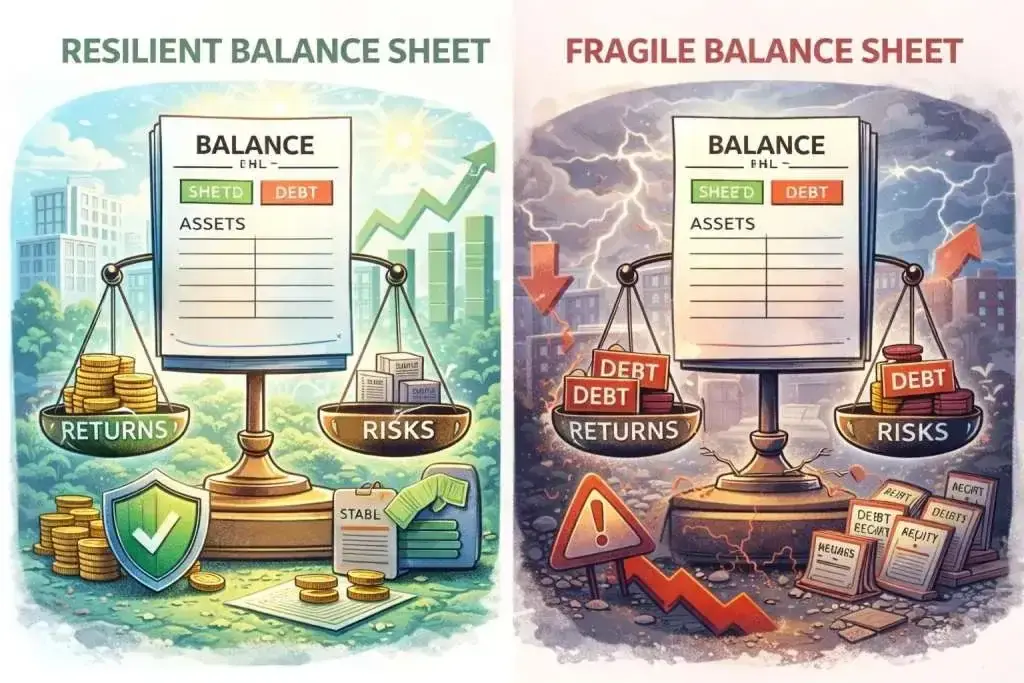
The goal isn’t to judge the business — but to check whether it has breathing room during stress.
Simple Checks to Run Quickly:
- Debt-to-EBITDA trend over the last 3–5 years
→ Rising faster than earnings = vulnerability building
- Interest Coverage Ratio (EBIT / Interest)
→ Below 2x in a micro-cap = high stress warning
- Short-term borrowings as % of total debt
→ High dependence = refinancing risk in downturns
- Operating Cash Flow vs Debt Repayment
→ If repayments rely on fresh borrowing → fragile
- Contingent liabilities vs Net worth
→ Large or recurring = hidden risk waiting to surface
- Subsidiaries / off-balance-sheet guarantees
→ Prefer clarity over complexity
- Working capital cycle (Receivables + Inventory days)
→ Sharp spikes = liquidity squeeze risk
Individually, these aren’t red flags — but together, they reveal whether the company can withstand a bad cycle without breaking. Some companies, like Suzlon, showed how leverage can magnify business shocks — while others, like Bharat Rasayan, benefited from conservative borrowing and better shock absorption across cycles.
The principle is simple:
In micro-caps, balance sheet strength isn’t about faster growth —
it is about buying time when reality doesn’t go as planned.
And once you evaluate survival, cash discipline, promoter behaviour, and financial shock absorption, you begin to see a pattern — why a handful of micro-caps quietly mature into future compounders, while others fade out as the cycle turns.
When Micro-Caps Truly Become Opportunities
Across businesses, the turning point rarely comes from faster growth — it comes from reduced fragility. Astral is a powerful real-world example of this transition.
And to understand this transition more clearly, let’s look at one business that went through this journey in real time — a company that moved from fragility → resilience → disciplined compounding.
Astral Pipes — A Real-World Example of How Fragility Turns Into Resilience in Micro-Caps
Phase 1 — The Fragility Phase (Proving the Business Deserves to Exist)
Astral’s journey didn’t begin with growth — it began with uncertainty. Before Astral Pipes, Sandeep Engineer had already gone through multiple failed businesses. Those failures taught him something most founders realise too late — in the early stage, the biggest risk isn’t competition, it’s fragility. One wrong decision can break the company.
During a visit to the United States, his uncle introduced him to CPVC piping — a material widely used in residential plumbing there. But in India, the reality was very different. People believed metal pipes were reliable and premium, while plastic pipes were considered weak. CPVC was costlier, fittings were imported, supply chains were slow, and contractors didn’t want to recommend something customers didn’t understand. The challenge wasn’t technology — it was mindset.
To pursue this idea, Sandeep made a deeply personal bet — he sold his house to set up Astral’s first manufacturing unit. The company wasn’t fragile because the product was weak — it was fragile because the ecosystem wasn’t ready.
So Astral didn’t chase growth. It focused on survival — manufacturing fittings in India to reduce costs, narrowing the price gap with metal, training plumbers, solving installation issues, and building trust project by project.
This wasn’t a growth phase — it was a validation phase. Astral wasn’t trying to scale fast — it was proving that the business deserved to exist at scale. And it was in this fragile period that Astral built the discipline and resilience that shaped everything it became later.
Phase 2 — The Turning Phase (From Validation to Breakthrough Momentum)
Once Astral cleared the first hurdle — plumbers trusted the product, fittings were manufactured locally, and CPVC pricing moved closer to metal — the foundation finally became stable. But even in the mid-2000s, Astral was still a small, under-recognised company doing barely ₹25–30 crore in revenue. The product was strong — the brand wasn’t. Growth couldn’t depend only on technical merit.
Astral understood that plumbing decisions in India aren’t made by one person — they move through developers, contractors, plumbers, and finally homeowners. Unless the brand mattered across all four, scale would always remain slow. So instead of chasing rapid expansion, Astral strengthened the ecosystem from within — plumber training, technical workshops, on-ground support, and quick complaint resolution.
Every leak claim was treated as an investment in trust. Over time, plumbers began to feel that installing Astral protected their own reputation — and that trust quietly became a moat.

Then came an unexpected breakthrough. In the film Dabangg, a fight scene showed Salman Khan lifting a pipe with the Astral logo — and recall exploded overnight. People began calling it “Dabangg Pipes.” Astral didn’t treat it as luck — it doubled down, later onboarding Salman Khan as brand ambassador to convert recall into identity. For the first time, a pipes company wasn’t just a vendor brand — it became a consumer-memory brand.

But brand visibility alone didn’t drive the compounding — execution discipline did.
From 2006 onward, Astral scaled capacity, widened distribution, deepened dealer relationships, and strengthened repeat demand — while staying cautious on costs and working capital. Growth was earned, not forced — and operating leverage began to work in its favour. When Astral eventually listed, it wasn’t a hype story — it was a business that had validated its model and institutionalised discipline.
Phase 2 was the true turning point — the shift from a small company proving a product, to a rising category leader with a brand, a network, and a trust-driven growth flywheel.
Phase 3 — The Franchise Phase (From Growth Company to Enduring Compounder)
As Astral entered its franchise phase, the nature of its challenge changed. It was no longer a company trying to prove acceptance — the brand was already trusted by plumbers, developers, retailers, and households across India. The question was no longer “Can Astral grow?” but rather “Can Astral continue scaling without losing discipline?” This is the stage where many companies slip into reckless expansion — but Astral chose to reinforce its core first and compound from strength.
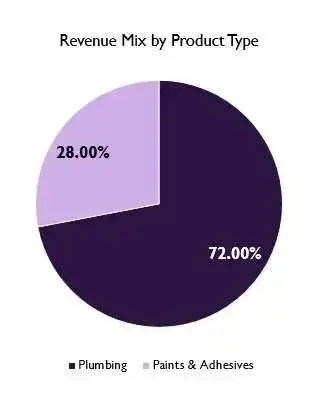
By FY25, Astral had evolved into a multi-engine building-materials platform. The plumbing and pipes business contributed roughly 72% of revenue, while adhesives, construction chemicals, paints, and allied categories contributed around 28% of the consolidated topline. Instead of diversifying randomly, Astral expanded into adjacencies that strengthened distribution depth and dealer relevance. Every new product category was evaluated through one lens — does it deepen retailer relationships, increase wallet share, and strengthen brand presence inside the home?
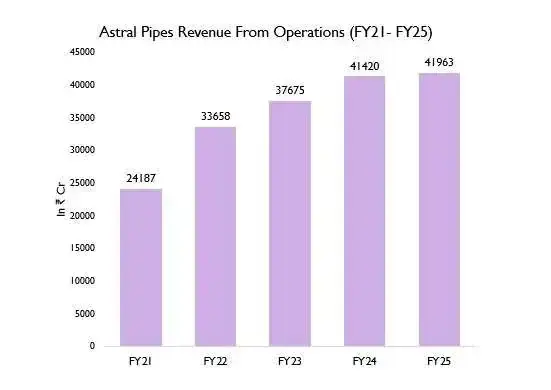
Even in a year where PVC prices corrected and industry demand remained uneven, Astral still delivered steady revenue and volume growth, along with healthy EBITDA performance. The pipes and plumbing segment continued to scale through capacity expansion, regional manufacturing hubs, and better operating efficiencies — improving execution while preserving balance-sheet flexibility.
At the same time, the adhesives and paints vertical gained meaningful traction — with domestic adhesives growing double-digits and margins improving as manufacturing automation ramped up. The bathware business also grew sharply from a small base, signalling early but credible momentum in a premium category that fits naturally into Astral’s home-solutions ecosystem. Growth was layered, not rushed — and importantly, much of it was supported by internal cash generation rather than leverage.
Competition intensified as more players entered CPVC and value-added pipes, but Astral avoided price wars. Instead, it doubled down on reliability, certification-led credibility, service consistency, and dealer trust — gradually shifting its role from a pipe manufacturer to a long-term solutions partner.
Strategic moves such as expanding fittings capability and widening infrastructure-grade product depth strengthened the portfolio — without drifting away from its core competence.
From fragile beginnings → to proven execution → to resilient, system-driven compounding — Astral didn’t win because it scaled the fastest, but because it scaled without losing discipline. Its journey shows that enduring franchises are not built during periods of excitement — they are built when a business steadily reduces fragility, institutionalises discipline, and compounds across cycles.
If you’d like to understand how such transition phases eventually lead to meaningful wealth creation, you may also read —The Multibagger Framework: A Step-by-Step Guide to Finding 10x Stocks
And once you start viewing micro-caps through this lens, one pattern becomes clear — the biggest winners rarely emerge in the excitement phase… they reveal themselves when risk starts quietly reducing.
How to Think About Returns — Time > Excitement
In micro-caps, true multibaggers don’t emerge in the early excitement phase — they emerge after survival is proven and stability turns into strength.
“Endurance is more important than brilliance — because businesses don’t win by shining early, they win by staying alive long enough to learn.”
— Jim Collins
The real reward begins when:
- balance sheet risk steadily declines
- Cash flows turn consistent
- dependence reduces and optionality increases
- The business model becomes repeatable instead of event-driven
“In the long run, it is not growth that protects a company — it is discipline.” — N. R. Narayana Murthy
That’s the phase where uncertainty turns into conviction — not because the story becomes bigger, but because the business becomes sturdier.
In one simple line:
Micro-caps don’t reward bravery — they reward patience and observation.
Because in this segment of the market, wealth isn’t created by predicting who grows fastest — but by identifying the few businesses that survive, endure, and compound over time.
If you’d like to understand how disciplined compounding quietly builds long-term wealth, you may also explore —The Power of Compound Interest: How to Create Wealth in the Stock Market
If this shifted the way you look at micro-caps — from excitement-chasing to survival-first thinking — comment “PATIENT” below to share your perspective.
Like the post if you want more research-led insights on business survival, capital discipline, and long-term compounding — and tell me:
Do you prefer early-stage optionality… or proven, cash-flow-backed scaling?
The most meaningful investing lessons are shaped through thoughtful discussion — not predictions, but perspective.
Explore our Products
Research Framework

Emerging Titans
Combination of quantitative analysis, industry tailwinds, and management assessment - SPRINT investment philosophy

Tiny Titans
Heavy emphasis on scuttlebutt research, plant visits, and early on-ground signals
FAQs ( Frequently Asked Questions )
What is micro-cap investing?
Micro-cap investing means investing in very small listed companies — typically at the lower end of the market-cap spectrum (₹300crore - ₹2,000 crore) — that are still in the early validation stage of their business journey. These companies are proving whether their business model can scale, whether cash flows can stabilise, and whether operations can sustain across cycles.
Earnings are often volatile, revenue may depend on a few key customers, and management discipline is still evolving. One misjudged expansion or debt-funded move can meaningfully increase risk.
When you invest in a micro-cap, you’re not buying a fully proven business — you’re backing a company that is still becoming one.
What is a high-risk, high-reward investment?
+A high-risk, high-reward investment is one where outcomes are uncertain, but the upside can be large if the business survives and strengthens. In micro-caps, risk comes from fragility — weak cash flows, customer concentration, or leverage — while reward comes when the company transitions from survival → stability → disciplined growth. The risk is real — but so is the compounding potential for the few that mature successfully
Are micro-cap stocks risky?
+Yes — micro-caps are riskier than mid and large caps because stability is still developing. Cash flows can be inconsistent, disclosures limited, and even small disruptions can affect liquidity or earnings. Many micro-caps don’t fail because prices fall — they fail because the business cannot handle stress. However, the minority that reduce fragility over time often create meaningful long-term wealth.
When does a micro-cap stop being speculation and start becoming a real business?
A micro-cap stops being speculation when survival risk reduces. This happens when cash flows begin to match profits, working capital stabilises, dependence on a few customers declines, and growth becomes repeatable instead of event-driven. At that stage, uncertainty turns into credibility — and the company starts resembling a genuine compounding business.

High growth stock specialist, Value Educator
Shashank Mahajan is an equity research professional with over 12 years of experience in identifying high-potential SME and micro-cap stocks at an early stage. He follows a rigorous scuttlebutt research–driven approach, combining on-ground insights with deep financial analysis. Shashank specializes in uncovering under-researched and under-owned companies with strong management quality and long-term growth potential. Through disciplined research and early identification, he focuses on spotting tomorrow’s market leaders before they enter the mainstream investor radar.

Glenmark: The USD 700 Mn Cancer Deal and Its Brands

Pharma Stocks in India 2026: Generics, APIs and CDMOs

Granules India: From Paracetamol to a 65% Gross Margin

Natco Pharma: After Revlimid, 29 Patent Challenges

Shilpa Medicare: Cancer APIs, Films and Biosimilars

Alembic Pharma: US Plants Pay Back, Margin Hits 22.2%
Explore our Products
Research Framework
Emerging Titans
Combination of quantitative analysis, industry tailwinds, and management assessment - SPRINT investment philosophy
Tiny Titans
Heavy emphasis on scuttlebutt research, plant visits, and early on-ground signals



Modern Warfare to Multibaggers
Key Trends. Strategic Shifts. Opportunities Ahead.
Today at 7:00 PM IST. Room opens 30 minutes before.
Don't Miss This Exclusive Webinar!
Join Value Educator to decode the key trends shaping India's defence sector and learn how to identify tomorrow's potential leaders in the space.
- In-depth research on India's defence sector
- Live Q&A session
- Actionable takeaways for long-term investors

 Orders
 Subscription
 Share with friends


Required Details
₹23999.00
(12 month subscription)
As per SEBI regulations, all users are mandated to complete the KYC that is validated for 1 year. Post payment, you will be redirected to the KYC screen


No comments yet. Be the first to comment!