
V2 Retail: Chasing 2,500 Small-Town Stores
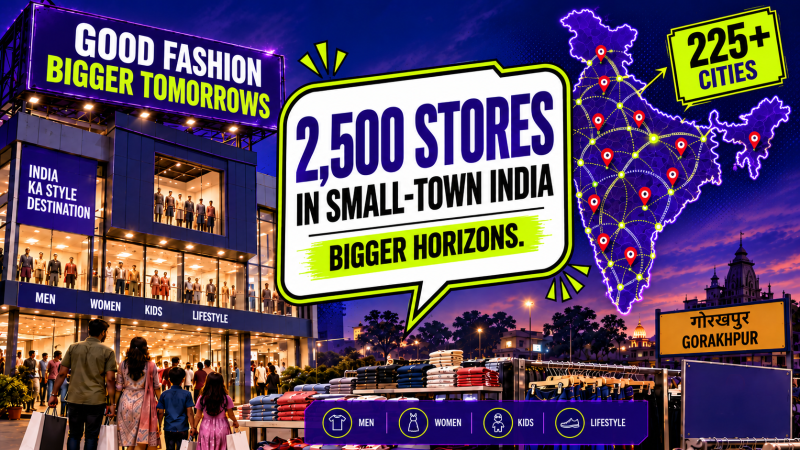
That gap between where organised retail has historically shown up in India (the metros, the malls, the premium price tags) and where the everyday demand for current, well-fitting, affordable fashion actually lives is the entire business case behind V2 Retail Limited. It is not a business built on being the cheapest option in the market, though price matters enormously to its customers. It is not built on chasing the same college-going, Instagram-literate shopper that every fast-fashion brand in the country is also chasing. It is built on a narrower, harder proposition: put a genuinely current, family-sized wardrobe within reach of a customer that organised retail talks about often and reaches rarely, and do it in towns where nobody else has bothered to show up first.
Meet V2 Retail Limited
“The desire of gold is not for gold. It is for the means of freedom and benefit.” — Ralph Waldo Emerson
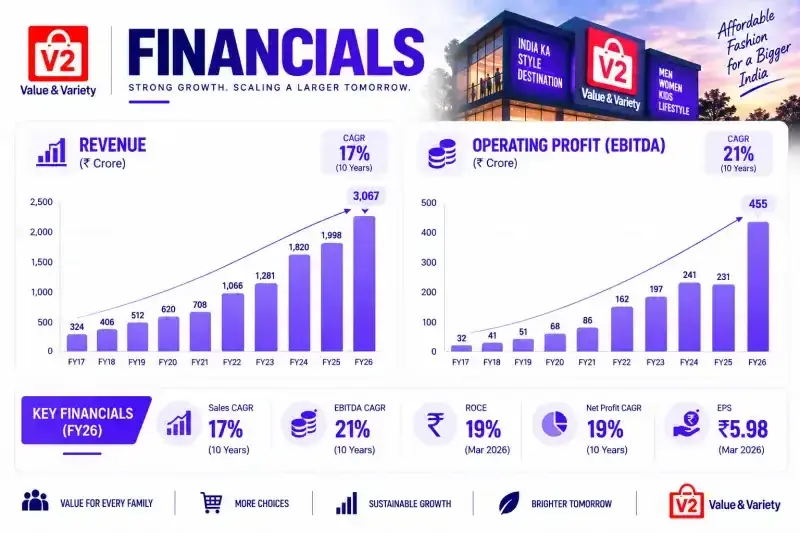
V2 Retail Limited is a Delhi-headquartered value fashion retailer, founded in 2001 by Ram Chandra Agarwal. Its stores bring men's wear, women's wear, kids' wear and lifestyle products together under one roof, mostly in Tier II and Tier III towns across northern, eastern, central and increasingly southern and western India.As of March 31, 2026, the network stood at 325 stores across 25 states and 1 Union Territory, spread over more than 225 cities and roughly 35.35 lakh square feet of retail space. For the financial year ended March 2026, consolidated revenue from operations came in at ₹3,067 crore, up 63% year-on-year, the second consecutive year of growth above 60% and consolidated profit after tax more than doubled to ₹162 crore.
The operating philosophy sits inside the company's own name. Value: prices that stay within reach. Variety: a wide, refreshed assortment across categories, sizes, colours, fabrics and occasions. The tagline the company has adopted for itself, "India ka Style Destination," is really just a restatement of the same idea: a store where a family can find what is new, what fits, what everyone in the household needs, and what the budget allows, in a single visit.
The Journey: From a Collapsed Chain to a National Platform
“You cannot escape the responsibility of tomorrow by evading it today.” — Abraham Lincoln
V2's history includes a chapter most retailers never survive: a full corporate reset. The business that eventually became V2 Retail began in the 2000s as Vishal Retail, one of India's early large-format value chains, and grew into a national presence before debt-funded over-expansion collided with the 2008-09 downturn. In 2011, after the Vishal retail business and brand were divested, the listed entity was relaunched as V2 Retail Limited, with Ram Chandra Agarwal rebuilding the platform from a far smaller base. The first V2-branded store opened in Jamshedpur in 2012, a deliberate choice to start the renewed journey in Tier II India rather than in a metro.
What followed was slow by design, then suddenly not. By 2014, the company had 16 stores and about ₹225 crore of turnover. It took a full decade, 2012 to 2022, to reach 97 stores. It then added 208 more in the next four years, and 189 stores and ₹1,884.5 crore of revenue by FY25. In FY26 alone, it opened 139 stores, closed 3, and ended the year at 325 stores and ₹3,067 crore of revenue. Put another way: it took twelve years to reach 117 stores, and just two more to add another 208.
That acceleration is really the whole story of this article. The question worth asking is not whether V2 can keep opening stores; the last two years already answer that. It is whether the newer, faster-opened stores can earn the way the older, slower-built ones did, and whether the balance sheet and cash flow can keep pace with a network that has more than tripled in four years.
Business Model: A Price Advantage Built Into the Structure, Not the Discount Bin
"An investment in knowledge pays the best interest."
— Benjamin Franklin
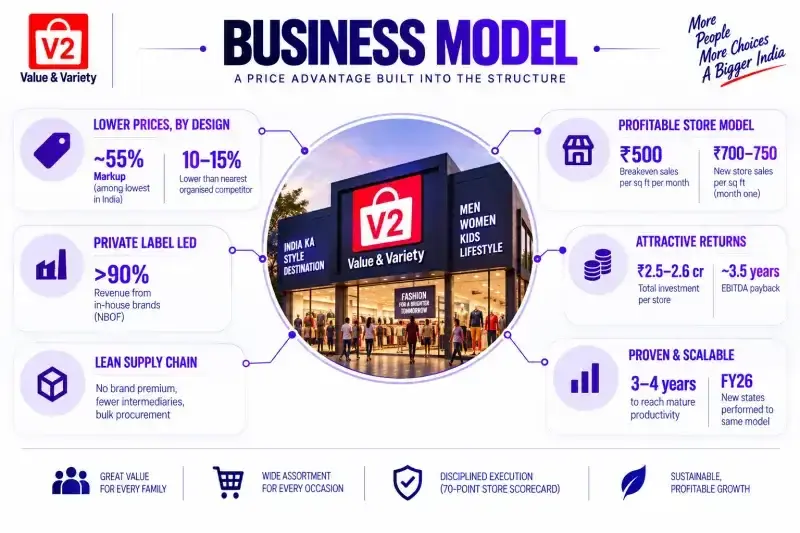
Strip away the store fixtures and V2's economics come down to a fairly simple chain: how many stores it runs, how much revenue each generates per square foot, how much of that revenue is defended by selling at full price rather than clearing it through markdowns, and how cheaply the company can put a garment on the rack to begin with. Nearly every structural choice V2 has made traces back to that last link.
The price advantage is structural, not promotional. V2 runs on a markup of approximately 55%, among the lowest in Indian value fashion, which management says lands finished products roughly 10-15% below the nearest organised competitor. That gap isn't funded by discounting; it comes from having no brand premium to pay for, fewer intermediaries between factory and shop floor, bulk procurement, and tight control over private-label costs. A store built only on low prices tends to earn one purchase and then lose the customer to whatever looks fresher next season; V2 bets that combining low price with real assortment depth earns the next visit too.
Private-label control sits above 90% of revenue. Design, quality, sourcing, pricing and timing are largely kept in-house through the company's own label house, styled internally as NBOF No Brands Only Fashion which covers distinct menswear, womenswear and kidswear ranges built for everyday wear, occasion-led purchases and family value respectively. Because there is no external brand cycle to wait on, the assortment can be refreshed around what is actually selling, not around a supplier's seasonal calendar.The store model is built to earn from month one, not year three. This is where the numbers get genuinely interesting. Management pegs breakeven at roughly ₹500 of monthly sales per square foot; new V2 stores open at an average of ₹700–750 per square foot, which means a typical new store is already EBITDA-positive in its first month of trading. Total investment per store runs ₹2.5–2.6 crore, split roughly ₹1.2–1.3 crore of capex with the balance in opening inventory, and management guides to an EBITDA payback period of about 3.5 years, with 3–4 years to reach mature-store productivity. FY26, in management's own words, "proved portability": new states performed to the same model that had already worked in the company's older heartland markets.
That combination of a structurally lower price point, private-label cost control and a store that pays for itself before its first full year is even up is a very different kind of moat from the qualification-locked supplier relationships that protect, say, a defence-electronics manufacturer or an aerospace component maker. It isn't a switching-cost moat; a competitor doesn't need years of technical qualification to open a store across the street. It is closer to a catchment-and-cost-structure moat: once a V2 store has proven a town's demand and built local trust and repeat behaviour, a rival chasing the same customer has to match a cost base that took two decades of private-label discipline to build, in a location where real estate and footfall are already spoken for. It is a real advantage, but a thinner and more contestable one than the kind of moat built on years of customer qualification, which is exactly why the execution discipline discussed later in this piece (the 70-point store scorecard, the new-state playbook) matters as much as the pricing itself. For a broader look at how investors can assess whether a competitive advantage is genuinely durable, see our guide on Economic Moat Explained: Why Some Companies Stay Dominant for Decades. Readers wanting a fuller framework for thinking about what makes competitive advantages durable versus contestable may find it useful to read a general explainer on economic moats and why some companies stay dominant for decades.
Value Chain: How V2 Decides What Is Current
"Given a ten percent chance of a 100 times payoff, you should take that bet every time."
— Jeff Bezos
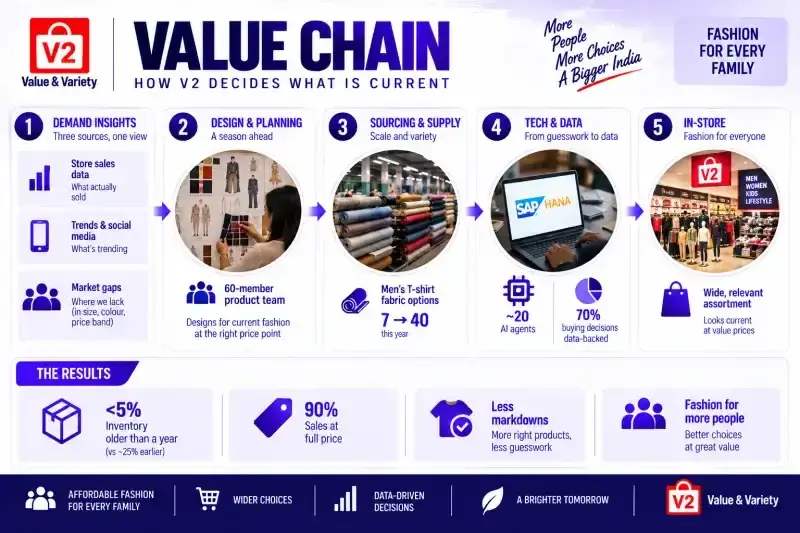
A 60-member product team works a season ahead, reading demand from three places at once: what actually sold last week at the till, what is trending on social feeds and high streets, and where the current assortment is falling short by size, colour or price band. The brief that comes out of that process is anchored to a rupee figure as much as a design sensibility, because the real constraint isn't taste; it's cost. The garment has to look current and still land at a value-fashion price point.
The year's clearest example of this method in action: fabric options in men's T-shirts went from about 7 to roughly 40, not because sourcing suddenly found more cloth, but because the design team judged that category was underserving a fashion-aware customer who had previously been excluded from that conversation entirely.
Behind the merchandising sits a technology layer that has been rebuilt over the past year. V2 completed its migration to SAP HANA in FY26, putting merchandising, sourcing, inventory and store operations on a single real-time base, and has deployed roughly 20 AI agents across workflows ranging from article creation to supplier relationship management. Management says about 70% of buying decisions are now data-backed, with the rest deliberately left to experienced human judgement. As CEO Akash Agarwal put it in the annual report: "Roughly 70% of our decisions are now data-backed. In fashion retail, that is the difference between guessing and knowing."
The result the company points to is a sharp reduction in aged inventory stock older than a year, which fell from roughly 25% of inventory to under 5%, alongside 90% of sales happening at full price. Inventory Turnover Explained: A Powerful Efficiency Signal Investors Ignore In a category where markdowns are the standard tax on guessing wrong about size, colour or fabric, that is a meaningful improvement, though it is worth remembering that FY26's absolute inventory position still grew sharply in rupee terms simply because the store count nearly doubled, a point this piece returns to in the financials section.
Products: One Store, Four Wardrobes
"Wide diversification is only required when investors do not understand what they are doing."
— Warren Buffett
That last shift is what the company itself calls the "quiet structural story" inside its numbers. Women in V2's markets are dressing more for work, college and occasion than they were five years ago, and the category has rewarded assortment depth across ethnic, fusion and western wear faster than any other part of the store. Where the range went deeper, the basket grew with it.
The private-label house behind all of this carries specific in-house brand names, Godspeed, Herrlich, Glamora, Ebellia and Honey Brats among them, spanning everyday and occasion-ready menswear, ethnic-to-western womenswear, and durability-focused kidswear. A typical V2 store now carries roughly 3,000 style options, against an estimated 1,200-1,300 at the closest organised competitors 80–90% more choice, which management frames as the reason a family shops one V2 store rather than three separate speciality stores.
Depth has widened elsewhere too: size options in key categories went from 2 to 6, a detail management credits with fitting customers "the old curve excluded." The store itself is treated as part of the product: new drops and seasonal colour placed at the entrance, garments displayed as outfits rather than stacked shelves, category adjacencies arranged so that one need turns into three.
V2 Retail's Growth Drivers
"The stock market is filled with individuals who know the price of everything, but the value of nothing."
— Philip Fisher
A genuinely large, still-unorganised addressable market. Management puts roughly 65% of Indian retail as still unorganised, with Tier II to Tier IV cities driving the next wave of growth. The company's own reading of the broader industry cited in its Management Discussion & Analysis puts India's total retail market at ₹90–95 trillion in 2025, up from ₹82 trillion in 2024, growing at roughly 8% a year over the trailing decade and projected to reach ₹210–215 trillion by 2035. V2 does not need to win a large share of that market for its own growth to matter; it needs enough of the underserved slice to keep filling several hundred more stores.
A disciplined, repeatable new-state playbook. Rather than entering a new state all at once, V2 opens with four or five stores and studies the signals: assortment fit, size curves, colour preference, price sensitivity before committing further. Karnataka is the clearest proof point: the company entered, learned, and has since scaled past 15 stores there. Gujarat, Andhra Pradesh, Goa and Maharashtra are, per management, "also building well." For FY27, roughly 30–40% of new stores are planned in these newer regions, with 50–60% going deeper into the existing northern and eastern heartland.
Technology moving from pilot to production. The SAP HANA migration and the roughly 20 AI agents already deployed are described as only the first layer. FY27's agenda includes full deployment of in-house merchandising software (assortment planning, demand forecasting, store-level allocation) and fleet management software (inbound logistics, inter-store transfers), both built to V2's own buying rhythm rather than bought off the shelf.
A customer base that is both growing and returning more often. V2's customer database crossed roughly 8 crore in FY26, doubling from the year before, engaged through WhatsApp, RCS and SMS. In mature stores, repeat customers now contribute about 68% of revenue, up from 56% three years ago, and the average gap between visits has tightened from roughly five-and-a-half months to about four. That is loyalty measured in habit rather than in a loyalty card.
A brand built on proof rather than spend. V2 spent roughly 0.3% of revenue on marketing in FY26 and still delivered its second consecutive year of 60%-plus revenue growth. Two years ago, the company had identified 22 underperforming stores it expected to close; only one actually closed. The other 21 are profitable today, a data point management uses to argue that store economics can improve materially once assortment, visual merchandising and operating discipline land properly in a catchment, rather than automatically write off a slow-starting location.
Explore our Products
Research Framework

Emerging Titans
Combination of quantitative analysis, industry tailwinds, and management assessment - SPRINT investment philosophy

Tiny Titans
Heavy emphasis on scuttlebutt research, plant visits, and early on-ground signals
Store Pipeline: The Road From 325 to 2,500
"In investing, what is comfortable is rarely profitable." — Robert Arnott
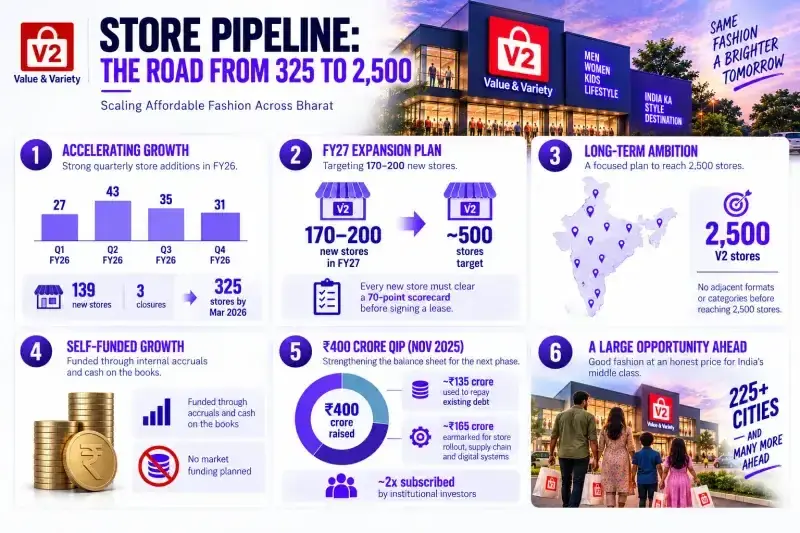
Unlike a manufacturer, V2 doesn't have a contracted order book in the conventional sense. Instead, it has a store-opening pipeline and a stated long-run target, both of which the company has been unusually specific about.The quarterly cadence through FY26 tells its own story of acceleration: 27 net stores added in Q1, 43 in Q2, 35 in Q3 and 31 in Q4, taking the network from 189 stores at the start of the year to 325 by March 2026, 139 openings against just 3 closures for the full year, a hit rate management is visibly proud of.
For FY27, the plan is 170–200 new stores, which would take the network toward roughly 500, close to half as large again in a single year. Every new location, per management, still has to clear a 70-point scorecard before a lease is signed, and the funding is explicitly framed as internal: accruals and cash on the books, "without going to the market for a rupee," in management's words on the FY27 plan. That claim is worth holding up against the company's own working-capital trajectory, discussed below, because it assumes operating cash generation stays healthy even as the store base keeps expanding.
The longer-run ambition sits well beyond FY27. Management has stated it will not consider adjacent retail formats or categories before the network reaches 2,500 V2 stores a deliberately narrow strategic choice, repeated by both the Chairman and the CEO in the annual report on the view that good fashion at an honest price still isn't available to most of India's middle class, and that opportunity alone is large enough to occupy the company for years. "The destination has not changed since 2001," the strategy section of the report puts it: "to be the best value fashion retailer in India, and, in time, beyond it."
Behind that ambition sits the November 2025 Qualified Institutional Placement of ₹400 crore raised at ₹2,134 per share, roughly twice subscribed by institutional investors. Of that capital, about ₹135 crore went toward repaying existing debt and roughly ₹165 crore was earmarked for the retail rollout, supply-chain capability and digital systems, strengthening the balance sheet ahead of the FY27 push rather than funding it directly.
Financials: The Numbers Behind the Scale-Up
"The biggest risk of all is not taking one." — Mellody Hobson
At first look, V2's FY26 numbers read almost too cleanly: revenue growing above 60% for a second straight year, profit more than doubling, margins expanding. They are real numbers, and the growth is real. But a few layers underneath the headline are worth pulling apart before taking the reported profit figure at face value.
The headline trajectory. On a consolidated basis, revenue from operations rose 63% to ₹3,067 crore, EBITDA rose 77% to ₹455 crore (a margin of roughly 14.9%, up about 120 basis points), gross profit rose 68% to ₹927 crore (margin 30.2%, up roughly 90 basis points), and profit after tax more than doubled, up 125% to ₹162 crore. On a standalone basis, the picture is broadly similar but slightly stronger: revenue of ₹3,060 crore (up roughly 62%), EBITDA of ₹466 crore (up about 85%).
Same-store sales and the volume story. Same-store sales grew 8.58% in FY26, on top of an already strong FY25 base, while volumes grew 47% and average selling price rose 10% to ₹327. The company is clear that this combination of more units sold and a higher average price reflects genuine product improvement accepted by customers, rather than simply pushing more expensive stock onto a shrinking basket. Full-price sales held at 90%, and the average bill value rose to roughly ₹925 from ₹859 in FY25.
Sales density eased, and management says that's the wrong number to worry about. Sales per square foot per month came in at roughly ₹925 for the year, described in the CEO's own words as "easing." The explanation offered is straightforward: 136 young, still-ramping stores entered the base in a single year, diluting the network average even though each cohort of new stores is tracking to the model of hitting breakeven productivity from month one and reaching full maturity over three to four years. It's a reasonable explanation, and one that should be testable in the FY27 and FY28 numbers as this year's new stores mature.
Ind AS 116 makes the reported EBITDA-to-PAT gap look larger than the underlying cash economics. This is worth spelling out because management flags it themselves. Of the roughly ₹279 crore that separates EBITDA from PAT, most is depreciation and finance cost tied to store leases under Ind AS 116, an accounting standard that, by construction, makes a retailer adding 136 leased stores in a year show unusually strong EBITDA margins on paper. Management says it prefers to look through this on a pre-Ind AS basis, the same basis it uses to run its internal budgets and incentives: on that view, EBITDA was ₹277 crore, up 83%, while PAT growth of 125% is unaffected either way. It's a useful reminder that "EBITDA" in a heavily leased retail business isn't always comparable to EBITDA in a business that owns its real estate outright.
A one-off gain sits inside the reported profit growth. Roughly ₹27.7 crore of consolidated pre-tax profit (₹18.1 crore standalone, after a partly offsetting item) came from an exceptional item: a reassessment of store lease terms under Ind AS 116, effective October 2025, which reduced right-of-use assets by about ₹484 crore and lease liabilities by about ₹499 crore, producing a largely non-cash accounting gain. On the standalone books specifically, that gain was partly offset by a ₹9.55 crore impairment charge against the company's investment in its wholly owned manufacturing subsidiary, V2 Smart Manufacturing Private Limited, which posted a loss of roughly ₹12 crore on turnover of about ₹44 crore in FY26, and from which V2 Retail's own purchases fell sharply, from roughly ₹214 crore in FY25 to about ₹37 crore in FY26. None of this is alarming on its own; subsidiaries occasionally lose money, and lease reassessments are a normal part of Ind AS 116 accounting, but it does mean the reported PAT growth of 125–130% is not purely a story of operating leverage, and a reader relying only on the headline profit number would miss both nuances.
Working capital moved the wrong way, on purpose, and that's the number worth watching most closely. Net working capital days rose to 81 in FY26 from 45 in FY25 (having steadily fallen from 99 in FY22 through 75, 71 and 45 in the three years before that), and inventory holding days rose to 136 from 108. Management's explanation is a deliberate safety-stock build made in March 2026, driven by two factors: geopolitical uncertainty in supply markets, and the need to have opening inventory ready for the FY27 store pipeline the day each new store opens. About half of that stock is under three months old and 76% under six months, with stock older than a year still below 5%, so the build looks like a timing decision rather than a sign of slow-moving inventory piling up. Management's stated target is to work back toward 90–100 inventory days over time, alongside creditor days closer to 45; on a separate disclosure basis, accounts payable days actually improved to about 61.5 in FY26 from 75.5 in FY25, though that is still some distance from the ~45-day aspiration.
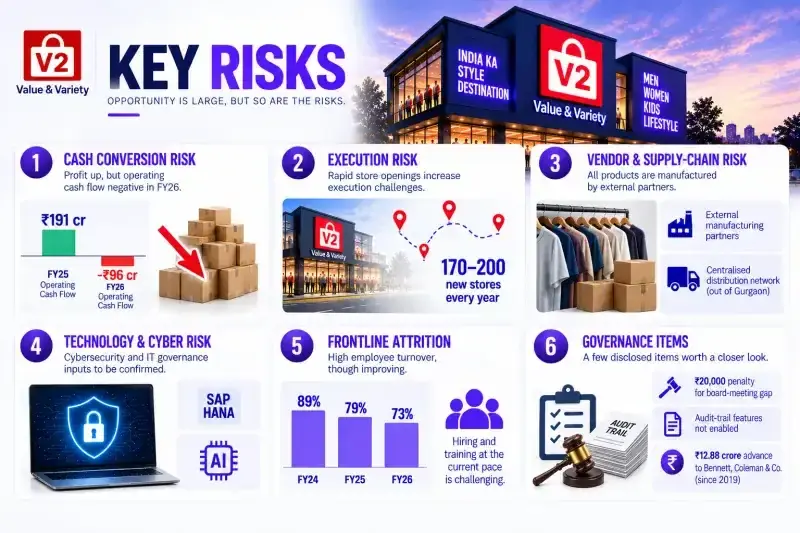
This is the point where the cash flow statement tells a different story from the profit and loss account. Reported profit more than doubled in FY26. Operating cash flow did not follow it; it actually turned negative, at roughly minus ₹96 crore on a standalone basis (versus positive ₹191 crore in FY25) and roughly minus ₹103 crore on a consolidated basis (versus positive ₹201 crore in FY25), almost entirely because of the inventory build described above. A business can grow its reported profit sharply while consuming cash rather than generating it, and that is exactly what happened here in FY26. This is why investors should look beyond the income statement and examine how reported earnings translate into actual cash generation. See Cash Flow Statement Explained: The Most Honest Financial Report for a deeper explanation. It doesn't invalidate the growth story; a deliberate, explained inventory build ahead of 170-200 planned new stores is a very different thing from inventory quietly going stale on a shelf, but it is precisely the kind of gap between accounting profit and cash generation that deserves tracking every quarter rather than assuming away. For readers who want a fuller framework on why cash flow can be a more honest signal than reported profit, this is worth reading alongside any single-quarter earnings headline.
The balance sheet is genuinely stronger after the QIP. Standalone debt-to-equity roughly halved, from about 2.5x in FY25 to about 1.1x in FY26, largely because the equity base expanded following the ₹400 crore raise rather than because debt itself shrank materially. Debt levels are particularly important when evaluating rapidly expanding companies. For a deeper understanding of this leverage measure, read What is Debt to Equity Ratio? Why it Matters for Small Cap Investing. Return on equity improved to 26.19% (standalone) from 22.89%, while return on capital employed held broadly flat at around 38%, as a stronger operating profit was offset by a larger capital base.
Key Risks
"The essence of investment management is the management of risks, not the management of returns."
— Benjamin Graham
Execution risk in an accelerating store-opening pace. Fast openings strain site selection, staffing consistency and the new-state playbook simultaneously. The company's own risk disclosures acknowledge this directly, pointing to the 70-point scorecard and the four-to-five-store probe approach in new states as the mitigants; the fact that only 3 of 139 FY26 openings were closed is a reasonable early scorecard, but that ratio will be tested harder as the pace increases further in FY27.
Vendor and supply-chain dependence. As a pure retailer, all of V2's product is manufactured by external partners; the company's own private-label control over design and specification only partly offsets the operational risk of relying on third-party production and a centralised distribution network out of Gurgaon.
Technology and cybersecurity disclosure gaps. Notably, the company's own risk-management table in the Management Discussion & Analysis flags technology and cyber risk as an area where "cybersecurity framework, data privacy and IT governance inputs" are still "to be confirmed" an unusually candid admission from the company itself that this area needs further disclosure and strengthening, even as it leans more heavily on SAP HANA and AI-driven decision-making.
Frontline attrition, though improving. Permanent employee turnover stood at 73% in FY26, down from 79% in FY25 and 89% in FY24 a clear improving trend, but still high by conventional standards- and management is candid that hiring and training at the company's current pace is "genuinely hard," with the customer experience directly exposed to whatever gets missed on that front.
Governance items worth a closer look. During FY26, both stock exchanges imposed a combined ₹20,000 penalty for a board-meeting gap exceeding the prescribed limit under the Companies Act a minor, disclosed, and paid non-compliance rather than a material issue, but worth noting alongside a separate statutory-auditor observation that audit-trail (edit-log) features were not enabled throughout the year across certain access levels in the company's SAP, sales-invoicing and payroll systems, a technical governance gap the auditor flagged without qualifying the overall opinion. Separately, the auditor's report carries an Emphasis of Matter on a ₹12.88 crore advance to Bennett, Coleman and Company Limited, outstanding since April 2019 against an advertising contract now extended to July 2026; management considers it fully recoverable, and the auditor's opinion is not qualified on the point, but a seven-year-old outstanding advance is the kind of balance-sheet item worth watching for resolution rather than perpetual extension. The company's working-capital facilities are also secured in part by a corporate guarantee and asset charge from a promoter-linked entity, Vishal Water World Private Limited, and by personal guarantees from the promoter-directors, a fairly common structure for a family-promoted business at this scale, but a related-party dependency worth being aware of.
Complacency, in management's own words. Asked directly what worries him, CEO Akash Agarwal answered: "Complacency, more than competition. This year's numbers are good enough to make a team comfortable, and comfort is dangerous in fashion." It is a rare thing for a company to name its own biggest risk this plainly, and it's worth taking at face value alongside the more conventional financial risks above.
Conclusion
"Know what you own, and know why you own it." - Peter LynchV2 Retail's story so far is genuinely unusual for Indian retail: a company that failed once as Vishal Retail, rebuilt itself for a decade in towns nobody else wanted, and has now compressed what took twelve years to achieve - 117 stores - into two more years to add another 208. Revenue has grown from ₹629 crore in FY22 to ₹3,067 crore in FY26. Profit swung from losses in FY22 and FY23 to ₹162 crore in FY26. Gross margin has recovered to just above 30%, private label sits above 90% of revenue, and the balance sheet is meaningfully stronger after a twice-oversubscribed ₹400 crore capital raise.
None of that guarantees the next stage works the same way. The next stage is where the model gets tested at a scale the company has never operated at before: 170 to 200 new stores in FY27 alone, funded by management's own account, entirely from internal accruals and cash on hand, with no fresh debt and no further equity raise assumed. That claim rests on operating cash flow behaving the way management expects it to: recovering from FY26's negative reading as the deliberate inventory build gets absorbed into a larger, more mature store base. If it does, the combination of a proven new-state playbook, a store model that pays for itself from month one, and a technology layer moving from pilot to full deployment could support a genuinely larger, more resilient V2 by the time the network approaches its next milestones. If working capital instead stays stretched while the pace of expansion keeps climbing, the same growth currently driving the thesis is exactly what could turn into the source of pressure on cash and returns.
The company's own stated destination of 2,500 stores before it will even consider a new format is a useful discipline to hold management to, in the same way its 70-point store scorecard is meant to hold every individual opening to account. The honest way to track this story from here isn't the headline revenue or profit growth alone; it's whether same-store sales and full-price selling hold up as the pace of new openings accelerates, whether inventory and working-capital days actually come back down toward the 90-100 day target management has set for itself, and whether operating cash flow starts tracking reported EBITDA again rather than diverging from it. Those are the numbers that will tell the difference between a retailer that scaled its model successfully and one that simply scaled its store count. For investors who want a structured process for evaluating a company's growth, financials and risks, our A Fundamental Checklist: How to Research a Stock in 1 Hour provides a practical framework.
FAQs
What is V2 Retail, and how does its business model work?
+V2 Retail is an Indian value-fashion retailer focused primarily on Tier II and Tier III cities. It operates stores offering men's wear, women's wear, kids' wear and lifestyle products under one roof. Its model is built around private-label sourcing, bulk procurement, limited intermediaries and a broad value-oriented assortment, allowing the company to offer products at prices management says are roughly 10–15% below the nearest organised competitors. More than 90% of revenue comes from private-label products.
Why is V2 Retail expanding so rapidly?
+V2 Retail sees a large opportunity in India's still-fragmented retail market, particularly in Tier II to Tier IV cities where organised fashion retail remains underpenetrated. The company has developed a new state expansion model in which it initially opens four to five stores, evaluates customer preferences and store performance, and then scales if the results are encouraging. In FY26, V2 added 139 stores, taking its network to 325, and management plans to add another 170–200 stores in FY27.
Are V2 Retail's new stores profitable?
+Management says new stores typically open at ₹700–750 in monthly sales per square foot against a breakeven level of roughly ₹500, making them EBITDA-positive from the first month. The total investment per store is estimated at ₹2.5–2.6 crore, including capex and opening inventory, with an EBITDA payback period of around 3.5 years. However, the article highlights that the rapid addition of newer stores has reduced average sales density, so whether these stores mature as expected remains an important test of the expansion strategy.
Why did V2 Retail's operating cash flow turn negative despite strong profit growth in FY26?
+Operating cash flow turned negative primarily because V2 Retail built up inventory ahead of its planned FY27 store expansion. Standalone operating cash flow fell to approximately –₹96 crore from ₹191 crore in FY25, while inventory days increased from 108 to 136. Management says the additional inventory was largely fresh stock intended to ensure new stores could open with adequate merchandise. The key question is whether this working-capital investment unwinds as the new stores absorb the inventory.
What are the biggest risks to V2 Retail's growth story?
+The biggest risks are cash-flow pressure from rapid expansion, execution risk from opening stores at a much faster pace, supply-chain dependence, high frontline employee attrition, technology and cybersecurity gaps, and certain governance-related issues. The most important financial risk is whether working-capital requirements remain elevated as the company moves toward 500 stores and beyond. The article therefore argues that investors should look beyond revenue and PAT growth and monitor same-store sales, inventory days, working capital and operating cash flow.

High growth stock specialist, Value Educator
Shashank Mahajan is an equity research professional with over 12 years of experience in identifying high-potential SME and micro-cap stocks at an early stage. He follows a rigorous scuttlebutt research–driven approach, combining on-ground insights with deep financial analysis. Shashank specializes in uncovering under-researched and under-owned companies with strong management quality and long-term growth potential. Through disciplined research and early identification, he focuses on spotting tomorrow’s market leaders before they enter the mainstream investor radar.

Zen Technologies: Why Revenue Fell After Its Biggest Win

Data Patterns: India's Radar Designer and Its Waiting Orders

KSH International: The Wire Inside India's Transformers

Krishna Defence: The Steel Behind India's Warship Hulls

PNG Jewellers: A 194-Year-Old Name Goes National

Axiscades: From Services to Missile and Radar Electronics
Explore our Products
Research Framework
Emerging Titans
Combination of quantitative analysis, industry tailwinds, and management assessment - SPRINT investment philosophy
Tiny Titans
Heavy emphasis on scuttlebutt research, plant visits, and early on-ground signals


 Orders
 Subscription
 Share with friends
 Logout


Required Details
₹23999.00
(12 month subscription)
As per SEBI regulations, all users are mandated to complete the KYC that is validated for 1 year. Post payment, you will be redirected to the KYC screen


No comments yet. Be the first to comment!