
SME Stocks That Created Millionaires

Most people imagine wealth creation as a bright, straight highway — blue-chip names, front-page IPOs, and constant market commentary.
Yet, in the last three years, many of India’s newest millionaires did not travel that highway at all.
Their journey looked more like a narrow service lane running parallel to the main road — mostly ignored by the crowd, but moving steadily faster.
If you’re new to SME stocks, you can read our article on: How SME IPOs Work – Complete Guide for Retail Investors
While large investors chased headline stocks, a handful of small and mid-sized businesses quietly used policy tailwinds, operational excellence, and disciplined capital allocation to multiply in value.
Among them, Krishna Defence and Allied Industries Limited stands out as one of the clearest illustrations of how an SME can transform itself — and in the process, create serious wealth for those who understood the story early.
If you want to know more about Wealth creation, you can read our article on: The Power of Compound Interest: How to Create Wealth in the Stock Market.
If you unpack this company’s journey from a modest dairy equipment producer to a strategic defence partner to the Indian Navy and Army, you get a practical handbook on how top SME stocks created millionaires between 2022 and 2025.
How SME Stocks Quietly Created Wealth
Over the last three years, a select group of SME-listed companies delivered multi-fold returns while remaining outside the spotlight of mainstream indices.
These businesses shared a few defining traits. They operated in narrow niches with high entry barriers. They supplied critical components where quality failures were unacceptable. And, they formed lasting relationships with institutions and government clients.
They didn't chase after every single opportunity. Instead, they focused on just one or two main things to make sure they became absolutely vital. In India, policy support amplified this effect.
Initiatives such as Make in India, defence indigenisation, and rising infrastructure and security spending created fertile ground for specialised manufacturers — especially those willing to invest in technical capability, accreditation, and R&D.
When these companies demonstrated a noticeable increase in orders and execution, the market progressed in stages: first from ignorance, then to recognition, and finally to enthusiasm.
While SME stocks are considered risky, some of them still manage to deliver returns of 5x, 10x, or even higher. These outcomes are not random — they follow a pattern
To know more about this, you can read our article on Multibagger Framework: A Step-by-Step Guide to Finding 10x Stocks.
.Valuations followed the business transformation — not the other way around.
Krishna Defence: The Long Road of Reinvention and Execution
Krishna Defence and Allied Industries didn't start out making defence gear. Think of their journey like a long, steady climb, where every step made sense with the one before it—no big leaps or sudden changes.
The real secret to their success wasn't a quick fix or a stroke of luck, but almost thirty years of just getting better, building up what they could do, and patiently putting themselves in the right place.
1. Humble Origins: Dairy Equipment as the Foundation (1997–2005)
The journey began in 1997 with the formation of a partnership firm named M/s Krishna Industries. The firm was established by Ankur Ashwin Shah, Pallavi Ashwin Shah, and Bhadresh Sanatkumar Joshi, with a clear focus on manufacturing dairy equipment.
At the time, the business catered to a very basic but essential segment of India’s economy. It manufactured stainless steel milk cans, milk cooling tanks, bulk milk coolers, and milking machines used by dairy cooperatives and rural milk collection systems.
This early phase looked unremarkable on the surface. Krishna wasn't an exciting company. It was a typical small business, working hard in a fairly mundane industry, far from the stock market hype or stories about rapid growth.
But secretly, they were getting really good at the basics: shaping metal, keeping their factory running smoothly, making good quality stuff all the time, and most importantly, creating strong connections with their business customers. These capabilities later became the invisible foundation of its defence business
2. Formalisation and Organisational Strengthening
A significant organisational shift took place in 2011. A new deed of partnership was executed in April of that year, effective from April 1, bringing in additional individual and corporate partners. This expanded ownership structure marked the beginning of a transition from a promoter-led proprietorship to a more institutionally structured enterprise.
This period is critical in understanding Krishna’s later success. The transition from proprietorship to partnership and then to a corporate structure reflected a deliberate shift in mindset. Defence manufacturing is a sector that demands compliance, governance, documentation, and scalability. Without this formalisation, entry into such a sector would have been structurally impossible.
3. The First Strategic Pivot: Entering Defence Manufacturing (2006–2010)
Even while dairy equipment remained the core business, Krishna made its first decisive strategic leap in 2006. The company attempted to indigenise shipbuilding steel bulb bars, a highly specialised structural component used in naval hull construction and entirely imported at the time.
This was not a marginal product addition. Producing bulb bars required deep metallurgical understanding, precision manufacturing, and the ability to meet exacting naval specifications. Krishna’s trial batch for the Indian Navy was successful, meeting requirements precisely.
In 2008, this achievement received formal recognition when the Defence Metallurgical Research Laboratory (DMRL), Hyderabad, awarded the company an appreciation certificate for successfully manufacturing indigenised steel bulb bars used in naval warships. This recognition transformed Krishna’s identity from a commodity fabricator into a company capable of executing nationally important import-substitution projects.
Around the same time, in 2010, Krishna expanded into large-scale manufacturing of kitchen equipment. These products were supplied to organisations running large Midday Meal programs, including kitchens capable of preparing up to one lakh meals a day. While seemingly unrelated to defence, this diversification followed a clear internal logic. Every step remained anchored in steel fabrication, hygienic design, process reliability, and servicing institutional clients at scale.
4. Establishing Credibility as a Defence Vendor (2011–2018)
In 2011, Krishna crossed a critical threshold when it was approved as a vendor for the Indian Navy. It was allowed to supply specialised shipbuilding steel sections—especially bulb bars used in warships. This wasn’t just about orders. It meant entry into a tightly monitored ecosystem where quality lapses can shut doors for years.
That trust deepened in 2014, when Krishna received the Defence Technology Absorption Award from the Ministry of Defence, presented by the Prime Minister. The award recognised its role in developing India’s first indigenous bulb bars in collaboration with DRDO. The prize money was little, but the credibility gain was enormous.
Innovation didn’t stop with defence. In 2015, Krishna secured a patent valid until 2035 for its Robotic Milk Collection Unit—an automated system that tests milk quality, detects adulteration, and rejects sub-standard supply at the village level.
By 2017, global validations followed. Krishna was approved by the Indian Register of Shipping and certified by the American Bureau of Shipping for marine applications. In 2018, it was also named among the INDIA SME 100, reflecting strong overall execution.
By this stage, Krishna wasn’t just supplying defence—it had become a trusted, audited, long-term participant in the ecosystem.
5. Transition from Vendor to Defence Platform (2019–2021)
From 2019 onward, Krishna’s defence business moved well beyond a single product. The company signed multiple Transfer of Technology agreements with DIPAS, New Delhi, allowing it to manufacture equipment for extreme conditions—space heaters for high-altitude cold, man-mounted cooling systems for intense heat, and solar snow melters for forward deployments.
Around the same time, Krishna also began receiving developmental orders for specialised weld consumables used in critical naval applications, where failure simply isn’t an option.
In 2020, the company entered the homeland security segment, with plans to manufacture vehicle barriers, tyre killers, launchers, and long-range LED searchlights. While key components were sourced through foreign partners, assembly and manufacturing were anchored domestically under the Make in India framework.
The expansion continued in 2021 with another ToT agreement—this time with R&DE (Engineers), Pune—for IED containment vessels designed to protect personnel and infrastructure. In the same year, Krishna also developed and supplied special steel alloy ballast bricks for Indian Navy platforms.
By this stage, Krishna had clearly transitioned from a single-product supplier into a multi-technology defence platform.
6. Identity Alignment with Business Reality (2021)
The corporate identity changes in 2021 reflected this transformation. The company converted from a private limited entity to a public company in September. In October, its name was changed to Krishna Allied Industries Limited.
Finally, in November 2021, the company adopted the name Krishna Defence and Allied Industries Limited, with a fresh certificate of incorporation issued in December.
The new name aligned the company’s identity with its true centre of gravity. Defence manufacturing was no longer an experiment or a side business. It had become the primary engine of growth and long-term value creation.
Listing, Capital, and the SME Wealth Creation Window (2022–2025)
The period between 2022 and 2025 represents the true wealth-creation window for Krishna Defence. This was the phase when years of capability building, certification, and positioning finally became visible to public market investors.
1. IPO and SME Listing: The Market Entry Point (2022)
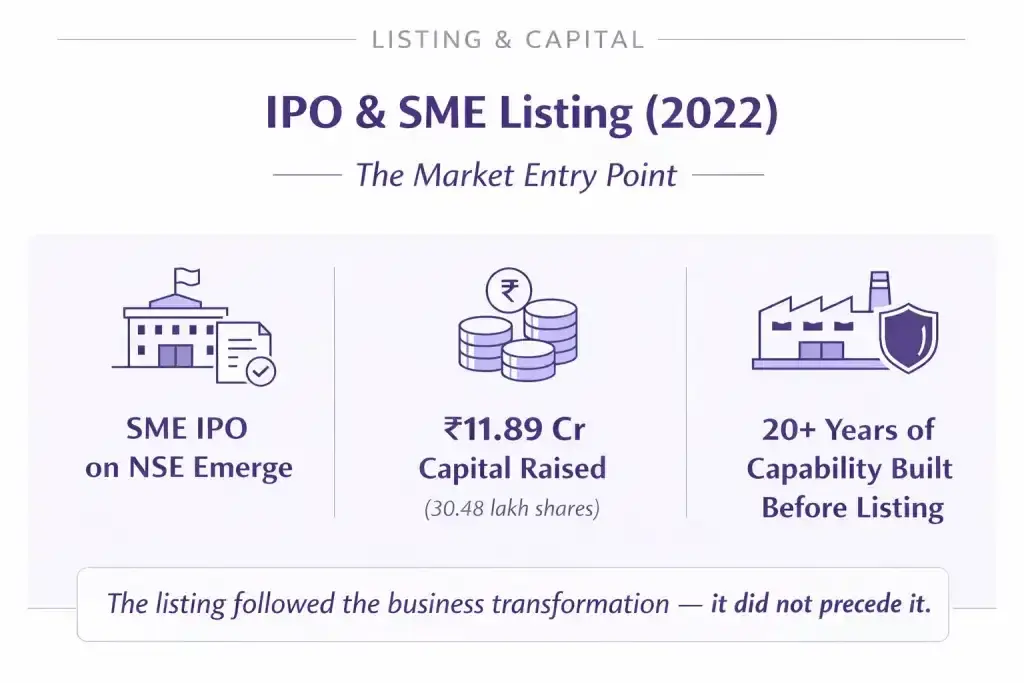
In March 2022, Krishna Defence raised capital from the public through an initial public offering on the SME platform.The company issued and allotted 30,48,000 equity shares, raising an aggregate amount of approximately ₹11.89 crore. The shares were listed on NSE Emerge, providing public market access to a business that had already spent more than two decades building technical depth and institutional credibility.
For many investors who would later see disproportionate returns, this IPO — and the years immediately following it — marked the critical entry point. Importantly, the listing did not precede the business transformation. It followed it. Much of the groundwork had already been laid before the company came to market.
2. Post-Listing Strategy: Expanding Capability and Adjacencies (2023–2025)
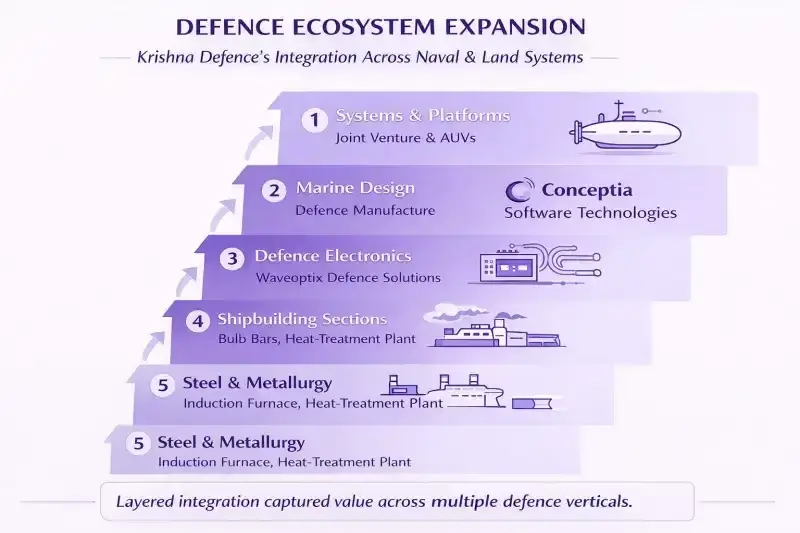
After listing, Krishna Defence did not slow down or pivot into unrelated areas. Instead, it used public capital and improved balance-sheet visibility to deepen its presence across defence-linked verticals.In 2023, the company formed Waveoptix Defence Solutions Private Limited as an associate company based in Bengaluru. Waveoptix focuses on electronic tactical communication converters, specialising in optic fibre over radio frequency. This marked Krishna’s formal entry into defence electronics — a natural adjacency to its existing defence manufacturing business.
In 2024, Krishna Defence strengthened its core shipbuilding capabilities by installing a dedicated heat-treatment plant for producing shipbuilding steel sections such as bulb bars. This investment was particularly important for meeting the stringent quality and performance requirements of the Indian Navy.
During the same period, the company acquired a 20% stake in Conceptia Software Technologies, marking its entry into marine design engineering. This move extended Krishna’s footprint upstream in the naval ecosystem, beyond manufacturing and into design and engineering services.
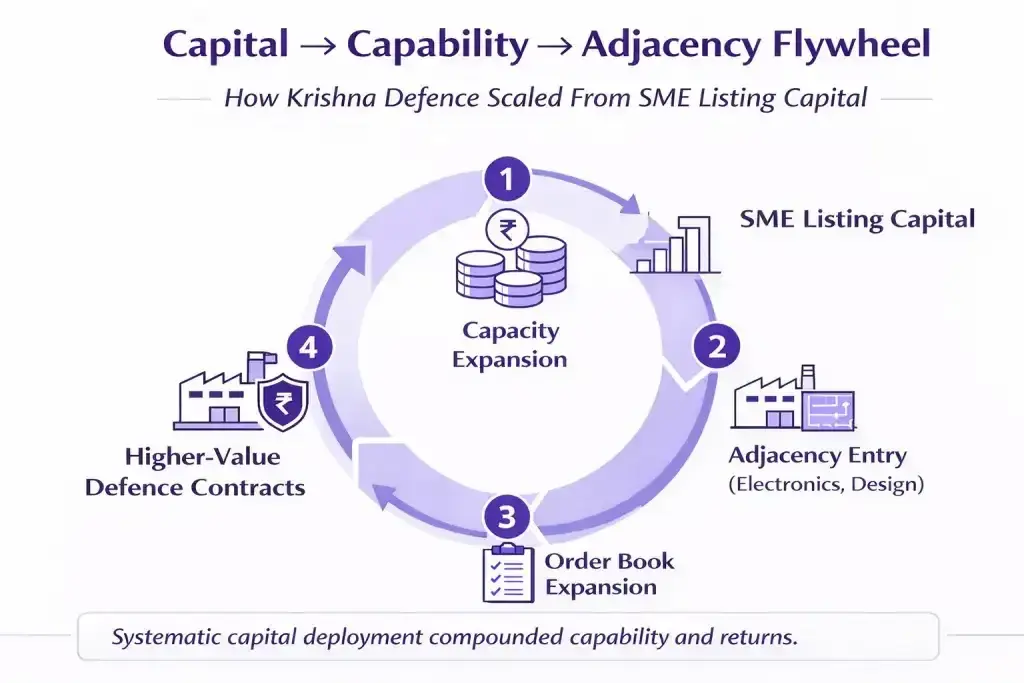
In FY 2025, Krishna increased its shareholding in Waveoptix Defence Solutions from 25% to 40%, signalling greater strategic importance of defence electronics within the group’s long-term vision.
3. Capacity Expansion and Higher-Value Defence Manufacturing (FY 2025)
FY 2025 was a year where the company really stretched its wings, physically. They brought new production lines online, installed some serious, cutting-edge induction furnaces, and gave their heat-treatment facilities a big-time upgrade.These investments were made to handle more products, with better accuracy, and for more complex defence needs, all while keeping quality high and delivering on time.
In April 2025, Krishna Defence entered into a joint venture with VABO Composite of the Netherlands, a specialist in composite naval doors, hatches, and superstructures. This partnership strengthened Krishna’s positioning as a systems-oriented defence supplier rather than a component-only manufacturer, allowing it to participate in higher-value segments of naval platforms.
Around the same time, the company launched a new category of special alloy long products for T-90 tanks. What began as development moved into bulk supply for the Indian Army, further diversifying Krishna’s defence revenue base across naval and land systems.
4. A Symbolic Milestone: Jalkapi and the Arc of Transformation (2025)
In June 2025, Krishna Defence hosted the ceremonial steel cutting for Jalkapi at its upgraded Halol facility. Jalkapi is India’s largest and most advanced Autonomous Underwater Vehicle, designed by the Indian Navy.This event carried symbolic significance far beyond a single project.
It captured the full arc of the company’s journey — from manufacturing bulk milk coolers for dairy farmers to producing steel sections and ballast bricks for warships, and ultimately to contributing to one of India’s most sophisticated underwater defence platforms.
The biggest returns often come not from sudden stories, but from businesses that quietly compound capability until the market can no longer ignore them.
How Krishna Defence Actually Made Millionaires: The Business Mechanics
The wealth creation in Krishna Defence and Allied Industries Limited was not sudden or mysterious. It was the outcome of a series of compounding business decisions, taken consistently over time, and aligned with both industry structure and national policy.Understanding these mechanics is essential to understanding why the stock created disproportionate wealth.
1. A Niche Where Mistakes Are Costly — and Vendors Are Sticky
Krishna Defence operates in segments where failure is not an option. Its portfolio spans shipbuilding steel sections and bulb bars, special alloy ballast bricks, critical naval weld consumables, extreme-environment heating and cooling systems, T-90 tank profiles, IED containment vessels, and homeland security barriers.These are not optional purchases. They sit deep inside defence platforms where safety, reliability, and performance are mission-critical.
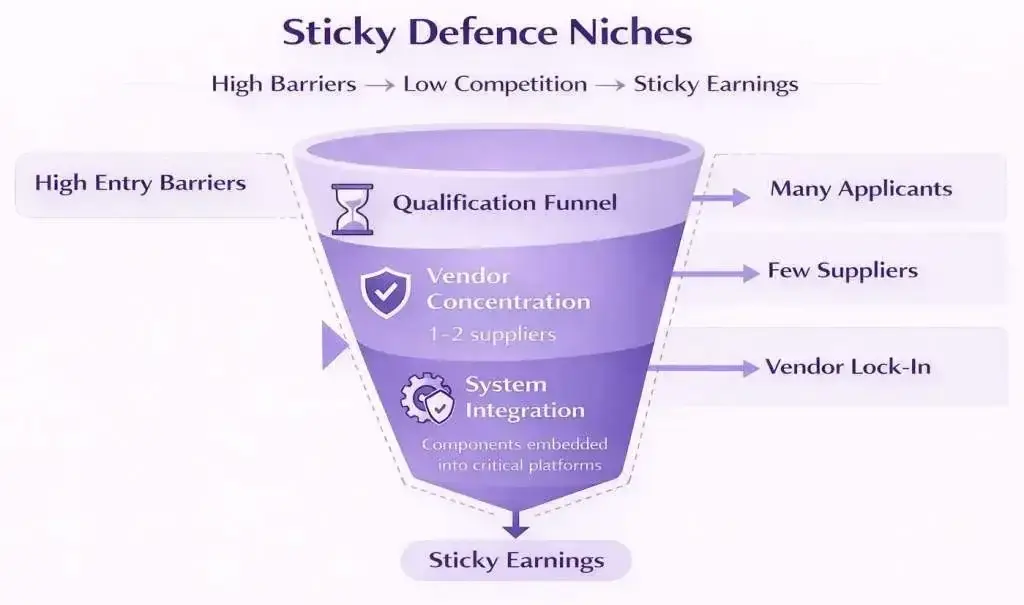
Because of this, every product goes through long qualification cycles, layered testing, and strict approvals before it is accepted. The process is slow, costly, and painful—for both vendors and the armed forces.
In many of these niches, there is only one or two approved domestic suppliers. Once a vendor proves reliability, switching becomes risky and expensive for the buyer.
That creates powerful stickiness. Competitive advantage here doesn’t come from cheaper pricing, but from execution, quality control, and compliance—exactly the kind of niches that can compound earnings quietly and are often mispriced in their early years.
2. Riding a Policy Wave: Defence Indigenisation as a Structural Tailwind
Krishna Defence’s scaling aligned closely with a major shift in India’s defence policy environment—greater indigenisation, import substitution, rising budgets, and long-gestation defence programs.What set Krishna apart was preparation. It didn’t react to policy momentum; it had positioned itself years earlier.
By the time policy intent turned into procurement, Krishna was already an approved vendor with in-house design, development, and manufacturing. Defence operations were based in Halol, dairy manufacturing in Kalol, and an electronics footprint was taking shape in Bengaluru.
As a result, growth came not from chasing scattered opportunities, but from deepening its role within a few expanding defence ecosystems.
This was structural growth—not opportunistic growth.
3. Order Book Visibility and the Power of Operating Leverage
The financial inflection point came when the order book began to outpace annual execution. In FY24, Krishna Defence opened with an order book of about ₹85 crore, received fresh orders of over ₹200 crore, executed roughly ₹104 crore, and closed the year with an order book of about ₹187 crore—largely defence-led.This phase is critical for any SME. Once the order book becomes meaningfully larger than annual revenue, visibility improves. Investors can start looking beyond the next quarter and model sustained growth.
As execution picked up, operating leverage kicked in. Revenue growth accelerated sharply—H1 FY25 saw year-on-year growth of around 167%. More importantly, EBITDA grew faster than revenue, and profits grew even faster than EBITDA.
By FY25, revenues were approaching ₹195 crore, EBITDA margins had moved into the mid-teens, and the order book stood close to ₹270 crore. Fixed costs were spread over a larger base, margins expanded, and forward visibility strengthened.
This is classic operating leverage—the point where business momentum begins to translate into long-term compounding.
4. Scaling Without Breaking the Balance Sheet
One of the most common mistakes SMEs make during growth phases is over-investing in fixed assets as soon as orders start rising.Krishna Defence took a more disciplined approach. It retained critical, high-precision, and IP-sensitive processes in-house, while outsourcing more generic and non-core activities such as basic machining, shot blasting, and painting.
This decision led to higher job-work expenses, but these costs were variable rather than fixed. At the same time, the company avoided heavy capex commitments and debt-funded overexpansion.
The result was a structurally healthier balance sheet. Fixed costs remained under control, return ratios stayed strong, and financial flexibility was preserved. This flexibility matters immensely in defence, where order flows can be lumpy and project timelines long.
This quiet capital-allocation choice is one of the least visible, yet most powerful, drivers of long-term SME wealth creation.
5. Management Behaviour That Evolved With the Business
Underlying all of this was steady leadership. Promoter and Managing Director Ankur Ashwin Shah, with over two decades of industry experience, guided Krishna through each phase of its evolution.As the business scaled, management behaviour scaled with it. Communication became more disciplined, expansion more selective, and investments more strategic. Partnerships such as the JV with VABO Composite and stakes in Conceptia Software Technologies and Waveoptix Defence Solutions stayed closely aligned with the core business.
The focus remained on R&D, quality systems, certifications, and institutional credibility. Governance and organisational processes matured alongside Krishna’s growing role as a strategic defence supplier.
The Common DNA of Millionaire-Making SME Stocks
Across the SME universe, the companies that created serious wealth between 2022 and 2025 share a surprisingly consistent set of traits. These are not accidental successes or one-cycle stories. They follow a repeatable pattern — one that Krishna Defence and Allied Industries Limited exemplifies with unusual clarity.If you want to know more about the signals that you could look for while finding a multibagger, you can read our article on: 7 Early Signals That a Stock Can Turn Multibagger
Focused Niches with High Entry Barriers
The most successful SME wealth creators did not try to do everything. They concentrated on one or two tightly defined domains where entry barriers were high, and customer tolerance for failure was low. These were niches with long approval cycles, strict technical qualifications, and deep integration into customer systems.
Once a company proved itself in such an environment, replacement risk became minimal. Growth came from expanding within the niche, not from jumping into unrelated businesses.
Early Proof of Profitability
These companies did not chase growth for the sake of headlines. Before scaling aggressively, they demonstrated that their core model worked. Customers paid on time. Margins were sustainable. Cash flows were real, not accounting constructs.Profitability came early, and growth followed from a position of strength rather than desperation.
Operating Leverage That Shows Up in Numbers
A defining feature of millionaire-making SME stocks is visible operating leverage.Revenues began to rise, but profits rose faster. As volumes increased, fixed costs were absorbed, and margins expanded in a way that could be clearly seen in financial statements
This was not theoretical leverage discussed in presentations. It showed up quarter after quarter in EBITDA and profit growth.
Order-Book-Driven Visibility
Another common trait was the presence of a strong order book. In many cases, order books reached two to three times annual revenue. This level of visibility allowed investors to look beyond quarterly volatility and focus on multi-year execution.Once future revenues became predictable, the market gradually shifted from scepticism to confidence.
Capital Discipline
Capital allocation was conservative and deliberate. Equity dilution was limited. Capital expenditure was controlled. Instead of buying every possible machine, companies outsourced non-core processes and kept only critical, high-value activities in-house.This preserved return ratios and balance-sheet strength, even during rapid growth phases.
You can also refer to our article on: How to Read a Balance Sheet Like a Professional Investor
Valuation Re-Rating After, Not Before, Transformation
The most important common trait was timing. These stocks weren’t re-rated on promises or projections. The market responded only after the business transformation was already visible in the numbers.Investors who understood the business early—before valuations caught up—captured the full arc of wealth creation.
Krishna Defence fits this pattern closely. It stands as one of the clearest examples of this dynamic within India’s defence manufacturing ecosystem.
Explore our Products
Research Framework

Emerging Titans
Combination of quantitative analysis, industry tailwinds, and management assessment - SPRINT investment philosophy

Tiny Titans
Heavy emphasis on scuttlebutt research, plant visits, and early on-ground signals
Conclusion: Where Compounding Actually Happens
SME wealth creation rarely looks impressive while it is happening.For long stretches, these businesses appear slow, illiquid, and easy to ignore. Their progress shows up in certifications earned, vendors approved, orders accumulated, and processes refined — not in headlines or short-term price movement.
Krishna Defence’s journey reinforces a broader principle: markets eventually respond to business reality, but they do so late.
The investors who benefited were not those reacting to visible momentum. They were those who understood the business architecture early, stayed invested through uneventful phases, and allowed operating leverage and time to work together.
This is why SME investing is uncomfortable when done properly. There is little external validation at the start. There is also a constant temptation to look elsewhere.
Yet, as this period shows, the most durable returns are rarely built by being fast. They are built by being aligned.
FAQs ( Frequently Asked Questions )
Why do SME stocks sometimes deliver disproportionately large returns?
+Because many SMEs operate from a small base in specialised niches with limited competition. When execution stabilises, and demand becomes visible through order books, even incremental improvements can compound meaningfully. The market often recognises this late, which is where outsized returns come from.
Why is order-book visibility emphasised so strongly in SME analysis?
+In SMEs, quarterly numbers can be volatile and misleading. A growing, executable order book provides forward visibility and reduces uncertainty. When order books meaningfully exceed annual revenues, it often marks a structural shift from “potential” to “scaling.”
What differentiates Krishna Defence from a typical SME success story?
+Krishna Defence and Allied Industries Limited spent years building capability, certifications, and institutional trust before entering public markets. Its valuation re-rating followed business maturity, not projections—making it a clean example of fundamentals-led wealth creation.
Why does capital discipline matter more for SMEs than for large companies?
+SMEs operate with less margin for error. Over-investment or excessive leverage during growth phases can permanently impair returns. Businesses that scale selectively and keep fixed costs under control preserve flexibility—an underrated advantage in long-gestation sectors like defence.
Is this framework limited to defence-related SMEs?
+No. Defence is a useful illustration because of its high entry barriers, but the framework applies broadly to any SME operating in critical, non-discretionary niches where execution quality and reliability matter more than pricing.

High growth stock specialist, Value Educator
Shashank Mahajan is an equity research professional with over 12 years of experience in identifying high-potential SME and micro-cap stocks at an early stage. He follows a rigorous scuttlebutt research–driven approach, combining on-ground insights with deep financial analysis. Shashank specializes in uncovering under-researched and under-owned companies with strong management quality and long-term growth potential. Through disciplined research and early identification, he focuses on spotting tomorrow’s market leaders before they enter the mainstream investor radar.

Zen Technologies: Revenue Fell After a Big Win




PNG Jewellers: A 194-Year-Old Name Goes National

Explore our Products
Research Framework
Emerging Titans
Combination of quantitative analysis, industry tailwinds, and management assessment - SPRINT investment philosophy
Tiny Titans
Heavy emphasis on scuttlebutt research, plant visits, and early on-ground signals


 Orders
 Subscription
 Share with friends


Required Details
₹23999.00
(12 month subscription)
As per SEBI regulations, all users are mandated to complete the KYC that is validated for 1 year. Post payment, you will be redirected to the KYC screen


No comments yet. Be the first to comment!