
Mazagon, GRSE, Cochin: Shipbuilding Stocks
“What the wise do in the beginning, fools do in the end.” — Warren Buffett
What if the real opportunity in India’s defence sector is not in what everyone is already talking about? What if it is quietly building out at sea, far from the usual spotlight?
India has been moving towards improving its naval capability for some time now, but this story has been largely missed. As global tensions continue to rise and protecting the waterways becomes increasingly important, there is an urgent increase in the need for high-tech warships, submarines, and support vessels. This development is compounded by how quickly the construction of new vessels is happening - the Indian Navy has been adding new vessels to its fleet while also improving its dock infrastructure and increasing its shipbuilding capabilities, which suggests they are committed long-term to achieving superiority at sea.
Another aspect of this segment that makes it attractive is its time horizon. Shipbuilding is not an immediate-cycle business; it is a multi-year process where patience, execution, and strategic relevance add up to create value long before the market or public becomes aware of it.

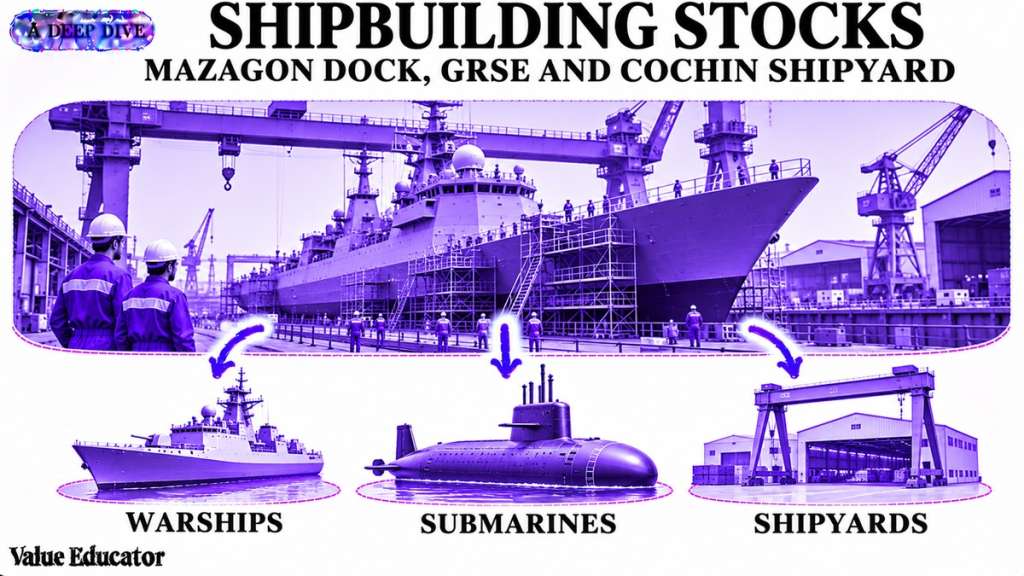
Companies like Mazagon Dock Shipbuilders Ltd, Garden Reach Shipbuilders & Engineers Ltd, and Cochin Shipyard Ltd are sitting at the key position in the development of the emerging opportunities.
Each of them plays a distinct role in strengthening India’s naval capabilities, yet their business models, execution strengths, and growth drivers differ in a meaningful way
Understanding these differences is where the real insight lies, because in a sector driven by long order cycles and strategic importance, not all players will benefit equally.
Mazagon Dock Shipbuilders Limited
Mazagon Dock Shipbuilders Limited is integral to the achievement of India’s naval aspirations through its capability to fulfill the aspirations of and execute the vision of the Indian military’s program for naval shipbuilding.
The company was established as a simple dry dock in 1774, evolving into a leading Indian shipbuilder for defence vessels (“Vessels”) to produce in excess of 800 vessels (both surface and sub-surface) thus far with the last major milestone achieved during the period 1960 through May 2010; these vessels include, among others, naval vessels, submarines, and dissymmetrical platforms.

Mazagon Dock holds a distinctive place in the shipbuilding industry as the only Indian shipyard capable of constructing destroyers and traditional submarines (there is no other competitor), thus providing Mazagon Dock with a finite specialty in a highly specialized niche of the market. Through the years, Mazagon Dock has also supported the defence system of India by developing significant naval programs such as stealthy frigates and submarines. Accordingly, as a critical player in India’s overall Defence ecosystem, Mazagon Dock will continue to be instrumental to India’s defence capabilities.
Curious to learn more about mid-cap companies? Read our article: How to Analyze a Mid-Cap Company – A Complete, Practical Framework
Mazagon Dock’s revenues are heavily focused on the core business of producing vessels: approximately 85% to 90% of Mazagon’s revenues are derived from the production of ships and manufacturing of submarines, respectively, which form the majority of Mazagon Dock’s revenue base. This is also a direct reflection of defence capital expenditure (capex) in India; that is, long-term development of projects and high-value contract awards drives the expansion of Mazagon Dock’s revenues, not the number of units produced per year.
The value of Mazagon Dock also lies in its order book. As of the end of Q3 FY26, the company had an order book between ₹35,000 and ₹40,000 crore, which equates to approximately three to four years of revenue visibility based on current execution timelines. The company has over 30 vessels (destroyers, frigates, and submarines) in various stages of execution. Due to the nature of project cycles within this industry being measured in terms of years rather than months, Mazagon Dock's level of revenue visibility provides a significant competitive advantage.
One last contributing factor is Mazagon Dock's execution capability. Mazagon Dock does not have a capacity issue, but rather it has a complexity issue to execute. The shipyard has infrastructure capable of simultaneously constructing up to 10 warships and 11 submarines while utilizing specialized yards in Mumbai and Navi Mumbai.

The next stage of expansion will involve strategic partnerships. The company is well-placed for big potential orders as they work with major global defence leaders on next-generation submarine programs and particularly Project 75I.
The second structural support for the business is indigenisation. Approximately 75% of warship content is now from India, with more than 50 key systems and components already indigenised. This will reduce the business’s dependency on imports while improving cost efficiency and aligning with the government’s objective of creating a self-reliant Indian Defence Manufacturing Industry.
Mazagon Dock is also creating optionality beyond the defence business. The company has opportunities to acquire engineering and offshore work in the energy sector and is pursuing options in the Maintenance and Repair segment. Although these areas are still relatively small, they provide incremental growth opportunities while maintaining Mazagon Dock’s focus on defence.
Capacity expansion is now moving to a critical point in the company’s growth plan. The company will invest ₹5,000 crore in appraising new dry docks, acquiring land, and developing greenfield shipyards. Once completed the business will have doubled (both in terms of vessel weight and size) the current capacity to take on the next wave of large defence contracts.

The company has also invested in future capabilities of the company. Currently, more than 5% of PAT (profit after tax) has been allocated to Research and Development, including several advanced technologies, such as AI (artificial intelligence) enabled inspection systems, underwater autonomous solutions, and shipbuilding processes. Though the investment will not immediately appear in the financials, Mazagon Dock needs to remain technologically relevant in their highly specialised industry.
Mazagon Dock registered a performance consistent with the inherent nature of defence shipbuilding during Q3 FY26. Year over year, Mazagon Dock demonstrated a strong revenue growth supported by the execution of key projects, and the margin continued to remain healthy in the 20%+ range due to effective cost control and a good project mix.
However, company performance is expected to remain lumpy on a sequential basis, as expected for this business. Revenue earned will be based on completion of milestones (on a non-linear basis) and not based on linear production; therefore, revenue will increase and decrease from quarter to quarter. Regardless, as of the end of Q3 FY26, the company had an approximately ₹35,000–₹40,000 crore order backlog, providing strong forward visibility.
Working capital cycles and execution timelines impact short-term financials to varying degrees; however, there is still an overall consistency in the direction of the business, either continuing on previous trends or improving slightly across multiple dimensions as it relates to the execution of major projects, and no significant decline/decrease in terms of the underlying fundamentals of the business.
If you are interested in knowing about penny stocks and understanding how they work, then read our article: What are penny stocks? The complete beginner's guide: pros & cons
Overall, under the circumstances of Q3 FY26 at Mazagon Dock, the results demonstrate the characteristics of the business within the defence shipbuilding sector (i.e., it is a capital-intensive industry/sector with very long cycle times from start to finish). The company has demonstrated strong revenue growth on a YoY basis due to the successful execution of various key projects during the quarter, with continued strong margins above 20% levels due primarily to effective cost management and a favourable project mix.
The sequential performance of Mazagon Dock was volatile, as is typical within the defence shipbuilding sector, due to the timing of revenue recognition being determined/recognised at the time of milestone completion (as opposed to the timing based upon discrete production). The company still had a strong order backlog of approximately ₹35,000 - ₹40,000 crore and continued to demonstrate the company’s capacity to provide strong forward visibility.
Garden Reach Shipbuilders & Engineers Ltd
When it comes to the story behind Defence Shipbuilding in India, whilst many will refer to the Size of Shipyards and their Historic Legacies, some aspects of that story may be more interesting than these two factors combined. When examining defence shipbuilding companies in India, Garden Reach Shipbuilders and Engineers Limited, which is part of the Ministry of Defence-operated Defence Procurement Programme, will be running quietly in the background, but in reality has built a solid reputational position.

GRSE stands out today as much by its history as by its consistency. The company is one of the few companies in the industry to have reported 13 consecutive quarters of year-over-year growth in revenue: ₹1,896 crore in Q3 FY26 compared to ₹1,271 crore in the same period last year and a profit after tax of ₹171 crore compared to ₹98 crore for the same period last year. GRSE's revenue for the first nine months of FY26 has nearly reached its revenue for all of FY25, with total revenue of ₹4,883 crore. This indicates that GRSE is growing rapidly.
The reason for this current growth is attributable to their successful execution. GRSE had delivered five major platforms in just nine months: one P-17A frigate, three anti-submarine shallow water crafts, and one survey vessel. This effectively means that GRSE has delivered a ship approximately every two months, which is an indication that they have an efficient operational model in a difficult and complicated industry.
Curious about what market cap actually means when it comes to stocks? Read our article on: What is Market Capitalization? Large, Mid, Small Cap Explained with Examples
Interestingly, the efficiency of execution has led to a sizable decline in their order book, which is now ¥18,482 crore as at the end of December, below ₹20,000 crore for the first time in many months. This decline is not due to a lack of demand but is indicative of faster execution that GRSE is completing related to the conversion of backlog for ten (10) projects and forty-two (42) platforms into revenue faster than ever before.
The order book contains a concentration of contracts for core defence programmes - approximately ₹14,276 crore worth of defence contracts (or ~77% of total) - by four key defence programmes (P-17A: ~₹8,236 crore; ASW-SWC: ~₹2,559 crore; & NGOPV: ~₹3,136 crore). The rest of the mix is comprised predominantly of exports (~₹1,481 crore) and non-defence programmes (~₹897 crore). In addition, GRSE has smaller order contributions for contracts such as engines, bridges & ship repairs.
As Warren Buffett once said, “The stock market is a mechanism to facilitate the transfer of money from those who are impatient to those who are patient." GRSE appears to have entered its next phase with the rapid improvement of execution. However, despite significant improvements, no substantial change will appear in GRSE's share price until the full potential is realised – even after the full impact has been reflected in GRSE's revenue numbers.
The next high-impact event for GRSE will be the approval of the Next Generation Corvette programme, which has a budget of ₹33,000 crores. GRSE has been the lowest bidder on approximately five ships under the programme. The final stages of contract negotiations are currently being completed. Once approved by management, GRSE's total order book will expand significantly - management estimates the order book could reach around ₹50,000 crores by the end of FY26.

However, there is an important nuance here. Even if the order is signed soon, revenue recognition is expected to begin only around Q4 FY28. This lag is typical in defence shipbuilding, where large projects take time to translate into financial performance, making it a long-cycle business.
Beyond this, the opportunity pipeline is massive. Projects worth around ₹1,55,000 crore have already received approval, including P-17 Bravo at ₹70,000 crore, Landing Platform Docks at ₹35,000 crore, and Mine Counter Measure Vessels at ₹32,000 crore. GRSE has indicated confidence in winning at least 20% of such opportunities, which could sustain growth visibility for years.
The real bottleneck for GRSE is not demand, but capacity. The company has already increased its concurrent build capacity from 24 ships to 28 and is targeting around 32 to 35 ships by the end of CY2026. It has also secured three additional sites for brownfield expansion, with two expected to become operational by the end of CY2026 and the third within the next couple of years.
In addition, GRSE is expanding beyond Kolkata with greenfield projects in Gujarat, including locations at Kandla and near Bhavnagar. These facilities are expected to take three to five years to become fully operational and are aimed at building large vessels of around 300 meters in length. This expansion could add capacity for around 12 large ships, significantly enhancing the company’s scale.
Global dynamics are also playing in its favor. European demand is emerging strongly, with countries like Germany, the Netherlands, Norway, and Sweden showing interest. GRSE has already seen repeat export orders, with one German client expanding its order from four to eight and then to twelve vessels. Deliveries for these are expected to begin from Q2 FY27 and continue through FY29.
At the same time, the company is building additional revenue streams. Ship repair, which currently contributes over 1% of revenue, is being scaled up as a higher-margin segment. In naval systems, GRSE has an order for 17 units of 30mm guns, of which four have already been installed and trialed, with full delivery expected by mid-2027. A potential order for 49 more guns from the Coast Guard is also under discussion.
Curious to find what debt signifies for a company and how it can impact your long-term returns? Read our article: What is Debt to Equity Ratio? Why it Matters for Small Cap Investing.
Margins have remained stable despite competitive pressures. Around 65% of project costs come from equipment, often nominated by clients, while steel sourcing is managed through tie-ups. This reduces the impact of commodity price volatility and helps maintain profitability across projects, even in competitive bidding scenarios.
As Peter Lynch said, “The key to making money in stocks is not to get scared out of them.” GRSE represents a business where the story unfolds over time, requiring patience to fully play out.

The combination of solid execution, an upcoming ₹33,000 crore order trigger, and a ₹1,55,000 crore pipeline provides investors with an opportunity for growth. Increasing the company's capacity to produce approximately 35 concurrent vessels and constructing large vessel capabilities should support further improvement in revenue. In addition, revenue growth can come through exporting and putting a greater focus on higher margin segments, such as ship repair.
There are also risks associated with the business. Revenue is lumpy; it is dependent on reaching project milestones. Management has stated that FY27 will be the peak year for revenue, and expects FY28 to plateau. Concerns over capacity issues, delayed construction of new facilities, and slow-moving non-defence opportunities could all impact the timing of future revenue growth. This is not a linear growth opportunity, but for investors who understand the cycle, there are elements of visibility and longer-term growth to support investing in the company.
Cochin Shipyard Ltd
The story of India's shipbuilding industry includes not only defence but also commercial shipbuilding on a large scale in terms of services and competitiveness in the world market. Located at this intersection between defence and shipping industries, Cochin Shipyard Limited has embraced both sides of the business, building both military ships as well as providing repair services and an export market for its products. Cochin Shipyard has come a long way since it was incorporated in 1972 and has transitioned from building bulk carriers to advanced ships, with approximately 45 vessels exported so far.
Today, what makes Cochin Shipyard an interesting prospect is the combination of growth/stability that they provide. For example, in the first quarter of FY26, their revenue increased from ₹771.47 crore last year to ₹1,068.59 crore this year, and profit after taxes also increased from ₹174.23 crore last year to ₹187.82 crore this year. Profit before taxes increased from ₹226.23 crore last year to ₹249.54 crore this year; both figures indicate they have good operational stability rather than simply expanding rapidly due to aggressive growth plans.
Margins also illustrate the strength of Cochin Shipyard during this quarter. Their EBITDA margin of 28% and PAT margin of 18% during the quarter are both above industry averages and indicate that Cochin Shipyard is performing well compared to its peers; however, management has already indicated that they expect to see these margins normalize over the course of the full fiscal year (EBITDA margins closer to 20%, PAT closer to 15%), primarily as a result of changes in the project mix.
This is where the nuance lies. The strong margins seen in previous years were partly due to high-value projects like aircraft carrier construction and repairs. As those projects roll off, margins are expected to settle at more sustainable levels, reflecting the underlying economics of shipbuilding, which typically operates at 10% to 12% margins.
As Warren Buffett once said, “It’s far better to buy a wonderful company at a fair price than a fair company at a wonderful price.” Cochin Shipyard’s story fits this well, where the business quality remains intact even as margins normalize.

The order book provides strong visibility. The company currently holds an order book of around ₹21,100 crore, with ₹19,600 crore in shipbuilding and ₹1,500 crore in ship repair. What stands out is the granularity, with 75 vessels spread across different stages, including 25 in early stages, 37 in mid-stage, and 13 nearing completion, which gives a clear picture of execution flow.
Passionate about the defence sector and planning to invest? Read our article on:Defence Stocks in India 2026: List by Segment and Order Book
Operationally, the company continues to build momentum. It secured new orders such as two high-powered tugs and a luxury river cruise vessel, while also delivering assets like the 19th electric hybrid water metro boat. Its Udupi facility also delivered its first dry cargo vessel to a European client, reinforcing its export credentials.
At the same time, not everything is smooth. A dredger project for the Dredging Corporation of India has faced delays, with management indicating challenges in timelines. While a launch is expected soon, final delivery will still take a few months, highlighting the execution risks inherent in such complex projects.
The biggest structural shift for Cochin Shipyard, however, comes from capacity expansion. The company has completed a ₹3,250 crore capex cycle over the past several years, commissioning a 310-meter drydock and an International Ship Repair Facility. These are now operational and form the backbone of future growth.
Explore our Products
Research Framework

Emerging Titans
Combination of quantitative analysis, industry tailwinds, and management assessment - SPRINT investment philosophy

Tiny Titans
Heavy emphasis on scuttlebutt research, plant visits, and early on-ground signals
The ship repair facility, in particular, is a key growth lever. It is designed to handle up to 82 ships annually and is currently working on 14 vessels. Management expects this facility to generate around ₹250 crore in incremental revenue over the next 18 to 24 months, scaling up to over ₹600 crore in a steady state.
What makes this even more interesting is the shift in capital allocation strategy. Management has indicated that the company aims to double its turnover by 2030–31, largely using existing assets and internal accruals. This suggests a phase of operating leverage, where growth comes without heavy incremental capital expenditure.
As Peter Lynch said, “Know what you own, and know why you own it.” In Cochin Shipyard’s case, the story is not about aggressive expansion, but about sweating existing assets more efficiently.
Another layer to this story is strategic partnerships. The company has entered into collaborations with global players like HD KSOE for merchant shipbuilding and Drydocks World for ship repair. These partnerships are not expected to contribute immediately to revenues, but are aimed at improving capabilities, productivity, and global competitiveness over a three to five-year horizon.
On the defence side, the company has an unexecuted order book of around ₹13,700 crore across 14 vessels, including anti-submarine corvettes and missile vessels. It has also bid for projects worth around ₹10,000 crore and is tracking large opportunities like P-17 Bravo, Landing Platform Docks, and Mine Countermeasure Vessels.
However, one of the biggest swing factors remains uncertain. The second indigenous aircraft carrier project has seen no fresh developments, and management has avoided giving timelines. Given the scale of such projects, any movement here could significantly impact long-term growth visibility.
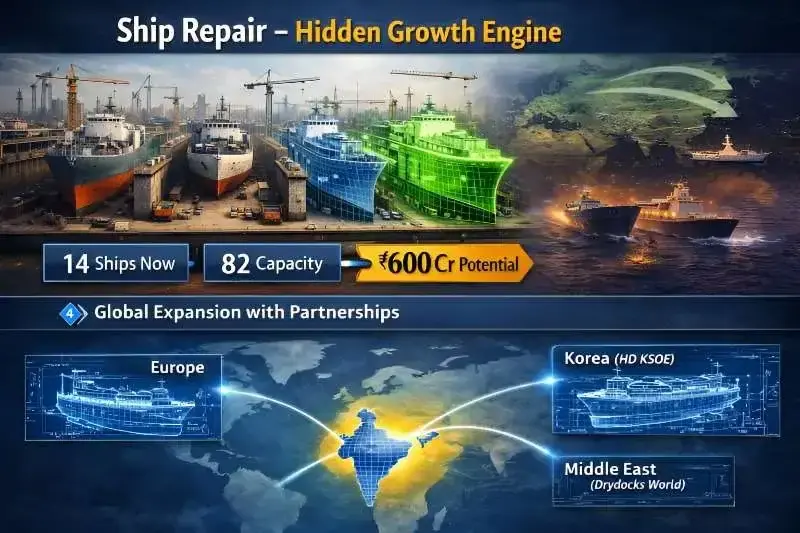
For investors, the opportunity lies in a combination of stable order book visibility, a completed capex cycle, and a clear growth path driven by ship repair and exports. With a ₹21,100 crore order book, a ramping repair facility with ₹600 crore potential, and steady 14% to 15% growth guidance, the company offers a relatively balanced growth profile compared to more volatile defence plays.
At the same time, risks remain. Margin normalisation from 28% EBITDA levels to around 20% could impact near-term profitability perception, and execution delays like the dredger project highlight operational challenges. Large defence catalysts such as aircraft carrier orders remain uncertain, and partnerships may take three to five years to translate into meaningful financial outcomes. This makes Cochin Shipyard a story of steady compounding rather than rapid re-rating.
Conclusion
Choosing the right naval defence stock ultimately depends on an investor’s financial goals, risk tolerance, and conviction in the long-term outlook of India’s defence sector.
Defence shipbuilding companies operate in a high-entry-barrier, project-based industry, where revenues and profitability are influenced by order inflows, execution timelines, and government spending cycles. Unlike traditional cyclical sectors, demand visibility here is relatively strong, but delays in execution, working capital intensity, and policy dependence can still impact performance.
Factors such as defence budgets, indigenisation push, geopolitical tensions, and the government’s focus on domestic manufacturing can significantly influence the sector’s trajectory. At the same time, company-specific factors like execution capability, margin profile, and order book quality play a critical role in long-term wealth creation.
For long-term investors, evaluating a company’s order book strength, execution track record, and strategic positioning within India’s naval ecosystem becomes crucial. Businesses that combine strong technical expertise, consistent delivery, and healthy margins are better positioned to benefit from this multi-decade opportunity.
In that context:
Mazagon Dock Shipbuilders Limited stands out for its execution strength and profitability,
Cochin Shipyard Limited offers future growth and strategic optionality &
Garden Reach Shipbuilders & Engineers provides order visibility with potential valuation comfort.
If this analysis helped you understand the naval defence space a little better, comment “NAVAL” below. We would also love to know which company you personally have the strongest conviction in and why.
FAQs
What makes defence shipbuilding different from cyclical industries?
+Unlike sectors like metals, defence shipbuilding benefits from long-term government contracts, which provide strong revenue visibility. However, execution timelines and project delays can still create variability in earnings.
Why do shipbuilding companies have long execution cycles?
+Warships and submarines are highly complex assets that require years of design, testing, and approvals. This leads to long project timelines and staggered revenue recognition.
How important is the order book for defence companies?
+The order book is one of the most critical metrics, as it indicates future revenue visibility. Companies with strong and growing order books are generally better positioned for sustained growth
What risks should investors consider in naval defence stocks?
+Key risks include execution delays, cost overruns, dependence on government orders, and working capital intensity. Policy changes or slower defence spending can also impact growth.
Which type of investor should look at these stocks?
+Long-term investors with patience and belief in India’s defence growth story are best suited. These stocks may not always deliver quick returns, but can create wealth over longer cycles.
Is India’s defence sector still a long-term opportunity?
+Yes, with increasing focus on indigenisation, rising defence budgets, and global geopolitical uncertainty, domestic defence manufacturers are expected to see sustained demand over the coming years.

High growth stock specialist, Value Educator
Shashank Mahajan is an equity research professional with over 12 years of experience in identifying high-potential SME and micro-cap stocks at an early stage. He follows a rigorous scuttlebutt research–driven approach, combining on-ground insights with deep financial analysis. Shashank specializes in uncovering under-researched and under-owned companies with strong management quality and long-term growth potential. Through disciplined research and early identification, he focuses on spotting tomorrow’s market leaders before they enter the mainstream investor radar.

Glenmark: The USD 700 Mn Cancer Deal and Its Brands

Pharma Stocks in India 2026: Generics, APIs and CDMOs

Granules India: From Paracetamol to a 65% Gross Margin

Natco Pharma: After Revlimid, 29 Patent Challenges

Shilpa Medicare: Cancer APIs, Films and Biosimilars

Alembic Pharma: US Plants Pay Back, Margin Hits 22.2%
Explore our Products
Research Framework
Emerging Titans
Combination of quantitative analysis, industry tailwinds, and management assessment - SPRINT investment philosophy
Tiny Titans
Heavy emphasis on scuttlebutt research, plant visits, and early on-ground signals



Modern Warfare to Multibaggers
Key Trends. Strategic Shifts. Opportunities Ahead.
Today at 7:00 PM IST. Room opens 30 minutes before.
Don't Miss This Exclusive Webinar!
Join Value Educator to decode the key trends shaping India's defence sector and learn how to identify tomorrow's potential leaders in the space.
- In-depth research on India's defence sector
- Live Q&A session
- Actionable takeaways for long-term investors

 Orders
 Subscription
 Share with friends


Required Details
₹23999.00
(12 month subscription)
As per SEBI regulations, all users are mandated to complete the KYC that is validated for 1 year. Post payment, you will be redirected to the KYC screen


No comments yet. Be the first to comment!