
KRN Heat Exchanger: Data-Centre Coils and a New Plant

Servers turn almost all the electricity they use into heat, and that heat has to leave the building all the time. India is adding servers quickly. Its installed data-centre power capacity rose from about 375 MW in 2020 to 1.57 GW in August 2026, and it is projected to reach nearly 8 GW by 2030. Every extra megawatt of servers needs cooling equipment to carry its heat away.
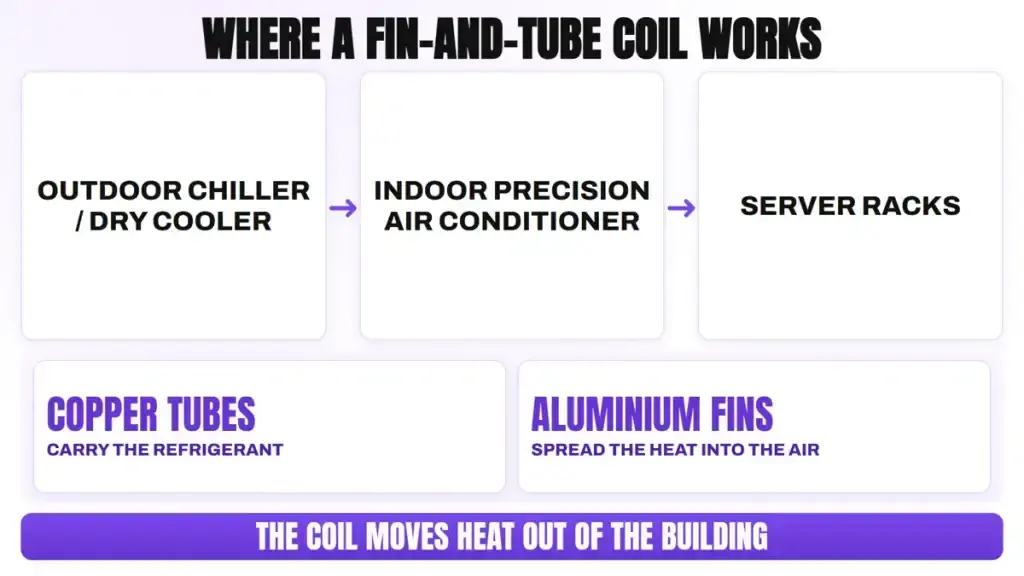
That cooling depends on a part most people never see. A fin-and-tube heat exchanger is a coil of copper tubes pushed through thousands of thin aluminium fins. A refrigerant or chilled water flows inside the tubes, and air blown across the fins either gives its heat to the coil or takes heat from it. The same kind of coil is found in a home air conditioner, a supermarket freezer, a bus air conditioner and the large chillers of a data centre.
Those chillers and air conditioners are made by cooling companies such as Daikin, Schneider Electric, Carrier, Voltas and Blue Star. They design the full machine, with its compressor, controls and cabinet, and sell it to builders, factories and data-centre operators. They earn on each machine they sell, and many earn again by servicing it. Room air conditioner makers often build their own coils, but commercial and industrial machines need many coil sizes in small batches. For those, the cooling companies often turn to specialist coil makers who can build each coil to the customer's drawing.
One of those specialists is in Rajasthan. KRN Heat Exchanger and Refrigeration Ltd (NSE: KRN) was set up in October 2017 at Neemrana by Santosh Kumar Yadav, who had earlier worked at Lloyd Electric & Engineering. It makes coils, headers, tubes and sheet-metal parts for more than 200 customers, including Daikin, Schneider Electric, Carrier, Voltas and Blue Star. In Q2 FY27, data centres alone brought it ₹116 Cr of revenue, against ₹18 Cr a year earlier.
KRN Heat Exchanger in five numbers
- Q2 FY27 revenue of ₹319.14 Cr, up 109.86% from a year earlier
- Data-centre revenue of ₹116 Cr in Q2 FY27, against ₹18 Cr in Q2 FY26
- Exports of ₹125.8 Cr in H1 FY27, up 192%, now 22% of revenue
- A new Neemrana plant with six times the capacity of the old one, planned at about 50% use in FY27
- More than 200 customers, with Daikin a customer since 2018
So how did a coil maker that listed only in October 2024 end up with data centres as more than a third of its quarterly sales? Let's first understand the company, and then look at the quarter where that change showed most clearly.
KRN Heat Exchanger: Company Overview
KRN Heat Exchanger and Refrigeration Ltd was set up in October 2017 and is based at Neemrana in Rajasthan. Its founder, Santosh Kumar Yadav, is the chairman and managing director, and the promoter group held 65.69% of the shares in September 2026. The company makes fin-and-tube coils, copper headers, tubes and sheet-metal parts for cooling companies such as Daikin, Schneider Electric and Carrier. Through its wholly owned subsidiary, KRN HVAC Products, it also makes bar-and-plate coolers, refrigerator parts, bus air conditioners and complete cooling systems. It runs two plants at Neemrana and has a workforce of more than 1,500 people. It earned ₹600.06 Cr of revenue in FY26 and ended September 2026 with about ₹141.34 Cr of cash and cash equivalents, against short-term borrowings of about ₹153.03 Cr. Read this MTAR: The Workshop Powering US AI Data Centres
"Never invest in a business you cannot understand."
— Warren Buffett
KRN's business is easier to follow once you know where a coil goes: into the chillers, air conditioners and coolers that cooling companies sell. The sections below follow that coil from Neemrana to data centres, buses and railways.
The Quarter Revenue More Than Doubled
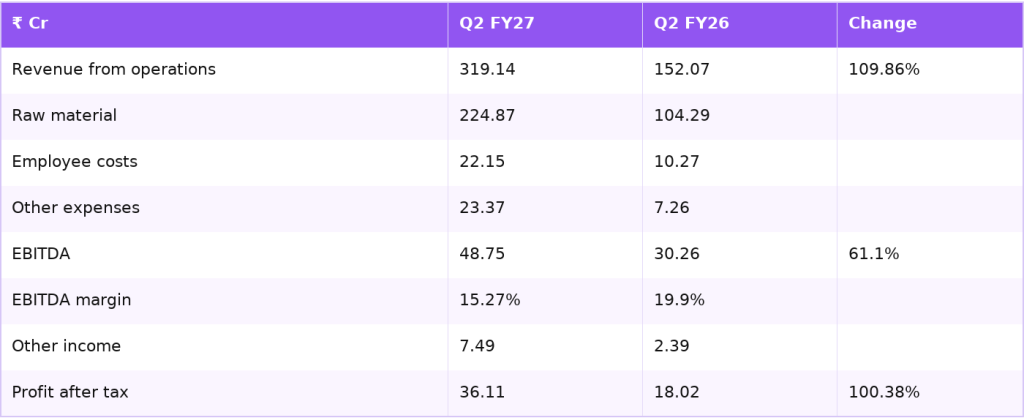
Let's look at Q2 FY27, the July to September quarter, when consolidated revenue more than doubled. Revenue was ₹319.14 Cr, up 109.86% from ₹152.07 Cr a year earlier. Profit after tax was ₹36.11 Cr, up 100.38% from ₹18.02 Cr. For the first half of FY27, revenue was ₹571.45 Cr, up 113.75%, and profit was ₹69.01 Cr, up 126.68%.
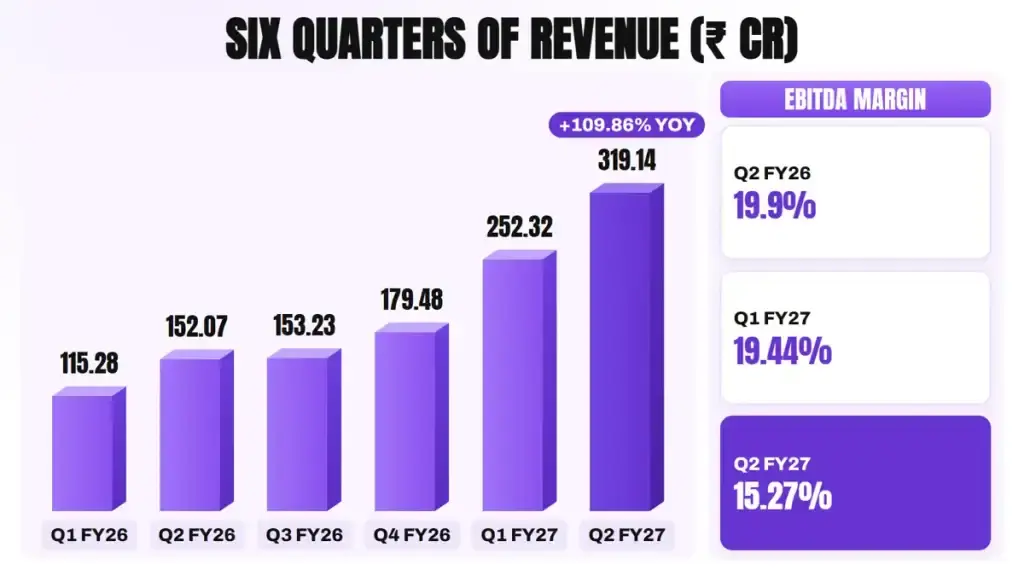
That jump has been building for six quarters. Revenue went from ₹115.28 Cr in Q1 FY26 to ₹152.07 Cr in Q2, ₹153.23 Cr in Q3 and ₹179.48 Cr in Q4. It then rose to ₹252.32 Cr in Q1 FY27 and ₹319.14 Cr in Q2 FY27. So the first half of FY27 alone came close to the ₹600.06 Cr of revenue in all of FY26.
That growth, as you can see, came from three places at the same time. The new plant at Neemrana started billing more products, data-centre customers placed larger orders, and exports nearly tripled in the half year. In Q1 FY27, the old company plant gave about ₹140 Cr of revenue and the new plant gave more than ₹115 Cr.
That profit, you may notice, grew a little more slowly than revenue, and management explained why. EBITDA rose 61.1% to ₹48.75 Cr, but the EBITDA margin was 15.27%, against 19.9% a year earlier and 19.44% in Q1 FY27. Management named four costs that together took about 3-4 percentage points off the margin.
The first two were freight and metal. Shipping costs rose sharply on export routes because of the war in West Asia, and freight alone took about 1.8-2% of revenue. Copper and aluminium were also costlier, which added about another 1.8-2%. KRN passes metal and currency changes on to customers, but only once a quarter, so a sharp rise inside a quarter shows up first as a cost. Read this Operating vs Net Profit Margin Explained
Daikin's pricing was the next reason, and it is about pricing, not cost. Prices on Daikin's orders went up by about 30% from the quarter before, to cover metal, but KRN's profit on that business is fixed in rupees. So revenue from Daikin rose while profit from it stayed about the same, and the margin percentage looked smaller. The fourth was higher spending on business promotion.
"Cooling requirements in this segment are rising and customers are planning and placing orders well in advance." - Komal Yadav, KRN Heat Exchanger
That same quarter, we should note, also carried the cost of a bigger team. Employee costs rose to ₹22.15 Cr from ₹10.27 Cr, as the group now has more than 1,500 people across its plants. Depreciation rose to ₹7.32 Cr from ₹4.85 Cr because the new plant is now running. Other income rose to ₹7.49 Cr, mainly interest on fixed deposits made from the money raised in June 2026. It does not yet include any production incentive, because KRN will book those only once the government certifies them.
The Rolling Orders Behind the Growth
So where do these sales come from, if KRN does not report an order book? The company works on a rolling order book, which means its main customers share a forecast for about six months, fix a firm order for the next month, and then roll the plan forward each month. Only about 1-2% of its business is tied to fixed projects.
That rolling model changes a little for data centres. Data-centre orders are larger and are placed earlier than ordinary orders. In May 2026, management said one data-centre customer had already booked orders six to seven months ahead. Its May 2026 deck described data-centre orders above ₹50 Cr as becoming routine, and mentioned a single data-centre order of ₹20 Cr.
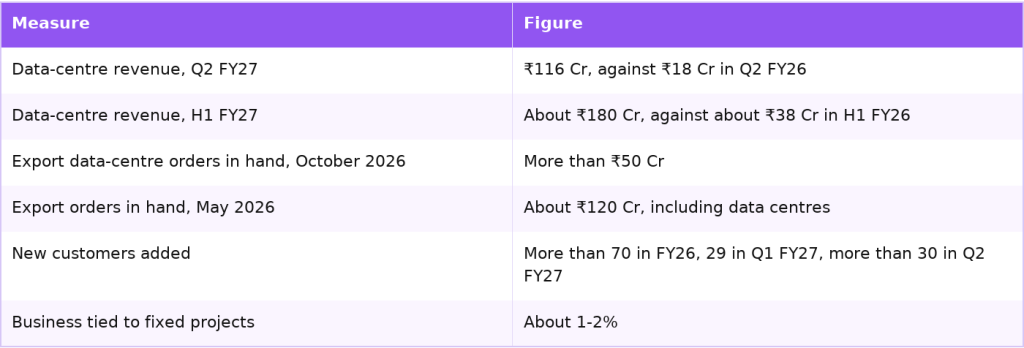
Those new customers matter to us because each one starts small and grows. In FY26, KRN added more than 70 customers, about two a month. It added 29 more in Q1 FY27 and over 30 in Q2 FY27, across fin-and-tube coils, bar-and-plate coolers, bus air conditioners, refrigerator parts and complete systems.
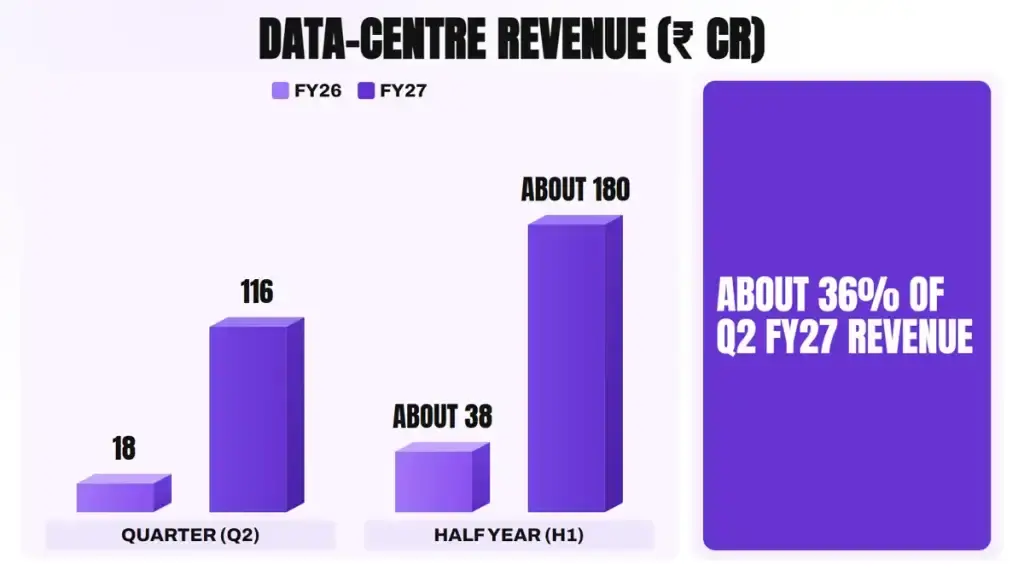
Why the data-centre number matters: ₹116 Cr out of ₹319.14 Cr means data centres gave about 36% of Q2 FY27 revenue. A year earlier, the same business was ₹18 Cr out of ₹152.07 Cr. Data-centre revenue grew more than six times in a year, and the rest of the business still grew about 52%, from ₹134.07 Cr to ₹203.14 Cr.
How a Neemrana Coil Shop Grew Into Two Plants
Now let's go back and see how KRN built the plant that is now carrying this growth. The company set up its first plant at Neemrana in October 2017 and started commercial production in 2018. It began exporting in 2019. In 2020, it bought two more plots and expanded the plant to 7,800 sq. mt.
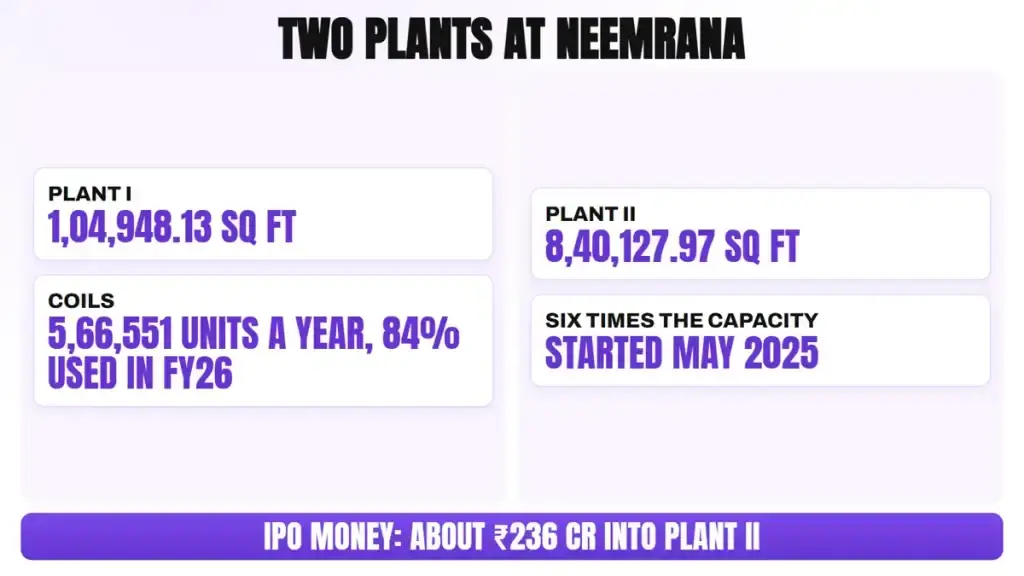
That first plant, as we will see, was built around coils. In 2021, KRN added lines for 5 mm copper tubes, a thinner tube used in lighter and more compact coils. In 2022, it added lines for larger coils with 9.52 mm and 12.7 mm tubes. By FY26, this plant was running at 84% of its coil capacity of 5,66,551 units a year, 84.53% for copper headers and 85.77% for sheet-metal parts.
That full plant is why the company listed. KRN listed on the NSE and BSE in October 2024, and its IPO raised about ₹311 Cr after issue costs. Of that, about ₹236 Cr went into its wholly owned subsidiary, KRN HVAC Products Pvt Ltd, to build a second plant at Neemrana. By September 2026, all of that money had been spent on the project.
That second plant started production in May 2025 and was formally opened on 11 March 2026. It stands on 8,40,127.97 sq ft of land, against 1,04,948.13 sq ft for the first plant, so it has about eight times the land. Management describes its capacity as six times that of the old plant.
The new plant also gave KRN room for new products. Besides fin-and-tube coils in new sizes, it now makes about eight or nine product types the old plant could not, such as refrigerator condensers, bar-and-plate coolers, dry coolers, ammonia evaporators and bus air conditioners. The bus air-conditioning business came through a deal in Q2 FY26, when KRN took over the bus AC division of Sphere Refrigeration Systems with its team and designs.
Those steps show up clearly in the yearly numbers, as you can see below. Revenue was ₹247.48 Cr in FY23, ₹308.28 Cr in FY24, ₹429.85 Cr in FY25 and ₹600.06 Cr in FY26. Profit after tax in FY26 was ₹76.47 Cr, up 44.62%. In June 2026, KRN raised about ₹350 Cr more through a qualified institutional placement, mainly to fund working capital at the new plant.
Data centres grew inside those numbers step by step. In FY24, they gave about 7% of revenue. By the first nine months of FY26, the share was about 15%, and in Q4 FY26 it was 18.7%. In Q2 FY27, it was about 36%.
Five Product Lines Around One Coil
Now let's see what KRN actually sells, product by product. The company does not report revenue by product line, but it describes five lines in its filings and on its calls. Read this Segment-Wise Revenue Analysis Explained All of them use the same skills: bending copper and aluminium, brazing joints that never leak, and testing each unit under pressure.
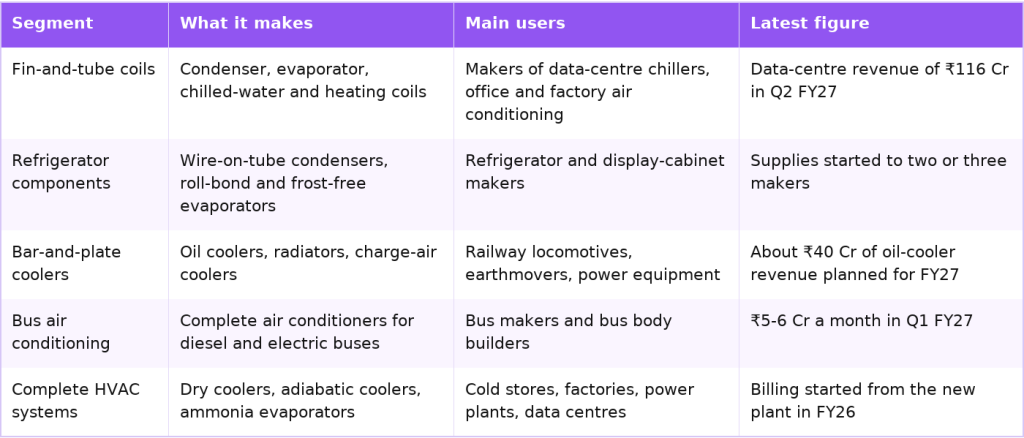
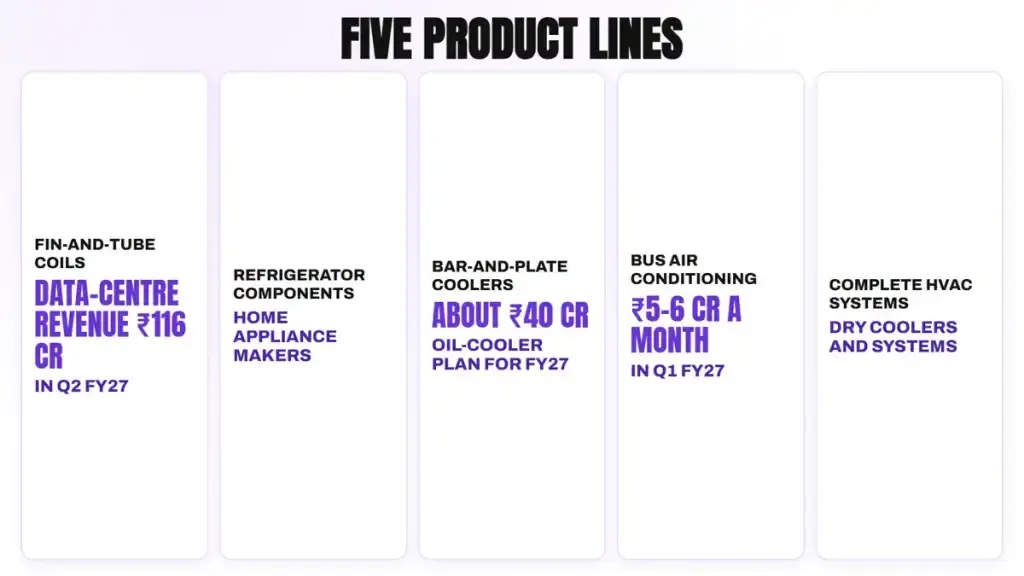
These five lines, we should be clear, differ in how much of the final machine KRN builds. In fin-and-tube coils and refrigerator parts, KRN makes one part that a cooling company puts into its own machine. Bar-and-plate coolers are a different design, with flat aluminium plates brazed into a block, and they cool oil or air in engines and transformers rather than room air. In bus air conditioning and complete HVAC systems, KRN builds the whole machine and sells it under its own design or for another brand.
Fin-and-Tube Coils for Data Centres
Let's start with fin-and-tube coils, the line that gives most of KRN's revenue and all of its data-centre sales. India had 130 data centres in CY 2021 and 271 in CY 2025. About USD 95 billion was invested in them over CY 2019-25, and investment is expected to pass USD 100 billion by CY 2027. Cooling makes up 15-25% of a data centre's capital cost.
That cooling, we can say, has two halves. Outside the building, air-cooled chillers and dry coolers throw the heat into the open air, and each of them needs large fin-and-tube coils. Inside, precision air conditioners and computer-room units cool the air around the server racks, and they need coils too. KRN supplies coils for both, and it can add sheet-metal sub-assemblies if a customer wants them.
KRN's data-centre work started with one customer. In FY24, data centres gave about 7% of revenue, and the main customer was Schneider Electric, a buyer since 2019, along with two other cooling makers. The old plant had little room for the very large coils a data centre needs. The new plant has that room, and management now says almost every company that makes data-centre cooling equipment in India buys from KRN.
That access, you can now see, shows in the size of the business. Three of KRN's top ten customers in FY26 came from data centres. In Q2 FY27, data-centre revenue was ₹116 Cr, and in H1 FY27 it was about ₹180 Cr, against about ₹38 Cr in H1 FY26. Management says KRN is the single coil source for some domestic data-centre customers, with shares of about 50-60% at others.
"Investing without research is like playing stud poker and never looking at the cards."
— Peter Lynch
With KRN, looking at the cards means knowing that its data-centre revenue comes through cooling makers, not from data-centre operators, and that a few large buyers decide how much of it arrives each quarter.
The next step is abroad. KRN started exporting data-centre coils to two large overseas customers in FY26, and it added one more large North American data-centre customer in Q2 FY27. As of October 2026, it held more than ₹50 Cr of export data-centre orders.
That growth also raises a fair question for us about technology. Racks that once gave off about 5 kilowatts of heat can now give off about 100 kilowatts, and such racks are cooled by liquid that runs close to the chips. Management's answer is that liquid cooling adds a part rather than removing one. The room around the racks still needs air cooling, and the outdoor chillers and dry coolers still need fin-and-tube coils.
"If you want to heat exchange then you have to use heat exchanger." - KRN management
That added part is a plate heat exchanger inside the coolant distribution unit, the box that moves heat from the liquid loop to the building's water loop. KRN already uses vacuum brazing for its bar-and-plate coolers, and it is using that skill to develop a brazed plate heat exchanger for this unit. It expects revenue from that product in FY28 or FY29. It is also adding microchannel coils, a flatter aluminium design used in some outdoor units.
Coils for Air Conditioners and Refrigerators
Next, let's look at the coils that go into ordinary air conditioners and refrigerators, the older half of the fin-and-tube business. The Indian HVAC market was about USD 17.1 billion in FY 2025 and is projected to reach USD 32.6 billion by FY 2030. About 110 million room air conditioners were in use in FY 2025, and another 130-150 million are expected to be added by FY 2035.
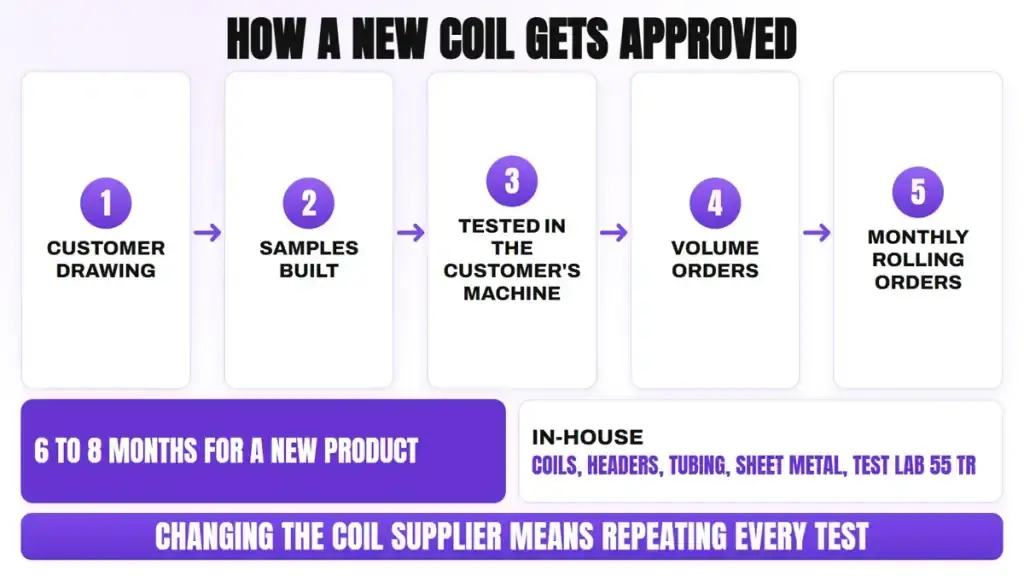
That demand, as we saw in the opening, reaches KRN through the large cooling brands. Daikin has bought from KRN since 2018, Carrier and Voltas since 2019, Kirloskar Chillers since 2020 and Blue Star since 2021. Daikin is now the largest single customer, at about 20% of revenue this year. For these customers, KRN makes condenser and evaporator coils for commercial and room units, and also copper headers that spread refrigerant across a coil's tubes.
The new plant has added refrigerator parts to this list. KRN now makes wire-on-tube condensers, roll-bond evaporators, frost-free evaporators and skin condensers, the parts that keep a household or display refrigerator cold. It has started supplies to two or three refrigerator makers and is working to add another large one. Management says these parts earn a little less than fin-and-tube coils.
Bar-and-Plate Coolers for Railways and Machines
Now let's turn to bar-and-plate coolers, the line that takes KRN into railways and heavy machines. A bar-and-plate cooler is built from flat plates and bars brazed into one solid block. It cools oil, coolant or compressed air, so it is used in locomotive transformers, earthmovers, compressors, forklifts and power equipment.
That railway work, we should note, started with an approval. In FY25, KRN HVAC Products was approved by the Ministry of Railways as a vendor of oil cooler radiators for the converter transformers of electric locomotives. It delivered a 10-unit trial order to Banaras Locomotive Works, and its coolers then passed a six-month field trial. It now bids in railway tenders as an approved supplier.
Those tenders are now arriving. In August 2026, KRN said it had come first on price in a tender from Chittaranjan Locomotive Works worth about ₹70 Cr in all. A single supplier can win at most 20% of that tender, so KRN's share would be about ₹8 Cr. Management expects about ₹40 Cr of oil-cooler revenue in FY27 from railways and industrial buyers together.
The bigger railway step is air conditioning. KRN has built a team for railway HVAC and has made a prototype cab air conditioner for locomotive drivers. After the railways approve its plant, it plans to bid for cab units first, then for LHB coaches and later for Vande Bharat trains and metros. Management expects about ₹20 Cr of railway HVAC revenue in FY28. Bar-and-plate products earn a slightly higher margin than fin-and-tube coils.
Bus Air Conditioning
Next, let's look at bus air conditioning, the newest complete machine in KRN's range. The Indian bus air-conditioning market is about ₹1,000 Cr a year, and its electric part is growing about 25-30% a year. The PM e-Bus Sewa scheme alone has sanctioned 10,000 air-conditioned electric buses across 116 cities.
KRN entered this market in Q2 FY26 by taking over the bus AC division of Sphere Refrigeration Systems. The deal brought designs, know-how and an experienced team. KRN already made the coils and tubes for such units, and it also makes the fibre-reinforced plastic body parts in-house, so most of a bus air conditioner is now built under its own roof.
That integration, you can now see, is turning into sales. Bus AC revenue was about ₹10 Cr in FY26, and in Q1 FY27 it ran at ₹5-6 Cr a month. KRN has started supplies to its first bus maker, has added several body builders and has signed an agreement with a large anchor customer. It aims for about 15% of the market and supplies units for electric buses already.
Complete Cooling Systems
Finally, let's look at complete cooling systems, where KRN sells a full machine for industrial use. These include V-type dry coolers, adiabatic coolers that use a little water to pre-cool air, evaporative condensers, ammonia evaporators for cold rooms and remote radiators for engines. The new plant started billing these products in FY26.
That range links back to data centres too. Dry air coolers and open-top condensers are used to throw heat out of data centres and power plants. KRN sells some of these under its own design and makes others for cooling brands. It is also entering cold storage, where its air-cooling units and ammonia evaporators go into pharma and food stores.
Management says complete systems earn a better margin than fin-and-tube coils. KRN makes most of the parts itself, from the sheet metal and tubing to the coil. So a complete system keeps more of the value inside the group.
Why North American Buyers Now Order From Neemrana
So far we have looked at what KRN makes. Now let's look at where it sells, because North American buyers now order more from Neemrana than ever, and exports are the fastest-growing part of the business. In H1 FY27, exports were ₹125.8 Cr, up 192% from a year earlier, and they made up 22% of revenue against 16% in H1 FY26. Products went to customers in 14 countries in Q1 FY27 alone.
That export mix has also changed country by country. In FY26, the UAE was the largest export market at 37.94% of exports, followed by the USA at 31.10%. In H1 FY27, the USA gave 43.75% of exports, Canada 12.82%, France 12.67%, the UK 7.93% and Italy 7.65%. Customers in North America and Europe are giving KRN more business, including new data-centre customers.
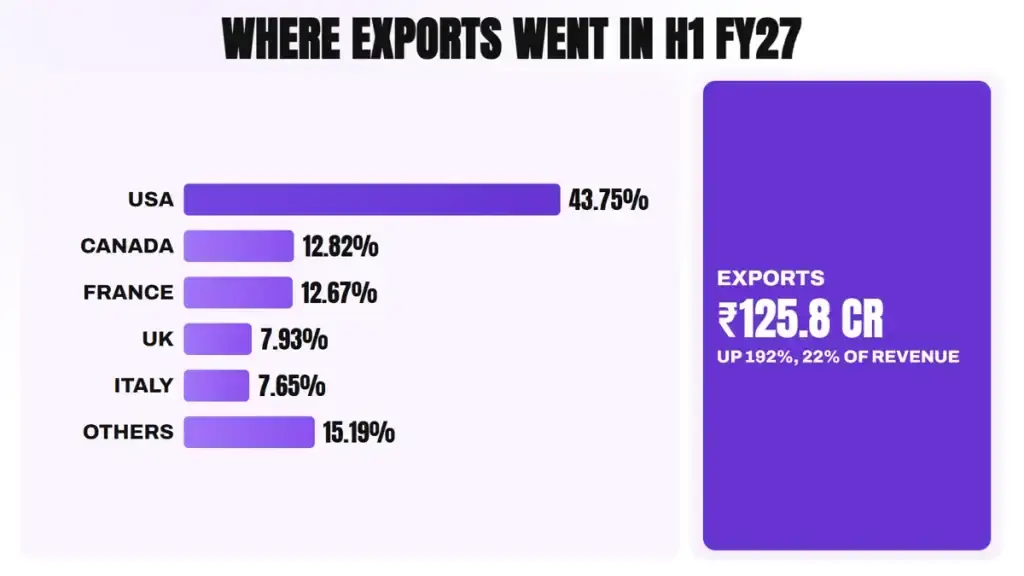
That shift also came from a change in freight. Shipping a container to the UAE cost about USD 1,500 before the West Asia war and about USD 6,000 after it. So KRN shipped less to the UAE and more to North America and Europe, and its total exports still grew. Management sees this spread of markets as a strength, because a gap in one country can be filled from another, as we saw with the UAE.
Those exports, and this matters for us as readers, also earn more. Leaving freight aside, an export order earns about 4-5% more EBITDA margin than a similar domestic order. KRN also prices its products about 20-25% below its European competitors. Abroad, KRN competes mainly with European and North American coil makers rather than with Chinese ones.
That pull from abroad is now part of the target. Management first aimed for about ₹200 Cr of exports in FY27, after about ₹100 Cr in FY26. In October 2026, it raised the target to about ₹250 Cr. It expects another 60-80% growth in exports in FY28, and it aims for half of its fin-and-tube coil sales to come from exports by FY28.
Why Cooling Makers Rarely Switch a Qualified Coil Supplier
Now that we have seen each product line and market, let's understand what keeps customers with KRN. It starts with qualification. A cooling maker gives KRN a coil design, KRN builds samples, and the customer tests them in its own machine before it orders in volume. For a new product, that process can take six to eight months.
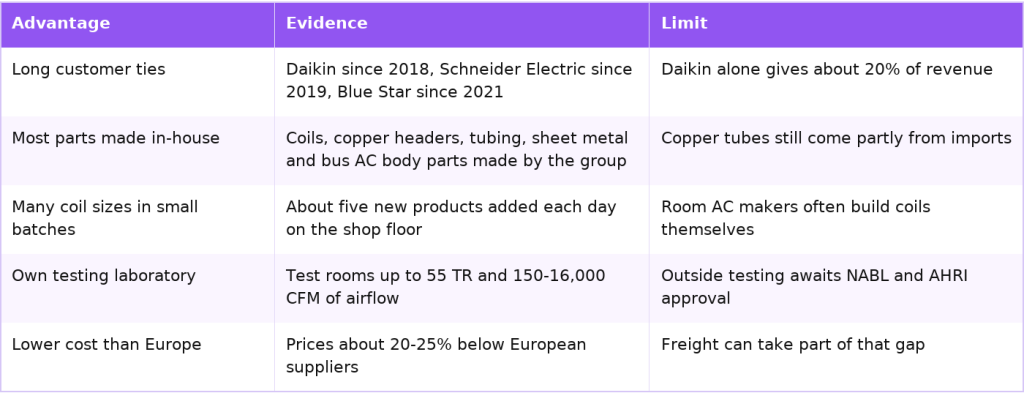
That qualification is why, as you would expect, the customer list grows slowly but stays. Once a coil is approved inside a chiller or an air conditioner, the cooling maker has tested that exact coil for pressure, airflow and life. Moving to another coil maker would mean new samples, new tests and months of waiting. Read this Economic Moat Explained So most of KRN's large customers have stayed for five years or more.
The rolling order model adds to that hold. KRN's main customers share six months of forecasts and place firm orders every month, so KRN is built into their monthly production plans. On average, about 80 customers have work running on KRN's shop floor at any time. That spread of orders is also why the company sees little seasonal swing.
Making most parts in-house also helps KRN win these approvals. It bends and brazes its own copper headers, makes its own tubing and sheet-metal frames, and in bus air conditioning even makes the fibre-reinforced plastic body parts. That control over parts lets it promise delivery dates and quality that a smaller coil maker may not match. Management also says it is not competing with Chinese suppliers, because its coils are custom-made in small batches rather than sold from a catalogue.
That custom work needs testing, and KRN now has its own laboratory. Thermotech Research Laboratory has more than 15 test systems, a psychrometric room that tests coils from -20°C to +60°C outside air, and test capacity of up to 55 TR. With it, KRN can check a coil's performance before the customer does, and it can redesign a coil to use less copper while giving the same cooling. It expects NABL accreditation in a few weeks from October 2026, followed by AHRI certification, before it opens the lab to outside clients.
"So, to survive small vendor is not possible in this market. So, and that is the advantage for us as of now." - KRN management
That line points us to the last layer of the moat, which is money. Coils are made of copper and aluminium, and their prices have risen sharply. A coil maker must hold weeks of metal stock and wait for customers to pay, and smaller coil shops struggle to fund that. Read this Inventory Turnover Ratio Explained KRN's IPO and placement money gave it the balance sheet to carry large stocks for large data-centre orders.
Financials: Fast Growth, Cash Tied Up in Stock
KRN's numbers changed scale when its second plant started in May 2025, so the table runs from FY23 to the first half of FY27. FY23 figures are standalone; later years are consolidated.
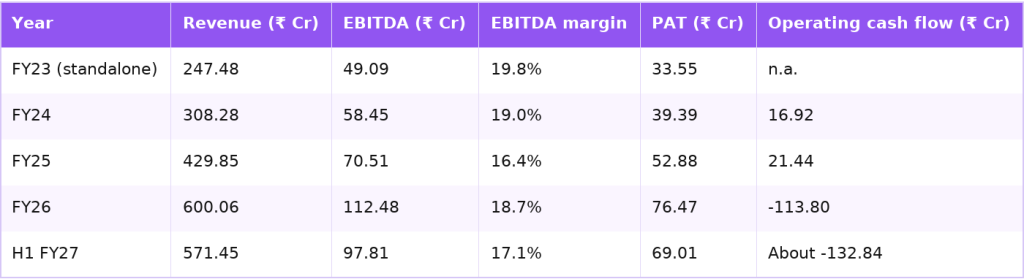
Revenue grew about 2.4 times from ₹247.48 Cr in FY23 to ₹600.06 Cr in FY26, and the first half of FY27 alone came close to the whole of FY26. Profit after tax rose from ₹33.55 Cr to ₹76.47 Cr over the same three years. The EBITDA margin stayed in a band of about 16-20% in every year, even as revenue more than doubled.
Cash flow is the weakest number in the table. From FY24 to FY26, profit after tax added up to about ₹168.74 Cr, while operating cash flow added up to about minus ₹75.44 Cr. Inventory rose from ₹95.85 Cr in March 2025 to ₹272.91 Cr in March 2026 and about ₹379.52 Cr in September 2026, as KRN stocked copper tubes ahead of import rules and built stock for new products. Receivables rose from ₹92.96 Cr to ₹174.71 Cr and then to about ₹308.95 Cr.
The balance sheet is carrying that gap with equity rather than debt. After the June 2026 placement, equity was about ₹984.26 Cr in September 2026, against short-term borrowings of about ₹153.03 Cr, a debt-to-equity ratio of about 0.16. Management expects working capital and cash flow to improve by March 2027.
"Only when the tide goes out do you discover who's been swimming naked."
— Warren Buffett
For a fast-growing manufacturer, the tide is cash. KRN's profits have grown every year, but the cash flow statement shows how much of that profit is still sitting in stock and in customers' unpaid bills.
What the Next Two Years Look Like on Management's Numbers
So what could all of this add up to for you as a reader following KRN? Management does not publish a revenue target, but it has responded to analysts' numbers on its calls. In October 2026, an analyst asked whether FY27 revenue could pass ₹1,250 Cr. The chairman said it could, unless force majeure, a wider war or new US tariffs got in the way.
That figure would need a strong second half. H1 FY27 revenue was ₹571.45 Cr, so ₹1,250 Cr for the year would mean about ₹678.55 Cr in H2 FY27. That is about ₹339 Cr a quarter, against ₹319.14 Cr in Q2 FY27. Management expects Q3 to be about flat because of freight costs and the Diwali break, and Q4 to be stronger.
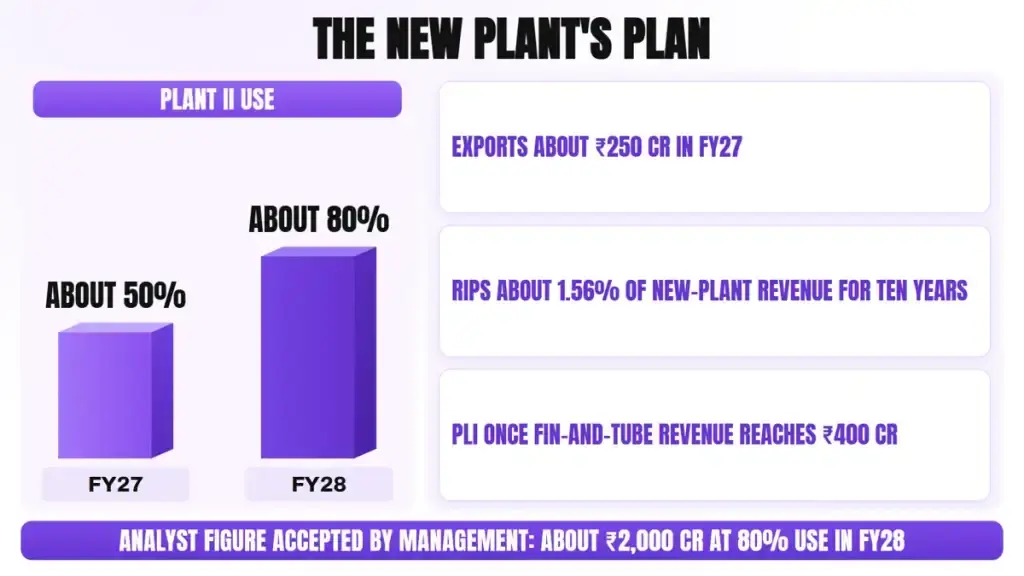
Beyond FY27, the plan is set by the new plant. Management expects it to run at about 50% of capacity in FY27 and about 80% in FY28. In August 2026, an analyst put 80% use in FY28 at about ₹2,000 Cr of revenue, and management said that plan still held. After FY28, it expects growth of at least 30% a year.
Margins are the second part of the plan. Management expects the EBITDA margin to stay near the Q2 level in Q3 and rise by 1-2 points in Q4. Over the longer term, it agreed with an analyst's band of 18-20%, helped by exports, data centres and two government incentives.
Those incentives, let's explain, matter for the margin. The central government's production-linked incentive, or PLI, would pay KRN about 5% on its heat exchanger production once fin-and-tube revenue for the year reaches ₹400 Cr. The Rajasthan Investment Promotion Scheme, or RIPS, would give the new plant about 1.56% of its revenue for ten years. KRN has not booked either yet, and expects to report them only after the government certifies them.
"Show me the incentive and I will show you the outcome."
— Charlie Munger
For KRN, the PLI and RIPS incentives are a real part of management's margin plan. Until they are certified and booked, the margin you see in the results does not include them.
Next, let's look at capital spending, which will be small next to the last plant. KRN plans about ₹100 Cr over about a year for a plant near Bangalore, close to five or six customers in South India, and for a separate site for bus air conditioning and railway products. The Bangalore plant would add about 10-15% to capacity, and it would first take over work KRN already ships south from Neemrana.
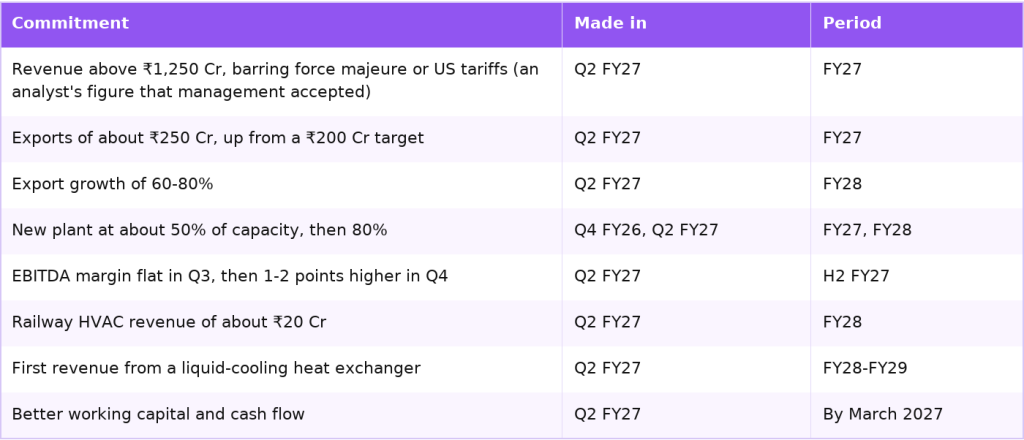
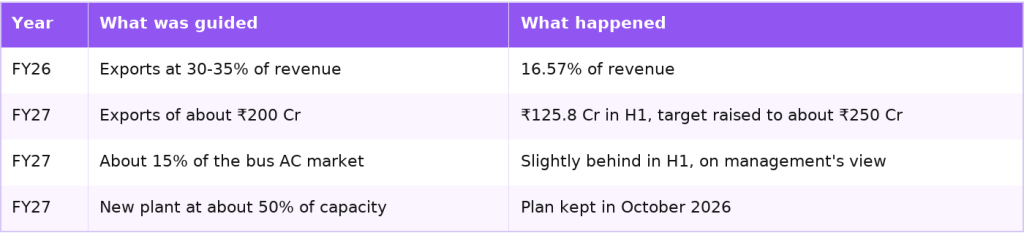
These commitments come with a record we can check. In May 2025, management aimed for exports at 30-35% of revenue by FY26, and the actual share was 16.57%. In August 2026, it repeated an aim of about ₹200 Cr of exports in FY27, and the first half alone gave ₹125.8 Cr. Its aim of a 15% share of the bus AC market in FY27 was running slightly behind in H1.
Key Risks
No business grows in a straight line, so let's look at what could go wrong for KRN.
- Cash is tied up in stock and dues: operating cash flow was minus ₹113.80 Cr in FY26, against profit of ₹76.47 Cr, and about minus ₹132.84 Cr in H1 FY27. Inventory rose from ₹272.91 Cr in March 2026 to about ₹379.52 Cr in September 2026, and receivables from ₹174.71 Cr to about ₹308.95 Cr. KRN built stock for new products and ahead of import rules on copper tubes, and customers of new lines take longer to pay. The placement money is funding this gap, so cash flow depends on the working-capital plan working by March 2027.
- Margins slipped in Q2: the EBITDA margin was 15.27% against 19.44% in Q1 FY27, because of freight, metal costs and Daikin's pricing. Management expects Q3 to stay near that level, so the 18-20% band is not yet in sight.
- One large customer: Daikin gives about 20% of revenue, and the top ten customers gave 73.21% of FY25 revenue. A cut in orders from one of them would show quickly in the numbers.
- Liquid cooling could change the coil count: AI racks are moving to liquid cooling, which needs plate heat exchangers in coolant distribution units. KRN's own product for that unit is about 1.5 years away, so rivals that already make one could take that new spend.
- Copper tube supply: India's quality rules now limit imports of inner-grooved copper tubes to 50% of last year's level. KRN has stock, import licences for exports and two local suppliers, but a shortage or a price jump would hit costs before it can pass them on.
- Incentives are not yet booked: the PLI needs ₹400 Cr of fin-and-tube revenue in a year, and both PLI and RIPS need government certificates. Any delay keeps the margin lower than management's band.
- A record of missed targets: exports reached 16.57% of FY26 revenue against an aim of 30-35%, and bus AC approvals are taking longer than planned. The June 2026 placement also added 33,01,886 new shares, so each existing share now owns a slightly smaller part of the company.
"All I want to know is where I'm going to die, so I'll never go there."
— Charlie Munger
For KRN, the places to avoid are clear from the numbers: cash tied up in stock, one customer at about a fifth of revenue, and a cooling technology that is moving towards liquid. The risks below look at each.
Explore our Products
Research Framework

Emerging Titans
Combination of quantitative analysis, industry tailwinds, and management assessment - SPRINT investment philosophy

Tiny Titans
Heavy emphasis on scuttlebutt research, plant visits, and early on-ground signals
What to Track Next
If you follow KRN, these are the signals that will show whether the plan is on track.
- Data-centre revenue staying above ₹116 Cr a quarter, and the share of new North American customers
- Exports reaching about ₹250 Cr in FY27
- The EBITDA margin returning from 15.27% towards 18-20%, and the first PLI and RIPS income
- Inventory and receivables coming down from about ₹379.52 Cr and about ₹308.95 Cr, with operating cash flow turning positive
- The new plant moving from about 50% use in FY27 to 80% in FY28
- The first brazed plate heat exchanger for liquid cooling, and railway HVAC orders
Conclusion
Let's step back and put it all together. KRN spent its first seven years building coils for India's large cooling brands in one full plant at Neemrana. Its IPO money built a plant six times larger just as data centres began to buy far more cooling. Data-centre revenue reached ₹116 Cr in Q2 FY27, exports nearly tripled in the half year, and revenue more than doubled. The cautious thread is cash and concentration: operating cash flow was minus ₹113.80 Cr in FY26 and about minus ₹132.84 Cr in H1 FY27, and Daikin alone gives about 20% of revenue. The next two quarters will show whether the margin climbs back from 15.27% and whether inventory starts to come down.
So the next year will show whether that growth can also turn into cash. The new plant is only about half used, which leaves room to grow without another large plant. If working capital comes down and the incentives arrive, KRN could keep growing with better margins, but if stock and dues keep rising, growth will keep needing outside money.
FAQs
What does KRN Heat Exchanger make?
+KRN makes fin-and-tube heat exchangers, the copper-and-aluminium coils inside chillers, air conditioners and refrigerators, along with copper headers, tubes and sheet-metal parts. Through its subsidiary it also makes bar-and-plate coolers, refrigerator parts, bus air conditioners and complete cooling systems, for more than 200 customers including Daikin, Schneider Electric, Carrier, Voltas and Blue Star.
How much of KRN's revenue comes from data centres?
+Data-centre revenue was ₹116 Cr in Q2 FY27, about 36% of the quarter's ₹319.14 Cr of revenue, against ₹18 Cr a year earlier. In H1 FY27 it was about ₹180 Cr, against about ₹38 Cr in H1 FY26. KRN supplies coils to the companies that build data-centre cooling equipment, not to data-centre operators directly.
How did KRN perform in Q2 FY27?
+Consolidated revenue was ₹319.14 Cr, up 109.86%, and profit after tax was ₹36.11 Cr, up 100.38%. The EBITDA margin was 15.27% against 19.9% a year earlier, because of higher freight and metal costs and Daikin's pricing. For H1 FY27, revenue was ₹571.45 Cr and profit ₹69.01 Cr.
What is KRN's new plant and how much is it used?
+The second Neemrana plant, run by KRN HVAC Products, started production in May 2025 and has six times the capacity of the old plant. Management expects it to run at about 50% of capacity in FY27 and about 80% in FY28. About ₹236 Cr of IPO money went into building it.
How big are KRN's exports?
+Exports were ₹125.8 Cr in H1 FY27, up 192%, and made up 22% of revenue. The USA gave 43.75% of exports, followed by Canada, France, the UK and Italy. Management raised its FY27 export target from about ₹200 Cr to about ₹250 Cr.
What are the main risks for KRN Heat Exchanger?
+The main risks are cash tied up in stock and receivables (operating cash flow was minus ₹113.80 Cr in FY26), a margin that slipped to 15.27% in Q2 FY27, Daikin at about 20% of revenue, the shift to liquid cooling in AI data centres, copper tube supply, and government incentives that are not yet booked.

High growth stock specialist, Value Educator
Shashank Mahajan is an equity research professional with over 12 years of experience in identifying high-potential SME and micro-cap stocks at an early stage. He follows a rigorous scuttlebutt research–driven approach, combining on-ground insights with deep financial analysis. Shashank specializes in uncovering under-researched and under-owned companies with strong management quality and long-term growth potential. Through disciplined research and early identification, he focuses on spotting tomorrow’s market leaders before they enter the mainstream investor radar.
Macpower CNC: A Rajkot Machine Maker With ₹476 Cr of Orders
KSB: The Pune Pump Maker With ₹1,235 Cr of Reactor Orders

Kilburn Engineering: The Dryer Maker With ₹470 Cr of Orders

Rossell Techsys: Boeing and Lockheed Wiring From Bengaluru
Unimech Aerospace: From Engine Tools to Flying Parts
Taneja Aerospace: The Airfield With ₹161 Cr of Rent Signed
Explore our Products
Research Framework
Emerging Titans
Combination of quantitative analysis, industry tailwinds, and management assessment - SPRINT investment philosophy
Tiny Titans
Heavy emphasis on scuttlebutt research, plant visits, and early on-ground signals



Modern Warfare to Multibaggers
Key Trends. Strategic Shifts. Opportunities Ahead.
Don't Miss This Exclusive Webinar!
Join Value Educator to decode the key trends shaping India's defence sector and learn how to identify tomorrow's potential leaders in the space.
- In-depth research on India's defence sector
- Live Q&A session
- Actionable takeaways for long-term investors

 Orders
 Subscription
 Share with friends


Required Details
₹23999.00
(12 month subscription)
As per SEBI regulations, all users are mandated to complete the KYC that is validated for 1 year. Post payment, you will be redirected to the KYC screen


No comments yet. Be the first to comment!