
SG Finserve: Funding India's MSME Supply Chain
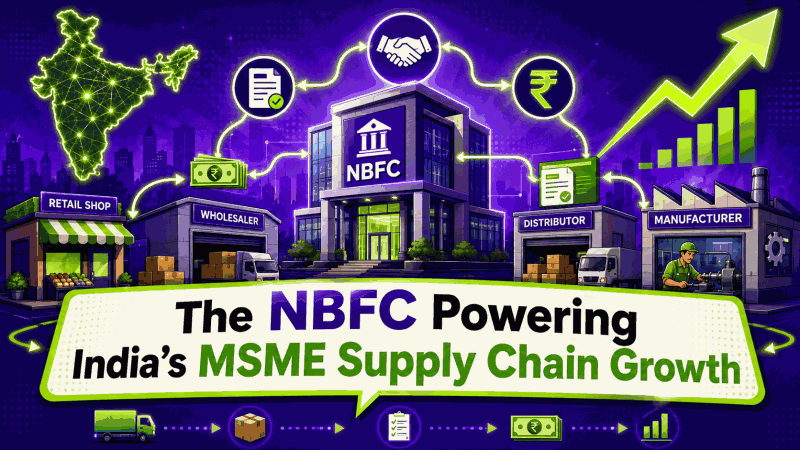
India’s growth is not built only by large companies.
It is also built by thousands of dealers, distributors, vendors, and MSMEs that keep goods moving every day.
They are the ones that buy inventory. They further supply it to local markets. They connect large manufacturers with smaller customers. They keep the real economy running.
But there is one problem that keeps coming back for many of these businesses: cash flow.
“Never take your eyes off the cash flow because it is the lifeblood of business.” — Richard Branson
A dealer may have demand but not enough money to buy more stock. A distributor may have orders but may be waiting for payments. A vendor may be part of a strong corporate supply chain but still need short-term liquidity to keep operations moving.
This is where a focused supply-chain finance model becomes powerful.
Instead of giving loans without proper due diligence, the lender finances real business transactions linked to invoices, anchors, dealers, and repayment cycles. The funding is usually short-term, transaction-backed, and connected to actual movement of goods. If done well, this can create a high-velocity lending model with better visibility and stronger control over risk. This is where a focused NBFC can create real value.
One such company operating in this space is SG Finserve Limited.
What Does the Company Actually Do
The company is focused mainly on supply-chain finance.
In simple words, the company provides working capital finance to dealers, distributors, vendors, and MSMEs connected to large anchor corporations. These anchors are usually established companies that have a large dealer or distributor network.
The business works around a simple problem.
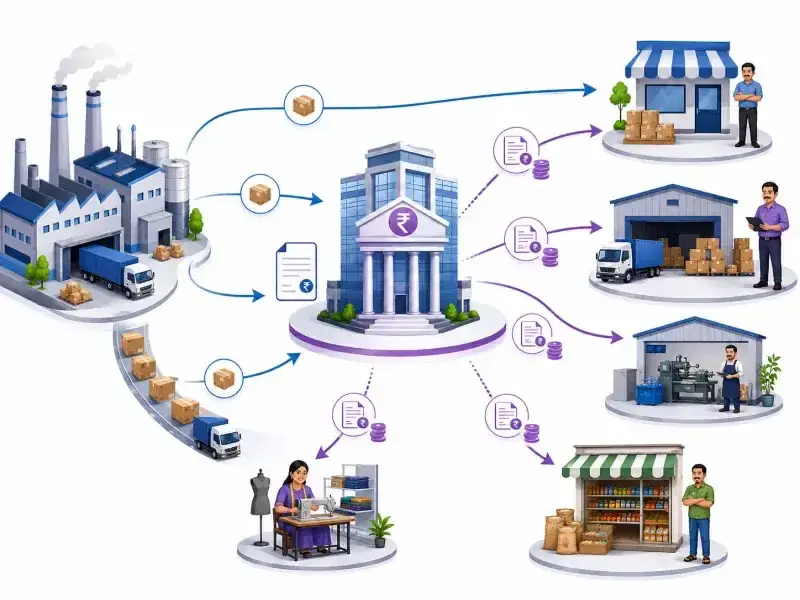
A dealer needs to buy goods from a large corporation but it may not have enough immediate cash. This is where the NBFC steps in and finances the purchase. The dealer gets inventory, the anchor receives payment, and the NBFC earns interest and fees on the financing.
This may sound basic, but the structure is powerful because it is linked to actual business transactions.
The loan is not given for an uncertain purpose. It is usually backed by an invoice. The end-use is monitored. The payment often goes directly to the anchor. The loan cycle is short. The dealer’s ability to keep buying from the anchor depends on repayment discipline.
That is what makes the model different from many other forms of unsecured or general-purpose lending.
Why Supply-Chain Finance Matters
India’s economy is full of small and medium businesses that sit inside larger supply chains.
A steel dealer, an electronics distributor, a building material supplier, an auto component channel partner, or a consumer durable distributor may all be part of a larger corporate ecosystem. These businesses often need working capital before they receive cash from customers.
This creates a funding gap.
Banks may not always serve this gap quickly. Traditional lending can be slow, documentation heavy, and collateral driven. Smaller dealers may also struggle to get flexible working capital limits.
Supply-chain finance solves this problem by connecting financing directly to the business flow.
The lender does not look at the borrower in isolation. It studies the borrower’s relationship with the anchor, the invoice, the purchase cycle, the repayment history, the inventory movement, and the cash conversion cycle.
This makes the lending more transaction-led and data-driven.
If you're new to evaluating financial companies, understanding the fundamentals is essential. Read our guide on How to Read a Balance Sheet Like a Professional Investor to learn how investors assess businesses before investing.
For India, this is important because MSMEs and channel partners are the small but important carriers of economic activity. Large manufacturers may produce goods, but those goods need dealers and distributors to reach the final market.
If the channel has liquidity, goods move faster.
If goods move faster, manufacturers sell more.
If manufacturers sell more, the supply chain becomes stronger.
That is why supply-chain finance can become a powerful enabler of India’s manufacturing, consumption, infrastructure, and MSME growth story.
“Small opportunities are often the beginning of great enterprises.” — Demosthenes
The Business Model: Anchor, Dealer and Financier
The core of SG Finserve’s model is the tripartite relationship between the anchor, the borrower, and the financier.
The anchor is the large corporation. The borrower is usually the dealer, distributor, vendor, or MSME connected to that anchor. The financier is SG Finserve.
This structure creates discipline.
If a dealer is buying goods from an anchor, the financing is linked to that purchase. The NBFC does not simply hand over money for any use. In many cases, the money is paid directly to the anchor. This helps ensure that the funds are used for the intended transaction.
The dealer then sells the goods, converts inventory into receivables, and eventually turns receivables into cash. That cash is used to repay the loan. Once the old invoice is repaid, the dealer can again use the facility for fresh procurement.
This helps create a continuous cycle.
This is why management often refers to churn.
A short churn cycle is important because it reduces the duration of credit exposure. If the book turns over quickly, the lender can detect stress faster, recycle capital faster, and control risk better.
“The essence of strategy is choosing what not to do.” — Michael Porter
Why the Nil NPA Track Record Matters
One of the most striking parts of the company’s commentary has been its nil NPA (Non Performing Asset) track record.
In lending businesses, asset quality is everything.
A lender can grow fast, report strong income, and look very attractive for a few years. But if underwriting is weak, the real problems show up later through NPAs, provisions, write-offs, and capital erosion. That is why nil NPAs are important.
Asset quality is only one part of the story. Investors should also understand how leverage impacts lenders by reading What is Debt to Equity Ratio? Why it Matters for Small Cap Investing.
However, investors should understand this carefully. Nil NPA is a positive sign, but it should not be blindly assumed to continue forever. The business is still scaling. As the loan book becomes larger, the real challenge will be whether asset quality remains strong through different economic cycles.
The company’s model has certain built-in protections. The loans are short-term. The financing is invoice-backed. The end-use is monitored. The payment often goes directly to anchors. The borrowers are connected to large corporates. But lending always carries risk.
The real question is not whether risk exists. It always does. The real question is whether the company has systems strong enough to identify, price, monitor, and control that risk.
FY26 Financial Performance
FY26 was a pivotal moment for the company as it shifted from a growth focused NBFC to a more prominent and scalable supply chain finance platform.
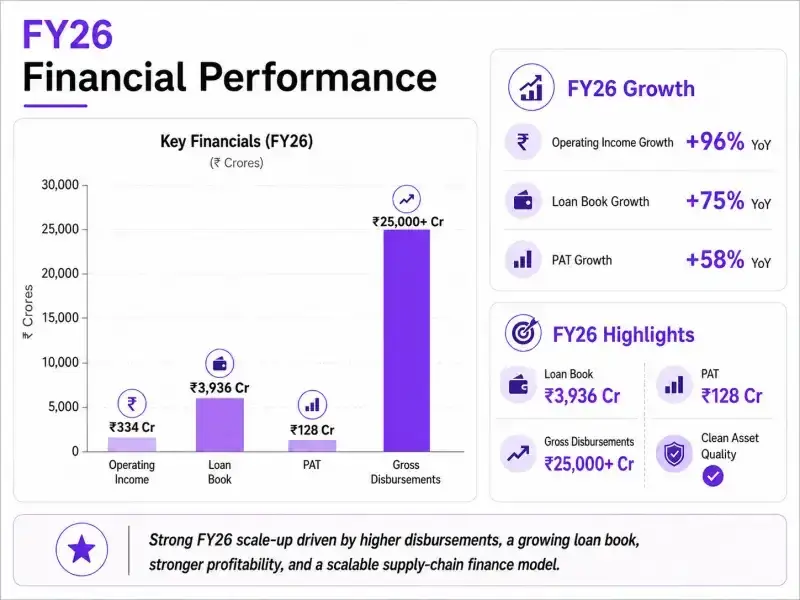
The company earned an operating income of approximately ₹334 crore for the year ended March 31, 2026, up 96% YoY. This indicates strong growth of the income engine, with the loan book growing in size and the supply-chain finance model taking off.
The loan book grew to ₹3,936 crore as of end FY26, up 75% from the previous year. That's significant since the company isn't creating a slow-moving inventory of loans. It operates on the model of short cycle transactions which are backed by an invoice and in which the capital continues to flow through the group of dealers, distributors, anchors and MSMEs.
Profitability also improved by a large margin. PAT for FY26 was around ₹128 crore, which has increased by 58% YoY. This means that the company has ended FY26 in a stronger earnings position than it began the year.
Another important number is gross disbursement. Gross disbursements for FY26 were over ₹25,000 crore. This indicates that the platform is actively financing a high volume of real transactions, not merely reporting closing loan-book growth. It is actively investing in an extensive number of transactions throughout the value chain.
The bottom line of FY26 is rather simple: SG Finserve posted solid growth in income, loan book, disbursements and profits, and maintained clean asset quality. In an NBFC, it is significant as the growth without asset quality could become risky and asset quality without growth, value creation is limited.
The company's supply-chain finance model has begun to scale; this is evident in FY26. What will be tested next is whether the same growth can be maintained in the face of disciplined underwriting, lower funding costs, disciplined leverage and good repayment habits.
“Don’t be afraid to give up the good to go for the great.” — John D. Rockefeller
FY26 shows that the company has reached meaningful scale, but the next phase will depend on whether growth continues without pressure on asset quality, leverage, or spreads.
Why This Is Not a Traditional NBFC: The Role of Anchors
Many NBFCs grow by entering retail lending, unsecured lending, vehicle finance, housing finance, gold loans, microfinance, or personal loans.
SG Finserve’s story is different because its main focus is supply-chain finance.
The company is not currently trying to become a broad retail lender. Management has indicated that the focus remains on supply-chain finance, including anchor-led business, open account financing, and factoring-based business.
This matters because the risk profile of supply-chain finance is different from many retail lending products.
The loans are shorter in tenure, the transaction is linked to invoices, the borrower is part of an anchor ecosystem and the end-use can be monitored. The repayment discipline is linked to the dealer’s ability to continue procuring from the anchor.
That does not make the business risk-free. But it does make the business more structured.
In lending, the difference between a good lender and a bad lender is rarely visible during boom times. It becomes visible when liquidity tightens, demand slows, or borrowers face pressure.
The company’s model depends on disciplined anchor selection, borrower quality, transaction monitoring, digital systems, and quick detection of stress.
Anchors are central to this business model. An anchor is usually a large corporation whose dealers, distributors, or vendors need financing. The stronger the anchor, the better the ecosystem quality can be.
Management has spoken about expanding from a single group customer to a wider anchor base that includes large corporates across sectors such as infrastructure, metals, auto, consumer durables, electronics, and IT peripherals.
This diversification matters.
If the company were dependent on only one group or one sector, the risk would be higher. But as the anchor base expands, the business gets more routes for growth. At the same time, anchor-led lending has its own challenges. If the anchor’s sector slows down, dealer demand can slow. If the anchor changes terms or shifts volumes, the financing opportunity can change. If concentration becomes high in a few anchors, business risk can rise.
Therefore, investors should track not just the number of anchors, but also the quality, sector spread, utilization, and concentration of the anchor portfolio.
Digital Infrastructure: Why It Matters
The supply-chain finance operates best when the lender can process deals swiftly and keep track of them all the time.
That's where technology comes into the picture.
SG Finserve has been talking about the tech stack, the massive number of invoices being discounted and their plans to launch a customer mobile app, credit monitoring systems and the bolstering of digital underwriting and portfolio oversight.
It is because supply-chain finance is a high volume business. A company can have thousands or lakhs of invoices across various anchors, distributors, location and sector.
This would take a lot of time if done manually and is risky.
Using a digital platform facilitates quicker processing, improved visibility, real-time borrower service, invoice tracking, repayment monitoring, and early-warning systems.
When the business loan cycle can be brief, speed is vital and monitoring is vital.
The key is if the company can merge technology with disciplined underwriting, it can grow without operating costs or credit risk escalating too rapidly.
This is one reason the company has been able to operate with a low cost-to-income ratio.
Factoring: The Next Product Extension
One of the important developments in FY26 was the factoring license.
Factoring can strengthen the company’s supply-chain finance offering because it allows financing against receivables. In simple terms, a business that has sold goods but is waiting to receive payment can get liquidity earlier by using factoring.
This fits naturally with the supply-chain finance model.
Supply-chain finance helps at the purchase side. Factoring can help at the receivable side. Together, they can improve the liquidity cycle for MSMEs, dealers, vendors, and channel partners.
Management mentioned that factoring was commercialized in March, and the FY26 closing loan book was backed by the core supply-chain finance business as well as factoring commercialization.
This is important because it expands the company’s addressable market.
However, factoring also needs careful risk management. The company must monitor receivables quality, buyer quality, documentation, repayment timelines, and concentration.
If executed properly, factoring can become a complementary growth driver.
Factoring can expand the opportunity size, but execution quality and receivable-risk monitoring will decide whether it becomes a real profit driver.
Capital Position and Leverage Room
A lending business cannot grow without capital.
For an NBFC, equity capital acts as the base on which borrowing and lending can grow. If the company is undercapitalized, growth becomes difficult. If leverage becomes too high too quickly, risk increases.
The NBFC appears well capitalized at the current stage.
Management has indicated that the company had equity of around ₹1,100 crore during the year and expected further capital from warrant conversion. In Q4 commentary, management also mentioned that the company was sitting with equity of around ₹1,481 crore, with additional warrant conversion in April.
The company’s leverage has remained conservative, near 2x, with management indicating that it can move toward 3x over time, but in a phased and cautious manner. This is important.
A lender growing too aggressively with high leverage can look attractive in the short term, but fragile in a downturn. A lender growing with a stronger equity base and controlled leverage has more room to absorb shocks.
The company also has bank lines available, and management has indicated that existing borrowing lines are not fully utilized.
For investors, the capital position is one of the important comforts. But it must be watched continuously because lending growth consumes capital.
Growth Roadmap: Deepening and Widening
Management has described its strategy as “Deepening and Widening.”
Deepening means increasing business with existing anchors and customers. If the company is already tied with large corporations, it can expand within those ecosystems by financing more dealers, distributors, or vendors.
Expanding means adding new anchors, customers, geographies, products, and potentially new financial services.
This strategy makes sense for a supply-chain finance company because growth can come from two directions. The first is higher penetration within existing anchor networks. The second is adding new anchor networks.
Management has also spoken about expanding product offerings, forging strategic partnerships, and exploring new financial services.
The board has approved exploration of new subsidiaries in areas such as ARC, AIF, insurance broking, and fintech, subject to regulatory approvals and business evaluation. These are still at the drawing-board stage, so investors should not assume immediate contribution. But they show the company’s ambition to build a broader financial services platform over time.
The core business, however, remains supply-chain finance. That is the engine investors should focus on first.
The company has given a long-term growth roadmap.
Management has spoken about growing the loan book at around 20% CAGR to reach ₹7,500 crore by March 2030. Profitability is expected to grow faster, with around 30% CAGR targeted over the same period. Management has also spoken about achieving PBT of around ₹500 crore by FY30, along with ROA of around 5% and ROE of around 15%.
In NBFCs, Cost-to-Income Matters as well, cost-to-income ratio tells us how efficiently the company operates.
A low cost-to-income ratio means the company is able to generate income without allowing expenses to rise too much. This is especially useful for a platform-based lending business.
The company has highlighted a cost-to-income ratio below 15% in its commentary. That is a strong operating metric.
Operating efficiency should always be viewed alongside profitability. Our article Operating Profit Margin vs Net Profit Margin: Which Tells the True Story? explains why both metrics matter when analyzing companies.
If the company can scale the loan book using technology, anchor relationships, and centralized systems, then incremental growth may not require proportionate increases in cost. This can improve profitability. But investors should still be careful.
As the company expands locations, adds employees, strengthens risk teams, builds technology, and explores new businesses, operating costs can rise. The key question is whether income grows faster than costs.
So, cost-to-income becomes one of the important metrics to track going forward.
Key Risks Investors Should Not Ignore
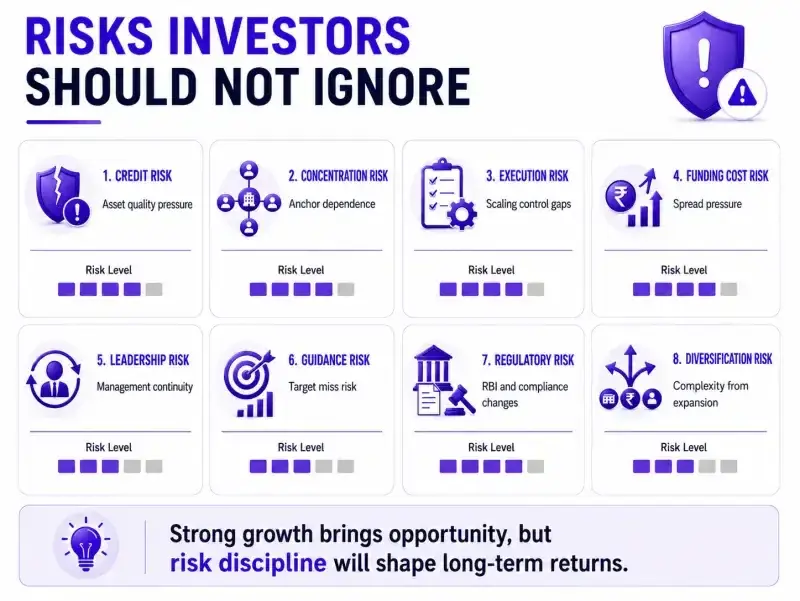
The first risk is credit risk. Even after the company has maintained nil NPAs so far, lending always carries risk. When the book grows, borrower stress, delayed payments, weak cash cycles, or sector slowdowns can affect asset quality.
The second risk is concentration risk. Supply-chain finance depends heavily on anchors and dealer networks. If a few anchors or sectors contribute a large share of the book, business risk can rise.
The third risk is execution risk. The company is scaling fast. Rapid growth in lending can sometimes create underwriting mistakes if controls do not keep pace.
The fourth risk is funding cost risk. NBFC profitability depends on borrowing cost. If funding costs rise or liquidity tightens, spreads can come under pressure.
The fifth risk is leadership transition risk. FY26 saw changes in senior management. While the company has indicated a smooth transition and strengthened leadership, investors should track continuity in execution.
The sixth risk is guidance risk. Management has shared progressive growth and profitability targets. If loan book growth, return ratios, or profitability fall short, market expectations may change accordingly.
The seventh risk is regulatory risk. An NBFC operates in a regulated environment. Changes in RBI rules, factoring regulations, capital requirements, or compliance norms can affect business operations.
The eighth risk is diversification risk. The company is exploring new financial services areas. These could create long-term opportunities, but entering new verticals without execution discipline can also create complexity.
Explore our Products
Research Framework

Emerging Titans
Combination of quantitative analysis, industry tailwinds, and management assessment - SPRINT investment philosophy

Tiny Titans
Heavy emphasis on scuttlebutt research, plant visits, and early on-ground signals
What Makes the Stock Worth Tracking
SG Finserve is worth tracking because it is operating in a niche that sits directly inside India’s working capital economy.
The company is not trying to build a broad consumer lending franchise. It is focused on supply-chain finance, where the need is large, the cycle is short, and the lending can be tied to actual invoices and anchor relationships.
FY26 showed strong growth in operating income, loan book, PAT, and disbursements. The business model has maintained nil NPAs so far. The company has a conservative leverage profile, strong capital base, growing bank lines, and a clear long-term growth roadmap.
The company also has optionality from factoring and possible future fee-based businesses.
But the company should not be treated as risk-free.
It is still a lending business. Asset quality, leverage, management execution, funding cost, credit discipline, anchor concentration, and macro conditions will decide long-term outcomes.
The story is attractive because the business is scaling.
The real test will be whether it can scale without damaging asset quality. That is why risk also becomes an important factor to watch.
What Investors Should Track Going Forward
Investors should track loan book growth, but they should not look at growth alone. They should check whether growth is coming with stable asset quality, disciplined underwriting, and controlled leverage.

They should track:
- Gross disbursements because this shows transaction velocity and platform activity.
- The average loan book because income is generated on the average book, not just the closing book.
- Nil NPA status and early overdue buckets because asset quality is the most important factor in lending.
- Cost-to-income ratio because operating efficiency is a key part of the profitability story.
- Leverage because growth funded with excessive leverage can become risky.
- Anchor concentration and sector concentration because the business depends on anchor-led relationships.
- Factoring growth because this can become a meaningful product extension.
- Funding cost and spreads because these directly affect profitability.
- Management execution because the company is in a fast-scaling phase and strong governance will be critical.
Conclusion
SG Finserve is a fast-scaling NBFC operating in a focused and important niche: supply-chain finance. FY26 showed strong growth in operating income, loan book, disbursements, and profitability, while asset quality remained clean.
The business is interesting because it sits inside India’s MSME and manufacturing ecosystem, where working capital demand can remain structurally strong. Its anchor-led, invoice-backed, short-cycle model gives it a differentiated position compared with many traditional NBFCs.
However, this is still a lending business. Investors should keep an eye on credit quality, leverage, funding cost, anchor concentration, regulatory developments, and execution as the company expands. The stock is worth tracking for but the investment decision should depend on valuation comfort, risk appetite, and the company’s ability to maintain asset quality while growing.
If you want a structured approach to evaluating companies like this, check out A Fundamental Checklist: How to Research a Stock in 1 Hour.
Want more such data-backed stock stories? Comment “Growth Stories” and keep following our research articles on India’s financial and industrial growth themes.
FAQs
Why does nil NPA matter for investors?
+Nil NPA shows that the company has maintained strong asset quality so far. For any NBFC, this is important because poor asset quality can hurt profits, capital, and investor confidence. However, investors should still track NPAs carefully as the loan book grows.
What should investors track every quarter?
+Investors should track loan book growth, gross disbursements, average AUM, NPAs, overdue accounts, cost-to-income ratio, leverage, borrowing cost, spreads, anchor concentration, and factoring growth. These numbers will show whether the company is scaling in a disciplined way.
Why is this business model different from normal lending?
+This model is different because the lending is usually invoice-backed, short-term, and linked to real purchases. The funds are often paid directly to the anchor company, which helps monitor end-use and reduce misuse of money.
Why is factoring important for future growth?
+Factoring can help the company finance receivables, which means businesses can get money earlier against payments they are supposed to receive later. This can strengthen the company’s supply-chain finance offering and create another growth opportunity.
What is supply-chain finance in simple words?
+Supply-chain finance is short-term funding given against actual business transactions. For example, when a dealer needs money to buy goods from a large corporate, the financier funds that purchase and earns interest or fees on the transaction.

High growth stock specialist, Value Educator
Shashank Mahajan is an equity research professional with over 12 years of experience in identifying high-potential SME and micro-cap stocks at an early stage. He follows a rigorous scuttlebutt research–driven approach, combining on-ground insights with deep financial analysis. Shashank specializes in uncovering under-researched and under-owned companies with strong management quality and long-term growth potential. Through disciplined research and early identification, he focuses on spotting tomorrow’s market leaders before they enter the mainstream investor radar.

Glenmark: The USD 700 Mn Cancer Deal and Its Brands

Pharma Stocks in India 2026: Generics, APIs and CDMOs

Granules India: From Paracetamol to a 65% Gross Margin

Natco Pharma: After Revlimid, 29 Patent Challenges

Shilpa Medicare: Cancer APIs, Films and Biosimilars

Alembic Pharma: US Plants Pay Back, Margin Hits 22.2%
Explore our Products
Research Framework
Emerging Titans
Combination of quantitative analysis, industry tailwinds, and management assessment - SPRINT investment philosophy
Tiny Titans
Heavy emphasis on scuttlebutt research, plant visits, and early on-ground signals



Modern Warfare to Multibaggers
Key Trends. Strategic Shifts. Opportunities Ahead.
Don't Miss This Exclusive Webinar!
Join Value Educator to decode the key trends shaping India's defence sector and learn how to identify tomorrow's potential leaders in the space.
- In-depth research on India's defence sector
- Live Q&A session
- Actionable takeaways for long-term investors

 Orders
 Subscription
 Share with friends


Required Details
₹23999.00
(12 month subscription)
As per SEBI regulations, all users are mandated to complete the KYC that is validated for 1 year. Post payment, you will be redirected to the KYC screen


No comments yet. Be the first to comment!