How a 91x Oversubscribed IPO Fell 30%, Promoters Bought More, and What Happened Next
 The IPO That Soared and Then Crashed — While Promoters Kept Buying
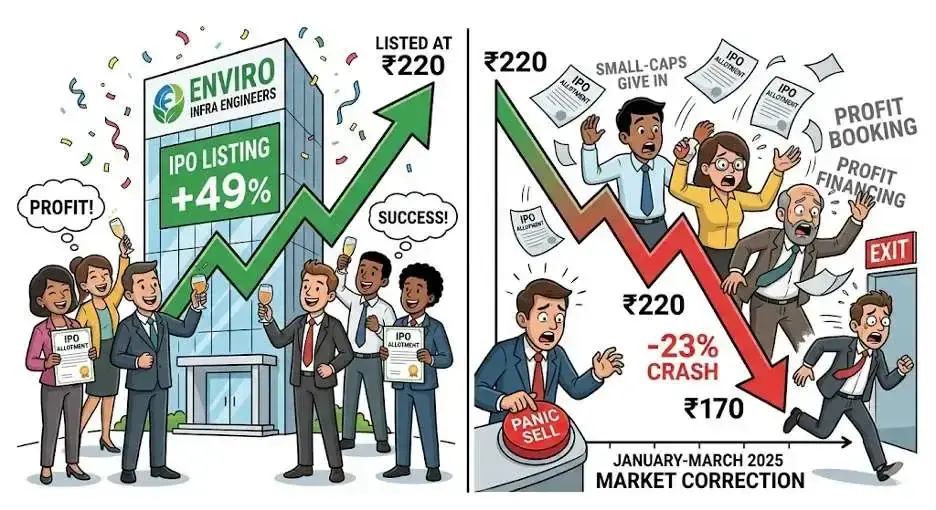
November 29, 2024. Enviro Infra Engineers listed on the stock exchanges with a bang. The IPO had been oversubscribed 91 times. Retail investors fought for allotments. The stock got listed at ₹220 on NSE, a stunning 49% premium over the issue price of ₹148. Investors who got allotments made instant profits. The media covered it as one of the year’s most successful debuts. Everyone was celebrating.
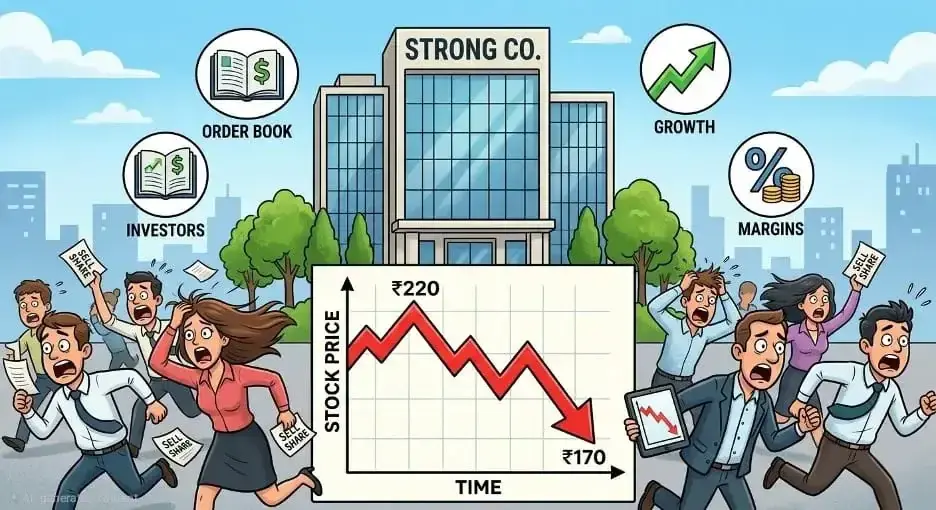
Then reality hit. The larger market began to correct in January 2025. Small and mid-caps, which had soared in 2024, started to give in. Profit booking intensified. By March 2025, Nifty dropped 12 percent compared to the peak. But small-caps fell much harder. Enviro Infra, despite being a strong business, wasn’t spared. The stock crashed from its listing price of ₹220 to ₹170 — a brutal 23% fall in just four months.
The same investors who made 49% gains on listing day were now sitting on losses. Panic selling started. Retail investors who bought on listing day exited at a loss. Mutual funds that participated in the IPO reduced their positions. The narrative changed from “water infrastructure champion” to “overvalued IPO that got caught in the correction.”
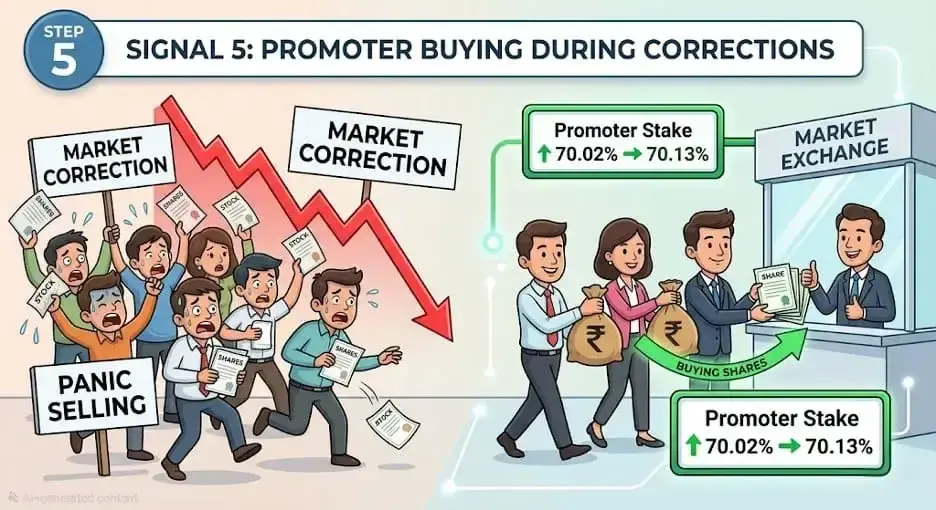
This is where the story gets interesting. While retail investors were selling and the stock was falling, something else was happening quietly. The promoters — Manish Jain, Ritu Jain, and Shachi Jain — were buying. Not token purchases. Real, material stake increases. Their ownership declined to 70.02% in December 2024 since it was 70.13 in December, 2025. They bought in their correction of the stock that had dropped to ₹180 levels compared to ₹220 levels. They bought when sentiment had turned negative. They bought when everyone else was selling.
This is the conversation most investors never have with themselves before they panic-sell during corrections. When a company has just completed a successful IPO, raised ₹572 crore in fresh capital, has an order book of ₹2,000+ crore providing two years of revenue visibility, and is backed by government infra spending — and the stock falls 25% purely due to market correction, not business deterioration — what does it tell you when promoters who already own 70% decide to buy more at lower prices?
It tells you they know something the market doesn’t. They know the business pipeline. They know the margins are improving. They know the government’s water infrastructure push isn’t stopping. And they’re backing that knowledge with personal capital when the stock is down, not when it was up 49% on listing day.
If you’ve ever sold a fundamentally strong stock during a market correction and watched it recover 50% within months, this case study will show you exactly why promoter buying during crashes is one of the most reliable signals in investing.
If you’ve ever wondered how to separate temporary price declines from permanent business deterioration, following informed insider buying is the answer. And if you’ve ever held an IPO stock through a brutal correction, wondering whether to sell or hold, understanding what the promoters are doing with their own money tells you everything you need to know. Because promoters don’t buy falling stocks to lose money. They buy because they can see around corners that retail investors can’t — and that information edge, combined with skin in the game, creates the most powerful signal in equity markets.
When promoters increase their stake in a stock that’s down 25% from its highs during a market crash, they’re not hoping. They’re calculating that current prices are absurd relative to business fundamentals.
Like this analysis? Get powerful insights like this every week. No spam.
1. The Business: Why Enviro Infra Matters Beyond the Stock Price
What the Company Actually Does
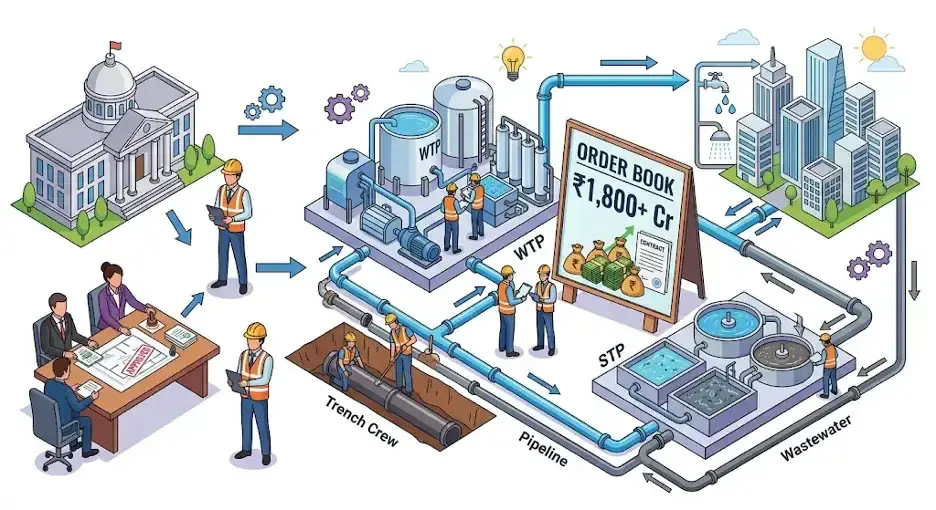
Enviro Infra Engineers isn’t a generic construction company. It’s a specialized EPC player focused exclusively on water and wastewater treatment infrastructure for government clients across India. The company designs, constructs, operates, and maintains sewage treatment plants, water treatment plants, and water supply schemes.
This narrow focus creates a moat — it operates in a niche requiring technical expertise in water treatment engineering and regulatory approvals that take years to build. As of September 2025, Enviro Infra has an order book of ₹1,800 crore, providing two years of revenue visibility, plus pending bids worth over ₹8,000 crore where results are awaited.
The financials show explosive but sustainable growth. The revenue has increased by 62 percent, with a five-year CAGR, between ₹179 crore in FY20 and ₹1,111 crore in FY25. The net profit increased at 102% CAGR, between ₹16 crore and ₹208 crore. Return on Equity averaged 34%, and Return on Capital Employed averaged 45%.
The margin profile is impressive for infrastructure EPC — EBITDA margins run at 22-24%, significantly higher than the 12-15% typical of general construction. This premium comes from technical complexity, recurring O&M contracts providing annuity income, and government clients paying on time under flagship schemes.
What separates Enviro Infra from its peers is its execution track record and in-house capabilities. The company has delivered 26 water projects, with 20 being large projects above 10 MLD capacity. It has an in-house team of 180 engineers covering design, process engineering, and project management. The ability to design zero liquid discharge systems and engineer customized treatment solutions creates genuine barriers to entry.
The government tailwind is structural — India’s water crisis requires multi-decade investment. Jal Jeevan Mission has ₹60,000 crore to spend, AMRUT 2.0 has ₹2.77 lakh crore in the next decade to be spent and Namami Gange has ₹20,000 crore to be spent on sewage treatment.
“Price is what you pay. Value is what you get. And during corrections, the gap becomes a gift.”
— Warren Buffett (adapted)
2. The Crash: What Happened Between November 2024 and March 2025
When Euphoria Turned to Panic
The textbook case of high bull market excitement in high-quality small-cap infrastructure investment was the Enviro Infra IPO in November 2024. The problem was listed at a price of ₹140-148 per share. Aggressive bidding by retail investors is done on a firm with high financial status, government-sponsored books of orders, and exposure to a thematic industry with multi-decade tail winds. The IPO was oversubscribed 89.9 times in the total retail portion, 24.48 times in the QIB portion, and 157.05 times in the HNI portion.
This was not unreasonable enthusiasm over a loss-making start-up. Shareholders were paying 25-28x trailing 12 months earnings of a company whose revenues are increasing at 60%+ and profits at 100%+. At ₹148, the price was skeptical but acceptable considering the growth history and industry tailwinds.
The listing day delivered exactly what investors hoped for. Shares opened at ₹220 on NSE, a 49% premium. Investors who got allotments made instant gains. The grey market premium before listing had been around ₹57, so the actual listing premium of ₹72 exceeded even optimistic expectations. For the next two weeks, the stock held around ₹210-220 levels as the listing euphoria sustained. The market was still in bull mode.
New highs were almost being hit each day by small and mid-caps. Those who had not participated in the IPO allotment were trading at the secondary market at ₹210-215 with a readiness to overpay since they felt that the growth story was to make even higher valuations. However, underneath the water, the larger market was cracking. By December 2024, FII selling had stepped up because the global interest rates remained intact higher than expected. Evaluations in small and mid-cap had been stretched to their limits in 2021 and then corrected itself. Nifty Smallcap 250 was valued at 25x P/E which is way higher than the 10 years average of 18x. Something had to give.
The correction started gradually in January 2025 and accelerated through February and March. Nifty fell 12% from its January peak. But small and mid-caps, which had outperformed on the way up, got hit much harder.
Nifty Smallcap 250 fell 22%. Nifty Midcap 150 fell 18%. Stocks that had listed with huge premiums in late 2024 got sold off aggressively as retail investors who bought at peaks panicked and exited. Enviro Infra wasn’t spared. Although the business fundamentals did not change as the company kept winning new orders, recording high quarterly figures, and projecting 25-30% revenue growth in FY26, the stock dropped by 220 to a minimum of 170 at the beginning of March 2025. That's a 23% crash in four months. Investors who bought on listing day at ₹210-215 were down 20-25%.
Even IPO allottees who didn’t sell on listing day saw their 49% gains shrink to just 15%. The narrative had completely flipped. Media articles questioned whether the IPO was overpriced. Analysts who had recommended “buy” at ₹220 now rated it “hold” at ₹180. Retail selling intensified. Mutual funds trimmed positions to manage redemptions.
The most important thing to know about this correction is that there was nothing fundamentally different about the business of Enviro Infra. The order book did not fall, and, on the contrary, it improved as new contracts were secured in the 4th quarter of FY25. Margins were not shrinking - they were at a 22-23 level of EBITDA. Revenue and profit growth outlooks were not downgraded - management repeated 25-30% topline growth and 35-40 profit growth in FY26. Annan government initiatives that support the order pipeline AMRUT 2.0, Jal Jeevan Mission, and Namami Gange were not cancelled or defunded.
So why did the stock fall 23%? Pure market sentiment. Small and mid-caps were correcting across the board. Stocks that had rallied 100-150% in 2024 were giving back 25-30%. High-beta names with stretched valuations got hit hardest. Enviro Infra, having listed at a 49% premium just months earlier, was seen as expensive and got sold indiscriminately. This is the reality of equity markets — sentiment drives short-term price moves far more than fundamentals. And this is exactly when promoter buying becomes the most valuable signal.
“Be fearful when others are greedy, and greedy when others are fearful. And watch what insiders do when fear dominates.”
— Warren Buffett
Be part of the
Value Educator
community
Get exclusive insights tailored to
sharpen your investment decisions.
3. The Promoter Response: Why They Bought When Everyone Else Sold
Skin in the Game at Maximum Fear
While retail investors were panic-selling and the stock was crashing from ₹220 to ₹170, the promoters of Enviro Infra were doing something very different. They were buying. The shareholding data tells the story clearly. As of December 2024, right after the IPO, promoter holding stood at 70.02%. By December 2025, after a year that included a brutal 4-month correction, promoter holding had increased to 70.13%.
That’s an increase of 0.11%, which might sound small until you calculate what it means in absolute terms. At a market cap of ₹2,700 crore, a 0.11% stake increase represents approximately ₹3 crore worth of shares bought in the open market. For a company where promoters already owned 70%, deploying another ₹3 crore of personal capital to increase stake during a period when the stock was down 20-25% from peaks is a significant signal.
The timing of these purchases is what makes them so revealing. The promoters didn’t buy on listing day when the stock was up 49%, and euphoria was at its peak. They didn’t buy when the stock was at ₹220, and momentum was strong. They bought during the correction between January and March 2025, when the stock fell from ₹210 levels to ₹170-180 levels. These were open market purchases at market price, meaning the promoters paid exactly what any retail investor would pay and took exactly the same risk.
There was no preferential allotment at a discount. No complex derivative structure providing downside protection. Just straight purchases of shares when sentiment was terrible, and the stock was falling. This is the gold standard signal in promoter buying — large enough to be material, timed during a correction, executed in the open market at market price, and done by promoters who already owned a dominant 70% stake and had no obligation to buy more.
Why would promoters who already own 70% of a company choose to increase their stake during a market correction? The answer reveals their conviction about business fundamentals versus market pricing. Promoters have access to information that retail investors don’t. They see the monthly order wins before they’re announced.
They know which ₹8,000 crore worth of pending bids are likely to convert and which aren’t. They know if margins are improving or facing pressure from raw material costs. They know if government payments are coming on time or getting delayed. They know if the company’s competitive position is strengthening or weakening. When they choose to deploy personal capital to buy shares during a crash, it means one thing — they believe current prices drastically undervalue the business, given what they know about the pipeline, margins, and sector outlook.
In the case of Enviro Infra, the promoters were buying at ₹170-180 as they had a comprehensive view of an order book which would give them two years of revenue, pending bids worth ₹8,000 crore and government schemes which would allocate ₹60,000+ crore of water infrastructure in the next 3-5 years. They could estimate that at ₹170, the stock was trading at about 15-16x FY26 estimated earnings of a growth rate of 30+ and an EBITDA margin in the 22+ and multi-year revenue visibility. That is an interesting risk-reward, particularly in the case you are familiar with the business.
The alternative scenario — if promoters had NOT bought during the correction — would have been far more concerning. Imagine if the stock fell 25% and promoters did nothing. Or worse, if they had sold shares to “diversify personal holdings” as some promoters do after IPOs. That would signal they either don’t have personal liquidity to deploy, or they’re not confident enough about near-term business prospects to put more capital at risk.
Neither interpretation is bullish. But when promoters increase stake during a correction, especially after an IPO when they’ve already raised capital and monetized partially through offer-for-sale, it’s a clear vote of confidence. They’re telling the market — “We just raised ₹572 crore in fresh capital for the business, we partially monetized through OFS in the IPO, and despite that, we’re now buying back shares with personal money because we think they’re cheap.” That’s a signal you ignore at your own peril. History shows that promoters who buy their own stock during corrections are usually right about the recovery, even if the exact timing is uncertain.
“In the short run, the market is a voting machine. In the long run, it’s a weighing machine. And promoters vote with their wallets.”
— Benjamin Graham (adapted)
4. What Happened Next: The Recovery and Lessons
From ₹170 to ₹290 in 12 Months
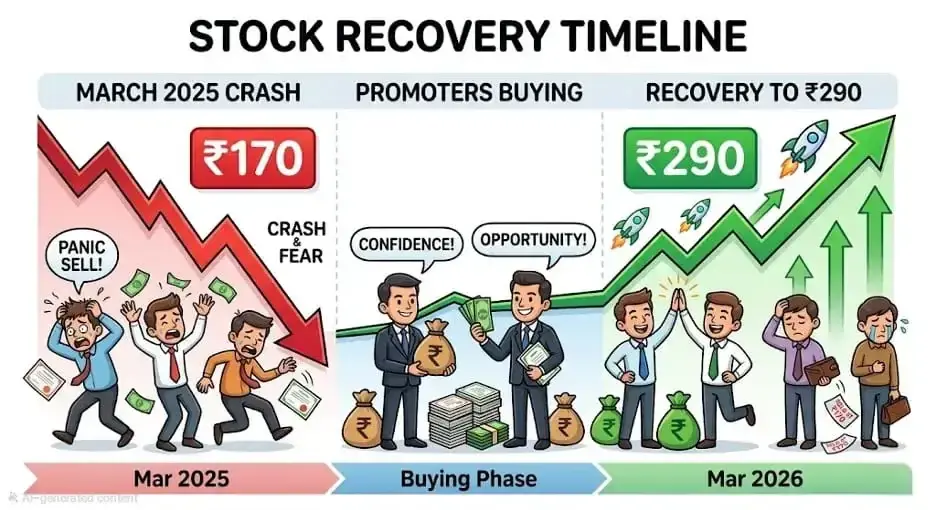
After bottoming out at around ₹170 in March 2025, Enviro Infra began a gradual recovery. By May 2025, the stock hit ₹195-200. By July, it crossed ₹220, back to listing levels. By September, it touched ₹250, a new high. As of March 2026, the stock trades around ₹280-290, representing a 65-70% gain from the March low of ₹170.
Investors who followed the promoter buying signal and bought between ₹170 and ₹185 made 55-65% returns in 12 months. IPO allottees at ₹148 are up 90-95%. But those who bought euphoria at ₹215 on listing day panicked during the correction and sold at ₹180, locked in permanent 15-20% losses.
It was not only sentiment improvement that motivated a recovery. The company fulfilled commitments. Q1 FY26 revenues increased by 28%, and profit increased by 35 percent, which is precisely as indicated. The business has reported three more order wins of ₹450 crore and an order book of ₹2,100 crore. The outcome of a number of big pending bids has been given, and Enviro won ₹1,200 crore in new contracts by August 2025.
Margins held steady at 23% EBITDA despite input cost inflation, proving pricing power. The O&M business providing recurring revenue grew to ₹95 crore annual run-rate, up from ₹70 crore.
Sector tailwinds occurred as anticipated. Union Budget 2025 announced that AMRUT 2.0 and Jal Jeevan Mission funding will be increased by ₹15,000 crore for sewage treatment. States have declared high tenders in the amount of more than ₹25,000 crore. The stress on the water supply caused by climate change forced the emergence of wastewater treatment projects. The industry estimates indicated that the market would increase to ₹1,50,000 crore in 2030 compared to ₹80,000 crore per annum in 2024.
The key lesson: promoter buying during crashes works because they have information advantages and long horizons that retail investors lack. When the stock crashed 25%, retail saw only a price decline and panicked. Promoters saw order pipeline, margin trajectory, and sector outlook. They calculated ₹175 for a business with a ₹2,000 crore order book, 30% growth, 23% margins, and a multi-year government demand was a gift. They waited 12-18 months for the market to recognize this.
“The stock market transfers money from the impatient to the patient. And from those who ignore insider signals to those who follow them.”
— Warren Buffett (adapted)
Join 1,45,000+ investors discovering under-researched small caps before they rerate.
5. How to Apply This Framework to Other Stocks
The Practical Checklist for Following Promoter Buying
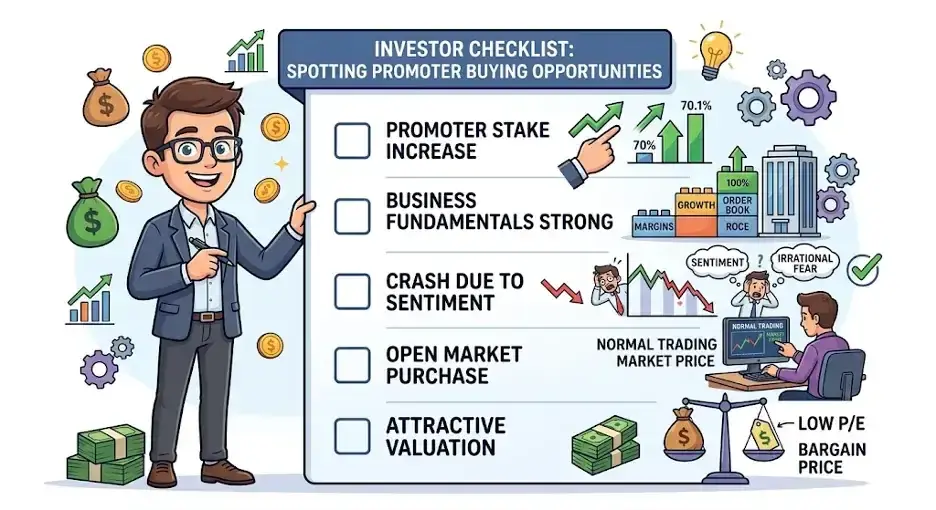
The Enviro Infra case study provides a template for using promoter buying signals during corrections. Here’s the systematic framework to apply to other stocks when the next correction arrives.
First, verify the size and nature of the purchase. Enviro Infra promoters owned 70% before buying more. Increasing to 70.13% meant deploying ₹3+ crore at ₹170-185 when the stock was down 20%. For promoters who just completed an IPO, choosing to buy back shares with personal capital during a correction is a strong signal. Verify the purchase was open market at market price, not preferential allotment. Enviro promoters bought in the open market, paying the same price any retail investor would pay.
Second, determine the business fundamentals so that the cause of decline was not deterioration-driven, but sentiment-driven. During the correction, the order book of Enviro increased. Margins held steady. Guidance remained intact. Government plans to support the pipeline were not scrapped. It was just an overall small-cap dumping following a good IPO crash. This is a tremendous contrast compared to situations where firms will lose key contracts, margins shrink, or industries experience regulatory backlash. You should never fail to cross-check current quarterly performance and industry trends whenever you observe promoter buying during crashes.
Third, compare the valuation at the promoter purchase price. Enviro promoters were buying at ₹170-185, translating to 15-17x FY26 earnings. For a company growing at 30% with 23% margins and government-backed visibility, that valuation was attractive versus the IPO price of ₹148 (25x trailing earnings) and peers trading at 22-28x. The promoters weren’t buying expensive stock hoping for multiple expansion — they were buying quality growth at a reasonable multiple during a temporary selloff.
Fourth, look for confirmation from business execution in quarters following the promoter purchase. Enviro delivered exactly what management guided — 28% revenue growth, 35% profit growth, new order wins, and stable margins. Track quarterly results for 2-3 quarters after spotting promoter buying. If performance matches or beats expectations, the signal was genuine. If it disappoints, exit.
“An investment in knowledge pays the best interest. And knowledge from insiders who have skin in the game pays even better.”
— Benjamin Franklin (adapted)
Market Cap focus
No. of ideas in a year
Holding period
Pricing

Emerging Titans
Combination of quantitative analysis, industry tailwinds, and management assessment - SPRINT investment philosophy
Multi Cap
20-25
3+ Years
Rs. 23,999/year

Tiny Titans
Heavy emphasis on scuttlebutt research, plant visits, and early on-ground signals
Exclusively for SME's
15-20
3+ years
Rs. 31,999/year
Conclusion
Most retail investors sell during market corrections because they focus only on price — their stock is down 25%, fear dominates, and they exit to “protect capital.” Meanwhile, the promoters who know the business inside-out, who see the order pipeline and margin trajectory that won’t show up in financial statements for two more quarters, who understand that government infrastructure spending isn’t stopping just because Nifty fell 12% — these insiders are buying shares with personal money at prices they calculate are absurd relative to business value. This information asymmetry is what creates wealth transfer during every market cycle.
The Enviro Infra case study isn’t unique or lucky. It’s a pattern that repeats in every correction across dozens of stocks. Fundamentally strong businesses with solid order books, healthy balance sheets, and sector tailwinds see temporary price crashes during broad market selloffs. Retail investors panic and sell. Promoters who have access to better information and longer time horizons buy. Twelve months later, the business delivers exactly what management knew it would deliver, the stock recovers to fair value or above, and those who followed the insider signal capture the entire recovery while those who sold during panic lock in permanent losses.
Understanding this pattern doesn’t require you to become an insider or work in the industry. It requires you to pay attention to what insiders are doing with their own money, verify that business fundamentals are intact, and have the patience to wait 12-18 months for the market to recognize what insiders already knew. The hard part isn’t the analysis — it’s controlling your emotions during the crash period when your portfolio is down and everyone around you is panicking. This is why having a systematic framework helps. Track promoter disclosures. Verify purchase size and nature. Check business fundamentals. Assess valuation. Buy if everything checks out. Then hold with conviction because you’re piggybacking on insider knowledge, not hoping and guessing.
The next market correction will come — it always does. Small-caps that rallied hard will give back 25-35% in a matter of weeks. Retail investors will panic and sell quality businesses at beaten-down prices. And somewhere in that chaos, promoters who know their businesses intimately will be buying shares in the open market with personal capital. Those disclosures will appear on stock exchange websites. Most investors will ignore them, distracted by the fear and red on their screens. But those who track these signals systematically, verify the fundamentals, and buy alongside insiders will position themselves to capture the recovery that always eventually follows. That’s how long-term wealth gets built in equity markets — not by timing the exact bottom, but by following informed insiders when prices disconnect from value.
FAQs
Was Enviro Infra’s correction an overreaction or justified by fundamentals?
+
It was a pure sentiment-driven overreaction. The business fundamentals didn’t change — order book grew, margins held, guidance remained intact, and government schemes continued funding. The stock fell 25% because the broader small-cap index fell 22%, and recent IPOs with listing premiums got hit hardest. This is exactly the scenario where promoter buying becomes most valuable — when price disconnects from fundamentals due to indiscriminate selling.
How do I track promoter buying in real time for stocks I own?
+
Check BSE/NSE websites under “Corporate Announcements” for each company. Set up Google Alerts for “[company name] promoter stake increase.” Use stock screening platforms like Screener.in or Trendlyne that have filters for recent changes in promoter holding. During market corrections, manually scan major companies’ announcements daily for 2-3 weeks to catch the biggest signals. Follow active investors on social media who share these disclosures in real time.
Should I have bought Enviro Infra immediately when I saw promoters buying?
+
Not necessarily immediately, without doing your own research. The promoter buy is a signal to pay attention and investigate, not a blind buy signal. First, verify the business fundamentals are intact. Check if the stock price decline was due to sentiment or deterioration. Assess valuation at current levels. Then buy if everything checks out. In Enviro Infra’s case, anyone who researched after seeing the promoter buying would have found a solid order book, intact guidance, and reasonable valuation — that’s when you buy.
Before acting on insider signals, investors should evaluate the company’s fundamentals systematically. Use this framework: A Fundamental Checklist: How to Research a Stock in 1 Hour
What if promoters are increasing their stake but also pledging shares?
+
That’s a major red flag that changes the entire signal. Enviro Infra promoters increased their stake without pledging, meaning they used personal liquidity to buy shares. If promoters are simultaneously increasing stake AND pledging those shares (or increasing pledging percentage), it suggests they’re buying with borrowed money or using shares as collateral. That’s not genuine conviction — it’s financial engineering. Always check quarterly pledging disclosures alongside promoter buying announcements.
Can this framework work in large-caps or only in small/mid-caps?
+
The framework works across all market caps, but the signal is often stronger in mid and small-caps because promoters in these companies have more direct business knowledge and concentrated ownership. In mega-cap companies where promoters own 20-30%, a 0.5% stake increase might not carry the same conviction as it does in a mid-cap where promoters own 60-70%. But large-cap examples like Mukesh Ambani buying ₹500 crore of Reliance during the COVID crash show the signal works everywhere when it’s material and well-timed.
How long should I hold after buying based on the promoter signal?
+
At least 12-18 months unless business basis wastes. Promoter purchasing in the crash indicates the medium-term belief, but not day trading. Enviro Infra took 12months to recover from ₹170 to ₹290. The process of recovery will vary depending on the time the larger correction will take, and also the speed at which the business can show performance. Measures monthly or quarterly results to ensure that performance is as expected, though it allows it to run a minimum of 3-4 quarters to be realized.
About the author

Shashank Mahajan
High growth stock specialist, Value Educator
Shashank Mahajan is an equity research professional with over 12 years of experience in identifying high-potential SME and micro-cap stocks at an early stage. He follows a rigorous scuttlebutt research–driven approach, combining on-ground insights with deep financial analysis. Shashank specializes in uncovering under-researched and under-owned companies with strong management quality and long-term growth potential. Through disciplined research and early identification, he focuses on spotting tomorrow’s market leaders before they enter the mainstream investor radar.
Join 1,45,000+ investors discovering under-researched small caps before they rerate.






 Orders
 Subscription
 Share with friends


No comments yet. Be the first to comment!