
HFCL: Riding the AI Infrastructure Boom

With investors piling into GPUs and AI software, is the fiber, connectivity and defense infrastructure supporting the next decade of digital growth being overlooked?
For the last two years nearly every conversation related to technology has been centered on AI. It's natural then, that nearly all attention has been placed on the companies building AI models, designing cutting-edge chip sets and constructing gargantuan data centers. Those companies, after all, are the visible face of the AI revolution.
But strip away the veneer and something else quickly appears.
AI generates massive amounts of data, and every prompt, every calculation, every cloud application, and every digital service depends on moving data from one location to another, the faster the AI grows, the more critical that movement becomes. That's where an often overlooked, yet vitally important element of the tech stack comes in. Connectivity. The increased computing power fueled by AI requires much more capacity from a networking perspective than previous generations of data centers have needed. With increased compute power has come increased fiber optic demand, in some cases connectivity is becoming every bit as important as compute.
What is particularly interesting about the current environment is that demand for fiber infrastructure has been increasing at a very rapid rate while supply has not kept pace. Manufacturing facilities take years to scale, critical raw material supply is restricted and expertise is held by a very small pool of firms. It's an environment which is set to significantly benefit existing manufacturers with economies of scale, customer relationships and the execution capability that already exists.
One Indian company has been quietly building out its position to capture exactly this. It's just a few years ago that this company was mostly known as a telecom infrastructure provider; today it appears dramatically different.
The order books of the company are ballooning; the order books currently stand over 21,000 crore.The company is investing in ramping up manufacturing capacities, backward integration, boosting exports, and moving toward higher-margin products.
Along with these, the company is focusing on increasing its presence in defense electronics, aerospace systems, communication equipment, radars, and drone detection.
What is noteworthy is that the company is tapping into more than one growth story.
The company is linked with multiple growth trends at the same time: AI infrastructure, data centers, cloud computing, 5G rollout, broadband deployment, defense modernization and domestic manufacturing.
Many investors typically recognize these trends once the revenue and earnings show signs of these. As of now most discussion is centered around AI software and semiconductor companies. In the meanwhile, some businesses which cater to the infrastructure of this growth have still not captured attention.
One of them is HFCL.
The company will be able to tap into these opportunities or not depends on the execution of the business. However, it is evident that the company is present in many future oriented business trends.
The Business Model: Why HFCL Is No Longer Just a Telecom Company
From Telecom EPC Contractor to Technology Infrastructure Company"One of the biggest mistakes investors make is thinking based on what it was, not on what it is going to be". For long HFCL was primarily known as Telecom EPC contractor and this perception lingers. However, the company as it stands today is very different from the one that investors may remember. It has transformed over the years into a diversified technology infrastructure company operating across:
Optical fibre, Optical Fibre cables, Telecom equipment, Networking solutions, Defence electronics, Data center connectivity, Passive connectivity solutions, Digital infrastructure projects.
This did not happen overnight; it was a long drawn process where management built manufacturing prowess, robust product portfolio, export reach and less reliance on EPC. Today it caters to telecom, enterprise, governments, defense and increasingly data centers as well. The annual report suggests strong focus on high-end telecom & defense equipment, optical fiber & cable, connectivity solutions and expansion of geographical reach.
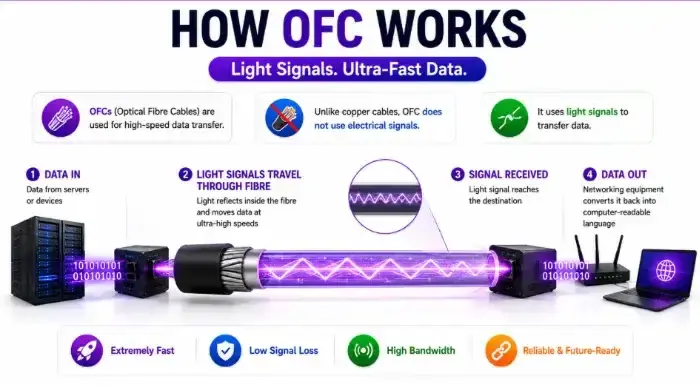
This diversification matters because infrastructure cycles can be unpredictable.
When one business segment slows down, another segment can provide stability.
A company dependent on a single revenue stream often struggles during industry downturns.
A company participating across multiple growth themes has more ways to win.
The Multibagger Framework: A Step-by-Step Guide to Finding 10x Stocks
HFCL's strategy increasingly resembles a platform business built around connectivity rather than a pure telecom contractor.
And that distinction could become important over the next decade.
Because connectivity itself is becoming more valuable.
“You can't build a reputation on what you are going to do.” — Henry Ford
The AI Infrastructure Opportunity: Why Connectivity Is Becoming the New Bottleneck
The most ignored part of the AI story in investors’ view is the one that supports all other components.The connectivity infrastructure.
When you talk about AI infra, the mind of investor goes directly to GPUs.
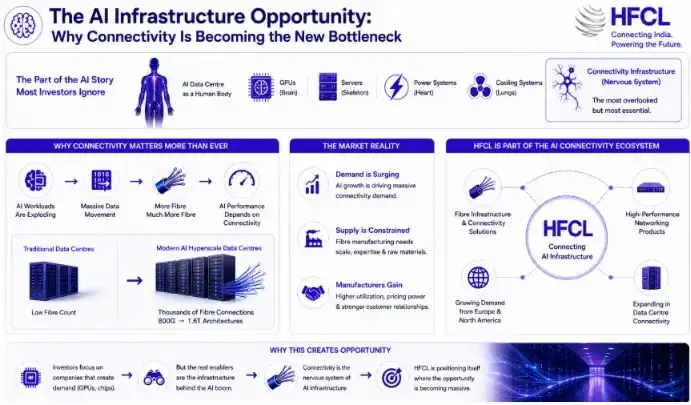
And this is quite understandable, GPUs are the most expensive part of an AI data center, and easy to spot. But the truth is: If you imagine an AI data center as a human body, where the GPU is the brain, servers is the skeleton, the power infrastructure is the heart, and cooling is the lungs, what would be the nervous system? It has to be the connectivity infra. No nerves, no signals can go between the brain and the rest of the body. Similar to an AI data center without proper connectivity infra, even the most complex AI cluster will be of no use. Data needs to flow continuously from server to server, CPU, storage systems, or network device to processor. And as the complexity of AI loads are increasing, the amount of data flow inside data centers is already becoming an explosion. This leads to a simple but very powerful solution: More fiber, Much more fiber. While the typical data centers rely on low count of fibers, the latest AI driven hyperscale data centers require thousands of fiber connections, and it is necessary that data flows fast between these GPU clusters. As network speeds are progressing towards 800G, 1.6T, etc., there is a huge demand of optical fiber connections rather than being a luxury. This is the major reason why many tech infrastructure companies are already pushing their capacities to the level of their best. The market is starting to acknowledge that the growth of AI is not just a story about semiconductors, but it is also a story about the connectivity, where HFCL is already present directly in the ecosystem.
How GDP Growth Impacts Corporate Earnings and Stock Markets
The company has expanded its presence in fibre infrastructure and connectivity solutions while also strengthening its position in high-performance networking products. During FY25, management highlighted growing demand from Europe and North America, entry into data centre connectivity through high-fibre-count cable infrastructure, and continued investment in manufacturing capabilities.
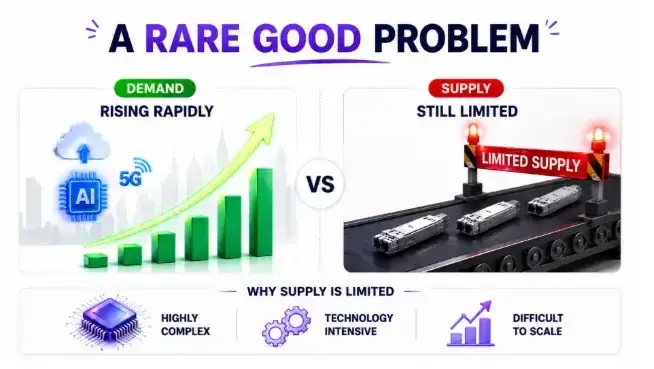
What's particularly interesting is that demand growth is occurring at a time when supply remains constrained.
Optical fibre manufacturing requires specialized technology, scale, expertise, and access to critical raw materials.
Capacity cannot be created overnight.
When demand rises faster than supply, existing manufacturers often gain pricing power, stronger customer relationships, and better utilization levels.
Investors frequently focus on the companies generating demand.
Sometimes the more interesting opportunity lies with the companies supplying the critical infrastructure.
And that is precisely where HFCL appears to be positioning itself.
Company Transformation.
This Is Not the HFCL you know. If you're thinking HFCL still works as it used to-as a conventional telecom EPC player-you're not seeing the current entity. Five years ago HFCL business was more concentrated around government tenders, public sector work and project-specific telecom infrastructure assignments. While a solid model, these businesses tend to have lower margins, delayed payments, and limited scope to scale.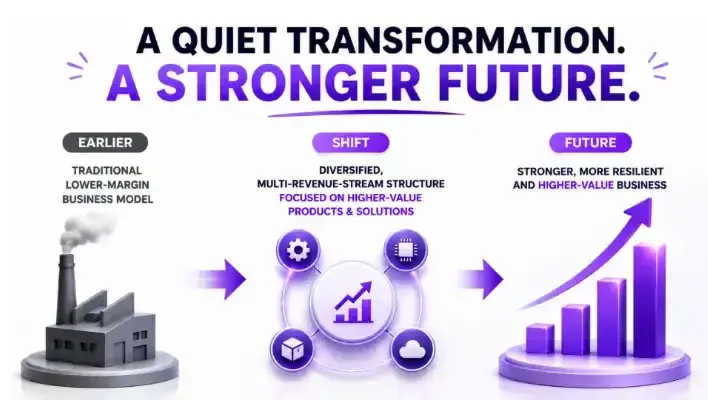
However the business has made significant changes to its strategy over the years without being loud about it.
Today HFCL depends far less on government supported projects and has greater focus on products, technology solutions, exports and customers from private sectors. Its mix of business has gradually moved away from projects, domestic opportunities and one-time execution to products, international markets and building technological relationships of a sustained nature.
While these shifts appear less pronounced, they will have major consequences as products business have better margins, international business has greater opportunities of expansion and private sectors have faster decision making and more certain cash generation cycle. Consequently HFCL is now a much stronger, diversified and quality business than in its earlier days and it is showing up in its financial numbers as it continues on its current journey.
So what does this translate into in practical terms?
Simply put, HFCL is deriving more value out of its business. Product sales, exports and private customers have better margins and economics as compared to standard domestic EPC business and products.
This effect is already evident with EBITDA margins improving to 17% and management aiming for 20% in the next couple of years.
The 17% to 20% margin expansion may not appear much in the first sight, but at the current scale of HFCL, even a few percentage points of margin expansion can bring in substantial profit increase and more importantly, the trend is moving on the right side.
While, investors may still be focusing on demand growth, for optical fibers today, it may be more exciting to be on the supply side and the deficit that exists on the supply side.
How to Find a Company's True Growth Engine
Order Book & Financial Performance
The Order Book That Changed the StoryOne number stands out immediately: HFCL's order book has grown from ₹6,776 crore in FY24 to ₹21,200 crore in FY26. That's more than three times larger in just two years.
But the size of the order book is only part of the story.
What's even more important is the quality and duration of these orders. Projects that were once executed over 12–18 months are now increasingly spread across 3–5 years. The ₹10,159 crore hyperscaler order, for example, will be executed over five years, providing long-term revenue visibility and a more predictable business outlook.
The mix of orders also tells an important story. Optical Fibre Cables (OFC) account for ₹13,483 crore, representing nearly two-thirds of the total order book. This is significant because fibre remains one of the strongest areas of global infrastructure demand, and it is also where HFCL has built deep expertise and manufacturing scale.
Perhaps the biggest validation is the hyperscaler order itself. Winning business from some of the world's largest data centre operators demonstrates that HFCL is no longer competing only in domestic telecom projects it is increasingly becoming a trusted supplier in the global digital infrastructure ecosystem.
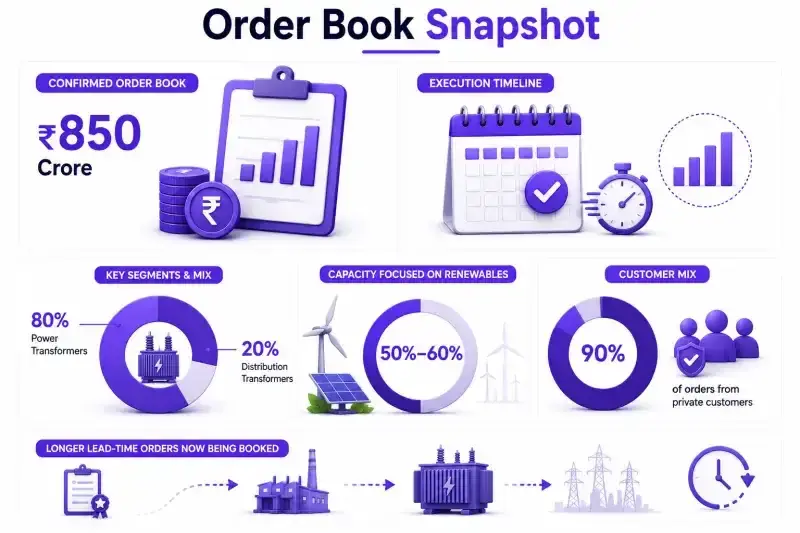
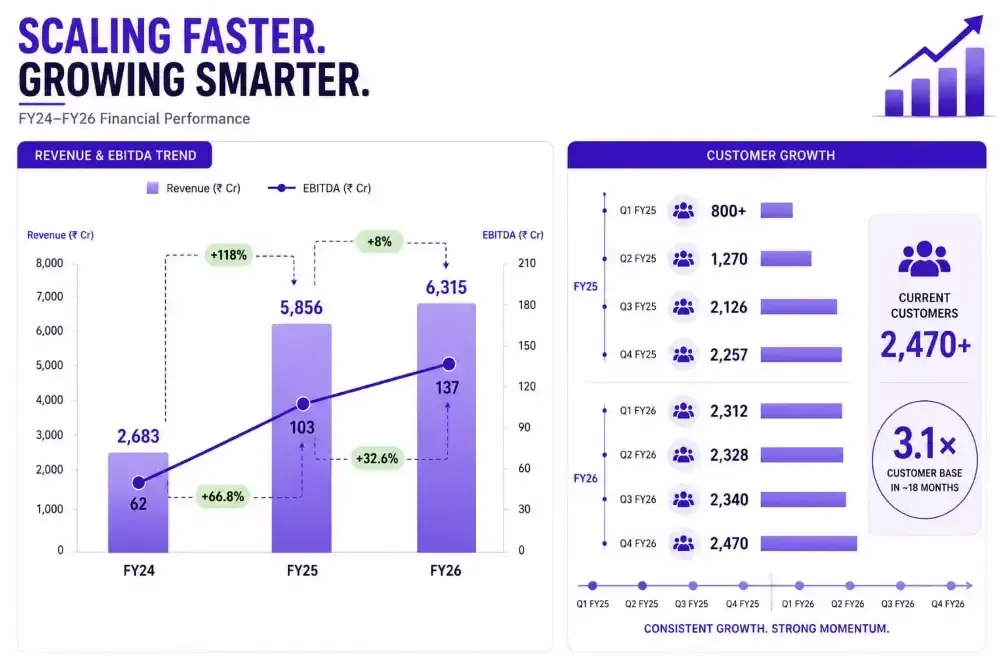
Here's a breakdown of your document with the critical numbers summarized:
Full year (FY26 v FY25)
Revenue up from 4065 Cr to 4949 Cr (+22%), the real news is profit, with EBITDA more than doubled from 507 Cr to 827 Cr and PAT also more than doubled from 173 Cr to 329 Cr (+90%).
The fourth quarter, the breaking quarter (Q4 FY26)
This has been a game-changing quarter with revenue jumping to 1824 Cr (v 801 Cr in Q4 FY25, a 128% growth year-on-year) while the EBITDA margin, recovered significantly to 18.47% from -2.79% in the same quarter last year. PAT stood at 184 Cr (v loss of 83 Cr last year)
Order book, the most critical number.
Two years, and order book increased by more than 3 times to 21206 Cr from 7685 Cr (FY24). The key number here is the 58% share in the total book from exports, with a USD 1.1 Bn single order from a hyperscaler accounting for almost half.
Business Mix transformation
From 42% to 62% in Products, 11% to 41% in Exports, 74% to 16% dependency on government customers, three numbers tell the story.
One thing to watch: The company is targeting EBITDA margins of ~20%, and Q3 FY26 briefly touched 20.11% before slipping slightly to 18.47% in Q4 — worth monitoring whether margins hold as execution scales up.
“The stock market is a device for transferring money from the impatient to the patient.” — Warren Buffett
The Hidden Growth Engine
Defense: The Opportunity Most Investors Are Missing Whilst most investors focus on HFCL’s optical fibre segment, a second opportunity is developing steadily on the backend – defense electronics. The defense division is by no means an experimental segment; HFCL has established presence in radars, communication radios, electro-optic systems, drone detection, foliage penetration radars among others. To fortify this segment HFCL made two strategic acquisitions – Raddef and Defsys. Defsys will be instrumental in a key sense of the two acquired segments. With a long lead-time for any certification for entry into the aviation and defense segment (which typically takes 5-7 years), acquisition of an already certified segment by HFCL can circumvent years of obtaining requisite licenses. Apart from a robust backlog of orders of ~1,680crore in both export and domestic orders in both segments acquired (Raddef and Defsys combined), acquisition of defense has accelerated the company’s foray into high-value defense programs. The segment is the company's second biggest growth driver, though still overshadowed by the fiber division for now.
“The best way to predict the future is to create it.” — Peter Drucker
The electronic fuzes opportunity is particularly niche and powerful. India requires approximately five lakh fuzes annually. Currently, there are almost no private Indian manufacturers. HFCL is positioning itself to fill that gap — a category with near-zero domestic competition and government-backed demand.
“The big money is not in the buying and selling, but in the waiting.” — Charlie Munger
Moving up value chain.
From Cables Maker to Connectivity Platform
The winners in connectivity, haven't only been making cables; companies like Corning, CommScope, Prysmian etc have moved up value chain from manufacturing and built the entire connectivity ecosystem. It seems HFCL is already on the same route.
It is steadily climbing up the value chain through diversification into data-center interconnects and Passive Connectivity Solutions(PCS). One of these divisions will generate about 500cr of revenue by FY27, more significantly builds upon HFCLs manufacturing competencies but will generate higher margins as compared to the conventional cable products.
On the telecom equipment front, the company is moving at good pace. It is the first Indian manufacturer to design and commercially deploy their indigenous 5G Fixed Wireless Access(FWA) product.
The response has been good, four-lakh odd units shipped in the first year alone is testament to not just being a proof of concept but a commercial viable product with real market demand. Combined these moves would take the company from just making cables to becoming a connectivity solution provider, creating new revenue streams and addressing an ever expanding market.
The logic of value chain - extended
Cables. Connectivity solutions. Complete systems. Each upward step adds margin, cements customer relationships, and entrenches HFCL.
Step 1: Cables (where HFCL began)
A cable is a commodity. You bid for the job at one price, a rival bids lower, and the customer leaves. There's no customer lock-in, no switching costs, no relationship. Only the lowest cost is a competitive variable. Hence, the low margin and cyclicality inherent in the old HFCL model: selling optic fiber cables to government telecom projects. When government spending slowed, revenue disappeared.
Step 2: Connectivity solutions (where switching costs emerge)
Selling a connectivity solution-whether a 5G Fixed Wireless Access router, a configured data center interconnect, or a tested high-fiber-count cable assembly-transforms customer relationships. A solution, unlike a commodity off-the-shelf product, has been designed, tested, and verified for the customer's network topology. Replacing it now means recertification, re-testing, and integration risk; switching costs quietly climb.
Step 3: Complete systems (where HFCL becomes irreplaceable)
Offering end-to-end data center connectivity, comprising cables, interconnects, routing hardware, and integration, embeds HFCL deeply into the customer's infrastructure plans. Replacing HFCL now means abandoning not just a product, but an entire technical relationship, years of institutional knowledge, and a certified supply chain. The 10,159 crore hyperscaler contract perfectly exemplifies this. The customer bought not just cables but a five-year supply partner who cleared their stringent global criteria. The probability of the customer switching during the program is effectively zero.
Why it impacts margins
With each step up the value chain, price sensitivity declines and margin expands. A commodity cable customer demands competitive pricing for each order. A systems customer negotiates just once, then prioritizes consistency. This explains why HFCL's EBITDA margins have risen from deeply negative (-2.79% in Q4 FY25) to 18-20%, with management targeting over 20% sustainably. The gain isn't due to lower input costs, but a shift in the product mix toward items that customers cannot easily do without.
The replacement asymmetry.
Today, a customer buying cables from HFCL can source the same from STL or China tomorrow. A customer buying end-to-end data center connectivity from HFCL has validated HFCL's proprietary high-fiber-count cable designs, integrated HFCL routing hardware into their network, and standardized their procurement processes around HFCL's supply chain. Untangling this relationship will be more costly than any price concession a competitor can offer. This asymmetry-easy entry, difficult exit-constitutes the true competitive moat.
“The big money is not in the buying and selling, but in the waiting.” — Charlie Munger
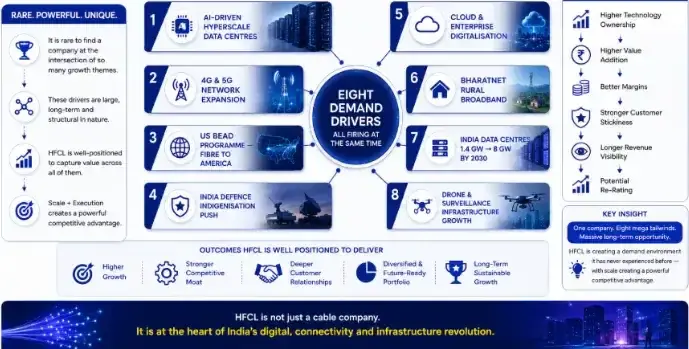
Demand Drive — All Firing at the Same Time.
HFCL's Key Growth Drivers1. AI-Driven Hyperscale Data Centers
The single biggest growth driver for the optical fibre industry at present is the massive growth of the AI infrastructure. Companies like Google, Microsoft, Meta, and Amazon are making massive investments of hundreds of billion dollars in AI Data centers, where thousands of GPUs are required to communicate with each other at massive speeds. At these high speeds, copper connectivity is not a practical option and optical fiber becomes the only feasible choice.
This has lead to enormous demand for ultra-high fiber count cables which can provide massive connectivity inside the existing physical footprint. HFCL has already developed and manufactured fiber optic cables having as high as 6,912 fibers and also obtained a large long term order from a global hyperscaler. As each generation of AI models requires more computational power, the demand for fiber infrastructure is likely to be there for years to come.
2. Cloud and Enterprise Digitisation
Migration of businesses from traditional on-premise applications to cloud-based infrastructures continue to be another major demand driver. Be it banks, hospitals, retailers or manufacturing organizations, everybody is increasingly depending on cloud services to operate its business.
Migration to the cloud requires a high end network back-bone that can support large amounts of data in reliable and efficient way. The trend might be more slow burning than the AI Data centers opportunity but the same is quite broad-based and recurring in nature. HFCLs connectivity and networking products are rightly positioned to cater to the same.
3. Expansion of 4G and 5G Networks
The telecom infrastructure opportunity continues to remain quite significant. India is way ahead in the deployment of 4G, however network expansion in many areas is still on and it is still early stages in case of 5G densification.
Every tower requires fiber back-haul and 5G networks, due to increased number of small cells required will lead to a substantially higher demand of fiber on per site basis. HFCLs relationships with all telecom operators and multiple product categories will allow it to benefit from this ongoing trend.
4. BharatNet Rural Broadband Program
Government's BharatNet scheme to provide broadband to rural India, it is still one of the largest digital infrastructure projects in India and HFCL has been an active participant and continue to contribute to network expansion in various rural areas.
While it is more a low margin business in comparison to the product business, it has the benefit of a visible revenue stream and is good for the stability of the business. The pace of BharatNet execution is expected to pick up going ahead and contributes to revenue.
5. US BEAD Program
United States has introduced a large broadband infrastructure program via BEAD with over $40B in funding aimed at providing high-speed internet access to all underserviced communities across the country.
This is a massive opportunity of multi years for the optical fiber producers in the world. US production capacity will be able to meet only a portion of the demand, thus requiring considerable amount of global suppliers. HFCL is one of the strong players in the export market already and the US fiber build out may provide significant boost to its revenue stream and margins.
6. India's Rapid Growing Data Centre Industry
India's data center market is projected to see rapid growth over the next decade, driven by increased adoption of cloud computing, surging internet usage, data localization mandates and large investments from international tech firms.
Each and every data center requires large amount of fiber connectivity to ensure internal networking and interconnection solutions are implemented. In response to the same HFCL has increased its focus on data center infrastructure products and manufacturing capacity is also been enhanced to cater to the increased demand. The increasing investments will boost demand for HFCLs multiple products.
7. Defence Indigenisation
The move to "Make in India" and the push towards indigenous defence manufacturing are opening vast avenues for existing, capable Indian companies. HFCL has steadily expanded its defence product portfolio which includes defense communications, radars, surveillance equipment, thermal imaging products, electronic fuzes and drone detection technology, among others.
Several critical certifications and qualifications are already obtained by the company which serve as an entry barrier. With government focus growing further towards indigenous defense manufacturing and import substitution, it seems thatHFCL is ideally placed for sustained demand over many years to come.
8. Growing Drone Detection and Surveillance System Demand
The widespread use of drones for both military and civilian applications have generated a growing need for sophisticated surveillance and counter-drone technologies that can detect, track, identify, and neutralise drone threats in real time.
HFCL has already ventured into this space by building its defense portfolio through acquisitions to include drone detection radars and advanced surveillance systems. As defense and governments spend more on securing their borders and countering drone attacks, the market for these solutions will expand.
Explore our Products
Research Framework

Emerging Titans
Combination of quantitative analysis, industry tailwinds, and management assessment - SPRINT investment philosophy

Tiny Titans
Heavy emphasis on scuttlebutt research, plant visits, and early on-ground signals
Conclusion — HFCL in Brief
There has been a tremendous transformation of HFCL from what it was five years ago. It has shifted from a primarily government-focused telecom contractor business into a technology-oriented business with the participation in the strongest long-term business themes namely AI infrastructure, indigenisation of defence, and global fiberization opportunity.The financial numbers are starting to show up the transformation. Revenue is steadily increasing, profit margins are significantly improving, and it has changed from loss making to profit making business. The order book of the company has shot up significantly over the last 2 years and offers good visibility to the future business. Furthermore, larger proportion of the business now comprises of higher margin product categories, export orders comprise a decent chunk of the order pipeline, and global clients have given commitments of long term orders proving that it is a capable company.
The company has built few barriers to entry and competitive moats that cannot be easily replicated.
Economic Moat Explained: Why Some Companies Stay Dominant for Decades
The forward/backward integration in its fiber manufacturing capabilities, specific defenses capabilities gained from Defsys, exclusive role in the manufacturing of the fuses and its strong domestic position in the optical fiber market give a strong platform for the future.
However, there are certain risks that are involved and are to be monitored. The pledging of promoter holdings is one, Helium availability could impact its operations and its expansion plans must be implemented effectively to be able to deliver its large order book.
All in all, HFCL stands at an exciting juncture, having successfully completed the majority of the heavy lifting for its business transformation. The tailwinds from the industry continue to be very strong, the financial numbers are finally beginning to show the positive returns from the investment made in the past few years. It has a huge growth opportunity and the only thing left for management is to implement its plans effectively and deliver the future order book as profits.
“The biggest investment risk is not the volatility of prices, but whether you will suffer a permanent loss of capital.” — Howard Marks
FAQs
Q1. What exactly does HFCL make and why does it matter?
+While the company is largely perceived as a fibre optic manufacturer, this fails to tell the full story of the group. HFCL has successfully evolved beyond its original telecom foundations to cover three main product segments over the last few years.
First is fibre and fibre cables; the company has produced higher fiber counts to use in both AI data centers and large scale digital infrastructure projects. These are increasingly sought after given the growing demand for artificial intelligence and cloud computing.
Second is telecom equipment, with the group producing devices like 5G Fixed Wireless Access routers, enabling homes and businesses to obtain rapid internet connections through 5G without requiring physical connections directly to premises.
Third is perhaps the most interesting and important segment of defense electronics. HFCL has invested in the manufacturing of devices including surveillance radars, drone detection systems, thermal imagery devices, communications equipment, electro-optic systems, and fuzes in this category.
This diversification is important as it provides the group exposure to numerous long term opportunities and reduces dependence on a single industry.
Q2. How has HFCL entered the defence space, and why is the acquisition of Defsys crucial?
+HFCLs move into defense has not been sudden, rather it has been an outcome of numerous strategic acquisitions, the most notable being Defsys and Raddef.
The most important aspect of the Defsys acquisition has been that it provides the group access not only to the manufactured products and customer base of Defsys, but also to the company’s certifications and approvals. It takes a company between five to seven years to gain the approvals necessary to produce and supply items for the defense industry and, by acquiring Defsys, HFCL has sidestepped this extensive process. Most crucially, Defsys also brought a pipeline of orders and established contacts in the domestic and international defense industries.
The company has therefore turned Defense into a meaningful profit and revenue generating segment rather than just an extension from the main optical fiber business. Furthermore, margins are higher in this segment, while lead times are longer and the barriers to entry are much higher compared to the more commodity driven telecom and fiber markets. Overall, the purchase of Defsys has provided a healthy diversification for HFCL as well as a second major growth driver to complement the fiber and telecom segments.
Q3. How has HFCL fared in comparison to Sterlite Technologies?
+Both HFCL and Sterlite Technologies compete within the same two primary segments, but their strategies over the past couple of years have diverged significantly. Sterlite had remained a largely vertically integrated fiber optic company throughout. The success of such strategy had come during the good times when telecom expenditure was high, but a dependency on a single industry was always likely to prove costly when the market turned. The limited product scope meant that when spending declined, Sterlite was largely defenseless. In contrast, HFCL continued to develop its fiber optic segment but broadened its horizons with entry into the defense sector, along with hardware manufacturing of telecom products and growth in international exports and a reduction of its business from lower-margin Government projects. These strategic decisions have played out directly withHFCLs performance showing strength of diverse business streams and a substantial order book while its profitability holds more strongly through a poor fiber optic cycle.The example of HFCL vs. Sterlite goes to show the advantage a diversified company can bring.
Q4. What are the most important aspects to monitor over the next 12-18 months?
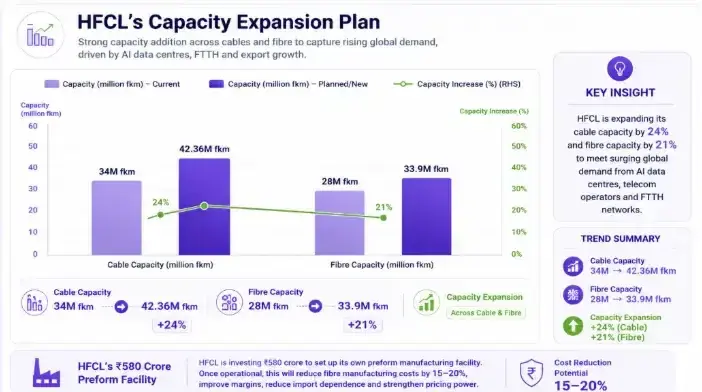
+Execution is undoubtedly key going forward. HFCL already holds a vast order book and is well positioned within the industries that it competes in. The first stage of acquiring the order book and positioning the company is completed; now, management must efficiently convert these into sales and profits. It faces challenges on multiple fronts with its planned capacity expansion projects underway in Poland and its new manufacturing facilities in Andhra Pradesh (for the defense business), as well as plans to integrate vertically via its preform manufacturing process and grow its data center interconnect product segment. Success depends on effective execution. Delays to these capacity expansion plans, approvals, supply chains, or project delivery could see growth levels take a nosedive and investor sentiment turn.
In many ways, the major transformation that the company is undergoing is already done. All investors can do at this stage is sit back and wait to see if the management is competent in translating its ambitious plans into reality; that is arguably going to be the single most critical element to the performance of the group in the coming two years.
Q5.Is HFCL just an optical fibre company, or is there more to it?
+Yes, optical fibre is still part of the story — but alongside that, HFCL now builds 5G Fixed Wireless Access equipment, data center interconnect solutions, networking products, and an entire range of defence technologies including radars, drone detection systems, surveillance equipment, and electronic fuzes. That's a dramatically different business from simply manufacturing cables.
What makes this shift genuinely exciting is where it takes the company in terms of value. Selling optical fibre is, at the end of the day, a volume game with thin margins and plenty of competition. But when you're supplying integrated communication systems or defence-grade technology, you're in a completely different conversation — one where relationships run deeper, margins are healthier, and customers don't just switch vendors.
And that last point matters a lot. Once a customer integrates HFCL's systems into their network or defence infrastructure, walking away isn't simple. There are certifications to redo, testing cycles to repeat, and integration work to undo. That kind of stickiness is what investors call a moat and it's something a pure cable manufacturer simply doesn't have.
So HFCL's evolution isn't just about selling more products. It's about building the kind of business where customers stay, margins grow, and competition becomes structurally harder to pull off.

High growth stock specialist, Value Educator
Shashank Mahajan is an equity research professional with over 12 years of experience in identifying high-potential SME and micro-cap stocks at an early stage. He follows a rigorous scuttlebutt research–driven approach, combining on-ground insights with deep financial analysis. Shashank specializes in uncovering under-researched and under-owned companies with strong management quality and long-term growth potential. Through disciplined research and early identification, he focuses on spotting tomorrow’s market leaders before they enter the mainstream investor radar.

Zen Technologies: Revenue Fell After a Big Win



PNG Jewellers: A 194-Year-Old Name Goes National
Explore our Products
Research Framework
Emerging Titans
Combination of quantitative analysis, industry tailwinds, and management assessment - SPRINT investment philosophy
Tiny Titans
Heavy emphasis on scuttlebutt research, plant visits, and early on-ground signals


 Orders
 Subscription
 Share with friends


Required Details
₹23999.00
(12 month subscription)
As per SEBI regulations, all users are mandated to complete the KYC that is validated for 1 year. Post payment, you will be redirected to the KYC screen


No comments yet. Be the first to comment!