
Skipper Limited: A Tower Maker With ₹10,066 Cr of Orders

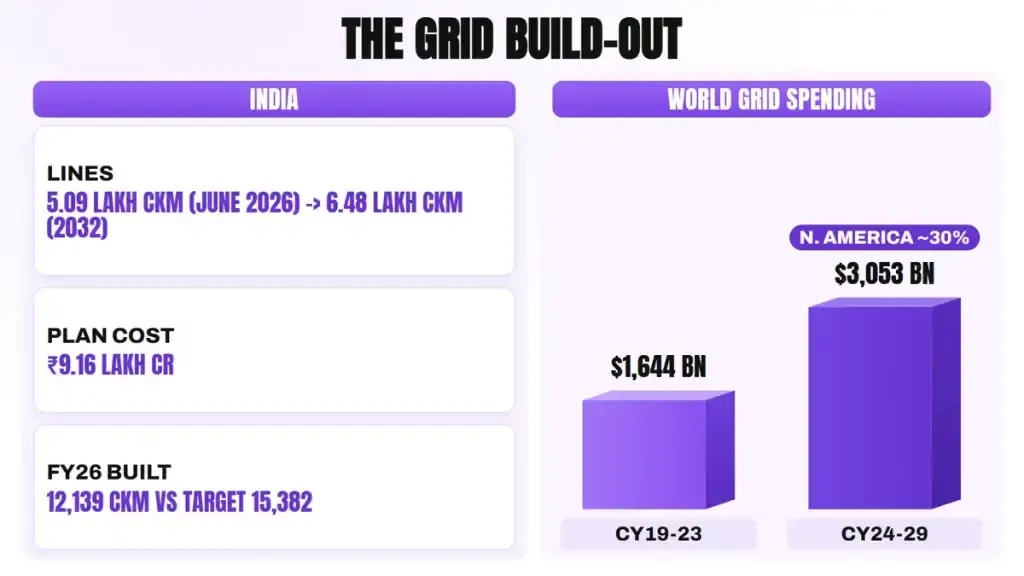
India's high-voltage grid had about 5.09 lakh circuit km of lines in June 2026. The national plan wants 6.48 lakh circuit km by 2032. That plan costs about ₹9.16 lakh Cr. Yet in FY26 the country built 12,139 circuit km of new lines, against a target of 15,382. That is a gap of about a fifth. So the plan is clear, and the building has to speed up.
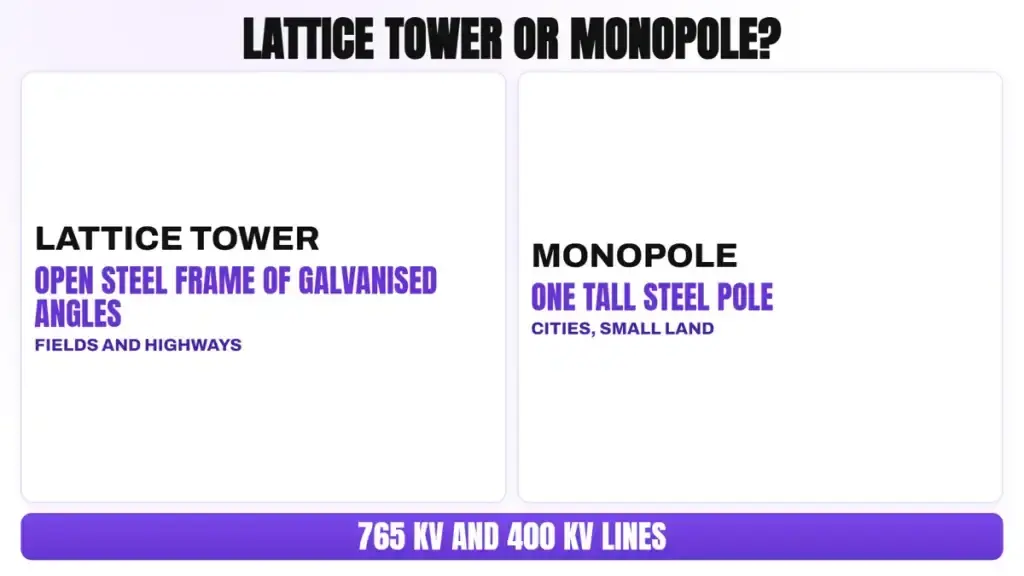
Every one of those lines hangs from steel towers. A lattice tower is the familiar open steel frame you see along highways and fields. It is bolted together from galvanised steel angles, and it carries the heavy wires high above the ground. Cities need something slimmer, and a monopole is a single tall steel pole that carries the same wires on a much smaller patch of land.
So who orders all these towers? In India, the main buyers are POWERGRID, state utilities and private developers. Most new lines are now awarded through tariff-based competitive bidding, or TBCB, which means developers bid for the right to build and run a line. The lowest yearly charge wins, and the winner then needs towers, conductors and a contractor to put them up. That is where tower makers come in, both as suppliers and as line builders.
One of those tower makers is Skipper Limited (NSE: SKIPPER, BSE: 538562) of Kolkata. It started in 1981 making Hamilton poles, a type of steel pole, and it now makes transmission towers, monopoles, distribution poles, telecom towers and railway structures. It also builds transmission lines and substations as a contractor, and it sells polymer pipes under its own brand. Its engineering plants can make 3,75,000 tonnes of steel structures a year, and it has customers in more than 65 countries.
That scale shows up in the numbers: in FY26 the company's revenue was about ₹5,553 Cr, about 3.3 times its FY22 level. Then, in September 2026, its order book crossed ₹10,000 Cr for the first time.
Skipper Limited in five numbers
- An order book of ₹10,066 Cr in September 2026, up 18.4% since March 2026
- Q2 FY27 order inflow of ₹2,111 Cr, up 70% on a year ago
- Export orders of about ₹1,055 Cr in that one quarter, more than in all of FY26
- North America now 44% of the export order book
- Capacity rising from 3,75,000 to 4,50,000 tonnes a year, with 6,00,000 planned by FY29
So a pole maker from Kolkata now holds orders from US and Australian utilities. Why, then, did its export revenue fall by almost half in the latest quarter? Let's first understand the company, and then look at the quarter where both of those things happened.
Skipper Limited: Company Overview
Skipper Limited was incorporated in 1981 and has its registered office in Kolkata. It makes transmission towers, monopoles, distribution poles, telecom towers and railway structures, builds transmission lines and substations as a contractor, and sells polymer pipes under the Skipper brand. Its POWERGRID-approved plants are at Uluberia and Junglepore near Kolkata and in Guwahati, with 3,75,000 tonnes a year of engineering capacity and 62,000 tonnes of pipe capacity. Sajan Kumar Bansal is the chairman and managing director, and the promoters held 66.50% of the shares in March 2026, before the preferential issue. The company had 4,962 permanent employees at that date. Revenue was about ₹5,553 Cr in FY26, and debt to equity was 0.38 times in September 2026 after the equity raise. Read this Yash Highvoltage: Bushing Maker With ₹760 Cr of Orders
"Behind every stock is a company. Find out what it's doing."
— Peter Lynch
Skipper is easy to mislabel as a steel company. What it actually does is carry India's new power lines from the plan on paper to the steel in the field, and that is the business to follow.
The Quarter Its Export Orders Hit a Record
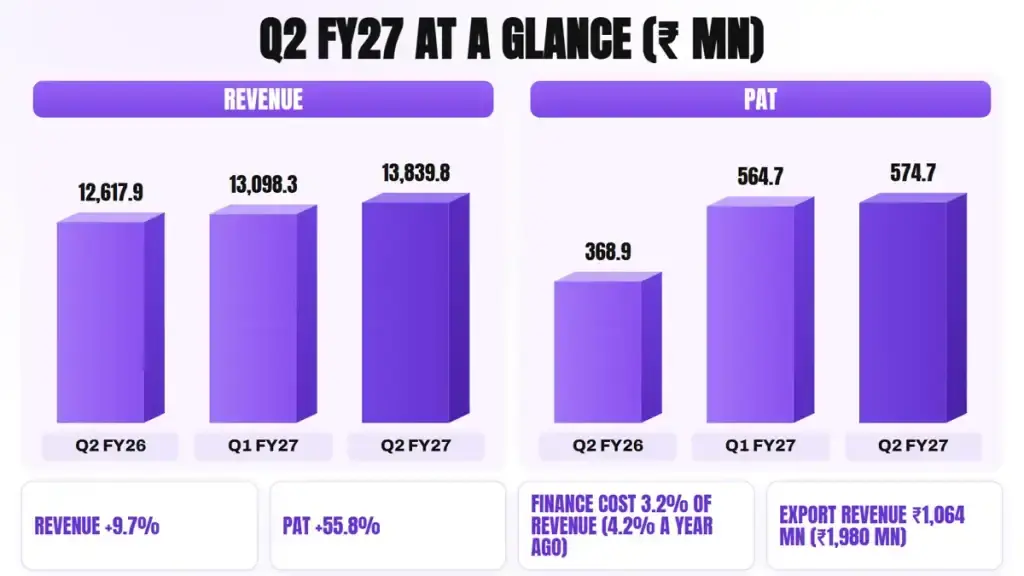
Let's look at Q2 FY27, the July to September quarter, when export orders hit a record. The company reported it on 30 October 2026, with revenue of ₹13,839.8 Mn, or about ₹1,384 Cr, up 9.7% on a year ago. That is its highest second-quarter revenue so far. Profit after tax rose faster, by 55.8%, to ₹574.7 Mn. That gap needs explaining.

Why did profit grow almost six times as fast as revenue? Three cost lines explain it, starting with EBITDA, which rose 10.8% and added ₹141.4 Mn. Next, finance cost fell to ₹440 Mn from ₹535.6 Mn, which saved ₹95.6 Mn and brought interest down to 3.2% of revenue from 4.2%. Then depreciation took back ₹58.1 Mn of that gain. On top of this, Q2 FY26 had carried a one-time charge of ₹106.8 Mn, which this quarter did not have.
"Does the company have a worthwhile profit margin?"
— Philip Fisher
For a tower maker, the margin story is less about price and more about cost below EBITDA. Skipper's interest bill has shrunk as a share of revenue, and that is where most of its profit growth has come from.
That lower interest bill came from a smaller debt pile. Gross debt, counting interest-bearing acceptances from suppliers, was ₹9,642 Mn in September 2026, against ₹13,245 Mn a year earlier. The cash for part of that cut came from a preferential issue of 92,23,402 shares at ₹470 each, which raised ₹4,335 Mn from long-only institutional investors. Debt to equity is now 0.38 times, against 0.61 times a year ago, and Crisil rates the company A+/Stable. Read this Debt to Equity Ratio Explained
Those gains came in a quarter when export shipments slowed sharply. Export revenue was ₹1,064 Mn, down about 46% from ₹1,980 Mn a year ago. Many overseas buyers chose to delay shipments because sea freight became very costly during the war in West Asia, so they are waiting for cheaper freight.
So the domestic business carried the quarter. You can see it in the segments. The infrastructure projects segment, which builds lines and substations, grew 44.5% to ₹2,154.4 Mn, while engineering products, the tower and pole business, grew 4.3% to ₹10,403.8 Mn. Polymer pipes grew 11.1% to ₹1,281.6 Mn.
Those segment figures leave out one more cost line worth a look. Employee cost rose to ₹932.11 Mn from ₹681.05 Mn, because Q2 included pay rises along with the arrears for Q1. Management expects it to settle at about 5.5% of revenue in Q3.
Beyond costs, working capital also moved the right way over the year. Net working capital days, leaving out supplier credit that carries interest, were 93 in September 2026 against 109 a year earlier. Debtor days were 94. Inventory days were 83. Management says 90-100 days is a stable level for the company, and it believes its peers run at 120 days or more.
The Orders Behind the ₹10,066 Cr Book
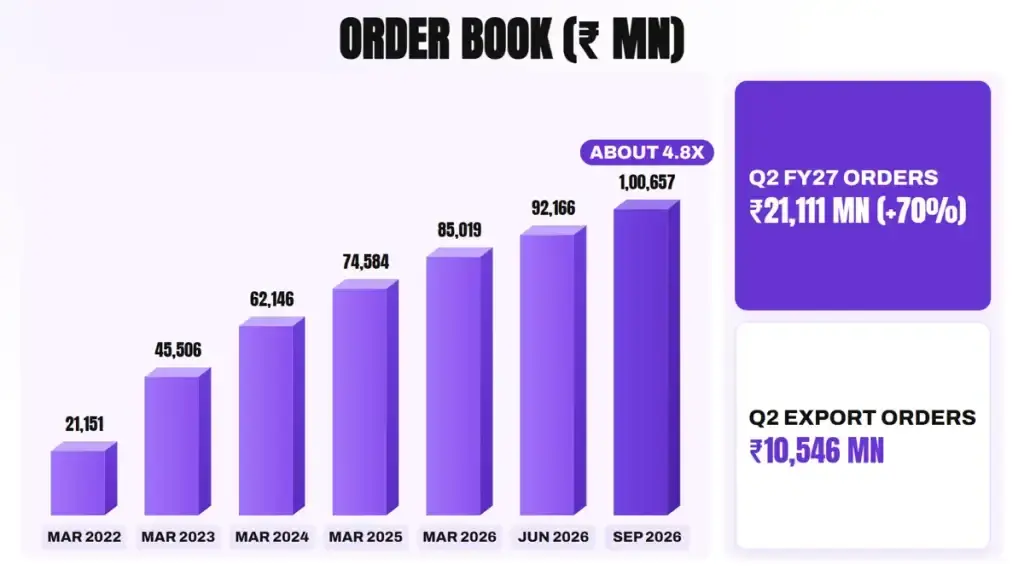
Now let's move from the quarter's results to its orders. The order book stood at ₹1,00,657 Mn in September 2026, or about ₹10,066 Cr. That is up 18.4% from March 2026, in just six months. It is also about 1.8 times FY26 revenue, and management says its orders usually run over two to two and a half years.
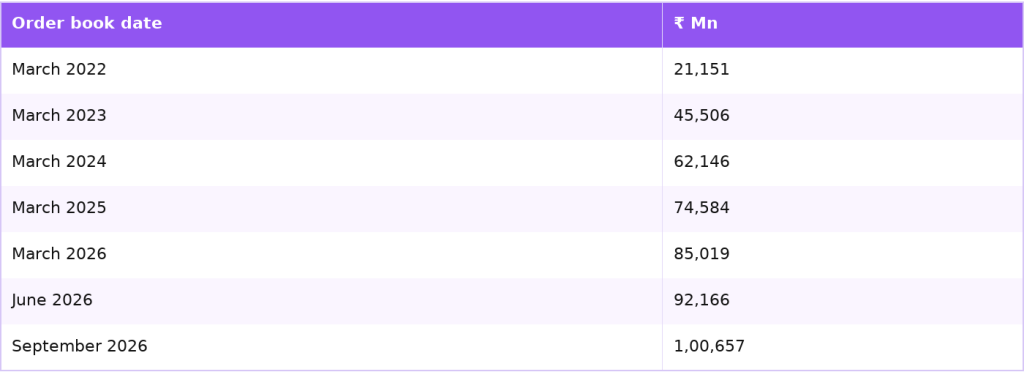
So the book has grown about 4.8 times since March 2022. The biggest jump came in FY23, when it more than doubled in a single year. In FY26 the company took a record ₹5,678 Cr of orders.
New orders in Q2 FY27 were ₹21,111 Mn, up 70% on a year ago. For the half year, new orders reached ₹37,855 Mn, up 18%. But the bigger change was where those orders came from. Export orders in Q2 were ₹10,546 Mn, the highest for any quarter and more than the company took from abroad in all of FY26. That is a big shift.
Those numbers came through three large orders that the company announced in the half year.
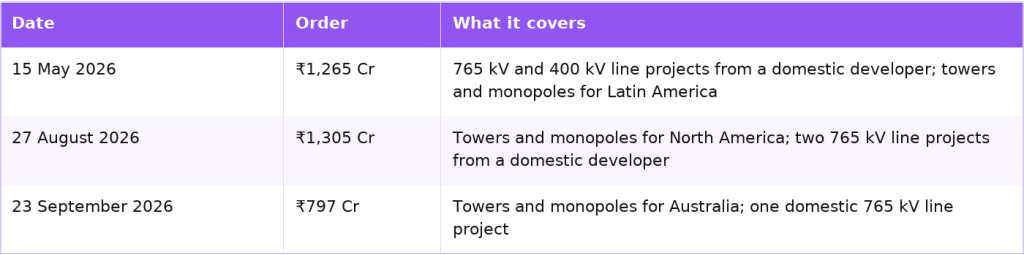
As you can see, each release paired a big domestic line with an export supply order. In Q2 alone, the company won three 765 kV line projects from one domestic developer. It also signed its largest order so far in North America, a multi-million-dollar contract with a top-tier utility.
That changed the shape of the export book. Exports were 10% of the order book in March 2026 and 17% in September 2026. Within exports, North America is now 44%, Australia 19%, the Middle East 18% and Africa 17%, while Latin America and South and South-East Asia are 1% each.
What the export book says: about ₹1,711 Cr of the order book is now for export, and about ₹753 Cr of that is for North America. The Middle East used to be the company's main export market. Today developed markets make up more than 60% of the export book. That export book is about double the ₹850 Cr of March 2026.
Still, the domestic side is most of the book. Domestic transmission and distribution work is 73% of it. Telecom, railway, solar and other steel structures in India make up another 10%. The developers behind the domestic orders include POWERGRID, private transmission companies and state electricity boards.
"So in fact, now North America makes up almost about 44% of our total export order book. Australia makes up almost 18% to 19%." - Sharan Bansal, Director, October 2026
How Skipper Grew From a Pole Maker
Now that we have seen the quarter, let's go back and see how a pole maker from Kolkata got here. Skipper was set up in 1981 to make Hamilton poles. It moved into towers and masts over the next two decades, and in 2006 it received POWERGRID's approval for its tower unit, along with its first order for 400 kV towers.
That approval opened the door to bigger lines. In 2009 it won India's first order for 800 kV transmission towers from POWERGRID. A year later it set up its own rolling mill, which turns steel into the angles that towers are made from. In 2016 it finished its first line as a contractor, the 400 kV Panchkula-Patiala line for POWERGRID. In 2020 it opened one of India's largest test stations for towers and monopoles.
Its export business started early too. It began in Latin America. In 2014 Skipper won supply contracts in South America, under an exclusive agreement with a major transmission operator there. It set up a Brazilian subsidiary, Skipper LATAM, in March 2026 to grow in that market.

Those five years show two different gains, and we should look at each. Revenue grew at 34.3% a year, as the domestic grid plan and the company's capacity both grew, while profit grew much faster, at 70.6% a year. That is because interest fell from 5.45% of revenue in FY22 to 3.91% in FY26, while the EBITDA margin crept up. Read this Operating vs Net Profit Margin Explained
Those gains lifted the returns too. They rose sharply. Return on capital employed rose from 9.2% in FY22 to 21.1% in FY26, and return on equity rose from 3.43% to 14.29%. Meanwhile, net working capital days fell from 231 to 98 over the same years, which is why the company could grow without its debt rising as fast.
One case shows how far the engineering has come. Skipper tested a 500 kV HVDC bipole heavy angle tower for its client Saudi Energy. That tower weighs 320 tons and stands 107 m tall, and the company says it set a world record for the heaviest transmission tower ever tested.
Three Businesses Built on One Steel Plant
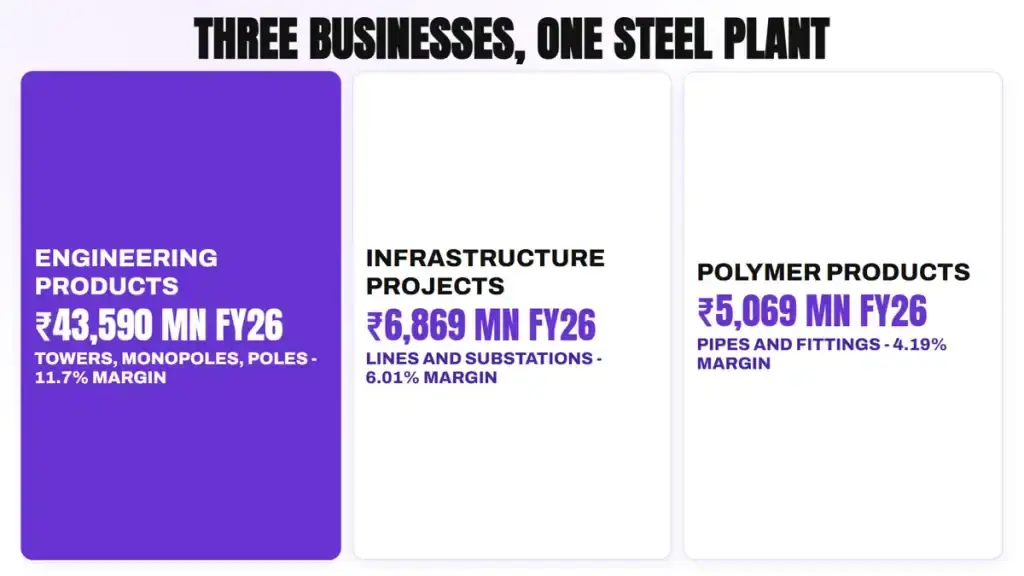
Now let's split the company into its three businesses, which share one steel plant. Engineering products make the towers and poles. Infrastructure projects use many of those towers to build complete lines and substations. Polymer products make plastic pipes, a separate consumer and farm business.

Where the profit comes from: engineering products earned about 89% of FY26 EBITDA, infrastructure about 7% and polymer about 4%. So the tower business still decides the company's profit, even as infrastructure grows faster.
These segments sound linked, but as we will see, each earns money differently. Read this Segment-Wise Revenue Analysis Explained Engineering sells a product by the tonne, to utilities, developers and contractors at home and abroad. Infrastructure is different. It is a contract business, where Skipper is paid to build a complete line or substation. Polymer is different again. It is a branded product sold through dealers to farmers, builders and plumbers.
Engineering Products
Let's begin with engineering products, the tower business, which sells into a grid build-out that is getting heavier. India's 2022-32 plan adds about 1,91,474 circuit km of new lines. Within that, 765 kV additions are about 85% higher in the current five-year plan than in the last one. POWERGRID has guided its own capex to ₹370 bn in FY27 and ₹450 bn in FY28, against ₹350 bn in FY26.
The same build-out is happening abroad, where a study the company cites expects global spending on transmission and distribution lines to reach about $3,053 bn over CY24-29. That is nearly double the $1,644 bn spent in CY19-23. That total puts North America alone at about 30%.
That spending covers every kind of line, and Skipper's products cover the same range. It makes lattice towers, monopoles, distribution poles, telecom towers and railway electrification structures, for lines from 11 kV up to 1,200 kV. It also makes its own steel angles, bolts, nuts and tower fittings. About 75% of production runs on automated CNC lines, and the plants have seven galvanising units.
So what does it earn? It brought in ₹43,590 Mn in FY26, up 24%, at an EBITDA margin of 11.7%. In H1 FY27 its revenue was ₹19,805.1 Mn, while its margin rose to 12% from 11.5%. Q2 alone was ₹10,403.8 Mn, up 4.3%, as export shipments were held back.
Beyond power lines, telecom and railway structures are a smaller part of this business. Together with solar and other steel structures in India, they make up 10% of the order book. A study the company cites expects spending on telecom towers in India to rise from ₹864 bn in CY19-23 to ₹1,479 bn in CY24-29, as 5G spreads. The government also plans to invest over ₹10 tn in railways from FY25 to FY30.
Those power line sales go mostly to large utilities. In India the main ones are POWERGRID, private transmission developers and state electricity boards. POWERGRID has given it a "Largest Tower Supplier" award. Abroad, the company was among the first Indian makers to design and supply transmission monopoles to North America.
Those exports were about 16% of engineering revenue in FY26, or ₹7,100 Mn. The company's long-term aim is a 50:50 split between domestic and export revenue. It has set up subsidiaries in Brazil, the UAE and Texas to win more of that work.
Management expects that export push to keep going. It has guided for about ₹1,500 Cr of export orders in FY27, and it had already taken about ₹1,000-1,100 Cr by September. The growth in North America comes partly from new data centres, which need new lines to bring them power.
Infrastructure Projects
Now let's discuss the infrastructure projects segment, which builds the lines itself. Its market is the construction of new transmission lines, both between states and inside them. In September 2026 the government approved the third phase of the Green Energy Corridor, with an outlay of ₹1,86,405 Cr. That plan pays for intra-state lines to carry up to 135 GW of renewable power by 2032-33. A longer plan from the Central Electricity Authority goes further. To connect more than 900 GW of clean power by 2035-36, it needs about 1,37,500 circuit km of new lines at a cost of about ₹7.9 lakh Cr.
That plan needs line builders, and Skipper became one in 2016 as a step forward from supplying towers. Today it builds extra-high-voltage and HVDC lines and substations. In Q2 FY27 it charged the Sikar II-Khetri 765 kV line in Rajasthan, about 144 km long. As of September 2026 it was building about 5,500 circuit km of EHV and HVDC lines.
That work is now the fastest-growing part of the company. Infrastructure revenue was ₹6,869 Mn in FY26, at an EBITDA margin of 6.01%. In H1 FY27 it reached ₹4,681.3 Mn, up 86.5% on a year ago, and its margin rose to 7.2% from 5.8%.
That growth comes from POWERGRID and the private developers that win TBCB lines. In 2024 Skipper secured nine POWERGRID projects, including eight 765 kV line projects. POWERGRID also gave it an award as an emerging power EPC player. The 765 kV lines won in the last two quarters came from domestic developers.
More of this work is on the way. Management expects ₹90,000 Cr to ₹1 lakh crore of transmission bids in India in FY27, against about ₹50,000-60,000 Cr of TBCB bids in FY26. In November 2026 it set up a new subsidiary, Evergrid India, for transmission and EPC work. Management expects infrastructure to lead the company's growth in H2 FY27 as well.
Polymer Products
Now let's move to the smallest business, polymer pipes. It is a different trade. India's pipe market is moving from metal to plastic in farms, homes and sewers. A study the company cites puts UPVC pipe sales at about ₹362 bn in CY24, rising to ₹548 bn by CY29. Over the same years, CPVC pipe sales are projected to more than double, to ₹251 bn.
Skipper makes UPVC, CPVC and HDPE pipes, fittings, storage tanks and bath fittings under the Skipper brand. Its pipes are certified to NSF 61, a US standard for products that carry drinking water. It also has a tie-up with Lubrizol, a global pioneer of CPVC, to make pipes with its Temprite technology for India. A joint venture with Metzerplas of Israel makes micro and drip irrigation systems.
The pipe plants can make 62,000 tonnes a year, near Kolkata and in Guwahati. The business sells through more than 30,000 retail outlets, and it is one of the largest pipe makers in West Bengal and eastern India. Cricketer MS Dhoni has been its brand ambassador since 2023.
That business brought in ₹5,069 Mn in FY26, at an EBITDA margin of 4.19%. In Q2 FY27 its revenue rose 11.1% to ₹1,281.6 Mn, and its margin rose to 5.8% from 4%. Management had guided for about 20% growth in FY27, and the company's stated aim is to reach the volume that supports double-digit margins in this segment.
Why a Qualified Tower Maker Is Hard to Copy
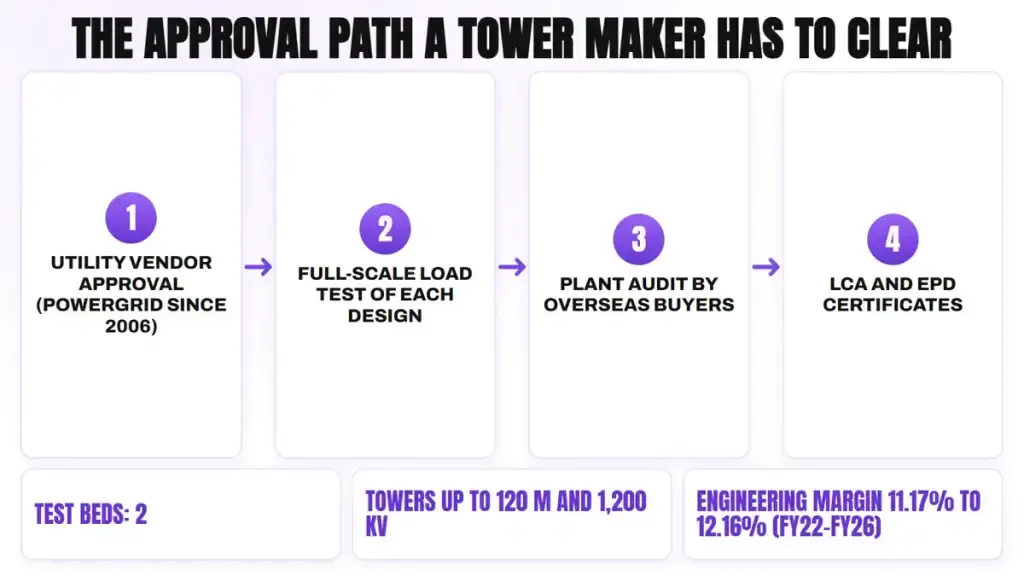
Now that we have seen all three businesses, let's understand the moat in towers. A tower that bends or breaks can take a whole line down, so utilities buy only from makers they have tested and approved. That approval works at three levels: the utility's vendor list, a full-size test of each new tower design and, abroad, an audit of the plant itself.
Each level takes years to clear. None of it is quick. For example, in India POWERGRID approves a tower plant before it can bid, and Skipper has had that approval since 2006. Every new tower design then has to pass a full-scale load test, where the tower is pulled with cables until it proves it can carry its rated load. Skipper owns one of India's largest tower and monopole test stations, with two independent test beds at one site.
That test station matters more than you might think. It can test towers up to 120 m tall and up to 1,200 kV, and the company also runs a research centre approved by the government's science department. It says the test station and research centre have improved its standing in export markets. In FY26 it spent ₹367 Mn on research and development.
Export approval adds a third layer, and in Q1 FY27 Skipper cleared qualification audits by customers from the USA, Finland and Australia. It also obtained life cycle and environmental product certificates for its towers and poles, which buyers in Europe and the US require. Each of these takes time to earn. Read this Economic Moat Explained
Beyond approvals, cost is the other half of the moat. Here scale helps. Skipper rolls its own steel angles, makes its own bolts and fittings, and galvanises everything in-house. Most of its capacity sits at one location near Kolkata, close to the Haldia and Kolkata ports. In October 2026 it also agreed to buy Sansha Fastener, a small fastener maker in Tamil Nadu, for ₹15.5 Cr.
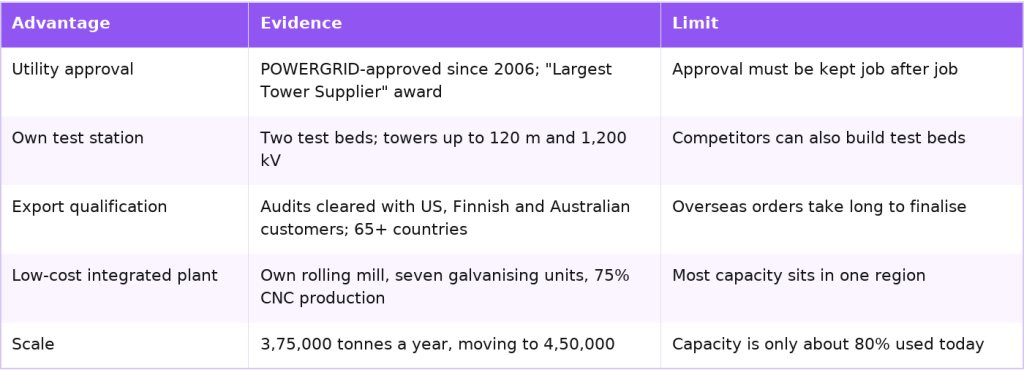
That table also shows how to test the moat. A maker that customers cannot easily replace should earn a steady margin, even when steel prices move. The engineering margin stayed between 11.17% and 12.16% in each year from FY22 to FY26. So the margin on the new export orders, which management says is higher, will show whether that edge is widening.
"The key to investing is not assessing how much an industry is going to affect society, or how much it will grow, but rather determining the competitive advantage of any given company and, above all, the durability of that advantage."
— Warren Buffett
The grid build-out will help every tower maker. What sets Skipper apart is the approval list, the test station and the integrated plant, and the margin record shows how durable that has been so far.
Financials: Skipper's Five Years of Growth, Interest and Cash
One quarter can mislead in a project business, so let's look at five full years together. These are consolidated figures in ₹ Cr. EBITDA here is the company's own measure of operating profit.
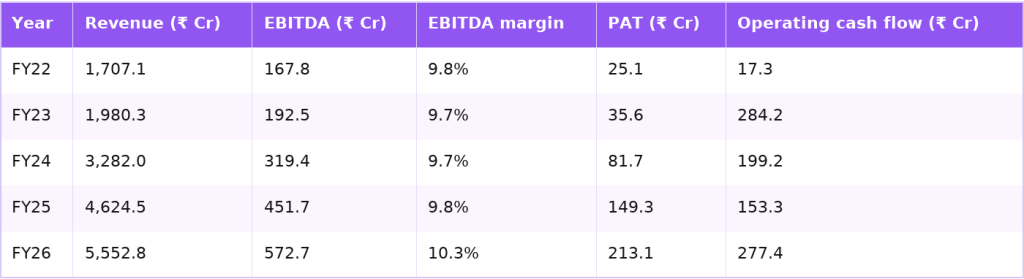
Revenue grew about 3.3 times in four years, while profit after tax grew about 8.5 times, from about ₹25.1 Cr to about ₹213.1 Cr. The EBITDA margin barely moved, so most of that extra profit came from lower interest as a share of revenue.
Cash flow has broadly kept up with profit. Over the five years, operating cash flow added up to about ₹931.3 Cr, against about ₹504.9 Cr of profit after tax. FY22 was the weak year, with only about ₹17.3 Cr of operating cash flow.
The pressure point is spending on plant. In FY26 the company spent about ₹366.4 Cr on property, plant and equipment, more than its operating cash flow, and borrowings stood at about ₹921.8 Cr in March 2026. The preferential issue of ₹4,335 Mn in mid-2026 brought debt to equity down to 0.38 times, so the next plant can be built from a stronger base.
"The essence of investment management is the management of risks, not the management of returns."
— Benjamin Graham
Skipper's returns have risen as its interest bill fell. Keeping that gain while it builds a new greenfield plant is the test of how well it manages the balance sheet.
What FY27 and FY28 Could Look Like on Management's Numbers
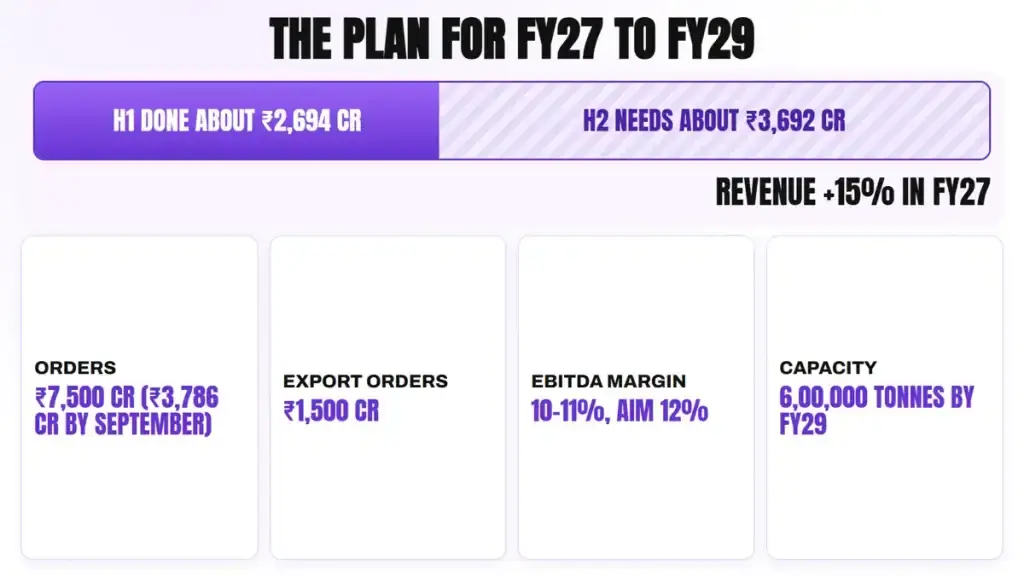
So where does the company go from here? Let's lay out what management has guided for, one item at a time. In April 2026 it guided for 15% revenue growth in FY27 and about 30% growth in profit. In October 2026 it kept that guidance, and said that at worst growth could come in one or two points lower.
Let's put that guidance against the half year. A 15% rise on FY26 means revenue of about ₹6,386 Cr in FY27. Since H1 FY27 brought in about ₹2,694 Cr, H2 would need about ₹3,692 Cr. That is about 37% more than H1, and about 21.6% more than H2 FY26. That is a steep climb.
"So we are well aware of what our order book is and what is up for execution. So I say that we have full visibility and execution remains robust." - Sharan Bansal, Director, October 2026
That plan is easier to read against the order book. In August 2026 management expected to execute about ₹5,000 Cr of the then ₹9,200 Cr book within FY27. Its execution usually picks up in the second half, after the monsoon. Infrastructure projects are expected to lead the growth again.
Next comes the order target, which is ₹7,500 Cr for FY27. The company had ₹3,786 Cr by September, so it needs about ₹3,714 Cr more in H2. That is about as much as in H1. That target includes about ₹1,500 Cr of export orders. Management says the bidding pipeline is over ₹35,000 Cr, and it has historically won about 20-25% of what it bids for.
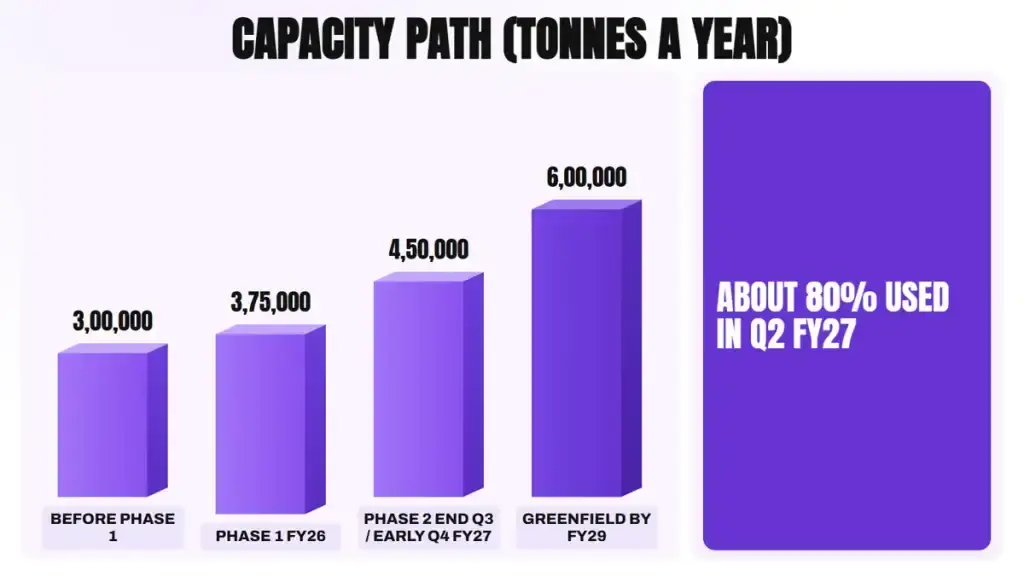
Then there is capacity, the second part of the plan. It comes in steps. First, Phase 1 took the plants from 3,00,000 to 3,75,000 tonnes a year in FY26. Phase 2 adds 75,000 tonnes at the existing site, due at the end of Q3 FY27 or early in Q4. The next step will be a new greenfield plant, built in two steps by the end of FY28 and FY29, taking capacity to 6,00,000 tonnes.
That plan needs money, but less than the scale suggests. Annual capex has run at about ₹250-300 Cr, and the current expansion costs about the same. Beyond that, the greenfield plant should add mainly the cost of land. After the equity raise, management says the balance sheet can fund all of it.
On margins, management expects the EBITDA margin to stay at 10-11% in the near term. Its long-term aim is 12%, and it says export orders will help it get there faster. It also expects finance cost to stay between 3.2% and 3.5% of revenue for FY27.
"And now with exports coming in with good volumes, we definitely feel that, that journey towards 12% will be faster." - Sharan Bansal, Director, October 2026
Beyond FY28, management sees a long runway. It expects at least ₹1 lakh crore of transmission bids in India every year until 2032 or 2033. Beyond India, it says data centres in the US are adding to the need for new lines. Those two markets are where most of the new capacity is meant to go.
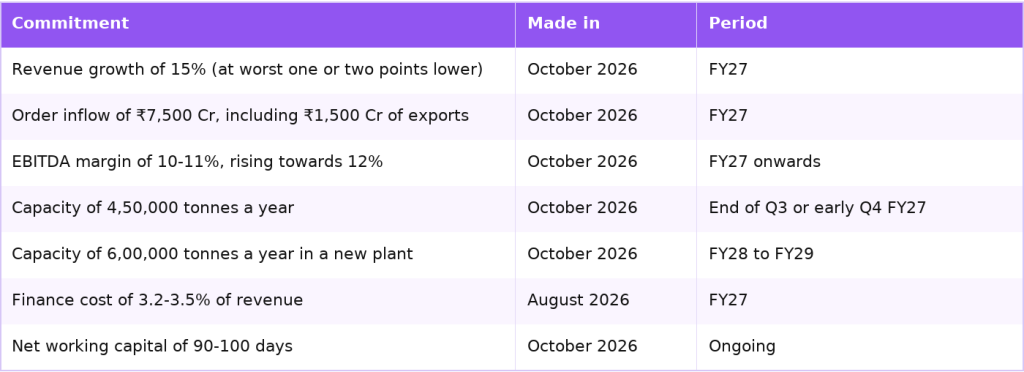
Those commitments are easier to judge against the past. So let's check what management has guided before against what it delivered.
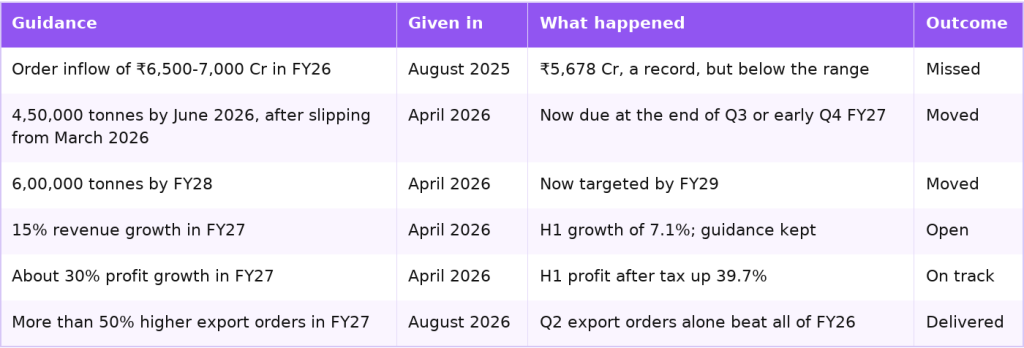
That record is mixed. The company has delivered on profit, on margins and on its export push. But its order inflow and capacity dates have slipped, mostly when they depended on customers or on outside events.
Key Risks
Now let's look at what could go wrong for Skipper, because the latest half year has already shown some of these risks.
- Export shipments: export revenue fell about 46% in Q2 FY27, to ₹1,064 Mn, and about 49% in H1. Buyers are delaying shipments while sea freight stays costly. Less than 25-30% of the export book is on terms where Skipper pays the freight.
- Revenue guidance: H1 FY27 revenue grew 7.1%. Hitting 15% for the year needs H2 revenue about 37% above H1, and management has already said growth could come in one or two points lower.
- Engineering growth: the tower business grew 4.3% in Q2 and shrank 2.1% in H1, as FY26 orders were thin and exports were held back. Capacity use was about 80% in Q2, against up to 90% in the past.
- Mix and margins: infrastructure projects earn about 6-7%, against about 12% in engineering. If infrastructure keeps leading growth, the overall margin is harder to lift. Most orders are on fixed prices, so steel and fuel costs also matter.
- Middle East: the region is still 18% of the export book, and management is not hopeful about it until the war eases.
- Cash flow and capex: operating cash flow was ₹608.75 Mn in H1 FY27, against ₹1,367.92 Mn a year earlier, as inventory rose and suppliers were paid down. Spending on plant was ₹2,202.73 Mn in the same half, and a new greenfield plant is coming.
- Capacity dates: the 75,000-tonne expansion was first due in March 2026 and is now due late in FY27. The 6,00,000-tonne target has moved a year, to FY29.
- Tax demand: in October 2026 the Odisha GST department issued a show cause notice for about ₹41 Cr, cut from about ₹227.5 Cr in the first notice. The company disputes it and does not treat it as a liability.
- Dilution: the preferential issue added 92,23,402 shares, which raised the share count by about 8.2%.
"So it's hard to say because export orders tend to have a little bit of an uncertain time line of finalization. Many times, we feel okay that the order is about to be finalized and we are favorably placed. But then again, another 2 quarters pass and the order is not finalized." - Sharan Bansal, Director, October 2026
"Being too far ahead of your time is indistinguishable from being wrong."
— Howard Marks
Skipper's export orders are real, but their timing is not in its hands. A record order book only turns into revenue when buyers take delivery, and the tracking list below is how to see whether that happens.
Explore our Products
Research Framework

Emerging Titans
Combination of quantitative analysis, industry tailwinds, and management assessment - SPRINT investment philosophy

Tiny Titans
Heavy emphasis on scuttlebutt research, plant visits, and early on-ground signals
What to Track Next
If you follow Skipper Limited, these are the signals that will show where it goes next.
- Revenue in Q3 and Q4 FY27 against the 15% growth guidance, and export revenue after ₹1,064 Mn in Q2
- Order inflow in H2 FY27 against ₹7,500 Cr for the year, and the order book after ₹10,066 Cr
- The 4,50,000-tonne capacity going live, and the site chosen for the greenfield plant
- The engineering EBITDA margin on the new export orders, against 11.9% in Q2
- Operating cash flow and net working capital days, after 93 days in September 2026
- The outcome of the Odisha GST notice
Conclusion
Let's put it all together. Skipper has grown from a pole maker into one of India's main tower suppliers and line builders. Its order book has grown about 4.8 times in four and a half years, and interest now takes a much smaller share of its revenue. The cautious thread is execution: H2 FY27 needs about 37% more revenue than H1, and in FY26 spending on plant ran ahead of operating cash flow. The next two quarters, with the new capacity, the H2 order intake and export shipments, will settle which thread is stronger.
But the latest quarter showed both sides of the business. Export orders hit a record, mostly from North America and Australia, while export shipments were held back by freight costs. What happens next depends on whether those export orders ship, whether the 4,50,000-tonne capacity goes live on time and whether H2 brings the growth that management has promised.
FAQs
What does Skipper Limited do?
+Skipper Limited makes transmission towers, monopoles, distribution poles, telecom towers and railway structures, and it builds transmission lines and substations as a contractor. It also sells polymer pipes under the Skipper brand. Its engineering plants can make 3,75,000 tonnes of steel structures a year.
How did Skipper Limited do in Q2 FY27?
+Standalone revenue was ₹13,839.8 Mn, up 9.7% on a year ago, and profit after tax rose 55.8% to ₹574.7 Mn. Finance cost fell to ₹440 Mn from ₹535.6 Mn. Export revenue fell about 46% to ₹1,064 Mn as overseas buyers delayed shipments.
What is Skipper Limited's order book?
+The order book was ₹1,00,657 Mn, or about ₹10,066 Cr, in September 2026, up 18.4% from March 2026. Exports were 17% of it, and within exports North America was 44%, Australia 19% and the Middle East 18%. New orders in Q2 FY27 were ₹21,111 Mn, up 70% on a year ago.
How much capacity is Skipper adding?
+Capacity is rising from 3,75,000 to 4,50,000 tonnes a year, with the new 75,000 tonnes due at the end of Q3 or early in Q4 FY27. A new greenfield plant is planned in two steps by the end of FY28 and FY29, taking capacity to 6,00,000 tonnes. Annual capex has run at about ₹250-300 Cr.
What has Skipper Limited guided for FY27?
+Management guided for 15% revenue growth in FY27 and said growth could come in one or two points lower at worst. It targets ₹7,500 Cr of new orders, including about ₹1,500 Cr from exports, and an EBITDA margin of 10-11% on the way to 12%. H1 FY27 revenue grew 7.1%.
What are the main risks for Skipper Limited?
+Export shipments are being delayed while sea freight stays costly, and the Middle East is still 18% of the export book. H2 FY27 revenue needs to be about 37% above H1 to meet guidance, and the 75,000-tonne expansion has slipped from its first date. The company also faces an Odisha GST notice of about ₹41 Cr, which it disputes.

High growth stock specialist, Value Educator
Shashank Mahajan is an equity research professional with over 12 years of experience in identifying high-potential SME and micro-cap stocks at an early stage. He follows a rigorous scuttlebutt research–driven approach, combining on-ground insights with deep financial analysis. Shashank specializes in uncovering under-researched and under-owned companies with strong management quality and long-term growth potential. Through disciplined research and early identification, he focuses on spotting tomorrow’s market leaders before they enter the mainstream investor radar.
Nuclear Power Stocks in India 2026: Suppliers and Orders
BESS Stocks in India 2026: Battery Storage Value Chain
Transformer Stocks in India 2026: Makers and Order Books

RACL Geartech: Gears for KTM, BMW and Royal Enfield

Transrail Lighting: A Line Builder With Its Own Tower Plants
Sedemac Mechatronics: 1.45 Million Controllers a Quarter
Explore our Products
Research Framework
Emerging Titans
Combination of quantitative analysis, industry tailwinds, and management assessment - SPRINT investment philosophy
Tiny Titans
Heavy emphasis on scuttlebutt research, plant visits, and early on-ground signals



Modern Warfare to Multibaggers
Key Trends. Strategic Shifts. Opportunities Ahead.
Don't Miss This Exclusive Webinar!
Join Value Educator to decode the key trends shaping India's defence sector and learn how to identify tomorrow's potential leaders in the space.
- In-depth research on India's defence sector
- Live Q&A session
- Actionable takeaways for long-term investors

 Orders
 Subscription
 Share with friends


Required Details
₹23999.00
(12 month subscription)
As per SEBI regulations, all users are mandated to complete the KYC that is validated for 1 year. Post payment, you will be redirected to the KYC screen


No comments yet. Be the first to comment!