
MAN Industries: Pipes for India's Infra Boom

There are some businesses whose products are impossible to ignore. You see their cars on the road, their phones in people's hands and their brands on supermarket shelves. Then there are businesses whose products are almost completely invisible, even though modern economies could not function without them.
Every refinery needs them. LNG terminals need them. Gas transmission networks need them. Large water projects need them. Oil fields need them. And as countries invest more aggressively in hydrogen, desalination, energy security and industrial infrastructure, the amount of critical piping required across these projects only continues to increase.
Yet when investors discuss these themes, the conversation usually revolves around the companies constructing the projects or producing the energy. Very few look at the companies manufacturing the infrastructure that actually carries oil, gas and water from one place to another.
That is where MAN Industries enters the picture.
For more than three decades, MAN Industries has been manufacturing large-diameter steel pipes used across oil & gas, water transmission, hydrocarbons and city gas distribution. The company has more than 1.2 million tonnes of installed capacity in India, six production lines across two manufacturing facilities, has supplied more than 20,000 km of pipes since inception and has established a presence across more than 30 countries.
On the surface, that may sound like another industrial manufacturing story.
But something has changed.
MAN is no longer simply expanding its Indian pipe manufacturing business. Over the last few years, it has been steadily adding capabilities, products and geographies that could transform the economics of the company. The most important development came in FY26, when MAN acquired National Pipe Company in Saudi Arabia for US$102 million. The acquisition brought a 430,000-tonne operating facility, LSAW and HSAW manufacturing capabilities, API certification, Aramco approval and a two-decade relationship with Aramco. The acquired business also carried an order book of approximately US$120 million.
At the same time, MAN is building a stainless-steel seamless pipe facility in Jammu and developing a large pipe-coating facility in Dammam.
Taken together, these developments point towards something much bigger than a company simply making more steel pipes.
MAN is attempting to build an integrated pipeline platform positioned across India and Saudi Arabia, two markets where energy, water and industrial infrastructure investment could remain significant for years.
The question for investors is therefore no longer simply whether MAN can sell more pipes.
The more interesting question is whether the company can use its manufacturing scale, customer approvals, technical capabilities and new geographic presence to capture a larger share of the value created by the next infrastructure cycle.
“Patience is the most underrated asset in investing.” — Howard Marks
The Business Most Investors Rarely Think About
A large pipeline project is not simply a purchase of steel.
Suppose an energy company is constructing a pipeline hundreds of kilometres long. The pipe has to be manufactured to precise specifications, transported to the project site, installed and then operate reliably for decades. Depending on the application, it may have to withstand high pressure, temperature variations, corrosive environments and demanding operating conditions.
A failure is not comparable to a defective consumer product being returned to a store. A pipeline failure can disrupt an entire project.
This is why customers in critical infrastructure care about more than price. They need suppliers with the right manufacturing capabilities, certifications, quality systems, technical expertise and execution track record.
That distinction is important because it changes how one should look at MAN Industries.
The company manufactures LSAW, HSAW and ERW pipes along with specialised coating solutions, with its products finding applications across oil & gas, water, hydrocarbons and CGD infrastructure.
But its competitive position has been built over decades.
MAN established its LSAW plant at Pithampur in 1996, added HSAW capacity in 1999, expanded into coating, built a large pipe and coating complex at Anjar, developed a hydraulic JCO press in-house and subsequently added concrete weight coating and ERW capabilities. The company has also progressively moved into larger and more technically demanding applications. More recently, it added an advanced spiral mill and PU coating facility and became a certified vendor of Qatar Energy LNG.
That history is more important than it may initially appear.
This is one reason why industrial moats often look different from consumer moats. There may be no famous brand. There may be no patent protecting the entire business. There may not even be a product that an ordinary consumer can identify.
And MAN has spent more than three decades building exactly that. This is a classic example of how an industrial competitive advantage can be built over time. For a deeper look at how such advantages protect a company from competition, see Economic Moat Explained: Why Some Companies Stay Dominant for Decades.
The company's API-grade capabilities, approvals from domestic and international oil & gas majors and global presence across more than 30 countries.
That creates an important barrier.
That is the foundation on which MAN is now trying to build its next phase.
“The best businesses are those with a durable competitive advantage.” — Warren Buffett
Saudi Arabia Could Be the Turning Point for MAN Industries
The company acquired National Pipe Company in Saudi Arabia for US$102 million.
The acquired business operates a 430,000-tonne facility with LSAW and HSAW manufacturing capabilities. It is API certified, Aramco approved, fully operational and backed by a two-decade Aramco relationship. It also had approximately US$120 million of order book at the time of acquisition.
It effectively acquired an operating platform. Management stated that the transaction was funded through US$70 million of debt and US$32 million of internal accruals, with the acquisition debt sitting within the Saudi subsidiary rather than directly on MAN India's standalone balance sheet. The company also stated that the acquisition was completed at approximately 1.5× EV/EBITDA.
The financial terms are certainly interesting. But the larger investment thesis is about the market into which MAN has bought itself. Saudi Arabia is investing heavily across energy, water and industrial infrastructure as it develops its economy under Vision 2030.
For MAN, that creates a particularly attractive addressable market because many of these projects require exactly the type of large-diameter, high-specification pipes that the company manufactures.
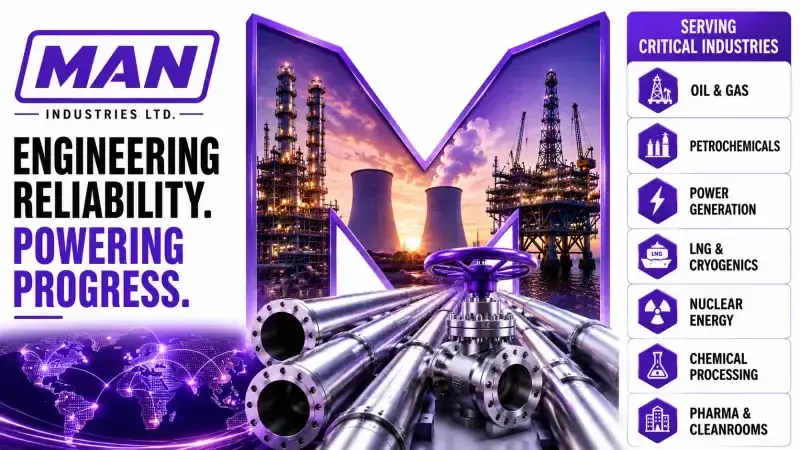
Oil & gas remains a core opportunity, but the water market could become equally important.
Management has highlighted an approximately US$80 billion Saudi water infrastructure programme under Vision 2030 and identified water transmission as an opportunity for the acquired Saudi platform.
This is significant because it broadens the thesis.
MAN does not have to depend entirely on another wave of oil & gas investment. It can participate in water transmission, desalination-related infrastructure, industrial projects and other large-scale infrastructure requirements. At 80–85% utilisation, management estimates potential KSA revenue of approximately ₹3,500–4,000 crore with EBITDA margins of 15–18%.
In other words, the Saudi platform, if it eventually reaches management's potential estimates, could become a business of a scale comparable to the company's entire existing operation.
Of course, potential is not the same as realised earnings. NPC will have to be integrated successfully. Utilisation will have to rise. Orders will need to convert into revenue. Margins will need to remain healthy.
But the strategic logic is clear.
The company is investing approximately US$40 million in a pipe-coating facility with annual capacity of around 4 million square metres, targeted for commissioning by mid-2027. Management expects EBITDA margins of approximately 25–35%, depending on coating type.
That may appear to be a smaller project compared with the NPC acquisition.
The Next Step Is to Capture More Value From Every Project
A steel pipe by itself is only one part of the pipeline value chain.
Depending on the application, the pipe may require specialised coating to protect it from corrosion and extend its operating life.
For customers executing large infrastructure projects, having manufacturing and coating capabilities available through an integrated platform can simplify procurement, logistics and project management.
This is why the Dammam coating facility matters.
MAN already manufactures pipes. NPC gives it manufacturing capacity inside Saudi Arabia.
The coating facility can add another important layer around that manufacturing base. Management believes that once the Dammam facility becomes operational, MAN-NPC could be among the few GCC players capable of offering integrated pipe manufacturing and coating solutions from a single platform for large, time-sensitive Aramco and SWCC projects.
That creates the possibility of increasing the amount of value MAN captures from each project.
This is an important distinction.
The first phase of MAN's growth was primarily about establishing manufacturing capacity. The next phase appears to be about increasing the value density of that capacity. The Jammu project supports the same argument from a different direction.
MAN is developing a greenfield stainless-steel seamless pipe facility in Jammu, with construction expected to be completed by December 2026 and commercial production targeted for March 2027. Revenue contribution is expected from FY28 onwards.
Stainless-steel seamless pipes are not simply another version of the company's existing large-diameter pipe products. They allow MAN to participate in applications requiring different material characteristics and potentially higher specifications.
Management has indicated an expected EBITDA margin of approximately 18–22% for the Jammu project.
This gives MAN another potential growth engine. The company's expansion is therefore becoming increasingly multi-dimensional.
This is why the company is beginning to look less like a traditional pipe manufacturer and more like an industrial platform built around pipelines.
But for this transformation to matter to shareholders, the strategy eventually has to show up in the financial statements.
MAN Industries' Financials Are Starting to Confirm the Story
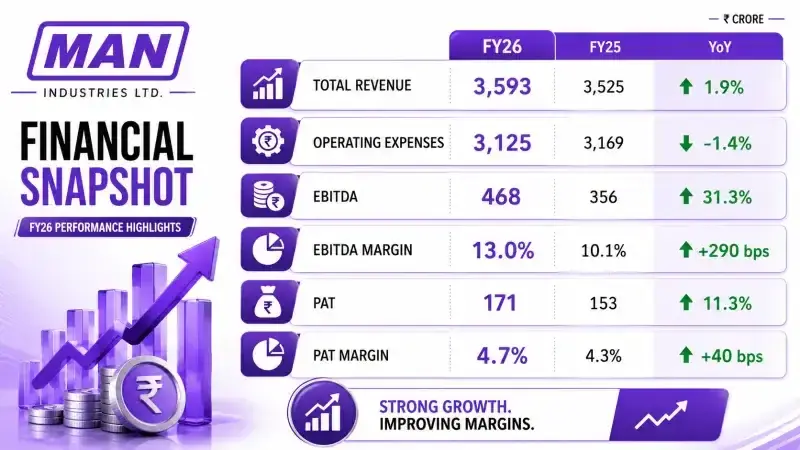
This operating leverage was clearly visible at the EBITDA level. EBITDA increased 31.3% YoY from ₹356 crore to ₹468 crore, while EBITDA margin expanded sharply from 10.1% to 13.0%, a 290 bps improvement. The expansion is particularly noteworthy because it was achieved despite only 1.7% growth in revenue, indicating an improvement in the company's underlying operating efficiency and profitability. Management has also attributed the improvement in margins to a more favourable product and geographic mix and stronger execution.
The improvement at the operating level, however, was partly absorbed below EBITDA. Depreciation and amortisation increased 74.4% to ₹79 crore, while finance costs rose 48.1% to ₹152 crore. As a result, PBT increased at a more moderate pace of 13.7% YoY, from ₹208 crore to ₹237 crore. Tax expenses also increased 20.4% to ₹67 crore, leading to consolidated PAT growth of 11.3% YoY from ₹153 crore to ₹171 crore. PAT margin nevertheless improved from 4.3% to 4.7% YoY, expanded by 40 bps.
The key takeaway from FY26 is therefore not revenue growth, but earnings quality at the operating level. MAN Industries generated an additional ₹112 crore of EBITDA on just ₹59 crore of incremental revenue, demonstrating significant operating leverage. The challenge going forward will be to ensure that the benefits of higher EBITDA margins translate into stronger PAT and, importantly, cash generation as depreciation, finance costs and capital expenditure increase with the company's ongoing expansion.
The Opportunity Is Large, But Execution Will Decide the Outcome
But large opportunities also create large expectations.
The company is simultaneously expanding in Saudi Arabia, building a stainless-steel facility in Jammu and developing a coating business in Dammam. Managing all three successfully will require capital, execution capability and disciplined project management.
Infrastructure businesses can look excellent on the income statement while consuming significant working capital. Materials have to be purchased, labour and contractors have to be paid and project execution happens before customers necessarily pay.
That is why investors should not evaluate MAN purely on revenue and EBITDA. They should watch whether operating cash flow and free cash flow rise alongside earnings. Return on capital will become equally important. This is where the cash-flow statement becomes critical: reported profits can look strong while working capital and capital expenditure absorb cash. For a practical framework, read Cash Flow Statement Explained: The Most Honest Financial Report
A company can double its capacity and revenue while creating very little shareholder value if the incremental capital earns inadequate returns.
And that brings us to the risks.
The first major risk is therefore execution.
A delay in commissioning Jammu pushes out the revenue opportunity. A delay in Dammam delays the higher-margin coating opportunity. A slower-than-expected ramp-up at NPC reduces the contribution from the Saudi acquisition.
The second risk is utilisation.
Manufacturing capacity looks impressive on an investor presentation, but unused capacity does not generate returns. The key question is not how many tonnes MAN can theoretically produce. It is how many tonnes it can produce consistently at attractive margins.
The third risk is Saudi integration and margin normalisation.
NPC had previously generated higher margins when its business was heavily concentrated on Aramco orders. Management has indicated that the sustainable margin range going forward is around 15–18%, partly because the business is expected to broaden into water and other segments.
That remains attractive, but investors should avoid assuming that the historical peak margin is the new normal.
The fourth risk is geopolitical exposure.
As MAN becomes more dependent on the Middle East, it becomes more exposed to regional tensions, shipping disruptions, currency movements and project delays. The company has already experienced export shipment deferrals because of geopolitical disruptions, demonstrating that these risks are not theoretical.
The fifth risk is capital intensity.
MAN is moving from a relatively established Indian manufacturing base into a period of significant investment. The acquisition, Jammu project and Dammam facility all require capital, and the company needs to ensure that its expansion does not weaken the balance sheet or lead to excessive working-capital requirements.
There is also a more subtle risk. Success itself can become a problem.
“You don't have to do extraordinary things to get extraordinary results.” — Warren Buffett
When a company identifies several attractive opportunities simultaneously, management can become tempted to pursue all of them.
Together, these pieces begin to resemble a platform. Not a platform in the technology-company sense, but an industrial platform built around a specialised capability.
It could become an integrated pipeline infrastructure player positioned at the intersection of India's infrastructure expansion and Saudi Arabia's enormous energy and water investment cycle.
“The stock market is designed to transfer money from the Active to the Patient.” — Warren Buffett
Explore our Products
Research Framework

Emerging Titans
Combination of quantitative analysis, industry tailwinds, and management assessment - SPRINT investment philosophy

Tiny Titans
Heavy emphasis on scuttlebutt research, plant visits, and early on-ground signals
FAQs
What does MAN Industries do?
+MAN Industries manufactures large-diameter steel pipes, including LSAW, HSAW and ERW pipes, along with specialised coating solutions. Its products are used across oil & gas, water transmission, hydrocarbons and city gas distribution (CGD) infrastructure.
What is the biggest growth opportunity for MAN Industries?
+Saudi Arabia is currently the biggest potential growth driver. MAN acquired National Pipe Company (NPC) for US$102 million, gaining a 430,000-tonne operating facility, Aramco approval and an established relationship with Aramco. Management estimates potential KSA revenue of around ₹3,500–4,000 crore at 80–85% utilisation, with EBITDA margins of 15–18%.
What gives MAN Industries a competitive advantage?
+MAN's moat is primarily built around technical capabilities, certifications, customer approvals, manufacturing experience and established relationships. The company has supplied more than 20,000 km of pipes, operates across more than 30 countries and has approvals from major oil & gas customers. These relationships and execution credentials are difficult for a new competitor to replicate quickly.
What are the key upcoming projects for MAN Industries?
+MAN is pursuing three major expansion initiatives:
Jammu: Stainless-steel seamless pipe facility, with commercial production targeted for March 2027.
Dammam: US$40 million pipe-coating facility with approximately 4 million sq. m annual capacity, targeted for mid-2027.
Saudi Arabia: Ramp-up of the recently acquired NPC facility.
Together, these initiatives expand MAN's geography, product portfolio and share of the pipeline value chain.
What are the key risks for MAN Industries?
+The major risks are execution delays, low capacity utilisation, Saudi integration and margin normalisation, geopolitical exposure and high capital intensity. Investors should particularly monitor whether the company's increasing EBITDA translates into operating cash flow, free cash flow and healthy ROCE as its expansion accelerates.

High growth stock specialist, Value Educator
Shashank Mahajan is an equity research professional with over 12 years of experience in identifying high-potential SME and micro-cap stocks at an early stage. He follows a rigorous scuttlebutt research–driven approach, combining on-ground insights with deep financial analysis. Shashank specializes in uncovering under-researched and under-owned companies with strong management quality and long-term growth potential. Through disciplined research and early identification, he focuses on spotting tomorrow’s market leaders before they enter the mainstream investor radar.

Zen Technologies: Revenue Fell After a Big Win




PNG Jewellers: A 194-Year-Old Name Goes National

Explore our Products
Research Framework
Emerging Titans
Combination of quantitative analysis, industry tailwinds, and management assessment - SPRINT investment philosophy
Tiny Titans
Heavy emphasis on scuttlebutt research, plant visits, and early on-ground signals


 Orders
 Subscription
 Share with friends


Required Details
₹23999.00
(12 month subscription)
As per SEBI regulations, all users are mandated to complete the KYC that is validated for 1 year. Post payment, you will be redirected to the KYC screen


No comments yet. Be the first to comment!