Every morning, long before India's cities come alive, an invisible system has already been at work for hours.
Millions of litres of water is travelling through rivers, reservoirs, treatment plants, pumping stations, through hundreds of kilometres of underground pipelines before reaching a kitchen tap. At the same time, electricity generated hundreds of kilometres away is flowing through substations and transmission networks to power factories, hospitals, schools and homes.
Most people never think about these journeys.
They only notice the rare day they stop. SPML Infra has spent decades building the water side of this system.
Infrastructure has a peculiar relationship with society. The better it performs, the less anyone notices it. A city's water network receives little appreciation when every tap runs. A transmission grid earns no headlines when every light turns on. Their success lies in becoming invisible.
That invisibility often extends to investing as well.
Markets naturally gravitate towards businesses that launch new products, build consumer brands, or disrupt existing industries. Infrastructure companies rarely fit that narrative. They do not create value through annual product launches or breakthrough technologies. Their competitive advantage is built differently through engineering capability, decades of execution experience, disciplined project management, and the ability to deliver complex physical assets where failure is simply not an option.
Building infrastructure is less about invention than about solving the same engineering problem repeatedly and reliably, under vastly different conditions. Every project presents its own combination of terrain, geology, weather, regulation, logistics, and financing. Success depends not on writing better software, but on coordinating thousands of workers, suppliers, engineers, and machines over several years while keeping costs, time-lines, and quality under control.
That is precisely why infrastructure remains one of the highest barriers to entry in the economy.
Experience cannot be replicated overnight. A company cannot simply decide to build a 300 MLD water treatment plant or a utility-scale power substation because demand exists. Governments typically require contractors to demonstrate that they have already completed projects of similar size and complexity before they are even allowed to bid. In other words, the experience needed to win large projects can only be gained by having successfully completed large projects in the past.
Execution creates eligibility, eligibility creates opportunity and opportunity compounds into competitive advantage.
This is the cycle that has quietly shaped the company SPML Infra Limited over the past four decades.
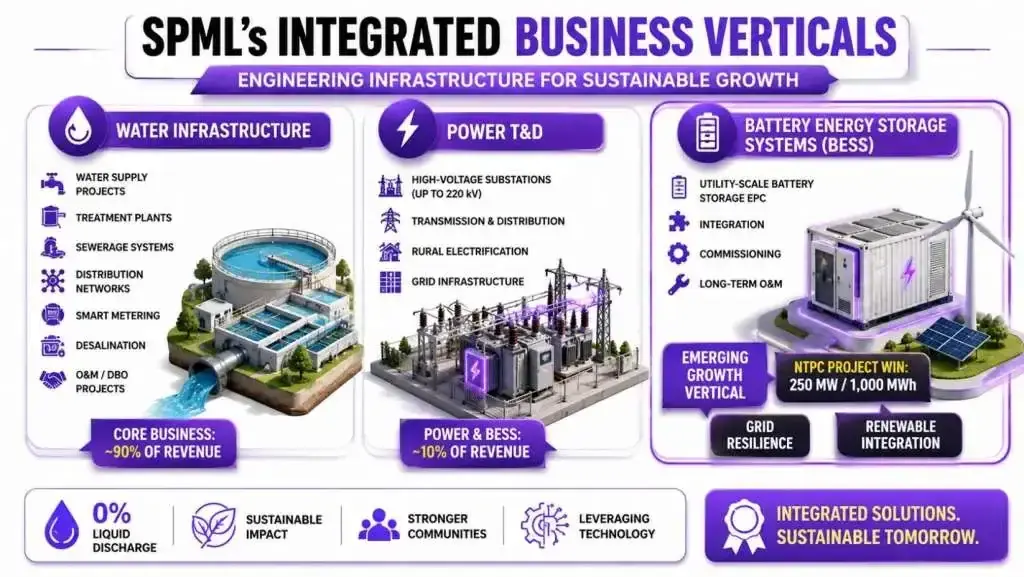
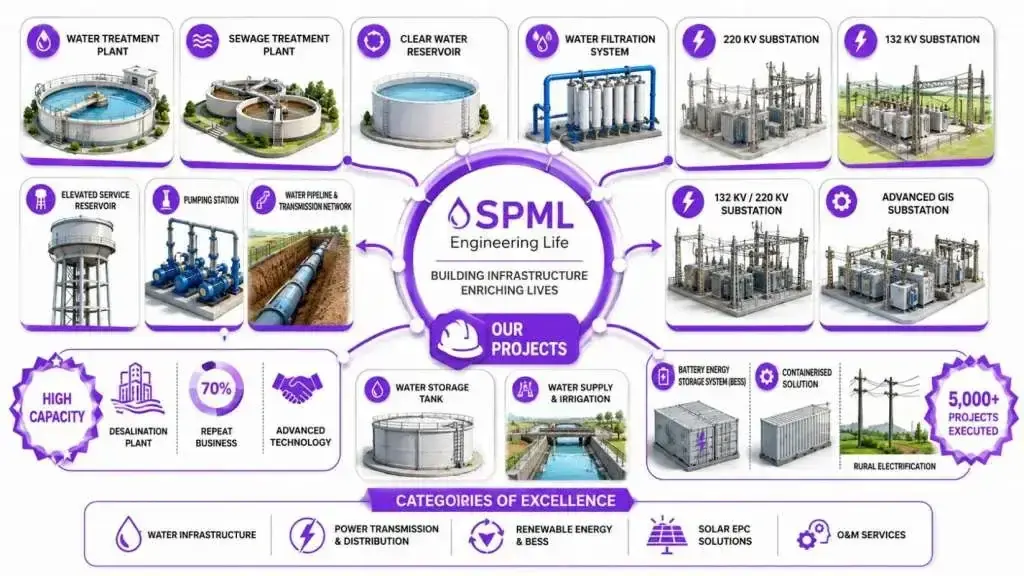
While many investors associate the company with water infrastructure, that description only captures part of the story. SPML operates across two sectors that appear different on the surface but share remarkably similar engineering foundations: transporting water and transporting electricity. Both require designing large utility networks, executing complex EPC projects, integrating multiple systems, and maintaining critical public infrastructure over long operating lives.
For more than forty years, the company has participated in building these invisible networks across India, executing over 700 EPC projects spanning bulk water transmission, drinking water supply systems, wastewater treatment, power transmission, substations, and rural electrification. The objective has never been simply to construct assets, but to enable essential services that millions of people rely upon every day without ever seeing the engineering behind them.
Yet the story of SPML today is no longer only about water.
India is entering a new phase of infrastructure development. Over the past decade, the national priority was expanding access - bringing drinking water to rural households, extending electricity to underserved regions, and building the physical networks needed to support a rapidly growing economy.
The next phase is different.
It is about making those networks smarter, more reliable, and capable of supporting an energy system increasingly powered by renewable sources.
That transition is creating a new infrastructure challenge, one that looks remarkably similar to the problem SPML has been solving for decades.
The company already knows how to build the physical networks that transport essential resources across the country.
Now it is attempting to apply that same execution capability to one of India's fastest-growing infrastructure opportunities: Battery Energy Storage Systems (BESS).
Understanding whether that transition can create long-term shareholder value requires first understanding the business that built SPML in the first place.
And that business begins with something every civilisation depends upon—but very few people ever think about.
Water!
"The stock market is a device for transferring money from the active to the patient."
— Warren Buffett
The Business of Moving Water
Gravity hides the complexity of moving water, making it seem to be achieved effortless.
A tap is turned on and clean drinking water flows in seconds. The system behind those nitty-gritty operations is one of the very biggest engineering constructions that any single nation employs that can only possibly work continuously throughout the day, throughout the year, regardless of geography, population growth, weather.
Water cannot be "created" where it is used as it can be the case with electricity.
Cities are frequently located more than 100 miles away from a reliable water source. Flow of river can be several hundred kilometres away. The reservoirs are built where it’s located and not where it’s needed. A great amount of water needs to be pumped, moved, treated, stored and then transported through a network of pipelines, pumping stations, and reservoirs to a single household.
Pipelines are subject to changes in elevation, operating pressure, ground motion, and years of continuous use. Pumping water requires a lot of energy, as it has to be uploaded uphill. Before reaching consumers, treatment plants are required to have increasingly higher quality standards all the time. Failure is readily recognised for many industrial processes; interruptions have consequences for families, hospitals, industries, and even entire cities. The movement of water is not only a building process.
Its job is to care for and move safely, efficiently and without interruption, one of the world's heaviest resources, across long distances. It is this, in fact, that accounts for the fact that governments seldom tend to provide such projects on the basis of price only.
The line of work can be opened up by a contractor in an aggressive method, but if they have no experience in completing projects on this level of scale, the repercussions are too extreme, if anything goes wrong. From delayed commissioning of critical pipelines, millions of people may be without safe drinking water. This makes it difficult for all companies to be considered for largescale municipal projects, and means it is more likely to be done by experienced EPC companies who may be the first to apply for the project as they have the technical qualifications to meet the budget.
Like this analysis? Get powerful insights like this every week. No spam.
In water infrastructure, reputation isn't built through advertising - it is earned underground through flawless execution, where each completed project proves capability for the next. This track record creates an competitive moat that SPML Infra has established project by project over four decades.
A durable competitive moat is often what separates long-term compounders from ordinary businesses. Learn how investors identify such advantages in Economic Moat Explained: Why Some Companies Stay Dominant for Decades
Instead of focusing its operations on any one part of the water cycle, the company has evolved its capabilities over time, so it can become involved in all aspects of water from where it is first pumped to where it can be returned to the environment.
This trip starts with bulk water abstraction.
This is the business section that deals with heavy engineering. The water comes from rivers, lakes, reservoirs or canals and is pumped via large diameter transmission pipelines over long distances. They include intake works, pumping stations and large pipe systems that transport millions of litres of water daily, and balancing reservoirs. The high value of the contracts and the engineering complexity of these projects typically result in them being among the largest water infrastructure projects in municipalities.
But, moving water just clears half the issue.
No water is safe to drink unless it has been treated.
It has to go through treatment plant before it becomes a part of the distribution network where impurities are eliminated by physical, chemical and biological processes so it meets drinking water standards. But another engineering challenge now starts, as treated water is distributed with a high degree of reliability to millions of households across the urban distribution system, with appropriate pressure in the network, keeping leakage rates down and adding smart metering systems to optimise the network's operation even more.
For most people, this is the only part they normally come into contact with.
Water must flow out of the tap. That simple moment is made possible by infrastructure which remains largely invisible. But it's not the end of the road.
Eventually, all water provided will turn into wastewater.
If all the elements of the water collection and treatment system are not working properly, then today's drinking water will be a problem for tomorrow. Modern urban infrastructure is not just about providing clean water; it is also about reliably gathering the sewage and treating the wastewater, if at all possible, for reindustrialisation or for use in agriculture. Water is no longer considered a commodity to be used up and thrown away, but a fluid that needs to be continually controlled in a circular format, as the green wave builds across the district. As the green wave travels through the district, water is no longer a resource to be taken and thrown away but rather one that must be continually managed within a circular system.
Together these activities show that SPML is more than a pipeline company.
It is involved in the creation and development of the infrastructure needed for the full cycle of water, from source to city. That makes a difference as India's water situation is evolving.
The focus for decades in the country has been on enlarging the access to drinkable water. Now more is being put behind value of reliability, urbanization, wastewater management, recycling, and smart water distribution networks. The investments are no longer just in the laying of pipelines. It is not only about the modernization of current systems, but also about minimizing losses, optimizing systems, developing infrastructure that can accommodate the rapidly growing cities.
This structural change increases the number of possibilities for companies with skills and general engineering competencies rather than just one segment of water cycle.
For decades, SPML has worked to develop just those skills. While today, water is the company's biggest business, it won’t be the same in its future next decade. Unlike water, the electricity grid, which forms the backbone of India's infrastructure ecosystem, is the next chapter in the country's infrastructure journey and is happening right here.
India's Next Infrastructure Challenge: Energy Storage
The problem with electricity in India was very simple for decades i.e. Generate more power. The economy was rapidly industrialising and the requirement for electricity was greater than that being generated. The answer was equally simple: increase the number of thermal plants, add more hydroelectric generation, expand transmission lines and slowly increase electrification nationwide. That strategy worked.
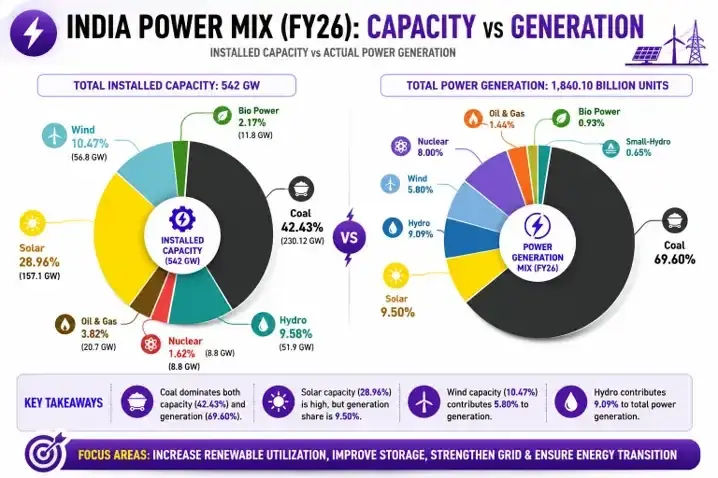
Today, India’s power sector challenge has fundamentally transformed. The country no longer struggles with structural shortfalls in overall electricity generation; instead, the core difficulty lies in effectively harnessing and deploying renewable power at the precise moments it is needed most. On the surface, this presents a counterintuitive paradox where total generation capacity is abundant, yet the grid struggles to time-shift clean energy to meet real-time demand patterns.
After all, India is one of the fastest growing markets for Renewable Energy in the world. Solar parks are spread across the states of Rajasthan and Gujarat to the tune of gigawatts. Wind farms are established along the sea shores of Tamilnadu and Gujarat. Renewable energy continues to grow every year towards the goals of 500 GW of non-fossil fuel capacity by 2030.
However, installed capacity only conveys part of the picture.
A solar plant can produce electricity all day long, and demand might not be at its peak when it's at its peak. Consumption tends to be highest after dark, which is when sun energy is falling to zero. The same issue exists with wind generation: it varies in accordance with the weather, not according to which consumers are using it.
Unlike water, a drawback of electricity is that it can only be transported over a distance if you know where the source of electricity is located.
It may not just be made and consumed the next day.
Throughout most of the grid's history, generation and consumption needed to take place very close together. Each of the units produced required an almost immediate consumer. When there was more electricity available than was needed, electricity was sometimes limited. When demand was greater than supply, utilities had a shortage or had to utilize expensive peaking power.
Historically, the power grid was designed to maintain real-time balance rather than store energy, an approach that functioned seamlessly when fossil fuels and hydroelectric plants could be ramped up or down to meet fluctuating demand. The rise of renewable energy fundamentally disrupts this paradigm, as solar and wind generation are governed by weather patterns rather than consumer behaviour. Consequently, the core challenge of the energy transition has shifted from merely producing green power to storing it for when it is needed most. In this evolving landscape, Battery Energy Storage Systems (BESS) are critical; acting not as energy generators, but as strategic reservoirs that absorb surplus power during periods of abundance and discharge it into the grid during peak demand. A utility-scale battery has exactly the same role as electricity. It consumes excess electricity that is produced during high renewable energy generation times, such as afternoons with sunshine or nights with wind, and which might otherwise be lost. As demand increases later on in the day, the stored electricity can be returned to the grid, making for a more reliable power supply without needing to generate more fossil fuel electricity.
But in that sense, batteries are not “competing” with renewables.
They are facilitating it!
As more intermittent renewables enter the grid mix, the more valuable large-scale storage becomes.
This is one of the key facts investors may be misled by is the following.
India already has a significant amount in renewable generation capacity but the share of renewable generation in the generation mix is much smaller. It isn't just about the production of more solar or wind energy. It represents the general issue of transmission limitations, grid balancing and, more recently, the scarcity of utility scale storage in particular.
That's why energy storage has transitioned from a niche technology to a priority infrastructure for the nation.
Recent policy measures have started to provide support for large-scale battery use, such as via viability gap funding and dedicated storage tenders, as the investments in renewable generation require complementary investment in storage infrastructure to the same extent.
It alters the opportunity altogether for the infrastructure companies.
Establishing a battery manufacturing plant requires massive capital expenditure and exposes a company to rapid technology obsolescence. In contrast, developing grid-scale storage infrastructure relies on systems integration, utility relationships, and engineering execution. These represent two distinct business models with entirely different risk profiles and capital requirements.
The company requires years of research and development, billions of rupees of capital expenditure and advanced electrochemistry to manufacture these lithium-ion cells.
Installing utility-scale battery systems, however, is a fundamentally infrastructure project.
It involves civil works, electrical integration, substations, high voltage connections, control systems, commissioning, and operations and maintenance over its life cycle – all the same disciplines that have been developed over decades of experience by EPC contractors.
This is why a few old school infrastructure firms are starting to get into the energy-storage business.
BESS is not a completely new venture for SPML Infra. In fact they are its extensions.
The company already has decades of experience in the execution of substations, transmission projects and utility infrastructure. It can leverage many of those engineering attributes to one of the fastest expanding power infrastructure markets in India: battery storage.
It's here that SPML's strategy starts to differentiate itself.
Be part of the
Value Educator
community
Get exclusive insights tailored to
sharpen your investment decisions.
SPML's Bet on Battery Energy Storage Systems
SPML isn't trying to build batteries, it's trying to build the infrastructure around them. The buzz around battery energy storage has made it easy to fall prey to the temptation. All companies would like to be exposed to the sector. However, the battery value chain is not as homogeneous as might be thought.
A few businesses produce lithium-ion batteries. Others come together to build battery packs. Others come up with software to control charging and discharging. A storage owner can be a utility; a storage operator can be a utility or an EPC contractor. EPC contractors are the ones who encounter the challenge of designing and building infrastructure that is reliable and suitable for the electricity grid.
Every one is on a very different part of the value chain.
Most important, each must have a drastically different ability set.
One of the most tech-difficult manufacturing operations in the world is the manufacture of lithium-ion cells. It takes years of research and development, specialized materials science, high precision manufacturing and billions of rupees of investment to bring the first commercially viable product to the market. But today, manufacturers continue to deal with constant technological shifts, falling cell costs, and fierce competition from other worldwide manufacturers who have long experience.
It's not SPML's business – neither is it attempting to become one.
Rather than entering into battery chemistry battle, SPML has decided to compete in the areas where it has decades of experience: engineering, system integration, and the utility infrastructure.
This distinction does a lot to alter the economics and execution risk.
Consider a Battery Energy Storage System a large industrial project instead of a collection of battery cells.
The batteries are one part of it.
Power conversion systems, transformers, switchgear, battery thermal management, battery management systems, energy management software, civil foundations, high voltage interconnections, grid integration, com-missioning, testing and long term maintenance are also necessary to install a utility scale installation.
A battery project is an engineering project not just a manufacturing project.
Here is where the existing skills and expertise of the SPML team comes into play.
The company has already gained experience in shaping, integrating and commissioning large utility assets, having worked on a number of substation and transmission projects and complex EPC work for decades. There are new technologies for battery storage, but the project execution disciplines - planning, procurement, civil construction, electrical integration and commissioning - are all familiar.
SPML is not new but rather an extension of an existing ability to an adjacent market.
The company's partnership with the global energy storage solution provider Energy Vault, is in keeping with that strategic move.
SPML has chosen to sign a long-term technology licensing and transfer agreement that enables the company to access Energy Vault's designs for its energy management platform, VaultOS, and its B-VAULT container designs, rather than building its own. This enables SPML to invest in the localization, manufacturing, and project execution without trying to duplicate the years of specialized research and development.
"It's far better to buy a wonderful company at a fair price than a fair company at a wonderful price."
— Warren Buffett
This is significant from an investor's point of view. In fast-changing sectors, technology risk can be a prime uncertainty. The batteries are continually being refined. Programs get more advanced and versatile. Product standards evolve.
With SPML sharing this technology that has already been proven, rather than trying to reinvent it on their own, the company helps to eliminate a lot of the technology uncertainty and focuses on the piece of the value chain they know best: delivering infrastructure projects.
Why Execution Is SPML's Competitive Advantage
The business shifts away from invention to execution for its competitive advantage.
To support this strategy, SPML has already procured around 25 acres of industrial property at Supa MIDC, Pune for setting-up a dedicated factory for manufacturing and integration of Battery Energy Storage System. The first phase involves the commissioning of a 2.5 GWh production line while the second is planned to expand to 5 GWh. The total investment is projected to be in the range of ₹175 crore, which will be sourced from the investment of the company and preferential capital raised by the company.
Even by the world's battery production, it's a fairly low-single-digit investment.
That's mainly because SPML isn't building a fully-fledged lithium-ion cell unit manufacturing ecosystem.
It features a facility for assembling, integrating and deploying complete battery energy storage solutions from licensed technology, where the capital intensity would be significantly lower compared to producing the cells in the upstream battery business.
The current potential annual revenue is estimated to be around ₹4,000 to ₹5,000 crore with the facility reaching its planned 5 GWh capacity. The number should be considered a long-term management goal rather than an actual forecast, as revenue will also be determined by how much is being used, orders received, pricing and execution. The strongest initial sign of success in this path came before the plant was even open to commercial operations.
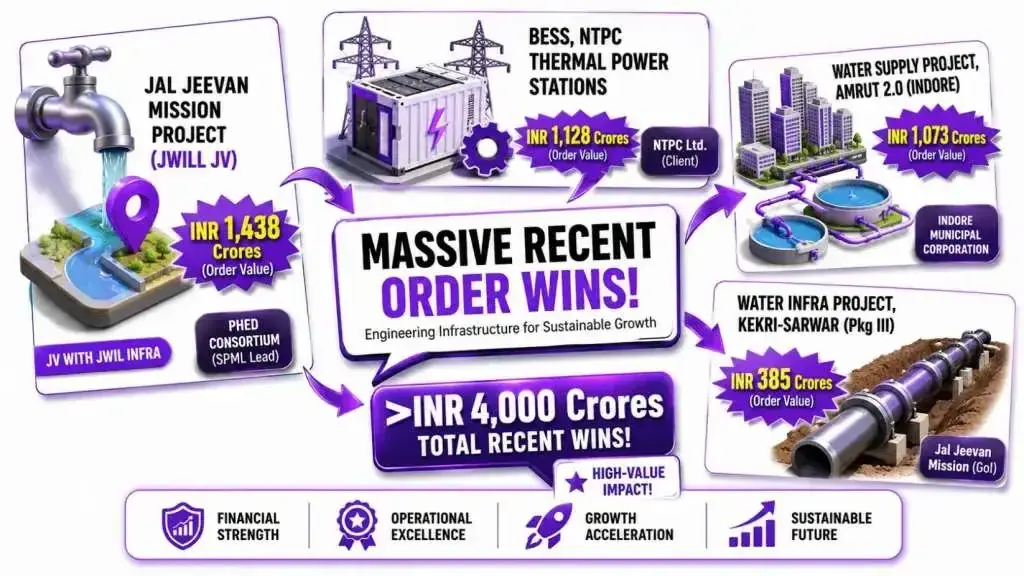
SPML obtained a contract for ₹1,128 crore from NTPC for the construction of a 1GWh Battery Energy Storage System at its Barauni Thermal Power Station (BTS) in Bihar. More than simply providing battery containers. This covers civil, electrical systems, high voltage switch yards, battery management systems, thermal management systems, commissioning and a long-term operations and maintenance agreement. In other words, the contract indicates the type of infrastructure project integrated in exactly the way SPML has historically delivered value to its clients in EPCs.
Beyond its headline financial value, this landmark order proves that utilities are already willing to entrust SPML Infra with large-scale battery projects despite India’s utility-scale storage market being in its infancy, effectively eliminating any uncertainty surrounding its order-win capability. The strategic focus now shifts entirely to execution—whether SPML can consistently deliver, scale its capacity, and consolidate its early mover advantage in India's long-term energy storage race. Ultimately, in public infrastructure, winning a contract is merely the starting line; sustainable value creation depends on execution backed by institutional credibility—SPML’s ultimate moat that grants it pre-qualification access to high-value projects competitors cannot even bid on.
In the infrastructure sector, credibility serves as a far more critical moat than capital because public project failures carry severe political, financial, and regulatory consequences. To mitigate execution risk, government procurement mandates strict pre-qualification criteria based on past project scale and complexity, creating a virtuous cycle where successful delivery unlocks eligibility for larger, non linearly complex contracts. SPML Infra’s four-decade track record of over 700 completed projects forms an institutional pre-qualification barrier that protects its market access and establishes deep, trust based relationships with state utilities.
This execution credibility is particularly valuable as SPML pivots into high growth adjacencies like Battery Energy Storage Systems (BESS), where utilities still procure projects using traditional EPC frameworks that demand proven integration capabilities over unproven experimentation. Crucially, following past balance sheet distress, SPML’s recent evolution is defined by a strategic shift from chasing top line volume to disciplined, selective bidding. By prioritizing high margin, cash generative projects with favourable commercial terms over sheer order book size, management is transforming the company’s focus toward capital allocation efficiency and sustainable profitability.
"The key to investing is determining the competitive advantage of any given company and, above all, the durability of that advantage."
— Warren Buffett
SPML 2.0: A Turnaround Is Only Meaningful If the Business Changes
Corporate turnarounds often attract significant investor attention, but history suggests that many of them ultimately disappoint. A company reporting a few quarters of improved profitability or announcing a reduction in debt does not necessarily become a fundamentally stronger business. Temporary improvements can result from favourable commodity prices, one-time gains or cyclical recoveries, only to reverse when external conditions change. The more important question for investors is not whether the financial statements have improved, but whether the business itself has become structurally different.
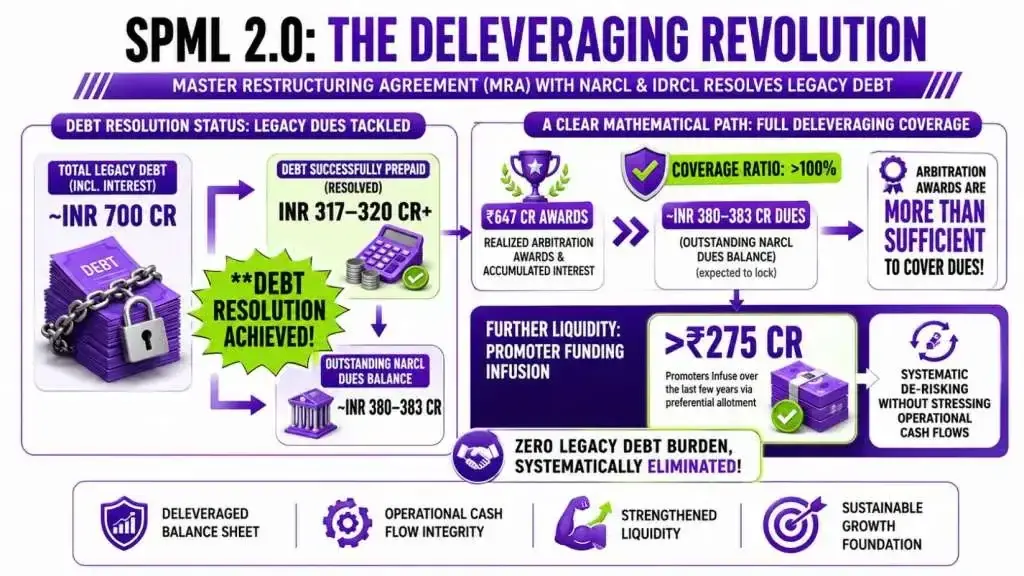
During the previous decade, the company experienced a prolonged period of financial stress driven by delayed receivables, arbitration claims and an increasingly leveraged balance sheet. Although many of its projects had been completed successfully, payments from government authorities and public sector clients remained tied up in contractual disputes. The result was a business with strong engineering capabilities but limited financial flexibility. Higher borrowing costs reduced profitability, constrained growth and forced management to devote considerable attention to balance-sheet repair rather than business expansion.
The developments over the past few years, however, suggest that management has approached this challenge through a combination of financial discipline and operational restructuring rather than relying solely on cyclical recovery. A significant portion of legacy arbitration claims has either been resolved or progressed through the legal process, resulting in cash inflows that have strengthened liquidity. Simultaneously, the company has reduced debt, improved its net worth and rebuilt its financial position, providing greater flexibility to pursue new growth opportunities without placing undue pressure on the balance sheet.
Infrastructure companies often measure success by the size of their order books, creating an incentive to pursue every available project regardless of its commercial attractiveness. While this approach can produce impressive revenue growth during favourable market conditions, it frequently leads to margin pressure, working capital strain and elevated execution risk. SPML appears to have consciously moved away from this strategy. Management has repeatedly emphasised selective bidding, preferring projects with stronger payment mechanisms, better contractual terms and healthier return profiles over aggressive expansion. This represents a subtle but meaningful shift in capital allocation. Rather than maximising revenue, the company is increasingly focused on maximising the quality of revenue.
Revenue alone rarely tells the full story of a business. Understanding where profits actually come from is equally important. Read Segment-Wise Revenue Analysis: How to Find a Company's True Growth Engine.
This change also aligns well with the broader evolution of India's infrastructure market. Over the past decade, the emphasis was largely on expanding physical infrastructure as quickly as possible. Today, many government agencies are placing greater importance on project quality, lifecycle costs and timely execution. Contractors capable of consistently delivering complex projects while maintaining financial discipline are likely to be better positioned than those competing primarily on price. In such an environment, selective bidding is not merely a defensive strategy—it can become a competitive advantage.
"Risk means more things can happen than will happen."
— Elroy Dimson
The Financial Renaissance: A Foundation for Growth
This restored financial flexibility has enabled SPML to evolve from a traditional water EPC firm into a comprehensive utility infrastructure platform. By expanding into Battery Energy Storage Systems (BESS) through system integration and technology licensing with Energy Vault—avoiding the capital-intensive risks of upstream cell manufacturing—SPML is effectively redeploying its 40-year engineering and execution credibility into a high-growth clean energy vertical. While the growth outlook is compelling, investors should evaluate performance through the lens of infrastructure's operational and cash-flow realities. Earnings are likely to remain uneven from quarter to quarter due to project milestones, execution schedules and the timing of revenue recognition. Working capital requirements will continue to fluctuate, and receivable collection will remain an important variable, particularly given the company's exposure to government clients. These characteristics are inherent to the EPC business model and should not be interpreted as evidence that the turnaround has failed. Instead, they highlight why long-term evaluation should focus on execution quality, cash generation and return on capital rather than short-term earnings volatility.
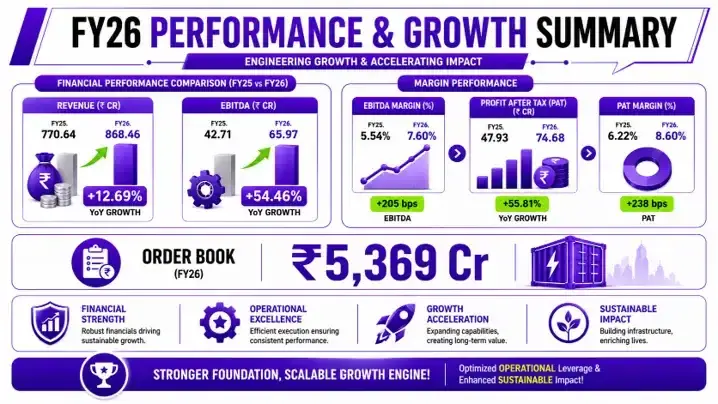
Ultimately, the significance of SPML's turnaround extends beyond cleaner financial statements. The company appears to have emerged with a different strategic mindset—one that places greater emphasis on disciplined capital allocation, stronger project selection and adjacent growth opportunities that leverage its existing engineering capabilities. If this discipline is maintained, the turnaround will represent more than a recovery from past challenges; it will mark the beginning of a fundamentally different phase in the company's evolution.
Join 1,45,000+ investors discovering under-researched small caps before they rerate.
From Water Infrastructure to a Utility Infrastructure Platform
At its core, the investment case for SPML Infra is not based on the assumption that India will spend more on water infrastructure or that battery energy storage will become an attractive industry. Both of these trends are already visible. Government expenditure on water supply, urban infrastructure and renewable energy integration has increased steadily over the past decade and is likely to remain a structural priority as India continues to urbanise and expand its electricity network. The more relevant question is whether SPML is positioned to participate in these opportunities while earning attractive returns on capital.
SPML Infra is leveraging its over four decades of multi-vertical EPC experience across water and power transmission to position itself as a comprehensive utility infrastructure platform. Its expansion into Battery Energy Storage Systems (BESS)—focused on system integration and technology licensing from Energy Vault—allows the company to capture high-growth energy transition opportunities while avoiding the capital-intensive and technological risks of upstream cell manufacturing.
"The best opportunities are found where everyone else is looking in the wrong direction."
— Howard Marks
Crucially, this transition is supported by a fundamental strategic shift toward capital discipline, balance-sheet repair, and selective bidding that prioritizes margin quality and cash flow over sheer order book expansion. While the business remains exposed to inherent EPC risks such as working capital fluctuations and government approval delays, SPML's initial NTPC BESS win underscores its execution credibility. Long-term shareholder value creation will ultimately depend on management’s ability to maintain capital discipline and consistently replicate this execution success across its expanding project portfolio.
Every morning, millions of Indians turn on a tap without wondering how the water arrived. Every evening, lights illuminate homes without anyone thinking about the infrastructure balancing electricity across the grid.
The best infrastructure is invisible.
The best infrastructure companies often are too.
Market Cap focus
No. of ideas in a year
Holding period
Pricing

Emerging Titans
Combination of quantitative analysis, industry tailwinds, and management assessment - SPRINT investment philosophy
Multi Cap
20-25
3+ Years
Rs. 23,999/year

Tiny Titans
Heavy emphasis on scuttlebutt research, plant visits, and early on-ground signals
Exclusively for SME's
15-20
3+ years
Rs. 31,999/year
FAQs
What does SPML Infra do?
+
SPML Infra Limited is an Indian infrastructure EPC company with over four decades of experience in water infrastructure, power transmission, substations, and utility projects. The company has executed more than 700 projects across India, covering bulk water supply, drinking water systems, wastewater treatment, power infrastructure, and rural electrification. It is now expanding into Battery Energy Storage Systems (BESS), leveraging its existing engineering and project execution capabilities.
Why is SPML Infra entering the Battery Energy Storage System (BESS) business?
+
India's rapid adoption of renewable energy has created a growing need for utility-scale energy storage to balance the electricity grid. Instead of manufacturing battery cells, SPML is focusing on designing, integrating, installing, and maintaining Battery Energy Storage Systems. This strategy allows the company to utilise its decades of EPC and power infrastructure expertise while avoiding the technological and capital-intensive risks associated with battery manufacturing.
What is SPML Infra's competitive advantage?
+
SPML's primary competitive advantage lies in its execution capability. Government infrastructure projects require contractors to demonstrate successful completion of similar large-scale projects before qualifying for new tenders. With over 40 years of experience and more than 700 completed projects, SPML has built a strong execution track record, enabling it to compete for complex utility infrastructure projects that many newer companies cannot bid for.
How is SPML Infra reducing the risks associated with its BESS expansion?
+
Rather than developing battery technology in-house, SPML has partnered with Energy Vault under a technology licensing agreement. This provides access to proven battery storage designs and software while allowing SPML to focus on engineering, project execution, manufacturing integration, and long-term operations. This approach reduces technology risk and enables the company to concentrate on its core competency of infrastructure execution.
What are the biggest risks investors should consider before investing in SPML Infra?
+
Although SPML's financial position has improved significantly, it continues to operate in the EPC infrastructure sector, where earnings can fluctuate due to project execution schedules, working capital requirements, and payment cycles from government clients. The long-term success of the company will depend on disciplined capital allocation, efficient execution of its BESS projects, timely receivable collections, and maintaining profitability through selective bidding rather than aggressive expansion.
About the author

Shashank Mahajan
High growth stock specialist, Value Educator
Shashank Mahajan is an equity research professional with over 12 years of experience in identifying high-potential SME and micro-cap stocks at an early stage. He follows a rigorous scuttlebutt research–driven approach, combining on-ground insights with deep financial analysis. Shashank specializes in uncovering under-researched and under-owned companies with strong management quality and long-term growth potential. Through disciplined research and early identification, he focuses on spotting tomorrow’s market leaders before they enter the mainstream investor radar.
Join 1,45,000+ investors discovering under-researched small caps before they rerate.








 Orders
 Subscription
 Share with friends


No comments yet. Be the first to comment!