
Jindal SAW: The Pipe Network Beneath India
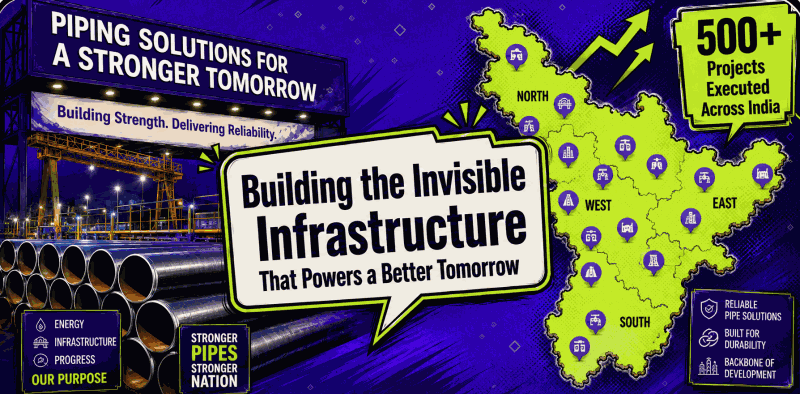
Every morning starts pretty much the same way. You turn a tap and water comes out. You light the stove and gas is there. Somewhere, far away, a power plant is humming along and a refinery is doing its job. It feels effortless. That's kind of the whole point — nobody stops mid-breakfast to wonder how that gas travelled a thousand kilometres to reach their kitchen burner.
The answer is under our feet. Literally. And one of the biggest Indian makers of those pipes is Jindal SAW. There's a massive, invisible network of pipelines running beneath cities and farmland that keeps everything moving — water flowing, industries running, economies humming along. Take it away and refineries stop, taps run dry, and growth grinds to a halt. Most people only notice this system when something goes wrong: a burst main flooding a street, a gas leak shutting down a block, a refinery starved of crude because a line is down. The rest of the time it just works, quietly, underground, completely out of mind.
One company has spent years quietly building this hidden infrastructure.
Meet Jindal SAW.
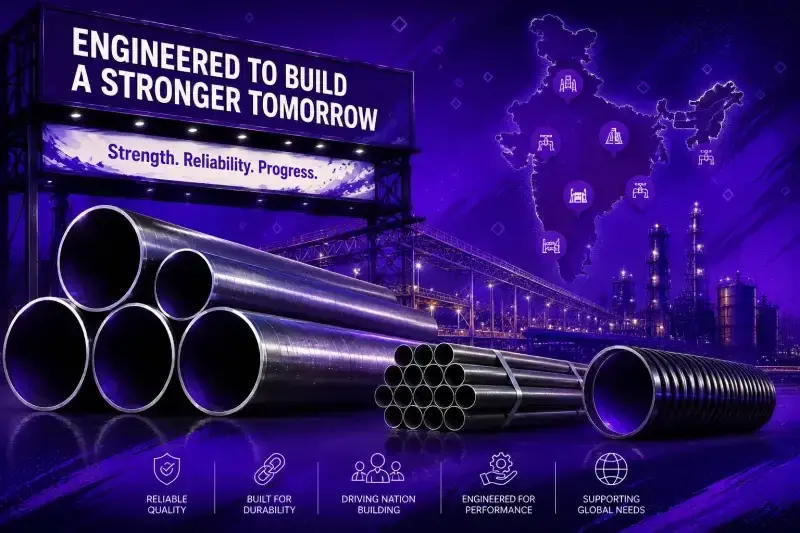
A major manufacturer of SAW pipes, Ductile Iron (DI) pipes, and Seamless pipes, serving water, oil & gas, power, and industrial customers in India and abroad. It's not exactly a household name. But that's sort of the point — the most important infrastructure businesses rarely are.
Roads and airports get all the headlines. Pipelines don't, even though they're arguably more essential. No pipeline, no drinking water. No transmission network, no gas at your door. No pipe, no crude reaching a refinery. No sewage line, no working sanitation for a city of millions. Pipelines are the blood vessels of an economy — invisible when they work, impossible to ignore the second they don't. Funny how that works: the more reliable something becomes, the less anyone thinks about it.
For a long time, pipes were seen as a boring commodity — buy from whoever's cheapest, move on. That view is changing fast. Governments across the world are pouring money into water networks, sanitation, gas transport, and industrial expansion. At the same time, aging pipeline systems in older economies need replacing, while entirely new ones are being laid from scratch in developing markets. Pipes have quietly turned into strategic infrastructure, tied to economic growth, energy security, and public welfare all at once. The global pipe market is expected to keep growing steadily over the next decade, and given the scale of India's ongoing infrastructure push, this country is likely to grow faster than most.
India, in particular, looks like one of the more promising long-term markets here — and not just because of its size. The country's infrastructure ambitions go well beyond roads and railways. Drinking water, irrigation, gas distribution, industrial corridors, sanitation — large, sustained money is flowing into all of it. The Jal Jeevan Mission is pushing piped water deep into rural India. The "One Nation, One Gas Grid" plan is steadily expanding the country's gas backbone. Every new refinery, industrial park, water treatment plant, or irrigation project needs thousands of kilometres of specially engineered pipeline underneath it before any of it can actually function.
Unlike industries that rise and fall with consumer moods, demand for pipeline infrastructure tracks the pace of a country's long-term economic development. It doesn't vanish when sentiment turns cautious, and it doesn't need a marketing push to keep going. That makes it one of the more boring — in a good way — themes in infrastructure. The kind of business that compounds quietly while flashier sectors grab all the attention.
Worth noting too: not all pipes are the same. A pipe carrying drinking water needs nothing like the specs of one carrying crude oil at extreme pressure. Gas pipelines need serious corrosion resistance. Sewage systems need their own kind of toughness. Pipes headed for power plants, refineries, or petrochemical facilities have to hold up under extreme heat and pressure, and offshore projects push those demands even further, into some genuinely brutal operating environments.
Each application needs different manufacturing methods, different engineering know-how, different quality certifications. The tougher the spec, the fewer companies can reliably deliver it.
Companies that consistently meet demanding industry standards often build durable competitive advantages over time. We explain this concept in Economic Moat Explained: Why Some Companies Stay Dominant for Decades.
That gap is where the real barriers to entry live in this business.
You can't just undercut on price and win here. Qualifying for these projects alone can take years.
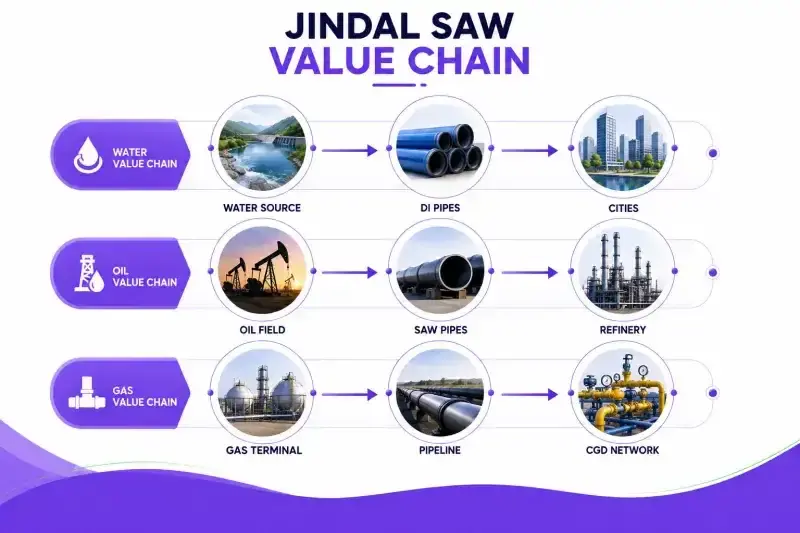
This is roughly where Jindal SAW has carved out its space — not as a single-product pipe maker chasing whatever tender shows up, but as an integrated player spanning Large Diameter SAW Pipes for oil, gas and water transmission; Ductile Iron Pipes for drinking water and sewage; Seamless Pipes for power, refinery and petrochemical use; plus anti-corrosion coatings, fittings, bends and flanges on the side. Manufacturing happens across plants in India, with additional operations in the UAE and the US extending its reach well past domestic borders.
Looked at this way, calling Jindal SAW "just another steel company" misses the point entirely. It sits right at the intersection of three long-term structural themes: urbanization, water security, and industrial-energy infrastructure. Its products stay buried underground, invisible to anyone using them, and yet they form the backbone of some of the most critical services a modern economy leans on every single day.
So the real question for an investor isn't whether these themes are genuine. They clearly are, and they're backed by sustained government spending, not fickle consumer sentiment.
The real question is whether Jindal SAW specifically can turn that opportunity into durable value for shareholders over time.
Plenty of companies have sat in the middle of a great industry and still failed their shareholders.
To figure out if this one's different, we need to look at four things: the order book, the financials, the risks that could derail things, and finally whether it all adds up to something worth investing in.
"Price is what you pay. Value is what you get." — Warren Buffett
The Order Book: A Roadmap of Future Revenue
For a project-based business like this one, the order book isn't just a number sitting in an investor deck. It's closer to a preview of the next few years of revenue — not what the company earned yesterday, but roughly what it should earn over coming quarters, assuming execution goes reasonably to plan.Here's a way to picture it. Two businesses. One's a restaurant living off nightly walk-in traffic — some evenings packed, some dead quiet, no way to know in advance. The other's a catering company that's already signed contracts for a full year of weddings and corporate events. The second business has far more visibility, even though technically neither has "earned" the money yet. Infrastructure companies work a lot like the caterer. Today's order book becomes tomorrow's revenue, recognized gradually as projects grind through execution, milestone by milestone.
That's why the recent trend in Jindal SAW's order book is worth paying attention to. In Q2 FY26, the company's total pipe order book climbed to about 19.25 lakh metric tonnes — one of the highest levels in the company's history. And it didn't taper off after that, the way you might expect if demand were softening underneath. Instead it grew further, to roughly 19.64 lakh metric tonnes by December 2025. Even while the company was wrestling with short-term execution headaches, customers kept placing new orders.
That tells you something. The friction was on the delivery side, not the demand side.
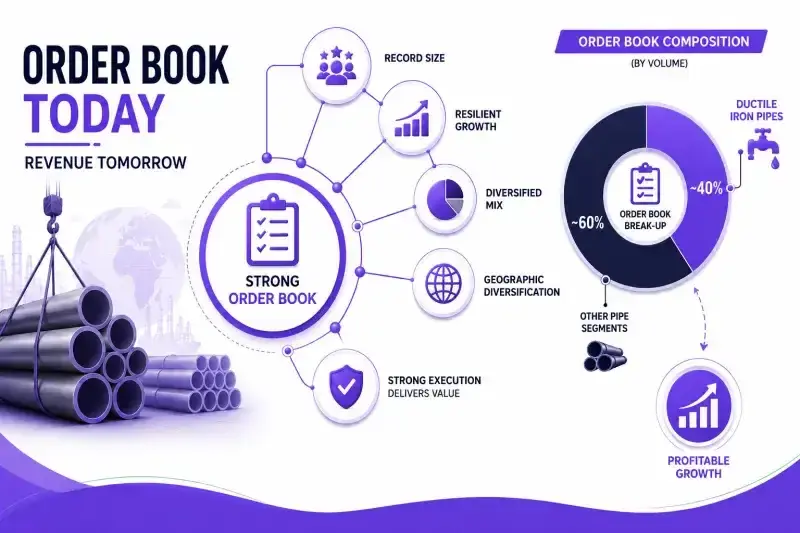
What the backlog is made of matters just as much as how big it is. Roughly 40% of it is Ductile Iron pipe orders, tied to a mix of exports and the ongoing Jal Jeevan Mission, with the remaining 60% spread across other segments serving domestic and export customers alike. That spread matters because it limits dependence on any one customer, geography, or product line. If one segment slows — say a temporary lull in domestic water tenders — the rest doesn't automatically get dragged down with it. It gives everyone, management included, a clearer sense of how revenue is likely to play out over the next few quarters.
But experienced investors know a big order book by itself doesn't mean much. Two companies can have identically sized order books and end up delivering very different outcomes for shareholders. The difference is in the quality behind the number — what margins are baked in, how creditworthy the customers are, what the payment terms look like, how long each project takes, how complicated the execution actually is. The headline figure is a fine starting point. Discipline in execution is what decides whether it turns into profitable growth or just a bigger, thinner-margin number.
For project-based businesses, revenue alone rarely tells the full story. Learn how to identify a company's real growth drivers in Segment-Wise Revenue Analysis: How to Find a Company's True Growth Engine
This is exactly why the company's capacity investments deserve to be read alongside the order book rather than on their own. The biggest recent move has been installing a new seamless pipe piercing mill. After a trial run, commercial production kicked off during FY26, adding roughly 1.5 lakh tonnes per annum and pushing total seamless pipe capacity past 4 lakh tonnes per annum. This matters more than the raw tonnage suggests, because seamless pipes go into some of the most technically demanding end-markets around — oil & gas, refineries, petrochemicals, power — where standards are stricter and margins tend to be better. It's not just adding volume; it's pushing the company further into harder-to-replicate, higher-value territory.
The company's export record adds another layer of comfort here. One highlight worth mentioning: an export order for roughly 6.22 lakh metric tonnes of HSAW pipe tied to a large water infrastructure project in Saudi Arabia — one of the biggest such orders the company has ever landed. Production for it began during FY26, and it did more than just pad the order book. It showed, concretely, that Jindal SAW can compete for and win serious infrastructure work internationally, not just wait around for the next domestic tender.
That geographic spread is genuinely useful because infrastructure cycles rarely move in lockstep across countries. A slowdown in one market — local funding delays, an election, a budget cycle — can often get offset by strength somewhere else. For a company this exposed to government-driven capital cycles, having several growth engines running at once in different geographies isn't just a nice diversification story on a slide. It's a real structural cushion.
Put it all together and the order book paints a pretty encouraging picture: record size, resilient growth even through short-term hiccups, healthy spread across products and geographies, and capacity expansion pointed squarely at higher-value work.
But an order book, no matter how big or well spread, is still just a promise of future revenue.
Whether that promise actually shows up — and shows up profitably — comes down to what happens next.
Jindal SAW Financials: Where the Real Test Begins
A growing order book and expanding capacity make for a good story.But stories don't pay dividends.
Shareholders don't own an order book, and they don't own a factory. They own a business, and a business only creates value when it can reliably turn opportunity into revenue, profit, cash flow, and decent returns on the capital it's using.One of the best ways to verify whether profits are translating into real value is by studying cash generation. Read Cash Flow Statement Explained: The Most Honest Financial Report to understand why seasoned investors focus on cash flow alongside earnings.
This is exactly where a lot of infrastructure companies trip up, even in genuinely good industries. To win more projects, they end up competing on price, taking thinner margins just to keep volume moving. Revenue climbs. Margins shrink. Working capital needs balloon as receivables pile up. Debt creeps higher to plug the gap. Cash generation — the thing that actually funds dividends, reinvestment, debt repayment — quietly gets worse. On paper it looks like growth. In reality, shareholders barely feel any of it.
So the smarter question isn't "is revenue growing," it's "is this growth actually making the business stronger over time, or just inflating the top line." For Jindal SAW, the honest answer over the past year is: it's been mixed. Worth walking through why.
The company's performance took a hit on profitability during FY26 and into early FY27, even with the broader industry backdrop staying favorable. Revenue growth held up decently, but EBITDA and profit after tax both came in below the unusually strong numbers from the year before. Management pointed to a fairly specific set of causes: water infrastructure projects that ran behind schedule, delayed payments from the EPC contractors running those projects, and some temporary export disruption tied to geopolitical noise. And in call after call, management kept insisting customer demand hadn't actually weakened — the real struggle was converting that demand into profitable, on-time sales.
That distinction is worth sitting with for a second, because it separates two very different problems.
A demand problem means customers don't want what you're selling anymore. That's structural, often hard to fix.
An execution problem means customers still want it, you're just struggling to deliver and get paid on time. Uncomfortable, sure, but usually temporary.
Infrastructure businesses, almost by design, tend to run into the second kind far more than the first.
Part of this comes down to how revenue recognition actually works here. A consumer goods company makes something, sells it, and collects cash within weeks. Infrastructure companies run on a completely different clock — projects stretch across months or years, revenue gets recognized bit by bit as work is completed, and payments hinge on milestones, sign-offs, and often government funding cycles that move at their own pace. One delay anywhere in that chain can wreck a single quarter's profitability even while the multi-year demand story stays completely intact. That's basically what management kept repeating through FY26: the problems were operational, not structural. The company wasn't struggling to win new business. It was struggling to finish and collect on business it already had.
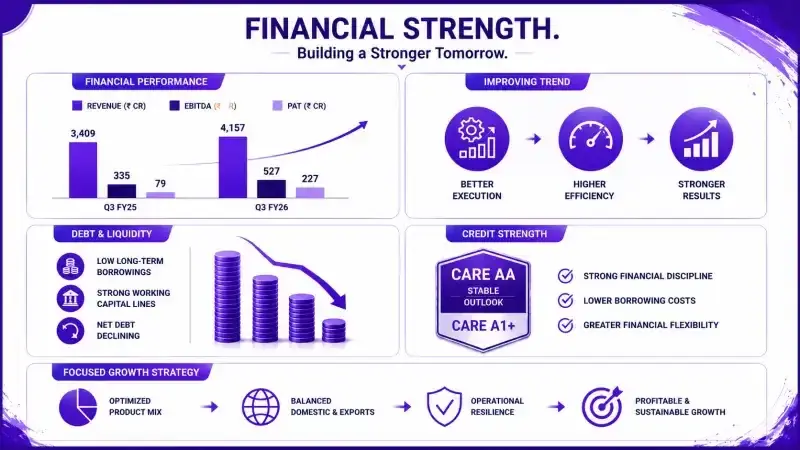
And there were real signs of things turning around as the year went on. After a rough second quarter, the company posted a clear sequential improvement in the third. Standalone revenue rose to roughly ₹4,157 crore in Q3 FY26, up from ₹3,409 crore in the same quarter a year earlier. EBITDA bounced back from ₹335 crore to nearly ₹527 crore, and profit after tax jumped from ₹79 crore to around ₹227 crore over the same stretch. These numbers still sat below the exceptional highs from the previous year. But the direction was unmistakable.
Production, efficiency, and execution were all improving together. Management called Q2 the low point of the cycle and said continued order inflows plus better execution should translate into steady improvement from here.
The balance sheet deserves just as much attention as the P&L in a business like this.
A strong balance sheet often separates companies that survive industry cycles from those that struggle. Our guide How to Read a Balance Sheet Like a Professional Investor explains the key metrics every investor should understand.
Working capital needs for infrastructure companies naturally rise and fall with project execution and customer payment cycles, and that can create real, if temporary, cash pressure. The companies that get through these cycles comfortably tend to be the ones with disciplined debt management and liquidity built in ahead of time — not scrambled together mid-crisis. On this front, management has been fairly consistent across conference calls: long-term borrowings remain relatively low, and most of the debt is tied to working capital rather than permanent leverage. Comfortable banking limits, healthy liquidity, adequate working capital lines — these came up repeatedly, even through the rough patch. More telling, net debt (standalone and consolidated) started declining in the quarters after the low point, which suggests management was actually working on strengthening the balance sheet rather than just waiting out the storm.
There's an outside check on all this too. In FY27, CARE Ratings reaffirmed Jindal SAW's long-term credit rating at CARE AA with a Stable outlook, and kept the short-term rating at CARE A1+. A credit rating obviously isn't a stock tip, and it shouldn't be treated as one. But it is an independent read on financial discipline, debt-servicing ability, and overall borrowing profile. In a capital-heavy business like pipe manufacturing — where huge sums sit tied up in plant, machinery, and working capital for long stretches — a strong, stable rating can genuinely improve financial flexibility and lower long-term borrowing costs. Small edge, but a real one.
Maybe the most encouraging part of all this is the growth strategy management keeps describing. Rather than chasing revenue aggressively regardless of profitability, the stated focus has been on optimizing the product mix, balancing domestic and export work, and building in operational resilience. When domestic water projects slowed due to payment delays, the company leaned harder into exports and kept building out seamless pipe capacity, instead of discounting aggressively just to protect volumes. It's a more deliberate way to grow — one where staying competitive over the long run matters more than winning every tender available right now. In an industry where one badly priced or badly executed project can drag on profitability for years, that kind of discipline isn't a small thing. It's usually the difference between a company that just rides an industry and one that actually compounds value from it.
Key Risks for Jindal SAW: What Could Go Wrong
No infrastructure story is risk-free.Not even this one, no matter how good the long-term backdrop looks. So it's worth being straightforward about where this could go sideways, instead of glossing over the uncomfortable bits.
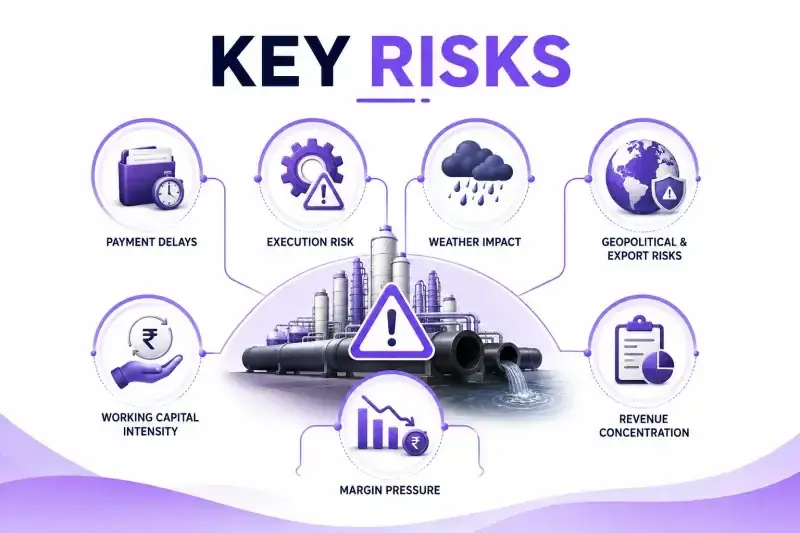
Payment delays from EPC contractors and government-funded projects. A big chunk of the water infrastructure business depends on payments tied to government funding cycles — cycles that run on their own schedule and don't always line up with a company's reporting quarters. When these payments slip, as they did in FY26, sales, margins, and working capital all take a hit at once, even if underlying demand hasn't moved an inch. This is probably the single most visible risk in the recent numbers, and it's not fully within the company's control to fix on its own timeline.
Execution risk, more than demand risk. Management has been fairly consistent about framing recent troubles as operational, not structural — delayed projects, not lost customers. That's a genuinely milder risk to carry. But it's still a risk. Repeated slippage, quarter after quarter, can chip away at investor patience even while the order book keeps growing, simply because markets tend to reward consistent delivery over promised delivery.
Weather. A prolonged monsoon directly hurt operations and profitability in FY26 — a plain reminder that, unlike a digital or asset-light business, physical execution of infrastructure projects is exposed to weather and other stuff nobody can control. And it's not a one-time risk either; every monsoon season carries some chance of throwing schedules off.
Geopolitical and export disruptions. The company's growing export book, including large Middle East projects, adds valuable diversification — but it also brings exposure to geopolitical shifts, cross-border trade friction, and currency swings that a purely domestic player never has to think about. The temporary export disruption management flagged in FY26 is a small-scale taste of a risk that could, under different circumstances, be a lot bigger.
Working capital intensity. Infrastructure and project-based businesses are, almost by nature, heavy on working capital. Even with management's reassurances about liquidity and low leverage, this remains a business where cash flow can swing meaningfully quarter to quarter, purely based on project timing — largely independent of how the underlying business is actually doing.
Margin pressure from competitive bidding. The industry-wide risk here is the temptation to chase revenue through low-margin bids just to protect share or keep factories running. Jindal SAW's management says it's avoiding that trap in favor of a more disciplined, mix-focused approach — but that's exactly the kind of promise that needs checking across several reporting cycles, not just taken at face value from one earnings call.
Concentration in project-based revenue. Since revenue gets booked incrementally as projects progress, any unlucky bunching of delays across multiple large projects at once could create sharper-than-expected swings in quarterly results, even while the underlying multi-year demand story stays fully intact.
None of these risks individually break the long-term case for the industry. But together, they're a good reminder that a favorable industry backdrop is necessary, not sufficient, for a good investment outcome. The next few quarters of actual execution will matter just as much as the multi-year story everyone already understands.
Explore our Products
Research Framework

Emerging Titans
Combination of quantitative analysis, industry tailwinds, and management assessment - SPRINT investment philosophy

Tiny Titans
Heavy emphasis on scuttlebutt research, plant visits, and early on-ground signals
Investment Thesis: Connecting the Dots
Zoom out far enough and the pieces start forming a coherent picture.Jindal SAW sits right at the crossing point of three durable, multi-year themes — urbanization, water security, and energy-industrial infrastructure — all backed by sustained, long-horizon government spending rather than fickle consumer sentiment or short-term cycles.
That's a genuinely rare combination to find: a business tied to structural, long-duration demand that isn't going to evaporate with the next bit of economic wobble.
The order book backs this reading up. It's grown to record levels, stays well diversified across products and geographies, and roughly 40% of it sits in Ductile Iron pipe tied to long-running government water programs — a segment with unusually strong revenue visibility for a manufacturing business. Capacity has expanded meaningfully too, especially in higher-value seamless pipes, positioning the company to compete for bigger, tougher, typically more profitable projects rather than just chasing more volume in crowded, low-margin segments.
Financially, the honest read on the past year is a temporary dip in profitability, not a broken business. The pressure on EBITDA and PAT during FY26 traced back to execution delays — payment timing, an unusually long monsoon, temporary export disruption — rather than any real weakening in customer demand. The sequential recovery visible by Q3 FY26, paired with a disciplined balance sheet, falling net debt, and a stable, reaffirmed credit rating, suggests the underlying business is on firmer ground than the headline profit numbers alone might suggest to a casual reader.
That said — and this is worth saying plainly — this isn't a stock to buy just because the industry tailwinds are real.
Great industry does not automatically mean great investment. The risks laid out above are genuine, and mostly execution-related: payment delays outside the company's control, working capital swings tied to project timing, weather disruption that repeats every year, and the constant industry-wide temptation to chase revenue at the cost of margin. The thesis here isn't "great industry, therefore great stock" — that kind of shortcut has burned investors in infrastructure before, and it will again. The fairer way to put it: Jindal SAW looks, based on the evidence so far, like one of the more disciplined operators in a genuinely good long-term industry — as long as it keeps converting its order book into profitable, well-timed execution instead of just bigger headline numbers every quarter.
For long-term investors who can stomach the lumpiness that comes with project-based infrastructure businesses — where one delayed payment can dent a quarter's profit even while the multi-year story stays intact — Jindal SAW is a genuine way to ride India's water, gas, and industrial infrastructure buildout. But the fair conclusion is that the next few quarters of actual execution, not the order book alone and not the industry story alone, will decide whether this opportunity shows up where it matters: in real, compounding shareholder returns.
If you want a structured process to evaluate companies like Jindal SAW before investing, check out A Fundamental Checklist: How to Research a Stock in 1 Hour. It provides a practical framework used by long-term investors.
FAQs
Why is Jindal SAW considered more than just a steel pipe manufacturer?
+Jindal SAW manufactures a wide range of specialized pipes, including SAW pipes, Ductile Iron (DI) pipes, and Seamless pipes, serving critical sectors such as water supply, oil & gas, power, refineries, and industrial infrastructure. Rather than being a commodity steel company, it is positioned at the intersection of India's long-term themes of urbanization, water security, and energy infrastructure.
What makes Jindal SAW's order book important for investors?
+The order book provides visibility into future revenue because infrastructure projects are executed over several quarters. Jindal SAW's pipe order book reached record levels of around 19.64 lakh metric tonnes, with approximately 40% comprising Ductile Iron pipe orders and the remaining 60% spread across other pipe segments, providing diversification across products and geographies.
Why did profitability decline despite strong industry demand?
+The decline was primarily due to execution-related challenges rather than weak demand. Delays in water infrastructure projects, slower payments from EPC contractors, temporary export disruptions, and monsoon-related operational issues impacted margins and profitability. Management maintained that customer demand remained healthy and that the issues were operational rather than structural.
What are the biggest risks investors should monitor?
+Key risks include delayed payments from government-linked projects, execution delays, weather-related disruptions, geopolitical risks affecting exports, working capital intensity, margin pressure from competitive bidding, and fluctuations in quarterly earnings due to the project-based nature of the business. These factors can affect financial performance even when long-term demand remains intact.
What is the core investment thesis for Jindal SAW?
+The investment case is based on structural demand from India's expanding water, gas, and industrial infrastructure, supported by a record order book, capacity expansion into higher-value seamless pipes, and signs of improving execution after temporary setbacks. However, long-term returns will ultimately depend on the company's ability to consistently convert its strong order book into profitable execution while managing execution and working capital risks.

High growth stock specialist, Value Educator
Shashank Mahajan is an equity research professional with over 12 years of experience in identifying high-potential SME and micro-cap stocks at an early stage. He follows a rigorous scuttlebutt research–driven approach, combining on-ground insights with deep financial analysis. Shashank specializes in uncovering under-researched and under-owned companies with strong management quality and long-term growth potential. Through disciplined research and early identification, he focuses on spotting tomorrow’s market leaders before they enter the mainstream investor radar.

Zen Technologies: Revenue Fell After a Big Win



PNG Jewellers: A 194-Year-Old Name Goes National
Explore our Products
Research Framework
Emerging Titans
Combination of quantitative analysis, industry tailwinds, and management assessment - SPRINT investment philosophy
Tiny Titans
Heavy emphasis on scuttlebutt research, plant visits, and early on-ground signals


 Orders
 Subscription
 Share with friends


Required Details
₹23999.00
(12 month subscription)
As per SEBI regulations, all users are mandated to complete the KYC that is validated for 1 year. Post payment, you will be redirected to the KYC screen


No comments yet. Be the first to comment!