
Venus Pipes & Tubes: ₹185 Cr Data-Centre Cooling LOI
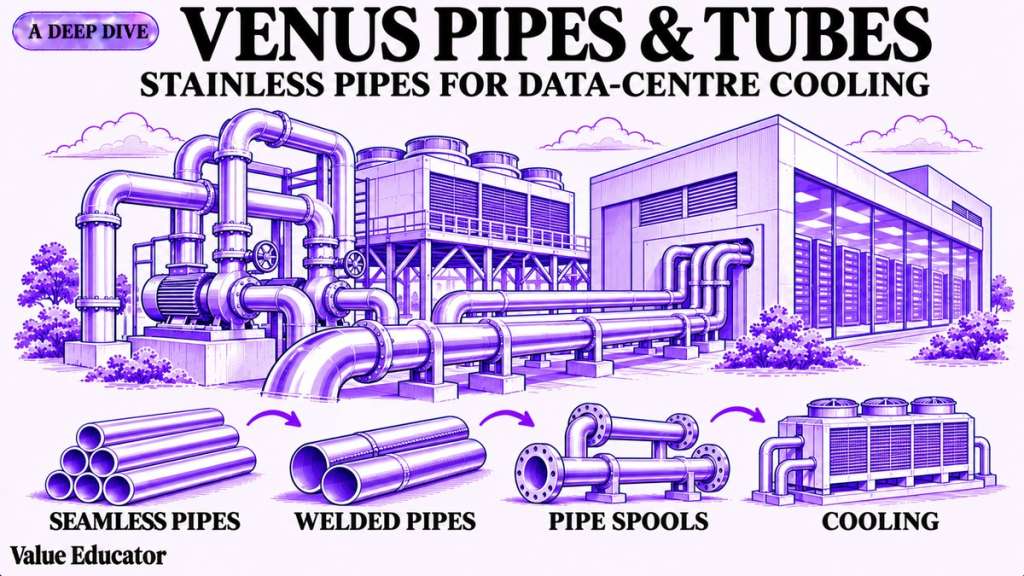
On 20 October 2026, a stainless steel pipe maker in Kutch, Gujarat, started making something new: pipe spools for the cooling system of a data centre. Ten days later, on 30 October, it received its first order for them, worth ₹29 Cr. That order is the first part of a ₹185 Cr letter of intent from a single data-centre customer. For a company that earned ₹1,166.8 Cr of revenue in FY26, that one letter is worth about 15.9% of a full year's sales.
That shift needs a few terms, starting with the pipes. A seamless pipe is a pipe made from a solid steel bar. The bar is heated and pierced into a rough tube, called a mother hollow, which is then drawn to size, so the pipe has no welded joint along its length. Such pipes are used where pressure and heat are high, as in boilers, refineries and heat exchangers. A welded pipe is a pipe made by rolling a flat stainless steel strip into a tube and welding the edge, which suits larger sizes and lower cost.
Then comes the newest product, built from those pipes. A pipe spool is a ready-made piece of piping, with pipes, bends, flanges and valves cut, welded and tested in a factory, so that the site team only bolts it together. The company compares it to a pre-engineered building, where the steel frame is made in a factory and only assembled at the site.
That company is Venus Pipes & Tubes Ltd (NSE: VENUSPIPES). It makes stainless steel seamless and welded pipes and tubes at Dhaneti, near Bhuj, in Kutch, close to the Kandla and Mundra ports. Its installed capacity is 48,000 tonnes a year, and it exports to more than 30 countries.

So Venus sits at a clear point in the industrial chain. It buys stainless steel, turns it into pipes, tubes and fittings, and now joins them into spools. Those pipes go to power plants, refineries, chemical and pharma plants, and now a data centre.
Venus Pipes & Tubes in five numbers
- Q2 FY27 revenue of ₹361.1 Cr, up 23.9%
- Exports of ₹147.2 Cr in the quarter, 41% of revenue
- A data-centre letter of intent of ₹185 Cr, with a first order of ₹29 Cr
- An order book of more than ₹670 Cr in November 2026
- Revenue of ₹1,166.8 Cr in FY26, against ₹386.9 Cr in FY22
So a company that listed in May 2022 has tripled its revenue in four years and is now adding a data-centre business on top. How did the latest quarter look? Let's first understand the company, and then look at the latest quarter.
Venus Pipes & Tubes: Company Overview
Venus Pipes & Tubes Ltd was incorporated in 2015 and makes all its products at one plant at Dhaneti, near Bhuj in Kutch, Gujarat, on a land bank of 2,66,282 sq m close to the Kandla and Mundra ports. Arun Kothari is Chairman and Managing Director, Jayantiram Choudhary, Megharam Choudhary and Dhruv Patel are whole-time directors, and Kunal Bubna is Chief Financial Officer. The company makes stainless steel seamless and welded pipes and tubes, LSAW pipes, pipe fittings and, from October 2026, pipe spools, with an installed capacity of 48,000 tonnes a year and its own mother hollow for seamless pipes. It listed on the NSE and BSE in May 2022 and had 955 employees on its rolls in March 2026. Revenue from operations was ₹1,166.8 Cr in FY26, of which exports to more than 30 countries made up 34.3%. Borrowings stood at ₹382.1 Cr in September 2026, before a preferential issue of about ₹372 Cr that management plans to use mostly to repay debt. Read this Data Centre Stocks in India 2026: Suppliers and Operators
"Know what you own, and know why you own it."
— Peter Lynch
Venus is two businesses in one plant: a stainless steel pipe maker with a long export record, and a new spool maker with one data-centre customer. Knowing which one drives the next few quarters is the first step to reading its results.
The Quarter With Record Revenue and Flat Profit
Let's look at Q2 FY27, the July to September quarter that Venus reported on 5 November 2026. Revenue from operations was ₹361.1 Cr, up 23.9% from ₹291.5 Cr a year ago. It was also higher than the ₹320.5 Cr of Q1 FY27, and it was the company's highest quarterly revenue so far.

As we can see, revenue grew much faster than profit. Read this Operating vs Net Profit Margin Explained EBITDA, the operating profit before interest, depreciation and tax, rose 9.1% to ₹51.7 Cr. The EBITDA margin came down to 14.3%, against 16.3% a year ago. Profit after tax was ₹26.0 Cr, almost the same as the ₹26.1 Cr of Q2 FY26.
That gap has three causes, and management put numbers on two of them. Selling prices rose by more than 10% from a year ago and by more than 5% from the previous quarter. Higher prices lift revenue but not the profit per tonne, so the margin looks lower. Without the price rise, management says the margin would have been about 15.5%. The rest came from higher export freight and fuel costs, and without those the margin would have been above 16%.
Those costs show in the profit per kilogram. That profit is the EBITDA per kg of pipe sold, and it was ₹62 per kg in Q2 FY27, against ₹64 per kg a year ago. Management says the ₹2 gap came mostly from freight. So the company chose to keep shipping export orders taken earlier at lower freight rates, rather than delay them for long-standing customers.

As you can see, that chart also shows the longer pattern. Quarterly revenue rose from ₹276.4 Cr in Q1 FY26 to ₹361.1 Cr in Q2 FY27. Over the same six quarters, profit after tax stayed between ₹24.8 Cr and ₹26.4 Cr. Interest and depreciation took most of the gain: finance cost was ₹13.8 Cr in the quarter against ₹10.1 Cr a year ago, and depreciation rose to ₹8.8 Cr from ₹5.9 Cr as new plants started.
Inside the EBITDA line, the costs of a bigger company also show. The gross profit, which is revenue minus the cost of steel and other materials, rose 32.2% to ₹127.7 Cr from ₹96.6 Cr. So the products themselves earned more per rupee of sales. But other expenses, which include freight, fuel and power, rose to ₹59.1 Cr from ₹36.6 Cr, and employee cost rose to ₹16.9 Cr from ₹12.6 Cr as the company staffed its new seamless, fittings and spool plants.
Beyond the quarter, exports did most of the lifting. Export revenue reached a record ₹147.2 Cr, up 27% from ₹115.6 Cr a year ago and more than 55% higher than the previous quarter, and it made up 41% of revenue. Management says the United States drove most of that export growth. Domestic revenue also rose, by 22% to ₹213.9 Cr.
That same growth shows in the first half too. H1 FY27 revenue was ₹681.6 Cr, up 20.0%. EBITDA was ₹103.2 Cr at a margin of 15.1%, and profit after tax was ₹52.4 Cr, up 3.1%. Management says about 12% of the quarter's 24% growth came from higher prices and about 8% from more tonnes sold, with the rest from fittings.
The Orders and the New Equity
Now let's look at the orders, because they show how much of the next few months is already booked. In November 2026 management put the order book at more than ₹670 Cr. Of that, about ₹640 Cr is for pipes and fittings and about ₹30 Cr is the first data-centre order. It expects to ship most of the pipe orders in four to five months.

That book has moved with large orders. It was about ₹575 Cr in May 2025, after a ₹190 Cr letter of intent for boiler tubes from a large power-equipment maker, ₹560 Cr in August 2025 and about ₹470 Cr in February 2026. In May 2026 it was ₹450 Cr. By August 2026 it was more than ₹600 Cr, and by November more than ₹670 Cr. Around 40% of the pipe book is for export, and more than half of that export part is for the United States.
On top of that book sits the rest of the data-centre letter of intent. A letter of intent, or LOI, is a written promise from a customer to place orders, before the formal purchase orders are signed. After the first ₹29 Cr order, about ₹156 Cr of the LOI is still to turn into orders.
What the order book says: more than ₹670 Cr of orders, plus about ₹156 Cr still under the data-centre LOI, comes to more than ₹826 Cr of visible work. That is more than the ₹718.6 Cr Venus needs in H2 FY27 to grow revenue 20% for the year.
That growth needed money, and the balance sheet shows it. Borrowings were ₹382.1 Cr in September 2026, up from ₹285.6 Cr in March. Read this Debt to Equity Ratio Explained In September 2026 the board approved a preferential issue of shares to selected investors, worth about ₹372 Cr. By November the company said it had raised the money and would use about ₹344 Cr of it to repay debt. Management expects that to save ₹28 Cr to ₹30 Cr of interest a year, and ₹12 Cr to ₹13 Cr in H2 FY27 alone.
That growth also shows in working capital. Inventories were ₹446.3 Cr in September 2026, against ₹386.9 Cr in March, and trade receivables were ₹295.7 Cr. Management puts net working capital at about 120 days of sales, with receivables at about 75 to 80 days. Read this Inventory Turnover Ratio Explained Operating cash flow for the half was ₹44.4 Cr, against ₹122.7 Cr spent on investments, mostly the new plants.
How a Kutch Pipe Maker Grew Its Capacity Seven Times
Now that we have seen the quarter, let's go back and see how a Kutch pipe maker grew to this size. Venus was incorporated in 2015, and its plant at Dhaneti began with welded pipes. Arun Kothari, a chartered accountant who joined the company as a director in 2021, is its Chairman and Managing Director. Jayantiram Choudhary, Megharam Choudhary and Dhruv Patel, who have been with the company from its early years, are whole-time directors.
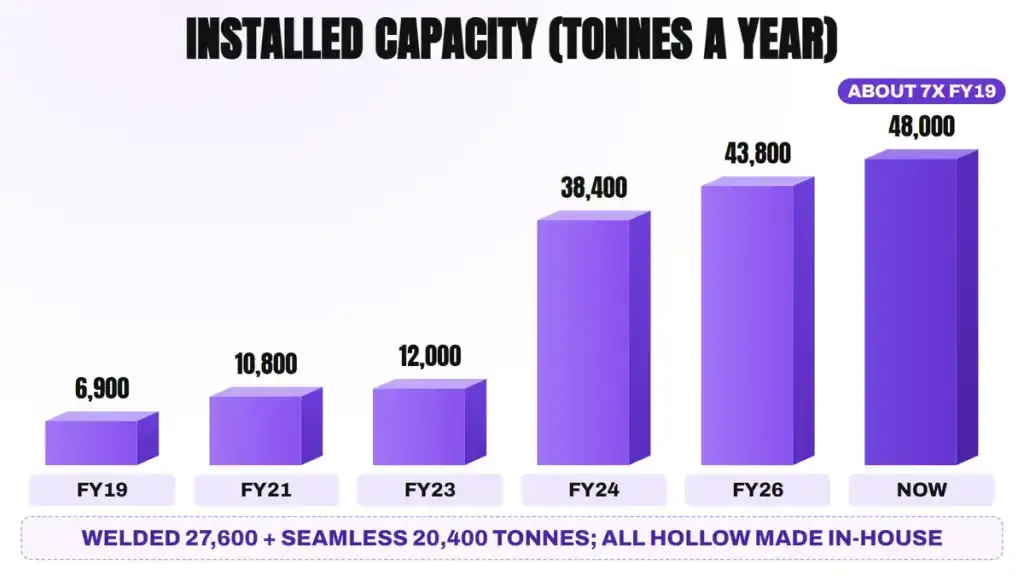
That small plant grew in steps. In FY19 Venus could make 6,900 tonnes of pipe a year. It then added a piercing line to make its own mother hollow, the rough tube that a seamless pipe is drawn from, so it no longer had to buy it. That step is backward integration, and today the company makes all the hollow its 20,400 tonnes of seamless capacity needs.
That growth sped up after the IPO in May 2022. The company raised ₹107.9 Cr for capacity, and capacity rose from 12,000 tonnes in FY23 to 38,400 tonnes in FY24. Further lines took it to 43,800 tonnes in FY26 and 48,000 tonnes now, about 7 times the FY19 level.
As we can see, that capacity turned into revenue. Revenue grew from ₹386.9 Cr in FY22 to ₹1,166.8 Cr in FY26, a growth rate of 31.8% a year. Exports grew even faster: from ₹40 Cr in FY22 to ₹400 Cr in FY26, when they made up 34.3% of revenue.
That export push changed the customer list too. In FY24 exports were ₹99 Cr, or 12.3% of revenue. A year later they were ₹338 Cr, or 35.3%, as Venus won buyers in Europe and the United States. In FY26 no single customer made up more than 10% of revenue, so the pipe business does not lean on any one buyer.

Before FY24, Venus earned a thin margin as a pipe maker that bought its hollow. The new seamless lines and the hollow plant lifted the EBITDA margin to 18.2% in FY24. Since then the margin has eased to 16.3%, as new capacity took time to fill and exports carried higher freight.
That same period shows better cash conversion. Operating cash flow was ₹8.7 Cr in FY23, when inventory and receivables grew with the new plants, and ₹112.4 Cr in FY26. As a share of EBITDA, it rose from 13% to 59% over those four years.
That table also shows where the profit went. Finance cost rose from ₹7.1 Cr in FY22 to ₹40.8 Cr in FY26, because the company borrowed for working capital as it grew. Profit after tax grew at 34.0% a year over the four years, but it rose only about 9.7% in FY26, from ₹92.9 Cr to ₹101.9 Cr.
"Spools are used to avoid on-site fabrication. So, the pipes are fabricated with fittings in the factory and connected by nuts and bolts at the site only." - Kunal Bubna, Chief Financial Officer, May 2026
Three Product Lines and a New Fourth
Now let's split the business into its parts, because each one serves a different buyer. Venus reports one business segment, pipes and tubes, but it gives revenue for its product lines. Seamless pipes bring in more than half, welded pipes most of the rest, and fittings and spools are the new lines.

These lines share one plant, but as you will see, each wins orders in a different way. Seamless tubes often need boiler and plant approvals. Welded pipes compete more on size range and price. Fittings and spools let Venus sell a larger share of each project's piping.
Seamless Pipes and Tubes
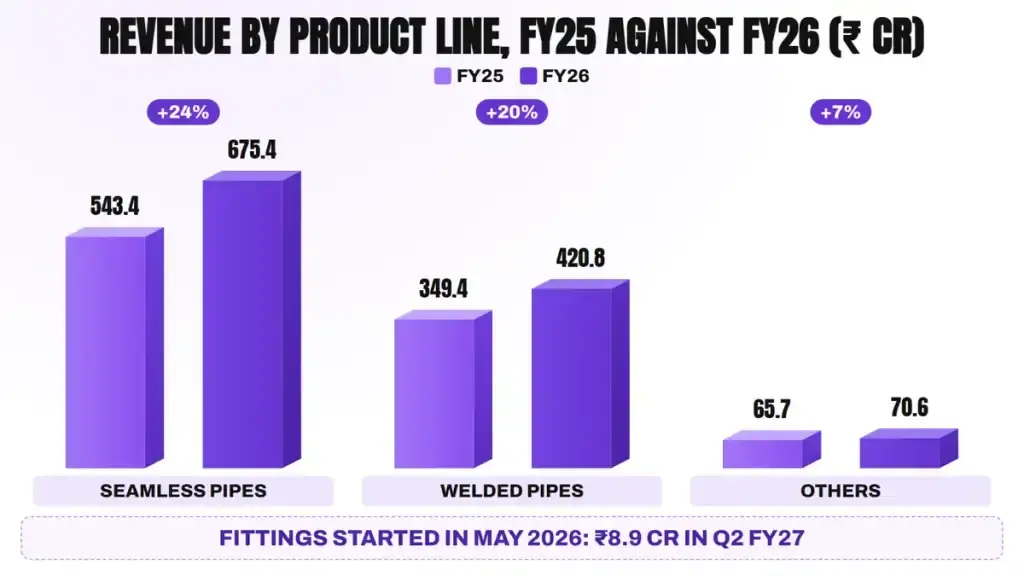
Let's start with seamless, the largest line. Revenue was ₹675.4 Cr in FY26, up 24% from ₹543.4 Cr, and ₹197.6 Cr in Q2 FY27, up 20%. Those seamless tubes go into heat exchangers, boilers, condensers and hydraulic systems, where a weld seam could fail under pressure or heat.
That line has also been the fullest. Seamless capacity ran at more than 90% to 95% of its limit in FY26, so the company added 6,000 tonnes of capacity, more than the 4,800 tonnes it first planned. Part of it started in November 2025 and the rest in May 2026. In Q2 FY27 the seamless lines ran at more than 80% of capacity, and management expects more than 90% in the second half.
Welded Pipes and Tubes
Next, let's look at welded pipes, the original business. Revenue was ₹420.8 Cr in FY26, up 20%, and ₹135.8 Cr in Q2 FY27, also up 20%. Venus now makes welded pipes from 6 mm up to 1,422.4 mm in diameter, including large LSAW pipes, which are long, straight-seam pipes for big plants.
This welded line has room to grow. Welded capacity of 27,600 tonnes ran at more than 60% in the quarter, and management expects 60% to 70% in H2 FY27. A ₹12 Cr JCO press added in FY26 lets Venus make longer welded pipes, which the company says only a handful of Indian makers can produce.
That welded and seamless output also reaches buyers abroad through stockists. Management says it sells in the United States mainly to distributors, who then supply oil and gas, chemical and other plants. That spreads demand across many end users, though it also means Venus sees less of each final project, and its export order book can change quickly with freight and trade rules.
Fittings and the Spooling Business
Finally, let's look at the two newest lines. Fittings are the elbows, tees and reducers that join pipes, and Venus started making them in May 2026 after spending about ₹60 Cr. They brought in ₹8.9 Cr in Q2 FY27, because each fitting needs separate customer approval. Management expects ₹40 Cr to ₹50 Cr in H2 FY27, and a peak of ₹180 Cr to ₹200 Cr a year from this plant.
Spools sit one step above fittings. A spool uses the company's own pipes and fittings, so every spool order also fills the pipe and fitting plants. The spool project cost about ₹70 Cr, including the spooling and fabrication plant and fitting machines, and it started making spools on 20 October 2026, ahead of the December 2026 date the company had set.
Where Venus Fits in Data-Centre Cooling
Now let's place the spools in the data-centre chain, since this is the newest part of the business. A data centre is a building full of servers, and every server turns power into heat. That heat is the problem, since newer AI servers run so hot that air alone cannot cool them well, so many data halls now pipe a liquid coolant to the racks.
That liquid moves in two loops. The outer loop carries water from chillers or cooling towers to a coolant distribution unit, or CDU, which is the machine that passes the heat from one loop to the other. The inner loop, which Venus calls the secondary fluid network or SFN, carries clean coolant from the CDU to the racks inside the building. Management says its spools are for this inner network.
"Invert, always invert."
— Charlie Munger
For Venus, inverting the question means asking what would stop the spool business: a delayed design from the one customer, a quality problem on the first deliveries, or a rival fabricator with a lower price. The rest of this article looks at each of these.

As you might expect, that inner network has strict needs. The pipes run past live servers, so a leak or even fine dirt inside the pipe can damage equipment. That is why such networks use stainless steel and want pipes made, cut and welded in clean, controlled conditions. Management says the customer chose Venus after visiting its plant, and because Venus makes its own pipes and fittings and could promise fast delivery.
Here is what the data-centre business looks like so far:

That table shows us how large one customer can be for Venus. The ₹70 Cr planned for H2 FY27 alone would be close to a fifth of a full quarter's revenue. Management expects the rest of the LOI to turn into orders over about four quarters, as the customer finishes its designs.
That demand could also grow. Management puts India's data-centre capacity at about 1.3 GW in 2025 and expects it to reach about 10.5 GW in five years, about 8 times as much. The company lists data centres, solar manufacturing and semiconductors as its new-age end markets, beside its older ones such as power, oil and gas, chemicals and nuclear.
For now, though, that spool plant is full. Management says the capacity installed so far is set aside for this one LOI, and more capacity should be ready by January or February 2027. Together they can support about ₹250 Cr to ₹300 Cr of spool business a year. Venus has said it plans to take spools next to power, then to oil and gas, and later to nuclear plants.
That spool plan also changes how the plant works together. Management says that in some orders 20% to 30% of the fittings a spool needs can come from its own fitting plant, along with its own welded and seamless pipes. It expects the spool business to need about the same working capital as pipes, at about 120 days of sales, and to turn over about 3 times its capital cost in revenue each year. On ₹70 Cr of spool capex, that would mean about ₹210 Cr of revenue a year.
Why Venus's Moat Is Hard to Copy
Now that we have seen the parts, let's understand the moat. A stainless steel pipe can look like a commodity, since many Indian and Chinese mills make them. So the question is why a refinery, a heat exchanger maker or a data centre should choose Venus.
"Your margin is my opportunity."
— Jeff Bezos
Spool margins near 30% will draw other pipe makers and fabricators. Venus's answer is its own pipes, fittings and approvals, and the moat is only as good as its ability to keep winning orders against them.
One part is the product range. Venus makes seamless tubes from 6 mm to 219.3 mm and welded pipes from 6 mm to 1,422.4 mm, in many grades, plus fittings and now spools. A buyer who needs many sizes for one project can get most of them from one plant. The company calls this a one-stop piping supplier, and its pitch to project buyers is fewer vendors and shorter lead times.
Another layer is approvals, which take years. Venus has had the German TÜV AD 2000 approval since 2017, Indian Boiler Regulations approval since 2018, and BIS approval for seamless and welded pipes since 2022. In 2025 its testing laboratory received NABL accreditation. Those approvals repeat with each buyer, since every new customer or sector, from power plants to oil companies, also approves the plant and the product before it orders.
That leads to the third layer, the cost base. The hollow plant gives Venus its own feedstock for seamless pipes, and a solar plant of 7.4 MW, including a 6.1 MW unit added in August 2026 for about ₹22 Cr, should save about ₹6 Cr of power cost a year. The plant at Dhaneti is close to the Kandla and Mundra ports, which helps exports.
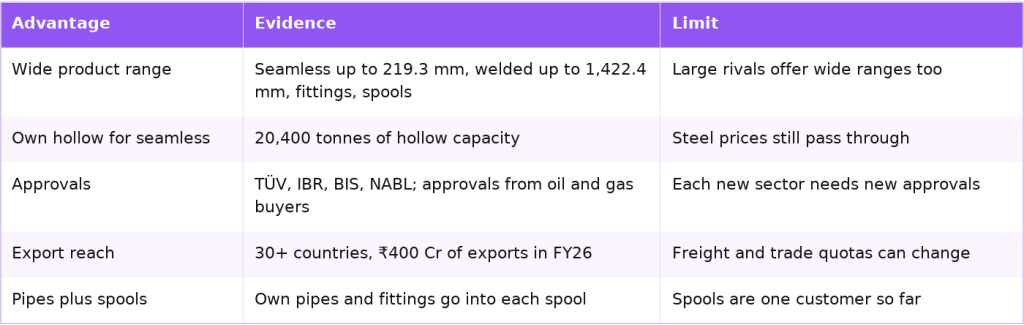

That table shows us why spools are the real test of the moat. Fabricators without their own pipe plants also make spools. If Venus can win spool orders beyond its first customer at margins near what it expects, its pipe range and approvals are worth more than a commodity mill's.
Financials: Five Years of Revenue, Margins and Cash Flow
One quarter can mislead in a business where steel prices, freight and new plants move the numbers, so let's look at the full years together. The first half of FY27 is shown for comparison.

Revenue grew about 3.0 times in four years, from ₹386.9 Cr in FY22 to ₹1,166.8 Cr in FY26, and profit after tax grew at 34.0% a year, from ₹31.7 Cr to ₹101.9 Cr. The EBITDA margin rose to 18.2% in FY24 when the new seamless and hollow lines started, and has since eased to 16.3% in FY26 and 15.1% in H1 FY27.
Cash flow has lagged profit but is catching up. From FY23 to FY26, operating cash flow added up to ₹242.0 Cr, against ₹324.9 Cr of profit after tax, or about 74%. It was negative at ₹60.0 Cr in FY22, when inventory and receivables grew with the business, and it reached ₹112.4 Cr in FY26, or 59% of EBITDA, against 13% in FY23.
The balance sheet carried that growth with both equity and debt. Total equity rose from ₹128.5 Cr in March 2022 to ₹668.5 Cr in March 2026, while borrowings reached ₹382.1 Cr in September 2026. Return on equity was 17.0% and return on capital employed 27.0% in FY26. The ₹372 Cr share issue, with about ₹344 Cr set aside to repay debt, is the next test of how much of the operating profit reaches shareholders.
"Only when the tide goes out do you discover who's been swimming naked."
— Warren Buffett
Venus has grown with borrowed working capital, and its interest cost has grown faster than its profit. The debt repayment from the new equity will show how much profit the business earns when the tide of borrowing goes out.
What FY27 and FY28 Could Look Like on Management's Numbers
So where does the business go from here? In May 2026 management guided revenue growth of more than 20% for FY27, and it repeated that in August and November. In August 2026 the Chairman also said he expects the business to double by about FY29 or FY30.
That growth plan has three parts. The pipe business should grow volume by about 15% in FY27, after about 8% in H1, as the new seamless lines fill. Fittings should add ₹40 Cr to ₹50 Cr in H2, and data-centre spools about ₹70 Cr. In August management also said spools could be about 5% of revenue in FY27 and 10% to 15% in FY28.
Now let's put that guidance against the first half. H1 FY27 revenue was ₹681.6 Cr. Growing 20% for the year means about ₹1,400.2 Cr, so H2 needs about ₹718.6 Cr. That is about 20.0% more than the ₹598.8 Cr of H2 FY26, which is the same pace as H1, with spools and fittings adding about ₹110 Cr to ₹120 Cr between them.

Those new lines also matter for margins. Management aims for an EBITDA margin of about 18% by FY28, from 16.3% in FY26. In August 2026 it said the FY27 margin would stay below 17%, because fittings and spools start only in the second half. The new lines carry higher margins: above 30% expected on data-centre spools and 17% to 20% on fittings, against about 16% on pipes.

Those commitments are easier to judge against the past. So let's check what management said before against what it delivered.
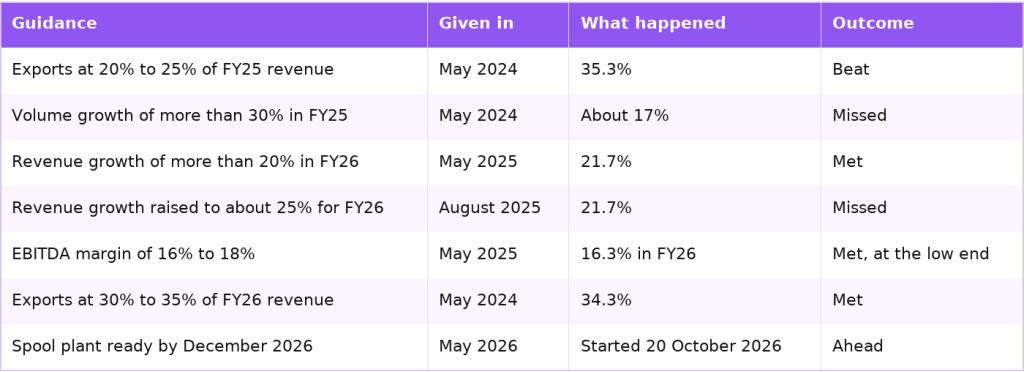
That record shows us a clear pattern. Venus has delivered more than 20% revenue growth, and it started its spool plant ahead of plan. The margin has been the softer number: it stayed near the bottom of the 16% to 18% range, and the 18% target has moved out to FY28. That makes the margin and the first spool deliveries the numbers to watch.
Spending is the other part of the plan. Management expects capex of ₹130 Cr to ₹140 Cr in FY27, with ₹30 Cr to ₹35 Cr of it in H2, covering the spool plant, fittings, the solar plant and upkeep. After that, the large expansion is mostly done, so the second half should show whether the new plants add to profit after tax, helped by the lower interest after the debt repayment.
Key Risks
Now let's look at what could go wrong for Venus, because the latest quarter has already shown some of these risks.
- One data-centre customer: the whole ₹185 Cr LOI comes from one customer, and only ₹29 Cr is a firm order. If the customer delays its designs or orders less, the ₹70 Cr planned for H2 FY27 would slip.
- A new business for Venus: spools are new to the company, and data-centre cooling pipes are critical equipment. A quality problem on the first orders would hurt the chance of winning other customers.
- Margin pressure in pipes: the EBITDA margin fell to 14.3% in Q2 FY27, and profit after tax has stayed near ₹24.8 Cr to ₹26.4 Cr a quarter for six quarters. Freight, fuel and steel prices all moved against the company, and few orders let it pass on fuel costs.
- Working capital and debt: inventories were ₹446.3 Cr and borrowings ₹382.1 Cr in September 2026. Net working capital of about 120 days of sales ties up cash, and operating cash flow of ₹44.4 Cr in H1 was well below the ₹122.7 Cr spent on investments.
- Export exposure: exports were 41% of Q2 FY27 revenue, and more than half of the export order book is for the United States. Freight costs, the Middle East conflict and the European Union's quota on steel pipe imports, which management says was cut by about 15% to 20%, can all hurt this business.
- Export obligations: the company had contingent duty of about ₹12.8 Cr in March 2026 on imports under advance licences, which becomes payable if it does not meet the linked export targets.
- Competition in spools: other pipe makers and fabricators are adding spool capacity, and management says new players are entering. Margins near 30% may attract more of them.
- New plants still filling: welded capacity ran at just over 60% in Q2 FY27, and fittings need customer approvals one by one. If demand does not fill the new lines, depreciation and staff costs stay without the matching profit.
- Equity dilution: the ₹372 Cr preferential issue cuts debt but adds new shares, so profit has to grow faster to raise earnings per share.
"Margin for this depends on the sector. For the data centre sector, we expect an EBITDA margin above 30%." - Arun Kothari, Chairman and Managing Director, November 2026
"The essence of investment management is the management of risks, not the management of returns."
— Benjamin Graham
No one can say when freight costs will ease or when the data-centre customer will finalise its next design. What an investor can watch is the order book, the margin and the spool deliveries each quarter, which is what the list below sets out.
Explore our Products
Research Framework

Emerging Titans
Combination of quantitative analysis, industry tailwinds, and management assessment - SPRINT investment philosophy

Tiny Titans
Heavy emphasis on scuttlebutt research, plant visits, and early on-ground signals
What to Track Next
If you follow Venus, these are the signals that will show where it goes next.
- Data-centre spool revenue in H2 FY27 against about ₹70 Cr, and orders against the remaining ₹156 Cr of the LOI
- A second data-centre customer, or a first spool order from power or oil and gas
- The EBITDA margin after 14.3%, and EBITDA per kg after ₹62
- Fittings revenue against ₹40 Cr to ₹50 Cr in H2 FY27
- Finance cost after the ₹344 Cr debt repayment, against ₹13.8 Cr in Q2 FY27
- Inventory and net working capital days as revenue grows
Conclusion
Let's put it all together. Venus Pipes & Tubes has grown revenue from ₹386.9 Cr in FY22 to ₹1,166.8 Cr in FY26, built capacity of 48,000 tonnes and made exports 41% of its latest quarter. Now it is adding fittings and spools, led by a ₹185 Cr letter of intent from a data-centre customer, with a first ₹29 Cr order already in hand. The cautious thread is the margin, which fell to 14.3% in Q2 FY27, and working capital of about 120 days of sales. The next two quarters, with the first spool revenue and lower interest, will show which thread is stronger.
Still, the next step depends on profit, not on tonnes. What happens next depends on whether the data-centre spools ship on time at the margin management expects, and whether a second spool customer follows. It also depends on whether lower interest after the share issue lifts profit after tax above the ₹26 Cr a quarter it has held for six quarters.
FAQs
What does Venus Pipes & Tubes do?
+Venus Pipes & Tubes makes stainless steel seamless and welded pipes and tubes at Dhaneti in Kutch, Gujarat, with an installed capacity of 48,000 tonnes a year. It added pipe fittings in May 2026 and pipe spools in October 2026. FY26 revenue from operations was ₹1,166.8 Cr.
How did Venus Pipes & Tubes do in Q2 FY27?
+Revenue from operations rose 23.9% to a record ₹361.1 Cr, and exports reached ₹147.2 Cr, or 41% of revenue. EBITDA rose 9.1% to ₹51.7 Cr, but the margin came down to 14.3% as selling prices rose and freight and fuel costs went up. Profit after tax was ₹26.0 Cr, against ₹26.1 Cr a year ago.
What is the Venus Pipes data-centre order?
+A data-centre customer in India gave Venus a ₹185 Cr letter of intent for stainless steel pipe spools used in the cooling network inside the building. The first firm order of ₹29 Cr came on 30 October 2026, and about ₹156 Cr is still to turn into orders. Management expects about ₹70 Cr of data-centre revenue in H2 FY27 and full execution before December 2027.
Where does Venus fit in data-centre cooling?
+Liquid-cooled data centres pipe coolant from a coolant distribution unit to the server racks through a secondary fluid network inside the building. Venus makes stainless steel spools for this network from its own pipes and fittings. It does not make the chillers, the coolant distribution units or the servers.
What is Venus Pipes' order book?
+Management put the order book at more than ₹670 Cr in November 2026, of which about ₹640 Cr is for pipes and fittings and about ₹30 Cr is the first data-centre order. About ₹156 Cr of the data-centre letter of intent is not yet in the order book. Around 40% of the pipe book is for export.
What are the main risks for Venus Pipes & Tubes?
+The data-centre business depends on one customer so far, and only ₹29 Cr of the ₹185 Cr letter of intent is a firm order. The EBITDA margin fell to 14.3% in Q2 FY27, inventories were ₹446.3 Cr and borrowings ₹382.1 Cr in September 2026. Exports are 41% of revenue, so freight costs and trade quotas also matter.

High growth stock specialist, Value Educator
Shashank Mahajan is an equity research professional with over 12 years of experience in identifying high-potential SME and micro-cap stocks at an early stage. He follows a rigorous scuttlebutt research–driven approach, combining on-ground insights with deep financial analysis. Shashank specializes in uncovering under-researched and under-owned companies with strong management quality and long-term growth potential. Through disciplined research and early identification, he focuses on spotting tomorrow’s market leaders before they enter the mainstream investor radar.
More about Shashank Mahajan →
Azad Engineering vs MTAR vs Unimech: Aerospace Parts

Subros vs Lumax Auto vs Sona BLW: EV Auto Parts Compared
Jyoti CNC vs Macpower CNC: Machine Tool Makers Compared
Data Patterns vs Astra Microwave vs Apollo Micro

Himadri vs PCBL: Carbon Black and Battery Materials

Inox Wind vs Suzlon: Wind Turbine Makers Compared
Explore our Products
Research Framework
Emerging Titans
Combination of quantitative analysis, industry tailwinds, and management assessment - SPRINT investment philosophy
Tiny Titans
Heavy emphasis on scuttlebutt research, plant visits, and early on-ground signals



India's Aerospace Opportunity
Global Demand. Supply Bottlenecks. Opportunities Ahead.
Don't Miss This Exclusive Webinar!
Join Value Educator to decode the key trends shaping India's aerospace sector and learn how to identify tomorrow's potential leaders in the space.
- How the aircraft value chain works, layer by layer
- Indian companies supplying global aircraft makers
- A framework to judge any aerospace company

 Orders
 Subscription
 Share with friends


Required Details
₹23999.00
(12 month subscription)
As per SEBI regulations, all users are mandated to complete the KYC that is validated for 1 year. Post payment, you will be redirected to the KYC screen


No comments yet. Be the first to comment!