
How SME IPOs Work: A Retail Guide

But that same shortcut can suddenly turn into a dead-end, a narrow lane where you can’t turn around, can’t reverse, and are forced to wait. That is what SME IPOs can do to your money.
And it has become increasingly important to understand them as SME IPOs aren’t a niche corner anymore. Capital raised through SME IPOs has grown exponentially in just five years.
Now lets circle back to the point. SME IPOs can actually turn INR 1 lakh into INR 3 lakhs in a day and can also trap that same INR 1 lakh with no easy exit for months or years. Both outcomes come from the same market. The difference is not luck. It is structured.
By the end, you will understand how SME IPOs actually work — not the hype, not the gossip, but the mechanics that decide whether you walk away with gains or with a stuck position.
Read more : Top SME Stocks That Created Millionaires in the Last 3 Years – Krishna Defence
What are SME IPOs, really?
SME IPOs are like well-paved but narrower state roads. They are functional. They can get you where you want to go. But they are not built for the same speed, volume, or comfort as highways.
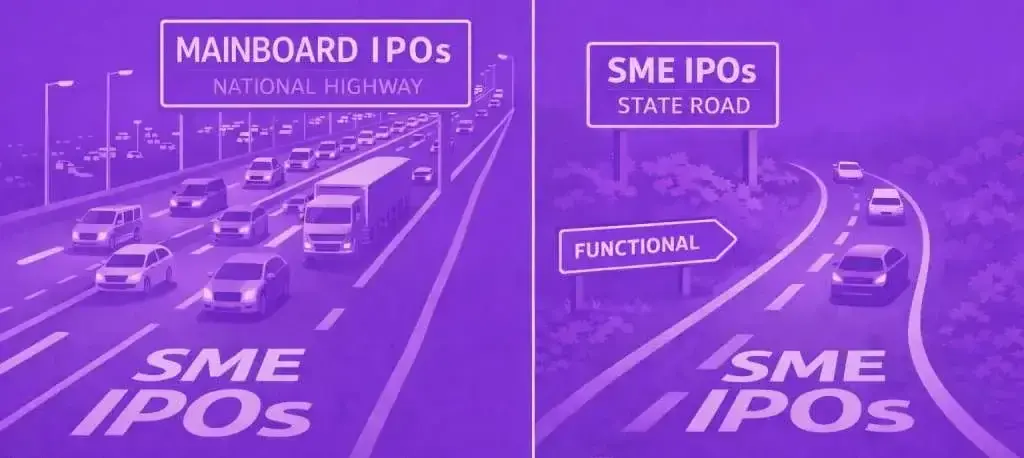
SME stands for Small and Medium Enterprises. In this context, “small” refers to the scale of operations, not the quality of the business. Many SMEs are profitable, well-run, and growing fast. They simply don’t yet meet the size, revenue, or paid-up capital criteria required for a mainboard listing.
So, the exchanges created a separate platform for them — the SME platform on NSE and BSE. This platform allows smaller companies to access public capital without needing to grow into a large corporation first.
It is not a “junior” version of the mainboard. It is a parallel track with its own rules, eligibility norms, and investor base
If you’re still getting familiar with how different segments of the Indian stock market fit together, this broader overview can help place SME IPOs in context.
Who lists here?
- Have outgrown pure promoter funding and small bank loans.
- Want to formalize their operations and step into the listed space.
- Need growth capital for expansion, working capital, or capex.
- Are not yet ready for the scrutiny and size requirements of the mainboard.
So when you see an SME IPO, don’t think “low quality by default.” Think “smaller scale, different road, different traffic.”
Now that we know what SME IPOs are, the real question is — why do companies choose this route in the first place?
Why SME companies choose the IPO route
Most retail investors look at an IPO only through their own lens: “How much listing gain can I make?”
But for companies, the decision to go for an SME IPO is rarely about “giving listing gains” to investors. It is about survival, growth, and long-term credibility.
First, there is the need for capital. SMEs often hit a ceiling with promoter capital, family funds, and traditional bank loans. To scale — open new branches, buy machinery, expand capacity, enter new geographies — they need meaningful equity capital. An SME IPO offers that.
Second, there is visibility. Being a listed company changes how the world sees you. Customers, suppliers, lenders, and talent perceive listed companies as more serious and stable. For an SME trying to win large clients or institutional orders, the “listed” tag can be a powerful signal.
Third, there is credibility with banks and partners. Listed companies follow disclosure norms, audits, and governance standards. This often makes banks more comfortable extending credit. It can also help in negotiations with vendors, distributors, and strategic partners.
Many retail investors assume: “SME IPO = promoter wants to cash out and exit.”
In reality, most SME IPOs raise primary capital — money that goes into the company, not into the promoter’s pocket. Yes, some offers may include an offer for sale component, but in many SME issues, promoters actually lock in capital, not withdraw it.
Are there exceptions? Of course. There are cases where valuations stretch, stories are oversold, and promoter intent is questionable. But at a structural level, SME IPOs are usually a growth tool for companies, not an exit tool. If companies come here for different reasons, it makes sense that the rules of the game are also different.

For smaller companies, the choice between borrowing and raising equity is critical—especially before entering public markets.
Read More : Small-Cap Investing: Mistakes That Cost Investors Money
How SME IPOs actually work: the mechanics that matter
This is where most misunderstandings begin.
On the surface, an SME IPO looks similar to a normal IPO. There is a price. There is an issue size. There is an allotment. There is a listing.
But under the hood, the design is very different. Let’s break it down into four simple parts.
1. Issue structure: fixed price vs book building
Mainboard IPOs are often book-built. This means there is a price band, and institutional investors participate in price discovery. The final price is discovered based on demand across investor categories.Many SME IPOs, on the other hand, are issued at a fixed price. The company, along with its merchant banker, sets a single issue price. There is no dynamic bidding within a band. This makes the process simpler for the company, but it can also make pricing less transparent from a retail investor’s perspective.
Because institutional participation is limited and analyst coverage is thin, you often don’t have a rich set of external checks on valuation. As a result, pricing can sometimes be very attractive — and sometimes very aggressive.
The key takeaway: pricing in SME IPOs behaves differently because the demand pool and discovery processes are narrower.
2. Lot size and minimum investment: why ticket sizes are large
If you have ever tried applying for an SME IPO, you would have noticed something immediately: The minimum investment amount is significantly higher than in many mainboard IPOs.Lot sizes in SME IPOs are deliberately larger. That means the smallest application itself can run into tens of thousands of rupees, sometimes more. Why?
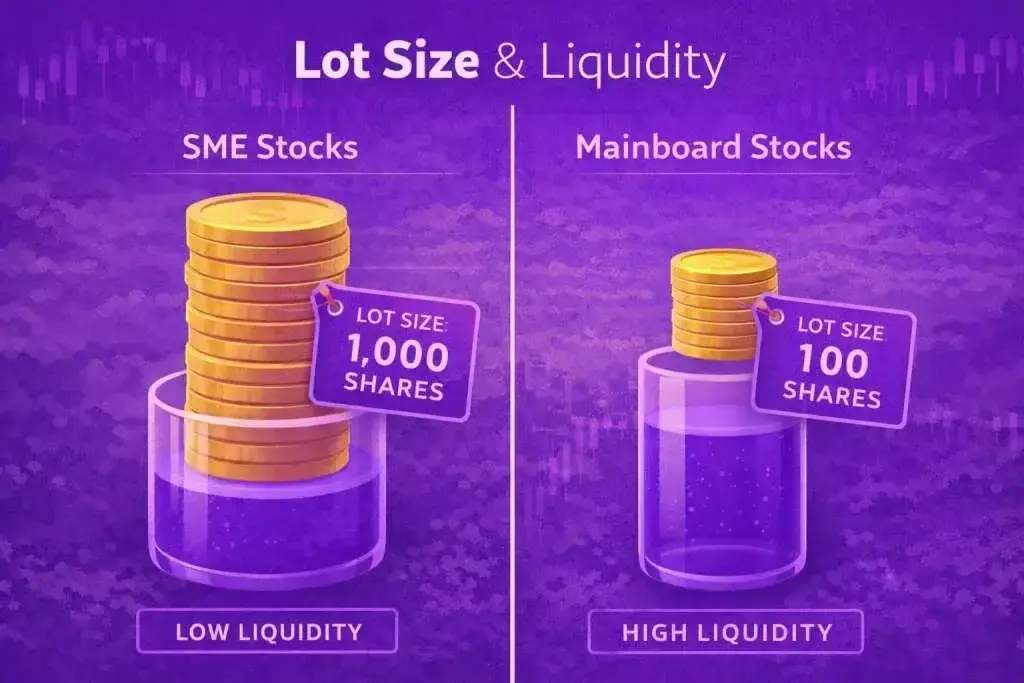
Because the platform is designed to attract more serious, risk-aware participants and reduce extremely small, speculative applications. It is also a function of lower overall issue size and the need to keep the shareholder base manageable. But this has a second-order effect: liquidity.
When minimum ticket sizes are large, fewer people participate. Fewer participants mean fewer shares floating freely in the market. That leads to thin trading volumes once the stock is listed.
In the absence of strong external price discovery, investors often need their own analytical framework to judge whether valuations make sense.
3. Allotment logic: oversubscription behaves differently
You will often hear lines like: “This SME IPO was oversubscribed 200 times!”“What a blockbuster!”
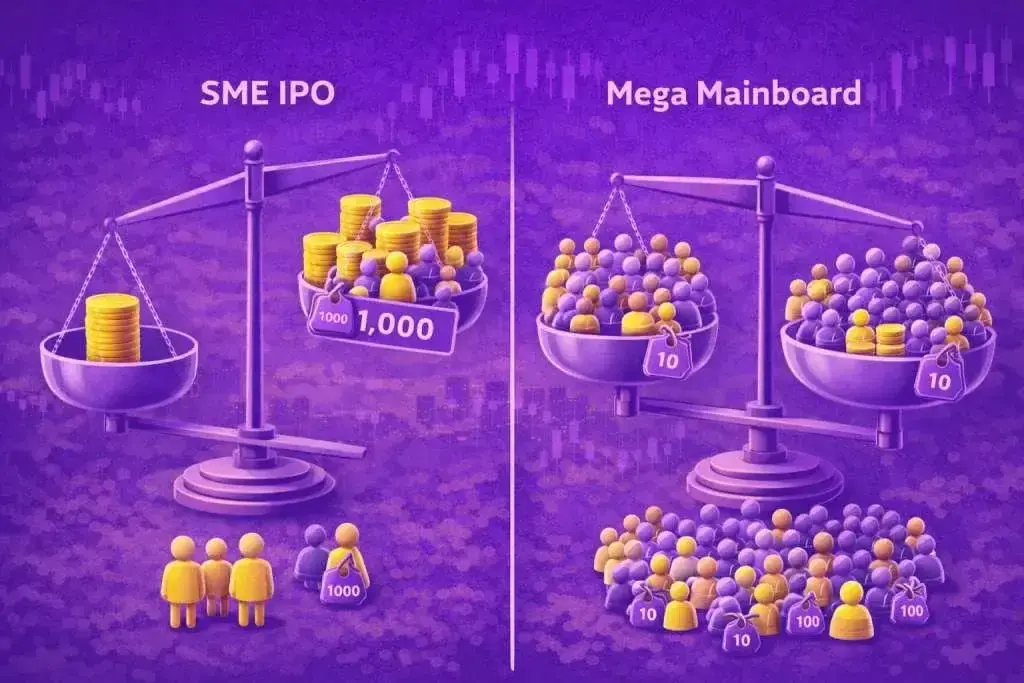
But oversubscription here does not behave the same way as a mega mainboard IPO. Because the number of investors is lower, and the minimum application size is larger, the absolute number of shareholders created can still be quite limited even after a seemingly huge oversubscription.
In other words, a few strong pockets of demand can make the issue look “super hot” numerically, but that does not guarantee a wide and diversified investor base after listing. So, a big headline subscription number in SME IPOs can generate excitement, but it does not automatically translate into steady, broad-based trading support post listing.
No, it is not “fake.” It is just different. The denominator is smaller.
4. Listing and trading: fast moves, thin volumes
This is where the real action happens — and where many retail investors get trapped.
Imagine a newly listed SME stock where:
- The free float, i.e., shares available to trade, is limited.
- The number of active traders is small.
- There are only a handful of buy and sell orders at any point.
In such an environment, even a small set of aggressive buyers can push prices up. Similarly, even a small wave of selling can drag prices down brutally. A few lakhs of rupees can move the stock 5%, 10%, sometimes even more in a single session.
Let’s keep the example simple. Suppose: A company issues 10 lakh shares in an SME IPO. Post listing, only a fraction of these are actively traded. On a given day, the total traded value is INR 10–15 lakhs. It does not take a large institutional cheque to move the stock price of this SME. It only takes a few determined buyers or sellers.
This is why SME IPO charts often look like vertical spikes — both upwards and downwards. These mechanics explain the opportunity. However, they also highlight the risk that most people overlook.
Many of these liquidity dynamics resemble what investors experience in extremely low-float stocks.
SME IPOs vs mainboard IPOs: same market, very different games
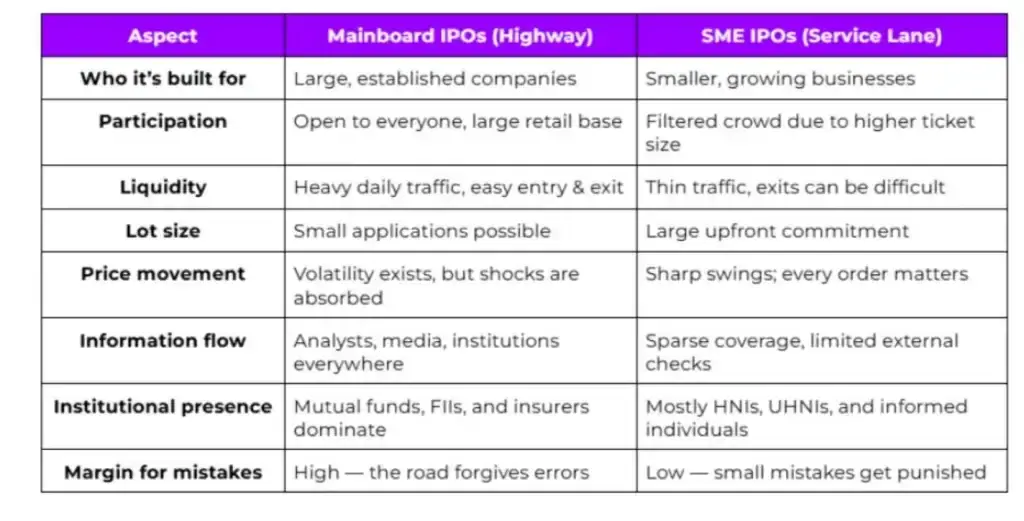
Think of Mainboard IPOs and SME IPOs as two very different roads leading into the same stock market city.Mainboard IPOs are like a national highway. Wide lanes. Heavy traffic. Signboards everywhere. Police patrols. Service stations at regular intervals. You’re rarely alone on the road, and help is always nearby.
SME IPOs are like a narrow service lane running parallel to that highway. Fewer vehicles. Fewer rules in practice. No signboards. No traffic police. If you know the road well, you can move fast. If you panic or misjudge a turn, there’s no buffer.
Both roads reach the market. But they demand very different driving styles
Common mistakes retail investors make in SME IPOs
When you look past the numbers, most painful SME IPO stories sound emotionally similar.The pattern is rarely “I did deep research and still got unlucky.” It is usually “I got carried away.”
One big trap is chasing GMP (grey market premium) blindly. GMP is whispered in WhatsApp groups, shared in Telegram channels, and treated like a secret shortcut to guaranteed listing gains. But GMP is unofficial, unregulated, and based on very thin, private trades. It reflects sentiment — not certainty.
Another common mistake is assuming listing gains equal business quality. A stock that doubles on listing is not automatically a great company. Sometimes, it is just a reflection of low float, high excitement, and crowd behavior. If the underlying business is weak, eventually the story and the stock price tend to part ways.
Then there is the blind spot around post-listing liquidity. Many investors think only up to the listing day. They don’t ask the harder question: “If I want to sell after listing, who will buy my shares and at what depth?”
Treating SME IPOs as lottery tickets is another behavioral error. When the minimum application itself is sizable, treating it like a scratch card is dangerous. The emotional framing of “either I double or I lose nothing” is simply not true. You can get stuck in an illiquid, falling stock with no graceful exit for a long time.
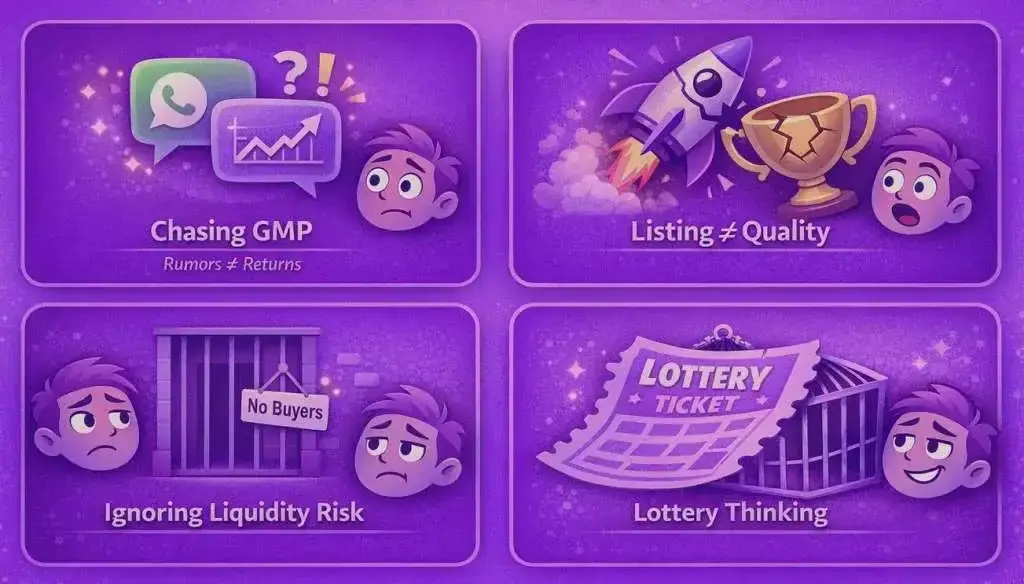
In all of this, the numbers matter less than the emotions: Greed, fear of missing out, and overconfidence. To see how this plays out in real life, it helps to look at patterns of actual outcomes.
Real-world SME IPO outcomes: patterns, not stories
Strip away the noise, and you usually see three broad outcomes in SME IPOs.1. Genuine long-term compounders
Some stocks look dead before they compound. Krishna Defence and Allied Industries Ltd (KDAIL) is a clear case.After listing, the stock spent long periods moving very little, trading close to its issue price with thin volumes. There was no sharp spike, no frenzy. But over the next few years, as revenues and profits scaled, the stock didn’t jump—it climbed.
What started as a quiet SME listing eventually delivered multiple times returns for patient investors. The re-rating didn’t come from one event. It came from years of price slowly following earnings.
This is how real compounding looks: boring first, rewarding later.
2. Flash, then freeze stories
Some stocks do everything early. Euro Panel Products Ltd did exactly that.Post listing, the stock ran up sharply in a short span — roughly 2x from its early trading levels—driven by momentum, low float, and excitement. The move was fast, visible, and tempting.
Then it stopped. For the next couple of years, the stock oscillated in a narrow range, giving back time instead of money. Anyone who bought near the peak didn’t crash—but also didn’t compound.
Here, the loss wasn’t price. It was years of zero returns.
3. Clear disappointments
The third outcome is more deceptive than a bad listing—stocks that go nowhere for years, briefly raise hope, and then quietly trap investors. Rajeshwari Cans Ltd shows this clearly.After listing, the stock remained stagnant for good 1.5 years. Only after that, the stock started to go up and made its all-time high of 344 in September 24. After this, everything just went downhill, and, over time, declining interest and weak performance pushed it well below the IPO price. Volumes dried up, and every bounce became weaker than the last.
In SME stocks, falling prices plus low liquidity are deadly. You don’t just lose value—you lose the ability to exit.
The same SME platform has produced successes, stagnations, and failures. The deciding factor was not just the IPO day. It was what the business did after listing — and how the investor behaved through that journey.
So how should a retail investor actually approach SME IPOs?
Read More : How to Identify Genuine Penny Stocks Before They Become Multibaggers
How retail investors should approach SME IPOs
The first step is to change your mindset. Don’t treat SME IPOs as a shortcut to quick riches.Treat them as high-risk, high-variance opportunities that demand extra homework and a clear plan.
Ask yourself a few simple questions before you even think of applying.
One: Does this fit my risk profile?
If seeing deep short-term volatility makes you anxious, or if your capital is needed in the near term, SME IPOs should be approached with extreme caution or avoided altogether.
Two: Do I understand the business beyond the brochure?
You don’t need to be an industry expert, but you do need a basic grasp of what the company sells, to whom, how it makes money, and what could realistically go wrong. If all you know is “GMP is high” and “listing gains expected,” that is not understanding — that is speculation.
Three: How much of my capital is at stake?
Treat SME IPOs, if at all, as a small satellite portion of your overall portfolio, not the core. Capital you can afford to see locked or impaired temporarily is very different from capital you need for goals in the next one to three years.
Four: What is my time horizon?
Are you prepared to hold beyond listing day if the business is sound but the market mood is weak? Or are you only applying with the intention of exiting on day one? Being honest about this upfront will save you from confused decisions later.
Five: Will I be okay if the IPO gives no allotment?
Oversubscribed SME issues can leave many retail investors without allotment. If you find yourself feeling disappointed or restless in such moments, that is a sign you are emotionally over-invested in a speculative outcome.
The healthiest approach is calm and boring:
Decide whether SME IPOs are even suitable for you.
If yes, limit exposure, do extra due diligence, and prepare for low liquidity.
Focus more on business strength and promoter track record than on grey market chatter.
This should feel like measured, long-term investing advice — not a strategy pitch.
Read More : Penny Stocks vs Small Caps – What’s the Difference and Which Is Better?
Explore our Products
Research Framework

Emerging Titans
Combination of quantitative analysis, industry tailwinds, and management assessment - SPRINT investment philosophy

Tiny Titans
Heavy emphasis on scuttlebutt research, plant visits, and early on-ground signals
Conclusion: Opportunity but with responsibility
SME IPOs sit in a strange, uncomfortable middle ground.They are not lottery tickets. They are not blue-chip safety nets either.
They are closer to early-stage public investing — where the upside exists precisely because the road is narrow, information is limited, and mistakes are punished quickly.
If you strip away the hype, SME IPOs reward three things far more than luck: clarity of intent, patience of capital, and emotional discipline.
The investors who walk away wealthier from this segment are rarely the loudest or the fastest. They are usually the ones who understood why they were applying, what they were buying, and how they planned to exit — even before the stock listed.
For everyone else, SME IPOs can quietly become capital traps disguised as exciting opportunities.
So the right takeaway is not “SME IPOs are good” or “SME IPOs are bad.”
The real takeaway is simpler and harder: SME IPOs demand respect. Respect for structure. Respect for liquidity risk and respect for your own temperament as an investor.
If you approach them with that mindset, they can add a powerful — but controlled — dimension to your investing journey. If you don’t, the same platform can teach you expensive lessons very quickly.
Frequently Asked Questions (FAQs)
Are SME IPOs suitable for first-time investors?
+Does high oversubscription in an SME IPO guarantee listing gains?
+Why do SME stocks sometimes hit upper or lower circuits repeatedly?
+Is it better to exit SME IPOs on listing day?
+How important is promoter background in SME IPOs?
+Promoter quality matters disproportionately in SME companies. Smaller businesses are more sensitive to execution discipline, governance standards, and capital allocation decisions. A credible, experienced promoter often matters more than short-term financial metrics.
Can SME-listed companies later move to the mainboard?
+Yes, some SME companies migrate to the mainboard once they meet size, profitability, and compliance criteria. However, migration is not guaranteed and should be viewed as a potential upside — not an assumption — when evaluating an SME IPO.
What is a reasonable allocation to SME IPOs within a portfolio?
+There is no fixed percentage, but for most retail investors, SME exposure should remain a small satellite allocation. Capital used here should be money you can afford to keep illiquid or volatile without disrupting near-term financial goals.
Is GMP a reliable indicator for SME IPO decisions?
+GMP reflects informal market sentiment, not intrinsic value or post-listing sustainability. It can sometimes indicate short-term demand but should never replace analysis of business fundamentals, valuation, and liquidity risk.

High growth stock specialist, Value Educator
Shashank Mahajan is an equity research professional with over 12 years of experience in identifying high-potential SME and micro-cap stocks at an early stage. He follows a rigorous scuttlebutt research–driven approach, combining on-ground insights with deep financial analysis. Shashank specializes in uncovering under-researched and under-owned companies with strong management quality and long-term growth potential. Through disciplined research and early identification, he focuses on spotting tomorrow’s market leaders before they enter the mainstream investor radar.

Glenmark: The USD 700 Mn Cancer Deal and Its Brands

Pharma Stocks in India 2026: Generics, APIs and CDMOs

Granules India: From Paracetamol to a 65% Gross Margin

Natco Pharma: After Revlimid, 29 Patent Challenges

Shilpa Medicare: Cancer APIs, Films and Biosimilars

Alembic Pharma: US Plants Pay Back, Margin Hits 22.2%
Explore our Products
Research Framework
Emerging Titans
Combination of quantitative analysis, industry tailwinds, and management assessment - SPRINT investment philosophy
Tiny Titans
Heavy emphasis on scuttlebutt research, plant visits, and early on-ground signals



Modern Warfare to Multibaggers
Key Trends. Strategic Shifts. Opportunities Ahead.
Today at 7:00 PM IST. Room opens 30 minutes before.
Don't Miss This Exclusive Webinar!
Join Value Educator to decode the key trends shaping India's defence sector and learn how to identify tomorrow's potential leaders in the space.
- In-depth research on India's defence sector
- Live Q&A session
- Actionable takeaways for long-term investors

 Orders
 Subscription
 Share with friends


Required Details
₹23999.00
(12 month subscription)
As per SEBI regulations, all users are mandated to complete the KYC that is validated for 1 year. Post payment, you will be redirected to the KYC screen


No comments yet. Be the first to comment!