
Jash Engineering: Keeping Water Moving

Nobody thinks about where water comes from when they turn on a tap. It arrives. Behind that, companies like Jash Engineering make the gates, valves and screens that control the flow. That's the full extent of most people's relationship with the infrastructure that delivers it. Clean, pressurised, reliably flowing water that appears on demand is one of the defining features of modern civilisation, and yet the machinery behind it is almost entirely invisible to the people it serves.
Go one level deeper and the picture gets more interesting.
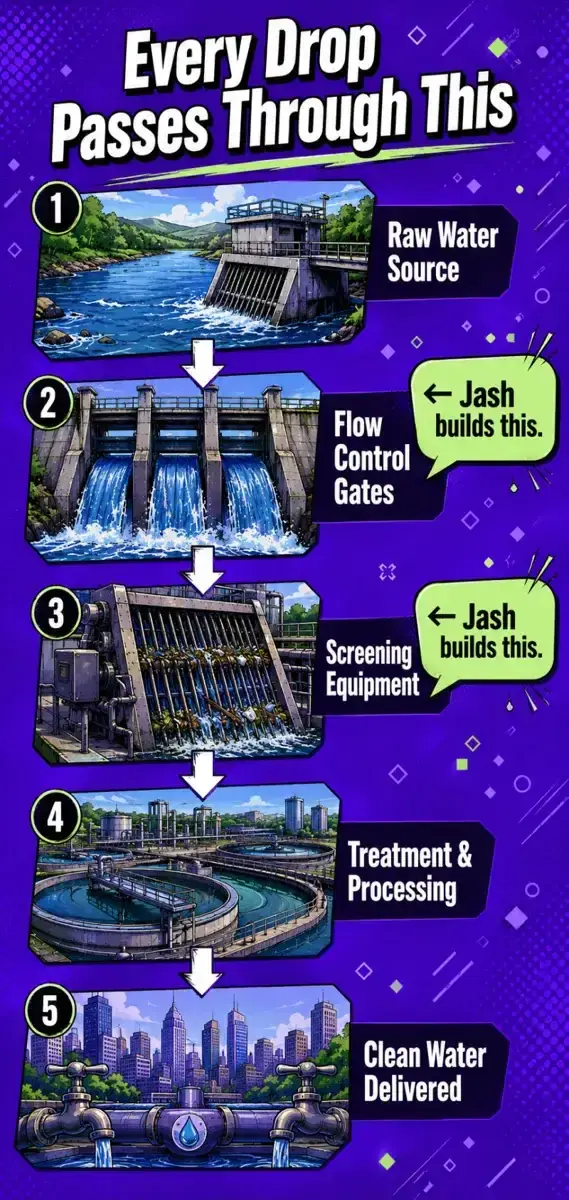
Before water reaches a treatment plant, it has to be pulled from a river, a reservoir, or a groundwater source. Before it can be treated, coarse debris has to be screened out. Before it enters a distribution network, flow has to be precisely controlled through gates, valves, and sluices. And once it's been used, wastewater has to be collected, screened again, treated, and either discharged or recycled. Every single one of those steps requires physical equipment, most of it custom-engineered to fit the specific dimensions, pressure ratings, and flow requirements of that particular facility.
It is not the kind of business that shows up in investment webinars. There are no viral product launches. There is no consumer brand. The equipment sits in concrete channels and underground pump stations, doing its job silently, and most of the people whose lives depend on it have never heard of the companies that build it.
Which is precisely why it deserves a closer look.
The company we are about to discuss today is Jash Engineering Limited.
What Jash Actually Makes
Water control infrastructure. It sounds simple. In practice, what it means is custom-engineered gates, screens, valves, and process equipment built to precise specifications for raw water intake facilities, wastewater pumping stations, storm water management systems, flood prevention infrastructure, and desalination plants.
Start with Water Control Gates, which account for 62% of Jash's revenue and form the original core of the business. These are not off-the-shelf products. Every gate is designed specifically for its installation, matching the channel dimensions, operating pressures, material requirements, and environmental conditions of that particular facility. Jash holds an estimated 70% market share in water control gates in its active markets. That number is striking, and it doesn't happen by accident. It happens because custom-engineered municipal infrastructure is a business where reputation, approval history, and technical track record compound over decades in ways that a new entrant simply cannot shortcut.
Screening Equipment is the second segment, at 16.5% of revenue. Mechanised bar screens, fine screens, and screening conveying and washing systems remove solids from water before treatment. Fine bar screens in particular are a growth driver right now, as municipalities globally upgrade aging infrastructure to meet tighter environmental standards.
Industrial and Knife Gate Valves contribute 13.5%. High-performance valves for water and wastewater applications, water hammer control valves, air vessels. These serve many of the same customers as the gates segment, which creates natural cross-selling opportunities.
The remaining 8% comes from Process Equipment, Hydropower, and Others. Micro hydro turbines, Archimedes screw pumps, clarifiers, thickeners, decanters. Technically diverse, serving both municipal and industrial applications.
Four product segments. All of them serving the same fundamental infrastructure need: getting water to where it needs to go, treating it while it's there, and managing it responsibly when it leaves. That need does not go away in a recession. It does not get disrupted by a new technology. It does not go out of fashion. Every city that grows needs more of this equipment. Every ageing plant that deteriorates needs to be upgraded. Every new desalination facility in a water-scarce region needs gates, screens, and valves designed from scratch.
"In the short run, the market is a voting machine, but in the long run, it is a weighing machine." Benjamin Graham
Jash Engineering: The Company Behind the Equipment
Jash was originally incorporated in 1973, in Indore, Madhya Pradesh. It converted from a private to a public limited company in 1994, then listed on the NSE SME platform in October 2017 via an IPO at Rs. 120 per share. Since listing, the market capitalisation has grown to exceed Rs. 3,100 Crore.
In October 2024, Jash executed a five-for-one stock split, subdividing the face value from Rs. 10 to Rs. 2 per share. The stated purpose was improving trading liquidity and retail investor participation. It achieved both.
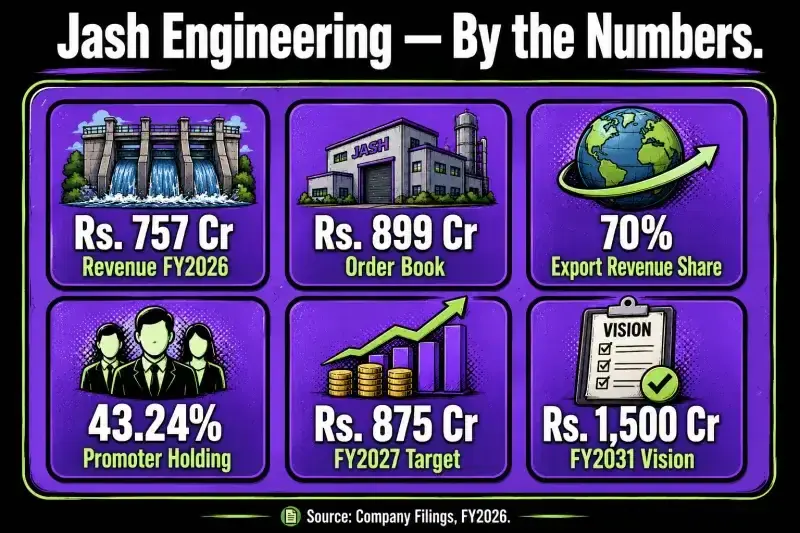
The company is led by Pratik Patel as Chairman and Managing Director, supported by a management team with long operational track records in the water infrastructure space. Promoter and promoter group holding stands at 43.24% as of March 2026. Here is something worth understanding about that number: the Patel family has strictly purchased and never sold shares in the open market. Minor historical dilutions in promoter holding were entirely due to the exit of the non-operational co-founding Amin family and warrant exercises. The buying-never-selling posture of the active promoter family is a clear signal of where their conviction sits.
"The investor's chief problem, and even his worst enemy, is likely to be himself." Benjamin Graham
Retail and non-institutional shareholders hold 54.58% of the company, with small retail holdings under Rs. 2 lakh accounting for 26.34% of that. FIIs hold 1.79% and DIIs 0.39%. For a company of this quality, the institutional ownership looks thin. That can change as more investors discover what sits under the surface here.
Understanding how to read a shareholding pattern properly is one of the most underrated skills in small-cap research. Read How to Analyse Shareholding Patterns of a Company to know exactly what to look for and what the numbers are really telling you.
A Global Footprint Built One Acquisition at a Time
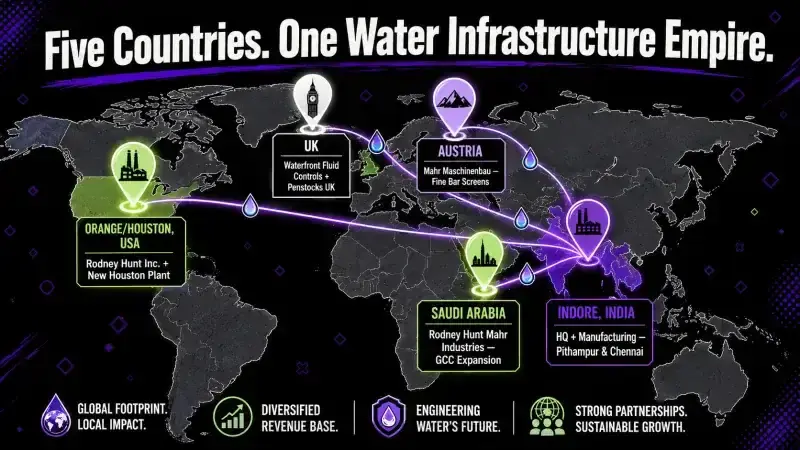
The Jash most investors see on a screener today is very different from the Indore-based manufacturer it was fifteen years ago. The company has systematically built a global presence through acquisitions, subsidiaries, and joint ventures, each one chosen to extend its reach into a new geography or a new product category.
Rodney Hunt Inc. in the USA was acquired to capture the premium North American municipal water market. Rodney Hunt is a well-established brand in the US water infrastructure space with decades of customer relationships. It gives Jash a direct presence in the world's largest municipal infrastructure market at a time when US water system investment is accelerating significantly.
Mahr Maschinenbau in Austria was re-established to manufacture and market globally recognised fine bar screen technology. Standard investors looking at Mahr's standalone order book, which has historically been sub-Rs. 20 Crore, often conclude the acquisition has stagnated. That reading misses the actual story. Mahr's globally recognised fine bar screen designs are now manufactured across multiple Jash group facilities. When Jash standalone or Waterfront UK sells a screen designed by Mahr, the revenue books in India or the UK. Mahr itself only records the engineering design fees. The value of the technology is being realised across the group, not within Mahr's P&L.
Waterfront Fluid Controls in the UK was set up to aggressively target water control gate projects across Europe. In March 2026, Waterfront acquired full ownership of Penstocks UK for £550,000, merging it to expand sales and service coverage across the UK Midlands.
Jash Invent India, a 50:50 joint venture with Germany's Invent Umwelt, specialises in marketing high-tech aerators and mixers in the Indian wastewater market.
WesTech Process Equipment India, acquired in January 2026 for Rs. 29.11 Crore, is the newest and most strategically interesting addition. WesTech gives Jash an entry into heavy industrial sectors including mining, metals, alumina refineries, and pulp and paper, areas where Jash previously had no presence. The acquisition also moves WesTech's outsourced manufacturing in-house to Jash's newly expanded Chennai plant, which should meaningfully improve margins over time. Jash holds 90% and has a contract to acquire the remaining 10% from WesTech's Indian employees after three years at a pre-agreed valuation.
Rodney Hunt Mahr Industries in Saudi Arabia is a wholly-owned subsidiary incorporated to position the group for the Gulf region's massive water infrastructure spend.
Five countries. Multiple product lines. Customers across municipal and industrial markets. The global buildout has been deliberate and it is far from finished.
The Story Behind the FY2026 Numbers
On the surface, FY2026 looks like a disappointment. Consolidated revenue grew only marginally to Rs. 756.68 Crore from Rs. 745.56 Crore in FY2025. EBITDA fell 11% to Rs. 122.69 Crore and margins compressed from 18.77% to 16.21%. PAT dropped 12.97% to Rs. 75.52 Crore.
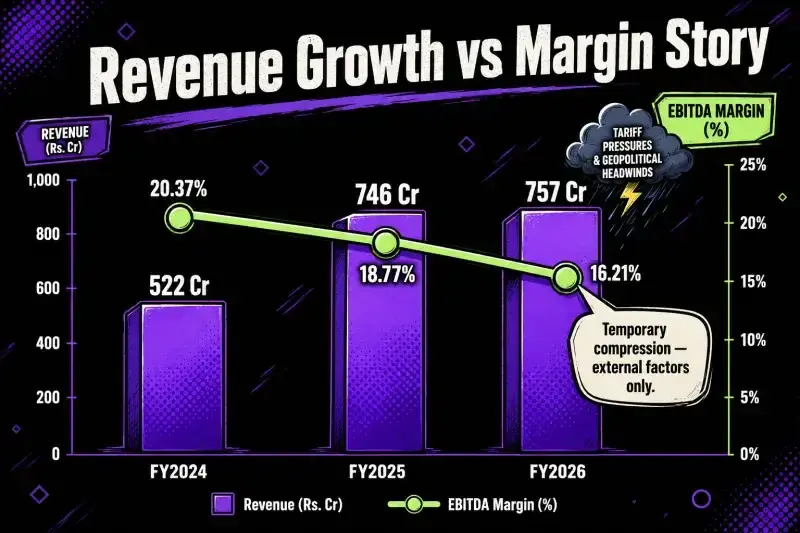
For a company that had been compounding well, flat revenue and contracting margins are the kind of numbers that make investors nervous. But the drivers behind FY2026's underperformance are almost entirely external and temporary, and understanding them properly changes how the numbers read.
The first and largest impact was US tariffs. Import tariffs on Jash's products were raised to 25% in January and then escalated to 50% in June 2026. The uncertainty around those tariff moves caused a slowdown in US dispatches while the company adjusted its strategy. The real damage came from fixed-price legacy orders that had been quoted before the tariff hikes, amounting to Rs. 50-60 Crore of deliveries from India to the US. Those orders simply could not absorb the new tariff costs, resulting in an estimated $1 to $2 million hit to profitability.
Here is the important nuance on tariffs that most people miss. Management is clear that they do not fear high tariffs. They fear variation in tariffs. For any new order, Jash simply adds the tariff directly to the customer's estimate. Since all US domestic competitors are also raising prices, this preserves margins. The losses only occurred on already-committed fixed-price legacy contracts. Once those contracts are fulfilled, the tariff issue becomes pricing strategy, not a margin threat.
The second headwind was geopolitical. The conflict in the Middle East affected export shipments in March 2026, leading to dispatch halts, shipping delays, and elevated freight costs. The third was a Rs. 35 Crore revenue timing issue: orders that were physically dispatched in March 2026 could not be recognised as revenue because they missed the Incoterms delivery cut-off date before year-end. That Rs. 35 Crore sits in Q1 FY2027's books, not FY2026's.
The fourth factor was overhead absorption. With consolidated revenue flat but headcount maintained to support future growth targets, regular overheads grew 7-10%. Those costs hit the P&L without the revenue to absorb them.
None of these are structural problems. They are timing mismatches, policy-driven disruptions, and geopolitical noise. The underlying business, evidenced by the standalone Indian operations growing 18% in FY2026 with PAT margins of 13.38%, remains healthy.
Before drawing conclusions from a single year of compressed margins, it helps to understand what profitability metrics are actually telling you. Read How to Read a Profit and Loss Statement to build that foundation.
The Houston Plant: More Than Just Capacity
When investors read about Jash building a new factory in Houston, Texas, the natural instinct is to file it under "capacity expansion." That framing misses most of what is actually going on.
Jash's US subsidiary, Rodney Hunt, currently operates out of Orange, Massachusetts. Orange is a very small town where young people simply do not want to work. The talent pool is chronically thin. Modernising the Orange facility was assessed and ruled out precisely because of this regional labour crisis. Houston solves the problem by being Houston: a major industrial city with a deep talent pool, strong manufacturing infrastructure, and proximity to the Gulf Coast energy and water sectors.
But the more pressing driver is regulatory, not operational. The US Build America, Buy America Act mandates that by 2029, 90% of value addition for municipal projects must be done locally in the United States. Rodney Hunt's entire municipal order pipeline, which runs into multi-million dollars of public contracts, is at risk if Jash cannot hit that 90% local-sourcing requirement. The Houston plant is not optional. It is legally necessary to protect Rodney Hunt's core business.

The construction has faced delays. The contractor Jash initially hired shut down after its owner passed away. A new contractor has been engaged. Capital expenditure is budgeted at $6 to $6.5 million, of which $4 million was already raised, with the remaining $2 million to be funded through US bank loans.
The timeline is tight but the imperative is clear. By 2029, Rodney Hunt must be manufacturing locally at meaningful scale. The Houston plant is how that happens.
"It's not whether you're right or wrong that's important, but how much money you make when you're right and how much you lose when you're wrong." George Soros
The WesTech Restructuring Nobody Is Talking About
Jash is quietly executing one of the more interesting strategic consolidations in its history, and most retail investors are not paying attention to it.
Historically, neither Shivpad Engineers in Chennai nor WesTech India had their own manufacturing plants. Both were dependent on outsourcing, which kept margins structurally lower than they needed to be. Jash merged Shivpad into Jash Standalone, built and commissioned a new factory in Chennai, and is now moving all of WesTech's and Shivpad's outsourced manufacturing in-house to that Chennai facility.
The margin implication of this restructuring is significant. When a business moves from paying outsourcing costs to running production in its own facility, the economics improve in ways that compound quietly over time. Management expects this to meaningfully expand operating margins in the process equipment segment.
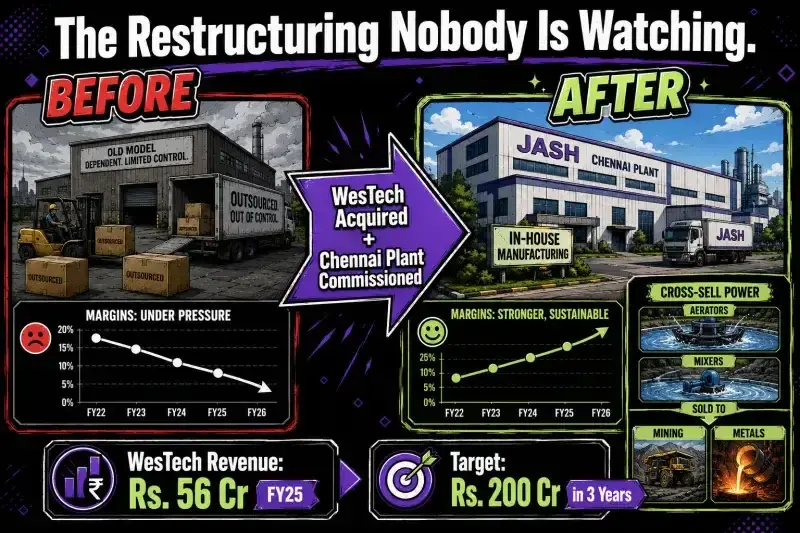
Beyond the cost angle, WesTech brings something Jash did not previously have: industrial customer relationships in mining, metals, alumina refineries, and paper and pulp. These are heavy industrial sectors with large, recurring equipment needs. They are also sectors where Jash's profitable Jash Invent aerator and mixer product range can now be cross-sold into an established customer base. One acquisition, two growth levers.
The acquisition mechanics are worth noting too. Jash bought 80% from WesTech USA and 10% from WesTech's Indian employees, with a contractual right to buy the remaining 10% from the employees after three years at a pre-agreed valuation. That structure gives the employees a meaningful stake and a financial incentive to grow the business before the remaining transfer, which is smart deal design.
Knowing how to read a balance sheet properly matters when evaluating acquisitions like this. For investors who want to understand the balance sheet implications of such deals, read What is Debt to Equity Ratio? Why it Matters for Small Cap Investing.
The Saudi Arabia Bet and the GCC Opportunity
The Middle East is undergoing one of the largest infrastructure investment cycles in its history. Saudi Vision 2030 alone encompasses hundreds of billions of dollars in urban development, desalination capacity expansion, wastewater treatment upgrades, and flood management systems. The GCC more broadly is spending at a scale that few regions in the world can match.
Jash incorporated Rodney Hunt Mahr Industries as a wholly-owned subsidiary in Saudi Arabia specifically to capture this opportunity. Local manufacturing in Saudi Arabia does two important things. First, it qualifies Jash for local content requirements that increasingly govern large Gulf infrastructure contracts. Second, it insulates the business from the global trade risks, tariff complications, and shipping volatility that affected FY2026 results so sharply.
Management has set a target of Rs. 100 Crore or more in regional Saudi and GCC revenue by 2030. Given the scale of infrastructure investment happening in the region and Jash's position as a globally recognised manufacturer of water control equipment, that target looks achievable. Getting local manufacturing operational on time is the execution challenge that will determine how quickly the revenue comes through.
The Order Book and What It Tells You
As of 1st May 2026, Jash's consolidated order book stood at Rs. 899 Crore. Export orders account for Rs. 627 Crore of that, with Rs. 272 Crore domestic. Beyond the confirmed order book, there are Rs. 28 Crore of negotiated orders and Rs. 80 Crore of orders under active negotiation.
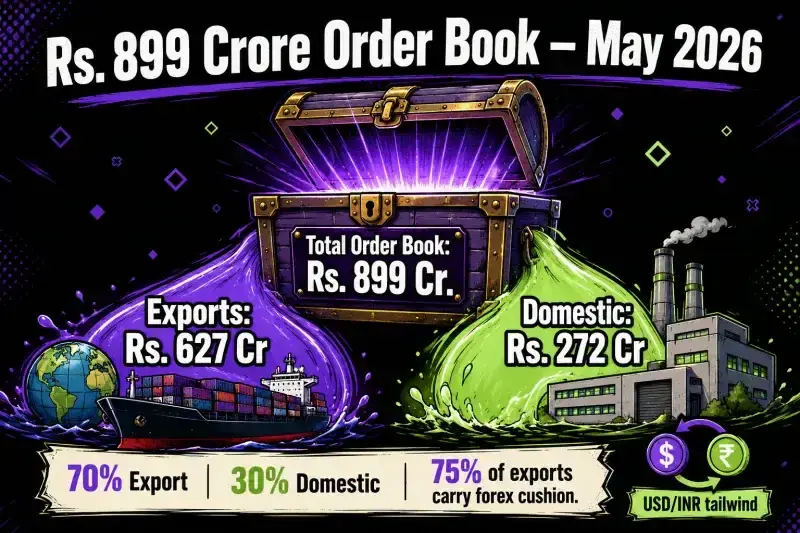
An order book at 1.2 times annual revenue gives meaningful visibility into the next 12 to 18 months of revenue. In a business where projects are custom-engineered and take time to design, manufacture, and deliver, a healthy order book is not just comfort. It is the foundation of revenue predictability.
The export-heavy composition of the order book, 70% exports versus 30% domestic, carries its own nuance. Over 75% of the current Rs. 627 Crore export order book qualifies for a significant foreign exchange cushion. Jash booked many of these long-term orders when the USD-INR rate was estimated at Rs. 82, but is invoicing and realising payments at Rs. 92. That Rs. 10 rupee difference flows directly into margins. As long as the dollar does not fall sharply against the rupee, this exchange rate tailwind remains a structural profit uplift embedded in the existing order book.
Read How to Do Segment Analysis When Researching Stocks to understand how breaking down order books by segment and geography reveals the real revenue quality inside a business like this.
The Working Capital Reality
There is one aspect of Jash's financials that no honest analysis can avoid: the working capital situation is genuinely stretched.
On a consolidated basis, Jash's debtor days stood at 1,119 days in FY2025, virtually unchanged from 1,114 days in FY2024. For readers who haven't seen that number before: yes, that is over three years of receivables on the balance sheet relative to daily revenue.
This needs context. Jash deals in custom-built municipal engineering projects with long delivery timelines and milestone-based payment structures. Large public infrastructure contracts routinely involve retention money held by the client until project completion. The nature of the business, not operational weakness, drives these stretched receivable cycles. Municipal clients in India and internationally are slow payers by structure, not by default.
That context does not make the number comfortable. Extended working capital cycles tie up capital, reduce return on equity, and add financing costs that would not exist in a faster-turning business. Management is aware of the issue. As the business shifts toward more industrial clients through WesTech, which typically have tighter payment cycles than municipalities, there is a gradual structural improvement possible. But investors going in need to understand that capital efficiency is not this company's strongest suit, and they should not expect it to become one quickly.
"Risk comes from not knowing what you are doing." Warren Buffett
FY2027 Guidance and the Path to Rs. 1,500 Crore
Management has set a consolidated revenue target of Rs. 875 Crore for FY2027, representing approximately 19% growth over FY2026. PAT margin guidance is 12% to 13%, which would yield an expected profit of Rs. 105 to 113 Crore. Gross margins are expected to land between 50% and 55%.
That recovery in margins from FY2026's 16.21% EBITDA and 10.26% PAT levels would represent a meaningful restoration of profitability. The drivers are clear: US tariff impacts on legacy contracts are being worked off, the Rs. 35 Crore of revenue that slipped into FY2027 arrives at the start of the year, Middle East shipping normalises, and the Chennai facility reduces outsourcing costs in the process equipment segment.
The longer-term vision is to double consolidated revenue to Rs. 1,500 Crore by FY2031. The roadmap involves the Houston facility coming online to protect and grow Rodney Hunt's US municipal business, Saudi Arabia scaling to Rs. 100 Crore in regional revenue, WesTech's process equipment segment doubling from Rs. 100 Crore to Rs. 200 Crore as outsourced manufacturing moves in-house, and Waterfront UK scaling from £3 million to a target of £12 million in annual revenue over four to five years.
Current group manufacturing capacity on a three-shift basis stands at roughly Rs. 1,200 Crore. With the Houston plant and the Saudi facility being established, that capacity will exceed Rs. 1,500 Crore. The infrastructure for the vision is being built. Whether execution matches ambition will depend on how the next three years play out.
Read Micro-Cap Investing: Where Extraordinary Wealth Is Built (and Tested) to understand the framework for evaluating whether a small-cap's ambition is backed by genuine business substance.
The Risks Investors Need to Understand
FY2026's margin compression came almost entirely from external factors. But that does not mean external risks will always resolve neatly. The US tariff situation evolved in an unexpected direction when the US administration moved Jash's products into Section 232, the national security tariff regime, after the Supreme Court ruled that country-wide tariffs were unconstitutional. Because Section 232 is tied to national security, it cannot be overturned by the courts. Jash is now permanently adapting to a 50% tariff regime for Indian exports to the US. A bilateral trade deal has brought an interim rate of 25%, expected to drop to 18% on ratification. But the uncertainty risk around US trade policy has not gone away.
The Houston plant timeline is critical and already delayed. If construction drags further, Rodney Hunt risks losing eligibility for US municipal projects that require local content compliance under the BABA Act by 2029. That is not a hypothetical risk. It is a specific, dated regulatory requirement that carries real commercial consequences.
Execution complexity has grown significantly. Managing subsidiaries across India, the US, the UK, Austria, and now Saudi Arabia, while simultaneously integrating WesTech, restructuring the Shivpad operations, and building two new facilities, is a serious management bandwidth challenge. Each of those initiatives is manageable in isolation. Together, they demand exceptional execution discipline.
Working capital remains structurally stretched. The debtors' days situation is inherent to the municipal infrastructure business model, but it caps return ratios and requires ongoing attention to ensure receivables are converting to cash in reasonable timeframes.
Promoter holding at 43.24% is lower than one typically likes to see in a small-cap, though as discussed, the active family has only purchased and never sold. The relatively high retail ownership means price volatility can be amplified, and the stock is more susceptible to sentiment-driven swings than its business fundamentals would warrant.
Explore our Products
Research Framework

Emerging Titans
Combination of quantitative analysis, industry tailwinds, and management assessment - SPRINT investment philosophy

Tiny Titans
Heavy emphasis on scuttlebutt research, plant visits, and early on-ground signals
What This Business Really Represents
Here is the simplest way to think about Jash Engineering.
Every city in the world needs water infrastructure. Every growing city needs more of it. Every ageing city needs to replace what is wearing out. Climate change is creating water stress in regions that were previously water-secure, driving desalination investment at a pace not seen before. The global push for urbanisation, particularly across South Asia, the Middle East, and Africa, is generating municipal infrastructure demand that will run for decades.
Jash sits in the middle of all of it. Not at the glamorous end, where companies get named in government press releases and feature in economic surveys. At the functional end, where the actual equipment that moves and controls water gets designed, manufactured, and installed. The gates, screens, and valves that nobody thinks about until they fail.
"The secret of getting ahead is getting started." Mark Twain
That position, unglamorous and structurally essential, is one of the more durable places to build a business. Customers do not switch vendors on water control infrastructure lightly. The custom engineering nature of every product means relationships take years to establish and are difficult to dislodge. Jash's 70% market share in water control gates in its active markets did not appear in a single year. It accumulated over five decades of consistent delivery.
FY2026 was a difficult year. The numbers reflect genuine external disruption. The underlying franchise, the customer relationships, the technical approvals, the global subsidiaries, the order book, and the strategic clarity around where the business is going, is intact.
The question for investors is whether they can look past one year of external noise to evaluate the business underneath. That capacity for patient, accurate assessment is what separates good small-cap investing from reactive decision-making driven by the last quarterly result.
The water has to flow. The equipment that controls it has to come from somewhere. For a significant portion of the world's municipal water infrastructure, it comes from Indore.
This article is intended for educational and informational purposes only and should not be construed as financial advice. Please consult a registered investment advisor before making any investment decisions.
FAQs
What does Jash Engineering manufacture and who are its customers?
+Jash Engineering manufactures custom-engineered water control and waste treatment infrastructure equipment. Its core products include water control gates, mechanical bar screens, knife gate valves, micro hydro turbines, Archimedes screw pumps, clarifiers, and decanters. These are used in raw water intake facilities, wastewater pumping stations, storm water management systems, flood prevention infrastructure, and desalination plants. Customers are primarily municipal water utilities, government infrastructure agencies, and industrial clients across India, the US, the UK, Europe, and the Middle East. Jash holds an estimated 70% market share in water control gates in its active markets.
Why did Jash Engineering's profits fall in FY2026 despite being a fundamentally strong business?
+FY2026's underperformance was driven almost entirely by external and temporary factors, not structural weakness. US import tariffs were raised to 25% in January and then 50% in June, hitting fixed-price legacy orders that had been quoted before the hikes and causing an estimated $1 to $2 million profitability impact. Geopolitical disruptions in the Middle East halted export shipments in March 2026. Additionally, Rs. 35 Crore worth of orders that were physically dispatched before year-end could not be recognised as revenue due to Incoterms delivery cut-off dates, pushing that revenue into Q1 FY2027. Standalone Indian operations, which are not exposed to these disruptions, actually grew 18% in FY2026 with healthy PAT margins of 13.38%.
What is the Houston plant and why is it critical for Jash's future?
+Jash is building a new manufacturing facility in Houston, Texas, to replace its existing US operations in Orange, Massachusetts, where a chronic labour shortage has made scaling impossible. The more urgent driver is regulatory. The US Build America, Buy America Act mandates that by 2029, 90% of value addition for municipal projects must be done locally in the United States. Jash's US subsidiary Rodney Hunt serves a large public municipal contract pipeline that will be at risk if local manufacturing is not operational in time. The Houston plant is budgeted at $6 to $6.5 million, with $4 million already raised and the remaining $2 million to be funded through US bank loans. Construction faced delays after the original contractor shut down, but a new contractor has been engaged.
What is the WesTech acquisition and what does it mean for Jash's margins?
+In January 2026, Jash acquired a 90% stake in WesTech Process Equipment India for Rs. 29.11 Crore. WesTech gives Jash its first entry into heavy industrial sectors including mining, metals, alumina refineries, and paper and pulp, sectors where Jash previously had no customer relationships. More immediately, WesTech's outsourced manufacturing is being moved in-house to Jash's newly commissioned Chennai facility, which is expected to meaningfully expand operating margins in the process equipment segment as outsourcing costs are eliminated. Jash also has a contractual right to acquire the remaining 10% stake from WesTech's Indian employees after three years at a pre-agreed valuation.
What is Jash Engineering's order book and what does it tell investors?
+As of 1st May 2026, Jash's consolidated order book stood at Rs. 899 Crore, roughly 1.2 times its FY2026 annual revenue, providing clear visibility into the next 12 to 18 months. Of that, Rs. 627 Crore is export orders and Rs. 272 Crore is domestic. Beyond confirmed orders, there are Rs. 28 Crore of negotiated orders and Rs. 80 Crore under active negotiation. A particularly important detail is that over 75% of the export order book carries a foreign exchange cushion, as many orders were booked when the USD-INR rate was around Rs. 82 but are being invoiced and realised at Rs. 92, with the Rs. 10 difference flowing directly into margins.
What are the biggest risks of investing in Jash Engineering?
+The most immediate risk is the Houston plant timeline. If construction is delayed further, Rodney Hunt could lose eligibility for US municipal contracts requiring local content compliance under the BABA Act by 2029, which would be a serious commercial setback. US tariff policy under Section 232 now permanently subjects Indian imports to a 50% tariff regime, though a bilateral trade deal has brought an interim rate of 25%. Working capital is structurally stretched, with debtor days at over 1,100 on a consolidated basis due to the milestone-based payment structure of municipal infrastructure contracts. Finally, managing subsidiaries across five countries while simultaneously integrating WesTech, building two new facilities, and entering Saudi Arabia creates real execution complexity that demands consistent management discipline.

High growth stock specialist, Value Educator
Shashank Mahajan is an equity research professional with over 12 years of experience in identifying high-potential SME and micro-cap stocks at an early stage. He follows a rigorous scuttlebutt research–driven approach, combining on-ground insights with deep financial analysis. Shashank specializes in uncovering under-researched and under-owned companies with strong management quality and long-term growth potential. Through disciplined research and early identification, he focuses on spotting tomorrow’s market leaders before they enter the mainstream investor radar.

Zen Technologies: Why Revenue Fell After Its Biggest Win

Data Patterns: India's Radar Designer and Its Waiting Orders
KSH International: The Wire Inside India's Transformers

Krishna Defence: The Steel Behind India's Warship Hulls

PNG Jewellers: A 194-Year-Old Name Goes National
Axiscades: From Services to Missile and Radar Electronics
Explore our Products
Research Framework
Emerging Titans
Combination of quantitative analysis, industry tailwinds, and management assessment - SPRINT investment philosophy
Tiny Titans
Heavy emphasis on scuttlebutt research, plant visits, and early on-ground signals


 Orders
 Subscription
 Share with friends
 Logout


Required Details
₹23999.00
(12 month subscription)
As per SEBI regulations, all users are mandated to complete the KYC that is validated for 1 year. Post payment, you will be redirected to the KYC screen


No comments yet. Be the first to comment!