
How to Build a Stock Watchlist

Most investors don't lose money because they picked the wrong stock. They lose money because they never had a real reason to pick it in the first place. They buy when prices rise. They sell when prices fall. Months later, they can't explain why they entered the position. No written thesis, no tracking framework, no predefined exit trigger, just reactions dressed up as decisions.
The market doesn't punish this immediately. Sometimes it rewards it just enough to feel like a skill. But over time, the randomness surfaces. Positions become unclear. Conviction evaporates. Learning stops.
The gap between amateurs and professionals isn't intelligence or access to information, but rather it's structure. Professionals don't hunt for stocks. They manage a pipeline such as pre-researched ideas, documented reasoning, and clear criteria for action. They don't "look for stocks." They run a system.
This article will show you how to build that system, starting with a structured watchlist and a written investment thesis so that investing becomes a repeatable decision-making process, not an impulse in disguise.
The Investment Lifecycle
Before building a watchlist, it helps to understand where it sits in the full investment process. A tool without context just becomes busy work.
There is a straightforward order to a healthy investment flow. You come up with an idea, conduct some research on it, write down your rationale, put it on the appropriate watchlist, decide when to act, only act when certain circumstances are satisfied, and then continue to check to see whether your initial thinking still makes sense. Every action has a goal. Skip one, and the whole process weakens.
A watchlist is not where the process starts. It sits in the middle somewhere between your research and your actual buying decision. Its job is to convert your thinking into structured readiness. It stops you from buying too early out of excitement, and it stops you from endlessly studying without ever acting.
Without this structure, most investors skip straight from "I heard about this stock" to "let me buy it." There is no documentation, no accountability, no learning from past decisions. Everything becomes reactive.
When used correctly, a watchlist acts as a bridge between your analysis and your capital. It ensures that when you finally buy something, it is because a predefined condition was met & not because the price moved and made you feel something.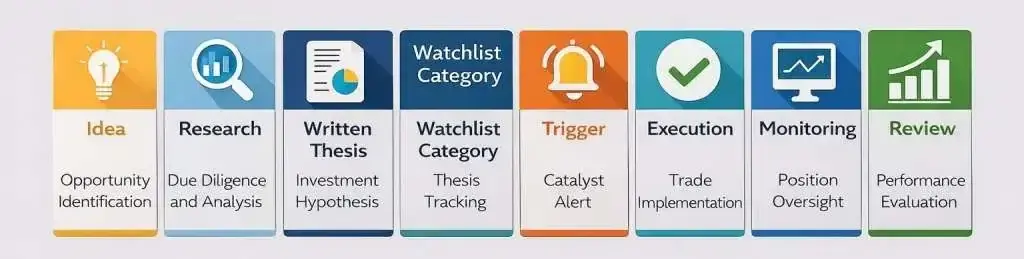
What a Stock Watchlist Really Is & What It Is Not
A stock watchlist is a ready list of companies you have already studied and shortlisted, not a random collection of company names you heard about somewhere. Every company on it should have passed a basic check, such as whether the business is good, does it make money, and do you understand what it does? If you cannot explain in two simple lines why a stock is on your list, it should not be there.
It is equally important to know what a watchlist is not. It is not a dump of stocks that are trending on social media. It is not a vague list of "stocks I will look at someday." It is not your portfolio. And it is definitely not a place to save tips from WhatsApp groups or random YouTube comments. Without clear rules for adding stocks, your watchlist quickly becomes useless noise.
The difference is simple. Without a watchlist, you buy out of excitement when prices rise and panic-sell when they fall. You trade too often and for the wrong reasons. With a proper watchlist, you only act when something meaningful changes in the business & not because the price moved. Your decisions become calmer and more planned.
A good watchlist is not about tracking more stocks. It is about being ready before the right opportunity arrives so you act with clarity, not panic.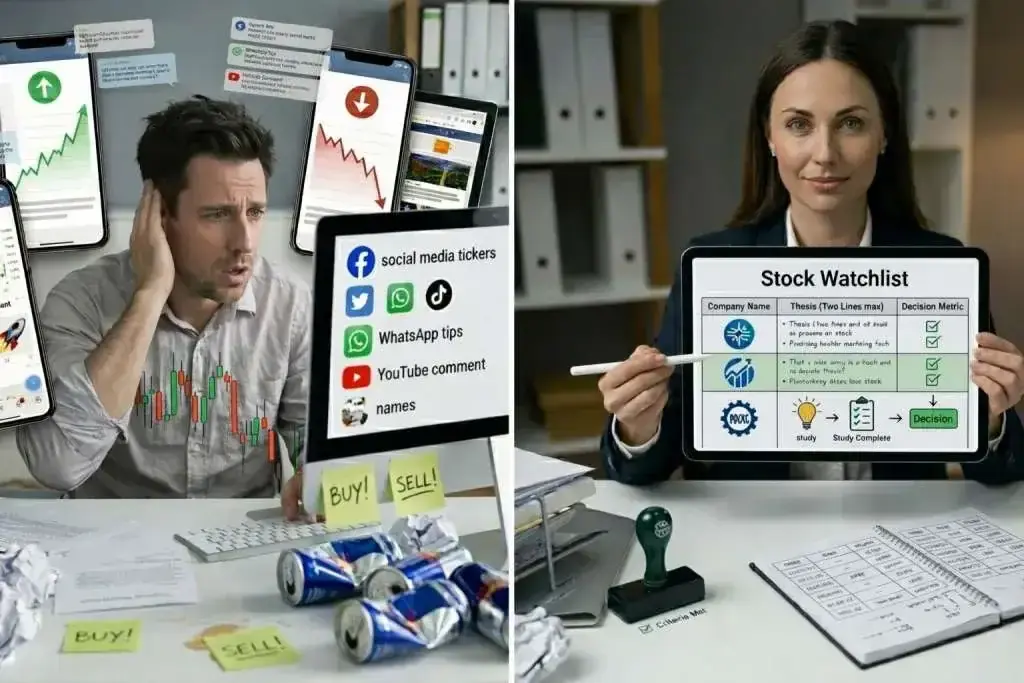
Writing Your Investment Thesis
A watchlist without a written thesis is just a list of names. The thesis is what gives it meaning. It must come before you categorize a stock because the quality of your thinking decides whether a stock belongs in your list.
An investment thesis answers three simple questions: why will this business grow in value over time? Why is the market possibly undervaluing it today? And what would tell you that you were wrong? If you cannot answer the third question, it is not a thesis; rather, it is just hope.
A good thesis has five parts:
- Business Summary
What does the business do, how does it generate revenue, and what factors influence its earnings? Write this in three to four simple lines. You don't really comprehend anything if you can't put it clearly. - Growth Drivers
What specific things will push revenue or profits higher? Avoid vague answers like "good management." Be specific, such as new capacity, rising prices, market share gains, or new products. - Competitive Strength
Why can this business keep earning good returns? Does it have a devoted following, reasonable prices, a strong brand, or anything that rivals find difficult to imitate? Without shelter, growth rarely continues. - Valuation LogicIs
Is the current price reasonable? What is the business worth if things go as planned? How much discount are you getting? This keeps optimism honest.
If you're unsure how to estimate that, here’s a practical guide on: what is value investing? Complete guide for beginners - Thesis Breakers
What specific things would tell you the story has changed? Rising debt, falling margins, losing customers, or a new competitor? Define this before you buy, not after.
Categorizing Stocks Based on How Ready Your Thesis Is
Once you have written your thesis, deciding where a stock belongs becomes easy. The strength and completeness of your reasoning tells you exactly which list it goes on. Do not organize your watchlist by sector or by which stocks are trending. Organize it by how ready your thinking is, because that is what determines whether you are ready to act.
- Opportunity Watchlist (Waiting for the Right Price)
This list contains businesses you already like but find too expensive right now. The company is good, you understand what it does, and the long-term picture looks attractive, but the price does not give you enough safety margin yet. These are not random bets. They are good businesses, you are patiently waiting to buy cheaper.
“The big money is not in the buying or the selling, but in the waiting.”- Charlie Munger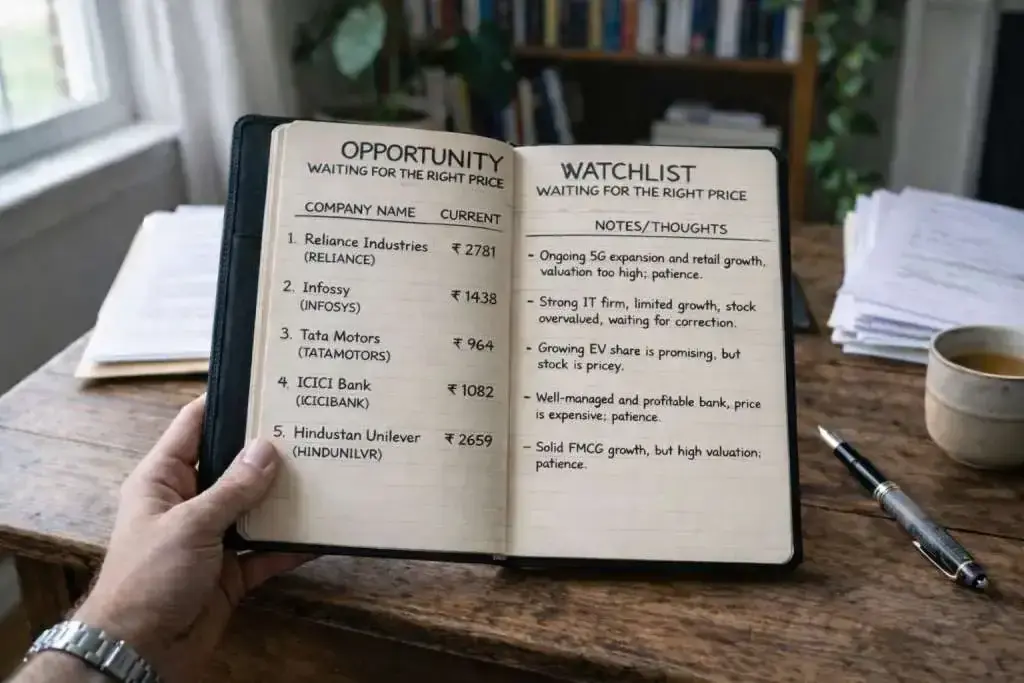
If you want to understand why waiting for valuation comfort matters, read: Why Market temporarily stop trading - Tracking Watchlist (Still Studying the Business)
This list contains good companies you are not ready to buy yet, either because the price is still high or because you need to understand them better. The goal here is not to buy soon. The idea is to keep an eye on things so that you are familiar with the industry when the time is perfect.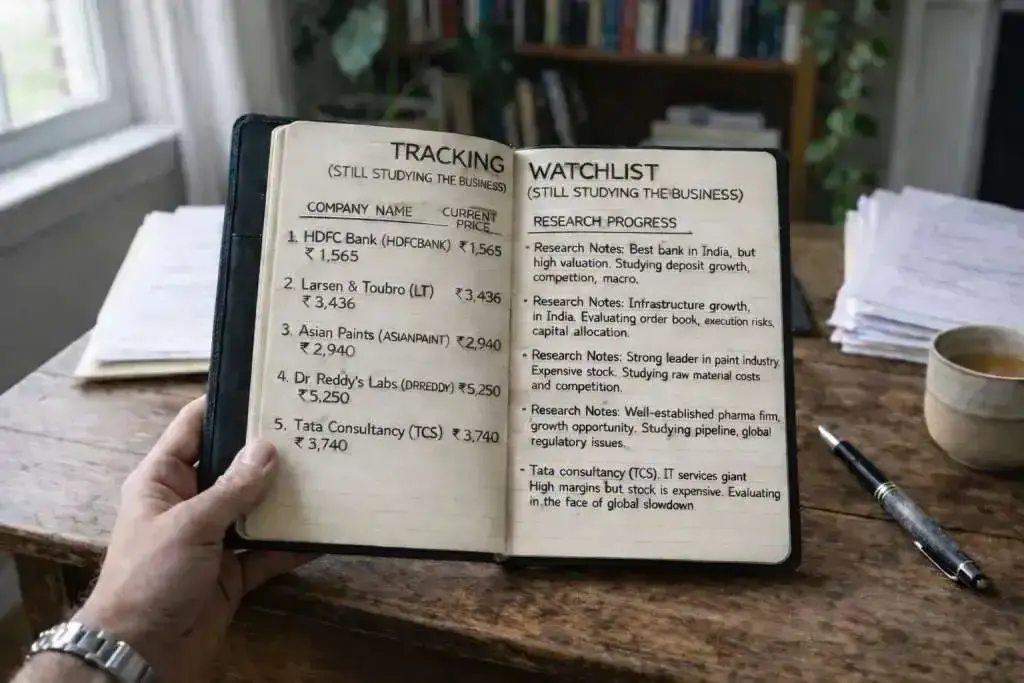
- High-Conviction Pipeline (Almost Ready to Act)
This is your strongest list. You have done deep research. You understand the business clearly. You have written down your thesis, your risks, and your buy conditions. You are not exploring anymore, you are simply waiting for the right moment to pull the trigger.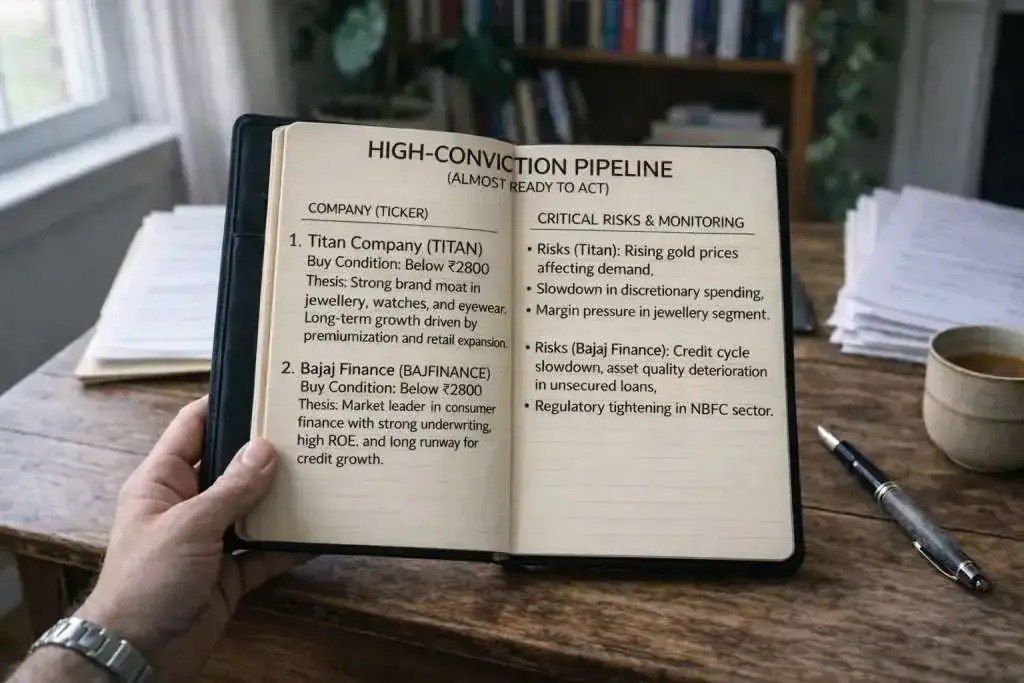
Building Your Watchlist: The Practical Steps
A good framework is only useful when you turn it into a set of repeatable actions. Building a watchlist should not feel exciting or spontaneous. It should feel like a checklist so that every stock on the list is there for a clear, honest reason.
- Know What You Actually Understand
The first filter has nothing to do with numbers. It is about honesty. Which businesses do you genuinely understand? Which industries can you explain clearly? Moreover, how does the company earn money, what drives its profits, and what could hurt it?
“Know what you own, and know why you own it.” - Peter Lynch
If you cannot explain a business in three simple lines, it does not belong on your active watchlist. The goal is not to follow as many sectors as possible. The goal is to deeply understand a smaller number. A short list you truly understand is far more valuable than a long list you barely follow. - Apply Basic Quality Filters
Before wasting time on further in-depth research, do a few basic quality tests to eliminate poor firms once you are aware of your regions. Seek sustainable cash flows, reasonable debt, a healthy return on capital, and regular profitability.
If you’re not confident analyzing these numbers, start with How to Read a Balance Sheet Like a Professional Investor.
Think of these filters as basic hygiene. They do not tell you which stocks to buy, they simply remove the ones not worth studying further. Passing these checks does not make a stock a good investment. It just makes it worth a closer look. - Tag Every Stock Immediately
Every stock that passes your filters must immediately go into one of your three lists — opportunity, tracking, or high-conviction. No unclassified stocks allowed. An unclassified stock means unfinished thinking, and unfinished thinking leads to impulsive decisions.
Tracking Your Thesis: How to Monitor the Right Things
Monitoring does not mean checking the price every day. It means regularly checking whether the reasons you bought the stock are still true. Price moves up and down due to market mood, news, and sentiment. But your thesis is built on business performance, competitive strength, and how management uses money. So your monitoring should focus on the business, not the price.
A simple quarterly check is enough for most investors. Once every three months, ask yourself:
Is revenue growing the way I expected, and if not, is the slowdown temporary or permanent?
Are profit margins improving, staying flat, or shrinking, and why?
Is management using the company's money wisely, or making decisions that do not make sense? Does what the management say match what they actually do?
And finally, has anything changed in the industry, like new competition, new rules, or shifts in demand?
These five questions keep your monitoring focused on facts, not feelings.
Beyond the quarterly check, use this simple framework whenever price moves:
- Price falls, but business is fine
Do not panic. A lower price on a good business often means a better buying opportunity, not more risk. - Price rises, but business is fine
Do not get overconfident. A rising price does not mean the business got better. Stay grounded. - Business weakens, but price is flat
Do not hold on just because you have not lost money yet. A deteriorating business is a reason to exit. - Thesis is broken
Sell. Do not let the price you paid stop you from making the right decision today.
Case Study: Applying the Framework to Titan Company
To make everything discussed so far feel real, let us walk through how this framework would work with a company most Indian investors already know — Titan.
The Thesis?
Trusted, established companies are gradually replacing tiny, disorganized local jewelers in India's jewelry business. This change immediately helps Tanishq, Titan's jewelry firm, as consumers trust the brand, the quality is reliable, and the business operates smoothly. Strong wedding season sales, increased demand for high-end jewelry, the establishment of new stores, and expansion into smaller locations are all anticipated to contribute to growth. The business earns strong returns on capital and has historically been run with financial discipline.
The opportunity to buy at a good price usually appears when gold prices cause short-term margin pressure or when the market overreacts to a temporary demand slowdown, even though the long-term business story remains unchanged.
Which Watchlist Does It Belong To?
That depends entirely on where your research and the valuation stand. If you understand the business well, but the price is too high, it goes on your Opportunity Watchlist. If your thesis is fully written and the price is approaching a comfortable level, it moves to your High-Conviction Pipeline. If you are still studying it, it stays on your Tracking Watchlist. Brand familiarity does not decide the category; your thesis maturity and the price do.
What Would Trigger a Buy?
Your trigger must be decided in advance. For example, the stock corrects to a valuation level that makes sense relative to its earnings growth. Or margins recover after a temporary fall. Or the company shows continued market share gains. The trigger converts your interest into a clear, actionable decision.
What to Monitor Every Quarter?
Watch whether new stores are actually driving revenue growth. Check whether profit margins are holding up despite gold price changes. Track inventory levels and how efficiently the business uses its working capital. Read management commentary carefully, are they doing what they said they would? And watch the broader industry for any regulatory changes or shifts in how people buy jewellery.
What Would Break the Thesis?
Exit or seriously reconsider if margins fall consistently and the reason appears structural rather than temporary. If return on capital starts declining due to overexpansion or poor capital decisions, that is a warning sign. If the Tanishq brand loses customer trust for any reason, the core argument weakens. And if the company starts taking on heavy debt, the risk profile changes entirely.
This case study shows that structure must come before conviction. The category, trigger, and exit criteria are all specified when the thesis is prepared. Every choice you make has a rationale.
Tools to Maintain Discipline
The practices that underpin a good framework determine how strong it is. Even the strongest ideas eventually wane, discipline lapses, and past errors subtly recur when there is no fundamental foundation in place.
- A Proper Spreadsheet — Not Just a Price Tracker
Your watchlist should not just show stock names and current prices. It should be a structured record that captures your thesis, your target entry price, your expected return, your buy trigger, which category the stock is in, how much of your portfolio you plan to allocate, and what would make you exit. Every column should have a purpose. The goal is to ensure that no stock exists in your system without a documented reason. - Write Your Triggers in Advance
Decide your buy conditions before the market gets volatile & not during. Whether it is a specific price level, a recovery in margins, or a particular business milestone, write it down in advance. When the moment arrives, you will act on your pre-decided logic rather than on fear or excitement. - Quarterly Review Log
Every three months, write a short note on each active thesis. Is the business performing as expected? Are margins holding? Is management delivering on what they promised? This does not need to be long. Even five to six honest lines per stock is enough. Over time, this creates a record of how accurate your thinking actually was. - Mistake Journal
Keep a simple log of every time you deviated from your own process such as being bought without a proper thesis, held too long, exited too early, or sized a position incorrectly. Pay attention to the decision's quality rather than its financial outcome. You won't even be aware that you are repeating mistakes if you don't write them down.
Common Mistakes That Quietly Destroy Your Process
Selecting the incorrect stock does not account for the majority of investment losses. They are brought on by little cracks in your procedure that eventually widen. Here is a simple checklist to spot where your system might be breaking down.
- Tracking Too Many Stocks
If your watchlist is so long that you cannot explain why each stock is on it without going back to your notes, it is too long. More stocks do not mean better investing. It means scattered attention and impulsive decisions. Ask yourself: can you explain the thesis of every stock on your list in under one minute, from memory? - Quietly Rewriting Your Thesis
If your written thesis keeps changing after results come out or after the price moves, you are not analysing; rather, you are making excuses. Only if there is a significant shift in the business should the thesis be altered. Consider this: have I gradually changed the plot to support my continued interest, or is my present justification the same as what I originally wrote? - Ignoring the Price You Pay
A great business can still be a bad investment if you buy it at the wrong price. If you are not calculating expected returns based on your entry price, you are investing on hope. Ask yourself: have I actually calculated what return I expect at the current price?
To avoid this trap, read Why Markets Temporarily stop trading - Believing the Story Over the Numbers
Management always sounds confident. Stories from the industry often seem fascinating. However, the tale is meaningless if the real cash flows, margins, and sales do not back it up. Consider if the tale is being used to justify the figures or whether the story is being used to hide poor numbers. - No Exit Plan
If you have not written down what would make you sell, you will hold forever by default even when the original reason for buying no longer exists. Ask yourself: under what specific conditions would I sell this stock today, and is that written down somewhere? - Checking Price Instead of Checking the Business
If you are opening your trading app ten times a day but only reading quarterly results once, your attention is in the wrong place. Price is just a number. The business is what matters. Ask yourself: Am I monitoring because something changed in the business, or because the price moved?
Ultimately, this framework only works when it aligns with your broader approach to markets. If you have not defined that yet, start with What is an Investment Philosophy? How to Find Yours.
Explore our Products
Research Framework

Emerging Titans
Combination of quantitative analysis, industry tailwinds, and management assessment - SPRINT investment philosophy

Tiny Titans
Heavy emphasis on scuttlebutt research, plant visits, and early on-ground signals
Conclusion
A structured watchlist, a written thesis, predefined triggers, and regular reviews all exist for one simple reason. So that your decisions are made in advance, not in the heat of the moment.
The goal is not to predict where the market goes next or guess the next quarterly result. The goal is to be ready before the opportunity arrives.
“You can’t predict. You can prepare.” - Howard Marks
If you cannot clearly answer when you would buy, when you would add more, and when you would sell, then you do not have a system. You just have exposure. Exposure means you are at the mercy of market mood and daily noise. A system means every action has a condition attached to it.
If this article helped you understand how to build a structured watchlist and track your thesis with discipline, comment “PROCESS” below. Share it with someone who buys stocks — but has never built a system around them.
The market does not consistently reward the smartest investors. It rewards the most prepared ones.
FAQs
How many stocks should a beginner keep on their watchlist?
+Although there is no set amount, novices should focus more on depth than quantity. A reasonable range is between 10 and 20 stocks in your area of expertise. The list is too lengthy if you are unable to describe each one's business strategy and thesis with confidence. A narrow, comprehensible list works better than a wide, superficial one.
How long should I track a stock before buying it?
+There is no mandatory time period. The deciding factor is thesis clarity, not time spent. Some businesses may require several quarters of observation before conviction builds. Others may become actionable quickly if valuation and understanding align. The key is not speed; it is confidence supported by written reasoning.
What if I miss the opportunity while waiting for the right price?
+Missing a stock is not a loss. Overpaying is. Your system is designed to protect capital first. There will always be new opportunities. Discipline means accepting that not every good business becomes your investment. The goal is not participation in every rally, but participation in favorable risk-reward situations.
Should beginners use this framework if they invest through SIPs or index funds?
+Yes, but with adaptation. Even if investing in index funds, you should define why you are investing, your time horizon, expected returns, and exit conditions. Structure improves clarity in all forms of investing. The framework is about disciplined decision-making, not just stock selection.
How do I estimate intrinsic value if I am not comfortable with financial modeling?
+Beginners can start simple. Use conservative growth assumptions, compare historical valuation ranges, and estimate expected returns based on earnings growth plus potential multiple changes. The goal is not precision, it is having a rational benchmark to compare prices against. Over time, valuation skill improves through practice.

High growth stock specialist, Value Educator
Shashank Mahajan is an equity research professional with over 12 years of experience in identifying high-potential SME and micro-cap stocks at an early stage. He follows a rigorous scuttlebutt research–driven approach, combining on-ground insights with deep financial analysis. Shashank specializes in uncovering under-researched and under-owned companies with strong management quality and long-term growth potential. Through disciplined research and early identification, he focuses on spotting tomorrow’s market leaders before they enter the mainstream investor radar.

Zen Technologies: Why Revenue Fell After Its Biggest Win

Data Patterns: India's Radar Designer and Its Waiting Orders

KSH International: The Wire Inside India's Transformers

Krishna Defence: The Steel Behind India's Warship Hulls

PNG Jewellers: A 194-Year-Old Name Goes National

Axiscades: From Services to Missile and Radar Electronics
Explore our Products
Research Framework
Emerging Titans
Combination of quantitative analysis, industry tailwinds, and management assessment - SPRINT investment philosophy
Tiny Titans
Heavy emphasis on scuttlebutt research, plant visits, and early on-ground signals


 Orders
 Subscription
 Share with friends
 Logout


Required Details
₹23999.00
(12 month subscription)
As per SEBI regulations, all users are mandated to complete the KYC that is validated for 1 year. Post payment, you will be redirected to the KYC screen


No comments yet. Be the first to comment!