
IPO Grey Market Premium (GMP) Explained

Before every IPO listing, one number suddenly starts dominating conversations — GMP. Investors track it daily, WhatsApp groups circulate updates every few hours, and Telegram channels turn it into a headline signal. For many retail participants, this single number quietly becomes the deciding factor: apply or skip.
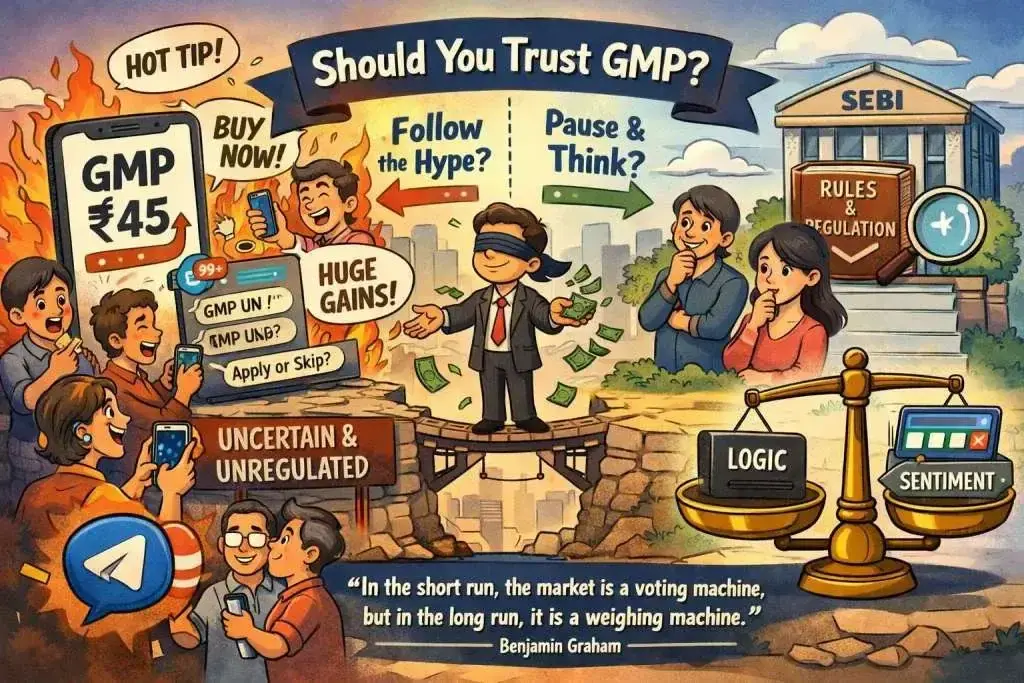
But pause for a second.
This number that feels so important… doesn’t come from the exchange. It isn’t published by regulators. And it isn’t backed by any formal mechanism.
Yet, despite all this, thousands of investors rely on it.
That’s where the gap lies.
GMP is widely discussed, heavily tracked, and often treated as a predictor of listing gains — but in reality, it operates outside the official market ecosystem. There is no standardised reporting, no regulatory oversight, and no guarantee that what you’re seeing reflects actual demand.
And that leads to a critical question most investors never stop to ask:
If GMP is unofficial, unregulated, and sentiment-driven…
should you trust it — or ignore it completely?
“In the short run, the market is a voting machine, but in the long run, it is a weighing machine.” — Benjamin Graham
If you’re new to how IPOs actually work and how they are structured, read more on → How SME IPOs work - Complete guide for retail investors
What is IPO GMP (Grey Market Premium)?
Let’s break this down in the simplest way possible.
Grey Market Premium (GMP) is the unofficial price at which IPO shares trade before they are listed on the stock exchange. It exists outside the formal market — meaning these trades happen informally through dealers or brokers, not on platforms like NSE or BSE.
Think of it like this:
- IPO issue price = ₹100
- GMP = ₹40
This means that in the grey market, people are willing to pay ₹40 extra even before the stock is officially listed.
So, the expected listing price becomes:
₹100 + ₹40 = ₹140 (expected listing price)
But here’s the key point — this is not a guarantee. It’s just an expectation based on current demand and sentiment.
The easiest way to remember this:
Think of GMP as a “black market expectation” of listing price.
It tells you what people are willing to pay today, not what the stock is actually worth.
How GMP Actually Works (Behind the Scenes)
To really understand GMP, you need to look beyond the number and see how it actually functions in the real world.
GMP operates in what is called the grey market — an unofficial, informal market where IPO shares are traded before they are listed on exchanges like NSE or BSE. These transactions are not recorded on any official platform and are usually facilitated through a network of local brokers, dealers, and market operators.

Here’s how it typically works:
When an IPO is about to list, buyers and sellers in the grey market start negotiating deals based on what they believe the stock will list at. If demand is high, buyers are willing to pay a premium over the issue price. If sentiment is weak, the premium drops — or can even turn negative.
These deals are often based on trust and informal agreements, not legal contracts. There is no centralized exchange, no order book, and no transparency in pricing. Each transaction depends on who is willing to buy, who is willing to sell, and at what price.
Most importantly, this entire market operates outside the regulatory framework of Securities and Exchange Board of India (SEBI). That means:
- No official reporting
- No investor protection
- No guarantee of settlement
This is why GMP can change rapidly — sometimes even within hours — because it is driven purely by demand, supply, and market sentiment.
And that leads to the most important takeaway:
GMP is not a guarantee — it’s just a reflection of the current market mood.
“In the short run, the market is a voting machine, but in the long run, it is a weighing machine.” — Benjamin Graham
To understand how prices actually form in markets beyond IPO hype, read more on → How Stock Prices Actually Move: Bid, Ask, and the Invisible Auction
Why GMP Moves (What Actually Drives It)
If you track GMP daily, you’ll notice it keeps changing — sometimes sharply. That’s because GMP is not based on a fixed formula. It moves based on market behaviour, demand, and perception, not strict valuation models.
To understand it properly, break it into four key drivers:
1. Subscription Demand
The biggest driver of GMP is how strongly the IPO is being subscribed.
When an IPO gets high subscription (especially from QIBs and HNIs), it signals strong demand. This pushes buyers in the grey market to bid higher, increasing the GMP. On the other hand, weak subscription leads to lower or even negative GMP.
Simple logic:
More demand → Higher GMP
2. Market Conditions
GMP doesn’t exist in isolation — it is heavily influenced by overall market sentiment.
- In a bull market, liquidity is high, confidence is strong, and investors are willing to pay a premium → GMP rises
- In a bear or volatile market, risk appetite drops → GMP falls or collapses
Even a strong IPO can see falling GMP if the broader market turns weak.
3. Company Narrative
Not all IPOs are treated equally. The story around the company matters a lot.
If the company belongs to a “hot sector” — like AI, defence, renewables, or digital platforms — GMP tends to be higher because investors expect strong future growth.
On the other hand, companies from traditional or low-growth sectors may see muted GMP even if fundamentals are decent.
Markets don’t just price numbers — they price stories.
4. Listing Gains Demand
A large part of IPO participation in India is driven by listing gains, especially from retail investors.
When more investors apply with the intention to sell on listing day, demand in the grey market increases, pushing GMP higher. This becomes a self-reinforcing cycle — higher GMP attracts more applicants, which further boosts sentiment.
Key Insight
Put all of this together, and one thing becomes clear:
GMP reflects sentiment more than fundamentals.
“Price is what you pay. Value is what you get.” — Warren Buffett
If you want to go deeper into how market cycles and sentiment affect investing decisions, read more on → Bull Market vs Bear Market – How Investors Should React
It tells you how excited the market is right now — not how strong the business actually is.
The Big Problem With GMP (What Most Investors Ignore)
This is where the real issue begins — not with GMP itself, but with how it is perceived.
Most investors treat GMP as a reliable indicator. In reality, it comes with serious limitations that are often overlooked.
1. Unregulated and Opaque
GMP operates completely outside the formal market structure. There is no official data source, no standardized reporting, and no regulatory oversight from bodies like Securities and Exchange Board of India.
Prices are based on informal deals between brokers and participants, which means:
- No transparency in pricing
- No way to verify accuracy
- No protection for investors
What you see online is often indicative, not definitive.
2. Easily Influenced and Manipulated
Since the grey market is small and unregulated, it can be influenced by a limited number of participants.
Operators and large players can:
- Create artificial demand
- Push GMP higher to build hype
- Influence retail sentiment
This doesn’t always reflect genuine market demand — it can sometimes reflect positioning and narrative creation.
“The four most dangerous words in investing are: ‘This time it’s different.’” — John Templeton
3. Focused Only on Short-Term Listing Gains
GMP is almost entirely driven by listing expectations, not business fundamentals.
It does not consider:
- Revenue quality
- Profitability
- Balance sheet strength
- Long-term growth
It simply answers one question:
“What price might this stock list at?”
Not:
“Is this a good business to own?”
The Core Truth
When you combine all these factors, the reality becomes clear:
GMP tells you what people feel today — not what the business is worth.
And confusing the two is where most investors go wrong.
Reality Check — Where Investors Go Wrong
This is where the biggest mistakes happen — not because of lack of information, but because of how investors behave around IPOs.
When GMP is high, many investors stop thinking and start following. The logic becomes simple: “If GMP is strong, listing gains are guaranteed.” Applications are made blindly, often without even reading the company’s fundamentals, valuation, or risks.
The focus shifts completely from business quality → listing price.
On the other side, when GMP is low or weak, the same IPO is ignored — even if the company has solid fundamentals, strong earnings visibility, or long-term growth potential.
And then comes the final mistake.
Many investors who do get allotment sell immediately on listing day, locking in short-term gains, without asking whether the company could create much larger value over time.
This behavior is driven by:
- Fear of missing out (FOMO)
- Herd mentality
- Obsession with quick profits
But here’s the reality most investors learn the hard way:
High GMP ≠ a good company.
Low GMP ≠ a bad company.
GMP reflects excitement.
Fundamentals reflect value.
And confusing excitement with value is where most IPO decisions go wrong.
Managing emotions during such phases is critical — read more on → How to Stay Emotionally Strong During Market Crash
Real Example — GMP vs Reality (With Actual IPOs)
To truly understand GMP, you need to see how it behaves in real situations — because this is where most assumptions break.
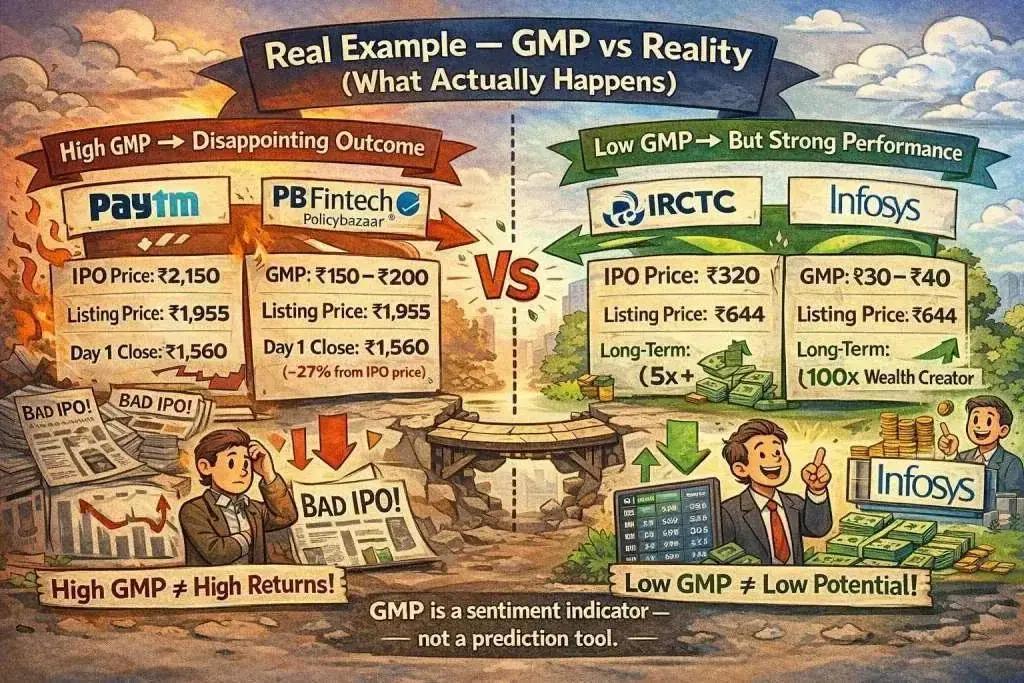
Case 1: High GMP → But Disappointing Outcome
A strong example is Paytm (One97 Communications).
- IPO Price: ₹2,150
- GMP before listing: ~₹150–₹200 (implying ~7–10% listing gain)
- Listing Price: ₹1,955 (–9% discount)
- Day 1 Close: ₹1,560 (–27% from issue price)
Despite strong hype and positive GMP signals, the stock delivered one of the worst large IPO listings in India.
What happened?
- Overvaluation
- Weak market sentiment at listing
- GMP failed to reflect actual institutional demand
Another example is PB Fintech (Policybazaar):
- IPO Price: ₹980
- GMP: ~₹150+ (strong expectations)
- Listing Gain: ~17% (₹1,150)
- But within months: stock corrected 50%+ from listing levels
Insight:
GMP got the listing direction right… but completely failed on sustainability
Case 2: Low GMP → But Strong Performance
Now look at the opposite side.
A strong example is IRCTC:
- IPO Price: ₹320
- GMP: Very modest (~₹30–₹40 range pre-listing)
- Listing Price: ₹644 (100%+ listing gain)
- Long-term: Became a multibagger (5x–6x+ over time)
What happened?
- Strong monopoly business
- High margins
- Underestimated by grey market
Another example is Infosys (classic long-term case):
- GMP concept wasn’t even relevant then
- Listing modest
- Long-term: one of India’s biggest wealth creators (100x+)
Insight:
Markets initially underestimate great businesses.
What You Should Take Away
When you put both sides together:
- GMP can overestimate hype-driven IPOs (Paytm)
- GMP can underestimate fundamentally strong companies (IRCTC)
- GMP may capture short-term excitement, not long-term value
And that leads to the most important insight:
GMP is a sentiment indicator — not a prediction tool.
That’s why smart investors don’t ask:
“What is the GMP?”
They ask:
“What is the business worth?”
Should You Trust GMP?
The right answer is not extreme — GMP is neither completely useless nor fully reliable. It has a role, but only if you understand where it fits and where it doesn’t.
Where GMP Can Be Useful
GMP can help you understand short-term market sentiment.
- It gives a rough idea of how strong the demand is before listing
- It reflects listing expectations based on the current market mood
- It helps gauge whether an IPO is being aggressively chased or ignored
In simple terms, GMP tells you:
“How excited the market is right now”
Where GMP Should NOT Be Used
GMP should never be the basis of a serious investment decision.
- It does not reflect business quality
- It ignores valuation and fundamentals
- It is unreliable for long-term judgement
Using GMP alone to decide whether to invest is like making a decision based on noise, not analysis.
The Balanced View
GMP is useful — but only in the right context.
Use it as:
- A sentiment indicator
- A short-term expectation gauge
But not as:
- A valuation tool
- A decision-making framework
And that leads to the most important takeaway:
GMP is a signal — not a decision tool.
A Practical Framework to Evaluate IPOs (Beyond GMP)
Instead of reacting to GMP, take a step back and evaluate the IPO with a clear structure. This helps you move from emotion-driven decisions to informed investing.
Before applying, ask:
1. Is the business actually strong?
Understand what the company does and how it generates profits. Look for consistent revenue growth, improving margins, and a business model that can sustain over time. A strong listing does not compensate for a weak business.2. Is the valuation reasonable?
Check how the IPO is priced compared to listed peers. If the valuation is too aggressive, future returns may already be limited. A good company at a bad price can still lead to poor outcomes.
3. Does the industry have tailwinds?
Companies in growing sectors tend to attract more interest and capital. If the industry itself is expanding, it provides a natural support to the company’s future growth.
4. Is GMP aligned or overhyped?
Use GMP only as a supporting indicator. A high GMP should be questioned — is it backed by fundamentals or just hype? Similarly, a low GMP does not always mean the opportunity is weak.
This framework ensures that your decision is based on business strength, valuation, and long-term potential, not just short-term market excitement.
If you want a structured approach to evaluating any company before investing, read more on → A Fundamental Checklist: How to Research a Stock in 1 Hour
Investor Psychology
IPO investing may look simple — apply, get allotment, sell on listing — but in reality, most decisions are driven more by behavior than logic. Greed pushes investors to chase high GMP IPOs, fear of missing out makes them apply without understanding the business, and herd mentality ensures everyone follows the same trend, often at the wrong time. That’s why the biggest losses in IPO investing don’t come from pricing mistakes, but from behavioral mistakes. Most IPO losses are not because the IPO was bad, but because the decision to invest was rushed.
“The big money is not in the buying and selling, but in the waiting.” — Charlie Munger
If this changed how you look at IPOs, comment “IPO” and I’ll share a practical checklist to evaluate IPOs before applying.
Explore our Products
Research Framework

Emerging Titans
Combination of quantitative analysis, industry tailwinds, and management assessment - SPRINT investment philosophy

Tiny Titans
Heavy emphasis on scuttlebutt research, plant visits, and early on-ground signals
FAQs
What is GMP in an IPO (Grey Market Premium)?
+GMP (Grey Market Premium) is the unofficial price at which IPO shares trade before listing on the stock exchange. It reflects how much extra investors are willing to pay over the issue price in the grey market.
For example:
IPO price = ₹100, GMP = ₹40 → Expected listing ≈ ₹140
However, GMP is not a confirmed price — it is only a reflection of current demand and market sentiment.
How reliable is grey market IPO data?
+Grey market data is not fully reliable because it is:
- Unregulated
- Informal
- Based on limited participants
There is no official reporting or transparency, and prices can change quickly based on sentiment. In some cases, GMP can also be influenced or exaggerated by market operators.
In simple terms:
GMP gives an indication, not a guarantee.
Is a high GMP good or bad?
+A high GMP is neither inherently good nor bad — it simply indicates strong short-term demand.
- High GMP → Positive sentiment, high listing expectations
- But it can also mean → overhype or overvaluation
Similarly:
- Low GMP does not mean the company is weak
- It may simply reflect low short-term excitement
Key idea:
GMP reflects sentiment, not business quality.
Is it okay to buy shares from the grey market?
+Buying shares in the grey market is not recommended for most investors because:
- It is unregulated
- There is no legal protection
- Transactions are based on trust, not enforceable contracts
If something goes wrong, there is no formal mechanism for resolution.
That’s why serious investors focus on:
- Applying through official IPO channels
- Evaluating fundamentals instead of relying on grey market activity

High growth stock specialist, Value Educator
Shashank Mahajan is an equity research professional with over 12 years of experience in identifying high-potential SME and micro-cap stocks at an early stage. He follows a rigorous scuttlebutt research–driven approach, combining on-ground insights with deep financial analysis. Shashank specializes in uncovering under-researched and under-owned companies with strong management quality and long-term growth potential. Through disciplined research and early identification, he focuses on spotting tomorrow’s market leaders before they enter the mainstream investor radar.

Glenmark: The USD 700 Mn Cancer Deal and Its Brands
Pharma Stocks in India 2026: Generics, APIs and CDMOs
Granules India: From Paracetamol to a 65% Gross Margin
Natco Pharma: After Revlimid, 29 Patent Challenges
Shilpa Medicare: Cancer APIs, Films and Biosimilars

Alembic Pharma: US Plants Pay Back, Margin Hits 22.2%
Explore our Products
Research Framework
Emerging Titans
Combination of quantitative analysis, industry tailwinds, and management assessment - SPRINT investment philosophy
Tiny Titans
Heavy emphasis on scuttlebutt research, plant visits, and early on-ground signals



Modern Warfare to Multibaggers
Key Trends. Strategic Shifts. Opportunities Ahead.
Today at 7:00 PM IST. Room opens 30 minutes before.
Don't Miss This Exclusive Webinar!
Join Value Educator to decode the key trends shaping India's defence sector and learn how to identify tomorrow's potential leaders in the space.
- In-depth research on India's defence sector
- Live Q&A session
- Actionable takeaways for long-term investors

 Orders
 Subscription
 Share with friends


Required Details
₹23999.00
(12 month subscription)
As per SEBI regulations, all users are mandated to complete the KYC that is validated for 1 year. Post payment, you will be redirected to the KYC screen


No comments yet. Be the first to comment!