
The T+1 Settlement Cycle Explained

If you don’t know when your money and shares actually move, you’re not trading… you’re guessing. Every day, thousands of new investors jump into the Indian stock market, thinking that buying and selling is instant: tap buy, tap sell, done. But behind those clicks lies a powerful system that decides exactly when your shares enter your demat account, when your money comes back, and when you can trade again. That system is called the settlement cycle, and today it runs on T+1.
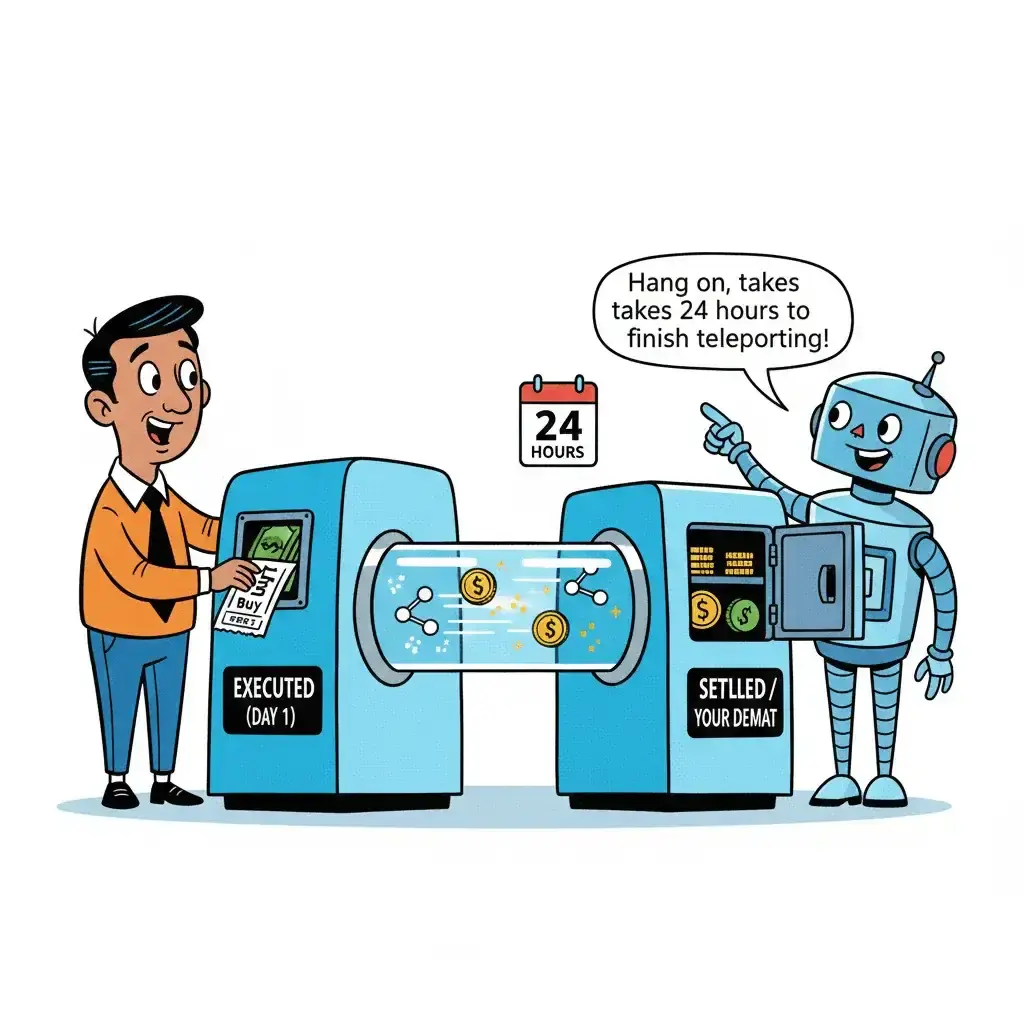
And here’s the truth most beginners misunderstand: Your order may execute instantly, but your shares and money do NOT move instantly.
“In investing, what is comfortable is rarely profitable.” — Robert Arnott
This gap between “executed” and “settled” is where most mistakes happen: missed dividends, BTST confusion, auction penalties, delayed profits, and trade failures. With India’s markets getting faster, more digital, and more youth-driven than ever, timing your trades isn’t just smart… It's our biggest trading advantage.
So, here’s my promise to you: by the end of this reading, you’ll know exactly how the settlement cycle works, when your money and shares actually move, and how to time your trades like someone who understands the market, not just someone who participates in it.
What is the Settlement cycle?
Placing a trade is instant, but completing a trade takes time. This time gap is what we call the settlement cycle, the heartbeat of the stock market that decides when your money or shares officially become yours.
Let’s break it down in the simplest way possible.
What is T+1?
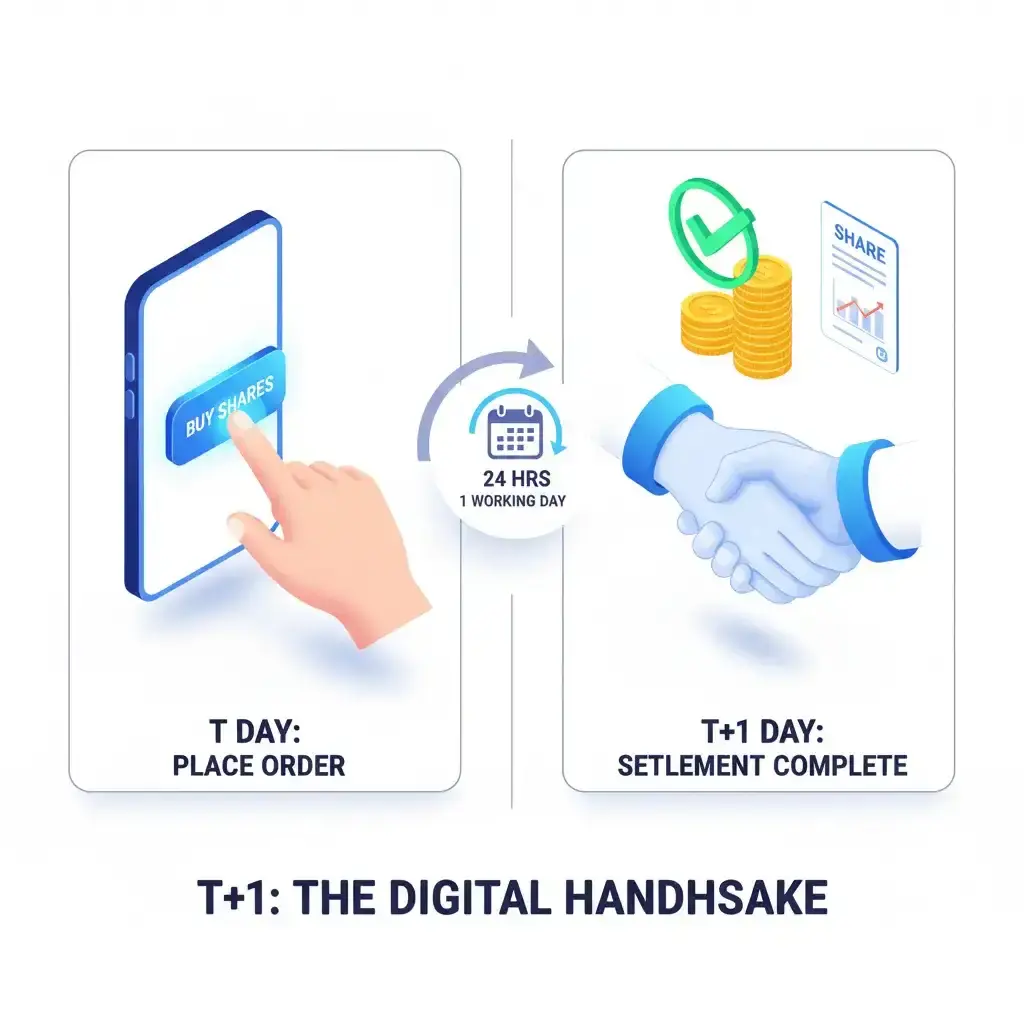
“T” simply stands for Trade Day, the day you execute your buy or sell order.
- If you buy shares on Monday, Monday is T.
- If you sell shares on Wednesday, Wednesday is T.
What Is “+1”?
“+1” means one working day after the trade day. So in India’s T+1 settlement cycle:
- You get the shares one day after you buy
- You get the money one day after you sell
That’s it, “Trade today, settle tomorrow.”
What Does “Settlement” Actually Mean?
Think of settlement as the final handshake between all parties involved.
It's when:
- Buyers receive shares
- ellers receive money
This is the moment a trade is officially completed, similar to payment success after a UPI transaction, except with one day of processing time and much stronger verification.
I am sure you might question, if everything happens digitally, then shouldn’t it all happen instantly? Not quiet.To complete a stock transaction, there are typically multiple layers of checks:
- Does the buyer really have the money?
- Does the Seller actually own the shares?
- Are both parties verified?
- Is the trade valid and error-free?
The T+1 cycle gives the market time to verify, clear, and deliver. This reduces risk and maintains fairness. Without this process, the stock market would be chaotic and prone to fraud.
“The essence of investment management is the management of risks, not the management of returns.” — Benjamin Graham
A Quick Example: “If You Buy Shares on Monday…” Let’s imagine you buy 100 shares of HDFC Bank on:
Monday (T Day): Your order gets executed instantly on the exchange. But the shares haven’t reached your demat yet. Tuesday (T+1), Shares are credited to your demat account, and Money is debited from your bank account. That’s when you officially own them. Similarly: Sell on Wednesday (T) and Money arrives Thursday (T+1).
Which parties actually handle the settlement process?
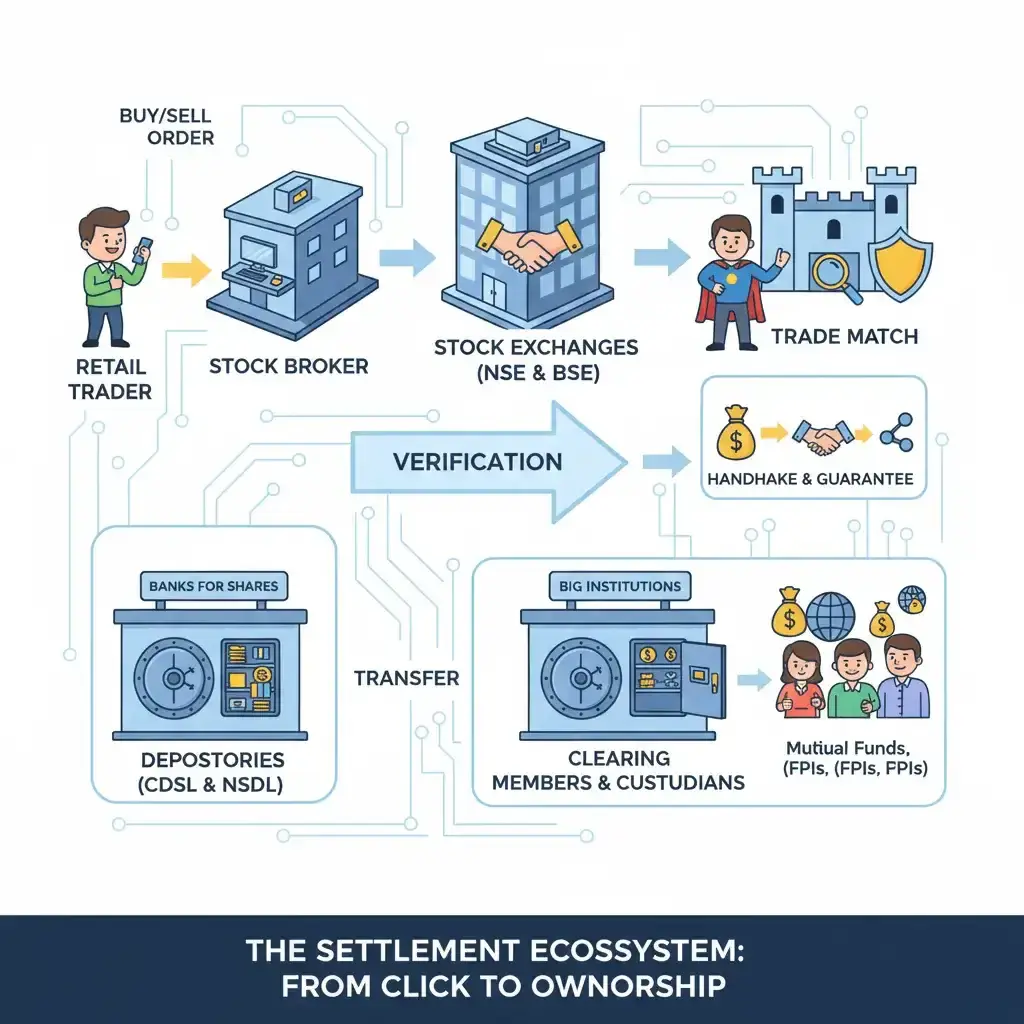
There’s a full-fledged ecosystem working silently in the background to make sure every trade is matched, verified, and settled safely. It starts with you, “the trader” placing a buy or sell order through your stockbroker, who sends the order to the stock exchanges (NSE or BSE). The exchanges match your trade with another participant willing to transact at your price. The responsibility then shifts to the clearing corporation (like NSCCL), which steps in as the guaranteed counterparty. This means they ensure the buyer actually pays, and the seller actually delivers, eliminating the risk of either party defaulting and helping maintain stability in the market.
After the trade is verified and cleared, the depositories, CDSL and NSDL, take over. Think of them as “banks for shares” because they hold all your securities in digital form and ensure the shares are transferred to or from your demat account correctly. At the same time, clearing members and custodians manage settlements for big institutions like mutual funds, FPIs, and insurance companies, who deal with much larger trade volumes. Together, these entities form the backbone of the settlement system, quietly making sure every stock you buy or sell moves exactly where it should, on time, and without errors.
If you’re new to markets, you can quickly read: A Beginner’s Guide to the Indian Stock Market.
How T+1 Impacts You as a Retail Investor?
A. The Benefits: Why T+1 Works in Your Favour
The biggest win for young investors is speed. When you sell a stock today, the money hits your account by the next day, not two days later. That means you can grab new opportunities quicker, whether it’s buying a dip, participating in an IPO on short notice, or simply rotating into a better stock. Your profits don’t sit idle anymore; you can put them back to work almost instantly.
T+1 also makes the market more liquid, which is just a fancy way of saying it’s easier for everyone to buy and sell without unnecessary delays. When millions of traders get faster access to money and shares, the whole market feels smoother, safer, and more efficient. You don’t have to keep checking whether your sale has “settled” or wait endlessly for your demat to update. It happens automatically.
B. The Challenges: What You Need to Be Careful About
With speed comes responsibility. Under T+1, you must be more alert about your funds and holdings. If you place a buy order, you need to have the money ready right now, not “sometime later.” If your bank delays or your UPI payment gets stuck (which happens), your order could fail. For last‑minute traders, this can be frustrating.
Similarly, if you try to sell shares that haven’t yet settled in your demat, you could end up in trouble. The system might treat it as a short delivery, which leads to auctions and penalties. In the past, you had a two‑day buffer. Now, there is zero room for slip‑ups.
T+1 rewards discipline but punishes carelessness. A small mistake in timing, like selling too early or assuming money will arrive instantly, can cost you.
“The market is a device for transferring money from the impatient to the patient.” — Warren Buffett
You might find this simple, yet let me break this down for clear understanding:
Let’s say you buy a stock today because you spot a great opportunity. You’re excited, the trade goes through instantly, and you assume the shares are “yours.” But here’s the catch: under the T+1 system, the shares don’t actually reach your demat on the same day. They settle only the next morning.
Now, imagine the next day the price jumps. You would want to sell immediately to book profit. Sounds easy!?
Not really.
If the shares haven’t yet been credited to your demat, even due to a small delay in the exchange or depository system, your sale can turn into something called short delivery. That means the system thinks you’re selling shares you don’t yet fully own. And once that happens, the exchange steps in, buys the shares on your behalf through an auction, and you end up paying penalties or a higher repurchase price.
In simple words:
T+1 moves fast, so if your shares arrive late but you sell early, you could get hit with auction penalties. This is one of the biggest real‑world drawbacks of T+1, not because the system is flawed, but because it leaves zero room for timing errors. One tiny settlement delay, and your profit‑booking can instantly turn into an unwanted loss.
Read more: Why Penny Stock Investors Lose Money
How T+1 Knowledge Helps You Build Smarter Trading Strategies
1. Dividend Capture Strategy
When you're trying to grab dividends by buying a stock before its ex‑dividend date, understanding T+1 becomes extremely important. Since shares now settle the very next day, you must ensure your shares actually reach your demat account before the record date. If you buy too close to the ex-date, even a small settlement delay can cause the shares to be credited late, and you may miss the dividend entirely. The shift to a T+1 settlement system in India has actually made life much easier for investors who want to capture dividends. Essentially, it removes the "will they, won't they" anxiety regarding your shares hitting your account. Because trades now settle in just one business day, you have a much tighter, more predictable window to ensure the company officially recognizes you as a shareholder by the time they check their books.
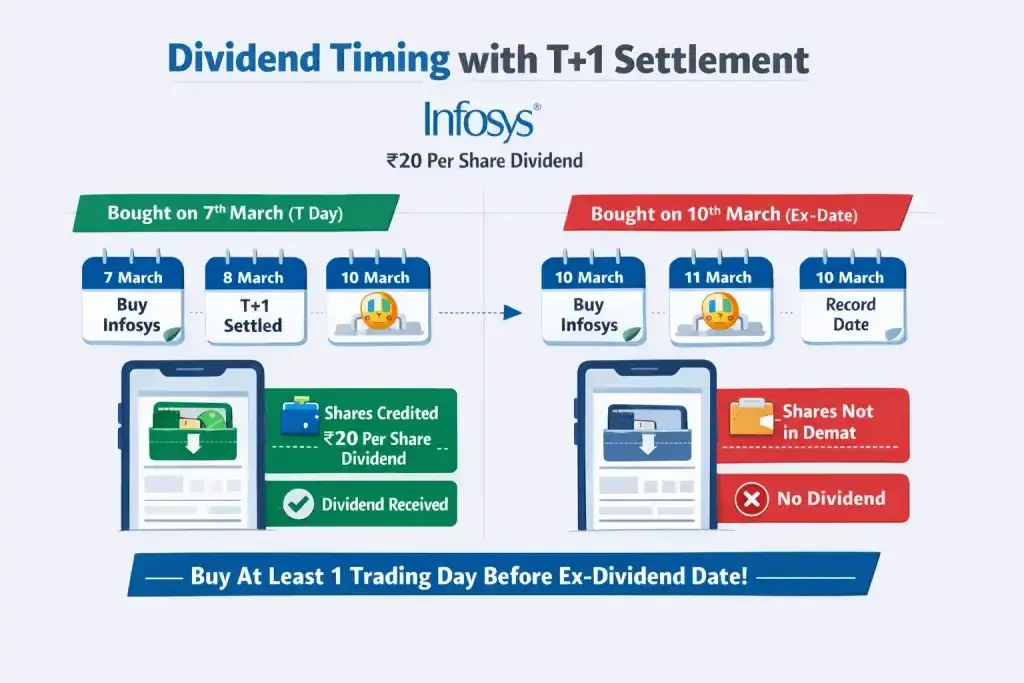
To see this in action, imagine Infosys announces a ₹20 dividend with an ex-dividend date of March 10. If you pick up shares on March 7, the T+1 magic happens and the trade settles by March 8. This means that when March 10 arrives, the shares are already parked in your demat account. When the company pulls its list of shareholders to see who gets paid, your name is right there on the list, and the dividend is yours.
However, timing is everything. If you wait until the ex-dividend date of March 10 to buy, you’ve technically missed the cutoff. Under T+1, that purchase won't settle until March 11. On the day the company verifies its records, you aren't yet the "owner of record," so the dividend goes to the person who sold you the shares instead. The simple takeaway for the modern Indian market is to always secure your position at least one trading day before the ex-dividend date if you want that passive income to hit your bank account.
Read More: Dividend Stocks for Passive Income: A Complete Guide
2. BTST (Buy Today, Sell Tomorrow)
BTST feels more convenient under T+1 because shares now settle faster, but this convenience comes with risks. Since your newly bought shares might not be fully credited by the next morning, selling them too early can still result in short delivery. Knowing the T+1 timeline helps you avoid selling before shares show up in your demat. That means checking settlement timing, understanding when the credit usually hits, and planning your BTST exit accordingly. In short, T+1 allows quicker profit booking, but you must respect the settlement window.
3. Intraday to Delivery Conversion
Sometimes an intraday trade doesn’t go your way, and you convert it into a delivery trade. Under T+1, this decision becomes more sensitive because settlement happens faster, and brokers expect funds immediately. If you convert to delivery but don’t have funds ready, the trade may fail or lead to penalties. With T+1, you must plan conversions early, keep your cash ready, and avoid last‑minute decisions that rely on slow bank transfers. A clear understanding of the T+1 clock helps you manage risk and ensures smooth delivery of trades.
4. Pledging and Unpledging Shares for Margin
Margin traders now have to think more carefully about pledging cycles. When you pledge shares, it typically takes some hours before the margin is credited. Under T+1, where everything moves faster, any delay in pledging can limit your ability to take trades the next day. Similarly, if you unpledge shares, they only come back to your demat after the settlement cycles are complete. T+1 makes this cycle quicker, but also removes the cushion. You must anticipate margin needs earlier and avoid waiting till the last minute to pledge or unpledge.
5. IPO Allotment Sell Strategy
When you receive IPO shares, selling them on listing day becomes easier to plan under T+1. Since shares settle to your demat account faster, you know exactly when they will be credited and ready for sale. However, if there’s any delay in crediting IPO allotments due to batch processing, attempting to sell before the shares actually appear can lead to auction risks. So, knowing the T+1 process helps you avoid premature selling and ensures you’re ready the moment trading begins.
6. Corporate Actions (Bonus, Split, Buyback, Rights Issue)
Corporate actions depend heavily on settlement timelines because the company must verify who actually holds the shares on the record date. T+1 makes this process faster and more predictable, but also less forgiving. If you buy shares just one day before the record date, they will usually settle in time — but only if there is no delay. Understanding T+1 helps you time your purchases accurately so you don’t miss bonuses, splits, or buyback eligibility simply because shares didn’t settle in time.
7. Cash Management & Liquidity-Based Strategy
T+1 changes the way young investors manage their money. Since funds from selling shares arrive the next day, you can rotate capital faster — perfect for active traders. But the flip side is that you cannot expect to fix mistakes later: if money doesn’t reach your broker instantly while placing buy orders, the trade will simply fail. Knowing T+1 helps you manage liquidity, keep extra buffer cash, and avoid relying on last‑minute fund transfers. This leads to smarter, cleaner, and more disciplined trading.
Where does India stand compared to the “Developed countries”?
While India has moved to a super-fast T+1 settlement cycle, many major global markets are still playing catch-up. For decades, the US and Canada operated on a slower T+2 cycle, but following India's success and the need to reduce market risk, they officially leaped to T+1 in May 2024. Meanwhile, the UK, European Union, and Switzerland are currently navigating the complexities of coordinating multiple currencies and jurisdictions, with asynchronized transition to T+1 now firmly targeted for October 11, 2027.
In Asia, the landscape remains varied: while Japan and Hong Kong still follow the T+2 standard, China utilizes a unique system that settles shares on T+0 but cash on T+1. By leading this global shift, India has significantly slashed "counterparty risk," the chance of a trade failing while in limbo, making its markets more secure and capital-efficient. For you as a trader, this means your money is "locked up" for less time, allowing you to rotate capital and react to new opportunities with a speed that much of the world is only just beginning to adopt.

Explore our Products
Research Framework

Emerging Titans
Combination of quantitative analysis, industry tailwinds, and management assessment - SPRINT investment philosophy

Tiny Titans
Heavy emphasis on scuttlebutt research, plant visits, and early on-ground signals
Conclusion
The shift to a T+1 settlement cycle has transformed the Indian market into a faster, more secure, and highly efficient environment, though it certainly demands more precision from every investor. Now that cash and stocks change hands within a single business day, getting your timing right isn't just a "nice-to-have" skill—it’s a core part of your trading strategy. By truly grasping the mechanics of how these trades settle, you can cut down on avoidable errors and navigate the markets with a lot more confidence.
At the end of the day, T+1 rewards those who stay prepared: the traders who keep funds ready, track settlement timings, avoid rushed decisions, and think one step ahead.
Because in a T+1 world, you’re not just clicking buy or sell, you're managing liquidity, planning entries and exits, and trading with intention.
Final takeaway: “Under T+1, smarter timing beats faster trading. You don’t just trade stocks, you trade time.”
“It’s not about being right or wrong, but about how much you make when you’re right and how much you lose when you’re wrong.” — George Soros
If this helped you understand how to read and interpret real company financials, Comment “T+1” below. If you gained meaningful information from this article, then do share it with your friends and comment on one insight you gained about the settlement cycle.
Read More: The Power of Compound Interest in Stock Markets
FAQs
If I sell shares today, when will I get my money?
Under the T+1 cycle, you will receive the proceeds from your sale one working day after you sell. For example, if you sell your shares on a Wednesday, the money will typically arrive in your account on Thursday.
Why doesn't settlement happen instantly if everything is digital?
+While the trade execution is instant, the settlement requires several layers of verification. The system must verify that:
- The buyer has the necessary funds.
- The seller actually owns the shares.
- Both parties are verified, and the trade is error-free.
What is "Short Delivery" and how do I avoid it?
+Short delivery occurs if you sell shares that haven't officially reached your demat account yet. Because shares take one day to settle, selling them too quickly (before they are credited) can lead to auction penalties where the exchange must buy the shares on your behalf at a potentially higher price.
How does T+1 affect my dividend eligibility?
+To receive a dividend, your name must be in the company’s records on the record date. Since settlement takes one day, you should buy the stock at least one trading day before the ex-dividend date to ensure the shares are credited to your demat account in time.

High growth stock specialist, Value Educator
Shashank Mahajan is an equity research professional with over 12 years of experience in identifying high-potential SME and micro-cap stocks at an early stage. He follows a rigorous scuttlebutt research–driven approach, combining on-ground insights with deep financial analysis. Shashank specializes in uncovering under-researched and under-owned companies with strong management quality and long-term growth potential. Through disciplined research and early identification, he focuses on spotting tomorrow’s market leaders before they enter the mainstream investor radar.

Glenmark: The USD 700 Mn Cancer Deal and Its Brands

Pharma Stocks in India 2026: Generics, APIs and CDMOs

Granules India: From Paracetamol to a 65% Gross Margin

Natco Pharma: After Revlimid, 29 Patent Challenges

Shilpa Medicare: Cancer APIs, Films and Biosimilars

Alembic Pharma: US Plants Pay Back, Margin Hits 22.2%
Explore our Products
Research Framework
Emerging Titans
Combination of quantitative analysis, industry tailwinds, and management assessment - SPRINT investment philosophy
Tiny Titans
Heavy emphasis on scuttlebutt research, plant visits, and early on-ground signals



Modern Warfare to Multibaggers
Key Trends. Strategic Shifts. Opportunities Ahead.
Don't Miss This Exclusive Webinar!
Join Value Educator to decode the key trends shaping India's defence sector and learn how to identify tomorrow's potential leaders in the space.
- In-depth research on India's defence sector
- Live Q&A session
- Actionable takeaways for long-term investors

 Orders
 Subscription
 Share with friends


Required Details
₹23999.00
(12 month subscription)
As per SEBI regulations, all users are mandated to complete the KYC that is validated for 1 year. Post payment, you will be redirected to the KYC screen


No comments yet. Be the first to comment!