
Goldman Sachs' 6 Private Defence Picks
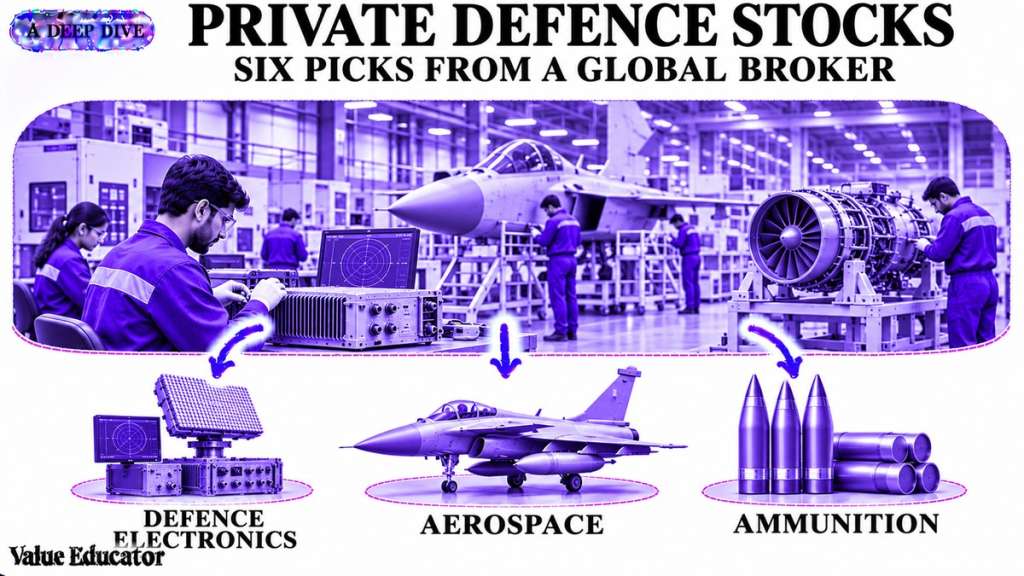
Geopolitical War headlines have blended into the background of regular life. A border clash here, a drone strike there, a new alliance forming overnight. For Indians, this isn't a distant drama. It instantly triggers one question: Are we really prepared for whatever comes next?
On one frontline, a jawan stands in the cold, trusting the radar, missile and communication systems behind him. On the other hand, deep inside India’s factories and labs, engineers are building those systems. And now, a third frontline is opening up the portfolios of Indian investors who want to participate in India’s defense strength, not just applaud it on social media.
As global defense budgets surge and supply chains reset, India’s private defense players are finally on the radar of Wall Street. Here we’ll break down Goldman Sachs’ 6 private defense stock ideas for 2026, and what they could mean for Indian retail investors looking to align patriotism with long-term, strategic wealth creation.
Read More: How to Research Stocks: The Fundamental Checklist for Indian Investors
The investment outlook for India is anchored by a staggering ₹7.85 lakh crore defense budget. Important to note here is that the Indian government has decided on reserving nearly 75% of procurement for domestic firms. This "Atmanirbhar" shift has moved the spotlight from slow-moving public giants to agile private-sector players. These companies are no longer just local vendors; they are becoming vital nodes in the global "China+1" supply chain, with India targeting ₹50,000 crore in exports.
Wall Street has taken note. Goldman Sachs' top six private picks Solar Industries, PTC Industries, Astra Microwave, Data Patterns, Azad Engineering, and BEL represent a unique intersection of national security and high-growth equity. These firms boast massive "moats," technical barriers, and order books giving visibility up to the 2030s.
Investing in these stocks is a play on strategic wealth. In a volatile era, defense spending is a survival necessity, not a discretionary expense. By aligning your portfolio with these private leaders, you aren't just chasing a trend; you are backing the hardware that secures the nation while positioning yourself for the long-term compounding that comes with a multi-decade modernization cycle.
Deep Dive: Union Budget Breakdown: How Policy Impacts the Stock Market
Why is Goldman Sachs bullish on Private Defense Players?
India has set over ₹2 lakh crore aside for capital expenditures, the overall defense budget for FY 2026–2027 is projected to be between ₹7.8 and 7.9 lakh crore. This amount of funding indicates a multi-year, ongoing modernization phase that makes more room for private sector participants.
Defense production has already risen to around ₹1.5 lakh crore annually as a result of the growth of domestic manufacturing. At the same time, exports have topped ₹23,000 crore and are continuing to grow. Private manufacturers can benefit from the government's target of ₹3 lakh crore in defense production and ₹50,000 crore in exports by 2029.
The national spend on defense each year has already reached around ₹1.5 lakh crore, proves that domestic manufacturing is growing. Exports, on the other hand, have grown ₹23,000 crore and are still rising. The government aims to produce ₹3 lakh crore worth of defense products and export ₹50,000 crore of goods by 2029. This means that private manufacturers have a lot more opportunities to get orders and grow in the long term.
The global supply-chain realignment is a major factor bolstering bullishness. Government support through policy stability and strategic cooperation between India and developed nations helps India serve as a natural China+1 manufacturing hub as geopolitical uncertainty changes sourcing decisions. The macro conditions outlined in India's 2026 outlook steady GDP growth, stable inflation, strong public investment, enhanced logistics, and growing digital and public infrastructure all support this.
Read more: Understanding the Link Between GDP Growth and Corporate Earnings
Private defence players also structurally outperform PSUs on earnings growth, technology adoption, and execution agility. India’s reform framework, including corporatisation of legacy factories, positive indigenisation lists, higher FDI limits, and incentives for advanced systems have leveled the playing field and enabled private firms to scale faster. As new orders emerge in high‑intensity segments like air defence systems, UAVs, counter‑UAV technologies, and network‑centric warfare, private companies benefit disproportionately because they innovate quicker, collaborate more globally, and execute with leaner cost structures.
This transition has direct implications for equity investors, especially those focused on mid‑caps, innovation‑led compounders, and early‑cycle multibaggers. Mid‑cap defence manufacturers are entering a sweet spot: rising order visibility, stronger balance sheets, and capacity expansion funded by both internal accruals and supportive policy tailwinds. India’s broader macro environment that is characterised by sustained capital expenditure and sector‑specific incentives, further strengthens the backdrop for corporate actions such as capex cycles, backward‑integration, and M&A within defence and dual‑use technologies.
For retail investors, the investment landscape is becoming more compelling: a high‑growth sector supported by national priorities, global realignment, visible multi‑year order books, and rising export potential. With India positioned as one of the world’s fastest‑growing economies underpinned by macro stability, infrastructure investments, and manufacturing self‑reliance private defence players are not just beneficiaries but structural winners of this decade‑long transformation. The coming years may determine whether India evolves into a major global defence hub and early investors in agile, innovation‑driven private manufacturers are likely to capture disproportionate upside.
Overview: Goldman Sachs’ 6 Private Defense Stock Picks for 2026
Solar Industries
Solar Industries India Limited has developed into a world leader in defense technology, ammunition, and industrial explosives. The business is distinguished by its substantial investments, which include a large defense project in Nagpur and increased production of missile propellants, as well as its low debt. The company operates in more than 90 countries, places strong emphasis on a high-tech manufacturing model that is backed by automation and exacting quality standards. They have increasingly entered the defense industry, producing warheads and propellants.
Solar Industries India Limited stands out as one of Goldman Sachs’ top private‑sector defence picks for 2026, backed by a structural shift in its business model and a rapidly expanding defence footprint. Once known primarily as an industrial explosives manufacturer, SOLARINDS has successfully repositioned itself as a high‑energy materials and advanced defence systems specialist, creating what Goldman Sachs describes as a unique competitive moat in a space where global capability remains limited.
Must Read: Traits of Multibagger Stocks: The Blueprint for Success
With Solar Industries' growing presence in high-margin verticals like ATGMs (Anti-Tank Guided Missiles), large-caliber ammunition, and RPVs (Remotely Piloted Vehicles), Brokerage predicts that SOLARINDS' defense revenue will surpass ₹80 billion by FY29. This indicates a deliberate shift away from commodity-linked products and toward technology-driven, proprietary platforms with super pricing power and long-cycle revenue visibility.
The company’s execution strength is underscored by its record defence order book of ~₹18,000 crore, anchored by a recently won ₹1,400‑crore international order, signaling rising global trust in Indian‑origin high‑energy defence systems. Goldman Sachs highlights SOLARINDS as a key beneficiary of the FY27 Union Budget’s 18% increase in defence capital procurement, particularly in the “other equipment” category covering missiles, ammunition, and advanced battlefield systems. This positions the company favourably for a multi‑year demand cycle driven by both domestic modernisation and global ammunition replenishment trends.
Financially, SOLARINDS continues to deliver standout performance. Goldman Sachs notes its “resilient earnings profile”, including an estimated 25% year‑on‑year profit growth and a medium‑term RoE above 26%, placing it well ahead of most defence PSUs and private peers. As countries rebuild strategic stockpiles and look for diversified supply chains, the company's alignment with India's Atmanirbharta (self-reliance) mission and growing export demand further enhance long-term visibility.
With a target price of ₹18,215, Goldman Sachs maintains a "Buy" rating, suggesting a compelling 30–36% increase from late-2025 levels. Goldman Sachs' top defense picks for 2026 include Solar Industries, a prime example of how private-sector defense manufacturers are changing India's strategic landscape due to its vertical integration, technological advantage, growing global relevance, and robust policy tailwinds.
Azad Engineering
Azad Engineering Limited, founded in 2008, has grown into a highly trusted name in precision engineering. The company builds the kind of mission‑critical and life‑critical components that must work flawlessly—whether they’re powering a fighter jet, guiding a missile, or supporting an aircraft in flight. Azad operates across four major sectors like Aerospace & Defense, Energy, Oil & Gas, and Industrial Technology—giving it a broad and resilient business base.
What really sets Azad apart is the complexity of what it makes. The company produces 3D rotating airfoil sections for turbine engines, along with engine assemblies, actuators, and hydraulic systems used in defence missiles, civil aircraft, and even spacecraft. These aren’t just parts—they’re high‑precision components that demand world‑class engineering, zero‑failure tolerances, and deep technical know‑how. In many ways, Azad Engineering has become one of the quiet enablers behind some of the most advanced machines operating in the sky today.
Goldman Sachs has placed Azad Engineering firmly on its list of top private defence plays for 2026, issuing a Buy rating with a target price of ₹2,055 and their optimism is easy to understand. Azad sits in a rare, high‑precision niche, being India’s only manufacturer of Titanium Aerofoils and one of the few globally with the capability to machine such complex aerospace components. This technological “moat” has made the company a trusted supplier to major global OEMs. With global supply chains shifting under the China+1 strategy, Goldman Sachs notes that Azad is in a “sweet spot,” offering Western clients a 25%–30% cost advantage even after potential tariff adjustments.
The company’s order book stands at a massive ₹65 billion as of October 2025, including a $156 million deal with Mitsubishi Heavy Industries, which gives it revenue visibility stretching across the next decade. Analysts expect over 30% EPS CAGR through FY25–35, supported by consistently strong 35%–38% EBITDA margins. Azad is also ramping up capacity aggressively, with plans to scale manufacturing nearly tenfold in 6–8 years, setting the stage for sustained long‑term growth. The only caution flagged by Goldman Sachs is the heavy CapEx and working‑capital needs, which could delay free cash flow positivity until FY35, yet even with that, the long runway for expansion keeps the brokerage firmly bullish on the company’s future.
PTC Industries
PTC Industries has quickly emerged as one of India’s most exciting defence and aerospace manufacturing powerhouses, backed by cutting‑edge materials expertise and a rapidly expanding global footprint. Known for its deep technological capabilities in titanium and superalloy castings, PTC is becoming an indispensable supplier to major global aerospace and defence OEMs.
PTC’s rise has been fuelled by a blend of innovation, long‑term strategic contracts, and bold capacity expansion plans positioning the company at the centre of India’s push toward defence indigenisation and global supply‑chain integration.
As the world moves toward China+1 diversification and demand for specialised materials accelerates, PTC Industries is stepping into a role that few Indian manufacturers have ever held: a critical player in the future of advanced defence materials.
Goldman Sachs is equally optimistic about PTC Industries, giving it a Buy rating with a target price of ₹24,725 and highlighting it as the fastest‑growing earnings story among Indian defence companies. The brokerage points to PTC’s powerful “3Cs” advantage Capabilities, Contracts, and Capacity which has helped the company build a dominant position in aerospace‑grade Titanium and superalloys, markets where global supply is tight and expertise is scarce.
With a projected 123% earnings CAGR through FY28, driven by rapid scaling in titanium and high-capacity castings, PTC is becoming deeply embedded in global supply chains, backed by major contracts from Blue Origin, Honeywell, and Pratt & Whitney. Its aggressive expansion plans include commissioning the world’s largest single‑site recycled Titanium facility in Lucknow by FY26, part of a ₹1,000‑crore capex program aimed at boosting production by 10–15x over the next seven years.
There’s also meaningful upside ahead. If India goes ahead with the purchase of 114 Rafale jets, the country could become a major regional MRO hub—and PTC is already well‑placed, supplying key components for the Rafale’s M88 engines. Add to that the fact that its EBITDA margins are expected to cross 40% by FY29, and it’s easy to see why Goldman Sachs believes PTC could become one of the most profitable and strategically important materials suppliers in the global aerospace and defence industry.
Data Patterns
Data Patterns has quietly emerged as one of India’s most critical defence electronics companies, an IP-rich, engineering‑heavy player that builds the kind of mission‑critical systems most investors rarely hear about, but every modern weapons platform relies on.
From advanced radars to avionics, electronic‑warfare equipment, and real‑time mission computers, the company has become a key player at the core of India’s rapidly evolving aerospace and defence ecosystem. What really makes Data Patterns stand out is its IP‑driven business model. Because it builds so much of its technology in‑house, customers tend to stick with the company for the long haul, leading to steady defence contracts and healthy margins. It’s the same formula you see in true long‑term compounders—high‑ROE, high‑tech defence firms that grow not just by getting bigger, but by consistently innovating.
As we head into early 2026, the optimism around Data Patterns is driven by a few powerful tailwinds. To start with, the company has carved out a strong leadership position in radar electronics, supplying essential subsystems for some of India’s most important defence platforms—including the Tejas Mk‑II, the Rafale fleet, and the upcoming AMCA program.
These aren’t one‑off orders; they're multi‑decade platforms, ensuring visibility and relevance across long product cycles. Financially, Data Patterns is in rarefied territory. With EBITDA margins of 35–40%, it operates at levels comparable to top global defence‑electronics firms, reflecting its focus on proprietary IP and high‑value engineering.
Goldman Sachs expects Data Patterns to deliver over 20% EPS growth from FY25 to FY28, giving the company a solid earnings runway backed by long‑term contracts and dependable program‑based revenue. And the story gets even more interesting with India’s potential purchase of 114 Rafale fighter jets—a move that could turn the country into a major regional MRO (Maintenance, Repair, and Overhaul) hub, opening up even more opportunities for companies like Data Patterns that specialise in advanced radar and avionics systems.
Radar subsystems and avionics are core to this opportunity and Data Patterns is already a leader in these segments. Add to this the global China+1 supply‑chain shift: firms like RTX plan to scale Indian sourcing tenfold by 2030, positioning Data Patterns as a natural partner in the global aerospace electronics ecosystem.
Supporting all this are strong policy winds. The Draft Defence Acquisition Procedure (DAP) 2026 is designed to speed up how quickly India buys new defence systems and put a stronger spotlight on technical excellence. It’s exactly the kind of environment where agile, IP‑driven companies like Data Patterns tend to thrive.
Put together, Data Patterns is not just another defence stock; it's a long‑term technology compounder carrying the hallmarks of sustained growth: IP ownership, high entry barriers, structural demand, global integration, and industry‑leading margins. In India’s fast‑expanding defence electronics landscape, it stands out as one of the clearest, most scalable plays for the decade ahead.
Astra Microwave
Astra Microwave is starting to stand out in India’s defence‑electronics space. The company combines the flexibility of a mid‑cap with growing expertise in high‑demand areas like RF subsystems, radar electronics, space‑communication gear, and counter‑drone tech. This wider footprint is helping it gain a stronger position as defence spending rises. What also makes Astra interesting is its shift from being just a parts supplier to taking on more complete, integrated solutions. It’s gradually taking on larger, integrated assignments, a shift that typically brings better margins and longer‑lasting customer relationships.
One major change investors have noticed is the improvement in the company’s revenue mix. A rising share of Astra’s business is now coming from domestic defence contracts, which are far more profitable. These projects usually deliver 40–45% gross margins, much higher than the 8–10% margin range seen in export‑oriented subsystem work. With this shift underway, the company is positioned for 18–20% annual revenue growth, stronger return ratios, and the potential to turn free‑cash‑flow positive by FY27.
Visibility for future earnings also looks encouraging. Astra’s order book currently stands at about ₹2,226 crore, which effectively secures more than two years of revenue. That kind of backlog is exactly what mid‑cap investors look for: predictable cash flows, scalability, and room for the balance sheet to strengthen over time. The company’s participation in major national defence programs—such as LCA Tejas, the Uttam AESA radar, and various electronic‑warfare platforms—adds another layer of long‑term stability.
Of course, the company isn’t without its challenges. Astra Microwave still has a few challenges to watch—its cash cycle runs long, big orders don’t always come on schedule, and margins could dip if exports suddenly make up a larger share of sales. Even with these risks, the company is well‑positioned to benefit from the steady rise in defence‑electronics demand. Its strong tech capabilities, growing order pipeline, and role in key national programmes make it one of the more attractive mid‑cap players in India’s defence‑modernisation story.
Bharat Electronics (BEL)
Among India’s defence heavyweights, Bharat Electronics Limited (BEL) continues to stand out as one of the most reliable, broad‑based, and financially sound players, and Goldman Sachs’ outlook for early 2026 only reinforces that view. Unlike niche private manufacturers that depend heavily on one or two verticals, BEL enjoys a diversified, “agnostic” exposure across the Army, Navy, and Air Force. This wide footprint insulates its revenues from fluctuations in any single category of defence spending and gives BEL one of the most stable demand pipelines in the entire sector.
What truly strengthens BEL’s long‑term visibility is its massive order pipeline. Goldman Sachs projects an average annual order inflow of ₹31,700 crore through FY28, with the total order book expected to scale up to an impressive ₹92,700 crore by that period. This pipeline is backed by BEL’s involvement in some of India’s most strategic defence programmes. The company is a lead integrator for high‑impact projects like the QRSAM (Quick Reaction Surface-to-Air Missile), Project Kusha, India’s long‑range air defence shield, and next‑generation Corvettes and ULPGM platforms, all critical to India’s future air and naval dominance.
BEL’s financial strength is another major reason analysts remain bullish. While many private defence firms struggle with capital‑intensive cycles and uneven cash flows, BEL stands apart by consistently generating healthy free cash flow. Its Return on Equity (RoE) and overall profitability remain above global defence electronics averages, underlining both operational discipline and an efficient business model. In fact, BEL’s asset turnover ratio of 0.7x mirrors global benchmarks, reflecting its ability to extract high productivity from its manufacturing infrastructure.
The company also emerges as a major beneficiary of budgetary tailwinds. The FY27 Union Budget sharply increased capital procurement spending on “other equipment,” which includes missiles, ammunition, and radar electronics, by 62% to ₹82,200 crore. As a national leader in radar and electronic warfare systems, BEL is perfectly positioned to capture a substantial portion of this expanded procurement pool.
Overall, BEL offers a rare combination of order security, financial strength, policy support, and diversified exposure across India’s defence ecosystem. For investors looking for stability with long‑term compounding potential, BEL continues to act as the sector’s cornerstone, steady, scalable, and strategically indispensable.
Compare: Multibagger vs. Blue-Chip Stocks: Which Builds More Wealth?
Explore our Products
Research Framework

Emerging Titans
Combination of quantitative analysis, industry tailwinds, and management assessment - SPRINT investment philosophy

Tiny Titans
Heavy emphasis on scuttlebutt research, plant visits, and early on-ground signals
Conclusion: When Strategy Meets Sovereignty
Some stories unfold in headlines. Others unfold quietly on factory floors. For decades, India’s defence narrative felt predictable — large public sector giants, steady but slow, carrying the weight of national security. But something has shifted. This is no longer just a PSU story. It’s a transition. A recalibration. A new layer of private capability rising beneath the surface.
Record capital outlays. Export ambitions stretching beyond borders. A global supply chain quietly rearranging itself under the China+1 shift. And in the background, a country modernising its defence architecture not for optics, but for resilience.
Goldman Sachs’ six picks — Solar Industries, Azad Engineering, PTC Industries, Data Patterns, Astra Microwave, and Bharat Electronics — aren’t random stock ideas. They represent different pieces of a larger machine. Explosives and propellants. Precision titanium. Radar brains. Electronic warfare systems. Integrated defence platforms. Each one is a component in a much bigger equation.
For retail investors, this isn’t a theme to chase because it feels patriotic. It’s a structural story. One built on long procurement cycles, technical barriers, specialised manufacturing, and policy alignment that stretches across years, not quarters.
Defence spending isn’t driven by consumer sentiment. It isn’t paused because the economy slows. It is strategic. It is budgeted. It is tied to survival.
Final Resource: Comprehensive Guide to Investing in the Indian Stock Market for Beginners
But markets are still markets. High growth does not erase valuation risk. An overflowing order book does not guarantee perfect execution. Government support does not make a stock immune to volatility.
This is where discipline separates enthusiasm from investing. The real edge lies in patience. In reading annual reports instead of headlines. In understanding margins, cash flows, and capital allocation. In thinking in decades, when the market thinks in days.
If India evolves into a global defence manufacturing hub by the end of this decade — and the ingredients suggest it could — the businesses that combine technology depth, execution strength, and financial discipline will compound quietly in the background.
The real question isn’t whether defence will grow. It’s the companies will convert national ambition into sustainable shareholder value.
Strategy is about protection. Sovereignty is about independence. Investing wisely is about understanding the difference between momentum and inevitability. History rarely announces structural transitions while they are happening.It whispers first.
If you found this read to be interesting and want more in-depth research like this, comment “More Alpha.”
FAQs
Are private defence companies safer than defence PSUs?
+Not necessarily safer — but often more agile. Private players typically grow faster due to leaner cost structures and technology focus. PSUs, however, offer stability and government backing. Portfolio balance matters.
How cyclical is the defence sector?
+Unlike sectors such as real estate or metals, defence spending is policy-driven and long-term. Budget allocations typically run in multi-year cycles, making revenue visibility stronger than most capital-goods industries.
What are the biggest risks in investing in defence stocks?
+- Execution delays
- Working capital stress
- Heavy capex cycles
- Dependence on government procurement timelines
- High valuations during momentum phases
Do defence companies benefit from exports meaningfully?
+Yes. Export growth improves margins, diversifies revenue, and reduces dependence on domestic tenders. India’s defence export target of ₹50,000 crore by 2029 creates an additional growth layer beyond domestic spending.
Is this sector suitable for long-term compounding?
+Potentially yes — especially IP-driven electronics, materials science, and high-precision engineering firms embedded in multi-decade platforms. However, entry valuation and capital discipline are critical.

High growth stock specialist, Value Educator
Shashank Mahajan is an equity research professional with over 12 years of experience in identifying high-potential SME and micro-cap stocks at an early stage. He follows a rigorous scuttlebutt research–driven approach, combining on-ground insights with deep financial analysis. Shashank specializes in uncovering under-researched and under-owned companies with strong management quality and long-term growth potential. Through disciplined research and early identification, he focuses on spotting tomorrow’s market leaders before they enter the mainstream investor radar.

Glenmark: The USD 700 Mn Cancer Deal and Its Brands

Pharma Stocks in India 2026: Generics, APIs and CDMOs

Granules India: From Paracetamol to a 65% Gross Margin

Natco Pharma: After Revlimid, 29 Patent Challenges

Shilpa Medicare: Cancer APIs, Films and Biosimilars

Alembic Pharma: US Plants Pay Back, Margin Hits 22.2%
Explore our Products
Research Framework
Emerging Titans
Combination of quantitative analysis, industry tailwinds, and management assessment - SPRINT investment philosophy
Tiny Titans
Heavy emphasis on scuttlebutt research, plant visits, and early on-ground signals



India's Aerospace Opportunity
Global Demand. Supply Bottlenecks. Opportunities Ahead.
Don't Miss This Exclusive Webinar!
Join Value Educator to decode the key trends shaping India's aerospace sector and learn how to identify tomorrow's potential leaders in the space.
- How the aircraft value chain works, layer by layer
- Indian companies supplying global aircraft makers
- A framework to judge any aerospace company

 Orders
 Subscription
 Share with friends


Required Details
₹23999.00
(12 month subscription)
As per SEBI regulations, all users are mandated to complete the KYC that is validated for 1 year. Post payment, you will be redirected to the KYC screen


No comments yet. Be the first to comment!