
MTAR vs BEL: Which Defence Stock Is Better?

The Indian Defence Industry is experiencing major change, and this transformation is fundamentally changing the defence sector as we know it, with its impact being felt across the industry for years to come. The rise of political instability in more parts of the world, and their growing demands for countries to increase their defence expenditure.
As it is famously said by Ray Dalio “Geopolitics has become a primary driver of economic outcomes and investment cycles.”
More defence-related goods will be purchased from in-country suppliers rather than from foreign countries in order to be better positioned to respond to potential military threats.
The defence industry consists of a diverse range of companies that operate under various business models. For instance, some firms build products that are used by military personnel, whereas others supply components that are used in major defence systems but do not sell their products directly to defence customers.
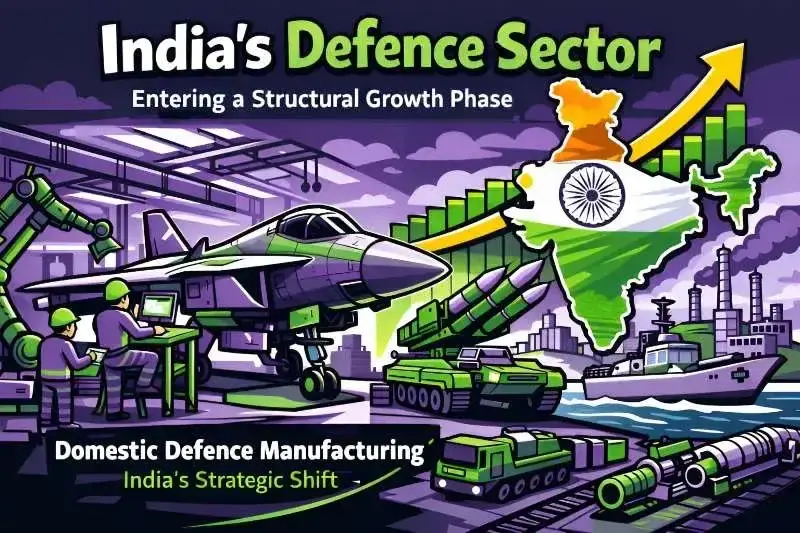
From an investment standpoint, MTAR Technologies and Bharat Electronics Limited are two widely analysed companies in the defence industry. Understanding how MTAR Technologies and Bharat Electronics generate revenue will be critical to investors' ability to make accurate comparisons between the companies, and will therefore be the only way for an investor to quantify the probable future returns of each investment. “India is not a short-term story. It is a long-term structural growth story.”— Rakesh Jhunjhunwala
MTAR Technologies
MTAR Technologies was founded in 1970 at a time when India was subject to international embargoes and restricted from accessing global engineering technologies. The company was established with the purpose of supporting India's technological needs by producing high-precision components locally. In the years since its founding, MTAR has developed a depth of engineering expertise and strong partnerships with major institutions like ISRO, DRDO, and the Nuclear Power Corporation of India.
MTAR focuses on mission-critical precision components used in highly complex systems, unlike other defence companies that build big hardware platforms or systems. Rather than often being visible to the public, these types of components play a major role in determining whether a high-tech system can perform its intended functions.
Many of MTAR's products may look quite technical at first glance, but they are mechanically based system components that convert rotational movement into very exact linear movement. Examples of MTAR's products are ball screws, roller screws, electro-mechanical actuators, and propulsion assemblies.
MTAR's products are extremely precise, and the importance of precision engineering in fields like aerospace or nuclear energy cannot be understated since a single microscopic defect in a component can lead to catastrophic failures within the entire system. As a result, manufacturers that operate in the precision engineering sector must meet exceptionally high-quality standards and go through years of qualification before they can become a supplier for systems used in aerospace or nuclear energy.
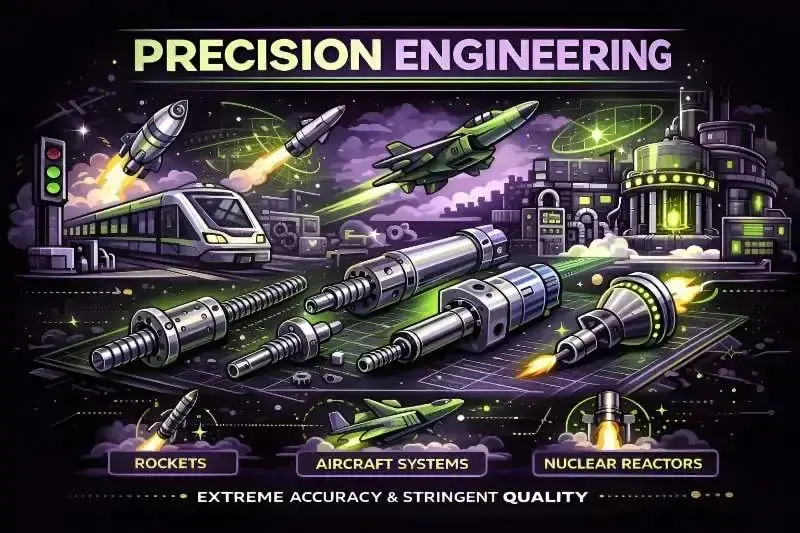
There are large obstacles for businesses to enter the field of precision engineering due to the stringent regulations. When companies build a successful position in the market, they tend to develop long-term customer relationships, as switching suppliers can involve significant technical and regulatory challenges.
One interesting aspect of MTAR’s business model is that it has a diverse portfolio across multiple industries. It operates in many advanced sectors, including nuclear, clean technology, aerospace, space exploration, and defence engineering. As a result of this diversity, the company is able to leverage and benefit from many of the same global technology trends at once.
Among all of the sectors mentioned, the civil nuclear power sector is a major contributor to overall revenue for MTAR. In a civil nuclear reactor system, there are many types of highly sophisticated “component” products and assemblies that operate in extreme conditions and require being able to operate at high temperatures, high pressures, and be resistant to radiation.
MTAR produces many of the necessary components for nuclear reactors, such as reactor assemblies. These components are in extremely high demand throughout the world because of the level of reliability that is required by the nuclear industry, which means there are very few companies worldwide that can design and manufacture such components.
If you are interested in knowing about penny stocks and understanding how they work, then read our article: What are penny stocks? The complete beginner's guide: pros & cons
MTAR has been supplying components for over 40 years to support the Indian nuclear power sector. With this long operating history, MTAR is recognised as a major supplier within the broad and highly specialised nuclear ecosystem.
Another fast-growing area of innovation for MTAR is in clean energy technology - specifically, solid oxide fuel cell technology. The fuel cell is an advanced energy conversion system that produces electricity from chemical energy.
In basic terms, fuel cells operate in a similar manner to a miniature power-generating system, using chemical energy to produce very high-efficiency electrical energy with relatively low environmental emissions. As companies look for more sustainable sources of energy, increased use of fuel cells will occur.
Interestingly, one of the new sources of fuel cell demand is the rapid expansion of data centres that leverage AI technologies. These massive facilities require significant amounts of electrical energy and have a critical need for a stable and reliable power supply. Fuel cell systems are now being considered as viable sources of energy for these types of high-demand applications.
MTAR manufactures essential parts for the Fuel Cell marketplace, therefore firmly establishing their role within the worldwide trend of Energy Transition. With increasing demand for clean and sustainable power sources, companies that create or manage supply chains for fuel cells should be looking at the long-term growth potential available to them.
MTAR also has considerable experience in manufacturing products for the Aerospace and Space Industry. They produce components that are designed to be used in liquid propulsion engines, cryogenic engine subsystems and satellite assemblies for Space Launch Vehicles.
Space programs require extremely precise engineering components capable of functioning in highly demanding environments. The company’s involvement in such programs demonstrates the level of technological sophistication it has developed over time.
In addition to the space sector, MTAR is gradually expanding its presence in aerospace manufacturing by supplying precision assemblies to global aerospace companies. These components form part of aircraft structures and other aviation systems.
A notable development for the company was the signing of a 15-year agreement with Israeli Aerospace Industries to supply mission-critical aviation assemblies. Long-term contracts of this nature provide visibility into future demand and help stabilise revenue streams over extended periods.
One of the most striking features of MTAR’s business model is its strong export orientation. Nearly 79% of the company’s revenue comes from international markets, while domestic sales contribute a smaller share.
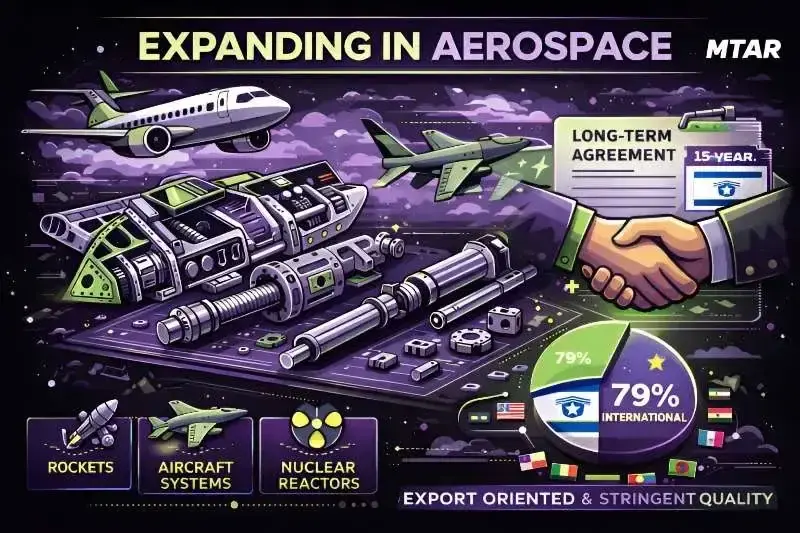
The company has a wide-ranging international presence due to its connection to global engineering supply lines. A large number of clients in aerospace, energy, and advanced engineering around the world employ the company’s services.
Long-term relationships are created between suppliers and customers in the aerospace and nuclear engineering sectors, so when a supplier has demonstrated their ability to deliver and perform technically, the customer is likely to retain that same supplier for many years.
This situation provides a high level of competitive advantage for companies that have established themselves as reliable suppliers. It was said best by the great investor Charlie Munger: “The best businesses are the ones that are the hardest for their competitors to copy.”
The recent performance of MTAR has been driven largely by the increase in demand for the company’s three major sectors. The most recent quarterly revenue figure for the company was approximately ₹278 crore and represents a strong increase from prior quarters based on increased order fulfilment in the clean energy, aerospace, and nuclear sectors.
For the total fiscal year, the company expects to achieve in excess of ₹900 crore in revenues, which would be approximately 30-35% growth on a year-over-year basis, owing primarily to record order inflows. Operating margins have been exceeding expectations with EBITDA margins in the 20-21% range for the quarter, indicating the company is beginning to experience improved operating leverage due to the increase in pro-rata volumes.
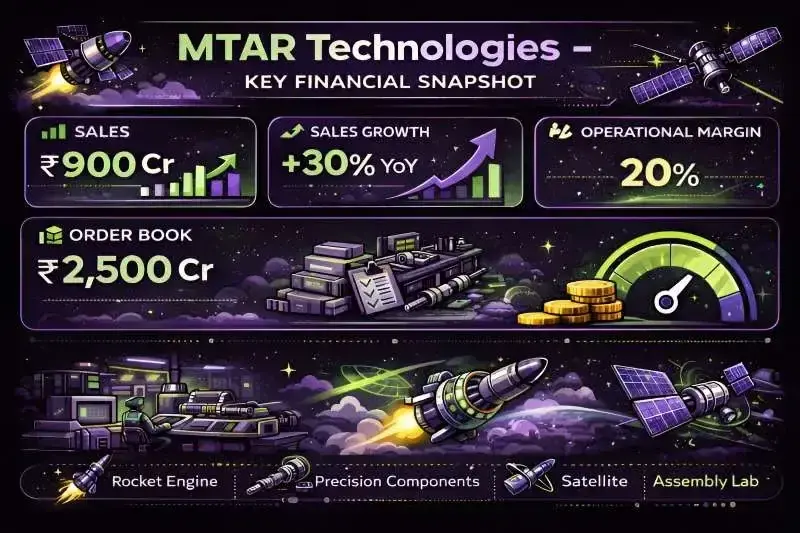
Another important indicator for investors evaluating engineering companies is the order book. The order book represents confirmed orders that the company will execute over the coming years. A strong order book generally indicates better revenue visibility.
MTAR’s order pipeline has expanded significantly in recent quarters, supported by demand across fuel cells, nuclear power components, and aerospace assemblies. This provides some degree of confidence regarding near-term growth prospects.
Read more about compounding in our article The Power of Compound Interest: How to Create Wealth in the Stock Market
However, no business operates without risks. One factor investors should watch closely is customer concentration. Historically, a large portion of MTAR’s revenue has come from a single major customer.Customer concentration simply means that a significant share of the company’s revenue depends on one client’s purchasing decisions. If that customer reduces orders or delays projects, the company’s revenue growth could temporarily slow.
Companies may have significant capital tied up in receivables and inventory during the execution of large projects. Managing working capital efficiently becomes important to maintain healthy cash flows
Despite these challenges, the company’s recent operational commentary suggests strong demand visibility across multiple sectors. In some segments, particularly fuel cell components, management has indicated that production capacity rather than demand is currently the limiting factor.
This is often considered a positive signal for manufacturing businesses. When companies expand capacity because customer demand exceeds production capability, it usually indicates strong underlying market demand.
As investor Peter Lynch famously stated, "Every stock has a company behind it, so find out what the company is doing." In order for investors to really understand why prices are changing, they can understand the underlying growth drivers behind a company's structure.
Many of the long-term trends affecting the growth of MTAR can be seen in ongoing nuclear power development, increased demand for renewable and clean fuels, and greater manufacturing activity in the aerospace sector.
Together with these factors, globally, we are experiencing a dramatic increase in military procurement. Nations are investing in their militaries, so India has begun its own focus on developing strategic technologies at home, providing opportunities for those companies involved in the defense and engineering ecosystem.
When an investor does an analysis of different companies, the key question they need to answer is not merely the size of the company being examined but rather the viability of the business model used in the context of long-term competitive advantage and growth.
MTAR is a precision engineering company that focuses on high-quality precision-engineered products and has a wealth of experience with advanced technology. MTAR's products are sold in a number of global markets, and it can manufacture highly complex products for several advanced industry sectors, thus providing a broad base of structural growth drivers
In summation, since the firm's overall size is relatively small, especially towards its main customer group, investors will be required to pay special attention to how MTAR executes its plans and how it can continue to diversify its customer base.
For MTAR, the long-range opportunity will be to apply its engineering expertise in production processes and eventually secure larger-scale production and the implementation of a worldwide business strategy for expanded global coverage.
If MTAR can build upon its reputation for quality and innovation and grow its production capabilities and the number of locations for those capabilities, it should be well-positioned to become a major player in the global high-tech supply chain.
Investors who want to establish a long-term investment strategy in companies that have created products or services that require specialised engineering expertise can build solid investments by understanding the potential for substantial growth in these specialised engineering niches. A key element of a successful investment strategy is to monitor how well MTAR is able to continue to strengthen its competitive advantage in technology and to grow the breadth of its market reach.
Bharat Electronics
Bharat Electronics Limited (BEL) is a key player in India's defence manufacturing ecosystem. Established in 1954, the company has become one of the most important suppliers of defence electronics to the Indian military and other defence forces. This includes a wide variety of mission-critical systems such as radars, missile control systems, communication systems, and electronic warfare systems that enable the Indian armed services to perform their international obligations effectively.
BEL's role as a systems integrator means that the company provides the combined technologies from many different sources, including hardware, software, sensors, and communications, into integrated defence solutions. BEL thus incorporates many different types of technologies into an integrated system that can operate together seamlessly in support of large defence system projects where reliability, accuracy, and long-term support are critical.
The company offers a full suite of defence technological capabilities such as radar, fire control, secure military communications, and electronic warfare. Some electronic warfare examples include the different types of systems designed to detect, disrupt, or deceive, for example, enemy communications, or to detect and disrupt radar systems. These systems provide military forces engaged in combat with a strategic advantage.

Over time, the company has greatly expanded its manufacturing operations. With manufacturing facilities in Bengaluru, Pune, Hyderabad, Ghaziabad, Chennai, and many others, the company now has one of the largest defence electronics manufacturing networks in India. Manufacturing takes place in these plants to support everything from manufacturing very complex radar antenna arrays, to night-vision devices, and complex missile subsystems.
While defence continues to dominate the company’s business model, BEL has slowly been expanding into civilian applications as well. The company now develops solutions for areas such as homeland security, smart city infrastructure, cybersecurity, medical electronics, and space electronics. Interestingly, the non-defence segment has grown rapidly in recent years, indicating that BEL is gradually diversifying beyond its traditional military customer base.
Exports are another area where the company is steadily building a presence. BEL now supplies sophisticated electronic components such as radar modules, communication systems, and surveillance equipment to several countries, including the United States, France, Israel, and parts of Southeast Asia. Although exports currently contribute a small share of revenue, the company has articulated a long-term ambition of significantly increasing its global defence footprint.
Read more about market phases in our article Bull Market vs Bear Market – How Investors Should React
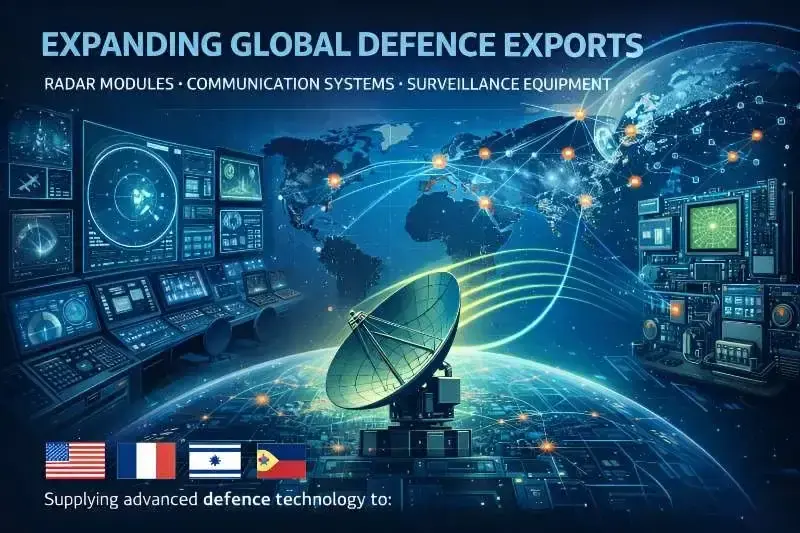
Partnerships have also played a crucial role in strengthening BEL’s technological capabilities. The company collaborates with multiple research institutions and global defence firms to develop advanced systems. Strategic partnerships with organisations in areas such as aerospace, defence electronics, and space technology help the company stay at the forefront of emerging defence innovations.
Another pillar of BEL’s competitive strength lies in its research and development capabilities. The company runs multiple research laboratories and development centres focused on technologies such as artificial intelligence, robotics, big data analytics, and next-generation communication systems. In an industry where technology evolves rapidly, sustained R&D investment often becomes the difference between staying relevant and falling behind.
This heavy focus on innovation is reflected in the company’s intellectual property portfolio. BEL has filed more than a thousand patents and continues to invest aggressively in indigenous technology development. In fact, nearly three-fourths of its products are now indigenously developed, which aligns well with India’s broader push toward defence self-reliance.
Warren Buffett once remarked, “The best business is one that earns high returns on capital and can reinvest those returns for many years.” Defence electronics companies often fit this description because large military programs run for decades, providing steady long-term demand for maintenance, upgrades, and replacements.
BEL’s order pipeline reflects this long-term visibility. The company currently holds an order book exceeding ₹70,000 crore, providing strong revenue visibility for the coming years. Large defence projects such as missile systems, radar platforms, and electronic warfare suites form a significant part of this backlog.
Some of the major defence programs contributing to the order book include advanced radar systems, missile defence platforms, electronic warfare equipment, and upgrades to existing military vehicles. These are long-cycle projects that typically span multiple years, ensuring sustained execution visibility for the company.
Large defence procurement programs like QRSAM, Akash missile systems, and various electronic warfare platforms are expected to play an important role in the company’s future growth. These programs involve sophisticated technologies and typically require extensive testing, integration, and certification before deployment.
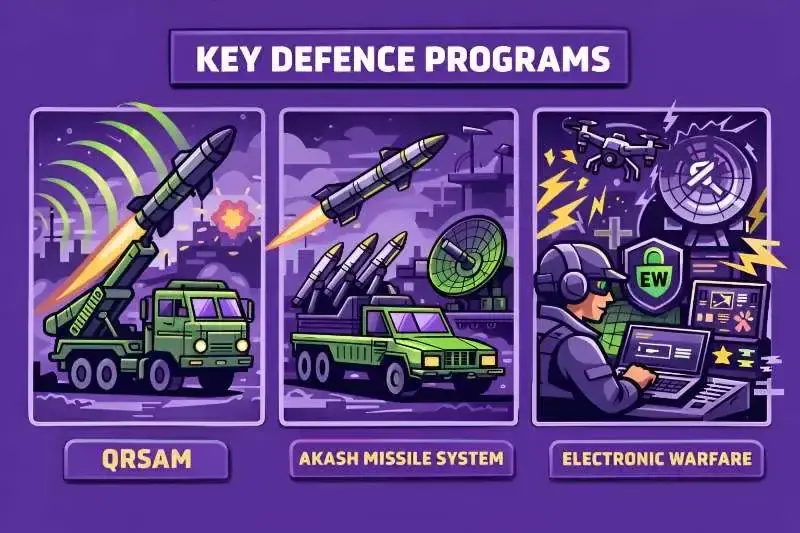
One interesting aspect of defence contracts is that they often involve multiple agencies working together. For example, missile programs may involve organisations like DRDO for research, BEL for electronic systems, and other defence companies for missile components. This collaborative ecosystem makes BEL an integral part of India’s defence manufacturing network.
From a financial perspective, the company has delivered consistent growth in recent periods. In the latest nine-month period, revenue crossed ₹17,000 crore, reflecting healthy expansion driven by the execution of major defence programs. Profit before tax and net profit also grew at a strong pace, supported by improved operating efficiencies and a favourable product mix.
Operating margins have remained robust as well, hovering around the high-twenties to thirty percent range. In simple terms, operating margin indicates how much profit a company generates from its core business before interest and taxes. Higher margins generally signal strong pricing power and efficient cost management.
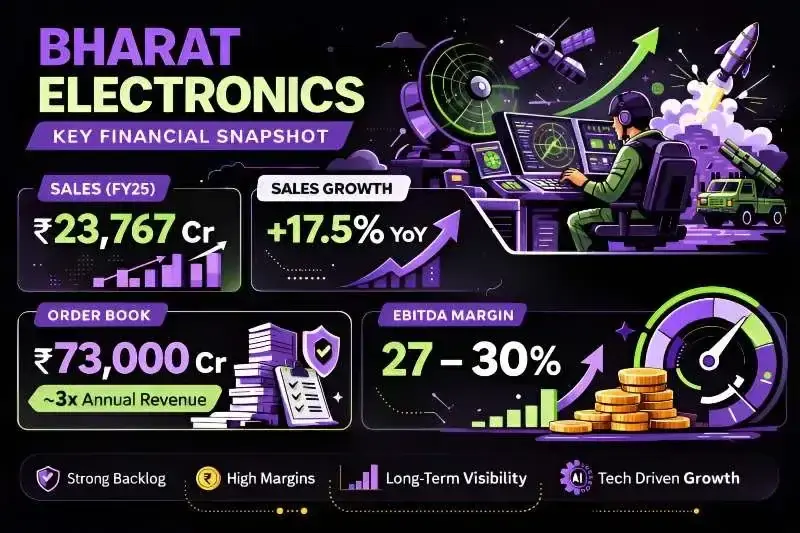
Another notable feature of BEL’s financial position is its strong balance sheet. The company holds a sizable cash balance and operates with minimal debt. This provides financial flexibility to invest in research, expand manufacturing facilities, and pursue new defence opportunities without excessive financial risk.
Read more about inflation in our article Inflation Explained: How It Erodes Savings and What Stocks Can Hedge Against It.
The company has also been actively investing in new facilities and modernisation initiatives. Recent capital expenditure has been directed toward expanding production capabilities for advanced sensors, night vision systems, and next-generation electronic warfare equipment. Such investments are essential to keep pace with the rapidly evolving defence technology landscape.
However, like any complex manufacturing business, BEL also faces operational challenges. One of the key issues the company has highlighted is the supply chain dependence on specialised electronic components, particularly semiconductors. These tiny chips are critical components inside modern electronic systems.
Semiconductors can account for a significant portion of the cost structure in advanced defence electronics. Any disruption in their supply chain can potentially affect production timelines. To address this, BEL has been working on alternate designs and exploring domestic semiconductor sourcing options.
Indigenisation is another major strategic focus for the company. The goal is to reduce reliance on imported components and strengthen domestic manufacturing capabilities. In some projects, the level of indigenous content has already crossed seventy percent, which significantly strengthens India’s defence self-reliance.
Beyond defence, BEL is gradually building capabilities in adjacent sectors such as railway safety systems, air traffic management solutions and secure digital infrastructure. For instance, the company is working on technologies related to railway safety and surveillance systems, which could become meaningful growth drivers in the future.
Cybersecurity and secure digital infrastructure are also emerging opportunities. As governments increasingly prioritise digital security, BEL’s expertise in secure communication systems and defence-grade encryption technologies could open new commercial opportunities outside the traditional defence sector.
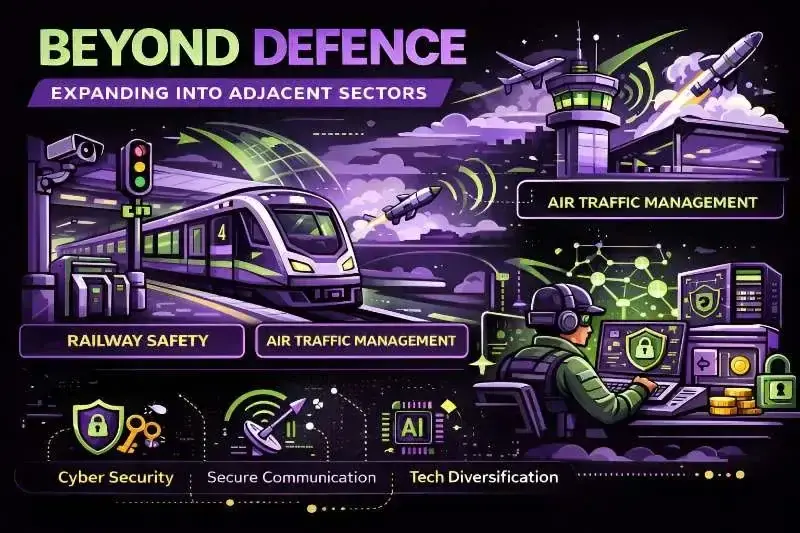
Looking ahead, several large defence programs are expected to drive BEL’s order inflows in the coming years. Projects such as next-generation missile defence systems, electronic warfare platforms, and advanced radar systems could significantly expand the company’s already strong order pipeline.
At the same time, the company is investing heavily in research to ensure it remains technologically competitive. Its R&D spending continues to grow each year, reflecting management’s commitment to building future capabilities in areas like artificial intelligence, autonomous systems, and advanced sensor technologies.
For investors evaluating the defence sector, BEL represents a relatively stable and mature player compared to smaller defence companies. Its long operating history, strong government relationships, and massive order book provide a level of earnings visibility that is uncommon in many industries.
However, it is also important to recognise that defence businesses often depend heavily on government procurement cycles. Delays in project approvals or changes in defence budgets can sometimes affect order inflows and execution timelines.
Despite these risks, the broader structural trend appears favourable. India’s defence spending continues to rise, and the government has been strongly encouraging domestic manufacturing under the “Make in India” initiative. Companies with strong technological capabilities and established defence relationships are likely to benefit from this shift.
In many ways, BEL sits at the centre of this transformation. As India gradually reduces dependence on imported defence equipment, domestic companies capable of developing complex electronic systems could see sustained long-term demand.
Read more about multibagger stocks in our article Top Multibagger Stocks of the Last 10 Years – What We Can Learn
For long-term investors, the key question is whether BEL can continue to innovate and expand into new technological domains while maintaining its strong execution track record. If it succeeds, the company could remain one of the most important beneficiaries of India’s growing defence manufacturing ecosystem.
In the end, as Charlie Munger famously said, “A great business at a fair price is superior to a fair business at a great price.” Companies operating in strategic sectors like defence often take years to fully reveal their potential. The real test for investors is patience and the ability to recognise structural opportunities before they become obvious to everyone else.
Which Stock Should be in your watchlist?
India’s defence industry has been entering a powerful growth phase in recent years. Rising geopolitical tensions, sensitive borders, and the push for defence self-reliance have steadily increased military spending. With initiatives like “Make in India” and large procurement programs for missiles, radars, and surveillance systems, demand for domestic defence companies is expected to remain strong for years. “The biggest investment opportunities come when structural changes reshape entire industries.” - Rakesh Jhunjhunwala.
In this ecosystem, MTAR Technologies and Bharat Electronics Limited operate in very different niches. MTAR focuses on specialised precision engineering components used in rockets, nuclear systems, and aerospace assemblies. This makes it a niche technology player with strong export exposure, though growth can sometimes depend on project cycles.
Bharat Electronics, on the other hand, sits at the core of India’s defence electronics infrastructure. Its portfolio includes radar systems, missile control technologies, electronic warfare equipment, and secure military communication networks. A large order book and steady government contracts provide stronger revenue visibility.
Explore our Products
Research Framework

Emerging Titans
Combination of quantitative analysis, industry tailwinds, and management assessment - SPRINT investment philosophy

Tiny Titans
Heavy emphasis on scuttlebutt research, plant visits, and early on-ground signals
For investors, the choice depends on risk appetite. MTAR may suit those seeking exposure to high-precision engineering and global aerospace growth. However, from a stability and scale perspective, Bharat Electronics appears to be the clearer winner due to its dominant position and consistent defence demand.
Conclusion
India’s defence sector is no longer just a government spending story. It is gradually becoming a long-term technology and manufacturing opportunity driven by rising geopolitical uncertainty, border sensitivities, and the push for self-reliance in strategic industries. As defence modernisation accelerates, companies with specialised capabilities and strong execution could benefit for years to come. “The big money is not in the buying and selling, but in the waiting.”— Charlie Munger
For investors seeking high-technology exposure and potential global aerospace growth, MTAR could be an interesting company to track. However, when it comes to scale, order visibility, and stability of defence demand, Bharat Electronics clearly appears to have the stronger structural advantage.
If this comparison helped you understand how different defence businesses operate and which one may suit your portfolio style, comment “DEFENCE” below. Like if the MTAR vs BEL comparison gave you new insights, share this with investors tracking India’s defence sector, and tell us which defence stock you currently have on your watchlist.
FAQs
Why is India’s defence sector attracting so much investor interest?
+India has been steadily increasing its defence spending while also pushing for domestic manufacturing through initiatives like indigenisation and “Make in India.” As geopolitical tensions rise and technology becomes central to modern warfare, demand for locally manufactured defence systems is expected to remain strong.
How are MTAR Technologies and Bharat Electronics different from each other?
+While MTAR Technologies focuses on highly specialised precision engineering components used in aerospace, space, and nuclear sectors, Bharat Electronics Limited primarily develops defence electronics such as radar systems, electronic warfare platforms, and secure military communication networks.
Which type of investor might prefer MTAR Technologies?
+MTAR may appeal to investors looking for exposure to high-precision engineering and the global aerospace ecosystem. Its strong export orientation and partnerships with international companies could create long-term opportunities, though growth may depend on project cycles.
Why is Bharat Electronics often considered a more stable defence investment?
+Bharat Electronics benefits from large and consistent government defence contracts. Its products are deeply integrated into India’s military infrastructure, which provides strong order visibility and relatively stable demand compared to niche engineering companies.
Can both companies benefit from the growth of India’s defence industry?
+Yes. Both companies operate in critical segments of the defence ecosystem. As India expands its defence capabilities and reduces dependence on imports, both precision engineering and defence electronics companies could see long-term growth opportunities.

High growth stock specialist, Value Educator
Shashank Mahajan is an equity research professional with over 12 years of experience in identifying high-potential SME and micro-cap stocks at an early stage. He follows a rigorous scuttlebutt research–driven approach, combining on-ground insights with deep financial analysis. Shashank specializes in uncovering under-researched and under-owned companies with strong management quality and long-term growth potential. Through disciplined research and early identification, he focuses on spotting tomorrow’s market leaders before they enter the mainstream investor radar.

Zen Technologies: Revenue Fell After a Big Win




PNG Jewellers: A 194-Year-Old Name Goes National

Explore our Products
Research Framework
Emerging Titans
Combination of quantitative analysis, industry tailwinds, and management assessment - SPRINT investment philosophy
Tiny Titans
Heavy emphasis on scuttlebutt research, plant visits, and early on-ground signals


 Orders
 Subscription
 Share with friends


Required Details
₹23999.00
(12 month subscription)
As per SEBI regulations, all users are mandated to complete the KYC that is validated for 1 year. Post payment, you will be redirected to the KYC screen


No comments yet. Be the first to comment!