
Why FIIs Poured ₹11,526 Cr Into Metal Stocks

Imagine waking up to a market where everything in our portfolio is bleeding red… except one lonely sector shining like a lighthouse in the middle of a storm. And believe it or not, that’s exactly what January 2026 felt like (if you held this lighthouse in your portfolio).
While FIIs were busy pulling money out of almost every corner of the Indian stock market, a massive ₹35,960 crore yanked out in just one month. They were quietly (well, not that quietly) pouring ₹11,526 crore into metal stocks. Yes, metals. The same sector most investors casually scroll past until suddenly it becomes the unexpected hero of the story.
And trust me, this wasn’t a gentle shift of preference. It was a full‑blown stampede.
Financials? ₹8,592 crore outflow.
FMCG? ₹7,497 crore outflow.
Healthcare? ₹6,162 crore outflow.
Auto? ₹3,594 crore outflow.
Everywhere you looked, FIIs were selling.
Everywhere… except metals.
So what flipped the script?
Well, the big global players are whispering something again, the return of a commodity super‑cycle. HSBC even hinted that surging demand from EVs and energy storage, paired with years of underinvestment in mining, may have kicked off a multi‑year boom. And this isn’t just market gossip: primary aluminium is expected to slip into a global deficit in 2026, with shortages widening over the next five years.
At the same time, the world’s green transition is devouring “critical minerals” faster than ever, for example copper for EV motors, zinc for solar frames, metals for wind turbines and grid‑scale batteries. Throw in rising Middle‑East tensions, disruptions around the Strait of Hormuz, force majeure announcements, and suddenly prices of HRC and rebar are jumping 14% and 7% quarter‑to‑date, respectively.
And who comes out smiling when metal prices start spiking?
Exactly…. Indian metal giants.
Supported by strong domestic demand, protected by a 12% safeguard duty, and now boosted by billions in FII flows… metal stocks didn’t just rise, they exploded.
As global fund managers put it perfectly:
“Emerging market investors are finally closing their underweight positions in metals. This isn’t a trade. It’s a repositioning.”
So if FIIs are treating metals as the “chosen one” in a sea of red… shouldn’t we at least understand why?
Let’s dive into the forces powering this unexpected, massive, and possibly long‑term shift into India’s metal sector.

High‑Level Use Cases of Key Metals
Before we make sense of why FIIs are going all‑in on metals, it helps to step back and understand what these metals actually do for the world. Metals aren’t just raw materials, they are the building blocks of modern industry, the backbone of global electrification, and the silent enablers of the clean‑energy revolution. Each metal carries its own story and economic purpose. Let’s break them down.
Steel — The Silent Skeleton Behind Every Industrial Revolution
Steel is everywhere, in our roads, rails, bridges, factories, and increasingly, in the electric vehicles we drive. In the EV world, steel isn’t just a supporting character, it’s a leading actor. Modern electric vehicles rely heavily on advanced high‑strength steel (AHSS) and ultra‑high‑strength steel (UHSS) for their body structures, crash‑protection zones, and most importantly, their dedicated battery enclosures, where safety is non‑negotiable.
Even the highly efficient motors inside EVs depend on a specialized iron‑silicon alloy known as non‑oriented electrical steel (NOES), something aluminium simply can’t replace.
But steel’s importance goes beyond engineering. It is cost‑effective, backed by an already well‑established global manufacturing base. Automakers don’t have to retool entire factories or invest billions into new processes, making steel the most economically sensible choice. Oftentimes steel emits less CO₂ during manufacturing compared to many alternatives, helping automakers meet tougher climate norms.
Simply put, steel doesn’t just support economic growth but amplifies it.
Aluminium — Lightweight, Affordable, and Powering the Grid of the Future
Should it be steel as the backbone, the lightweight muscle that makes electrification possible is aluminium. The major metal in the transmission of electricity cables, particularly overhead lines, is aluminium due to its lightness (compared to copper) and low cost. The demand of aluminium is increasing in a steep manner as nations grow and upscale their electricity systems.
Aluminium forms a major component of solar panels, wind turbines and renewable-energy buildings. Aluminium has the ability to reduce weight at the same time as being durable, a vital combination factor in large-scale energy projects.
Economically, the world that is moving towards electrification requires aluminium. In the case of sustainable electricity networks, analysts estimate that the demand of aluminium may almost increase by 2040.
If the 2020s are the decade of electrification, then aluminium is helping keep the “lights on”.
Copper — The Conductor of the Clean‑Energy Boom
Copper keeps electrons moving. Without copper, there is no electrical infrastructure, no EV motors, no charging networks and no renewable‑energy systems.
EVs, in particular, are copper‑hungry machines. They require copper for motors, battery systems, wiring harnesses, and high‑voltage cables. While copper use in traditional vehicles is growing slowly at just 0.5%, copper demand for EVs is exploding at 10.5% annually. That’s exponential growth in a world where supply is already tight.
Copper is essential for charging stations and electricity grids, a critical infrastructure that supports the clean‑energy transition. From solar farms to wind turbines to transformer stations, copper is at every step where energy flows.
In essence, copper is not just another industrial metal, it is in fact the lifeblood of modern electrical systems.
Zinc — The Protective Shield and the Energy‑Storage Understudy
Zinc may not make headlines often, but its role is vital. Its biggest job? Zinc prevents steel from corrosion. Zinc ensures that bridges, highways, telecom towers and power transmission lines survive against rain, heat and climate stresses for a longer period of time.
But zinc’s story is evolving rapidly.
Zinc is used in newer battery technologies, such as zinc‑nickel and zinc‑air batteries. These batteries are safer, cheaper, and more durable alternatives for grid‑scale storage. Zinc quietly makes infrastructure stronger today and simultaneously energy storage smarter tomorrow.
Cross‑Metal Perspective — Why These Metals Are the Heart of the Energy Transition
These metals are at the center of a major global shift. Steel, aluminium, copper, and zinc are increasingly embedded in improved technologies. And here’s the kicke.
Battery electric vehicles are 15–20% heavier than conventional cars, meaning they require more steel, more aluminium, and more copper per vehicle. Renewable energy systems also require significantly more metals than fossil‑fuel systems per unit of output.
This isn’t a short‑term trend, it’s becoming a structural evolution. And it’s one of the biggest reasons FIIs are treating metals as a long‑term, secular growth story rather than a cyclical trade.
Metals aren’t just industrial goods anymore, they’re the foundation of the world’s next energy and economic cycle.
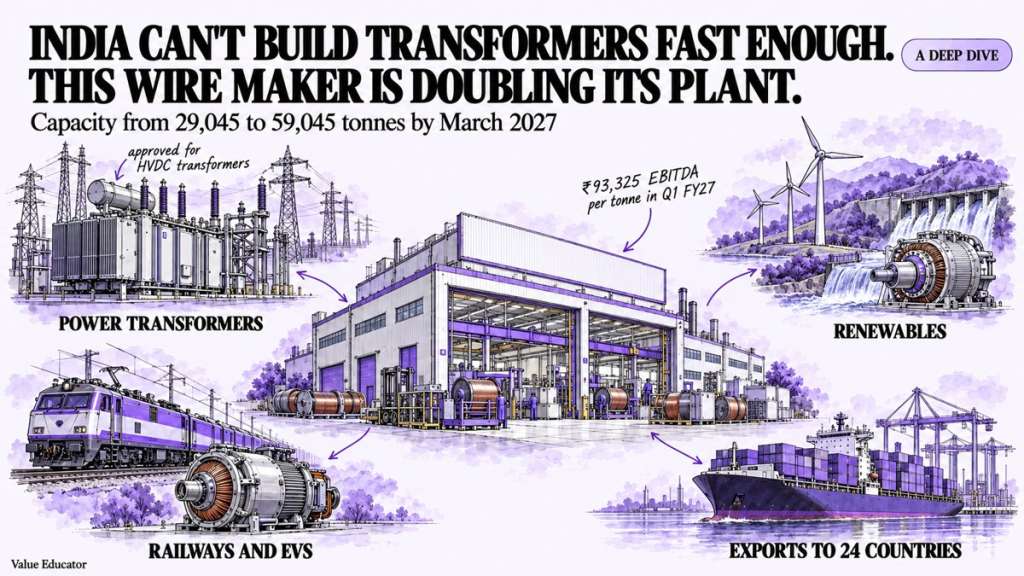
Keeping Aside the metals, learn about power transmission industry here: The Power Engineering SME Riding India’s Transmission Expansion Cycle.

The Indian Macro Environment Supporting Metals
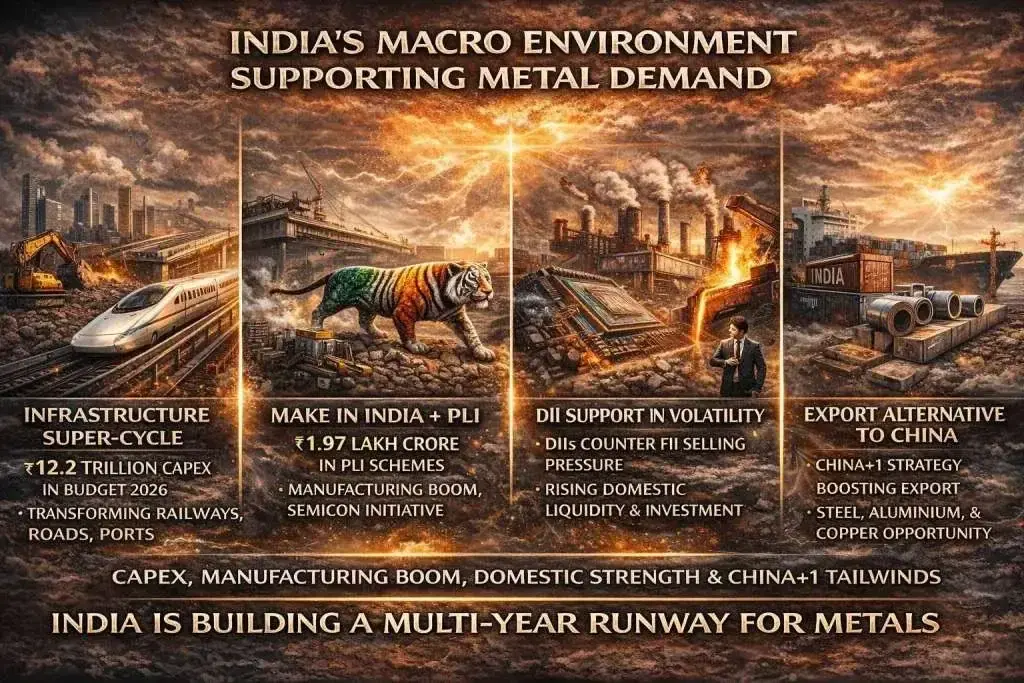
If FIIs are betting big on India’s metal sector, they’re not doing it in isolation. They’re responding to a macro environment that’s structurally rewriting the country’s growth trajectory, an environment powered by massive public capex, a manufacturing renaissance, rising domestic liquidity, and a global shift away from China. Put simply, India is creating the perfect multi‑year runway for metal demand, and the data backs it up.
The Infrastructure Super‑Cycle: India’s Engine of Long-Term Metal Demand
Over the next decade, India’s development story is being stitched together with concrete, steel, copper, and aluminium funded by some of the boldest capex pushes the country has ever seen. In the Union Budget 2026, capital expenditure was raised to a record ₹12.2 trillion, marking a solid 9% year‑on‑year jump. This isn’t just a number; it’s a declaration of intent.
The railways alone were allocated a historic ₹2.77 lakh crore, earmarked for seven new high-speed rail corridors and the game‑changing East–West Dedicated Freight Corridor, which will connect Dankuni to Surat. High‑speed trains, dedicated freight lines, and modern rolling stock all require enormous quantities of steel and aluminium. Ensuring metal demand isn’t just steady, but accelerating.
Roads and highways continue to be the backbone of India’s logistics transformation, with ₹3.09 lakh crore flowing into the sector and ₹1.87 lakh crore specifically channeled into NHAI for expressways, border roads, and mobility corridors. Combine this with the plan to operationalize 20–22 new waterways and a ₹10,000 crore plan for boosting domestic container manufacturing, and it’s clear that India is building a multi-modal, metal-intensive logistics ecosystem.
Learn more about India’s union budget here, Union Budget Analysis: What Actually Matters for Investors
Underpinning all this is the National Infrastructure Pipeline (NIP), Bharatmala Pariyojana, and the Sagarmala Project, each pulling India deeper into an era of infrastructure-led growth, where steel, aluminium, copper, and zinc remain indispensable.
In essence: India is building an infrastructure foundation so massive and long‑lasting that it practically locks in steady, predictable metal demand for years to come, making metals one of the biggest winners in the country’s growth story for the next decade.
The Manufacturing Push: Make in India + PLI = A Structural Metal Boom
On the industrial side, India is undergoing one of the most significant manufacturing overhauls in its history. The Production Linked Incentive (PLI) scheme, with a committed outlay of ₹1.97 lakh crore, has already attracted ₹1.76 lakh crore in realized investments, generated ₹16.5 lakh crore in sales, and created 12 lakh jobs across 14 sectors.
This isn’t abstract policy talk. It’s a hard pivot toward building domestic manufacturing capacity at global scale, and that shift directly fuels metal consumption.
Take specialty steel, for instance the backbone of automobile components, transformers, strategic alloys, and high-performance industrial applications. Rounds 2 and 3 of the PLI for specialty steel have already secured ₹17,000 crore in commitments.
Similarly, the government’s push into manufacturing is showing up in very real numbers. The PLI allocation for white goods has jumped to ₹1,004 crore, giving a strong boost to local production of components like compressors, motors, and cooling systems, all of which are heavy users of aluminium and copper. And with the India Semiconductor Mission 2.0 receiving a massive ₹40,000 crore boost, India is making an aggressive play in a sector that eats up copper and high‑grade metals at every stage of the value chain.
To make sure smaller manufacturers aren’t left behind, the government has also rolled out a ₹10,000 crore SME Growth Fund, pumping much-needed credit and equity into MSMEs. The true backbone of India’s factory ecosystem and a major collective consumer of industrial metals.
When you put all of this together, along with the government’s ambition to lift manufacturing’s share of GDP to 25%, a clear picture emerges. India isn’t just seeing more metal demand in fact it’s building it into policy. This isn’t temporary or cyclical. It’s structural, deliberate, and long-term.
DII Support During Volatility: The Rise of India’s Domestic Shock Absorbers
The Indian equity market is no longer solely dependent on foreign flows to stay stable. Even though FY26 saw massive FII selling due to global risk-off sentiment, driven by geopolitical tension and a weakening rupee, domestic investors stepped up in force.
InvITs and REITs have made it easier for domestic investors to take part in India’s long‑term infrastructure story, steering local capital into utilities, toll roads, renewable projects, and commercial real estate, sectors that quietly consume metals at an enormous scale.
India as an Export Alternative to China: The China+1 Tailwind for Metals
For years, China’s dominance in the metals market looked unshakeable, a story built on massive capacity, ultra‑low prices, and a flood of exports that left little room for competitors. But by 2026, that story has dramatically changed. What once felt like an endless stream of “cheap and easy” Chinese supply has now shifted into a structural slowdown, opening one of the most significant opportunities India’s metal sector has ever seen.
China’s domestic steel demand, especially from its once‑booming property sector, has slipped into a deep downcycle. Beijing has responded not by stimulating output but by tightening the screws. Production caps are now being strictly enforced, pulling China’s steel output down to nearly 1.01 billion tons, and the government has reintroduced export licenses on 300+ steel products. For thousands of smaller traders who relied on tax loopholes and VAT evasion to stay competitive, these rules have effectively shut the door. China’s focus has pivoted from high‑volume exports to quality control and its own green industrial transition.
And this is exactly where India enters the frame.
While China is pulling back, India is expanding with purpose. Indian steel production is already increasing at double-digit rates with the support of the rich iron ore reserves that are capable of producing 700 million tonnes per year with a domestic demand expectation of 9-10 percent in the year 2026. As India aims at 300 MT capacity by 2030, the country is ramping up at a time when the global consumers seek alternative sources that are dependable.
Geopolitics supports this change. With the world supply chains moving out of China, India has been filling the void - taking the place of close to 40 percent of the US smartphone imports that had been previously sourced in China and increasing its electronics exports by 40 percent. The establishment of rare earth corridors by the government in the mineral-rich states empowers the India position concerning critical raw materials required in EVs, batteries, and high-tech production.
Briefly, China has abandoned its low-cost metal exports, and India has embarked on an active capacity construction and policy subsidy, both have come together like a match made in heaven. India is not only taking the place of a vacuum- India is becoming the next giant metals center in the world.
Learn more about macro effects such a inflation here, Inflation Explained: The Silent Destroyer of Wealth
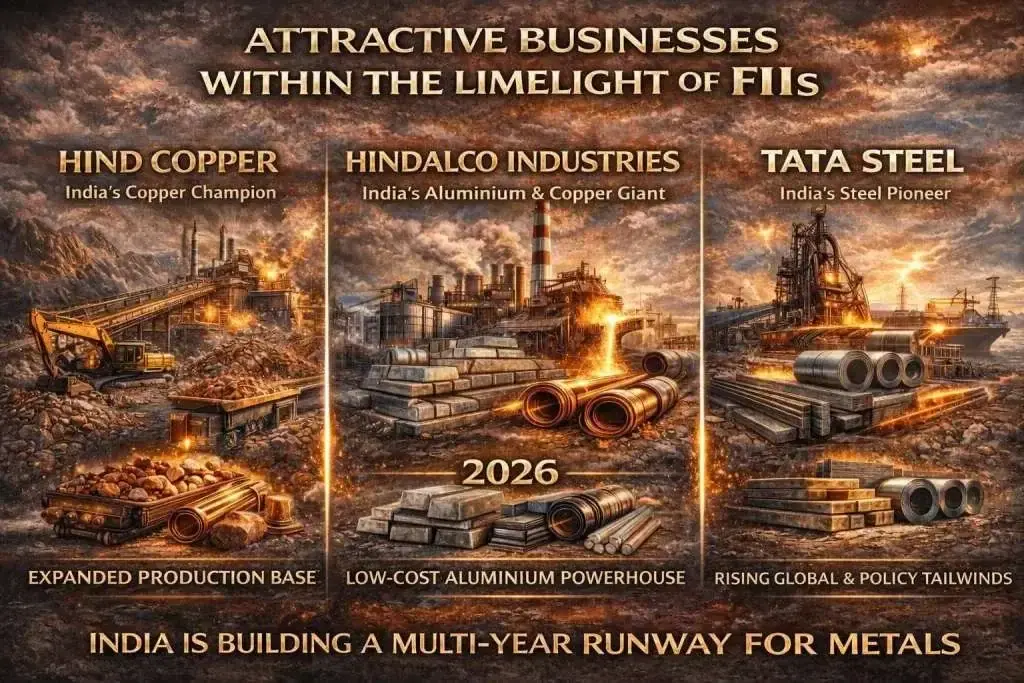
Attractive businesses that are within the limelight of FIIs
Hind Copper
Hindustan Copper steps into 2026 with real momentum behind it. The stock has already delivered strong double‑digit gains, helped by a surge of FII interest in metal names. And unlike many global metal producers, HCL hasn’t felt the pinch of the Middle East crisis, most of its key inputs are sourced domestically, keeping its cost structure stable while others struggle.
What really strengthens the company’s outlook is its expanding production base. The Kendadih mine restarted operations in January 2026, adding fresh ore supply, while output from Kolihan and Surda is set to rise steadily. Once fully ramped up, Kendadih and Surda together could add over a million tonnes of ore each year. HCL is also securing its long-term pipeline by winning new resource blocks such as Baghwari–Khirkhori, a promising copper-rich zone.
Operational upgrades continue in parallel. At Malanjkhand, a new service shaft is expected to boost efficiency and reduce manpower strain, while the company explores value-added ventures like recovering uranium from copper tailings.
With copper demand accelerating globally, from EVs to renewable energy, Hindustan Copper is positioned not just to participate in the “copper supercycle,” but to meaningfully benefit from it.
Hindalco Industries
Hindalco enters this cycle as one of the strongest structural stories in India’s metals space. At the core of its strategy is scale. Hindalco is doubling its upstream aluminium capacity to 1.71 MT by FY29, driven by greenfield expansions at Aditya’s alumina refinery and smelter. This is supported by an equally ambitious downstream plan, where the company aims to quadruple EBITDA by FY30 by focusing on high‑value products like battery foils, AC fins, and copper recycling—categories that directly benefit from EV adoption and sustainability trends. The upcoming Bay Minette project, a 600 KT facility scheduled for commissioning in 2HCY26, could become a major earnings engine on its own, with the potential to contribute USD 1,000 per tonne.
What truly sets Hindalco apart is its cost advantage. The company already sits on the lower end of the global cost curve, delivering a strong 42% EBITDA margin (~USD 1,600/t) in 3QFY26. And the gap is set to widen. With a clear roadmap to achieve 100% captive coal sufficiency by FY33, Hindalco expects savings of USD 200 per tonne, while plans to source 30% of its energy from renewables further shield it from volatile fuel prices.
Financially, the company is in excellent shape. Despite recent challenges, including a fire at Novelis’ Oswego plant, the management expects 70–80% of the cash flow impact (USD 1.3–1.6 billion) to be recovered through insurance. Meanwhile, Indian operations are nearly net‑debt‑free, giving Hindalco flexibility to self‑fund large projects without stressing its balance sheet. Unsurprisingly, global institutions like HSBC now call Hindalco their “preferred name” in Indian metals.
In short, Hindalco is not just keeping pace with industry shifts, it is positioned to lead them. With scale, cost efficiency, financial strength, and powerful market tailwinds all aligning, the company stands out as one of the most compelling long‑term metal plays in India.
Explore our Products
Research Framework

Emerging Titans
Combination of quantitative analysis, industry tailwinds, and management assessment - SPRINT investment philosophy

Tiny Titans
Heavy emphasis on scuttlebutt research, plant visits, and early on-ground signals
Tata Steel
Tata Steel enters 2026 with the kind of momentum that long‑term investors love to see. The stock has already benefited from the sharp rotation of FIIs into the metals space, delivering strong double‑digit returns early in the year. But the real story sits beneath the surface, in the company’s expanding capacity, rising policy support, and its natural resilience in a volatile world.
At home, Tata Steel’s growth engine is the KPO‑II Phase 2 expansion, a project that will add 3 million tonnes of fresh capacity. This expansion isn’t just about scale, it strengthens Tata Steel’s ability to meet growing domestic demand tied to infrastructure, autos, and manufacturing.
On the global front, the UK government’s recent move to slash steel import quotas by 60% and lift tariffs from 25% to 50% is a major tailwind. Starting July 2026, this protection sharply improves the competitiveness and margins of Tata Steel UK, which had been battling high energy costs.
Operationally, Tata Steel’s fully integrated blast‑furnace route gives it a built-in advantage during geopolitical shocks.
We have covered more on selective metal stocks her, Top 10 Metal Stocks in India for 2026: Why FIIs Are Turning Bullish on the Sector
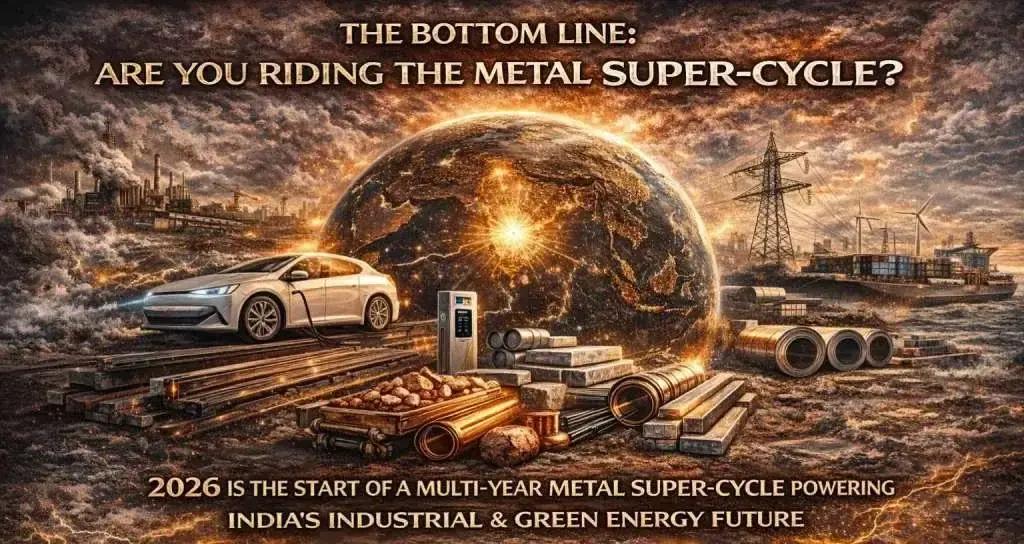
The Bottom Line: Are You Riding the Metal Super-Cycle?
The shift in metal stocks during 2026 isn't just another market cycle; it represents a significant repositioning by global investors who see India as the backbone of the next industrial and green energy era. With FIIs pouring ₹11,526 crore into the sector while pulling back from almost every other industry, the message is clear: metals are no longer just cyclical trades, they are structural winners in a world transitioning to EVs, renewable energy, and massive infrastructure.
Whether it’s the "silent skeleton" of steel powering our bridges or the "conductive lifeblood" of copper fueling the EV revolution, these materials are the foundation of the future. For investors, 2026 might just be the starting line of a multi-year super-cycle driven by domestic demand, a "China+1" global shift, and deep-rooted policy support.
If you found these insights helpful or if this shift in FII behavior changed how you’re looking at your portfolio, comment "Metals" below! Let’s get a conversation started on which stocks you think will lead the charge.
Also check out this article on steel sector for more insights, Steel Demand Boom: 5 Stocks Benefiting from India’s Infrastructure Push
FAQs
Why are FIIs suddenly pouring money into metal stocks while selling others?
+Foreign Institutional Investors (FIIs) are looking for "structural growth" rather than just short-term gains. With India’s aggressive push toward infrastructure and green energy, metal companies are seen as the foundational providers for this growth. While other sectors might face valuation concerns, metals currently offer a unique blend of high demand and strategic global positioning.
Is this growth driven only by domestic demand in India?
+No. While India’s internal infrastructure boom is a massive factor, the "China+1" strategy is also playing a role. Global manufacturers are looking for alternative sourcing hubs for industrial materials, and India’s metal sector, supported by favorable government policies, is becoming a primary beneficiary of this global supply chain shift.
Which metals are expected to benefit the most from the EV revolution?
+Copper and Aluminum are the frontrunners. Copper is essential for the wiring and motors of electric vehicles (EVs), requiring significantly more copper than traditional internal combustion engines. Aluminum is also highly valued for "lightweighting" vehicles to improve battery range and efficiency.
How do government policies like the Production Linked Incentive (PLI) scheme help?
+The PLI scheme and other "Make in India" initiatives provide financial incentives for companies to manufacture locally. For the metal sector, this reduces production costs and encourages the creation of specialized products (like high-grade steel), making Indian metals more competitive on the global stage.
Are metal stocks considered a safe long-term investment?
+Metal stocks are traditionally cyclical, meaning they fluctuate with the economy. However, many analysts believe we are entering a "super-cycle" where the transition to renewable energy and massive urbanization will keep demand high for a decade or more. As always, it’s important to look at the individual debt levels and efficiency of specific companies before investing.

High growth stock specialist, Value Educator
Shashank Mahajan is an equity research professional with over 12 years of experience in identifying high-potential SME and micro-cap stocks at an early stage. He follows a rigorous scuttlebutt research–driven approach, combining on-ground insights with deep financial analysis. Shashank specializes in uncovering under-researched and under-owned companies with strong management quality and long-term growth potential. Through disciplined research and early identification, he focuses on spotting tomorrow’s market leaders before they enter the mainstream investor radar.

Zen Technologies: Revenue Fell After a Big Win



PNG Jewellers: A 194-Year-Old Name Goes National
Explore our Products
Research Framework
Emerging Titans
Combination of quantitative analysis, industry tailwinds, and management assessment - SPRINT investment philosophy
Tiny Titans
Heavy emphasis on scuttlebutt research, plant visits, and early on-ground signals


 Orders
 Subscription
 Share with friends


Required Details
₹23999.00
(12 month subscription)
As per SEBI regulations, all users are mandated to complete the KYC that is validated for 1 year. Post payment, you will be redirected to the KYC screen


No comments yet. Be the first to comment!