
CCL Products: The Coffee Export Champion
The Aroma Before the Name
In Andhra Pradesh lies a small city, a small city that is very quiet, a place that never makes it to the international headlines, but something out of the ordinary has been happening there over the last thirty years. A company that is known to most Indians only by its corporate name and has practically no presence in India, but in a group of manufacturing plants within the Guntur district, this firm has been processing raw green coffee beans into instant coffee powder and granules, which are then exported to over 90 countries across the globe.
Its coffee is sold on supermarket shelves in Europe, in vending machines in Asia, and in jars bearing its name, which millions of consumers in the United Kingdom, Germany, the United States, and Australia buy without a second thought.
The company was practically working in the shadows all of that period of time, not because it was failing; it was merely winning without the need to draw attention to it. It was the industry powerhouse of the international instant coffee trade, the behind-the-scenes producer on which world-renowned brands had to call when they needed quality in quantity. It never appeared on television as an advertiser, never sponsored cricket tournaments, or competed to place its products on shelves like consumer companies. It merely just made coffee, and it did that very, very well and sold it to the outside world.
Then something shifted.
This company, over the last five years, was undergoing a very secretive strategic shift: into a legitimate fast-moving consumer goods company, with its own brands, its own retail distribution, and its own aspirations on the local Indian market.
Simultaneously, the coffee market around the world set on a path of one of the most unstable situations in the history of the market, the prices of green coffee shot up to unprecedented heights, the chains of suppliers were broken by the events of the climate and geopolitics, and the customers of the world became very concerned about the need to enter into long-term contracts.
Nevertheless, in all the above circumstances, the figures were still increasing. The revenues increased, profits swelled, the market share increased, new plants were opened in Vietnam, domestic branded business was starting to yield a lot of revenue, and debt, which had been soaring to finance the capacity expansion, started to decrease earlier than expected.
Can you guess which company we are talking about?
The answer is CCL Products (India) Limited, which is listed on the Bombay Stock Exchange as well as the National Stock Exchange, with its corporate office in Hyderabad. It has a consumer brand called Continental Coffee. Percol is its high-end global brand, which was obtained by acquiring it in the UK.
It is not a story of a single company. It is a tale of how India has become a major player in the world coffee processing business, how an esoteric commodity business can create phenomenal business value when treated with precision, and how a manufacturer built in the centre of Andhra Pradesh has become the supplier of coffee to some of the most recognized brands in the world - and also how it has created its own brands to compete with those same companies at the Indian shelf.
The Coffee Industry — The World's Second Most Traded Commodity
To understand CCL Products’ position, you first need to understand the scale of coffee in global trade. Coffee is often cited as one of the most traded commodities in the world, second only to petroleum. Every day, hundreds of millions of cups are consumed across continents. Taken together — from raw green beans to finished retail products — the global coffee industry represents hundreds of billions of dollars in annual economic activity.

That huge market, however, has a specific section of interest to the CCL story: instant coffee, also soluble coffee. Instant coffee, i.e., the powder or granules which are dissolved in hot water and do not require a brewing device, occupies a huge and increasing portion of the total coffee market. It is particularly strong in markets with an immature coffee culture, where convenience is the most important factor, or where fresh coffee infrastructure is not easily accessible. Such markets as Russia, Eastern Europe, Asia, Africa, and, more and more, India itself.
The Indian coffee market, which is largely dominated by instant formats, is estimated at around INR 4,000 crores, with INR 3,500 crores of the market being towards instant coffee alone, which is backed by the favorable demographics, increased disposable incomes, urbanization, and exposure to global consumption patterns.
The instant coffee business has its peculiar organization. On the summit are the giant branded players, the Nestles, the Jacobs Doewe Egbertses, the Strauss Coffees of the world, companies which spend billions on brand building, marketing, and retail relations. The lower ones are the private label operators- the retailers and proprietary brands that desire to offer instant coffee under their labels. And serving both parties is another layer of industrial manufacturers: the processors, who purchase raw green coffee beans and refine them into instant coffee by use of energy-intensive processes of spray-drying or freeze-drying, and sell the final product in large volumes to the companies, the names of which appear in the packaging.
CCL Products are in the middle level of the outsourced instant coffee manufacturing market. It is a market that is characterized by technical capability, scale economics, supply chain management, and consistent ability to produce quality coffee at competitive prices. It involves huge capital outlay in processing machinery, high technical expertise, knowledgeable about the coffee chemistry in the expertise of skill, advanced logistic systems, and resources to hold large green coffee stocks.
By most definitions, it is not a glamorous business. Nevertheless, it is a remarkably enduring one. And to a firm that has taken 30 years to hone its trade in this area, it has also been a very lucrative one.
The Geography of Coffee Production and the Indian Advantage
India is not usually the first country that comes to mind when people think about coffee. Brazil leads world production, followed by Vietnam for robusta varieties and then Colombia, Indonesia, and Ethiopia. India is a producer of coffee as well — the Western Ghats and the Nilgiri hills contribute to both the production of arabica and robusta of genuine quality — but India's production volumes are meagre compared to the global leaders.
What India does do, however, is something different and arguably more valuable for a processing-oriented business: an incredible combination of cost-efficient skilled labour, robust manufacturing infrastructure, a high level of government support for export-oriented industries, and a strategic geographical position that facilitates the sourcing of coffee-producing nations all around the world.
An export-oriented unit (EOU) in India can import green coffee from Brazil, Vietnam, Africa, or anywhere in the world, process it into instant coffee, and export it without having to pay import duties to the government for the raw material. This form of structure — essentially, treating the processing unit as an intermediary that facilitates trade — has been enormously beneficial to companies that knew how to make use of it.
CCL Products knew this from the start. Its founders — the Challa family, which built what would become one of India's most respected industrial groups — saw decades ago that the opportunity was not to get bigger, but to process the coffee. Not in the sale of bags of green beans but in the transformation of those beans into the convenient and high-value instant forms that the world market of consumers was demanding more and more.
The company built its registered office and main manufacturing plants in the Guntur district of Andhra Pradesh and its corporate office in Hyderabad. Over the years, it developed an integrated processing complex with the capacity to manufacture both spray-dried coffee (the more common, less expensive format) and freeze-dried coffee (the premium format with significantly higher margins and favoured by institutional buyers in Europe and North America).
The freeze-dried vs. spray-dried difference is enormous to this business. Spray-dried coffee is coffee made by spraying the liquid coffee concentration through a chamber filled with hot, dry air to form a fine powder. It is efficient to produce, and it's very commonly used, but the high temperatures involved can damage some of the more delicate coffee components in flavor.
Freeze-dried coffee, by contrast, is made by freezing the liquid concentrate and then sublimating the water under vacuum — a far more energy-intensive process, but one that retains much of the coffee's original flavor complexity. The result commands a significant premium: management has indicated that freeze-dried products have approximately 30 to 40 percent higher margins than comparable volumes of spray-dried product, although actual margins vary significantly by each blend, pack type, and customer profile.
By developing both abilities, CCL Products was able to position itself to be a supplier of the entire range of institutional coffee buyers — from price-conscious, private label buyers in developing markets to luxury brands of specialty coffee in Western Europe. This breadth of offering, in combination with the scale to serve big global accounts, is one of the central pillars of the company's competitive position.
Interestingly, many of these characteristics align with what we’ve observed in 7 Powerful Traits of Every Multibagger Stock – A Data-Based Study
The Vietnam Gambit — Doubling Down on Scale
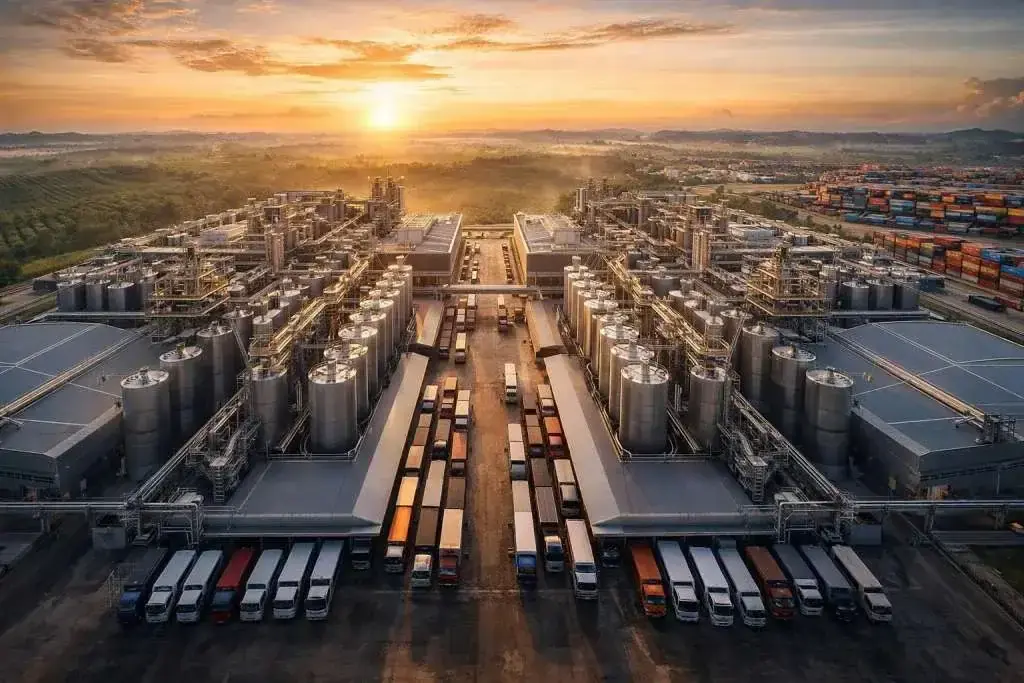
If you look at CCL Products over the last few years, one massive move really stands out. Building that huge new processing plant in Vietnam wasn't just a regular expansion—it's basically the blueprint for their entire next decade. And honestly, it makes total sense when you break it down. Vietnam grows more robusta coffee than anywhere else on earth, and robusta is the absolute backbone of the instant coffee market. By setting up shop right where the beans are grown, CCL slashes its shipping costs and can react almost instantly to local harvest changes. Add in the cheaper workforce and some seriously sweet trade deals—like zero tariffs when shipping to China, which India definitely doesn't have—and the whole project starts looking like a no-brainer.But here's the real kicker, especially now that we're navigating this messy post-2025 trade environment: Vietnam is the ultimate shield against Washington's tariff wars. Remember when the US slapped those massive import taxes across the board? Brazil got hit with a brutal 50% tariff, and India took a 25% hit. Because CCL had this new Vietnamese plant ready to go, they just smoothly shifted a big chunk of their American-bound exports over there, since Vietnam only faces a 20% rate. Most of their competitors are stuck paying the higher taxes, but CCL’s setup gives them this incredible flexibility to basically play matchmaker between their factories and global markets to get the best rates.
Getting this massive facility up and running wasn't cheap or fast. It took years of heavy lifting and a ton of cash. Between the Indian and Vietnamese operations, CCL can now pump out about 77,000 metric tons a year. That’s roughly double what they were doing just a little while ago, with India handling about 40,000 tons and Vietnam taking care of the remaining 36,000 to 37,000. To pay for all this, they took on quite a bit of debt. For a while, you could really see the strain on their balance sheet, with net debt pushing close to INR 2,000 crores.
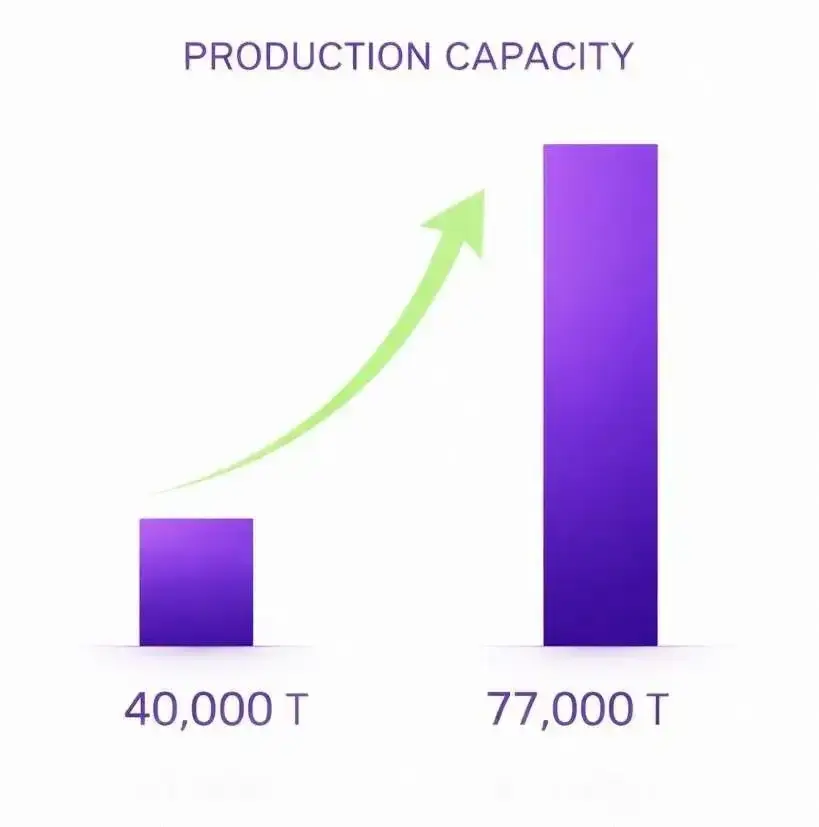
The good news? The heavy spending is finally in the rearview mirror. Management has been shouting from the rooftops throughout 2025 and 2026 that the big capital expenditure phase is officially over. Now, it's all about reaping the rewards. They're currently running at about 65% to 70% capacity across the board. Once that number climbs closer to the 80% or 85% mark—which is usually when companies start thinking about building again—almost all the extra cash from processing those beans will drop straight to their bottom line. We're talking better profit per kilo and some really strong free cash flow.
On top of all that, the Vietnam site has totally leveled up CCL’s game in the premium freeze-dried market. Just a year before their Q3 FY26 earnings, they didn't even have freeze-dried capabilities over there. Now, the new machinery is online and ramping up fast. If you've noticed their profit margins looking remarkably better throughout the FY26 year, this is exactly why. Pushing those higher-end, freeze-dried products out of Vietnam is doing wonders for their overall sales mix and profitability.
The Business Model — Simplicity as a Competitive Moat
One of the most important things to understand about CCL Products — and one of the things that consistently confuses analysts who try to model it like a traditional consumer goods company — is the fundamental simplicity and discipline of its core business model.The company operates almost entirely on what it describes as a "cost-plus" model. It does not speculate on green coffee prices. It does not carry significant unhedged commodity exposure. When a customer places an order, CCL prices the finished product based on the prevailing market price of green coffee at the time of the contract, plus its processing cost and margin. If green coffee prices rise, the selling price rises proportionally. If green coffee prices fall, the selling price falls proportionally.
This model has profound implications for how to analyze the business. The company's revenue figures can be extraordinarily misleading as a measure of underlying performance. If green coffee prices double — as they effectively did during the 2023-2025 period — revenues will look like they are surging, when in fact CCL is simply processing the same volumes at higher prices. Conversely, if green coffee prices fall, revenues will appear to contract even if volumes are growing strongly.
This is why management consistently and emphatically directs investors to focus on two metrics: volume growth and EBITDA growth in absolute terms. The EBITDA per kilogram figure — which management has guided toward the INR 120 to 140 range and which has been improving steadily — is perhaps the single most important indicator of underlying business quality. It captures the true margin the company earns per unit of coffee processed, insulated from the noise of commodity price fluctuations.
If you’re new to evaluating such metrics, check out our Complete Framework on How to Analyze a Mid-Cap Company
As CEO Praveen Jaipuriar explained during the Q1 FY26 earnings call: "The right way is to look at your EBITDA growth numbers. Our EBITDA will grow in line with our volumes. We have given guidance of 15 to 20 percent volume growth and EBITDA growth year-on-year, and that is what we have been maintaining."
This clarity of communication — the willingness to tell investors exactly which metrics matter and exactly why the revenue line can mislead — reflects a management team that is genuinely thinking about long-term business quality rather than short-term optics.
The cost-plus model also creates a kind of natural protection during periods of price volatility. Because the company's margin is essentially locked in at the time of contracting, it is protected from the scenario — devastating for many commodity businesses — where input prices rise faster than the company can pass them through to customers. The risk that remains is not margin compression but volume: when prices are rising sharply and unpredictably, as they were through much of 2023 and 2024, buyers become reluctant to commit to long-term contracts. They prefer shorter-duration agreements that limit their exposure to further price increases. This reduces CCL's forward visibility and can create some lumpiness in volume growth.
But as management has consistently observed, this is ultimately a demand elasticity question, not a structural competitive problem. Coffee consumption at the global level remains robust. Institutional buyers need a reliable supply of quality instant coffee regardless of the commodity price environment. And a processor with the scale, the product range, the certifications, and the track record of CCL Products will continue to win contracts — the question is simply whether those contracts come in three-month or twelve-month tranches.
Financial Performance — The Numbers Tell the Story
The financial performance of CCL Products across the FY2024-25 full year and the first three quarters of FY2025-26 tells a story of accelerating growth driven by volume ramp-up, improved per-unit economics, and the growing contribution of the domestic branded business. The numbers are striking.For the full financial year 2024-25, CCL reported consolidated revenues of INR 3,105.75 crores, up from INR 2,653.70 crores in the prior year — a growth of roughly 17 percent. Net profit on a consolidated basis reached INR 310.34 crores, compared to INR 250.08 crores in the prior year — growth of approximately 24 percent. On a standalone basis (Indian operations only), revenues were INR 1,718 crores and net profit was INR 92.30 crores — reflecting the weight of higher depreciation and interest costs as the new capacity was brought online.
But the more revealing picture emerges from the trajectory through the first three quarters of FY2025-26, covering April through December 2025. The numbers accelerated dramatically quarter after quarter.
CCL delivered a strong FY26 performance, with revenues and profits growing sharply across all three quarters, surpassing its entire FY25 revenue within just nine months.
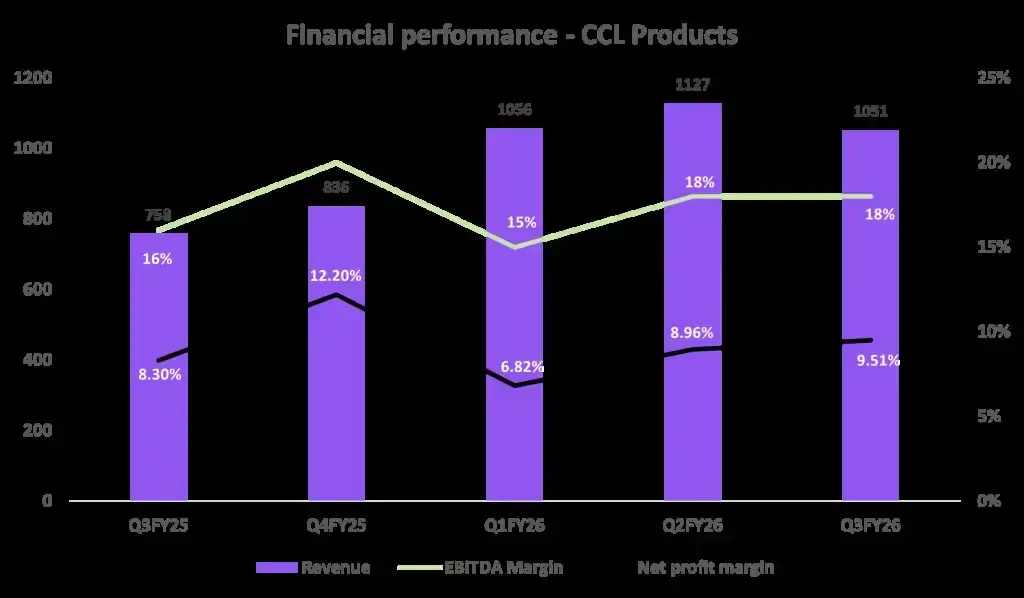
This trajectory prompted management to revise their full-year FY26 EBITDA growth guidance upward to approximately 25 percent — a significant upgrade from the original 15-20 percent guidance range.
The EBITDA per kilogram metric tells an equally compelling story. In Q1 FY26, this figure was approximately INR 125-135. By Q2, it had risen to approximately INR 130-132. By Q3, it had improved further to approximately INR 135-140. This steady improvement reflects the ramp-up of higher-margin freeze-dried capacity in Vietnam, the increasing contribution of the domestic branded business, efficiency gains from better capacity utilization, and the ongoing shift toward higher-value small pack formats.
The Debt Story — A Balance Sheet in Rapid Transformation
CCL Products' balance sheet tells a story of disciplined financial management navigating the consequences of an ambitious growth investment — and the results are ahead of even the company's own schedule.To fund the Vietnam expansion and related capacity additions in India, CCL took on substantial debt. At peak, net debt reached approximately INR 1,974 crores (around December 2024). This was a meaningful leverage ratio relative to the company's EBITDA at the time, and it drew legitimate questions from investors about the pace of deleveraging. The company was transparent about the concern and proactive in laying out its debt reduction roadmap.
What has happened since is impressive. Through a combination of strong operating cash flows, improved working capital management — particularly reduced inventory holding periods and faster receivables collection — and the tailwind of softening green coffee prices (which reduced the working capital required to carry the same volume of inventory), CCL systematically reduced its debt load ahead of each guidance milestone.
Net debt fell sharply to ~₹1,248 crores by Q3 FY26, already near FY26 targets, with strong free cash flow and no major capex supporting continued deleveraging.

The Twin Engines of Growth — Domestic Brand + Global Exports
For most of its history, CCL Products operated quietly as a B2B export powerhouse. But that is now changing. The company is building a second engine of growth — its domestic branded business — while its international export operations continue to scale steadily.On the domestic front, its flagship brand, Continental Coffee, has reached an inflection point. After years of investing in distribution, the brand is now present across 150,000+ retail outlets, supported by over 700 distributors, and has achieved double-digit market share across major e-commerce platforms. In key regions like Andhra Pradesh and Telangana, it has already emerged as the number two player, competing directly with established giants.
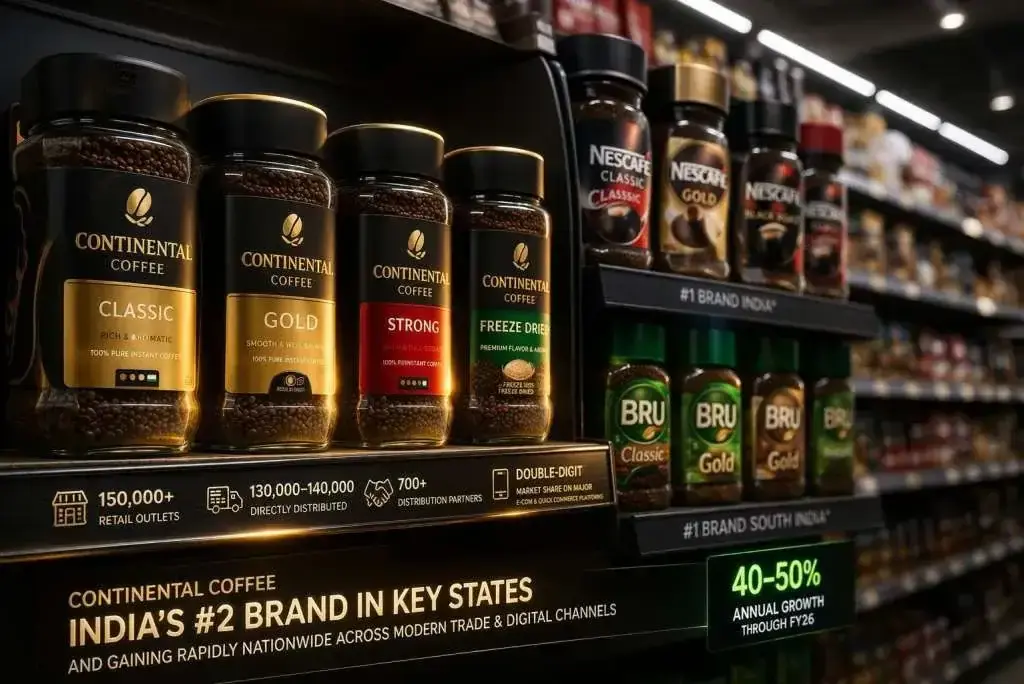
What makes this growth particularly powerful is the operating leverage. The domestic business has crossed its breakeven threshold, meaning incremental revenues now contribute at near-company-level margins. While margins are currently reinvested into brand building, this segment represents a long-term, high-margin opportunity as scale improves.
At the same time, CCL’s core international export business remains the primary earnings driver, spanning over 90 countries across Europe, Asia, and the Americas. The company serves a wide range of clients — from global brands and private label players to institutional buyers — leveraging its scale, quality, and certifications.
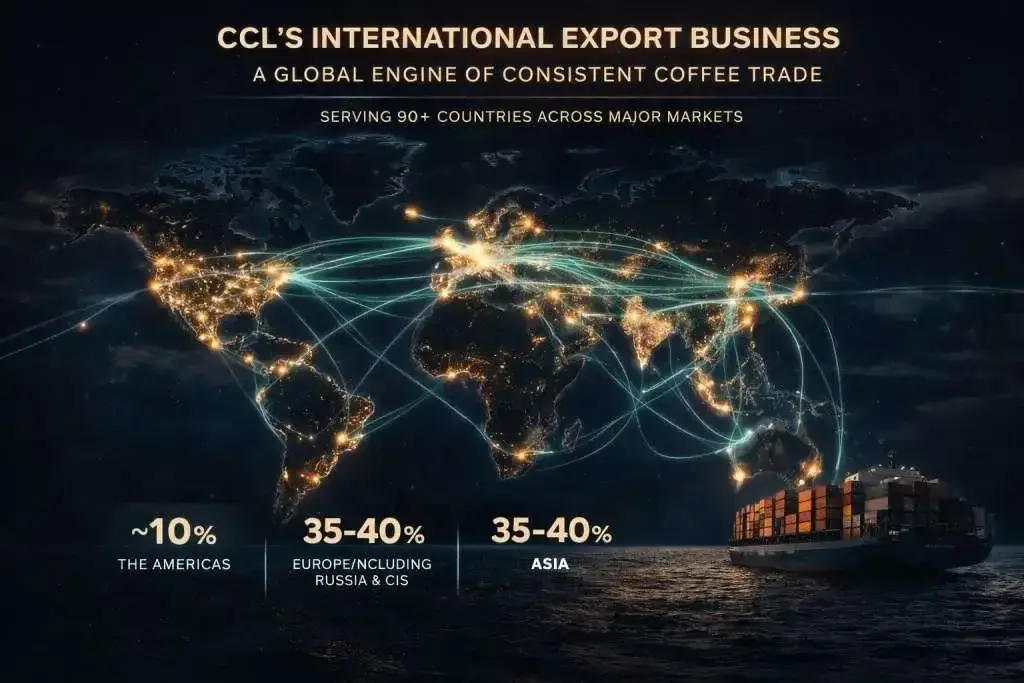
Export volumes have been growing at 15–20%, supported by strong demand and improving contract visibility as coffee prices stabilize. The company is also expanding into newer geographies like Africa and Eastern Europe, while continuously innovating through premium products such as freeze-dried coffee, cold brew formats, and specialty blends.
Together, these two segments create a powerful combination:
- A stable, high-volume global export engine
- A fast-growing, high-margin domestic brand play
This dual-engine model not only diversifies revenue streams but also positions CCL for a structural transition — from a manufacturing-led exporter to a globally integrated FMCG player.
The Green Coffee Price Saga — Navigating the Storm
No analysis of CCL Products would be complete without a serious examination of the green coffee price environment that has dominated the industry over the past two to three years, because the way CCL has navigated this period reveals something important about the quality of its management and the resilience of its business model.Green coffee prices reached historic highs through 2023 and much of 2024, driven by a combination of climate-related supply disruptions (notably in Brazil and Vietnam), speculative demand flows, and geopolitical disruptions that affected shipping routes and supply chain logistics.
Periods like these test investor psychology the most — here’s a guide on how to handle them: How to Stay Emotionally Strong During Market Crash
At times, arabica prices on the ICE futures exchange exceeded $3.50 per pound — levels not seen in decades. Robusta prices similarly surged.

As the CEO observed on the Q1 FY26 call: "If you were to match the supply and the demand trend for the last 25, 30 years, you will see that the difference sometimes is not more than 4 to 5 percent, but the speculation and the market spiral kind of make the coffee prices go up by 40, 50 percent." Coffee, being the second most traded commodity after oil, attracts significant speculative interest that can amplify supply-demand mismatches into price spirals far larger than the underlying fundamentals would justify.
For coffee processors, high and volatile prices create a specific set of challenges. Working capital requirements expand dramatically — processing the same volume of coffee at twice the raw material cost requires twice the cash tied up in inventory. Buyers become reluctant to commit to long-term contracts, preferring short-term agreements that limit their exposure to further price increases. And some buyers reduce order volumes altogether.
CCL experienced all of these pressures. Its debt levels rose partly because of expanded working capital requirements. Volume growth slowed from the target range of 15-20 percent to something closer to 10-15 percent in certain quarters. The guidance range for volume growth was temporarily broadened to 10-20 percent, reflecting uncertainty.
What CCL did not experience, however, was margin compression on a per-kilogram basis. This is the critical distinction, and it validates the cost-plus business model. While competitors who tried to hold prices while commodity costs rose were being squeezed, CCL simply passed costs through. Its EBITDA per kilogram remained stable and actually improved through this period as efficiencies kicked in and the product mix shifted toward higher-margin freeze-dried formats.
By Q3 FY26 (the quarter ending December 2025), management was cautiously optimistic that the worst of the price volatility was behind them. Green coffee prices had moderated significantly from their peaks. The Brazil crop (which flows from October onwards) was tracking well. The Vietnamese crop, which matures for harvest in the November-December period, was showing promising signs. The CEO indicated that the pricing environment looked "far more stable" than it had a year earlier, and that long-term contracts were beginning to flow back into the order book — a reliable leading indicator of improving buyer confidence.
The demand side remained robust throughout. As management pointed out: in most commodities, price spikes reduce demand, which eventually brings prices back to equilibrium. In coffee, demand has historically been far more resilient than in other commodities, because coffee is a deeply habitual product consumed by billions of people who adjust their purchasing behavior slowly, if at all, in response to price changes. This demand resilience means that supply fluctuations, rather than demand destruction, are the primary driver of coffee price volatility — and it means that when supply normalizes, demand is still there waiting.
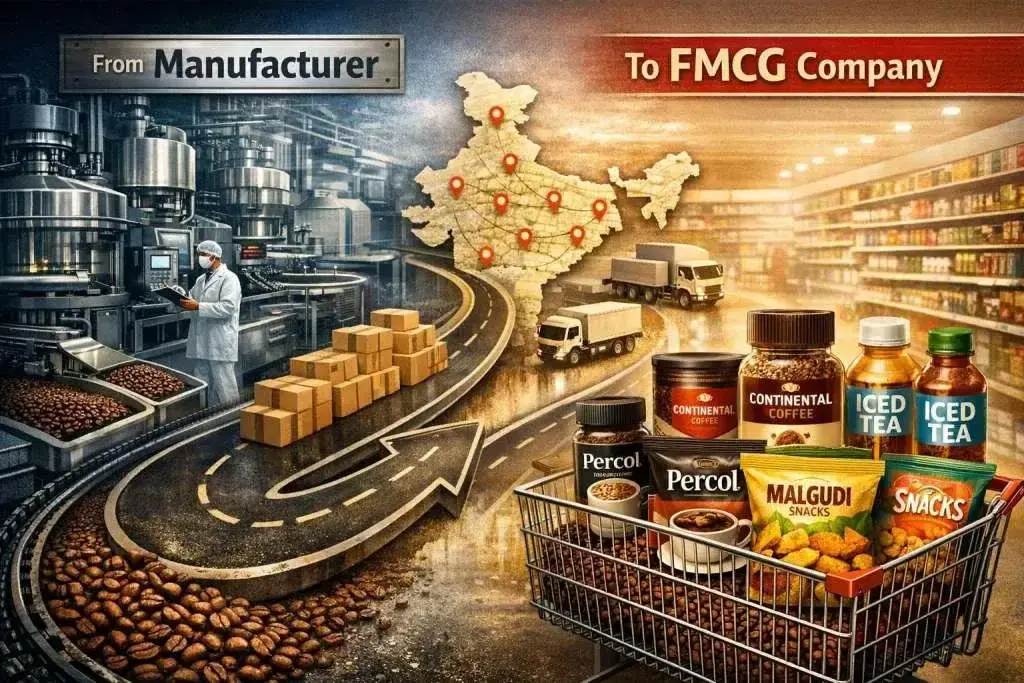
The Long-Term Strategic Vision — From Manufacturer to FMCG Company
Perhaps the most interesting dimension of CCL Products' story is not what it has already achieved but where it is explicitly trying to go: a full transformation from a manufacturing-oriented exporter to a multi-category fast-moving consumer goods company with its own portfolio of consumer brands.The logic of this ambition is rooted in a fundamental insight about distribution economics. The company has been building a physical retail distribution network in India for six or seven years — at a time when most consumer companies were pivoting toward direct-to-consumer digital strategies. By going the other direction, CCL built something that is genuinely scarce and valuable: a network of over 130,000-140,000 directly-served retail outlets across India, supported by more than 700 distribution partners.
This network, built and financed by the coffee business, is now available to carry additional product categories. And additional categories are urgently needed, because the economics of retail distribution improve significantly as more products flow through the same distribution infrastructure. As the CEO explained, "Every additional outlet you go to, the throughput has to match the cost of going to that outlet. So, unless and until we add to our portfolio, this may not be feasible." More products justify more outlets; more outlets justify more products. The flywheel logic is clear.
CCL is actively experimenting with several adjacent categories. In the institutional segment, it has begun supplying tea through its vending business — a natural extension, since vending machines that serve coffee also typically serve tea. For consumers, it has launched iced tea products targeting the growing ready-to-drink beverage segment. And most intriguingly, the company has conducted a small "nano test launch" of traditional snacks under the brand name Malgudi — a name that carries strong cultural resonance with its target South Indian consumer base.
One category experiment that CCL walked away from is equally instructive: plant-based meat. The CEO disclosed in the Q3 FY26 call that CCL had been exploring this category, conducted market testing, and then made the decision to exit quickly. "The whole category is almost on a shutdown basis," he noted, explaining that the company didn't want to incur further losses in a category that was not evolving positively. "We quickly cut down on the losses, and we stopped that category." This willingness to make fast, unsentimental exit decisions from failing experiments is a hallmark of disciplined capital allocation.
The approach to category expansion throughout is deliberately cautious. Management has repeatedly emphasized test marketing, market validation, and scaling only when evidence of consumer acceptance is strong. The CEO described CCL as a company that does not "do market bombing" — it seeds the market carefully, refines the product and pricing mix, and expands incrementally. This is the same methodology that produced Continental Coffee's market share gains against multinational giants, and there is every reason to believe it will be applied consistently to adjacent categories.
The UK acquisition — specifically the Percol brand — provides the international dimension of the branded strategy. Percol serves the Western premium coffee consumer, including in markets where the Percol name has legacy recognition. The brand is growing at expected rates of 30-40 percent, adding new retail accounts steadily despite operating in a highly competitive, brand-conscious market. The ambition to use Percol as a platform for European market entry — seeding the brand in multiple European countries using the UK as a launch market — adds a further dimension to CCL's long-term brand portfolio strategy.
Capacity Utilization and the Path to the Next Expansion Cycle
One of the most important forward-looking questions about CCL Products concerns the pace at which its newly expanded capacity will be absorbed, and what the implications are for financial performance as utilization rises.Currently, blended capacity utilization (combining India and Vietnam) is running at approximately 65-70 percent. The existing, pre-expansion capacity is essentially fully utilized. The new capacity — roughly 35,000 metric tons across both locations — is running at approximately 15-25 percent utilization. As volumes grow, each percentage point of additional utilization on the new capacity falls largely to the bottom line as improved profitability per kilogram, since the fixed costs associated with that capacity are already being absorbed.
Management has guided that at the current volume growth trajectory of 15-20 percent annually, CCL would reach approximately 80-85 percent blended capacity utilization within two years. At that point, conversations about the next expansion cycle would begin. The company has indicated flexibility in how it might address future capacity needs: organic expansion at existing sites, acquisition of capacity through strategic partnerships, or other structures. As the CEO put it: "As we have always maintained, there could be many ways we could source capacity — either we build, or we buy. So we will take a call maybe 2 years or 3 years down the line."
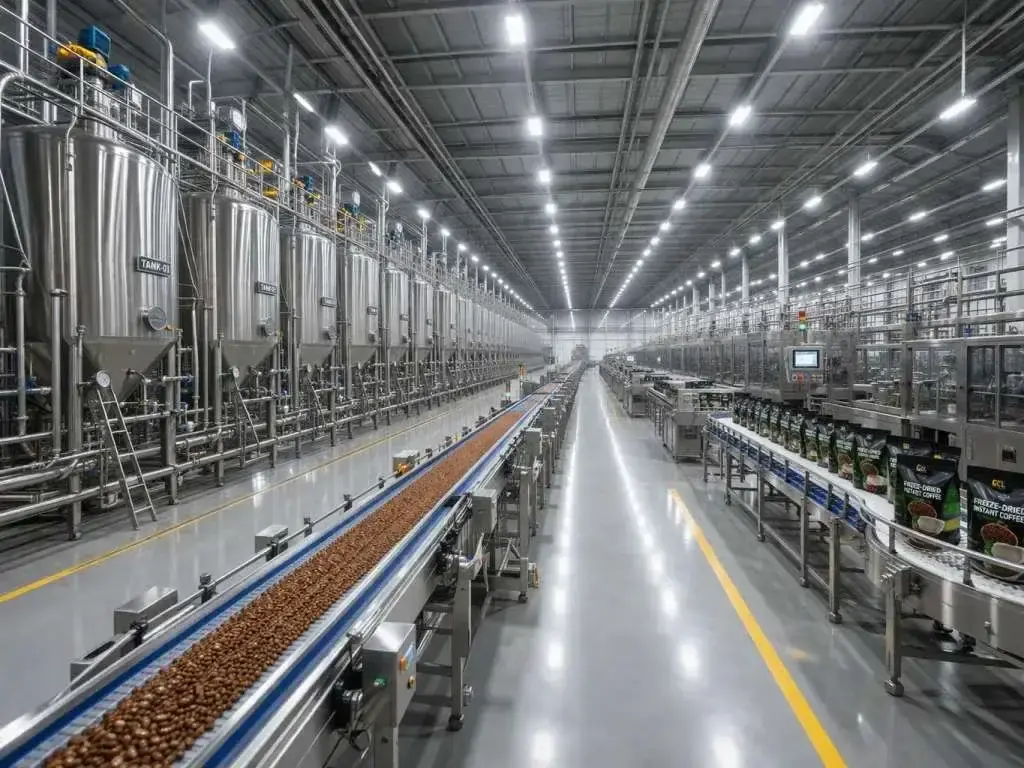
The small pack capacity deserves specific mention. Demand for small pack formats — sachets, single-serve packets, and small pouches — is growing strongly, particularly in markets like Africa and India where unit-price affordability is critical. CCL has an aggregate small pack capacity of 12,000-14,000 metric tons per year. Management disclosed in the Q3 FY26 call that they are already running out of capacity in the smallest pack formats (sticks and sachets) and are planning to expand this in the near future. The investment required is relatively modest — the facilities are designed for easy capacity addition simply by adding machines — and the demand signal is clear.
Glass jars and cans, by contrast, are currently at 50-60 percent utilization — meaning there is adequate headroom in those formats for volumes to grow before additional investment is needed.
The EBITDA per kilogram improvement trajectory as utilization rises is particularly attractive. At the current blended utilization of 65-70 percent, CCL is generating EBITDA per kilogram in the INR 135-140 range. As the new freeze-dried capacity in Vietnam ramps toward higher utilization, as the domestic branded business continues to scale beyond its breakeven, and as the fixed cost base is spread across a larger volume base, this metric should continue its upward trajectory. Management has been careful not to commit to specific forward targets for EBITDA per kilogram, but the directional guidance is clearly upward.
Risks and Their Real-World Dimensions
No investment thesis is complete without a clear-eyed assessment of the risks, and CCL Products faces several that are both material and worth understanding in depth.The most significant ongoing risk is green coffee price volatility. Despite the cost-plus model's protection of per-kilogram margins, sustained periods of extreme price volatility reduce buyer willingness to commit to long-term contracts, can reduce total demand volumes at the margin, and increase working capital requirements. The 2023-2025 period demonstrated that even a well-structured business can face volume growth headwinds and balance sheet pressure when commodity prices are truly extreme and persistent. A return to those conditions — triggered by climate events in key producing regions, speculative excess in coffee futures markets, or supply disruptions from geopolitical developments — would create near-term challenges even for this resilient business model.

Climate sensitivity extends beyond price to supply availability. CCL's sourcing from multiple regions provides meaningful diversification, but a sufficiently severe climate event affecting multiple producing regions simultaneously — or a structural shift in coffee-growing conditions due to long-term climate change — could test even a well-diversified sourcing strategy. The company is aware of this risk and has invested in agronomy relationships and alternative origin development, but no sourcing strategy can fully eliminate climate exposure in an agricultural commodity.
Intensified competition in the outsourced coffee manufacturing space is a real and growing concern. As global capacity builds up — including new investments in major producing countries like Brazil and Vietnam — the competitive pressure on processing margins could intensify over time. CCL's response — moving up the value chain toward premium freeze-dried formats, small packs, and specialty products — is the right strategic answer, but it requires sustained execution and continued product innovation to maintain its edge.
The domestic branded business, while exciting in its growth trajectory, faces the challenge of building genuine brand equity against entrenched and well-resourced competitors. The market share gains in modern trade and e-commerce are impressive, but converting those gains into lasting brand loyalty in the general trade channel — where most of India's coffee volume still sells — will require sustained and expensive brand investment for years to come. There is always the risk that a multinational competitor decides to invest more aggressively in response to CCL's gains, particularly in the southern markets where Continental Coffee has made its most significant inroads.
Currency risk exists given the significant gap between export revenues (largely USD or EUR denominated) and domestic cost base (INR denominated). Management has indicated the business is largely naturally hedged through import costs, also being primarily in foreign currency, and the CFO has confirmed this hedging is not material to call out every quarter. However, a sharp appreciation of INR could create some margin pressure, particularly in the domestic branded business where revenues are rupee-denominated but some input costs track international prices.
Finally, the tariff environment remains fluid. While CCL's dual-country manufacturing footprint provides meaningful protection against tariff-induced competitive disadvantage, further escalation of trade tensions — or a shift in U.S. tariff policy that disadvantages Vietnam more severely — could create challenges that cannot be fully offset through supply chain repositioning.
To balance such sector-specific risks, read: Portfolio Diversification – How Many Stocks Should You Hold?
Explore our Products
Research Framework

Emerging Titans
Combination of quantitative analysis, industry tailwinds, and management assessment - SPRINT investment philosophy

Tiny Titans
Heavy emphasis on scuttlebutt research, plant visits, and early on-ground signals
Conclusion: Why This Story Matters Beyond the Balance Sheet
The story of CCL Products is, at its core, a story about the possibilities of Indian manufacturing when it is combined with technical depth, long-term thinking, and the willingness to compete globally rather than sheltering behind domestic market protection.This is a company that had no natural advantages of geography (its raw material grows primarily in Brazil and Vietnam, not in India), no built-in advantage of domestic demand (instant coffee culture in India was underdeveloped when the company was founded), and no technological head start (the spray-drying and freeze-drying processes it uses were established technologies with global competitors already at scale). What it had was a founding family with a clear vision, the patience to build capabilities over decades rather than quarters, and the operational discipline to turn those capabilities into genuine competitive advantages.
The result is a company that supplies instant coffee to institutional and branded buyers in over 90 countries, that has built a domestic consumer brand challenging the world's largest food and beverage companies on their own turf, that has built manufacturing facilities in Vietnam to complement its Indian operations, and that has delivered consistent earnings growth while navigating one of the most volatile commodity environments in the history of its industry.
It is a story about the kind of slow, patient, disciplined compounding that tends to produce extraordinary long-term results — not the explosive, headline-grabbing growth of a technology startup, but the steady, resilient, year-after-year progress of a business that has found its place in the global economy and continues to deepen its moat.
If you want to understand how businesses like this turn into long-term wealth creators, read our guide on: The Multibagger Framework: A Step-by-Step Guide to Finding 10x Stocks
The coffee market will continue to evolve. Green coffee prices will rise and fall. Trade policies will shift. Consumer tastes will diversify. New competitors will emerge. But a company that has spent three decades learning how to process coffee better, cheaper, and more sustainably than almost anyone else in the world — and that has built the operational infrastructure, the customer relationships, the brand equity, and the financial resilience to weather multiple industry cycles — is well positioned to continue compounding value for its owners for decades to come.
That, ultimately, is the CCL Products story: a humble beginning in Guntur, a cup of instant coffee on a supermarket shelf in Hamburg or Minneapolis or Jakarta, and thirty-plus years of unglamorous, meticulous excellence connecting the two.
If this analysis added value, comment “COMPOUNDER” and share your take on CCL’s long-term potential.
Frequently Asked Questions (FAQs)
What makes CCL Products’ business model resilient during commodity price volatility?
+CCL operates on a cost-plus model, which allows it to pass on fluctuations in green coffee prices to its customers. This ensures that its per-unit margins remain stable, even when raw material prices are highly volatile
Why is the Vietnam expansion considered a strategic advantage?
+Vietnam is the world’s largest producer of robusta coffee, the primary input for instant coffee. By manufacturing close to the source, CCL benefits from lower logistics costs, faster sourcing, and favorable trade agreements, enhancing both efficiency and competitiveness
How is CCL transitioning from a B2B manufacturer to an FMCG company?
+CCL is leveraging its extensive retail distribution network (130,000+ outlets) to scale its branded products like Continental Coffee and expand into adjacent categories such as iced tea and snacks, gradually building a consumer-facing portfolio
What role does the domestic branded business play in CCL’s future growth?
+The domestic segment represents a high-growth, margin-accretive opportunity. After crossing breakeven, incremental revenues contribute significantly to profits, making it a key driver of long-term value creation
How has CCL managed its debt after significant capital expenditure?
+Following its expansion phase, CCL has focused on strong cash flow generation and working capital efficiency, reducing its net debt significantly and ahead of guidance, signaling disciplined financial management
What are the key risks investors should be aware of?
+Major risks include volatility in green coffee prices, execution risks in scaling the FMCG business, and competition from established global brands. However, CCL’s diversified model and operational flexibility help mitigate these challenges

High growth stock specialist, Value Educator
Shashank Mahajan is an equity research professional with over 12 years of experience in identifying high-potential SME and micro-cap stocks at an early stage. He follows a rigorous scuttlebutt research–driven approach, combining on-ground insights with deep financial analysis. Shashank specializes in uncovering under-researched and under-owned companies with strong management quality and long-term growth potential. Through disciplined research and early identification, he focuses on spotting tomorrow’s market leaders before they enter the mainstream investor radar.

Glenmark: The USD 700 Mn Cancer Deal and Its Brands

Pharma Stocks in India 2026: Generics, APIs and CDMOs

Granules India: From Paracetamol to a 65% Gross Margin

Natco Pharma: After Revlimid, 29 Patent Challenges

Shilpa Medicare: Cancer APIs, Films and Biosimilars

Alembic Pharma: US Plants Pay Back, Margin Hits 22.2%
Explore our Products
Research Framework
Emerging Titans
Combination of quantitative analysis, industry tailwinds, and management assessment - SPRINT investment philosophy
Tiny Titans
Heavy emphasis on scuttlebutt research, plant visits, and early on-ground signals



Modern Warfare to Multibaggers
Key Trends. Strategic Shifts. Opportunities Ahead.
Today at 7:00 PM IST. Room opens 30 minutes before.
Don't Miss This Exclusive Webinar!
Join Value Educator to decode the key trends shaping India's defence sector and learn how to identify tomorrow's potential leaders in the space.
- In-depth research on India's defence sector
- Live Q&A session
- Actionable takeaways for long-term investors

 Orders
 Subscription
 Share with friends


Required Details
₹23999.00
(12 month subscription)
As per SEBI regulations, all users are mandated to complete the KYC that is validated for 1 year. Post payment, you will be redirected to the KYC screen


No comments yet. Be the first to comment!