
Stocks With Steady Promoter Holding (5+ Yrs)

"While most investors are busy chasing the next 'hot tip' from a WhatsApp group, the wealthiest owners are doing something much quieter: absolutely nothing. For over five years, they haven't sold a single share. They aren't just 'holding' a stock, they're protecting a legacy. Why are the people who know the business best refusing to leave? Here is the 'silent signal' that separates a market gamble from a generational wealth builder."
When an investor sees high promoter holding, they aren't just looking at a number; they are looking at the ultimate vote of confidence. As you've noted, when the "insiders" who know every detail of the business refuse to sell, it’s a powerful signal.
"If you don't know the jewelry, know the jeweler." — Warren Buffett

Think about it, why are the people who know the business best, the ones who see the real numbers before anyone else, refusing to leave? That is the "silent signal." It’s the difference between a retail gamble and building generational wealth. As the saying goes, "Writing a check separates a commitment from a conversation." When a promoter keeps their skin in the game year after year, they aren't just managing a company; they are betting their own net worth on their own conviction.
In a market obsessed with "quick exits," finding a founder who refuses to blink for half a decade is like finding a lighthouse in a storm. Here is the elite list of stocks where the promoters haven’t touched their stake in over five years and why their refusal to sell is the most profitable hint you’ll ever get.
"Understanding why the 'jeweler' stays is the first step, but seeing it in action is where the profit lies. Let’s look at a company that moved from a local workshop to a global energy powerhouse without the founders ever flinching, starting with the transformer titan, Shilchar Technologies."
Read More: Why Promoter Buying is the Strongest Signal in Stock Markets.
1. Shilchar Technologies (SHILCTECH)
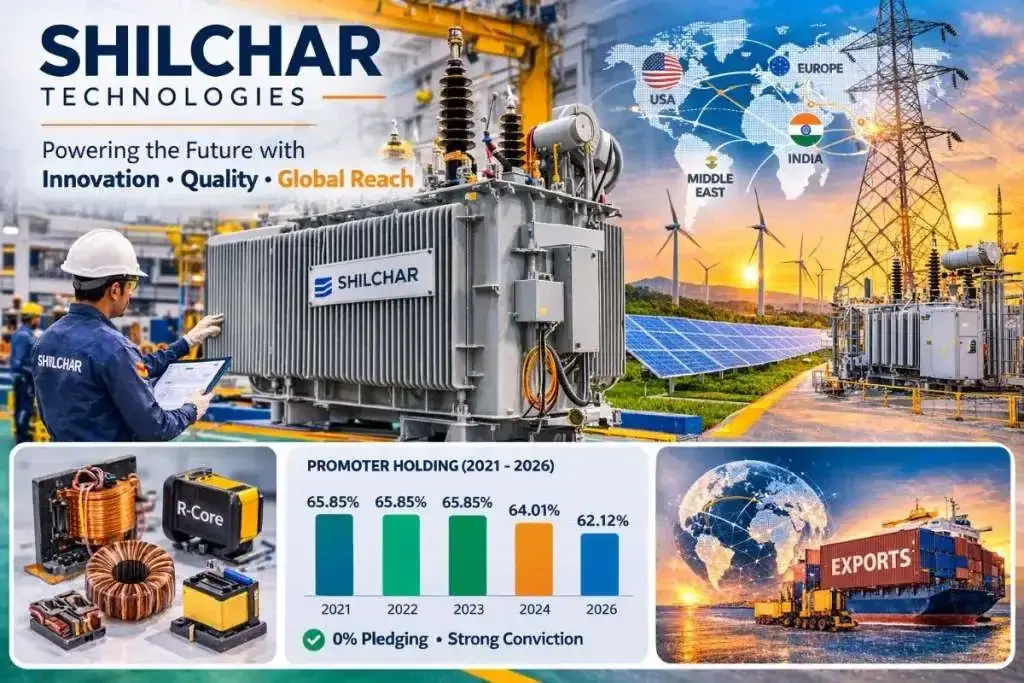
Shilchar Technologies is a classic case of a company that started as a small transformer shop and quietly evolved into a high-efficiency powerhouse. They’ve moved past just making generic electrical parts; instead, they’ve planted themselves right at the center of the global shift toward green energy. Here’s a breakdown of what’s actually making their business model work so well.

1. Sector & Industry: Riding the Green Wave
Sector: Industrials / Capital Goods.Industry: Electrical Equipment (Power & Distribution Transformers).
The Niche: What’s impressive here is their focus. Instead of fighting for crumbs in the crowded mass market, Shilchar has dominated the special-purpose transformer space. They are the "go-to" players for the renewable energy sector, specifically for solar and wind power projects that require very specific technical standards.
2. Business Model: Quality Over Quantity
Shilchar doesn't do "off-the-shelf." They operate as a specialist manufacturer, which means they build customized solutions that high-end clients actually need. Their portfolio is split into two high-value buckets:
Power & Distribution Transformers: This is their bread and butter. They build massive units (up to 50 MVA, 132 KV Class) that are essential for stepping down high-voltage electricity so it can actually be used by factories and utilities.
Electronics & Telecom Transformers: They were early movers in R-Core transformers. If you aren't a tech geek, all you need to know is that these are smaller, lighter, and far more efficient than the traditional bulky ones you see elsewhere.
The "Export-First" Strategy: One of the strongest parts of their story is their global reach. They aren't just dependent on the Indian market; they pull about 40-50% of their revenue from exports to the USA, the Middle East, and Europe. This gives them a great hedge against domestic slowdowns and lets them earn in stronger currencies.
3. The "Silent Signal": 5-Year Promoter Holding Analysis
Promoters who hold their stake through market cycles signal deep confidence in the company’s future value. If you track the data from 2021 to 2026, the consistency is striking:

Zero Pledging: This is a huge health marker. A 0.00% pledge means the promoters haven't borrowed a single rupee against their shares. They aren't using their ownership to fund a personal lifestyle or take on side debts, which keeps the stock safe from "forced selling" if the market gets shaky.
Skin in the Game: With a ~62% stake, the Shah family’s personal wealth is literally tied to the stock price. They aren't just professional managers collecting a paycheck; they are owners who feel the pain of a dip and the joy of a rally exactly like you do.
"Shilchar shows us how stability fuels industrial growth, but what happens when you combine that same founder conviction with high-stakes national security? Next, we’re diving into the 'Deep Tech' vault of a company that has become the invisible backbone of the Indian Navy and ISRO: Avantel Ltd."
Read More: Yash Highvoltage: Bushing Maker With ₹760 Cr of Orders
2. Avantel Ltd: The "Deep Tech" Sentinel of Indian Defense
While most of the market is busy chasing flashy consumer apps, Avantel Ltd is quietly operating in the high-stakes world of strategic electronics and satellite communication (Satcom). If you’re tracking the "Silent Signal," Avantel is a mirror image of Shilchar, showing massive promoter commitment in a sector that is currently seeing huge tailwinds from the government's push for self-reliance.
1. Sector & Industry: The Backbone of "Atmanirbhar" Defense
Sector: Telecommunications / Defense Electronics.
The Focus: They aren't making regular phones or routers. Avantel is a specialized player in Satellite Communication, high-frequency radios, and complex network management systems.
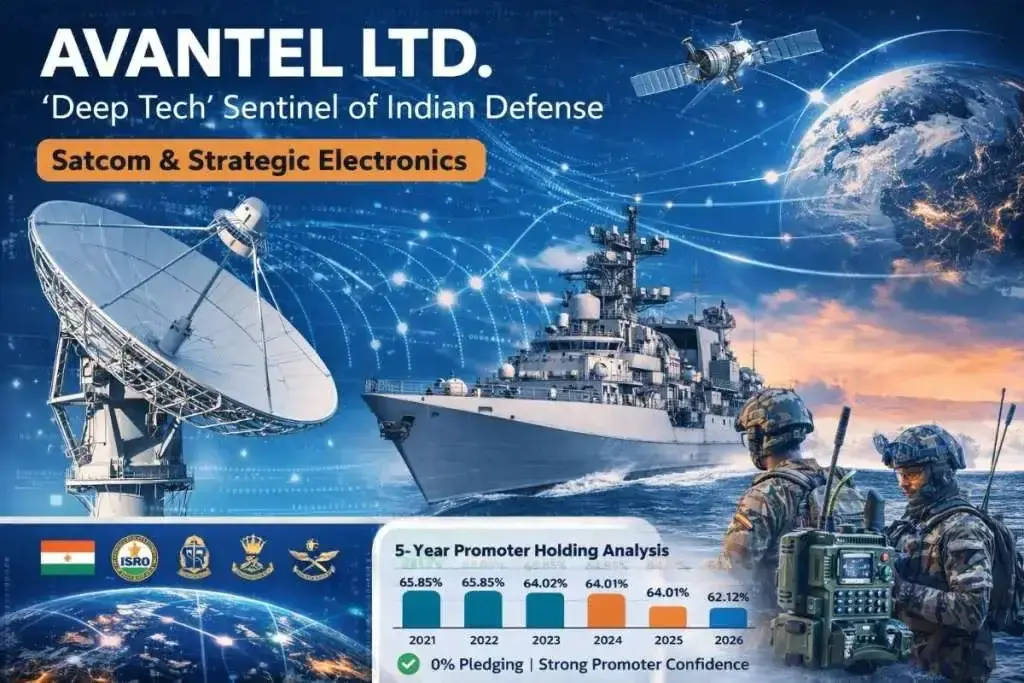
The Client List: Their order book looks like a "Who’s Who" of Indian defense. We’re talking about the Indian Navy, Army, Air Force, and ISRO. When your customer is the military, the barrier to entry is incredibly high. Once you’re in, you have a massive "moat."
2. Business Model & Product Portfolio (Avantel Ltd)
Avantel isn't just an assembly line; they are a high-tech engineering firm. They focus on indigenous solutions, meaning they own the Intellectual Property (IP). They don't compete in mass-market electronics where margins are thin. Instead, they play where the entry barriers are high, and the tech is "mission critical."
Their portfolio falls into three heavy-hitting segments:
Satellite Communication (Satcom): This is the heart of the company. They build sophisticated S-band and Ka-band terminals and antennas. These are the "ears and mouths" for our Navy ships and submarines, allowing them to stay connected in the middle of the ocean via satellite.
Software Defined Radios (SDR): Avantel is a pioneer here. Unlike old-school radios, SDRs are "future-proof" because you can upgrade them via software without changing the hardware. It gives the Armed Forces jam-resistant, secure communication that is vital for modern warfare.
Strategic Signal Solutions (Railways & Radar): They’ve smartly pivoted their satellite tech into civilian use, too. If you’ve heard of the Real-time Train Information System (RTIS) that tracks thousands of locomotives for Indian Railways, that’s Avantel. They also build specialized radar subsystems for weather monitoring.
3. The "Silent Signal": 5-Year Promoter Holding Analysis (Avantel Ltd)
Promoters who maintain their stake while a company scales from a small-cap player to a strategic defense partner signal immense confidence. For Avantel Ltd, the holding pattern reflects a "hands-on" leadership that has stayed remarkably steady throughout the recent defense sector boom.

Zero Pledging: This is one of the most critical health markers you can look for. A 0.00% pledge means the promoters aren't using their shares as collateral for personal loans. This is huge because it insulates the stock from "forced selling." If the market gets volatile, there’s no risk of a lender dumping their shares due to a margin call, a common trap that kills many small-cap stocks.
Skin in the Game: By holding ~62%, the Prasad family’s personal net worth is directly tied to the company’s success. They aren't just salaried managers watching a clock; they are owners whose wealth moves in lockstep with yours. When the people with the most "inside" knowledge refuse to sell, it’s the ultimate signal that they believe the real growth is still ahead.
"If Avantel is the sentinel of our skies and seas, our next pick is the master of specialized global niches. Beyond defense and power, there is a world of 'technical textiles' where the promoters are actually increasing their bet while the rest of the market sleeps. Let's look at the quiet dominance of Garware Technical Fibres."
Read More: Defence Stocks in India 2026: List by Segment and Order Book
3. Garware Technical Fibres Ltd: The "Technical Textile" Titan
Most people think of shirts and curtains when they hear "textiles," but Garware Technical Fibres (GTFL) is playing a completely different game. They operate in the high-precision world of technical polymers and specialized engineering. For those of us tracking the "Silent Signal," GTFL is a standout business where the founders have kept a tight grip on ownership while the company rides massive global waves in aquaculture and infrastructure.
1. Sector & Industry: Engineering Beyond Fabric
Sector: Technical Textiles / Specialty Polymers.
The Focus: GTFL doesn't make fashion; they make solutions. They are a global leader in high-performance ropes, aquaculture cage nets, and "geosynthetics."
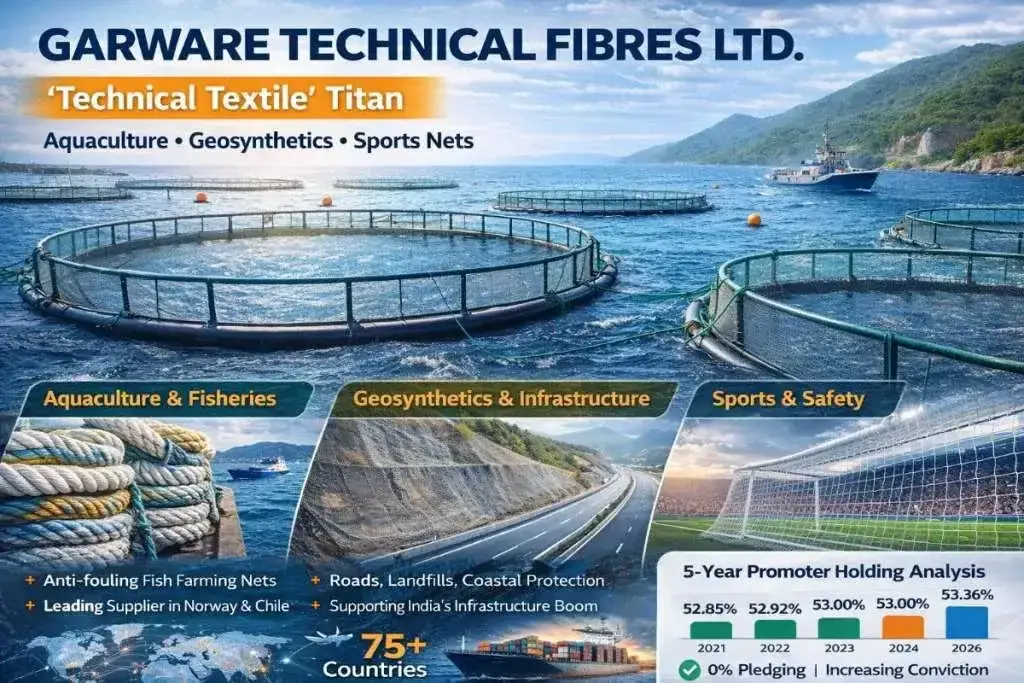
The Reach: This isn't just a domestic story. They have a presence in over 75 countries. Their products are literally mission-critical for the salmon farming industries in Norway and Chile, international sports stadiums, and massive highway projects across India.
2. Business Model: A Moat Built on Patents
GTFL is less of a textile mill and more of an innovation-first engineering firm. They hold over 29 patents and manage a massive catalog of 20,000+ SKUs. They intentionally play in high-entry-barrier niches where their technical Intellectual Property (IP) acts as a shield against competition.
Their business is anchored by three powerful segments:
Aquaculture & Fisheries: This is their biggest revenue engine. They make specialized "anti-fouling" nets that help large-scale fish farms operate efficiently. Their 2025 acquisition of Norway’s OTS (Offshore & Trawl Supply) was a masterstroke, basically handing them dominance over the North Atlantic market.
Geosynthetics & Infrastructure: This is their high-growth bet on India’s infrastructure boom. If you see a road project in the Himalayas using "slope stabilization" tech or a landfill being lined to prevent waste leakage, there’s a good chance Garware’s tech is at work.
Sports & Safety: From tennis nets at global tournaments to high-tenacity safety nets at massive construction sites, they dominate wherever "strength-to-weight" ratios aren't just a preference, but a non-negotiable requirement.
3. The "Silent Signal": 5-Year Promoter Holding Analysis
Promoters who maintain their stake while a company evolves from a domestic rope maker to a global technical textile powerhouse signal immense confidence. For GTFL, the ownership reflects a "long view" strategy by the Garware family.

Zero Pledging: One of the most critical health markers is that 0.00% of these shares are pledged. The promoters are not leveraging their stake for personal debt, ensuring the stock remains insulated from margin-call volatility.
Skin in the Game: By holding ~53%, the Garware family’s net worth is directly tied to the company's performance. They are owners who have consistently navigated cyclical global demands while keeping the balance sheet virtually debt-free.
"We’ve seen the names, the sectors, and the unwavering numbers that define these three giants. But what does this mean for your specific portfolio strategy? Let’s wrap this up by distilling these 'silent signals' into a clear roadmap for your own wealth-building journey."
Read More: How to Analyze a Mid-Cap Company: Complete Framework
Explore our Products
Research Framework

Emerging Titans
Combination of quantitative analysis, industry tailwinds, and management assessment - SPRINT investment philosophy

Tiny Titans
Heavy emphasis on scuttlebutt research, plant visits, and early on-ground signals
Conclusion
At the end of the day, the data from Shilchar, Avantel, and Garware proves that the most powerful move a promoter can make is often... nothing at all. In a world of high-frequency trading and "quick exits," these families have chosen to double down on their own vision for over half a decade.
When you find a company where the promoters haven’t pledged a single share and have kept their skin in the game through every market dip, you’ve found more than just a stock. You’ve found a partnership with owners who are betting their own net worth right alongside yours.
The lesson for us is simple: If the people with the most "inside" knowledge aren't selling, why should you? Look for the lighthouses, ignore the noise, and invest where the commitment is as real as the capital.
Like this, subscribe for more practical insights, and comment “WEALTH” below with your own experiences or questions!
Read More: A fundamental checklist: How to research a stock in 1 hour
Investor FAQs & Screening Tips
Why is "Zero Pledging" just as important as high promoter holding?
+Answer: High ownership doesn't mean much if those shares are being used as collateral for personal loans. If a promoter pledges their shares and the stock price drops, lenders can sell those shares forcibly, causing a "margin call" crash. Zero pledging means the promoter is financially stable and isn't gambling with the company’s ownership.
Is a small decrease in promoter holding (like 1–2%) a red flag?
+Answer: Not necessarily. Small dips often happen due to corporate actions like a bonus issue, an Employee Stock Option Plan (ESOP) dilution, or a small market sale for personal liquidity. The key is to look at the trend over 3–5 years. If the holding remains above 50% and the promoter isn't consistently dumping shares, the "conviction" remains intact.
What is the "Sweet Spot" percentage for promoter holdings in India?
+Answer: While more is generally better, the ideal range is often between 50% and 75%. Below 50%, the promoter might lose control; above 75%, SEBI rules usually require them to dilute to ensure enough shares are available for the public. A consistent holding in the 60% range, as we see in Avantel or Shilchar, is a perfect balance of control and liquidity.
Can a company be a good investment if it has low promoter holding?
+Answer: Yes, but the business model must be different. Some "professionally managed" companies (like L&T or ITC) have zero promoter holding but are run by highly competent boards. However, for mid-cap and small-cap companies, having a founder with "skin in the game" is usually a safer bet for retail investors.
How can I screen for these stocks myself?
+You can use tools like Screener.in or Ticker with these specific filters:
Promoter Holding > 50%
Pledged percentage = 0
Promoter holding 3-years ago > 50% (to check for consistency)
Debt to Equity < 0.5 (to ensure the company isn't over-leveraged)

High growth stock specialist, Value Educator
Shashank Mahajan is an equity research professional with over 12 years of experience in identifying high-potential SME and micro-cap stocks at an early stage. He follows a rigorous scuttlebutt research–driven approach, combining on-ground insights with deep financial analysis. Shashank specializes in uncovering under-researched and under-owned companies with strong management quality and long-term growth potential. Through disciplined research and early identification, he focuses on spotting tomorrow’s market leaders before they enter the mainstream investor radar.

Glenmark: The USD 700 Mn Cancer Deal and Its Brands

Pharma Stocks in India 2026: Generics, APIs and CDMOs

Granules India: From Paracetamol to a 65% Gross Margin

Natco Pharma: After Revlimid, 29 Patent Challenges

Shilpa Medicare: Cancer APIs, Films and Biosimilars

Alembic Pharma: US Plants Pay Back, Margin Hits 22.2%
Explore our Products
Research Framework
Emerging Titans
Combination of quantitative analysis, industry tailwinds, and management assessment - SPRINT investment philosophy
Tiny Titans
Heavy emphasis on scuttlebutt research, plant visits, and early on-ground signals



India's Aerospace Opportunity
Global Demand. Supply Bottlenecks. Opportunities Ahead.
Don't Miss This Exclusive Webinar!
Join Value Educator to decode the key trends shaping India's aerospace sector and learn how to identify tomorrow's potential leaders in the space.
- How the aircraft value chain works, layer by layer
- Indian companies supplying global aircraft makers
- A framework to judge any aerospace company

 Orders
 Subscription
 Share with friends


Required Details
₹23999.00
(12 month subscription)
As per SEBI regulations, all users are mandated to complete the KYC that is validated for 1 year. Post payment, you will be redirected to the KYC screen


No comments yet. Be the first to comment!