
Strong Stocks Under ₹100
In the Indian stock market, most low-priced stocks look cheap but turn out to be dangerous. Many of them seem like good deals at first, but later collapse under heavy debt and poor business decisions. Still, once in a while, a company rises from this group and proves that not all cheap stocks are bad.
Years ago, Astral Limited was a small and unnoticed company making special plumbing pipes. Most investors ignored it and chased popular tech and media stocks instead. But a few people studied its financial records and saw something important: the company focused on profitable products and avoided taking risky loans. When India’s construction and housing sector began to grow, Astral was ready. It expanded without piling up debt, and its share price climbed from double digits to over ₹1,000, turning small investments into life-changing wealth.

Today, we look at Indian stocks under ₹100 that are not just cheap, but financially healthy. These companies have low debt and strong balance sheets, giving them a better chance to survive bad markets and grow in good ones. By the end, you will know how to find such stocks instead of buying weak ones just because they are low-priced.
What Does a “Strong Balance Sheet” Really Mean?
To understand a company, you must look past the flashy stock price and into its "financial health," which is the Balance Sheet
At its simplest level, a balance sheet is a financial snapshot that shows exactly what a company owns (Assets) and what it owes (Liabilities) at a specific moment in time. The magic happens in the gap between the two, known as Equity. Think of it like a house: the market value is the asset, the home loan is the liability, and the portion you actually own after debt is the equity. In the stock market, a balance sheet tells you if a company is standing on solid ground or sinking in quicksand.
When you open a balance sheet, don't get lost in every tiny number; focus on the line items that truly dictate survival. The first is Cash and Equivalents, which is the "fuel" the company has to pay its bills. Next is Total Debt, specifically looking at how much interest the company must pay every month regardless of its sales. Finally, look at Retained Earnings, which represents the actual profit the company has saved up over the years instead of spending it all. These three items act as the "vital signs" of a business, showing you if the company is hoarding wealth or just living from one loan to the next.
So, what makes a balance sheet "strong"? A strong balance sheet isn't just about having big numbers; it’s about resilience. A healthy company usually has more current assets than current liabilities, meaning it can pay off all its short-term debts tomorrow and still have cash left over. It also maintains a low "Debt-to-Equity" ratio, ensuring that the owners have the most control over the business. When you find a stock under ₹100 with these traits, you’ve found a company that can: survive a recession, invest in new technology, and grow its size.
If balance sheets still feel confusing, read more: How to Read a Balance Sheet Like a Professional Investor.
Now that you know what financial strength looks like on paper, the next step is knowing how to spot it quickly. Instead of guessing, let’s build a simple filter that helps you separate real opportunities from dangerous traps.
Simple Checklist to Filter Quality Stocks Under ₹100
Finding a winner in the ₹100 category isn't a game of luck; it’s about building a "filter" that aggressively keeps the junk out. In this price bracket, many stocks are essentially "landmines" disguised as bargains, often plagued by price manipulation or weak fundamentals that can wipe out your capital in weeks.
To succeed, you must stop looking at the price ticker and start looking for Survivor DNA, that is, the rare financial strength that allows a small company to endure market storms and eventually scale into a giant. These six filters are your defense mechanism, designed to separate the future multibaggers from the temporary traps.
1. Check Net Debt: In the world of low-priced stocks, debt is the ultimate killer. Look for a Debt-to-Equity ratio below 1, and ideally below 0.5. A company with low debt isn't just safer; it has the "financial oxygen" to grow without asking a bank for permission. When interest rates rise, these companies survive while debt-heavy rivals suffocate.
Debt-to-Equity is the most dangerous number in cheap stocks. Read more about it: What is Debt to Equity Ratio? Why it Matters for Small Cap Investing.
2. The 15% ROE Rule: Return on Equity (ROE) shows how well the management uses your money to generate profit. A true "survivor" should consistently deliver an ROE of 15% or higher. If this number is falling or negative, the company is likely burning your capital instead of building it. High ROE is a sign that the business model is actually working.
3. Current Ratio: This measures liquidity, basically, can the company pay all its short-term bills tomorrow using only its short-term assets? A ratio above 1.5 suggests a healthy cushion, ensuring the business won't run into a sudden cash crunch. For stocks under ₹100, having enough cash to cover daily operations is the difference between staying in business and going bankrupt.
4. Interest Coverage Ratio: This tells you how easily the company can pay the interest on its debt from its current earnings. A ratio above 3 means they earn three times more than they owe in interest, providing a solid safety net. If this ratio is too low, one bad quarter could mean the company fails to make its interest payments, leading to a massive stock crash.
5. Price-to-Book (P/B) Ratio: For stocks under ₹100, the P/B ratio is a great "lie detector". A P/B ratio near or below 1 often suggests the stock is undervalued relative to its actual physical assets. It means you are potentially buying the company for less than the value of its factories, land, and cash. This provides a "margin of safety" for your investment.
With this checklist in hand, we can finally move from theory to action. Using these exact filters, we screened the market to find stocks that are not just cheap but financially fit. Let’s now see which companies passed this test.
Stocks Under ₹100 with Strong Balance Sheets
Picking a stock under ₹100 is a high-stakes game of separating future giants from failing experiments. Most retail investors lose money here because they chase low prices without asking a basic question: Does this company have the financial lungs to survive a market winter?Using the strict financial checklist, we filtered out debt-heavy traps and weak balance sheets to focus only on businesses that are not just cheap, but fundamentally fit. These are companies that value financial discipline over hype, ensuring your capital is supported by real assets and efficient operations, and not market rumors.
So now, let’s unwrap the best stocks under ₹100 and take a deep dive into what makes them financially strong.
1. NBCC (India) Ltd: The Government’s Go-To Builder
What if you could own a piece of the company that literally rebuilds India’s government cities, all for under ₹100?
NBCC is a "Navratna" powerhouse operating primarily in Project Management Consultancy (PMC) and Real Estate redevelopment. Unlike private builders, NBCC acts as an arm of the Ministry of Housing and Urban Affairs, making it the default choice for high-security and institutional infrastructure.
The upcoming Union Budget 2026 is expected to place a massive emphasis on "Infrastructure-led Urbanization". Analysts anticipate a revision of the "Affordable Housing" (PMAY) price cap from ₹45 lakh to nearly ₹80 lakh, which would trigger a fresh wave of redevelopment projects, a core specialty of NBCC.
The company is currently sitting on a massive consolidated order book of ₹1.28 Lakh Crore as of late 2025. With an order-book-to-revenue ratio of nearly 10 times, NBCC has guaranteed work and revenue visibility for the next decade.

Business Model: The "Asset-Light" Advantage
NBCC doesn't operate like a traditional developer that buys land and prays for buyers. Instead, it uses a back-to-back subcontracting arrangement. It earns a consultation fee (roughly 8–10% margin) to manage projects from concept to completion.
One of their most "clever" models is taking old government colonies (like East Kidwai Nagar in Delhi), redeveloping them into modern high-rises, and selling a small portion of the commercial space to fund the entire project. This makes the project self-sustainable and zero-cost for the government.
The Checklist Deep-Dive
1. Net Debt: Zero (Passed). NBCC is a rare debt-free player in a sector where most companies collapse under high interest. It has a cash and bank balance of approximately ₹4,866 Crore, giving it the "financial lungs" to survive any economic downturn.
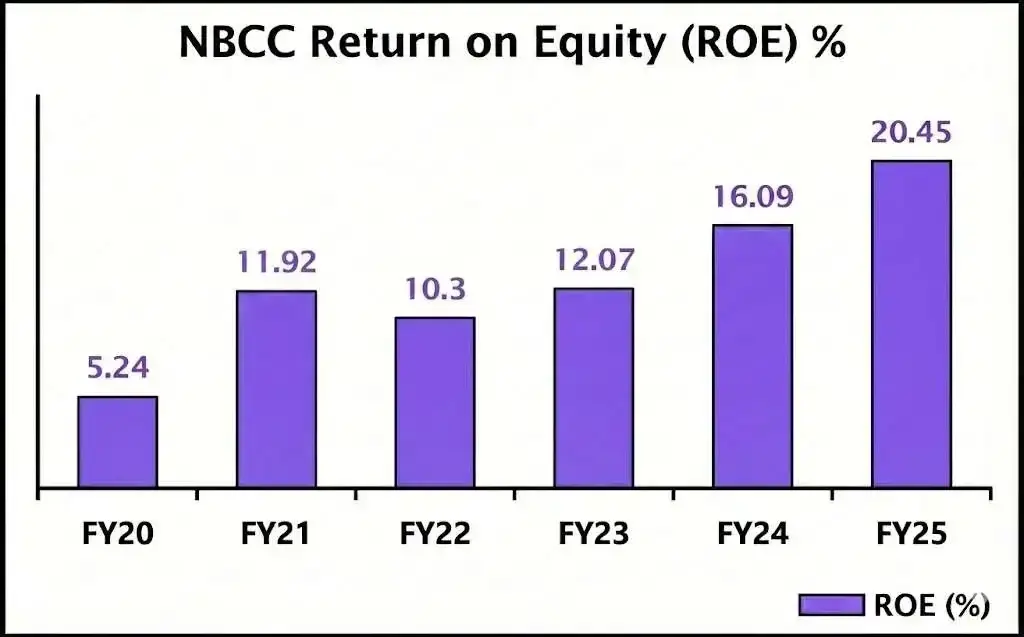
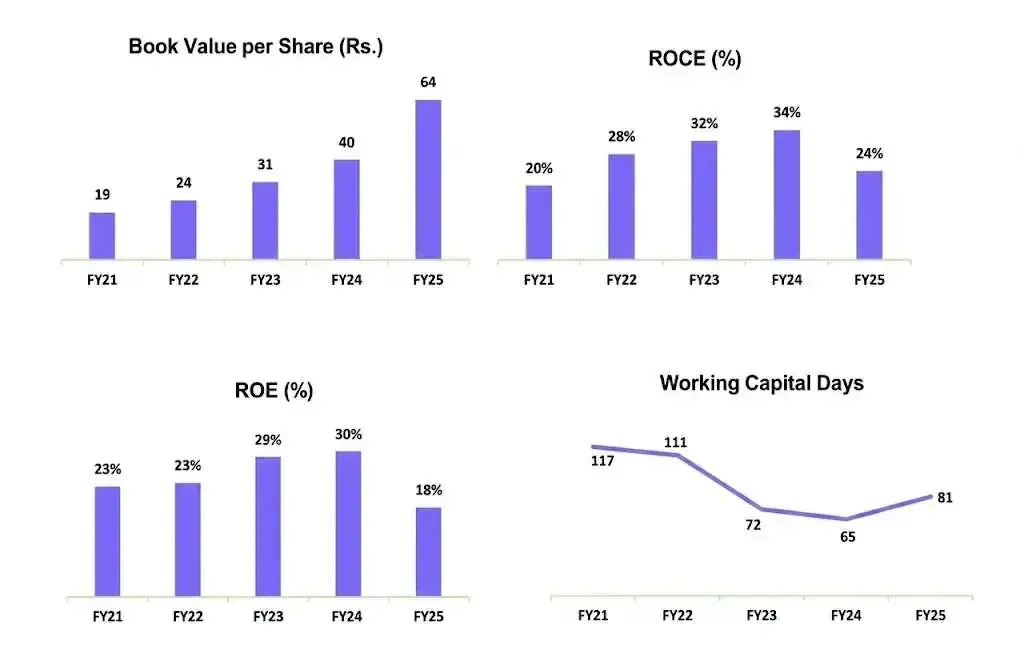
2. ROE: 25.45% (Stellar). This clears our 15% rule with ease. It indicates that for every ₹100 of your equity, the management generates over ₹25 in profit, showing elite operational efficiency for a public sector company.
3. Liquidity (Current Ratio): 1.21. While we typically look for 1.5, NBCC’s ratio is stable because 93% of its revenue comes from government bodies, meaning the "debtors" (people who owe them money) are sovereign entities. The risk of a payment default is virtually non-existent.
4. Valuation (P/B Ratio): 9.6x. This is high because the market treats NBCC as a "service company" rather than a "construction company". You are paying for the quality of the orders and the safety of the cash-rich balance sheet.
Key Risk
Roughly 20% of central sector projects in India face delays due to regulatory approvals or land litigation. Because NBCC manages long-term projects (3–5 years), a single delay in a government clearance can slow down revenue recognition for a few quarters.
Since the Government of India is both the client and the regulator, these hurdles are internal bureaucratic bottlenecks, not market failures. The "fee-based" model ensures that even if a project is delayed, NBCC doesn't lose money on interest payments because it has no debt to service.
2. IOL Chemicals: The Global Medicine Maker
Imagine owning one of the world’s largest producers of Ibuprofen: the painkiller in your cabinet, while the stock is trading at a "bargain-bin" price.
The Indian Active Pharmaceutical Ingredient (API) sector is currently a major beneficiary of the global "China Plus One" strategy. Large pharmaceutical companies in the US and Europe are aggressively reducing their dependence on Chinese supply chains, shifting orders to reliable Indian manufacturers.
The sector is forecast to grow earnings by a significant 24.5% per year as it moves from low-margin "commodity" drugs to high-margin specialty chemicals. IOL is perfectly positioned here, as it is already the global leader in Ibuprofen with a 35% world market share.
IOL is not stopping at pain relief. They are expanding into new therapeutic areas like Antidiabetics (Metformin) and Cardiovascular drugs (Clopidogrel), with new capacities commissioned in late 2025 to capture this global demand.
Business Model: The "Chef’s Kitchen" Model
IOL is the only company in the world that is fully backward integrated for Ibuprofen. This means they don't just "assemble" the medicine; they make the basic chemicals (like Iso Butyl Benzene and Acetyl Chloride) themselves.
Think of a chef who grows his own vegetables and mills his own flour. This "backward integration" allows IOL to maintain much lower costs than competitors and ensures they never run out of raw materials, even when global supply chains break.
They are also India’s largest single-location producer of Ethyl Acetate, a "green solvent" used in everything from food packaging to paints. This provides a second, steady engine of growth outside of the pharmacy sector.

The Checklist Deep-Dive
Net Debt: 0.09. Passing our #1 rule easily, IOL has effectively zero long-term debt. In a sector where R&D can be expensive, IOL funds its growth entirely through its own internal profits.
ROE: 6.1%. It is currently depressed because of operating deleverage. While the company doubled its productive engine, increasing fixed assets by 128% and, its global revenue remained flat due to a slump in chemical prices. This means high fixed costs are currently eating into profits, but as sales scale up to fill this new capacity, the ROE is positioned to move toward 15-20%.
Valuation (P/B Ratio): 1.1x. This is the "Bargain" signal. You are buying the company's massive factories, land, and cash for nearly what they are worth on paper. It’s like buying a fully-furnished house for the price of the bricks and cement.
Interest Coverage (10.3x): This score tells you that for every ₹1 the company owes in finance costs, it earns over ₹10 in profit. It is a rare level of safety for a stock priced under ₹100.
Key Risk
The main risk is the volatility of raw material prices (like Toluene or Benzene), which are linked to global crude oil. When oil prices jump or drug prices dip, IOL’s margins get squeezed temporarily.
Chemical cycles typically last 2–3 years. As IOL shifts more toward Specialty Chemicals (which have stable prices) and less on "commodity" Ibuprofen, these swings will become smaller. You are currently buying the company at the "bottom" of a cycle, which has historically been the best time to enter a quality asset.
3. Fineotex Chemical: The Specialized "Glue" of Industry
Behind every high-end textile or fancy detergent is a "specialty chemical" that makes it work. Fineotex is the secret ingredient that ensures your clothes feel soft, your colors stay bright, and your industrial processes run smoothly, all while trading at an accessible price point.Unlike "commodity" chemicals that are sold on volume, specialty chemicals are sold on performance. Fineotex doesn't just sell liquid; it sells a "solution" for a specific problem, allowing for much higher profit margins.
India is rapidly becoming a global textile hub as the world looks for alternatives to China. The Indian specialty chemical sector is forecast to grow at a 20% CAGR, but Fineotex is aiming higher, with an expected revenue and profit growth of over 20-25% through 2027.
While it dominates textiles, Fineotex is aggressively expanding into Oil & Gas (specialized drilling chemicals) and FMCG (cleaning and hygiene products). This diversification acts as a safety net—if one sector slows down, the others keep the engine running.

Business Model: The Power of "Sticky" Customers
Fineotex has over 470 specialized products. In the textile world, the cost of the chemical is only 3% of the total fabric cost, but if the chemical fails, the entire batch of fabric is ruined. This creates "customer stickiness"—once a mill finds a Fineotex chemical that works on their specific machine, they are terrified to switch to a cheaper competitor.Their R&D arm, Biotex Malaysia, allows them to create customized formulations for individual clients. They don't just ship a standard bottle; they send technical experts to the client's factory to ensure the chemistry is perfect for that specific water type and machine speed.
The Checklist Deep-Dive
Net Debt: Zero (Passed). Fineotex is a "debt-free warrior". It has grown its capacity from 43,000 to over 104,000 tonnes, almost entirely through its own internal profits. It currently holds a strong cash position, providing a massive safety cushion.
ROE: 18.4% (Passed). This clears our 15% rule comfortably. Historically, the company has delivered an ROE as high as 30%, indicating that the management is world-class at turning shareholder equity into actual profit.
Liquidity (Current Ratio): 3.8. This is phenomenal. It means they have nearly four times more cash and short-term assets than they owe. It’s the financial equivalent of having a massive emergency fund while your neighbors are struggling to pay their monthly rent.
Valuation (Price-to-Book): 3.1x. For a company that has grown its profits at a 70% CAGR since 2020, a P/B of 3.1x is considered a very fair entry point by many analysts. You are paying for a high-growth engine that is still reasonably priced.
Key Risk
About 60% of Fineotex’s raw materials are derived from crude oil. When global oil prices spike, their margins can get squeezed in the short term as they wait to pass those costs on to their customers.
Because of their "Sticky Moat," Fineotex has significant pricing power. Customers usually accept price hikes because the risk of switching to a lower-quality chemical is too high. Additionally, as they move further into the "Finishing" process of textiles (the last and most important stage), their margins become even more protected from raw material swings.
The real money is made before the crowd arrives. If you want to know more, read: How to Identify Genuine Penny Stocks Before They Become Multibaggers.
Strong companies alone don’t protect investors; strong behavior does. Before thinking about profits, let’s talk about how to control risk so one bad decision never ruins your portfolio.
The "Survival" Strategy: Position Sizing and Discipline
Investing in this segment isn’t about how much you can make, but how much you can afford to lose if a trade goes against you. In the Indian market, where volatility can be high, having a systematic way to manage your exposure is your best defense against catastrophic losses.1. The 2% Rule (Position Sizing): A common professional strategy is to never risk more than 2% of your total portfolio on any single stock under ₹100. For example, if you have a total investment of ₹1 Lakh, you shouldn't put more than ₹2,000 into one specific "under ₹100" pick. This ensures that even if one company fails, it doesn't drastically damage your overall wealth.
2. The Power of Diversification: Do not put all your eggs in one sector. If you pick a power stock like NBCC, balance it with a pharmaceutical play like IOL Chemicals or a specialty chemical company like Fineotex. Diversifying across 3–4 different sectors spreads out the impact of poor performance in any one industry.
Even strong stocks can fail; diversification is your real protection. Read more: Portfolio Diversification – How Many Stocks Should You Hold?
3. Avoid the "Average Down" Trap: One of the most common emotional mistakes beginners make is buying more of a falling stock to "lower their average price". In the sub-₹100 category, a falling price can sometimes be a warning sign of a hidden problem. It is often better to hold a losing position with a strict Stop-Loss than to keep pouring good money after bad.
4. Beware of "Pump and Dump" Schemes: Low-priced stocks are often prone to price manipulation through social media or Telegram groups. If a stock has risen 500% in a month without any major news or fundamental improvement, that is a massive red flag. Always base your decisions on your own research of the balance sheet, not on anonymous "tips".
Most losses in cheap stocks come from behavior, not bad analysis. Read more to understand: Common Mistakes Every Small-Cap Investor Makes (And How to Avoid Them).
Once you combine strong balance sheets with disciplined investing, the game changes from gambling to planning. Let’s bring everything together and see what truly separates survivors from speculators.
Explore our Products
Research Framework

Emerging Titans
Combination of quantitative analysis, industry tailwinds, and management assessment - SPRINT investment philosophy

Tiny Titans
Heavy emphasis on scuttlebutt research, plant visits, and early on-ground signals
Conclusion: The Survival of the Fittest
Investing in stocks under ₹100 is not a gamble if you prioritize the "Survivor DNA" of a rock-solid balance sheet over the noise of market speculation. By filtering for low debt, high ROE, and strong liquidity, you shift the odds in your favor, transforming a "cheap trade" into a calculated investment in a future leader.Companies like NBCC, IOL Chemicals, and Fineotex demonstrate that financial discipline and operational excellence are the true engines of long-term wealth creation. Remember that while the stock price might be small, your discipline in position sizing and research must be large. If you stay patient and stick to your checklist, you won't just survive the market's volatility—you will be positioned to thrive when these undervalued survivors finally get the recognition they deserve.
If you found this deep-dive helpful, please Like this article and Subscribe to our newsletter for more fundamental insights. We want to hear from you. Did any of our top picks surprise you, or is there another sub-₹100 gem on your radar? Drop a comment below with the word "Balance Sheet" and tell us which company you’re digging into next. Your engagement helps us keep bringing you the data that separates the multibaggers from the landmines.
FAQs
Why are most stocks under ₹100 risky investments?
Most sub-₹100 stocks are cheap because their businesses are weak, heavily indebted, or losing money. A low price often reflects poor fundamentals, not hidden value. Without checking balance sheet strength, investors confuse affordability with safety. That is why filtering for financial health is critical before even looking at growth.
What is the first balance sheet metric I should check in cheap stocks?
Always start with Net Debt or the Debt-to-Equity ratio. In low-priced stocks, debt acts like poison because even small revenue drops can trigger interest stress. A company with low or zero debt has breathing room during bad cycles. This gives management time to fix problems instead of fighting banks.
Is ROE reliable for judging small and cheap companies?
Yes, ROE shows how efficiently management uses shareholder money, but it must be seen over multiple years. A consistently high ROE signals a working business model rather than a one-time profit spike. In under-₹100 stocks, low or negative ROE usually means capital is being destroyed. Stability matters more than one good year.
Why does the Price-to-Book ratio matter more for low-priced stocks?
For cheap stocks, P/B helps measure how much real asset backing you are getting for your money. A low P/B suggests you are not overpaying for factories, land, and cash on the balance sheet. It also gives a margin of safety if growth is slow. This matters far more than PE ratios in distressed or cyclical companies.
How many under-₹100 stocks should I hold in a portfolio?
+These stocks should be a small satellite portion, not the core of your portfolio. Limiting exposure to a few carefully selected names reduces the risk of permanent loss. Diversifying across sectors also lowers damage from one industry downturn. Cheap stocks reward patience, not concentration.

High growth stock specialist, Value Educator
Shashank Mahajan is an equity research professional with over 12 years of experience in identifying high-potential SME and micro-cap stocks at an early stage. He follows a rigorous scuttlebutt research–driven approach, combining on-ground insights with deep financial analysis. Shashank specializes in uncovering under-researched and under-owned companies with strong management quality and long-term growth potential. Through disciplined research and early identification, he focuses on spotting tomorrow’s market leaders before they enter the mainstream investor radar.

Glenmark: The USD 700 Mn Cancer Deal and Its Brands

Pharma Stocks in India 2026: Generics, APIs and CDMOs

Granules India: From Paracetamol to a 65% Gross Margin

Natco Pharma: After Revlimid, 29 Patent Challenges

Shilpa Medicare: Cancer APIs, Films and Biosimilars

Alembic Pharma: US Plants Pay Back, Margin Hits 22.2%
Explore our Products
Research Framework
Emerging Titans
Combination of quantitative analysis, industry tailwinds, and management assessment - SPRINT investment philosophy
Tiny Titans
Heavy emphasis on scuttlebutt research, plant visits, and early on-ground signals



Modern Warfare to Multibaggers
Key Trends. Strategic Shifts. Opportunities Ahead.
Today at 7:00 PM IST. Room opens 30 minutes before.
Don't Miss This Exclusive Webinar!
Join Value Educator to decode the key trends shaping India's defence sector and learn how to identify tomorrow's potential leaders in the space.
- In-depth research on India's defence sector
- Live Q&A session
- Actionable takeaways for long-term investors

 Orders
 Subscription
 Share with friends


Required Details
₹23999.00
(12 month subscription)
As per SEBI regulations, all users are mandated to complete the KYC that is validated for 1 year. Post payment, you will be redirected to the KYC screen


No comments yet. Be the first to comment!