
Stocks With Strong FII Buying in 2026

“If you want to become a good swimmer, you don’t watch people who are struggling in the water - you observe how great swimmers swim.”
The same concept applies everywhere in life. And the stock market is no different.
If you want to become a good investor, you should understand where the big players are investing. Markets are driven by large capital, not by small individual trades. So who are these big players in investing?
They are FIIs (Foreign Institutional Investors) and DIIs (Domestic Institutional Investors). They have a huge amount of money and also strong professional teams that handle research, analysis, and investment decisions.
That is why it becomes important for a retail investor to periodically track where and why these big players have invested.

But here is a crucial point that needs to be understood.
Between the big players, when it comes to DIIs, they are compelled to invest only in India. Their mandate does not allow them to freely move capital across countries. FIIs, on the other hand, are not compelled to invest in any one country. They are free to invest anywhere in the world.
This freedom makes FIIs an extremely important player in the Indian stock market because they will only invest in the Indian market if it is worth investing.
FIIs don’t invest randomly. They follow a clear framework while allocating capital, a framework that retail investors can also learn and apply. You can learn it by reading our article: The Multibagger Framework: A Step-by-Step Guide to Finding 10X Stocks
In fact, research shows that from 1992 to 2014, FIIs acted as key market makers, with a strong positive correlation between FII flows and the Sensex, meaning both often moved together.
If you want to study this relationship in detail, you can read our article on FIIs vs DIIs: How Indian Markets Quietly Changed
What is FII Buying & Why It Moves the Indian Market?
With this context in place, we took a closer look at how FIIs invest their money in the stock market. The goal is simple to make you more clear about the headlines like FIIs selling headlines and help retail investors think more clearly about their decisions.
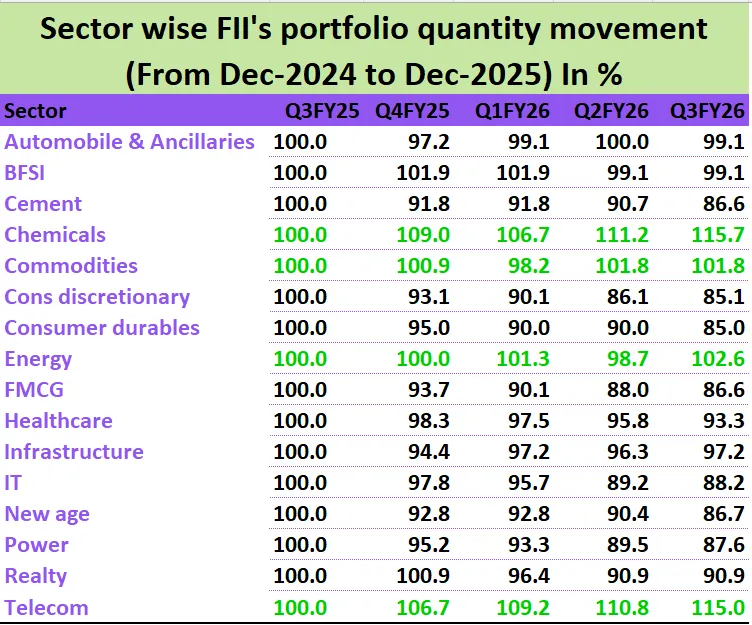
In 2025, investors were thinking that the overall Indian economy is not performing well because FIIs were net sellers in the Indian equity market, if we took a closer look at the data, which shows a clearer picture. Despite being net sellers overall, FIIs increased their holdings in some specific sectors like Chemicals, Commodities, Energy, and Telecom.
This tells us something important. FIIs were not exiting the market blindly. Instead, they were selectively reallocating capital, reducing exposure to some sectors while increasing conviction in a few others where they saw better risk & reward or long-term opportunity.
To understand this selective behavior more clearly, we identified some key stocks where FII ownership increased during the year. In the next section, we move to this stock-level analysis to better understand where FIIs chose to stay invested and why.
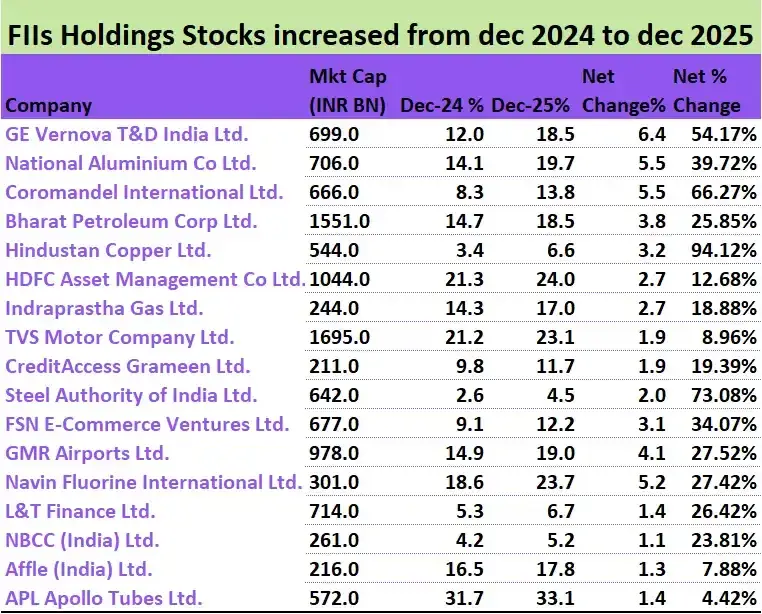
The table above brings everything together.
These are the stocks where FII holdings increased between December 2024 and December 2025. And this is not a random list. Most of these companies belong to the same sectors we identified earlier, such as Chemicals, Commodities, Energy, and Telecom. These are FIIs that selectively increased exposure despite being net sellers overall in 2025.
A common thread across these stocks is their relative strength during the year, whether through price performance, stable earnings, or strengthening fundamentals. This suggests that FII stake increases are rarely impulsive. They are usually based on business conviction rather than short-term market movements.
However, a list alone is not enough. To truly understand how FII thinking works, we need to go deeper into one company and study why foreign investors chose to increase their ownership there.
From this list, we will now take a closer look at Coromandel International Ltd. By studying this company in detail, we can see what may have attracted FIIs to the business, how it aligns with the larger sector trend, and what practical takeaways retail investors can draw from this investment move.
Let’s now take Coromandel International as a case study and try to find out the reason.
What does Coromandel actually do?
Coromandel International Limited is an agriculture-focused company that supports Indian farmers by supplying fertilisers, crop protection products, specialty nutrients, and agri-retail services. Its wide retail network helps the company stay closely connected to farmers and understand on-ground demand.
The company was founded in 1961 as Coromandel Fertilisers and later became Coromandel International Limited in 2009. Today, it is part of the Murugappa Group. This background gives the company strong institutional roots and operational credibility.
In simple words, Coromandel operates in the farm input space - a segment that becomes relevant whenever agricultural activity improves. When farmers sow more crops, use better nutrients, and adopt improved farming practices, companies like Coromandel naturally see higher demand for their products.

Understanding this business model is important because FIIs do not invest based on stock prices alone. They first try to assess whether the underlying business is linked to a long-term, sustainable demand cycle. In Coromandel’s case, that cycle is directly connected to India’s agriculture and food security needs.
With this clarity on what Coromandel does, we can now move one step deeper and examine what changed in the business environment and company performance that made FIIs increase their stake.
We have divided our analysis into two parts:
This selective behaviour highlights how institutional investors think very differently from retail participants.
“You can’t predict, but you can prepare - and preparation comes from understanding value and risk.” - Howard MarksLet’s see how FIIs prepare themselves
The first and most important: the Indian agricultural sector
Since Coromandel is directly linked to agricultural growth, it becomes important to first examine the agricultural sector. Agriculture continues to be one of the strongest structural pillars of the Indian economy. It supports the livelihood of nearly 55% of the population and contributes close to 18% of India’s GDP. More importantly, the sector is no longer stagnant. In FY25, agriculture recorded healthy growth, with Gross Value Added rising to around US$ 290 billion, reflecting a steady improvement in farm activity and income levels.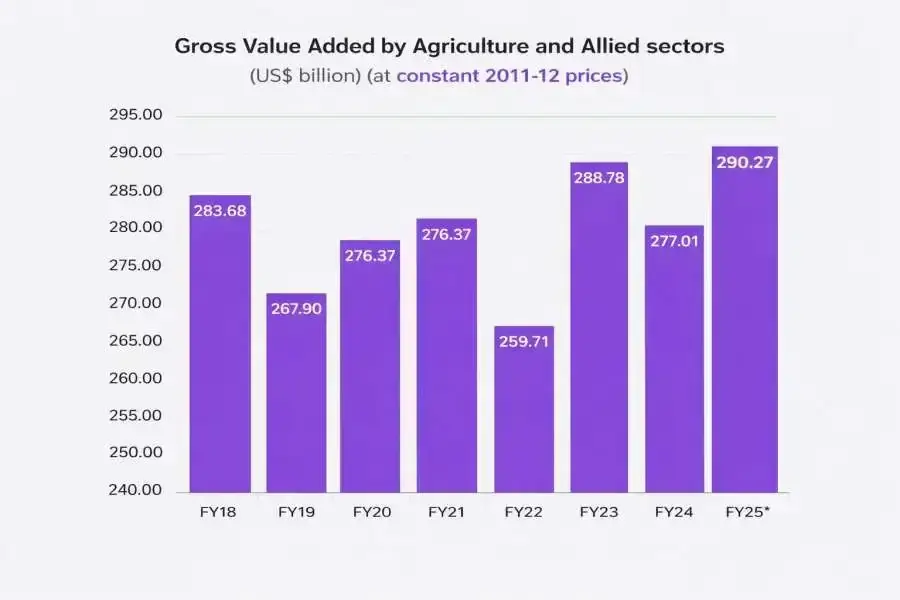
This progress is visible across multiple areas. Crop production has reached record highs, agricultural exports have also increased, and this is supported by good monsoons, higher MSPs, and direct cash transfer-like initiatives.
Agricultural exports are also performing well, crossing ₹4.4 lakh crores show how Indian farming is becoming increasingly connected to global demand, strengthening cash flows, and these positive signs might attract foreign investors to invest in agriculturally linked companies.
At the same time, government support continues to play an important role. Investments in irrigation, storage, food parks and logistics, also schemes like PMKSY and PM Dhan-Dhaanya Krishi Yojana, are helping improve productivity and help agriculture-linked companies to expand their roots.
For FIIs, this combination matters. A growing sector with policy support, improving farmer purchasing power, and rising exports creates long-term demand visibility. That is exactly what agri-input companies depend on.
Put simply, FIIs were not investing in Coromandel in isolation. They were responding to a broader agricultural upcycle in India - one where demand for fertilisers, specialty nutrients, and crop protection products is becoming more stable, predictable, and scalable.
For a company like Coromandel, which sits directly at the intersection of farm productivity, nutrient supply, and crop protection, this sectoral strength becomes a natural tailwind and the first trigger for increased foreign investor interest.
With this macro backdrop in place, we can now move further and examine the second factor.
The Second Factor: How Coromandel positioned itself to benefit from this agricultural upcycle.
Before investing in any stock, whether FIIs are buying it or not, it is important to analyse the business fundamentals properly. If you want to know how to analyse a company, you can read our article: A fundamental checklist: How to research a stock in 1 hourFIIs do not invest only because a sector is doing well. They look for companies that can convert a favourable environment into consistent earnings, better margins, and lower risk. In Coromandel’s case, several execution-level changes stood out.
First - Strong operational Performance
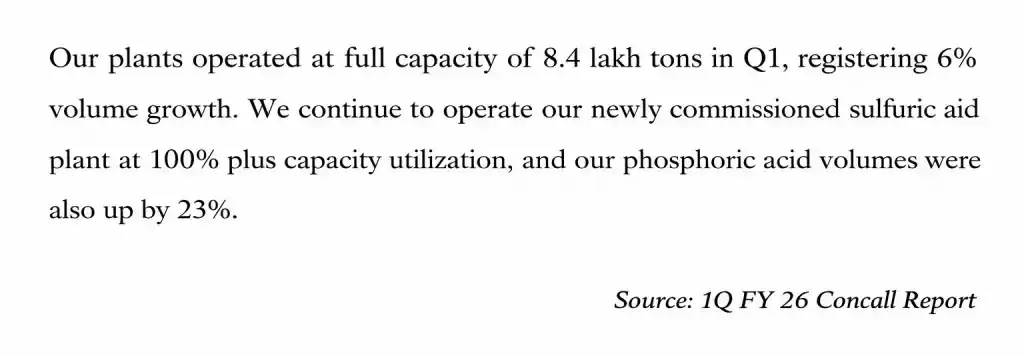
Coromandel showed strong operational performance at a time when visibility was improving. The company operated its plants at near full capacity, delivered healthy volume growth, and improved throughput using digital tools and operational efficiencies. For FIIs, this signals discipline, growth that comes from execution, not from aggressive assumptions.
Second - Reducing raw material and supply chain risk
Coromandel worked actively on reducing raw-material and supply-chain risk, which is a critical factor in the fertiliser and agrochemical business. Through backward integration projects, long-term sourcing arrangements, and securing rock phosphate supply via its overseas mining asset, the company reduced its dependence on volatile global markets. This directly improves earnings stability - something FIIs value far more than short-term growth spikes.
Third - Improved quality of earnings
The quality of earnings improved. While fertilisers remain the base business, a growing share of profits started coming from crop protection, specialty nutrients, and bio products - segments that typically offer better margins and pricing power. FIIs tend to favour companies that are gradually shifting away from purely commodity-linked earnings towards more differentiated, value-added products.
Here we have the financial performance data of it.
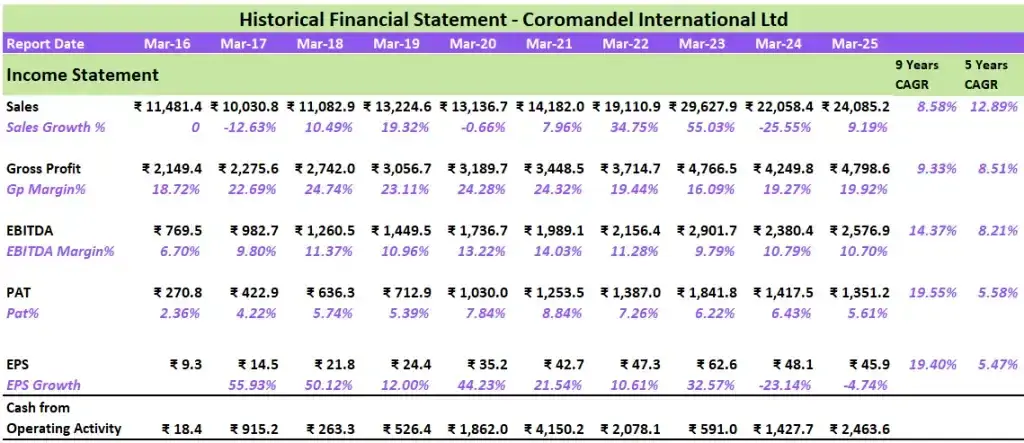
What this financial table tells us
When we look at Coromandel’s sales over a longer time frame, the 9-year CAGR of around 8.6% shows steady but moderate growth. The more important insight comes from the recent period, where the 5-year CAGR of nearly 13% clearly indicates that growth momentum has strengthened.
Between 2014 and 2021, sales were largely flat, reflecting a phase of consolidation rather than expansion. The real shift started from FY22 onwards, when sales began rising sharply, suggesting that the company has entered a stronger growth phase in the current cycle.
At the same time, gross margins were higher in the earlier years and have moderated in recent years. This decline is mainly due to higher input costs and rising COGS, which is common in agriculture-linked businesses. Despite this margin pressure, the company continued to scale its revenues, indicating demand strength and volume growth.
A similar pattern can be seen in EBITDA and PAT when we compare the 9-year and 5-year CAGR numbers. While long-term growth remained steady, recent years show a clear improvement in momentum. This points to better scale and stronger execution, even while operating in a challenging cost environment.
Another important sign of business strength is operating cash flow. Coromandel has consistently generated healthy cash from operations, and in many years, this cash flow has been strong relative to reported PAT. This shows that the company’s profits are supported by real cash generation, not just accounting entries.
Overall, the table reflects a business that stayed stable over many years, navigated recent cost pressures, and still managed to improve its growth and cash generation. This blend of resilience and better execution explains why long-term investors continue to have confidence in the company.
Numbers only make sense when you know how to read them the right way. If you also want to do this kind of analysis, you can read our article: How to Read a Balance Sheet Like a Professional Investor
Forth- Capital allocation Clarity
Coromandel demonstrated capital allocation clarity. The company outlined a clear capex roadmap, focused on capacity expansion, integration, and adjacencies, while maintaining balance-sheet discipline. This indicates long-term thinking, investing ahead of demand without overstretching finances - another key institutional preference.
Final - Strong Direct Connection with farmers
The company has built a much stronger direct connection with farmers over time. Expanding its retail reach, offering on-ground advisory support, investing in digital platforms, and introducing initiatives like drone spraying. These efforts help create deeper farmer relationships and give the company clearer visibility into real demand at the ground level. From an FII perspective, this reduces reliance on one-off seasonal demand and supports a more stable and predictable business model.
FII's not only buy Quality stocks but also value stocks. If you also want to learn value investing, you can read our article: What is Value Investing? Complete Guide for Beginners
A note of caution for retail investors:
This is where retail investors must pause and reflect before blindly following institutional activity.“An investment operation is one which, upon thorough analysis, promises safety of principal and an adequate return.” - Benjamin Graham
The points discussed above explain the fundamental reasons why FIIs increased their stake in Coromandel. However, one important thing retail investors must always remember is that FIIs can exit a stock anytime they want. Their investment horizon, risk appetite, and decision-making process are very different from those of a retail investor.
So while FII buying can act as a positive signal, it should never be the only reason to invest. Every investor must understand the risk–return trade-off and enter a stock with their own analysis and conviction.
Coming to the risks, Coromandel’s business is heavily dependent on monsoons. Uneven or weak rainfall can affect crop sowing and reduce short-term demand. The business is also exposed to government policy risk, especially in fertilisers where subsidies play an important role. Additionally, raw material costs are linked to global prices, which can put pressure on margins during volatile periods.
Some retail investors make decisions in panic to remain emotionally strong during a market crash. You can read our article How to Stay Emotionally Strong During Market Crash
Final Thoughts:
In this article, we learned that while FIIs were net sellers in the Indian equity market during 2025, their actions were far more selective than the headlines suggested. Instead of exiting the market blindly, FIIs showed clear conviction in specific sectors such as chemicals, commodities, energy, and telecom, where they continued to deploy capital despite overall selling pressure.We also identified individual stocks where FII shareholding increased meaningfully, indicating stock-specific conviction rather than broad market optimism. To make this understanding more practical, we conducted a deep dive into Coromandel International Ltd. as a case study and analyzed why FIIs increased their stake. The analysis was approached through two lenses, industry-level tailwinds and company-specific fundamentals, reflecting how institutional investors actually think.
Importantly, we also discussed the risks associated with such companies, reinforcing the idea that FII buying alone should never be the sole reason to invest. FIIs have different time horizons, risk appetites, and exit strategies compared to retail investors.
This article should be taken as a reference framework, not a recommendation. Large capital does have the power to drive stocks to new highs, but sustainable wealth creation stems from independent, fundamental analysis, not blind imitation. Investors can use this framework to analyse the FII-backed stocks listed in this article and make decisions based on their own research.
Explore our Products
Research Framework

Emerging Titans
Combination of quantitative analysis, industry tailwinds, and management assessment - SPRINT investment philosophy

Tiny Titans
Heavy emphasis on scuttlebutt research, plant visits, and early on-ground signals
FAQs
Why is overall FII buying or selling not enough to understand the market?
+Because net FII numbers hide details. FIIs may sell at the index level while increasing exposure to selected sectors or stocks. Understanding allocation matters more than headline numbers.
Should retail investors directly follow FII buying or selling?
+Why do FIIs invest selectively during uncertain market conditions?
+What do FIIs generally look for before increasing their stake?
+They assess industry trends, business fundamentals, cash flows, balance-sheet strength, and valuation comfort.
What should retail investors learn from tracking FII behaviour?
+The goal is to learn the process, not copy the trade. Use FII data to shortlist ideas and then apply your own analysis.

High growth stock specialist, Value Educator
Shashank Mahajan is an equity research professional with over 12 years of experience in identifying high-potential SME and micro-cap stocks at an early stage. He follows a rigorous scuttlebutt research–driven approach, combining on-ground insights with deep financial analysis. Shashank specializes in uncovering under-researched and under-owned companies with strong management quality and long-term growth potential. Through disciplined research and early identification, he focuses on spotting tomorrow’s market leaders before they enter the mainstream investor radar.

Atlanta Electricals: Capacity Nearly Quadrupled in a Year

Kirloskar Oil Engines: Data Centres, Nuclear and the Navy

Yash Highvoltage: Bushing Maker With ₹760 Cr of Orders

Quality Power: Reactor Maker With a ₹1,945.5 Cr Order Book

Azad Engineering: Turbine Blades, Jet Engines and Orders

Cyient DLM: Aircraft Electronics and a Record Order Book
Explore our Products
Research Framework
Emerging Titans
Combination of quantitative analysis, industry tailwinds, and management assessment - SPRINT investment philosophy
Tiny Titans
Heavy emphasis on scuttlebutt research, plant visits, and early on-ground signals



Modern Warfare to Multibaggers
Key Trends. Strategic Shifts. Opportunities Ahead.
Don't Miss This Exclusive Webinar!
Join Value Educator to decode the key trends shaping India's defence sector and learn how to identify tomorrow's potential leaders in the space.
- In-depth research on India's defence sector
- Live Q&A session
- Actionable takeaways for long-term investors

 Orders
 Subscription
 Share with friends


Required Details
₹23999.00
(12 month subscription)
As per SEBI regulations, all users are mandated to complete the KYC that is validated for 1 year. Post payment, you will be redirected to the KYC screen


No comments yet. Be the first to comment!