
Cash Flow Statement Explained
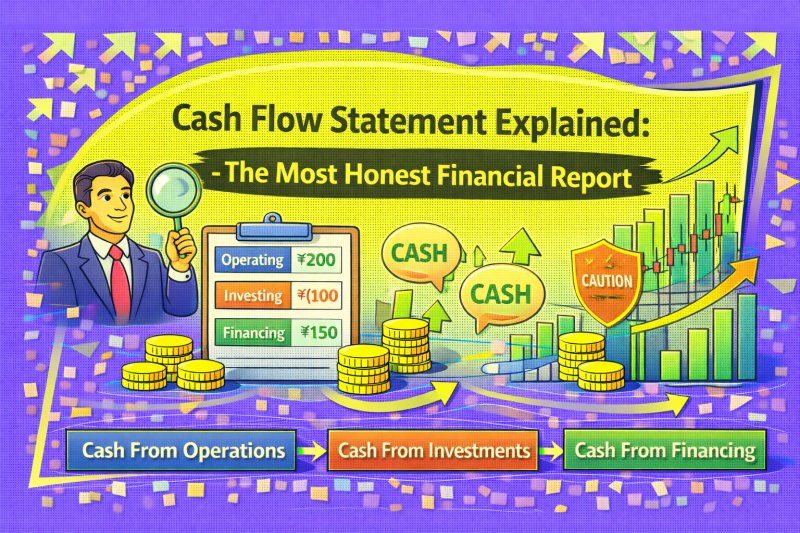
Why Profitable Companies Go Bankrupt — And How to Spot It Before It Happens
The Company That Made ₹500 Crore Profit and Still Went Bankrupt
December 2019. Café Coffee Day -the biggest chain of coffee outlets in India- declared that its founder, VG Siddhartha, had gone missing. Days later, the tragic news broke. He’d left behind a note mentioning “failed to create value” and “pressure from lenders.”The shocking part? Café Coffee Day wasn’t unprofitable. The company was reporting positive earnings. Revenue was growing. But something else was bleeding — something most investors never look at.
Cash.
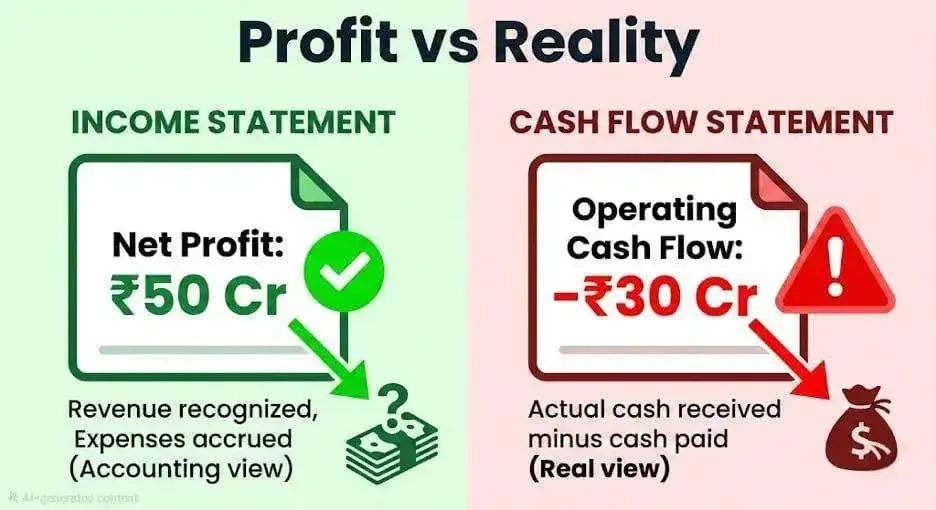
The income statement reflected the profit, but the cash flow statement reflected otherwise. The company had been consuming cash at a rate that was much higher than its ability to produce cash. Loans were piling up. Operating cash flows couldn’t cover debt payments. The business was profitable on paper but dying in reality.
This is the conversation nobody has when teaching financial statement analysis:
You can show profit and still run out of money. You can report revenue growth and still collapse. The income statement shows whether a company is profitable. The cash flow statement tells you if it can survive.
To understand how profit is calculated — and where it can mislead you — read: How to Read a Profit & Loss Statement (P&L) in 10 Minutes: A Practical Investor’s Guide
Accounting rules shape profit. Cash is shaped by reality.
Revenue can be booked before payment is received. Expenses can be deferred. But cash cannot be manufactured. It either enters the bank account or it doesn’t.
1. What the Cash Flow Statement Really Means (And Why It Matters More Than You Think)
The Truth Hidden in Plain Sight
Every quarter, companies release three financial statements. Most investors obsess over two: the income statement (profit and loss) and the balance sheet (assets and liabilities). The third statement, the cash flow statement, gets ignored or skimmed.If you want to fully understand how assets and liabilities interact with cash flow, read: Understanding the Balance Sheet — Assets, Liabilities, and Equity
This is a catastrophic mistake.
The cash flow statement answers the most important question in business: Where is the actual cash coming from, and where is it going? Not revenue. Not profit. Cash. It’s the money that pays salaries, buys inventory, services debt, and keeps the lights on. Most investors realise this too late — you can record accounting profits, but you can’t record cash. It either exists or it doesn'tRevenue can grow while cash shrinks. That’s why operating cash flow matters more than reported profit.
The Three Activities That Define Every Business
The cash flow statement breaks down into three sections, and understanding these is the foundation of everything:1. Operating Activities (The Core Business)
This is money used or spent by the business activity of the company at hand, i.e., producing goods, offering services, receiving money, paying bills, and wages. In the case when a company fails to generate positive cash flow from its operations regularly, the business model is questioned. Any sum of money financed or assets sold cannot rescue a company that spends money on its operations continuously. Furthermore, Cash flow from operations are used to cover finance costs from CFF and Capex in CFI.2. Investing Activities (Building the Future)
This is cash spent on or generated from long-term assets — buying machinery, building factories, acquiring other companies, or selling off assets. Healthy growing companies typically show negative cash flow here because they’re investing in expansion. But if a company is selling core assets to generate cash, that’s often a red flag. You’re watching the business being dismantled.
3. Financing Activities (Where the Money Comes From)
This is cash from or paid to investors and lenders — issuing shares, taking loans, repaying debt, paying dividends. This section shows how the company funds itself and rewards shareholders. A company constantly raising debt to cover operating losses is borrowing its way to bankruptcy.The interplay between these three sections tells you everything. A company generating strong operating cash flow, investing in growth, and returning cash to shareholders is a compounding machine. A company burning operating cash, selling assets, and raising emergency loans is structurally unstable.
“Cash flow is the lifeblood of any business. Without it, even the most promising company can fail.”
— Warren Buffett
2. Operating Cash Flow: The Only Number That Really Matters
Why Profits Mean Nothing Without CashOperating cash flow shows whether the core business generates real cash. Profit and cash flow often differ because accounting records revenue before cash is received.
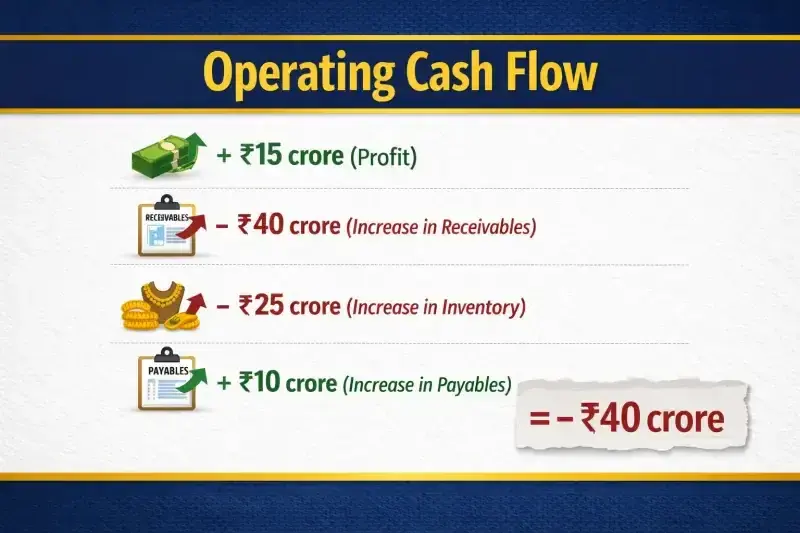
Practical example of the profit-cash gap:
- Example: A company reports ₹15 crore profit.
- But: Receivables increase ₹40 crore
Inventory increases ₹25 crore
Payables increase ₹10 crore - Operating Cash Flow = – ₹40 crore
- Profit exists. Cash does not, and that gap is where risk lives.
The Red Flags in Operating Cash Flow
Red Flag 1: Operating Cash Flow Consistently Below Net Profit
Occasional divergence is normal. Persistent divergence is a warning. If a company reports profit year after year but operating cash flow is always significantly lower or even negative, something is broken. Either the company isn’t collecting from customers, or it’s stuffing channels with inventory to inflate revenue, or it’s using aggressive accounting to book sales that aren’t real. Any way you cut it, the business is on borrowed time.Red Flag 2: Rising Receivables Faster Than Revenue
If revenue grows 20% but receivables grow 40%, the company is selling more on credit and collecting less. That’s not growth — that’s desperation. Customers might not be paying, or the company is offering overly generous credit terms to push sales. Either way, reported revenue is inflated relative to actual cash economics.Red Flag 3: Operating Cash Flow Turning Negative
When a company that is mature and established all at once begins to burn money in operations, put everything aside and investigate. This means the core business has stopped generating cash. Maybe customers stopped paying. Maybe costs spiked. Maybe competition destroyed margins. Whatever the reason, negative operating cash flow in a mature business is a five-alarm fire.The fix investors miss: Don’t just look at one quarter. Track the trend over 3-5 years. Over time, operating cash flow should grow alongside revenue and profit. If it doesn’t, the business model is deteriorating — even if reported profits say otherwise.
“Rule No. 1: Never lose money. Rule No. 2: Never forget Rule No. 1. And the way you lose money is by not watching cash flow.”
— Warren Buffett
3. Investing Cash Flow: Reading Between the Lines
When Negative Is Good (And When It’s Terrible)
Investing cash flow is almost always negative for healthy, growing companies — and that’s exactly what you want to see. Negative investing cash flow means the company is spending cash on property, equipment, technology, acquisitions — building the future. This is called capital expenditure (CapEx), and it’s how companies grow.But there’s a critical difference between good negatives and bad negatives.
Negative investing cash flow is normal in growing companies. The key question is whether growth is funded by operating cash flow or by debt. If operations generate surplus cash after CapEx, growth is sustainable. If not, risk increases.
The Asset Sale Warning Sign
When a company shows positive investing cash flow, pay very close attention to why. Sometimes it’s from selling an investment or a non-core business — that can be fine, even strategic. But if a company is selling core productive assets (factories, equipment, land) to generate cash, it’s often dismantling the business to stay alive.Real warning signs:
- Repeated asset sales year after year — the company is running out of things to sell
- Asset sales while operating cash flow is negative — the core business isn’t working, so they’re liquidating to cover losses
- Acquiring assets with debt, then selling them for cash later — financial engineering to mask problems
The healthy pattern: The cash flow to be invested should be negative (growth spending), but in a lesser magnitude compared to the operating cash flow. With an operating cash flow of 100 crore and an investing cash flow of -60 crore, the firm will be able to finance its growth in-house, and it will be left with 40 crore. That’s a strength.
CapEx Intensity: The Hidden Competitive Moat Indicator
Some businesses require constant heavy capital expenditure to stay competitive. Steel plants, airlines, telecom — these are capital-intensive industries. Every few years, you must reinvest heavily, or your assets become obsolete, and competitors crush you.Other businesses — software, consulting, asset-light services — require minimal ongoing CapEx. Once you build the product or platform, marginal costs are low.
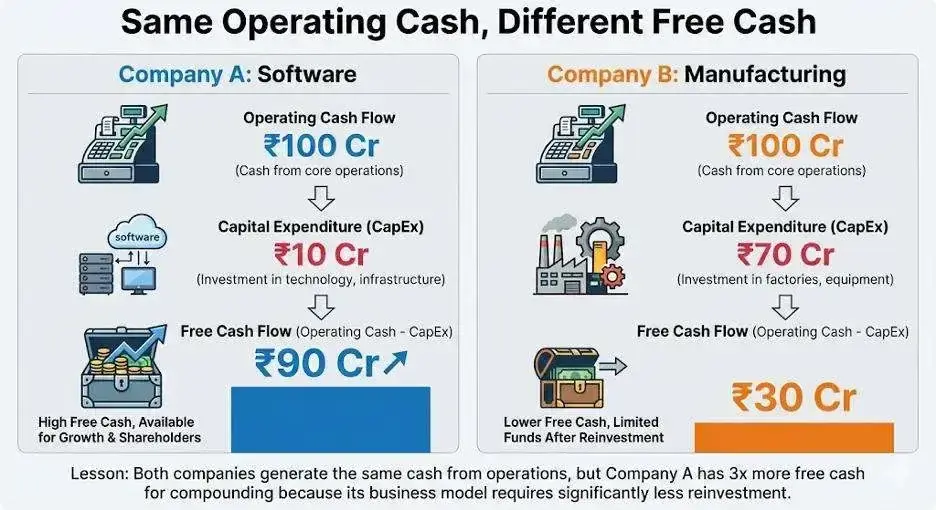
Why this matters for investors: Light industries accumulate money at an accelerated rate. A software company that earns 100 crore volume cash flow, operating with a cash flow of 100 crore and CapEx of 10 crore, earns 90 crore free cash flow. The manufacturing firm that produces 100 crore operating cash flow and requires 70 crore CapEx will have a free cash flow of 30 crore only. The operating cash flow in both reports is similar, but the software company has 3 times greater cash to use in growth, dividends, or buybacks.
The test: Calculate Free Cash Flow = Operating Cash Flow - CapEx. Companies with consistently high and growing free cash flow are compounding machines. Companies with declining or negative free cash flow are struggling.
“Someone’s sitting in the shade today because someone planted a tree a long time ago.”
— Warren Buffett
4. Financing Cash Flow: Follow the Money Trail
What Companies Do When They’re Desperate
Financing cash flow reveals how a company funds itself and what it does with excess cash. This section shows borrowing, repaying debt, issuing shares, paying dividends, and buying back stock. The patterns here tell you if management is confident or desperate.Healthy financing patterns:
- Paying dividends steadily or increasing them, the company generates more cash than it needs
- Repurchasing shares- the management believes that the stock has been under-priced and it has surplus cash.
- Gradually repaying debt — strengthening the balance sheet over time
- Funding a particular growth opportunity - strategic, disciplined capital.
Desperate financing patterns:
- Constantly raising debt just to cover operating losses — borrowing to survive, not to grow
- Issuing equity repeatedly despite falling stock price — diluting shareholders out of necessity
- Cutting or eliminating dividends suddenly — the company needs every rupee to stay afloat
- Selling assets and using proceeds to repay debt — shrinking the business to avoid default
Numerical example of the death spiral:
Company XYZ: - Year 1: operating cash flow = - 20cr, issues 50cr debt - Year 2: operating cash flow = - 30 cr, issues 80cr to lenders, more debt - Year 3: operating cash flow = - 40cr, sells core division = 200cr to repay lenders.
This company never fixed the operating problem. It just kept borrowing and diluting until there was nothing left. Every year, the cash flow statement screamed “This business doesn’t work,” but investors who only read the income statement missed it until it was too late.
The Dividend Sustainability Test
Dividends make many investors purchase stocks. But what about knowing whether the dividend is sustainable? Instantly, you are told by the cash flow statement.
Sustainable dividend: Operating cash flow 100 Cr, CapEx 30Cr, Free cash flow 70Cr, Dividend paid 40Cr. Free cash flow can comfortably meet the dividend with a spare amount. This can continue.
Unsustainable dividend: > “Operating cash flow ₹50 crore, CapEx ₹40 crore, Free cash flow ₹10 crore, Dividend paid ₹30 crore. > The company is paying ₹30 crore in dividends while generating only ₹10 crore in free cash flow. How? Borrowing 20Cr or asset sale. This dividend will either be reduced at an earlier date.
“Price is what you pay. Value is what you get. And cash flow is what you can count on.”
— Benjamin Graham (adapted)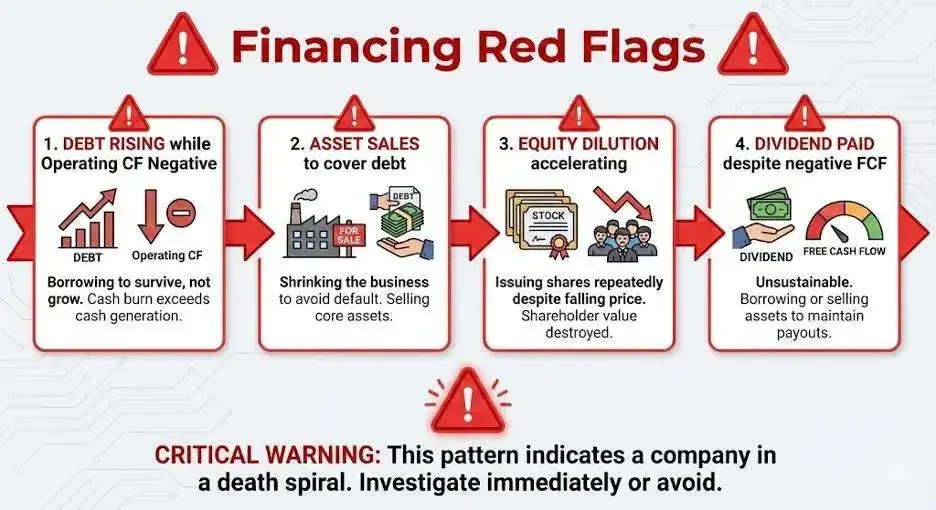
5. The 2008 Subprime Crisis: When Cash Flow Warnings Were Ignored
If you want to see cash flow analysis in action — and understand what happens when investors ignore it — study the 2008 financial crisis.What the Cash Flow Statements Were Screaming
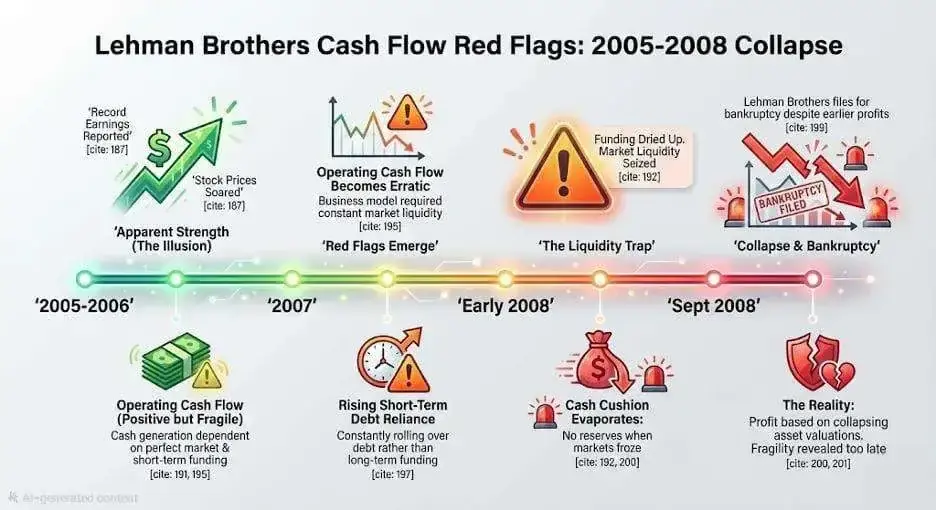
The period of 2005-2007 saw great financial institutions seemingly trying to be profitable on paper. Banks such as Lehman Brothers and Bear Stearns, among others, announced high profits. Stock prices soared. Bonuses hit all-time highs. But beneath the surface, the cash flow statements told a very different story.
What was happening:
During the 2008 crisis, major financial institutions reported profits while relying heavily on short-term borrowing to fund long-term assets. When liquidity dried up, they couldn’t refinance.
They weren’t short on reported earnings.
They were short on cash.
When funding stopped, collapse followed.
That’s all you need. Keep it sharp.
The Lesson for Individual Investors
You don’t need to analyse banks or complex financial institutions. But the lesson applies to every company you evaluate:
Companies that look profitable but have fragile cash flow structures collapse fast when conditions change. A business that reports profit but relies on constant borrowing to fund operations is one bad quarter away from disaster. A business that generates strong operating cash flow can survive external shocks because it has a cash cushion to adapt.
“In the business world, the rearview mirror is always clearer than the windshield.”
— Warren Buffett
6. The Biggest Cash Flow Statement Mistakes Investors Make
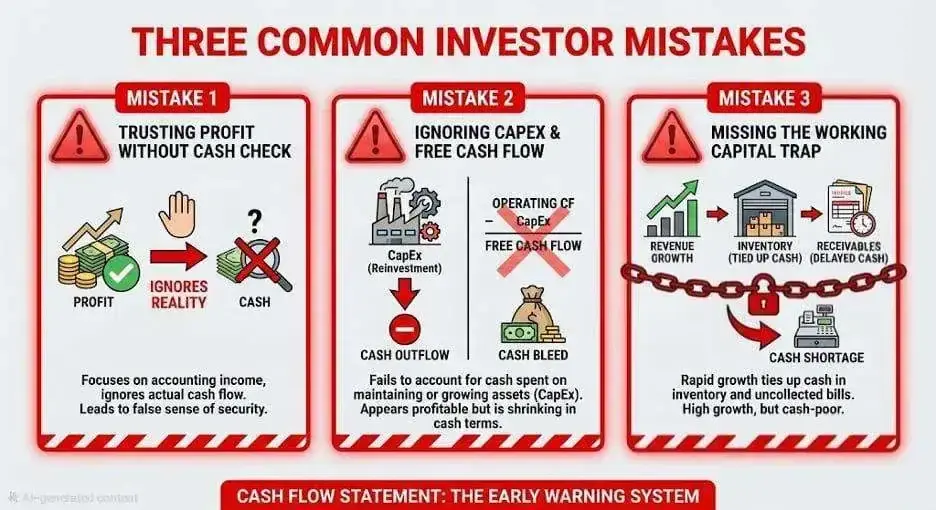
Mistake 1: Trusting profit without checking cash.
If operating cash flow is consistently lower than net profit, investigate.
Track the Cash Conversion Ratio (OCF ÷ Net Profit). Below 0.8 for multiple years is a warning.
read more: Inflation Explained: The Silent Destroyer of Wealth
Mistake 2: Ignoring Free Cash Flow Entirely
The trap: “Operating cash flow is positive and growing. The company must be doing well.”The reality: The cash flow operating does not include the amount of cash required to sustain and expand the business (CapEx). The operating cash flow of a company can be 100 crore and still require 120 crore in CapEx so as to keep the company's operations running. Free cash flow is negative by 20 crore of money- the business is literally depleting in terms of cash, though operating cash flow is high.
Real example: There are a lot of capital-intensive companies (telecom, airlines, manufacturing) that are performing well in their operating cash flow but are burning cash when you take away CapEx. They are on a treadmill - racing so hard not to get left behind. They cannot grow or even sustain their operations without outside funding.
The fix: It is always good to compute the Free Cash Flow = Operating Cash Flow - CapEx. This is the cash on hand to give dividends, buybacks, pay off debts, or to purchase other companies. Value traps are companies that have negative free cash flow that has been negative over a long period.
Mistake 3: Missing the Working Capital Trap
The trap: “Revenue is growing 30% year-over-year. This is a high-growth company.”The reality: Fast revenue growth often comes with a hidden cost — exploding working capital needs. As the company sells more, it needs more inventory (cash out), extends more credit to customers (cash delayed), and may have to pay suppliers faster (cash out sooner). The result is that cash gets trapped in working capital, and the business needs constant infusions of capital to fund growth despite being “profitable.”
Indian example: Many small and mid-cap companies report strong revenue and profit growth, but constantly dilute shareholders by issuing equity or raising debt. Why? Because working capital is consuming all the cash. They’re growing but not generating free cash flow. Investors chasing the growth story get diluted over time and never see the returns they expected.
For example: PC Jeweller
PC Jeweller reported strong revenue growth and accounting profits during its expansion phase. However, a large amount of cash was locked in inventory and receivables (working capital). Operating cash flow did not consistently match reported profits.
To sustain growth, the company relied heavily on debt and external funding. When growth slowed and liquidity tightened, the stock price collapsed, and shareholders suffered significant losses.
Lesson:
Revenue growth without free cash flow is fragile.
If working capital keeps absorbing cash and the company depends on dilution or borrowing, growth is not creating real shareholder value.
The fix: Determine whether the working capital is growing at a higher rate than the revenue. When the revenue increases by 20 percent, and working capital increases by 40 percent, then the business model is cash-inefficient. Sustainable businesses experience an increase in working capital that is in proportion to revenue, or it increases at a lower rate than revenue.
Read More: What is Market Capitalization? Large, Mid, Small Cap Explained with Examples
“It’s far better to buy a wonderful company at a fair price than a fair company at a wonderful price. And wonderful companies generate cash.”
— Warren Buffett
7. How to Actually Use the Cash Flow Statement (The Practical Framework)
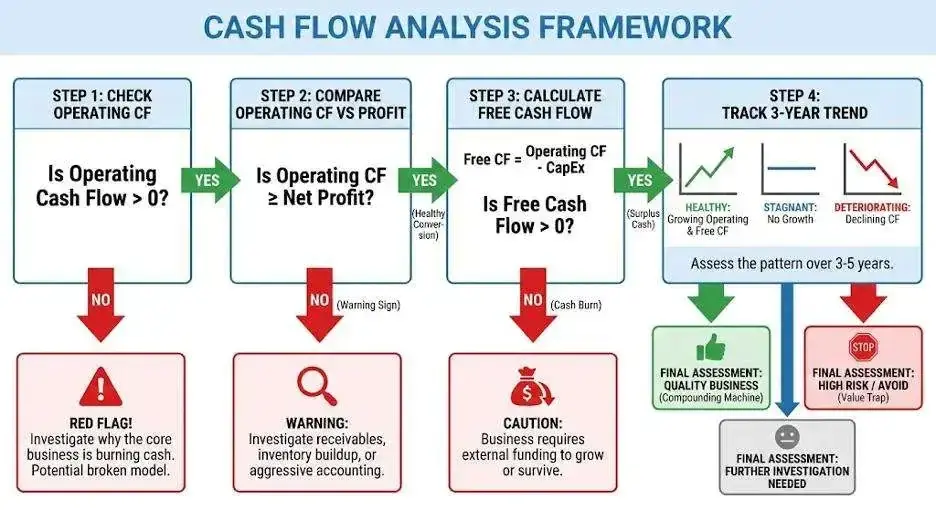
Step 1: Start With the Cash Flow Summary
Open any company’s annual report or quarterly results. Go directly to the cash flow statement. Ignore the income statement for now. Look at three numbers:- Operating Cash Flow (cash from core business)
- Investing Cash Flow (cash spent on or from assets)
- Financing Cash Flow (cash from or to investors/lenders)
Add them together. That’s the net change in cash for the period. If it’s positive, the company ended the period with more cash than it started. If negative, it burned through cash.
Step 2: Check the Quality of Cash Generation
Question 1: Is operating cash flow positive?
If yes, good start. If not, why not? Is it a start-up that is in the investment phase (understandable in the case of start-ups), or is it a mature business with a failed model (red flag)?
Question 2: Is operating cash flow greater than net profit?
If yes, excellent. The company is efficiently converting profit into cash. If not, investigate why. Are receivables piling up? Is inventory bloating? Are profit accounting tricks inflating profit?
Question 3: Does the Free cash flow (operating cash flow - CapEx) have a positive value?
In case yes, the firm conserves excess cash following/expanding the business. Otherwise, the company wastes money and requires external financing to sustain its operations.
Step 3: Analyse the Three-Year Trend
A quarter or a year does not mean a lot. Compare 3-5 years of cash flow projections. What patterns emerge?Healthy pattern: - Operating cash flow has been increasing -investing cash flow is negative and disciplined (the company is investing in growth) -financing cash flow demonstrates the repayment of debt or dividends (the company is giving cash back to stakeholders)
Warning pattern: - Operating cash flow is Erratic or declining - Investing cash flow is positive (selling assets to get cash) - Financing cash flow is demonstrating consistent borrowing or equity dilution.
Step 4: Calculate Key Ratios
Cash Conversion Ratio = Operating Cash Flow / Net ProfitTarget: Above 1.0 consistently. A red flag is less than 0.8 over several years.
Free Cash Flow Margin = Free Cash Flow / Revenue
Target: 10 percent+ of good businesses. The bad sign with mature companies is worrying.
Dividend Coverage = Free Cash Flow / Dividends Paid
Target: Above 1.5x. When the business spends a greater amount of money in making dividends compared to the amount that it earns in the form of free cash flow, then it can be said that the dividend is not sustainable.
If you want a deeper breakdown of the most powerful ratios beyond cash flow, read: Financial Ratios That Actually Matter for Stock Picking
Explore our Products
Research Framework

Emerging Titans
Combination of quantitative analysis, industry tailwinds, and management assessment - SPRINT investment philosophy

Tiny Titans
Heavy emphasis on scuttlebutt research, plant visits, and early on-ground signals
Conclusion
In the end, stock prices fluctuate. Accounting policies change. Narratives shift. Cash does not.Companies don’t fail because earnings dip for a quarter. They fail because cash dries up. And the investors who ignore the cash flow statement usually realise the mistake only after the damage is done.
Before you buy your next stock, don’t start with revenue growth. Don’t start with margins. Start with operating cash flow. Subtract capital expenditure. Follow the three-year trend. If the cash generation doesn’t make sense, neither does the investment.
At Value Educator Research, we break down real Indian companies using a fundamentals-first framework — focusing on cash generation, capital discipline, and long-term durability rather than short-term earnings noise.
Comment “CASH” if you want our simple 5-step cash flow analysis template used for evaluating businesses.
Frequently Asked Questions (FAQ)
If a company reports profit but has negative cash flow, is it a fraud?
+Can a company operate with negative operating cash flow ?
+What is considered a healthy free cash flow margin?
+It varies by industry.
Software and service businesses: 15–25% is excellent.
Manufacturing and retail: 5–10% is respectable.
Capital-intensive sectors (telecom, infrastructure): Even 3–5% may be acceptable.
However, a mature company consistently generating negative free cash flow should raise concern.
How can I judge whether capital expenditure (CapEx) is too high?
+Compare CapEx with depreciation over a 3–5 year period:
If CapEx is 2–3× depreciation, the company is expanding.
If CapEx roughly equals depreciation, it is maintaining its assets.
If CapEx is consistently below depreciation, the company may be under-investing, which can hurt long-term competitiveness.
Patterns matter more than one year’s data.
Should I avoid companies with debt?
+No. Debt itself isn’t the problem — mismanaged debt is.
Assess whether the company can comfortably service its obligations from operating cash flow.
A simple check: Operating Cash Flow ÷ (Debt Repayment + Interest)
Above 2× → Comfortable coverage
Between 1.5× and 2× → Monitor carefully
Below 1× → Dangerous territory
If a company needs to borrow just to repay existing debt, the situation can quickly spiral.
What if a company buys back shares despite negative free cash flow?
+
High growth stock specialist, Value Educator
Shashank Mahajan is an equity research professional with over 12 years of experience in identifying high-potential SME and micro-cap stocks at an early stage. He follows a rigorous scuttlebutt research–driven approach, combining on-ground insights with deep financial analysis. Shashank specializes in uncovering under-researched and under-owned companies with strong management quality and long-term growth potential. Through disciplined research and early identification, he focuses on spotting tomorrow’s market leaders before they enter the mainstream investor radar.

Zen Technologies: Why Revenue Fell After Its Biggest Win

Data Patterns: India's Radar Designer and Its Waiting Orders

KSH International: The Wire Inside India's Transformers

Krishna Defence: The Steel Behind India's Warship Hulls

PNG Jewellers: A 194-Year-Old Name Goes National

Axiscades: From Services to Missile and Radar Electronics
Explore our Products
Research Framework
Emerging Titans
Combination of quantitative analysis, industry tailwinds, and management assessment - SPRINT investment philosophy
Tiny Titans
Heavy emphasis on scuttlebutt research, plant visits, and early on-ground signals

Download your free E-book - Beyond the radar
Master your micro-cap investing with our tailor-made E-book. Beyond the radar. Download now!


 Orders
 Subscription
 Share with friends
 Logout


Required Details
₹23999.00
(12 month subscription)
As per SEBI regulations, all users are mandated to complete the KYC that is validated for 1 year. Post payment, you will be redirected to the KYC screen


No comments yet. Be the first to comment!