
EBITDA Explained: Uses and Limits
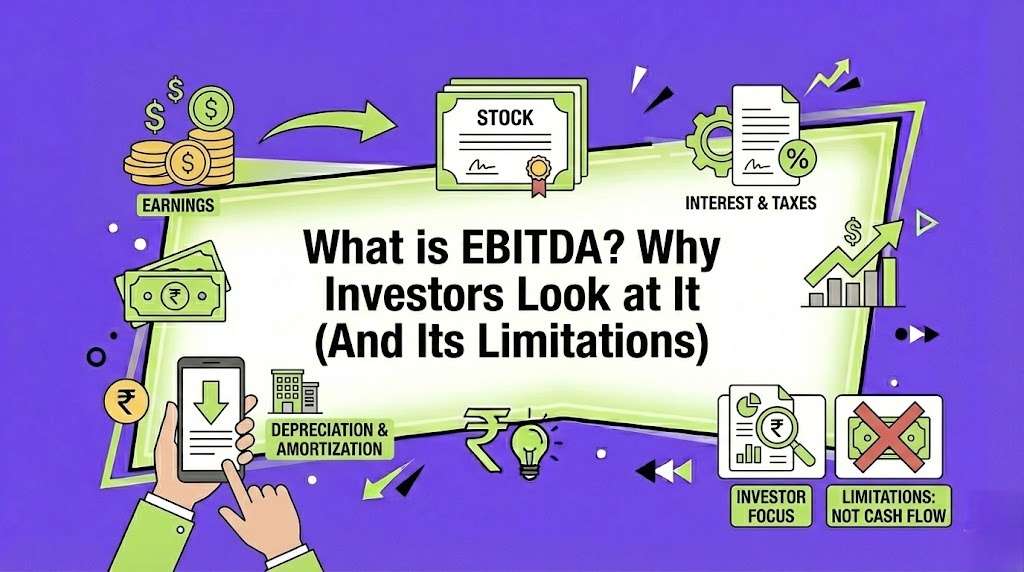
For years, profitability has been considered the holy grail of business success – the point at which growth equals success. However, in today’s world, many startups and high-growth companies have something to celebrate long before they hit profitability: they’ve become EBITDA positive. Investors have been surprised by their own enthusiasm for this new trend, as if it’s a sign of success when they’re still losing money.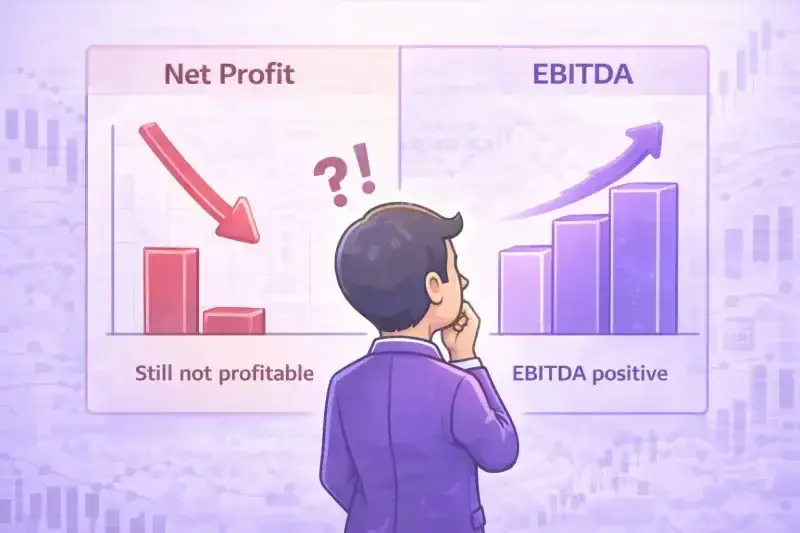
But this also leads to a larger question of how performance is being interpreted in the modern market. If profits have yet to materialise, what is it exactly that investors are seeing in EBITDA that is altering their perspective?
Is it a better understanding of strength, a means of separating accounting noise from signal, or simply a useful tool that paints a more positive picture? The increasing emphasis on EBITDA is more than simply a financial formula; it is a larger trend in how businesses are being measured, particularly in industries where capital intensity and accounting charges can muddy the waters.
On the other hand, the universal nature of EBITDA has confused. EBITDA is often characterised as a statement of earnings, a measure of cash flow, a basis of valuation, or all three at once. It is important for an individual attempting to grasp financial performance beyond the figures to understand why investors speak of EBITDA, what EBITDA actually measures, and where EBITDA creates confusion.
In order to grasp why this particular metric has received so much attention and why achieving a positive EBITDA is often considered a significant achievement, it is helpful to take a step back and examine what EBITDA actually measures and how investors actually use it.
Behind the Bottom Line: What is EBITDA?
EBITDA is an acronym that represents Earnings Before Interest, Taxes, Depreciation, and Amortisation. While the name itself may seem complicated, the idea is actually very simple: it attempts to gauge the performance of the core business, regardless of the impact of financial choices, tax environments, and other accounting treatments.
“Accounting is the language of business.” - Warren Buffett
Talking in simple terms, EBITDA tries to measure business performance by stripping away items that can be quite different from one business to another, but do not necessarily measure business efficiency.
For instance, interest expenses are dependent on how a business is financed – whether it is debt-heavy or equity-heavy. Taxes can also vary based on geographical differences, tax authorities, or short-term tax incentives. Depreciation and amortisation are accounting methods of past investments, which implies that they can have a huge impact on the bottom line without changing the business performance.
One way to easily understand the concept of EBITDA is as follows: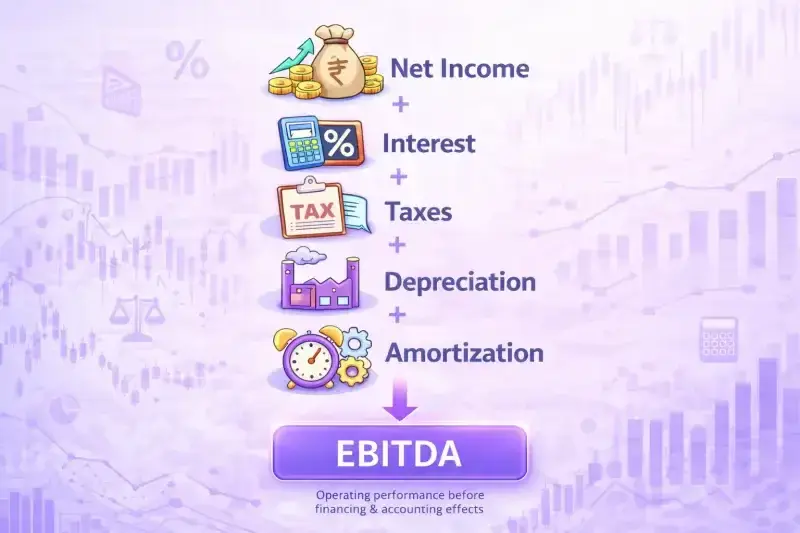
EBITDA = Net Income + Interest + Taxes + Depreciation + Amortization
Read More: How to Read a Balance Sheet Like a Professional Investor
By this, investors are able to use EBITDA as a tool to focus on the operating part of the company and get a comparable view. While EBITDA can be a useful tool, it is important to understand what it encompasses and what it does not before using it as a tool to measure financial strength.
Read More: 7 Early Signals That a Stock Can Turn Multibagger
Understanding what EBITDA measures is only the first step. The real question is why this metric attracts so much attention from investors, analysts, and management teams, often becoming a central part of how a company’s performance is discussed.
The Investor Perspective: Why EBITDA Gets So Much Attention
EBITDA has become one of the most commonly used terms in financial discourse, being discussed in earnings calls, analyst reports, and valuation talks. One of the reasons why it has become so popular is that it is a very straightforward concept, allowing investors to look beyond the details of financial reporting that can sometimes cloud the bottom-line profit number.
“Show me the incentive and I will show you the outcome.” - Charlie Munger
For an investor trying to compare companies, this can be very helpful. Two companies may be in the same industry, but they may have very different levels of debt or tax structures, making it difficult to compare them solely on the basis of their net income. EBITDA tries to provide a more equal playing field by showing how the underlying business is performing before these factors are taken into account.
Another reason why investors focus on EBITDA is that it may offer the first glimpse of success. This is particularly true in the case of companies that are expanding or investing heavily. It may take some time for such companies to start showing profits. However, a rising EBITDA may indicate that the business model is becoming more efficient, even if the profits are not yet reflecting this.
However, the popularity of EBITDA has also resulted in some misconceptions. It is sometimes treated as if it represents real earnings or cash flow, when in reality it is simply one lens among many for evaluating performance. Investors rely on it because it helps isolate certain aspects of a company’s operations, but understanding why they use it also requires recognising what it does and does not capture.
Read More: How to Identify Genuine Penny Stocks Before They Become Multibaggers
Once investors grasp what EBITDA indicates, the next course of action is to observe how EBITDA is applied in analysis. Instead of focusing on EBITDA alone, investors tend to use EBITDA in conjunction with basic ratios to compare firms, determine efficiency, and spot possible pitfalls.
How EBITDA is used in Analysis
In reality, EBITDA is never considered in isolation. Investors usually employ it in conjunction with a few other important ratios that can help them derive more significant information from operating results.
“Valuation is not about numbers alone, it is about stories backed by numbers.” - Aswath Damodaran
- EV/EBITDA - A Different Perspective on Valuation
Among the most frequently mentioned ratios is the EV/EBITDA ratio. This ratio matches the total value of a company, including both equity and debt, to its operating profits. Investors find this ratio more informative when comparing companies in the same industry because it helps to reduce the differences in their capital structures.Read More: Circulation vs. Consumption Stocks: Which Type is More Recession-Proof?
- EBITDA Margin - Making Sense of Operational Efficiency
EBITDA margin analysis looks at EBITDA in relation to revenue, enabling investors to make more informed judgments about the efficiency of the business in earning profits from revenue. This is particularly useful when comparing different businesses of different sizes, enabling investors to make informed judgments about the efficiency of the business rather than its size. EBITDA margin trends can also enable investors to make informed judgments about the efficiency of the business’s management. - EBITDA vs Operating Cash Flow - Connecting Earnings to Reality
While EBITDA is a useful tool for evaluating earnings, it is also possible to compare EBITDA to operating cash flow to determine the extent to which the earnings are actually generating cash. A large discrepancy between the two may suggest working capital problems, high reinvestment requirements, or other issues that may be affecting the company’s liquidity. This is a very important reminder that EBITDA is not cash flow. - Debt to EBITDA - A Quick View of Financial Risk
Another common use of EBITDA appears in leverage analysis. Debt to EBITDA ratios help investors make informed decisions regarding how much debt is manageable in relation to the operating earnings of a business. By comparing the debt and the operating performance, investors can make informed decisions regarding whether the financial obligations seem sustainable or not.
While EBITDA can offer useful insight into operational performance, its usefulness is not universal. The value of this metric often depends on the nature of the business itself; in some sectors, it helps clarify performance, while in others it can oversimplify important financial realities.
Not Every Business Is the Same: Where EBITDA Matters Most
Explore our Products
Research Framework

Emerging Titans
Combination of quantitative analysis, industry tailwinds, and management assessment - SPRINT investment philosophy

Tiny Titans
Heavy emphasis on scuttlebutt research, plant visits, and early on-ground signals

- Where EBITDA provides meaningful insight
- Capital-intensive industries (telecom, infrastructure, airlines, manufacturing, utilities) :
Those firms that are highly dependent on tangible and intangible assets are likely to report significant depreciation and amortisation expenses, respectively, which could impact their bottom-line performance despite strong operating performance. EBITDA assists investors in disregarding such accounting allocations and concentrating on the efficiency of the underlying business in generating operating profits. Eg: Bharti AirtelRead More: LINK: Understanding Industry Cycles: How to Invest in Cyclical vs Defensive Stocks - Companies with varying capital structures :
In the same industry, there could be two different companies that could be operating with significantly different amounts of debt. This could make it difficult to compare the two companies based on their net income. EBITDA helps to create a comparable starting point. Eg: Larsen and Toubro (L&T) - Valuation and M&A contexts :
EBITDA is a key component of ratios such as EV/EBITDA, which are used by investors and acquirors to make relative valuation comparisons. This is because EBITDA is a measure of operating performance that is not affected by financing and tax differences. Eg: Tata Steel - Early-stage or scaling businesses :
For companies that are still heavily investing in order to grow, it is possible that they may not yet be showing consistent profitability. In such scenarios, EBITDA may be used as a tool to determine whether the companies are on the right track, even before they start showing net profits. Eg: Zomato
- Where EBITDA may be less reliable
- Financial institutions :
For banks, NBFCs, and insurance companies, interest income and expense are fundamental to how the business operates. Removing these elements reduces the relevance of EBITDA and may obscure rather than clarify performance. Eg: HDFC Bank - Asset-light businesses (IT services, consulting, certain software models) :
When depreciation and amortization are relatively small, EBITDA may not provide significantly different insight compared to operating profit, limiting its analytical value. Eg: Infosys - Businesses with heavy reinvestment or working capital requirements :
EBITDA does not factor in capital spending and working capital, which can result in a rosy scenario being painted for companies that need constant reinvestment in order to stay in business. Eg: IndiGo - Companies emphasizing heavily “adjusted” EBITDA :
Although changes may occasionally enhance understanding, too many exclusions could potentially misrepresent reality, making it more difficult for investors to distinguish between actual improvements and accounting representations. Eg: WeWork
Having a clear understanding of what EBITDA is and how it is perceived conceptually, the next step is to analyse how these concepts are applied. By analysing an example, it is possible to gain a better understanding of how the information is received from theory to practice.
Moving Beyond the Equation: Practical Understanding of EBITDA
“Know what you own, and know why you own it.” - Peter Lynch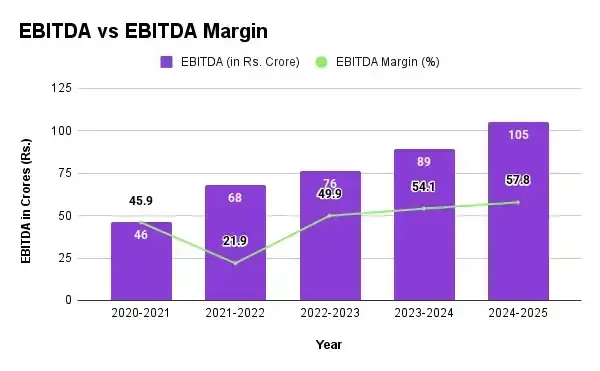
A capital-intensive telecom business such as Bharti Airtel is a good example to understand how EBITDA is perceived in practice, as opposed to theory. Over the past five years, Airtel’s EBITDA has grown from ₹461,387 Mn in FY 2020-21 to ₹1,049,994 Mn in FY 2024-25, with the EBITDA margin expanding from 45.9% to 57.8%. Instead of merely showing improved profitability, this data shows how the operating model of the company has changed over time in a competitive and capital-intensive industry.
Telecom companies are capital-intensive, requiring significant investment in spectrum and network. However, once the foundation is laid, incremental business such as growing subscriber base or data usage may not necessarily drive an equal increase in operating expenses. This is why EBITDA margins emerge as a crucial metric to focus on. The fact that the margin has moved from ₹46 per ₹100 of revenue to a close of ₹58 per ₹100 of revenue suggests that Airtel is able to generate more operating profit per unit of revenue, which is a welcome change in an industry where cost structures and pricing dynamics are so important.
From an industry perspective, a rise in EBITDA and margins suggests that the telecom service company is likely to be better positioned in the market, either because of pricing power, customer base, or operational efficiencies due to scale. In other words, investors tracking Airtel’s EBITDA performance would be looking at it not merely as a measure of earnings growth but also as an indicator of its relative efficiency in its core business, given the capital intensity of the industry.
After seeing how EBITDA highlights operating performance, it becomes equally important to understand what the metric leaves out.
Why EBITDA Isn’t the Whole Story
“We don’t look at EBITDA, because depreciation is a real expense.” - Warren Buffet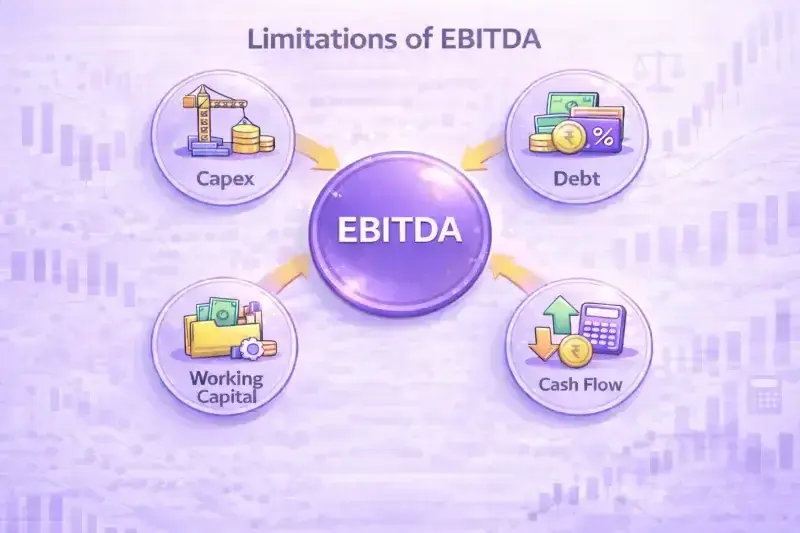
EBITDA is a convenient way to analyze financial results by stripping out some expenses, but the same process can also obscure important information about financial reality.
One important thing that EBITDA misses is capital expenditure. Even if the operating profit is strong, some companies still need to make capital expenditures to sustain or expand their business. Since these expenditures are not included in EBITDA, the measure can sometimes overstate the profitability of a company compared to its actual financial needs.
EBITDA also strips out interest expenses, which helps to make comparisons between companies easier, regardless of their capital structure. But the fact is that debt still exists and affects financial risk. A company that has strong EBITDA but high debt may be constrained in a way that EBITDA does not show.
Read More: LINK: How to Read a Balance Sheet Like a Professional Investor
The other weakness is that EBITDA does not take into account changes in working capital and other cash flow patterns. It may not necessarily mean that there is an increase in cash flow, such that EBITDA should not be used as a proxy for cash flow.
Read More: Portfolio Rebalancing – Why and When You Should Adjust Your Portfolio
Lastly, EBITDA can be misleading if it is highly adjusted or if it is shown out of context. Because EBITDA is not strictly defined under accounting rules, it is important to interpret EBITDA results carefully.
“Risk means more things can happen than will happen.” - Howard Marks
Taken together, these weaknesses do not diminish the usefulness of EBITDA but rather support that EBITDA should be used as one of many tools.
EBITDA Revisited: What It All Means
“The investor’s chief problem, and even his worst enemy, is likely to be himself.” - Benjamin Graham
EBITDA is considered to be a tool that can be used to quickly assess the performance of a business, but its true use is in its ability to help shape interpretation rather than provide answers. It enables investors to see how well the core operations of the business are working by looking at operating earnings before financing and accounting adjustments. At the same time, its exclusions remind us that strong EBITDA does not automatically mean strong cash flow or low risk.
As discussed throughout this article, EBITDA is most useful as a lens, not a conclusion. Industry dynamics, capital intensity, leverage, and business structure all impact what the measure actually says. When considered in conjunction with profit, cash flow, and balance sheet strength, EBITDA becomes a point of departure for further analysis, rather than a means of measuring success.
If this changed how you think about EBITDA, comment “EBITDA” below. Share this with someone who still treats it as profit, and tell me, when analysing a company, do you start with EBITDA or look at cash flow first?
FAQs
Is EBITDA the same as profit?
+No. EBITDA is not the same as net profit. It excludes interest, taxes, depreciation, and amortization, which means it focuses on operating performance rather than the final earnings available to shareholders.
Does EBITDA represent cash flow?
+Not exactly. EBITDA may sometimes move in the same direction as cash flow, but it does not account for working capital changes, capital expenditure, or debt repayments. This is why EBITDA should not be treated as a substitute for operating cash flow
Why do investors focus on EBITDA instead of net income?
+Investors use EBITDA to compare companies more easily by removing differences caused by financing choices, tax environments, or accounting allocations. It helps isolate how efficiently the core business operates.
Is a higher EBITDA always better?
+Not necessarily. A rising EBITDA may signal improving operations, but it does not automatically mean the company is financially strong. Debt levels, reinvestment needs, and cash flow must also be considered.
Which industries rely more on EBITDA?
+EBITDA is commonly used in capital-intensive industries such as telecom, infrastructure, manufacturing, and utilities, where depreciation or financing structures can significantly impact net profit.
Can EBITDA be misleading?
+Yes. Because EBITDA excludes certain expenses and is not strictly defined under accounting standards, companies may present “adjusted EBITDA,” which requires careful interpretation to avoid misunderstanding performance.

High growth stock specialist, Value Educator
Shashank Mahajan is an equity research professional with over 12 years of experience in identifying high-potential SME and micro-cap stocks at an early stage. He follows a rigorous scuttlebutt research–driven approach, combining on-ground insights with deep financial analysis. Shashank specializes in uncovering under-researched and under-owned companies with strong management quality and long-term growth potential. Through disciplined research and early identification, he focuses on spotting tomorrow’s market leaders before they enter the mainstream investor radar.

Zen Technologies: Why Revenue Fell After Its Biggest Win

Data Patterns: India's Radar Designer and Its Waiting Orders

KSH International: The Wire Inside India's Transformers

Krishna Defence: The Steel Behind India's Warship Hulls

PNG Jewellers: A 194-Year-Old Name Goes National

Axiscades: From Services to Missile and Radar Electronics
Explore our Products
Research Framework
Emerging Titans
Combination of quantitative analysis, industry tailwinds, and management assessment - SPRINT investment philosophy
Tiny Titans
Heavy emphasis on scuttlebutt research, plant visits, and early on-ground signals

Download your free E-book - Beyond the radar
Master your micro-cap investing with our tailor-made E-book. Beyond the radar. Download now!


 Orders
 Subscription
 Share with friends
 Logout


Required Details
₹23999.00
(12 month subscription)
As per SEBI regulations, all users are mandated to complete the KYC that is validated for 1 year. Post payment, you will be redirected to the KYC screen


No comments yet. Be the first to comment!