
Risk vs Reward: Why Psychology Matters
Why Most Investors Get This Backwards — And How It’s Costing Them
The Phone Call That Changed Everything
February 2018. A friend called me at 11 PM, voice shaking.
“The market’s crashing. I’m down 35%. Should I sell?”
He’d put his daughter’s college fund — money needed in 18 months — into small-cap stocks because they’d been delivering 40% returns. Everyone was making money. He didn’t want to miss out. Now those same stocks were collapsing. And he couldn’t sleep.
This is the conversation that happens in every market crash. The same pattern. The same mistake. The same devastating realization: He never understood his risk appetite. He was confused watching others make money while being able to handle losses himself.
Read More: Bull Market vs Bear Market – How Investors Should React
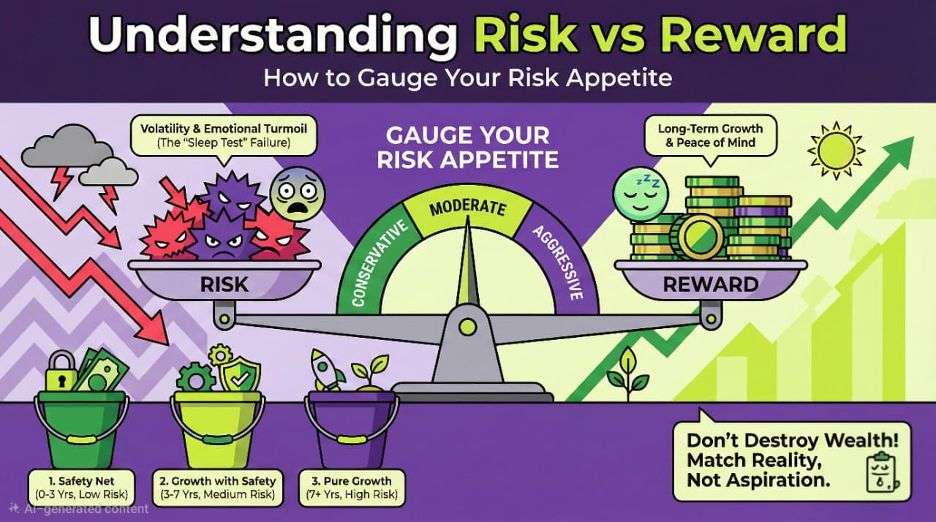
Nobody tells you this when you start investing: risk tolerance isn’t about how much money you want to make. It’s about how much loss you can take before you start making bad decisions. It’s about whether you can watch your portfolio fall 30% and NOT panic-sell at the bottom. It’s not about understanding volatility intellectually. It’s about experiencing it emotionally and still sticking to your plan.

This is where most investors destroy wealth.
They overestimate their risk appetite during bull markets when everything is rising. They discover their true tolerance only when markets crash — by which point it’s too late. The damage is done. They’ve already sold low, locked in losses, and missed the recovery. If you’ve ever sold during a panic and watched those same stocks double within a year, this write-up will show you why. If you’ve ever taken more risk than you could handle because ‘everyone else was doing it’ — you’re about to understand what went wrong.
This isn’t about becoming a risk-taker or a conservative investor. It’s about understanding YOUR actual capacity for risk — not the version you imagine when markets are calm, but the version that shows up when your portfolio is bleeding.
Risk appetite isn’t what you think you can handle. It’s what you can handle when things actually go bad.
1. What Risk Appetite Actually Means (And Why Most Definitions Are Worthless)
The Test Nobody Passes
Walk into any bank. Fill out a risk profiling questionnaire. You’ll see questions like: “What is your investment time horizon?” and “What percentage loss can you tolerate?” You’ll answer honestly. The algorithm will categorize you: Conservative. Moderate. Aggressive.
And it will be completely wrong.
Because these questionnaires measure what you THINK you can handle when markets are calm. They don’t measure what you’ll ACTUALLY do when your portfolio falls 40% in three weeks. Risk appetite is the maximum psychological and financial pain you can endure without abandoning your investment plan — not the pain you’re willing to accept in theory, but the pain you can actually survive in practice, when your spouse is asking why the portfolio is down, when friends are panic-selling, when business channels are predicting further crashes, when your own conviction is wavering.
Read more: What Is an Investment Philosophy? Why Every Serious Investor Needs One
The Three Dimensions Nobody Talks About
Real risk appetite consists of three elements, and the majority of investors consider a single one
1. Financial Capacity (Can you afford the loss?) This is the only dimension questionnaires measure. Do you need this money in 6 months? 3 years? 10 years? Can you survive if it drops 50%? Simple math. Important — but not enough..
2. Emotional Capacity (Can you handle watching the loss?) This is where theory meets reality. Watching ₹10 lakh become ₹6 lakh feels completely different than imagining a ‘40% drawdown’ on paper. Some investors check portfolios daily and panic at every dip. Others check quarterly and sleep fine. Same loss, completely different emotional experiences.
Read More: How to Stay Emotionally Strong During Market Crash
3. Behavioral Capacity (Can you stick to the plan despite the loss?) This is the killer. It’s not just about tolerating pain — it’s about not making destructive decisions because of it. Can you hold during crashes? Can you avoid panic-selling? Can you resist chasing performance? Can you rebalance when it feels terrifying?
Risk appetite is where all three dimensions intersect. Miss any one, and your portfolio will eventually blow up.
Think about my friend with his daughter’s college fund. He had no financial capacity (needed money in 18 months), no emotional capacity (35% loss kept him awake at night), and no behavioral capacity (ready to sell at the worst possible time). But he scored “Aggressive” on his bank’s questionnaire because he checked the “willing to accept volatility” box. That’s why standard risk profiling fails. It measures intentions — not real capability.
"Risk comes from not knowing what you’re doing." — Warren Buffett
2. Why Risk Appetite Matters More Than Returns
The Cycle That Destroys Portfolios
Here’s the pattern that repeats in every market cycle:
Year 1–2 (Bull Market): Markets rise 25% annually. Small-caps deliver 40%. Your friend who went “all-in” is bragging about returns. You feel like you’re missing out on your balanced 60-40 portfolio.
Year 3 (Peak Euphoria): You can’t take it anymore. You increase equity from 60% to 85%. You chase small-caps. You tell yourself you understand the risks.
Year 4 (Crash): Markets fall 35%. Your 85% equity portfolio drops 30%. That’s ₹30 lakh gone if you had ₹1 crore. You can’t sleep. You check prices hourly.
Year 5 (Capitulation): You’re down 40% total. You sell. You move to FDs at 6% because “stocks are too risky.”
Year 6–7 (Recovery): Markets recover 60% from the bottom. Your old portfolio would be back to even and climbing. But you’re sitting in FDs at 6%, watching the wealth you could have had multiply.
This is how mismatched risk appetite destroys wealth.
Not because the investments were wrong. Because the investor couldn’t handle the journey.
The Real Cost: Numbers That Shock
Investor A (Balances Risk with Appetite): 60% equity / 40% debt.
Portfolio fell ~22% during the crash.
Stayed invested and rebalanced.
10-year CAGR: ~11%.
Most importantly, slept fine.
Investor B (Overestimates Tolerance): 90% equity to “maximize returns.” Portfolio fell 35% during the crash. Panics, sells at the bottom, moves to FDs. 10-year CAGR: 4%. Stress, regret, missed opportunities.
Same market. Same stocks. Completely different outcomes.
Investor B didn’t lose because he took risk. He lost because he took MORE risk than he could handle, forcing bad decisions at the worst time.
The Paradox Nobody Explains: Taking LESS risk than you can handle is also costly. A 30-year-old with stable income and a 25-year horizon who parks 100% in FDs out of fear is leaving enormous wealth on the table. The goal isn’t minimum risk or maximum risk. It’s OPTIMAL risk — the highest level you can sustain without behavioral failures. This is what separates wealth builders from wealth preservers.
"The stock market is designed to transfer money from the Impatient to the Patient." — Warren Buffett

3. How to Actually Measure Your Risk Appetite
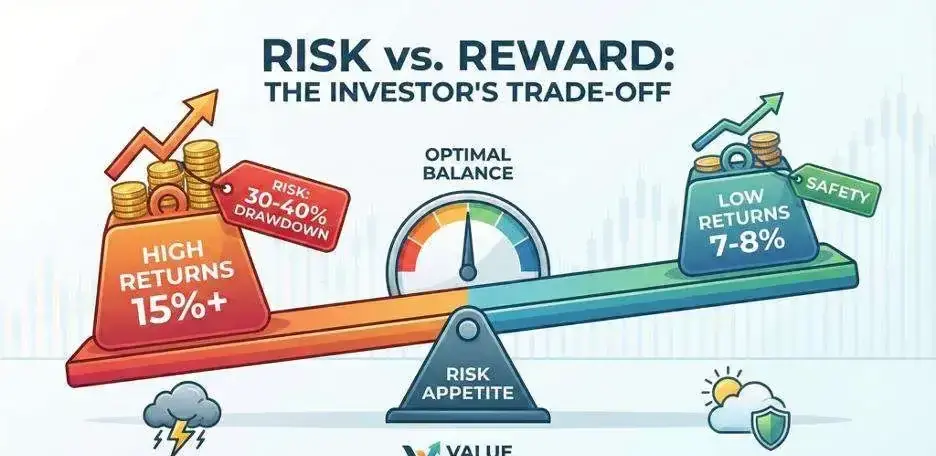
Risk vs Reward in One Sentence
Higher reward is always rented, not bought — and the rent is paid in volatility.
That’s the entire game. You can’t get 15% returns without accepting 30% drawdowns. You can’t chase multibaggers without risking 50% losses. The market doesn’t give returns for free. It charges rent in the form of stomach-churning volatility. The question isn’t whether you want high returns. Everyone does. The question is: can you afford the rent?
The Math Nobody Shows You
Let us say you have a portfolio that's worth ₹10 lakh. You decide to put 80% of this money, which is ₹8 lak,h into equity investments. The remaining 20%, which is ₹2 lakh, you put into debt investments. Now imagine the markets have a fall; they go down by 40%. Because of this, the value of your equity investments falls to ₹4.8 lakh. Your debt investments remain the same at ₹2 lakh. So when you add these two together, your total portfolio is now worth ₹6.8 lakh.
₹3.2 lakh gone — 32% of your entire portfolio.
Now ask yourself the real question: Can you handle watching ₹3.2 lakh of your own money disappear, not knowing when or if it will come back — and still not sell? If yes, 80% equity suits you. If that number makes your stomach turn, 80% equity will destroy your wealth. Not the market. You will.
Test 1: The Sleep Test
Look at your current portfolio. Now, imagine it falls by 30% tomorrow itself – actually visualize it. Your ₹10 lakh will become ₹7 lakh. Your ₹50 lakh will become ₹35 lakh. Now, tell yourself the truth – will you be able to sleep tonight? Not “would you be okay intellectually.” Can you actually sleep? Can you go to work the next day without checking prices every 10 minutes? If the answer is no — if a 30% drop would genuinely disrupt your life — your risk appetite is lower than 30%. Doesn’t matter what any questionnaire says.
Test 2: The Action Test
That 30% drop happens. Markets are in panic mode. Business channels predict further falls. Your friend sold yesterday and is urging you to do the same. What would you actually do? Not what you should do. Not what Warren Buffett would do. What would YOU do, in that moment, with real money, under real pressure? If you can’t honestly answer “hold without checking daily,” your actual risk tolerance is much lower than you think. Most investors discover they’re panic-sellers during crashes — not the disciplined long-term holders they imagined themselves to be when markets were calm.
Test 3: The Past Behavior Check
Look at your investment history. Ignore what you think your risk appetite is — your behavior reveals the truth. 2020 COVID crash: Did you hold or sell? 2018 correction: How did you react when markets fell 15%? Past behavior predicts future behavior. And when you panicked at 15% in 2018, you will panic at 30% in 2026. Build your portfolio for who you actually are — not who you wish you were.
"In investing, what is comfortable is rarely profitable." — Robert Arnott
4. The Risk Appetite Spectrum: Where Do You Actually Fit?
Conservative: Needs money within 3–5 years. Loses sleep with any portfolio decline. Prioritizes capital preservation. Common mistake: Adding small caps to “boost returns” – always ends in panic selling during corrections. Actual scenario: Senior citizen with ₹1 crore corpus, generating monthly income. Conservative allocation is not cowardly. It is appropriate for the situation.
Moderate: 5–10 year horizon. Can tolerate volatility intellectually. Stable income, manageable expenses. Common mistake: drifting to 70–80% equity during bull markets without realizing it, then getting hit harder than expected. Real example: A 35-year-old saving for his child’s education in 8 years. A balanced approach avoids both extremes.
Aggressive: 10+ year horizon. Can stomach 35–40% drawdowns. Proven ability to hold through crashes. Common mistake: going 100% equity with zero buffer — no dry powder to rebalance when a crash comes. Most people who think they qualify as aggressive don’t know yet. The ones who truly do have survived a 40%+ crash without selling. Real example: 28-year-old, no dependents, ₹15L annual income, 20+ year horizon.
5. The 2008 Crisis: When Risk Appetite Met Reality
If you want to understand risk appetite in practice — not theory — study 2008. This is the case study that holds all the answers.October 2007: Markets at all-time highs. Everyone’s a genius investor. A lot of people who invest their money are willing to take risks. In fact, 80% of retail investors are what you would call aggressive retail investors. Risk appetite questionnaires show this about investors. They are normally retail investors.
September 2008: Lehman Brothers goes bust. Markets crash another 25%. Total loss from peak: 40%.
March 2009: Markets down 60% from peak. ₹1 crore is now ₹40 lakh. Banks are failing. Panic all around.
This is where risk appetite was tested for real.
Investor A (Matches Risk to Appetite): 60% equity, 40% debt. Lost 33% (painful, but tolerable). Rebalanced during the crash. By 2012, all bounced back and then some. Emotionally: stressed, but functional.
Investor B (Overestimates Risk Tolerance): It is 90 percent equity, which is aggressively invested to get high returns. Lost 50% (mentally shattering). Sold near the bottom in March 2009. Money put in FDs did not get the whole recovery. By 2012: still 35% short of the 2007 peak.
The Data That Shocked Everyone
Nifty fell by 60 percent between October 2007 and March 2009. Small-caps fell even harder from October 2007 until March 2009. Small-cap index fell 70%. Real estate stocks fell 80%+. Banking stocks fell 75%. By March 2015, Nifty had increased by 150 percent from its lows. Investors who sold in 2009 missed it completely.
For context, the 2020 COVID crash: Nifty fell 38% in just 4 weeks. Recovery took 5 months to reach previous highs. Investors who sold in March 2020 missed 80%+ gains by year-end. And in 2018: small-cap index fell 40%+ from January peaks to October lows. Individual stocks dropped 60–70%.
The lesson: Your risk appetite isn’t tested during the fall. It’s tested at the bottom — when you have to decide whether to sell, hold, or buy more. The investors who held or rebalanced at the 2009 bottom compounded their wealth enormously. The ones who sold were locked in permanent losses.

6. The Biggest Risk Appetite Mistakes
Mistake 1: Confusing Knowledge with Tolerance
"I understand volatility intellectually. I’ve read about market crashes. I know stocks always recover. Therefore, I can handle big drawdowns." This is completely wrong. Understanding something and living through it are completely different. An engineer friend built a 95% equity portfolio, saying, “I’ve modeled historical returns. I can handle this.” Then 2020 happened. Portfolio fell 38% in three weeks. Despite knowing it was temporary, despite having decades to invest, he couldn’t function. He sold 60% of his equity in March 2020.
The fix: Test yourself with small amounts first. Start with 50% equity. Experience a 10–15% correction. See how you actually react. Then adjust. Knowledge is not tolerance. Tolerance must be earned through experience.
Mistake 2: Changing Risk Profile Mid-Journey
"Markets have been rising for 3 years. I was too conservative. Time to increase equity." This is exactly backwards. You should increase risk when you’re scared (market lows), not when you’re confident (market highs). In 2017, after 3 years of strong returns, mutual fund inflows hit record highs. By 2018, when markets corrected 15%, those same investors redeemed aggressively. They bought high and sold low.
The fix: Set allocation based on time horizon and emotional capacity. Stick to it. Rebalance mechanically. Never change based on recent market performance. Your risk appetite shouldn’t change with market direction — that’s emotional reactivity, not risk management.
Mistake 3: Comparing Yourself to Others
"My friend made 60% in small-caps last year. I only made 15% in balanced funds. I need to take more risks." You see others’ gains, not their stress. You see their best year, not their average. You see their wins, not their hidden losses. In 2017, an investor switched from balanced funds to sector funds. Gained 45% in 2017. Then fell 35% in 2018 and sold everything. His original balanced fund would have been down only 8%.
The fix: Your risk appetite is personal. Stop comparing returns. Start comparing whether you can sleep at night.
"It’s not whether you’re right or wrong that’s important, but how much money you make when you’re right and how much you lose when you’re wrong."
— George Soros

7. How to Build a Portfolio That Matches YOUR Risk Appetite
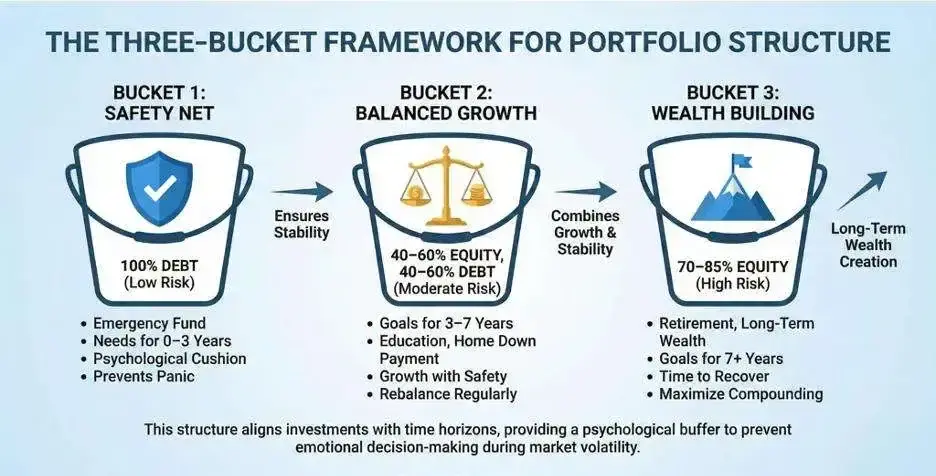
The Three-Bucket Framework
Bucket 1 — Safety Net (0–3 Years): 100% low-risk debt. Emergency fund + any money you’ll need in the next 2–3 years. Liquid funds, FDs, short-term debt funds. This bucket lets you be aggressive with the rest. When markets crash, and Bucket 2–3 are down 30%, you know you have safety. That psychological cushion prevents panic.
Bucket 2 — Growth with Safety (3–7 Years): 40-60% equity, 40-60% debt. For medium-term plans, such as children’s education or a down payment on a home. Conservative bias: 30% equity. Moderate: 50% equity. Aggressive bias: 70% equity.
Bucket 3 — Pure Growth (7+ Years): For retirement and long-term wealth. Based entirely on your risk appetite: Conservative 40% equity, Moderate 70% equity, Aggressive 85% equity. This bucket has years to recover from any crash.
When a crash happens, you check Bucket 1 — it’s safe. You know Bucket 2 will recover before you need it. Bucket 3 has years to heal. This structure prevents panic. That’s the entire point.
The Rebalancing Discipline
Set allocation. Stick to it. Rebalance once a year. Example (Moderate – 60/40): Start of year: 60L equity, 40L debt. After 30% equity gain: 78L equity, 42L debt = 65/35.Action: Sell ₹8L equity, buy ₹8L debt. Back to 60/40. This forces you to sell high and buy low mechanically, removing emotion from every decision. Rebalancing alone adds 1–2% annual returns over time.
read more: Portfolio Rebalancing – Why and When You Should Adjust Your Portfolio
Explore our Products
Research Framework

Emerging Titans
Combination of quantitative analysis, industry tailwinds, and management assessment - SPRINT investment philosophy

Tiny Titans
Heavy emphasis on scuttlebutt research, plant visits, and early on-ground signals
8. Conclusion
In the end, the market doesn’t punish you for taking risks. It punishes you for taking the wrong kind of risk — the kind you can’t hold through.
The biggest investing mistake isn’t being conservative or aggressive. It’s building a portfolio that looks fine on paper but collapses the moment fear enters the room. If your allocation forces you to sell during a crash, then your strategy was never “long-term” in the first place — it was just luck during a bull market.
The goal is simple: take the highest level of risk you can sustain without breaking your own discipline. That’s where wealth actually gets built.
read more : The Power of Compound Interest: How to Create Wealth in the Stock Market
Comment “RISK” if you think that this is how risk and reward should be perceived in practice.
FAQs ( Frequently Asked Questions )
How do I know if I’m moderate or aggressive?
+The simplest test — imagine your portfolio drops 25% tomorrow. Not 5%. Not 10%. A full 25%. Would you sleep that night? Would you check prices the next morning or wait a week? If you’re reaching for the phone to sell, you’re not aggressive. You're moderate at best. Aggressive investors tend to have survived a complete crash period and emerge holding. Unless you have, do not think that you can cope with what you are yet to experience.
Is 100% equity ever okay?
+For very specific situations, yes. You need three things to align: a 15+ year time horizon with zero near-term cash needs, genuinely stable income that doesn’t depend on your portfolio, and proven emotional discipline from surviving at least one 30%+ crash without selling. Most people who think they qualify — don’t. The ones who actually do rarely need to ask the question.
What if I panic during a crash?
+First — that’s completely normal. Even experienced investors feel panic. The difference is what you do with it. Build a written Investment Policy Statement before the next crash that says exactly what your portfolio allocation is and under what conditions you’ll change it. Hint: “markets falling” should not be one of those conditions. Having something written stops you from making emotional decisions in the moment. If you still can’t hold, it means your allocation was wrong from the start. Fix the portfolio, not your emotions.
What is the age equity that I should have?
+Loans change the calculation significantly. A home loan at 9% is a guaranteed negative return on that capital. High-interest debt (personal loans, credit cards above 15%) should be cleared first. Home loans are okay to carry alongside investing. But overleveraged investors who also hold aggressive equity portfolios are sitting on a time bomb — one job loss away from forced selling at the worst possible time.
My spouse and I have varying risk appetites. What do we do?
+Split into three buckets: his, hers, and ours. For joint goals (retirement, emergency fund, children’s education), always use the lower of the two risk appetites. You cannot afford arguments during a crash about whether to hold or sell. Never average the two appetites — that just means both people end up uncomfortable with the same result.

High growth stock specialist, Value Educator
Shashank Mahajan is an equity research professional with over 12 years of experience in identifying high-potential SME and micro-cap stocks at an early stage. He follows a rigorous scuttlebutt research–driven approach, combining on-ground insights with deep financial analysis. Shashank specializes in uncovering under-researched and under-owned companies with strong management quality and long-term growth potential. Through disciplined research and early identification, he focuses on spotting tomorrow’s market leaders before they enter the mainstream investor radar.

Zen Technologies: Why Revenue Fell After Its Biggest Win

Data Patterns: India's Radar Designer and Its Waiting Orders

KSH International: The Wire Inside India's Transformers

Krishna Defence: The Steel Behind India's Warship Hulls

PNG Jewellers: A 194-Year-Old Name Goes National

Axiscades: From Services to Missile and Radar Electronics
Explore our Products
Research Framework
Emerging Titans
Combination of quantitative analysis, industry tailwinds, and management assessment - SPRINT investment philosophy
Tiny Titans
Heavy emphasis on scuttlebutt research, plant visits, and early on-ground signals

Download your free E-book - Beyond the radar
Master your micro-cap investing with our tailor-made E-book. Beyond the radar. Download now!


 Orders
 Subscription
 Share with friends
 Logout


Required Details
₹23999.00
(12 month subscription)
As per SEBI regulations, all users are mandated to complete the KYC that is validated for 1 year. Post payment, you will be redirected to the KYC screen


No comments yet. Be the first to comment!