
The Hose Maker Cooling India's AI Data Centres
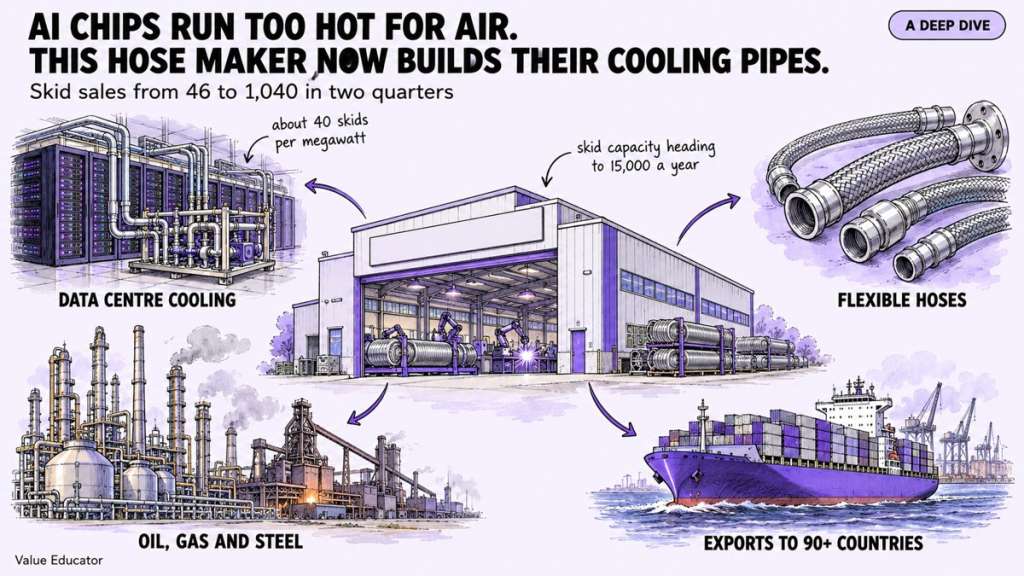
AI computers run hot, far hotter than the servers of a few years ago. A rack of AI chips can now produce 50 to 100 kW of heat or more, and blowing cold air over it no longer keeps it safe. So data centre builders are moving to liquid cooling, which simply means pumping a coolant through pipes right up to the chips to carry the heat away. The global data centre liquid cooling market was about USD 5.65 billion in 2024, and it is projected to reach about USD 48.4 billion by 2034.
For the most powerful AI chips, there is little choice left. Direct-to-chip cooling, where the coolant runs through a plate sitting on the chip, is the only way to cool such high-power GPUs.
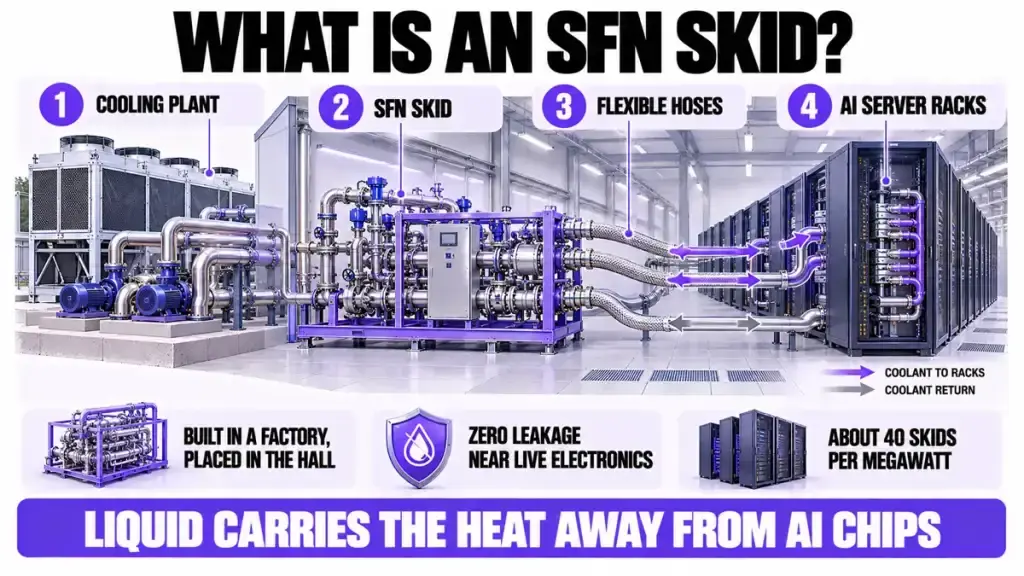
That coolant needs a plumbing system inside the building. Between the cooling plant and the server racks sits a network of steel pipes, valves and flexible connections that has to run without a single leak, since water near live electronics is a disaster. A secondary fluid network skid (SFN skid) is a ready-made frame of these pipes and fittings, built in a factory and placed in the data hall, so the building team only has to connect it.
At the end of each pipe there is usually a flexible hose, which means a corrugated stainless steel tube, often wrapped in braided wire, that can bend, absorb vibration and carry liquid or gas at high pressure. These hoses are used in refineries, steel plants, ships, fire sprinklers and air-conditioning, and now in data centres too.
One Navi Mumbai company makes both. Aeroflex Industries Ltd (NSE: AEROFLEX), founded in 1993, makes stainless steel flexible hoses, hose assemblies, metal bellows and, since FY26, SFN skids for data centres. It exports to more than 90 countries, and it is an approved supplier to a leading global provider of digital infrastructure and thermal management systems. Since 2018, it has been owned by Aeroflex Enterprises, formerly Sat Industries.
Its business has two engines. The older one sells hoses and assemblies to industries around the world, and it grew steadily for years. The newer one builds cooling skids for data centres in India, and it went from almost nothing to about a quarter of revenue in two quarters.
Aeroflex in five numbers
- Q1 FY27 total income of ₹145.97 Cr, up 72.41% from a year ago
- SFN skid revenue of ₹32.4 Cr in Q1 FY27, from ₹2.3 Cr two quarters earlier
- Skid capacity raised from 6,000 to 9,000 a year, heading to 15,000
- EBITDA margin of 23.04%, against 18.35% a year ago
- Exports to more than 90 countries
These numbers show a steady hose maker turning into a data centre supplier. This article tries to answer one question: is the skid business a short burst of orders, or a second engine that can change the size of a 33-year-old hose maker? Let's first understand the company, and then look at the latest quarter.
Aeroflex Industries: Company Overview
Aeroflex Industries was founded in 1993 as Suyog Intermediates, and it has made stainless steel flexible hoses in Navi Mumbai for most of the three decades since. Its promoter, Aeroflex Enterprises (formerly Sat Industries), took control in 2018, and the company listed on the stock exchanges on 31 August 2023. Promoters held 65.47% of the shares in March 2026, mutual funds 2.12% and foreign portfolio investors about 1.5%. It earned ₹443.29 Cr of total income in FY26 from flexible hoses, hose assemblies, metal bellows, SFN skids for data centres and hydraulic fittings made by its subsidiary Hyd-Air. Read this Aeroflex: Riding the AI Data Centre Cooling Boom
"Behind every stock is a company. Find out what it's doing."
— Peter Lynch
With Aeroflex, what the company does changed in just two quarters. A hose exporter now earns about a quarter of its revenue from cooling skids for Indian data centres, so the numbers need to be read with that shift in mind.
The Quarter Liquid Cooling Arrived
Let's look first at Q1 FY27, the April to June quarter, when liquid cooling arrived in the numbers. Management called it the best quarter in the company's history. Total income grew 72.41% from a year ago, and profit more than doubled.

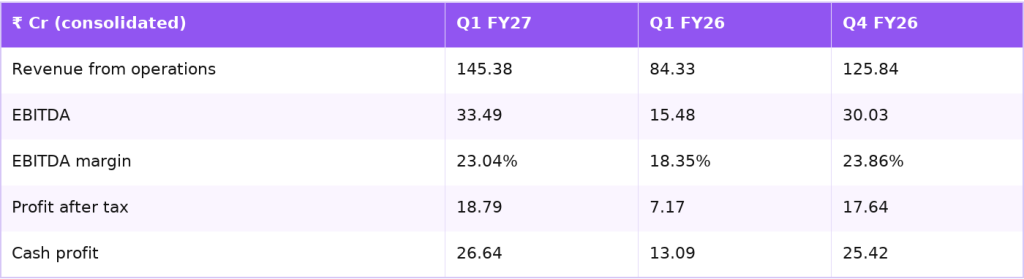
That growth came from both engines. Skid assemblies brought in ₹32.4 Cr, about 23% of revenue. At the same time, the stainless steel flexible hoses grew 40.53% from a year ago, and assemblies and other value-added products grew 36.96%. So the old business grew fast too, even without the skids.
That rise in skids is, in management's view, a change in what the company is.
"This marks a major step in our company's evolution from being just a flexible hose manufacturer to an integrated provider of advanced flow control and flow management solutions for mission-critical applications." - Asad Daud, Aeroflex Industries
Those skids also changed where the revenue came from. Domestic sales were 42% of revenue in Q1 FY27, against 28% a year earlier, because the skids are sold in India. Exports still grew 43%, helped by more business in Europe and the US. In Europe, growth came from Italy, Spain, France and the UK, from traditional industries and also from hose assemblies for data centres.
That shift also lifted the margin. The EBITDA margin rose to 23.04% from 18.35% a year ago. Compared with Q4 FY26, it came down a little, from 23.86%, even though the gross margin rose. Management gave three reasons. It hired more people for the skid business and for a new plant at Chakan, it set up a new line for one international customer, and freight costs rose because of the crisis in West Asia. Read this EBITDA Explained: Uses and Limits
That hiring and the new plant show up in the cost lines, as you can see. Employee costs rose to ₹13.94 Cr from ₹9.06 Cr a year ago, and other expenses to ₹17.25 Cr from ₹10.35 Cr. Both grew more slowly than revenue, so the margin still rose from a year earlier.
Those costs sit above EBITDA, and below it the new plants show up in depreciation. It was ₹7.84 Cr in Q1 FY27 against ₹5.93 Cr a year ago, after several years of capacity expansion. Finance costs stayed very small, because the company has very little debt. So most of the EBITDA growth reached profit, which grew 162.22%.
Those gains also show over the last five quarters. You can see revenue rising every quarter, while the margin settled around 23% after a softer start to FY26.

That quarterly climb came from three things in turn. In Q2 FY26, Hyd-Air's revenue rose to about ₹9 Cr from about ₹3 Cr and it turned profitable, while a better product mix and the currency helped the margin. In Q3 and Q4, the first skids were shipped. In Q1 FY27, the skids reached 1,040 a quarter.
That pace is new for Aeroflex. Over FY21 to FY26, total income grew from ₹144.8 Cr to ₹443.3 Cr, about 25% a year. EBITDA went from ₹22.3 Cr to ₹99.7 Cr, and profit after tax from ₹5.9 Cr to ₹55.5 Cr.
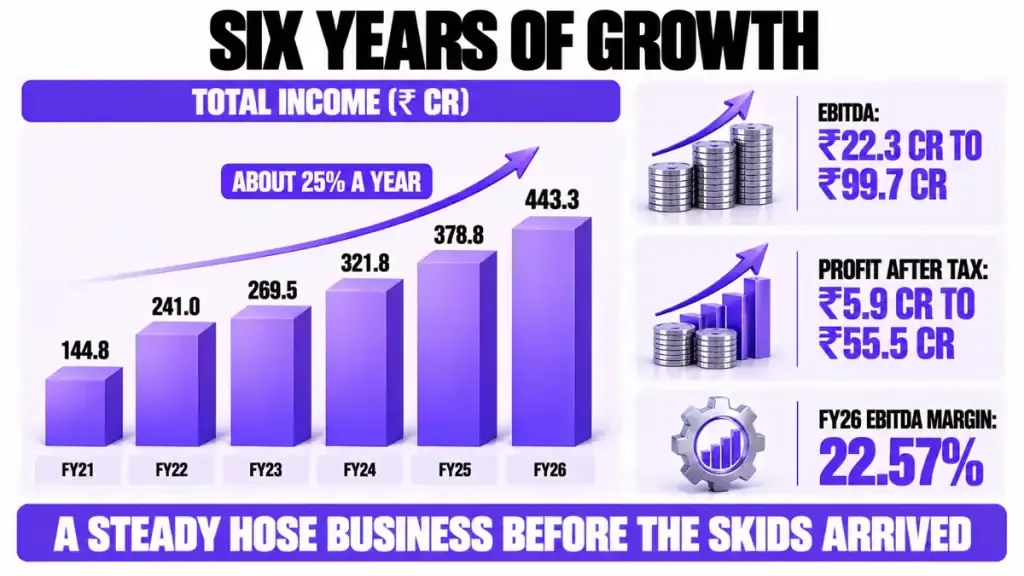
That six-year record includes FY26, which was a year of investment. Total income grew 17.04% to ₹443.29 Cr, after a slow first quarter. EBITDA grew 26.18% to ₹99.74 Cr, and the margin rose to 22.57% from 21.01%. Profit after tax grew only 5.75%, to ₹55.53 Cr, because depreciation more than doubled to ₹26.08 Cr from ₹11.27 Cr as new capacity came in.
That is why the company also reports cash profit, which adds depreciation back to profit after tax. Cash profit rose 27.95% to ₹81.6 Cr in FY26. Cash from operations was stronger still, at ₹65.84 Cr in FY26 against ₹26.58 Cr in FY25, as profit grew and working capital was managed better. Read this Cash Flow Statement Explained: The Most Honest Financial Report
That cash has funded the expansion without much debt. Aeroflex listed on the stock exchanges on 31 August 2023. In March 2026, its standalone borrowings were only about ₹1.07 Cr, against cash and bank balances of about ₹69.65 Cr and equity of ₹447.27 Cr. Total assets grew to ₹565.02 Cr from ₹426.55 Cr over the year, as the plants were built. Read this Debt to Equity Ratio Explained
The Skid Ramp
So how fast is the skid business growing? We can see it quarter by quarter, because the company gives the number of skids it sold.

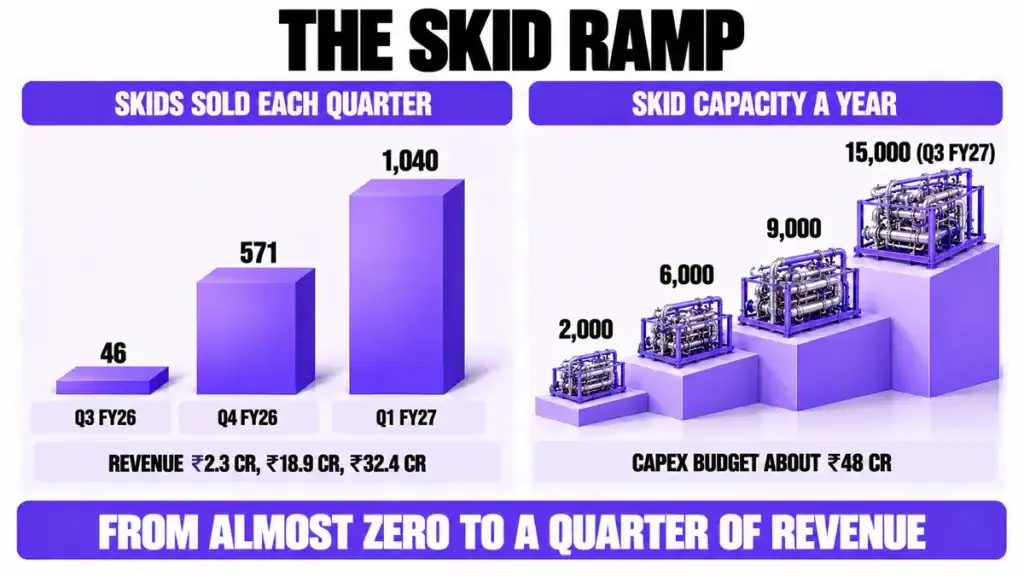
That lower average price in recent quarters is not a cut in price. Each skid is designed for a particular data centre, and even for a particular floor of it, so its value depends on how much piping it carries. Aeroflex has sold skids worth about ₹1 lakh and skids worth about ₹5 lakh. Management says each design is costed separately, so the margin does not depend on the average price.
That demand is why skid capacity is rising just as fast. Aeroflex started with capacity for about 2,000 skids a year, raised it to 6,000 by the end of FY26, and then to 9,000 in Q1 FY27. It plans to reach 15,000 skids a year in Q3 FY27, probably in October or November, depending on deliveries of machines from its suppliers. The whole expansion from 2,000 to 15,000 skids has a budget of about ₹48 Cr.
That capacity follows its customer's plans. The customer, a global thermal management company, gives Aeroflex a firm dispatch plan about two months ahead, and a list of the projects it expects in the following quarter. Management says that by March 2027 it aims to run the 15,000-skid capacity at least at 60-70%. In FY28, the first full year of that capacity, it sees about 80% as the best level it can sustain.
Four Product Lines, One Flow Business
Let's now see what Aeroflex sells overall. It has four product lines, and all of them move a liquid or a gas safely from one point to another.

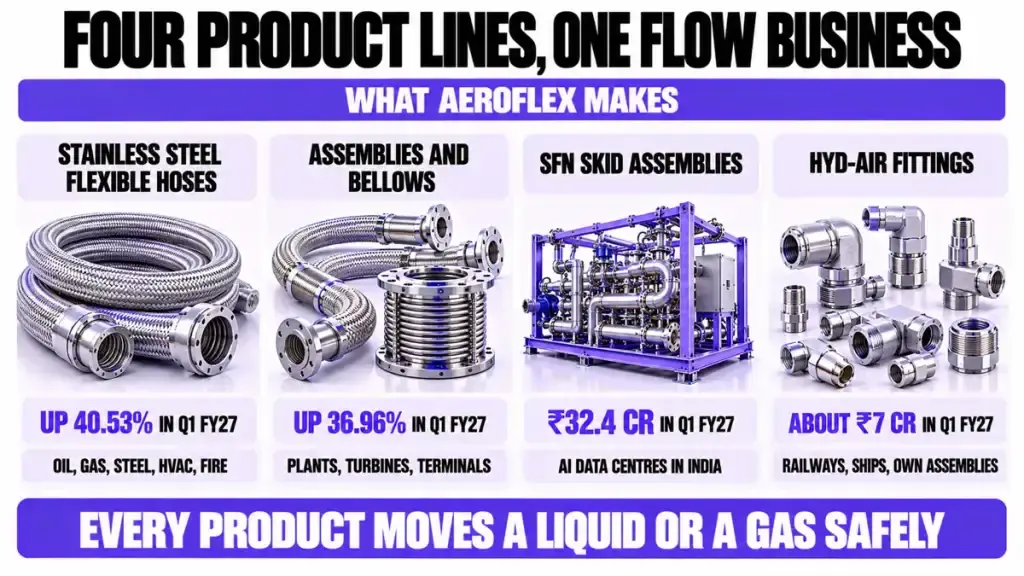
These lines differ in how much value they add. A plain hose earns an EBITDA margin of about 16-20%, while a hose sold as an assembly with fittings earns about 22-26%, because Aeroflex does more of the engineering. That is why the company has spent years selling more assemblies. In FY25, value-added assemblies passed 50% of total sales, ahead of its own target for the year, and in Q1 FY27 they were about 63% of the hose business. Within the hose business, assemblies and fittings made up about 63% of sales in Q1 FY27, and plain hoses about 37%.
All of them start from the same skills. The company welds thin stainless steel, forms it into corrugated tubes, braids it and tests it for leaks. It now applies the same skills to the piping and hoses inside a cooling skid.
Flexible Hoses and Assemblies, the Core Business
Let's begin with the core business, which built the company. The global market for stainless steel flexible hoses was about USD 2,182 million in 2025, and it is projected to reach about USD 4,380 million by 2035, growing about 7.2% a year. Oil and gas, chemicals, power, pharmaceuticals and food lead the demand, and users keep moving away from rubber and plastic hoses to stainless steel, which lasts longer.
Aeroflex has grown its share of that market for almost three decades. In May 2024, management put its share of the global stainless steel flexible hose market at about 1-1.5%, which leaves a lot of room. Its hoses go into steel and metal plants, oil and gas, petrochemicals, chemicals, food and pharmaceuticals, paper, solar, bulk terminals, fire sprinklers and HVAC. Newer users include semiconductors, hydrogen, robotics, electric mobility, aerospace and defence, and data centres.
That range comes from a wide set of products. Aeroflex makes more than 3,300 products, from hoses of a few millimetres to expansion joints of 3,000 mm in diameter, made from stainless steel, nickel alloys and Inconel. Its hoses come in two main kinds, annular and helical, depending on how the corrugations run, and many are wrapped in braided wire for higher pressure. It also makes composite hoses, with layers of plastic held by metal wire helixes, and interlock hoses made of coiled metal strips. It has plants at Taloja in Navi Mumbai, at Palava in Thane and at Chakan near Pune, close to the JNPT port for exports. The Government of India rates it a Two Star Export House.
Those plants have been expanded in steps. Hose capacity was 11 million metres a year in FY23, 13.5 million in FY24, 16.5 million in FY25 and 17.5 million in FY26. Each step let the company take on more orders and move into new applications such as data centres.
Those plants still have room to grow. In Q1 FY27, the plants used about 65-66% of their hose capacity, and capacity is rising to 20 million metres by Q3 FY27. That expansion has a budget of about ₹54 Cr, spread over FY25 to FY27. Management says that at full use of 20 million metres, with about 70% of sales as assemblies, the hose business could earn about ₹650-675 Cr of revenue a year.
Those hoses are also finding a new market in data centres themselves. They need flexible hoses for the last connection between a server rack and the cooling network, for fire suppression systems and for air-conditioning. Older data centres are also replacing rubber hoses with metal ones. Aeroflex already supplies hose assemblies for data centres in Europe, and a fire hose assembly for its largest US customer is due to start production around the end of Q2 or the start of Q3 FY27, at margins of about 23-26%. It is meant for supply abroad, and Aeroflex has already invested in it based on the volumes its customer expects.
Liquid Cooling Skids for Data Centres
Next, let's look at the business that changed the company's growth, cooling skids. India is becoming one of the world's fastest-growing data centre markets, with an announced pipeline of more than 9 GW over the next five years, led by companies such as Reliance Jio, Adani, TCS, Nxtra, STT GDC India, CtrlS and Yotta. The global liquid cooling market is expected to grow about 33.2% a year over CY25-CY32, and direct-to-chip cooling about 35% a year.

Several things are driving that pipeline in India. Data localisation rules want Indian data to stay in India, internet use keeps rising, the government's Digital India programme is pushing digital services, and global cloud companies have committed to building hyperscale centres here. These are coming up not only in the largest cities but also in Tier II cities. Read this The Hyderabad Workshop Powering America's AI Data Centres
Those numbers turn into skids at a simple ratio. Management says about 40 skids go into each megawatt of liquid-cooled capacity, on average. If all of India's announced 9 GW were liquid-cooled at that ratio, it would need about 3.6 lakh skids, many times Aeroflex's planned capacity of 15,000 a year. Not all of it will be liquid-cooled, but the ratio shows how large the market could be. At the Q1 FY27 average of ₹3,11,459 per skid, 40 skids would be worth about ₹1.25 Cr for each megawatt.
Inside each skid, Aeroflex combines stainless steel piping, precision metal hoses and metallic expansion joints that absorb movement and heat. The design is plug-and-play, so it can be installed quickly inside the data hall, and it is built for zero leakage and continuous running. It is also compact, which matters because floor space in a data centre is expensive.
Those skids reach the market through a partner, which is how Aeroflex entered this business. It is an approved supplier to a leading global provider of digital infrastructure and thermal management systems, and it builds skids for that partner's data centre projects in India. Its first deal with the partner took about 10 to 11 months from the first meeting to the first order. In 2026, Aeroflex also signed a long-term supply agreement with a leading US company for liquid cooling solutions for data centres.
That partnership also explains how Aeroflex won the work. Management says it developed a product that did not exist in India within about a year. It also says the latest skids it supplies are far ahead of the first ones in design. In its view, customers abroad are looking at it for its engineering, its pace of improvement and its speed, with lower cost as one more factor.
"Our speed is something which probably we can proudly say that we are among the ones who are the fastest and the most agile in terms of adoption of technology, both in engineering and also in our production." - Asad Daud, Aeroflex Industries
The next step is exports of skids. Skids for Europe and the US are designed differently from those for India, and Aeroflex is developing them with customers there. Management says it expects business from international markets in FY27. It also says the potential abroad is many times that of India, and it showed 15 data centre products at the Data Center World exhibition in the US in April 2026.
Why the partner matters: Aeroflex does not sell skids to the data centre owner. It sells to a global cooling company that designs the system and wins the project. So its skid volumes follow that partner's project wins and design approvals in India.
Metal Bellows and Hyd-Air
Now let's look at the two smaller lines, which are still building up. Metal bellows are flexible metal parts with folds, like a small steel accordion, that absorb movement and heat in pipes, engines and machines. The global market for them was about USD 3,012 million in 2025, and it is projected to reach about USD 5,608 million by 2035. Aeroflex introduced them in 2023 and has capacity for 1,20,000 pieces a year on six lines.
Those bellows are still small in revenue. They brought in about ₹3 Cr in Q1 FY27, and management expects sales to pick up over the next two quarters. Bellows are also used in EV battery cooling, semiconductors, aerospace and defence, which are among the new markets the company is targeting. In green hydrogen and solar plants, they help handle high-purity gases and manage heat. In semiconductor and electronics plants, ultra-precise bellows go into vacuum systems, wafer handling and clean-room equipment, and India is now building its first chip plants.
Next to bellows, Hyd-Air is the second of these smaller lines. Aeroflex bought Hyd-Air Engineering in 2024 to make its own hydraulic fittings and end parts for hose assemblies. Hyd-Air grew about 50% in FY26 and earned about ₹7 Cr in Q1 FY27. Its parts now go into Aeroflex's own hose assemblies, including those sold to data centres, and the company does not plan to sell them to other skid makers. A capital spending plan for Hyd-Air is under discussion and will be announced once it is final.
Exports to More Than 90 Countries
Finally, let's look at exports, which are still the larger part of the business. In Q1 FY27, exports were 58% of revenue, against 72% a year earlier, because the skids are sold in India. Of the exports, the Americas took 57%, Europe 33% and Asia 7%. The largest international customer gave about 25-26% of sales in FY26.
That customer base has been tested too. In FY26, US tariffs and trade uncertainty made the start of the year difficult, but exports recovered over the year. In Q1 FY27, the conflict in West Asia raised freight costs. Even so, exports grew 43% from a year ago.
The Engineering That Is Hard to Copy
Now that we have seen each product line, let's understand why its engineering is hard to copy and why customers keep returning. It starts with design. Every hose assembly and every skid is made to the customer's drawing, tested for leaks and approved before it is shipped, and many of them go into critical systems where a failure is costly.

That engineering shows in how fast the company moves. It took about a year to develop an SFN skid that did not exist in India, and it keeps improving each design. In a market where data centre builders need parts quickly and without leaks, speed and reliability count as much as price.
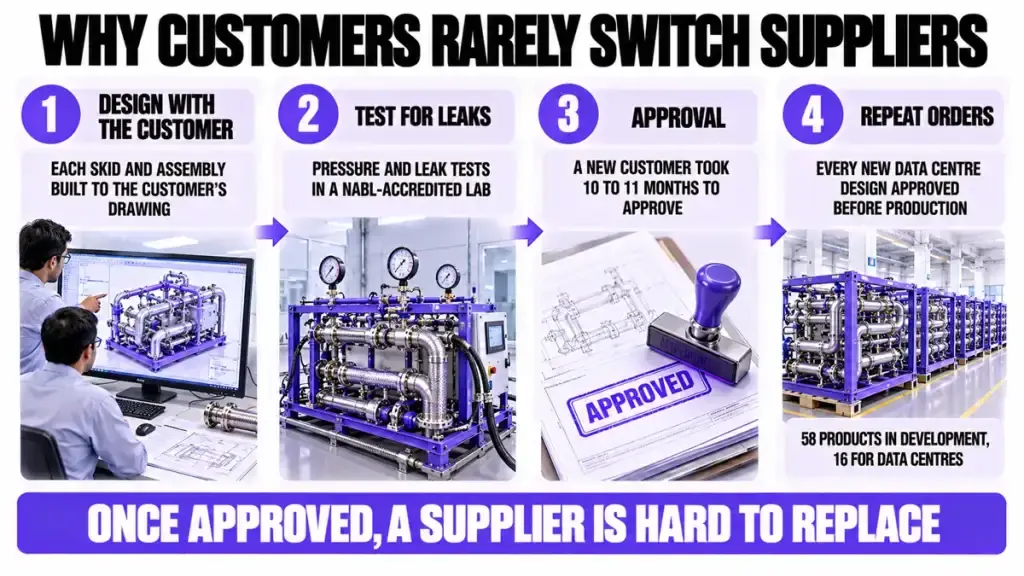
Much of that design work is also done together with customers. Aeroflex develops several of its data centre products with its customers, so each new design fits the customer's system from the start. That joint work builds long relationships and makes Aeroflex part of the customer's planning, not just a vendor that quotes a price.
Each of those approvals is also slow to win and slow to lose. A new customer takes many months to approve a supplier, and for an existing customer, every data centre design has to be approved before production. Once a supplier is in, the customer would have to repeat that work to change it.
"In business, I look for economic castles protected by unbreachable moats."
— Warren Buffett
Aeroflex's moat is not a brand. It is the approvals, the test records and the joint designs that a customer would have to build again with a new supplier.
That record also comes from 28 years in the business. Aeroflex has a workforce of more than 760 people and a 14-member R&D team. It holds ISO certifications for quality, environment and safety, and it has won a Great Place to Work award. Its R&D lab is NABL-accredited, so customers can accept its test results, and that lab is where the 16 data centre products now in development are being tested before they reach customers.
Its rivals in skids are large, but they are not yet in India at scale. Global companies such as Senior and Parker have started making SFN skids, and there are local makers in the US and Europe. In India, management says Aeroflex is among only a few suppliers today.
Its machines then add flexibility. Management says most of the machines bought for skids can also make piping for HVAC, ports and terminals, and other industries, and some can make bellows. So if data centre demand eased, much of the new capacity could still be used elsewhere. Read this HFCL: Riding the AI Infrastructure Boom
Financials: Five Years of Growth, Margins and Cash
One strong quarter can flatter any company, so let's look at five full years together.
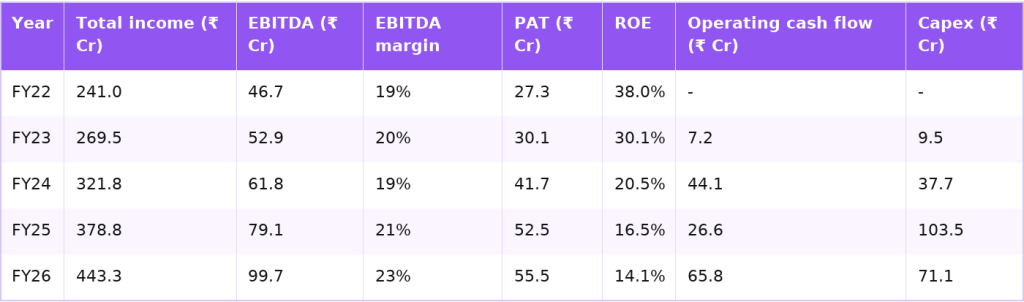
Total income grew about 1.8 times in four years, from ₹241.0 Cr in FY22 to ₹443.3 Cr in FY26, and it rose every year. The EBITDA margin moved in a narrow band of 19-21% until FY25 and reached 22.57% in FY26, as assemblies became a larger share of sales. Profit after tax doubled over the same years, from ₹27.3 Cr to ₹55.5 Cr.
ROE tells a different story. It fell from 38.0% in FY22 to 14.1% in FY26, even as profit doubled. That is because the equity base grew much faster than profit after the company listed in 2023, and because new plants raised depreciation before they were fully used. ROE can recover only if the new skid and hose capacity fills up.
Cash flow has lagged profit, because the business needs stock and credit to grow. Over FY23 to FY26, operating cash flow of ₹143.7 Cr came to about 80% of the ₹179.8 Cr of profit. Capex over the same four years was ₹221.7 Cr, more than the cash that operations produced, so free cash flow was negative in FY25 and FY26. The gap was funded with equity, not debt, since borrowings were only about ₹1.07 Cr in March 2026.
"The stock market is filled with individuals who know the price of everything, but the value of nothing."
— Philip Fisher
For Aeroflex, the value question sits in these five years of numbers: whether the margin can move from 22.57% to the 25% target, and whether cash flow catches up with profit once capex slows.
What FY28 Could Look Like on Management's Numbers
So what could all of this add up to for you as a reader following Aeroflex? Management has given capacity targets, a goal for how much of that capacity it will use, and a margin target, so we can put them together.
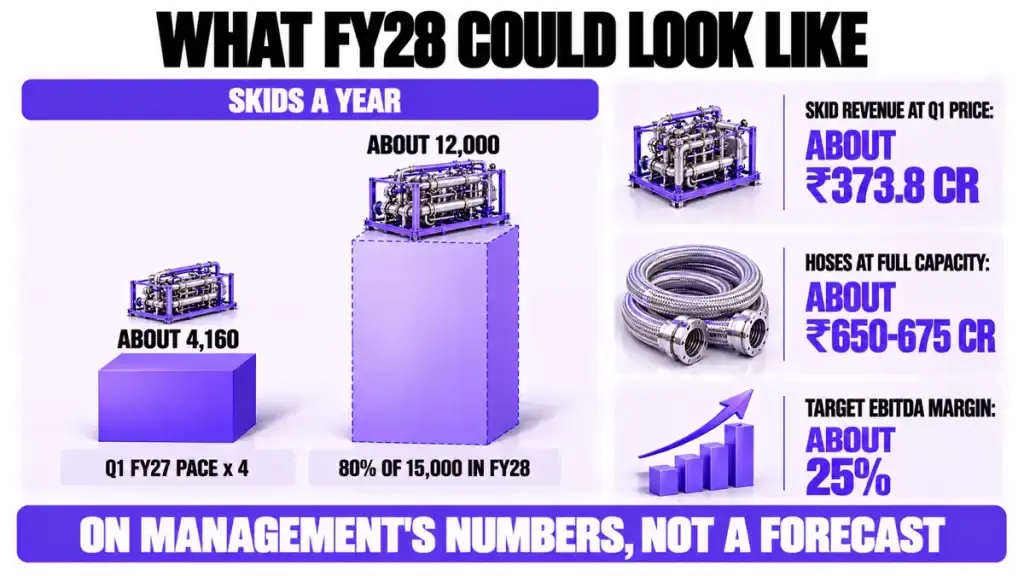
Those three numbers start with the skids. At 80% of 15,000 skids, the level management sees for FY28, Aeroflex would sell about 12,000 skids a year. At the Q1 FY27 average of ₹3,11,459 per skid, that would be about ₹373.8 Cr of skid revenue in a year. The average price will change with each design, so this is only a rough guide. For comparison, Q1 FY27's 1,040 skids, repeated for four quarters, would be about 4,160 skids a year, so the FY28 level needs about three times today's pace.
Then we add the hose business, at the ₹650-675 Cr we saw earlier for full use of its capacity. Together, that would be about ₹1,024-1,049 Cr a year, more than double the ₹443.29 Cr of total income in FY26. Neither figure is a forecast, and both assume full or near-full use of capacity.
Those revenues then meet the last part of the plan, the margin. Management's target is an EBITDA margin of about 25% for the company as a whole over the next few years, against 23.04% in Q1 FY27. It says the skids earn about the company's average margin, and that bellows and the fire hose assemblies should lift the blended margin as they grow.
The Plan for FY27 and FY28
Those numbers rest on a plan with several parts, so let's list what management has committed to. Most of it is about capacity and margins, and each item has a date we can track.

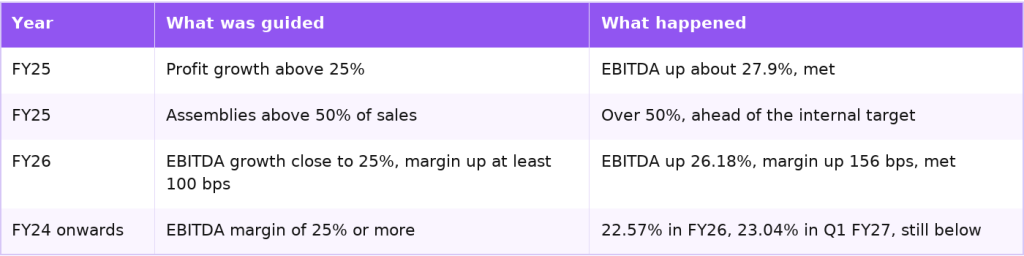
These commitments come with a record we can check. In FY25, management had guided profit growth above 25%, and EBITDA grew about 27.9%. For FY26, it guided EBITDA growth close to 25% with at least a 100 basis point rise in the margin, and EBITDA grew 26.18% with a margin rise of 156 basis points. Back in FY24, it had said margins would rise to 25% or more in the coming years, and that has not happened yet.
"Know what you own, and know why you own it."
— Peter Lynch
For Aeroflex, knowing why means tracking the skid count, the margin and these dated commitments each quarter.
Key Risks
No business grows in a straight line, so let's look at what could go wrong for Aeroflex.
- One skid partner: almost all skid revenue comes through one global cooling company and its projects in India. A delay or loss of that partner's projects would hit skid volumes quickly.
- Design approvals: skids can be made only after each data centre design is approved, and these approvals are sometimes delayed, which can push revenue between quarters.
- Machine deliveries: the 15,000-skid capacity depends on machines from outside suppliers, who have already faced delays.
- Customer concentration in exports: the largest international customer gave about 25-26% of FY26 sales, so its orders matter a lot.
- Competition: global companies such as Senior and Parker have started making SFN skids, and other Indian companies are starting too.
- Trade and freight: US tariffs and the West Asia crisis have both raised costs or slowed orders in the past year.
- Margin target: the 25% margin has been a goal since FY24, and plain hoses earn only about 16-20%.
- Depreciation: new capacity has more than doubled depreciation, so profit will grow slower than EBITDA until the plants fill up.
"You can't predict. You can prepare."
— Howard Marks
None of these risks can be timed in advance. What an investor can do is watch the few numbers below that will show early whether the plan is slipping.
Explore our Products
Research Framework

Emerging Titans
Combination of quantitative analysis, industry tailwinds, and management assessment - SPRINT investment philosophy

Tiny Titans
Heavy emphasis on scuttlebutt research, plant visits, and early on-ground signals
What to Track Next
If you follow Aeroflex, these are the signals that will show whether the plan is on track. Read this A Fundamental Checklist: How to Research a Stock in 1 Hour
- Q2 FY27 results, due by mid-November 2026, and skid sales after 1,040 in Q1
- The 15,000-skid capacity starting in October or November 2026
- Skid orders from customers in Europe and the US during FY27
- Production of the fire hose assembly for the largest US customer
- The EBITDA margin moving from 23.04% towards about 25%
- Hose capacity reaching 20 million metres by Q3 FY27
Conclusion
Let's step back and put it all together. Aeroflex spent almost three decades building a steady export business in stainless steel hoses, and in just two quarters it has added a data centre business that is now about a quarter of its revenue. Both engines grew in Q1 FY27, which is why revenue rose 72.41% and profit more than doubled.
So the next year will show how far the second engine can go. Skid capacity is heading to 15,000 a year, the partner is giving firm dispatch plans, and skid exports are being developed. If the data centre projects keep coming, Aeroflex could earn much more than it does today. If they slow or move to other suppliers, the company will lean again on its hose business. The cautious thread is concentration: almost all skid revenue comes through one partner, and the 25% margin goal set in FY24 has not been met yet. The next few quarters, starting with the 15,000-skid capacity and the first skid exports, will show which thread wins.
FAQs
What does Aeroflex Industries do?
+Aeroflex Industries is a Navi Mumbai company founded in 1993 that makes stainless steel flexible hoses, hose assemblies, metal bellows and, since FY26, secondary fluid network (SFN) skids for data centre liquid cooling. It exports to more than 90 countries and earned ₹443.29 Cr of total income in FY26.
What is an SFN skid and why does it matter for Aeroflex?
+An SFN skid is a factory-built frame of pipes, hoses and expansion joints that carries coolant to server racks in a liquid-cooled data centre. Aeroflex sold 46 skids in Q3 FY26 and 1,040 in Q1 FY27, when skids brought in ₹32.4 Cr, about 23% of revenue.
How did Aeroflex perform in Q1 FY27?
+Total income grew 72.41% from a year ago to ₹145.97 Cr, EBITDA was ₹33.49 Cr at a 23.04% margin against 18.35% a year earlier, and profit after tax rose to ₹18.79 Cr from ₹7.17 Cr. Both the skid business and the hose business grew.
How much skid capacity is Aeroflex building?
+Skid capacity rose from about 2,000 a year to 6,000 by the end of FY26 and 9,000 in Q1 FY27, and is planned to reach 15,000 a year in Q3 FY27 at a total budget of about ₹48 Cr. Management aims for at least 60-70% use by March 2027 and about 80% in FY28.
Does Aeroflex have debt?
+Aeroflex is almost debt-free. In March 2026 its standalone borrowings were about ₹1.07 Cr, against cash and bank balances of about ₹69.65 Cr and equity of ₹447.27 Cr.
What are the main risks for Aeroflex investors?
+Almost all skid revenue comes through one global cooling partner, skid production depends on design approvals and machine deliveries, and the largest export customer gave about 25-26% of FY26 sales. Competition from Senior and Parker, trade and freight costs, and a 25% margin goal still unmet since FY24 are other risks.

High growth stock specialist, Value Educator
Shashank Mahajan is an equity research professional with over 12 years of experience in identifying high-potential SME and micro-cap stocks at an early stage. He follows a rigorous scuttlebutt research–driven approach, combining on-ground insights with deep financial analysis. Shashank specializes in uncovering under-researched and under-owned companies with strong management quality and long-term growth potential. Through disciplined research and early identification, he focuses on spotting tomorrow’s market leaders before they enter the mainstream investor radar.

Zen Technologies: Why Revenue Fell After Its Biggest Win

Data Patterns: India's Radar Designer and Its Waiting Orders

KSH International: The Wire Inside India's Transformers

Krishna Defence: The Steel Behind India's Warship Hulls

PNG Jewellers: A 194-Year-Old Name Goes National

Axiscades: From Services to Missile and Radar Electronics
Explore our Products
Research Framework
Emerging Titans
Combination of quantitative analysis, industry tailwinds, and management assessment - SPRINT investment philosophy
Tiny Titans
Heavy emphasis on scuttlebutt research, plant visits, and early on-ground signals


 Orders
 Subscription
 Share with friends
 Logout


Required Details
₹23999.00
(12 month subscription)
As per SEBI regulations, all users are mandated to complete the KYC that is validated for 1 year. Post payment, you will be redirected to the KYC screen


No comments yet. Be the first to comment!