
Indoco Remedies: Brands, Exports and a Goa Plant Verdict
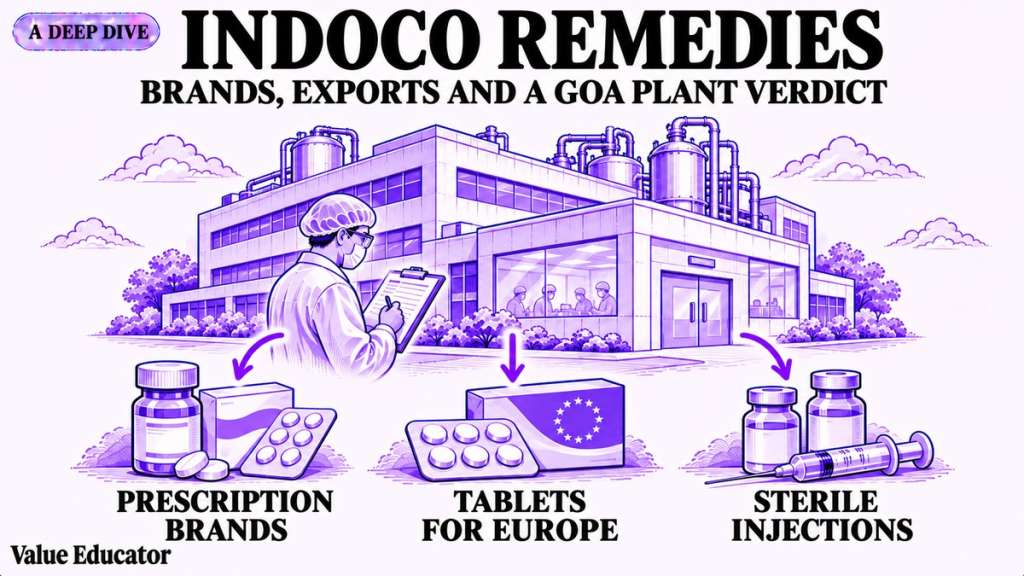
In FY24, an Indian drug maker sold about ₹285 Cr of medicines in the United States. Many of them were eye medicines and injections made at one sterile plant in Goa. In June 2024, US Food and Drug Administration inspectors arrived at that plant on a surprise audit, and a warning letter followed. A warning letter is the FDA's formal notice that a plant does not meet its manufacturing rules. Until it is lifted, the agency holds back new product approvals from that site, and products made there can be blocked from entering the US.
That one letter changed the company's numbers.
"It takes 20 years to build a reputation and five minutes to ruin it."
— Warren Buffett
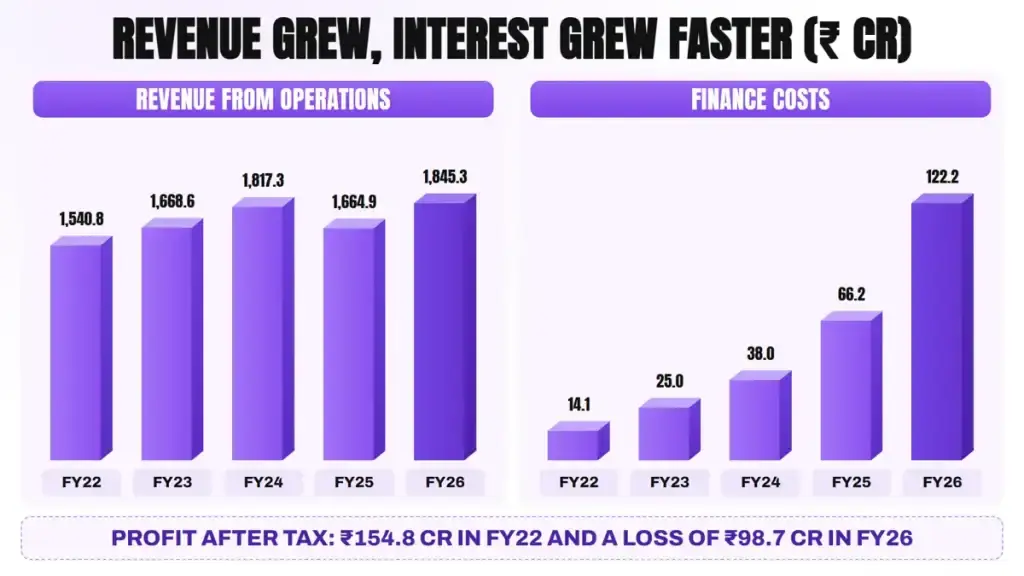
For a drug maker, a plant's standing with regulators works the same way: years of clean inspections can be undone by one audit, and winning it back takes far longer. Its profit after tax had been ₹154.8 Cr in FY22. By FY25 it was a loss of ₹78.0 Cr, and in FY26 a loss of ₹98.7 Cr. Over the same years its yearly finance cost went from ₹14.1 Cr to ₹122.2 Cr, because it had borrowed to build capacity that it could not yet fill.
That loss did not come from a lack of business. Its brands are prescribed by more than 2,42,278 doctors in India, and its European customers kept placing orders. In the July to September quarter of 2026, its revenue crossed ₹500 Cr for the first time.
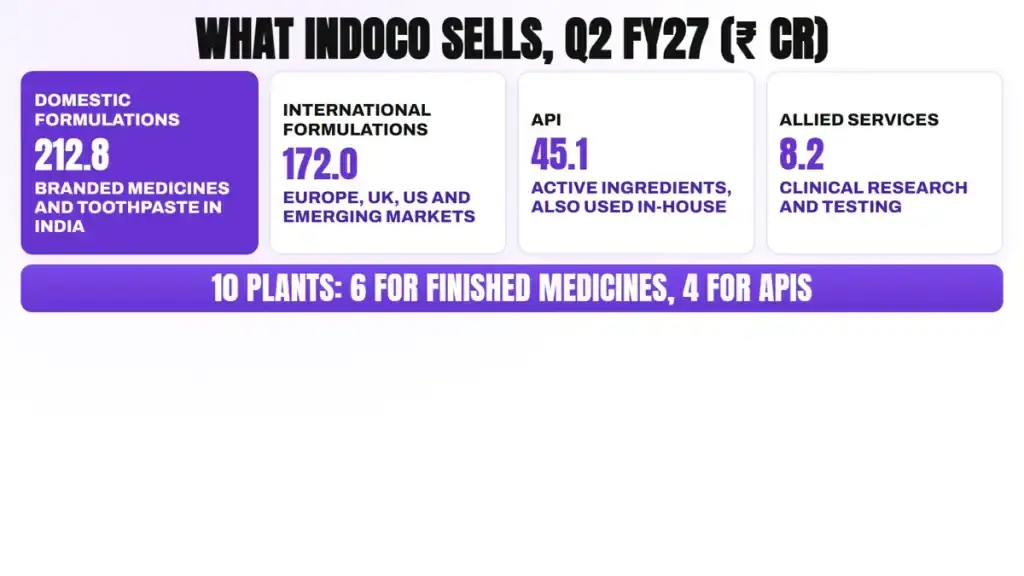
That company is Indoco Remedies Ltd (NSE: INDOCO), a Mumbai drug maker founded in August 1947, a week after India's independence. It runs 10 manufacturing plants, 6 for finished medicines and 4 for APIs, the active ingredients that go inside a tablet or a syrup. In FY26 its consolidated revenue from operations was ₹1,845.3 Cr.
The FDA came back to the Goa plant between 27 August and 4 September 2026 and left 7 observations. The answer on whether the warning letter goes is expected around December. Until then, the numbers depend on everything else Indoco does, and on how much of its profit goes to interest.
Indoco Remedies in five numbers
- Q2 FY27 revenue of ₹506.9 Cr, the first quarter above ₹500 Cr
- Regulated-market revenue up 21.1% to ₹110.9 Cr in Q2 FY27
- Cyclopam, its largest brand, at ₹206 Cr of sales
- Total debt of about ₹930 Cr in June 2026, against ₹964 Cr in March
- 7 FDA observations at the Goa sterile plant, with an outcome expected around December 2026
So a company with strong brands and full order books has spent two years losing money. Let's first understand the company, and then look at the latest quarter.
Indoco Remedies: Company Overview
Indoco Remedies Ltd was founded in Mumbai on 23 August 1947, a week after India's independence, and has its registered office at Kalina, Santacruz East, Mumbai. It makes and sells finished medicines and APIs, the active ingredients inside them. In India it sells prescription brands such as Cyclopam, Febrex Plus, Cital, Oxipod and Rexidin, and through its subsidiary Warren Remedies it sells Sensodent-K and Kidodent toothpaste. Abroad it makes generics for partners in Europe and the UK, sells in the US through Florida Pharmaceutical Products, and sells branded generics in Africa, Latin America and Southeast Asia. It runs 10 manufacturing plants in Goa, Baddi, Aurangabad, Rabale and Patalganga, 6 for finished medicines and 4 for APIs, a 1,00,000 sq ft R&D centre at Rabale with over 300 scientists, and AnaCipher, a clinical research organisation in Hyderabad. It employs over 6,000 people. Suresh G. Kare is the Chairman, Aditi Panandikar the Managing Director, Sundeep Bambolkar the Joint Managing Director and Pramod Ghorpade the Chief Financial Officer. Consolidated revenue from operations was ₹1,845.3 Cr in FY26. Read this Small and Micro Cap Stocks: Risk vs Reward
"Risk comes from not knowing what you're doing."
— Warren Buffett
For a drug maker, knowing what you own means knowing which plant makes which product, and which regulator has approved it. At Indoco, one plant explains most of the last three years.
The Quarter Revenue Crossed ₹500 Cr
Let's look at Q2 FY27, the July to September quarter, which Indoco reported on 27 October 2026. Consolidated revenue from operations was ₹506.9 Cr, up 7.4% from ₹471.8 Cr a year ago. Operating EBITDA, the profit before interest, depreciation and tax, was ₹46.4 Cr, at a margin of 9.2%.
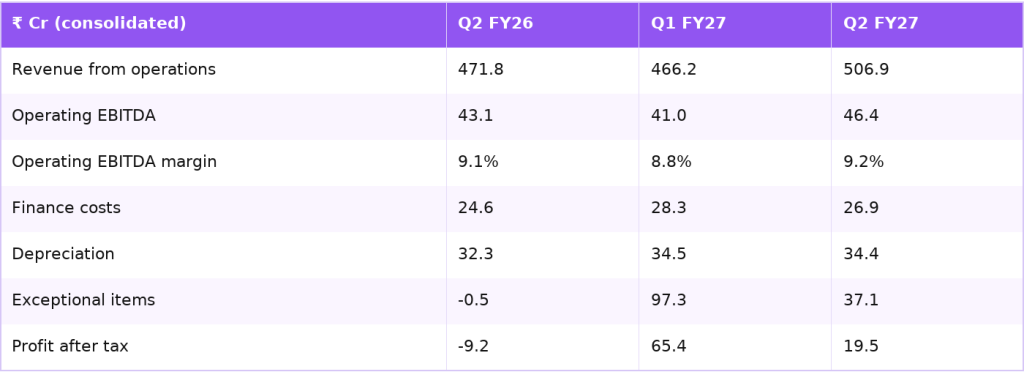
As we can see, the margin barely moved, and the reason was cost, not demand. Management says freight added about ₹13 Cr of cost in the quarter, because shipping was disrupted by an ongoing geopolitical conflict. Raw material, packing and solvent costs rose sharply too, so the gain from higher sales did not reach the margin.
That leaves a gap below the EBITDA line. EBITDA of ₹46.4 Cr had to cover ₹26.9 Cr of interest and ₹34.4 Cr of depreciation, or ₹61.3 Cr together. Read this Interest Coverage Ratio Explained So before one-off items, the company made a loss before tax of about ₹13.0 Cr.
The profit of ₹19.5 Cr came from a one-off gain instead. In August 2026 Indoco sold a plot of land at Andheri in Mumbai for ₹64 Cr, and booked a gain of ₹36.6 Cr on it. In the first quarter it had booked a larger gain from selling its eye-care business in India and parts of Africa. So H1 FY27 profit after tax of ₹84.9 Cr depends on ₹134.5 Cr of exceptional items.
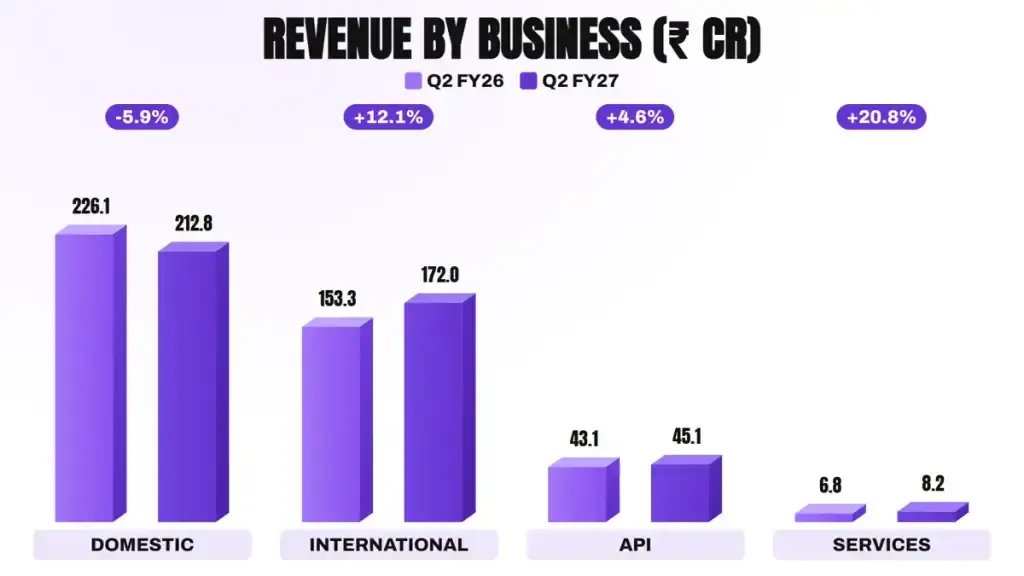
Now let's see where the revenue came from. Domestic formulations brought in ₹212.8 Cr, against ₹226.1 Cr a year ago. International formulations grew 12.1% to ₹172.0 Cr. The API business grew 4.6% to ₹45.1 Cr, and the clinical research and testing services grew 20.8% to ₹8.2 Cr.
Inside the international number, regulated markets did the work. Regulated markets are countries with strict drug regulators, such as the US, the UK and the European Union. Revenue there rose 21.1% to ₹110.9 Cr. Europe grew 23.5% to ₹67.5 Cr and the US 16.4% to ₹39.1 Cr. Emerging markets, such as French West Africa, Latin America and Southeast Asia, were flat at ₹61.2 Cr, partly because about ₹10 Cr of African eye-care sales went with the business that was sold.
Why the Domestic Number Shrank
The domestic number needs a closer look, because the brands themselves did well. Cyclopam, an antispasmodic for stomach pain, crossed ₹200 Cr and now sells ₹206 Cr a year. It holds the number two position in its market. The gastrointestinal portfolio grew 30.3% in the quarter and the dental portfolio 34.8%.
That drag came from cold, cough and fever products. Management says Cyclopam and Cital grew about 30%, while Febrex Plus was down about 20% and ATM about 16%. These are seasonal brands that sell when the monsoon brings infections, and this year the monsoon almost failed. Anti-infectives and respiratory products are still about 30% of the domestic business, against more than 50% at one time.
That domestic number also carries a base effect. The eye-care brands sold to Sunways in May 2026 made about ₹65 Cr in the previous year, and that revenue is now gone from India. So the like-for-like domestic picture is better than the reported 5.9% decrease. Management has kept its guidance of high single-digit domestic growth for FY27.
What the quarter says: revenue is growing and regulated markets are growing fastest, but EBITDA of ₹46.4 Cr still does not cover ₹61.3 Cr of interest and depreciation. Profit depends on the margin rising, debt coming down, or both.
How a Goa Plant Turned Profit Into Loss
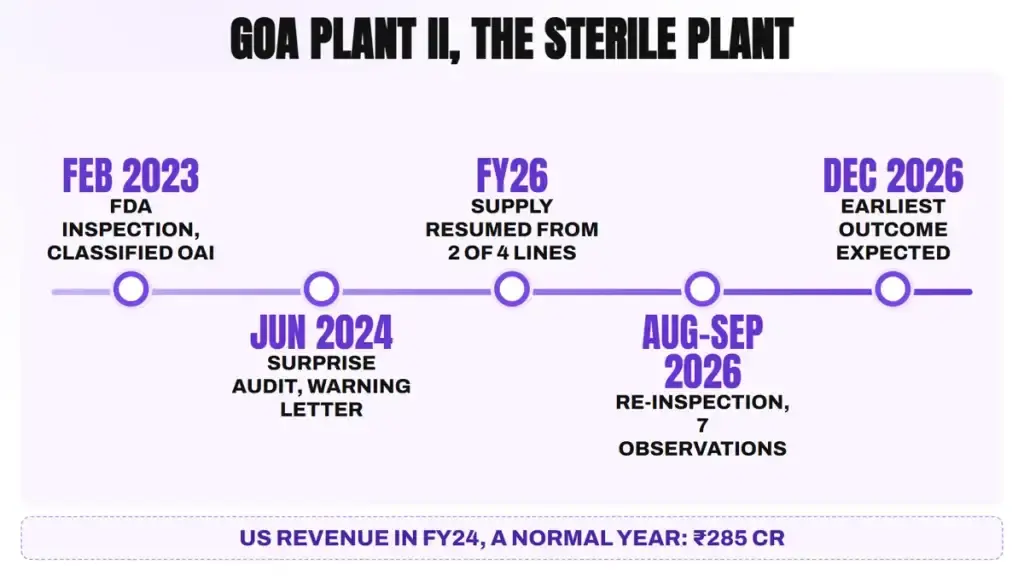
Now that we have seen the quarter, let's go back to the plant at the centre of the last three years. Indoco has two plants in Goa that make products for the US. Goa Plant I makes tablets. Goa Plant II is a sterile plant, which means it makes products that must be completely free of germs, such as eye medicines and injections. Sterile products are harder to make and approve, so fewer companies sell them and prices hold better.
That made Goa Plant II the centre of the US plan. In FY24, a normal year, US revenue was ₹285 Cr. In June 2023 Indoco also bought Florida Pharmaceutical Products, a US distributor, so that it could sell directly to American customers.
Then the FDA arrived. It had inspected the plant in February 2023 and classified it OAI, or "official action indicated", the most serious outcome of an inspection. Indoco was preparing its fixes when inspectors returned on a surprise audit in June 2024. That audit led to the warning letter. Several products the company was supplying to the US could no longer be shipped, and new approvals for the plant were put on hold.
The same years also brought two other costs. Under its Master Manufacturing Plan, Indoco expanded four of its large tablet plants to make bigger batches more cheaply. It also put money into Warren Remedies, a subsidiary at Aurangabad that makes toothpaste for its own brands and APIs. Capex was ₹426.0 Cr in FY24 and ₹356.2 Cr in FY25, much of it on borrowed money.
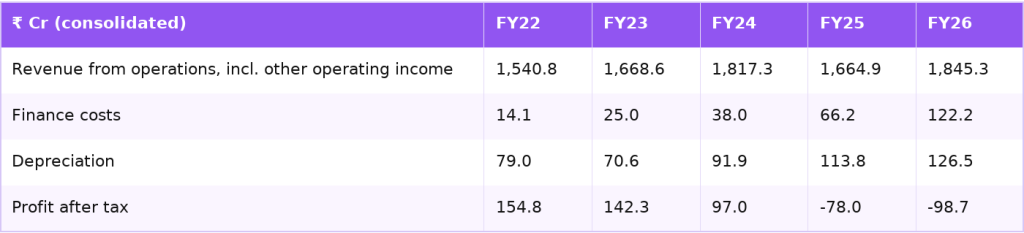
These numbers show the problem clearly. Revenue in FY26 was about 19.8% higher than in FY22. But finance costs were about 8.7 times higher, and depreciation had risen by more than half. FY26 operating EBITDA was ₹141.8 Cr, while interest and depreciation together came to ₹248.7 Cr.
That plant has not been idle, though. The FDA allowed Indoco to resume supply from two of the plant's four lines during FY26, and Europe's regulators have approved the site. But management said in July 2026 that the US business was not yet profitable, mainly because of the sterile plant's remediation costs. A sterile plant runs its utilities 24 hours a day whether it is full or not.
"I'm soon running out of patience, but something we will have to design around that plant and how to get the best out of it otherwise." - Aditi Panandikar, Managing Director, July 2026
After more than six months of waiting, the FDA finally came back on 27 August 2026. The inspection ended on 4 September with seven observations in a Form 483, the list of issues an inspector hands over at the end of a visit. Management says none of them relate to data integrity or cleaning validation, the two issues that usually matter most to the FDA. It says they are about how the plant investigates problems and runs its procedures, and that it has sent its response. The earliest it expects to hear is the first week of December 2026.
Four Businesses Inside Indoco
Now let's split the company into its businesses, because each one earns differently. Indoco reports a single segment, pharmaceuticals, but it gives revenue for each business every quarter. Read this Segment-Wise Revenue Analysis Explained Management describes India as the most profitable, with emerging markets close behind, and Europe as profitable but still improving.

These businesses sit together, but as we will see, they follow very different rules. In India, profit depends on how many prescriptions each sales representative generates. In Europe and the US, it depends on winning large supply contracts and keeping plants approved.

Domestic Formulations
Let's start with domestic formulations, the largest and most profitable business. Indoco ranks 33rd in the Indian pharma market by value and 20th by the number of prescriptions doctors write. In its FY26 annual report it counts about 104 million prescriptions a year across 15 major specialties. More than 3,500 medical representatives visit doctors across the country.
Its top five brands made ₹550 Cr in the twelve months to June 2026, or 42% of the domestic portfolio. Cyclopam grew from ₹136 Cr to ₹196 Cr over four years before it crossed ₹200 Cr. Febrex Plus, a cold and fever brand, sold ₹118 Cr. ATM sold ₹91 Cr, Oxipod ₹78 Cr and Cital ₹67 Cr.
Beyond these brands, dental care is a separate strength. Indoco has four brands in the top 20 of the stomatological market, the market for mouth and teeth products. Rexidin M Forte Gel became the most prescribed oral care brand among dentists. The company says products launched in the last two years now bring in about ₹100 Cr a year.
Warren and Over-the-Counter Toothpaste
Next to the prescription business sits a newer bet. Warren Remedies sells Sensodent-K and Kidodent toothpaste directly to consumers, not through doctors' prescriptions. It sold about ₹36 Cr of toothpaste in Q2 FY27, and management says this division almost broke even for the quarter.
That break-even came with a catch. Management held back advertising, and it admits that a consumer brand needs heavy spending for its first three or four years. The market leader in sensitivity toothpaste spends about ₹350 Cr a year on advertising, and Indoco has said it will never spend that much. About 90% of its presence is still in chemist stores.
International Formulations
Now let's move to exports, the business growing fastest. International formulations grew 29% in FY26, to ₹644.8 Cr from ₹501.1 Cr. Europe made up 46% of FY26 export revenue, emerging markets 32% and the Americas 20%.
The European business is largely contract manufacturing for generic companies. Indoco makes tablets at its Baddi and Goa plants for partners in the UK, Germany and other countries. These are long relationships with rolling orders, and in July 2026 management said it held more than ₹250 Cr of orders for execution. The Baddi and Goa tablet plants were running at about 70-80% on a single shift.
Next to Europe, the US business runs through Florida Pharmaceutical Products. Indoco has 30 approved ANDAs, the generic drug approvals needed to sell in the US, and 26 more filed. FPP's revenue crossed ₹100 Cr in H1 FY27, and management says it has been profitable within three years of the acquisition. New US products from the sterile plant wait on the FDA.
Beyond the regulated markets, emerging markets are branded, like India. Indoco has its own teams in French West Africa, where it is growing at a high double-digit rate, and sells in Latin America, Southeast Asia and other parts of Africa. These sales swing between quarters because distributors stock up before March.
API and Allied Services
Finally, the API business and the allied services support the rest. The API business makes active ingredients at Rabale and Patalganga near Mumbai, and now at Warren's new plant in Aurangabad. Its revenue grew 12% in FY26, to ₹145.6 Cr, and 42% in Q1 FY27. It holds 21 US drug master files, 11 European certificates of suitability and 75 API process patents.
Most of Indoco's ANDAs and dossiers use its own APIs. That means it controls the cost and supply of the ingredient. In September 2026 it set up Warren Lifesciences to separate the Aurangabad API business from the toothpaste business, because the two are very different. Management hopes for a US FDA audit of the Aurangabad API plant by around the second quarter of next year.
Alongside the API business, the allied services include AnaCipher, a clinical research organisation in Hyderabad, and Indoco Analytical Solutions. AnaCipher runs the studies that prove a generic works like the original. It has cleared seven consecutive FDA inspections without a Form 483, and in October 2026 it received approval from ANVISA, Brazil's drug regulator.
Why Indoco's Approvals Are Hard to Copy
Now that we have seen the businesses, let's understand the moat. A generic medicine is the same molecule anyone can make. What is hard to copy is the trust built around it: the prescriptions doctors write year after year, and the approvals regulators grant to each plant.
In India, the moat is the prescription. When a patient starts on Cyclopam, the next purchase usually follows the first prescription. Management says Cyclopam's prescriptions are growing at more than 16%, and that one is written about every four minutes. A new competitor would need years of doctor visits to earn the same trust. Read this Economic Moat Explained
Beyond India, the moat is the approved plant. Each Indoco site has been approved by regulators such as the US FDA, the UK MHRA, Europe's GMP inspectors and Australia's TGA. A European buyer cannot simply move a product to another supplier, because the new site would need its own approval. Between November 2025 and September 2026, its tablet plants at Baddi and Goa received EU GMP certificates from Malta's and Berlin's authorities, and Goa Plant I cleared a UK MHRA inspection with no critical or major observations.
Beyond prescriptions and plants, the pipeline adds a third layer. Indoco has spent on research for about a decade, and R&D was ₹120.6 Cr in FY26, or 7.40% of sales. Some of its European filings are first-to-file products, where patents expire in the next couple of years. When those products move into its plants, management expects each unit made to earn more than today's contract work.
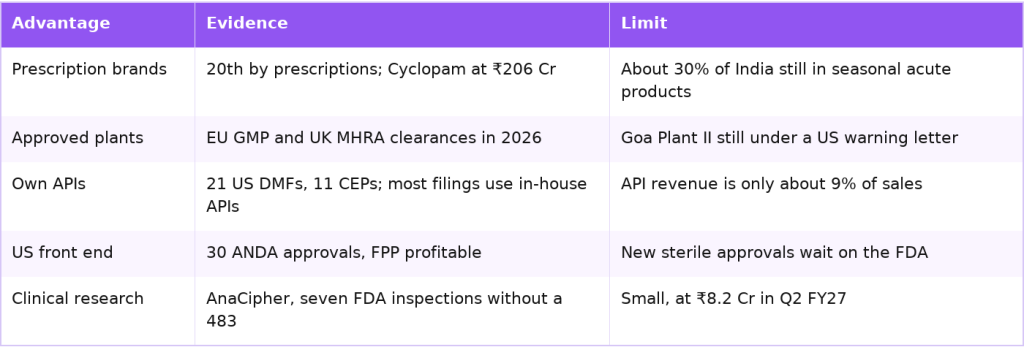
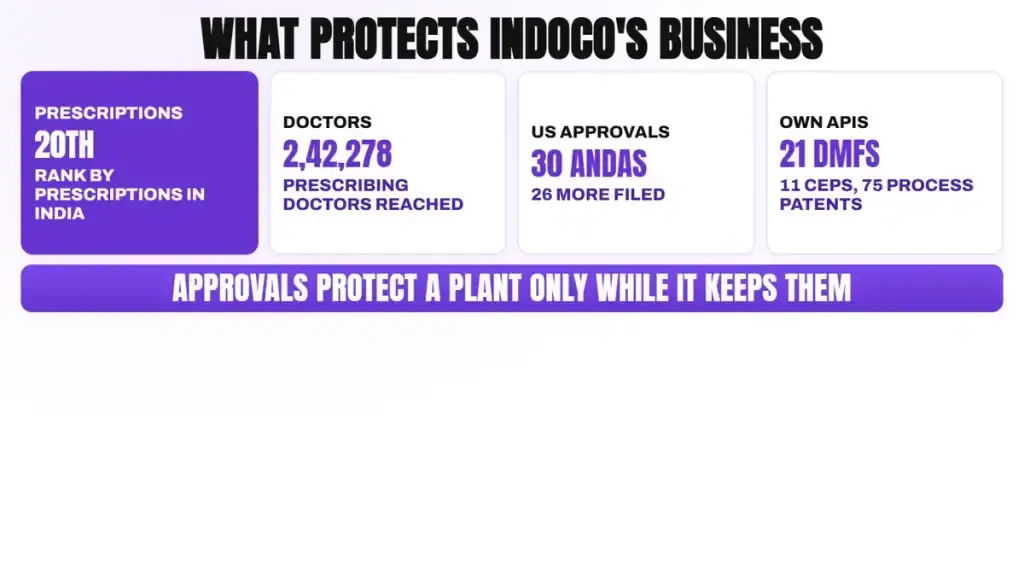
That table shows us where the moat is thinnest. Approvals protect a plant only while the plant keeps them.
"The first rule of compounding: never interrupt it unnecessarily."
— Charlie Munger
Indoco's brands kept compounding through the warning letter years. What interrupted the profit was one plant and the debt around it. Goa Plant II shows how one inspection can close a market for two years.
Financials: Five Years of Revenue, Profit, Cash and Capex
One quarter can mislead in a business where seasons and inspections move the numbers, so let's look at five full years together. Revenue here is consolidated revenue from operations, including other operating income. Operating cash flow is after tax, and capex is cash paid for plant, equipment and intangibles.

Revenue grew about 19.8% over four years, but profit went the other way. In FY24 Indoco spent ₹426.0 Cr on capex, more than twice the ₹207.3 Cr of FY23, and in FY25 another ₹356.2 Cr. In the same two years the warning letter cut US sales, and operating cash flow came down to ₹94.9 Cr in FY25.
Over the five years from FY22, capex added up to about ₹1,262.3 Cr, while operating cash flow came to about ₹795.1 Cr. The gap of about ₹467.2 Cr was met largely with borrowed money, which is why finance costs rose from ₹14.1 Cr in FY22 to ₹122.2 Cr in FY26.
FY26 shows the turn. Capex came down to ₹147.5 Cr and operating cash flow rose to ₹192.2 Cr, so the business funded its own spending again. With capex now limited to maintenance, the cash it makes can go to repaying debt.
"In the short run, the market is a voting machine but in the long run, it is a weighing machine."
— Benjamin Graham
Indoco's five-year table shows what gets weighed: revenue held up through the plant problem, but profit depended on interest and on how much cash the expansion consumed.
What FY28 Could Look Like on Management's Numbers
So where does Indoco go from here? Management has avoided margin guidance since the warning letter, but it has made several commitments over the last two quarters. They point in one direction: grow without new capex, and use the cash to repay debt.
Let's start with debt, because it decides how much of the operating profit reaches shareholders. Total borrowings were about ₹964 Cr in March 2026 and about ₹930 Cr in June. Read this Debt to Equity Ratio Explained The plan is to repay ₹110 Cr in FY27 and another ₹150 Cr in FY28, about ₹260 Cr in all. By September the company had repaid about ₹65 Cr at the consolidated level.
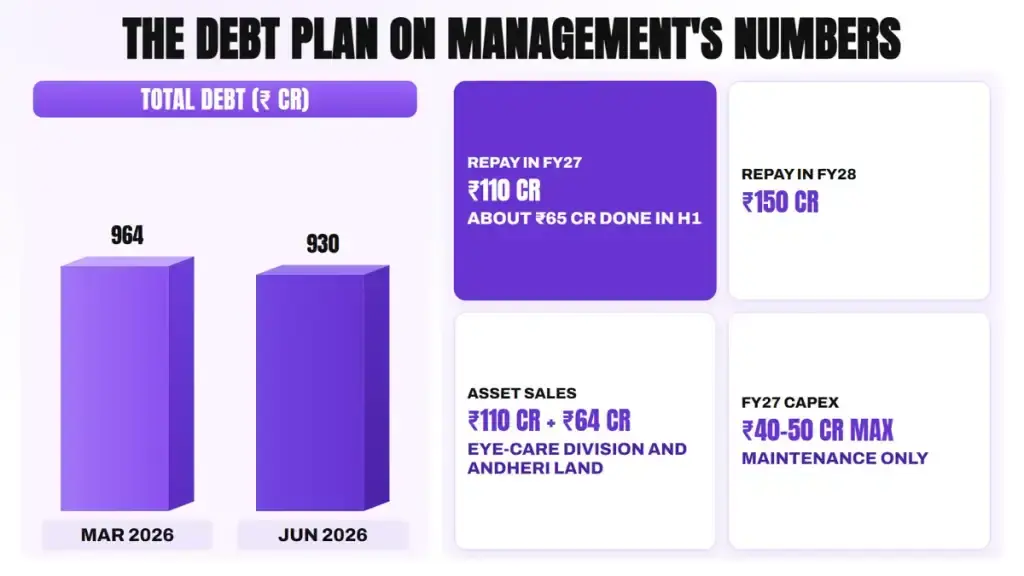
That repayment has two sources of cash. One is asset sales: the eye-care division brought ₹110 Cr and the Andheri land ₹64 Cr. The other is lower spending. Management expects only maintenance capex, not above ₹40-50 Cr in FY27, and says actual spending on plant and land will be under ₹25 Cr. It does not expect major capex in FY28 either. R&D is to stay under 5% of revenue, and it was about 4% in H1 FY27.
Next comes growth from capacity already built. Management says the existing plants could support up to four times the current international revenue. It expects regulated markets in Europe and the UK to grow by 20% or more over the next one to two years. It also says it is in line to double the export business in two to three years.
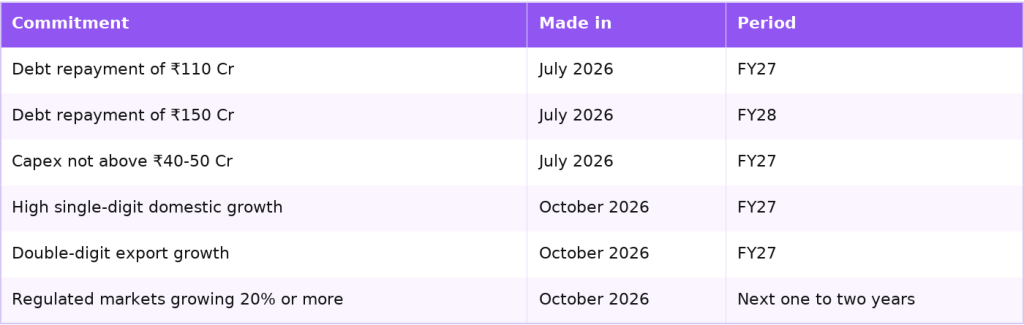
Those commitments are easier to judge against the past. So let's check what management said earlier this year against what has happened so far.

That record shows a clear split. The things Indoco controls, such as spending, costs and debt repayment, are on track. The things that depend on the market, such as the monsoon, freight and the FDA, have pushed growth and margins below plan. That split is the key to reading the next two quarters.
Key Risks
Now let's look at what could go wrong for Indoco Remedies, because several of these risks are already in the numbers.
- The FDA outcome: the seven observations at Goa Plant II could still lead to a longer wait. If the warning letter stays, new sterile approvals for the US remain on hold, and the plant's fixed costs keep weighing on profit.
- Interest burden: debt of about ₹930 Cr and finance costs of ₹26.9 Cr in Q2 FY27 take most of the operating profit. Part of the finance cost is in euros, so currency moves add to it.
- Profit from one-offs: H1 FY27 profit after tax of ₹84.9 Cr includes ₹134.5 Cr of exceptional gains from asset sales. Without them, the business still made a loss before tax.
- Seasonal brands: about 30% of the domestic business is still in anti-infectives and respiratory products. A weak monsoon can cut sales of Febrex Plus and ATM by 16-20% in a quarter, as it did in Q2 FY27.
- Cost of goods and freight: freight added about ₹13 Cr of cost in Q2 FY27, and raw material prices rose as supply tightened. Generic contracts in Europe do not always allow these costs to be passed on quickly.
- Working capital: export customers, especially in emerging markets, get long credit periods. Consolidated receivables were ₹489.2 Cr in March 2026, against ₹352.4 Cr a year earlier.
- Warren's spending: the toothpaste business needs years of advertising before it pays back, and the Aurangabad API plant earns little until it gets regulated-market approvals.
- Disputed claims and guarantees: in March 2026 the company reported disputed income tax, excise and GST claims of about ₹44.1 Cr, and a corporate guarantee of ₹264.5 Cr.
"I could tell you that for this quarter our toothpaste division has almost broken even. But that is because we probably have slowed down some of the expenditures on advertising." - Aditi Panandikar, Managing Director, October 2026
"All I want to know is where I'm going to die, so I'll never go there."
— Charlie Munger
For Indoco, the places to avoid are clear from the list above: a plant that cannot ship to its biggest market, debt that eats the operating profit, and a brand mix tied to the monsoon. The tracking list below shows how to see which way each one goes.
Explore our Products
Research Framework

Emerging Titans
Combination of quantitative analysis, industry tailwinds, and management assessment - SPRINT investment philosophy

Tiny Titans
Heavy emphasis on scuttlebutt research, plant visits, and early on-ground signals
What to Track Next
If you follow Indoco Remedies, these are the signals that will show where it goes next.
- The FDA's decision on Goa Plant II, expected from the first week of December 2026
- The operating EBITDA margin against the double-digit aim, after 9.0% in H1 FY27
- Total debt after ₹930 Cr, and repayments against ₹110 Cr for FY27
- Regulated-market growth against 20%, and emerging markets after a flat Q2
- Domestic growth once the eye-care base effect passes and the cold season starts
- Profit before exceptional items, which was a loss of about ₹13.0 Cr in Q2 FY27
Members can read our full Research Desk report on Indoco Remedies, with its detailed scorecard and section-by-section analysis.
Conclusion
Let's put it all together. Indoco Remedies has strong prescription brands in India, approved tablet plants that European customers rely on, and its own APIs and clinical research. Its revenue crossed ₹500 Cr in Q2 FY27. But a sterile plant under a US warning letter and debt taken on for expansion turned a profit of ₹154.8 Cr in FY22 into two years in the red. The more hopeful thread is the cost side: capex is down to maintenance, debt is being repaid on schedule, and the regulated markets are growing above 20%. The FDA's answer on Goa Plant II will show which thread is stronger.
Still, the fixes are now in motion. What happens next depends on whether the FDA clears Goa Plant II, whether the margin climbs back into double digits as freight and material costs ease, and whether debt comes down as planned.
FAQs
What does Indoco Remedies do?
+Indoco Remedies makes and sells finished medicines and APIs. In India it sells prescription brands such as Cyclopam and Febrex Plus, abroad it makes generics for Europe, the UK and the US and branded generics for emerging markets, and it also runs a clinical research business. FY26 consolidated revenue from operations was ₹1,845.3 Cr.
How did Indoco Remedies do in Q2 FY27?
+Consolidated revenue rose 7.4% to ₹506.9 Cr, its first quarter above ₹500 Cr. Operating EBITDA was ₹46.4 Cr at a 9.2% margin, and profit after tax was ₹19.5 Cr, helped by a ₹36.6 Cr gain on a land sale. Regulated-market revenue grew 21.1%.
What is the issue at Indoco's Goa plant?
+Goa Plant II, a sterile plant for eye medicines and injections, received a US FDA warning letter after a surprise audit in June 2024. The FDA re-inspected it from 27 August to 4 September 2026 and issued seven observations, and the company expects to hear the outcome from December 2026.
Why did Indoco Remedies make a loss in FY25 and FY26?
+The warning letter cut US sales, which had been about ₹285 Cr in FY24, while debt-funded expansion raised finance costs from ₹14.1 Cr in FY22 to ₹122.2 Cr in FY26. Profit after tax was a loss of ₹78.0 Cr in FY25 and ₹98.7 Cr in FY26.
What is Indoco Remedies' plan to reduce debt?
+Total debt was about ₹930 Cr in June 2026. Management plans to repay ₹110 Cr in FY27 and ₹150 Cr in FY28, using cash from operations and asset sales, including ₹110 Cr from the eye-care division and ₹64 Cr from Andheri land, with capex limited to maintenance.
What are the main risks for Indoco Remedies?
+The main risks are the FDA outcome at Goa Plant II, interest costs on about ₹930 Cr of debt, a domestic business still about 30% in seasonal acute products, and freight and material costs. H1 FY27 profit also relied on ₹134.5 Cr of exceptional gains.

High growth stock specialist, Value Educator
Shashank Mahajan is an equity research professional with over 12 years of experience in identifying high-potential SME and micro-cap stocks at an early stage. He follows a rigorous scuttlebutt research–driven approach, combining on-ground insights with deep financial analysis. Shashank specializes in uncovering under-researched and under-owned companies with strong management quality and long-term growth potential. Through disciplined research and early identification, he focuses on spotting tomorrow’s market leaders before they enter the mainstream investor radar.
Glenmark: The USD 700 Mn Cancer Deal and Its Brands
Pharma Stocks in India 2026: Generics, APIs and CDMOs
Granules India: From Paracetamol to a 65% Gross Margin
Natco Pharma: After Revlimid, 29 Patent Challenges
Shilpa Medicare: Cancer APIs, Films and Biosimilars
Alembic Pharma: US Plants Pay Back, Margin Hits 22.2%
Explore our Products
Research Framework
Emerging Titans
Combination of quantitative analysis, industry tailwinds, and management assessment - SPRINT investment philosophy
Tiny Titans
Heavy emphasis on scuttlebutt research, plant visits, and early on-ground signals



Modern Warfare to Multibaggers
Key Trends. Strategic Shifts. Opportunities Ahead.
Don't Miss This Exclusive Webinar!
Join Value Educator to decode the key trends shaping India's defence sector and learn how to identify tomorrow's potential leaders in the space.
- In-depth research on India's defence sector
- Live Q&A session
- Actionable takeaways for long-term investors

 Orders
 Subscription
 Share with friends


Required Details
₹23999.00
(12 month subscription)
As per SEBI regulations, all users are mandated to complete the KYC that is validated for 1 year. Post payment, you will be redirected to the KYC screen


No comments yet. Be the first to comment!