
Fineotex: The Chemistry in Every Fabric

Visit any good shop and choose an item from the shelves. A shirt, jeans, gym top. Look closely. The colour is even. The texture is uniform. The feel of the fabric is something that plain cotton or polyester can't naturally achieve. If it is wrinkle resistant, it remains wrinkle resistant. If it's moisture wicking, it wicks. If it is labeled as antimicrobial, someone did it on purpose.
All of that was not woven. All of it was not from the thread.
It was from chemistry, and Fineotex Chemicals is one of the companies that supplies it. In particular, from a sequence of chemical baths through which the fabric is passed from the loom to the finished garment. Pre-treatment to remove the fibre. Dyeing to colour it without patching. Printing so that patterns don't bleed. Completing to provide the product with the desired texture, stiffness, softness, or functional property when touched by the consumer. Every step relies on specialty chemicals that most people have never heard of, and companies that most investors have never paid attention to.
The global textile chemicals market is in the tens of billions of dollars. But very few investors in the investment world think about it, as it is invisible. You observe the T-shirt. You never see what went into making it look that way.
That's the whole point of being invisible.
Today's company is Fineotex Chemical Limited.
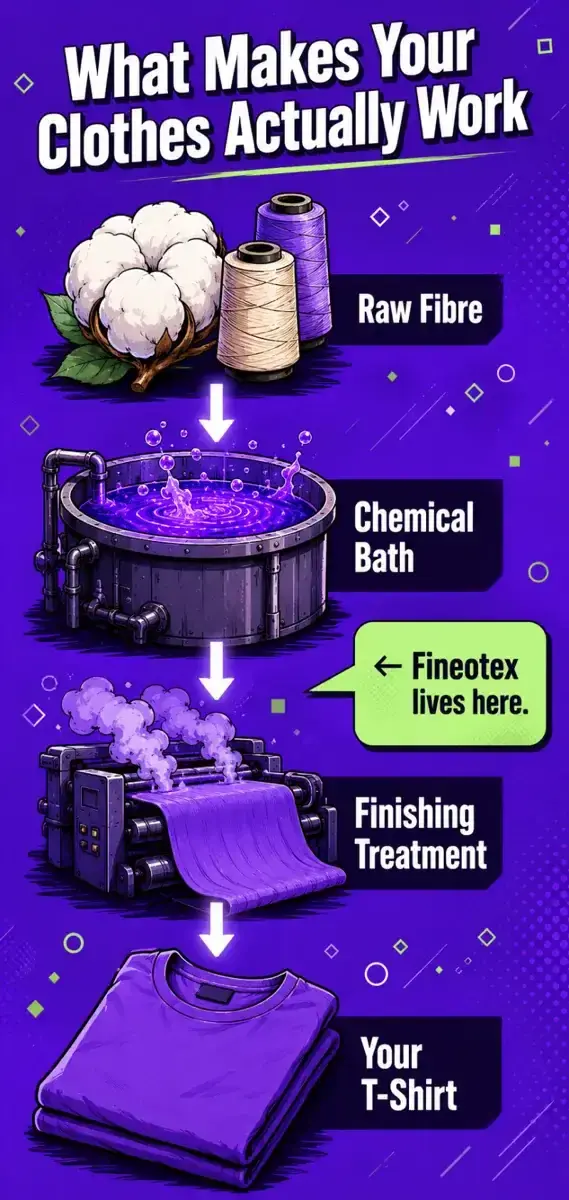
What Fineotex Actually Does
Specialty chemicals for textiles. Sounds dry, right? Hold on, the real business is far more interesting than that phrase implies.
Fineotex is involved in the whole textile value chain. Sizing polymers protect yarn from breaking during the weaving process. Enzymatic desizing agents are used to remove those sizing chemicals before dyeing is started. Wetting agents aid in the even penetration of dye into fibres instead of being on the surface. Levelling agents ensure that the colour is distributed evenly rather than in patches. Binders and thickeners allow for accurate printing. Then the finishing chemicals, silicone softeners, wrinkle resistance agents, hydrophilic treatments, each selected to impart that specific fabric with the property the brand desires you to feel.
Remove any one of them and the final product suffers in a way that the end consumer can definitely see.
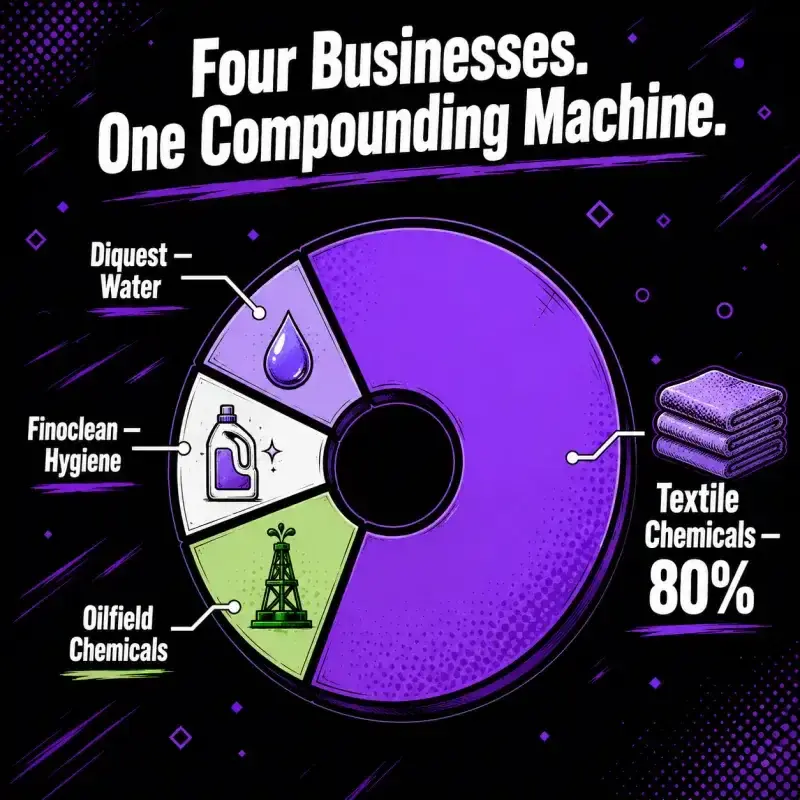
The base is textiles. Fineotex was no longer a pure textile chemicals company years ago. It currently operates four separate verticals. The main textile industry still contributes about 80% of the revenue. Next to it is an oilfield specialty chemicals business that supplies the upstream oil and gas industry with drilling fluid additives, cementing polymers, demulsifiers and corrosion inhibitors designed to withstand the heat and pressure that would kill regular chemistry. Also, there is Finoclean, a cleaning and hygiene brand that produces FDA certified floor cleaners and commercial laundry detergents for the hospitality and healthcare industry. And Diquest, an anti-scale polymer water treatment line for industrial boilers and desalination plants.
Four verticals. Over 470 product categories. More than 1,500 individual SKUs. Across multiple geographies. It's not a company that's just playing in one niche. It's a business that has been systematically growing its surface area, carefully selected adjacent square by square for decades.
"I try to invest in businesses that are so wonderful that an idiot can run them. Because sooner or later, one will." Warren Buffett
Fineotex: The Founding Story and Who Is Running the Business
Surendra Deviprasad Tibrewala founded Fineotex in 1979. At the time it was a closely held domestic operation making textile auxiliaries for the Indian market. Nothing glamorous. Formally incorporated in 2004, listed on the BSE in 2007, NSE in 2015.
Here is what makes the story worth paying attention to: the family never left.
Surendra Tibrewala is still the Managing Director and Executive Chairman. His son Sanjay serves as Executive Director and CFO. The family holds 62.3% of the company, with the founder personally sitting on 52.3% of that. These are people who built something from nothing in 1979 and are still showing up to run it in 2026. That kind of longevity does something to how you make decisions. You stop thinking about the next quarter. You start thinking about the next decade.
"Show me the incentive and I'll show you the outcome." Charlie Munger
The most telling recent signal came in March 2026, when CFO Sanjay Tibrewala went into the open market and bought approximately 40,000 shares, right before what turned out to be a blockbuster quarterly result. Executives buy their own stock for one reason. They think the market is wrong about what the business is worth. That is not a subtle signal.
Insider buying is one of the most overlooked signals in stock research. Read Stocks With Heavy Promoter Buying in India to understand why it matters and what to look for.
The Revenue Story: From Textile Chemicals to Global Specialty Conglomerate
For most of its life, Fineotex was a quiet story. A well-run Indian specialty chemical company, growing steadily, generating decent margins, not drawing much attention. The kind of business that shows up on nobody's radar until suddenly it does.
That changed over the last five years. Dramatically.
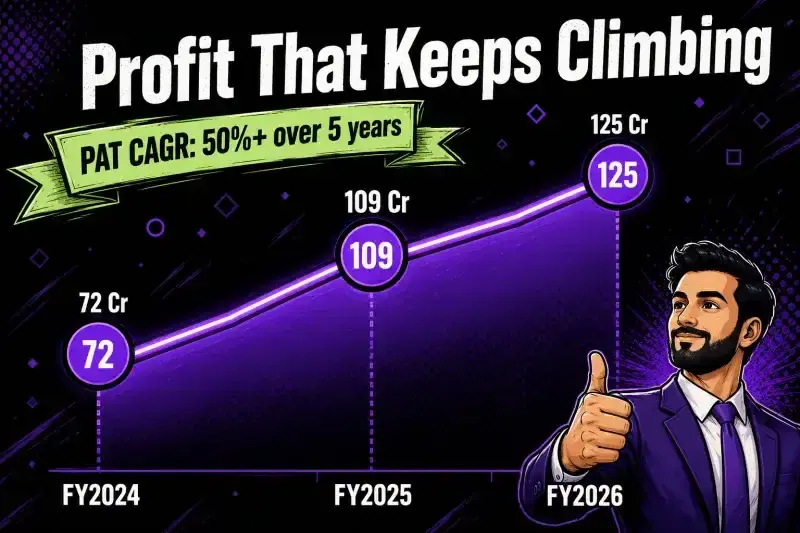
Revenue CAGR of 28%. PAT CAGR of over 50%. For five consecutive years. Those are not the numbers of a company coasting. That is a business that found its engine and floored it.
When a company operates across multiple segments, knowing which one is actually pulling the weight changes the entire investment case. Read How to Do Segment Analysis When Researching Stocks to see how to break this down yourself.
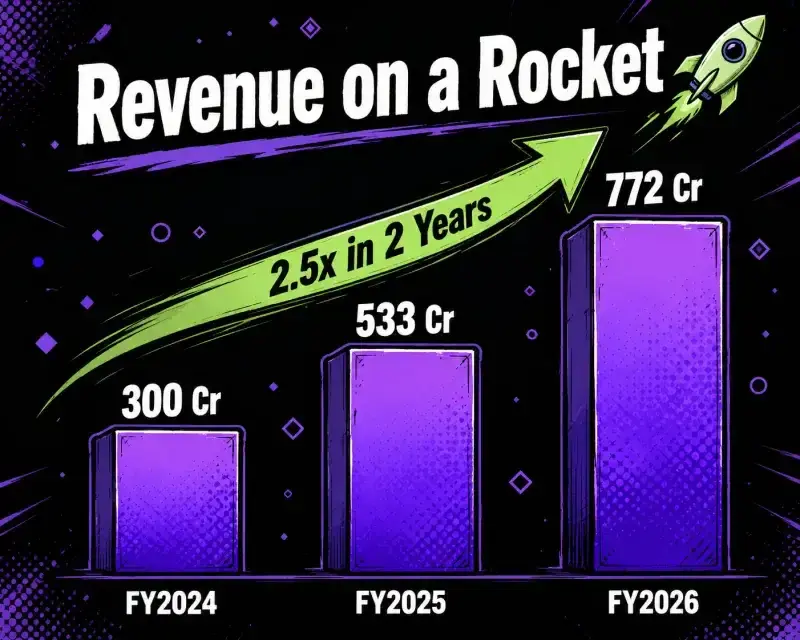
FY2025 gave us consolidated revenue of Rs. 533 Crore, PAT of Rs. 109 Crore, and operating margins of 23.85%. Solid. The kind of numbers that tell you the core business is genuinely healthy, not just riding a cycle.
Then FY2026 happened and everything accelerated.
Consolidated revenue jumped 44.79% to Rs. 772 Crore. Q4 FY2026 alone delivered Rs. 314 Crore in revenue, up 162% from the same quarter a year earlier. In a single quarter. That does not happen through organic growth. Something structural had shifted.
It had. Fineotex had gone to Texas.
The Bet on American Oil: The CrudeChem Acquisition
December 2025. Fineotex took the cash it had been quietly accumulating and acquired a 53.33% controlling stake in CrudeChem Technologies Group, a US oilfield specialty chemical business, for $11.50 million. Four debt-free entities, all serving the Permian Basin, one of the most active oil-producing regions on earth.
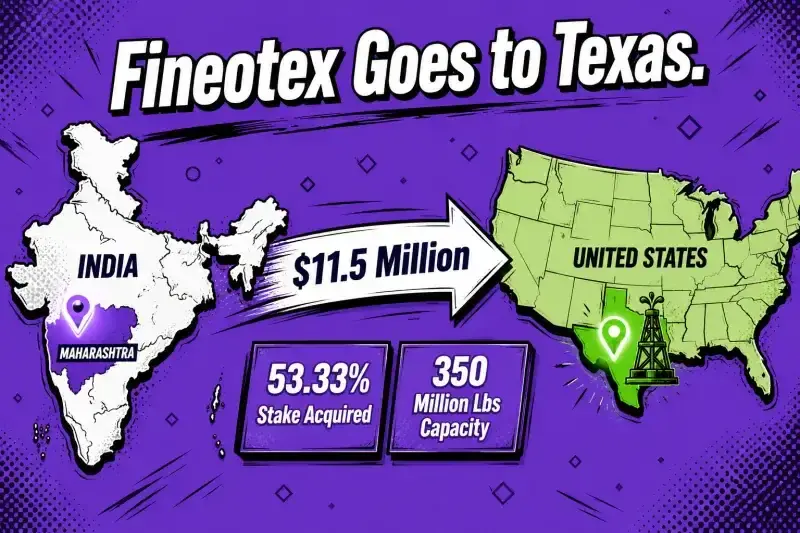
The entry price was not the ceiling. Fineotex holds an option to increase its stake to 78.33% by 2028, meaning if CrudeChem performs, the company can deepen its ownership at pre-agreed terms. And since all four entities came in debt-free, this was an acquisition of productive assets, not a leveraged rescue.
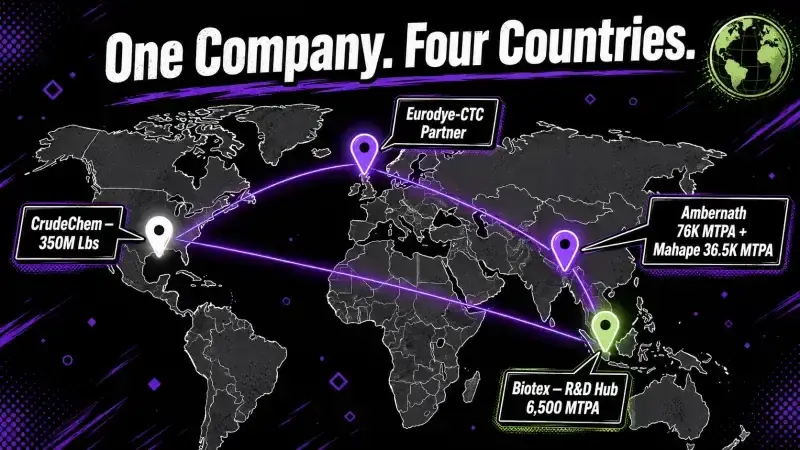
By mid-2026, less than a year after closing, Fineotex had already expanded CrudeChem's Texas manufacturing capacity by 75%, adding 150 million pounds and taking total US capacity to 350 million pounds annually. That is not the pace of a company hedging its bets. Management clearly likes what they see in the Permian Basin.
The stated target is a $200 million US oilfield specialty chemical business by 2028. From a standing start in late 2025, that looks ambitious on paper. But capacity is already being installed. Relationships with American oil majors are being built. And Fineotex has proven at home that it knows how to operate technical chemical businesses over the long run. This is a calculated bet, not a leap of faith.
"We are stubborn on vision. We are flexible on details." Jeff Bezos
The Global Alliance Network: How Fineotex Built Its Knowledge Base
Most Indian specialty chemical companies try to develop everything themselves. Fineotex took a different approach. Instead of reinventing formulations from scratch, it went out and found the best chemistry already developed in Europe and Southeast Asia, then figured out how to bring it to Indian cost structures. The result is a network of alliances that would take a competitor years to replicate.
Biotex Malaysia, acquired in 2011, is the most important piece. The facility runs at 6,500 MTPA and spearheads Fineotex's R&D function, focusing on fluorocarbon polymers, flame retardants, and green chemistry. It also benefits from free trade agreements with China, Vietnam, and India, making it a cheap and efficient sourcing hub for the Indian operations. Chemistry developed in Malaysia. Manufactured in India. Sold globally. That arbitrage is real.
Then there is Eurodye-CTC, a Belgian specialty chemical company that became a strategic partner in 2021. The tie-up lets Fineotex bring European-designed eco-friendly chemistries into the Indian market for export-compliant textile mills. Given that global apparel brands are now auditing their entire supply chains for sustainability credentials, this partnership is not peripheral. It is becoming the entry ticket.
HealthGuard Australia contributes US EPA-certified antimicrobial and antiviral chemistry for performance wear. The Sasmira Institute collaboration in India focuses on reducing water and energy consumption in textile processing. Put it all together and you have a company with global formulation access running on an Indian cost base. That combination is genuinely hard to build and even harder to copy.
The Green Chemistry Story: Sustainability as a Competitive Weapon
Here is something most people get wrong about sustainability in industrial businesses. They treat it as a compliance cost, something you spend money on to avoid regulatory problems. Fineotex figured out that in specialty chemicals, sustainability certifications are actually a market access mechanism. You either have them, or you cannot supply certain customers. Full stop.
The most striking example of this thinking is Aquastrike Premium. The global mosquito control market runs on petroleum-derived chemicals like BTI and Abate, both toxic, both facing increasing regulatory pressure in markets that care about what goes into public water systems. Aquastrike uses Azadirachtin (extracted from neem) to create a natural film over water that stops mosquito breeding without introducing insecticides into the environment. It already has approvals from India's Central Insecticides Board and the Haffkine Institute, and management is targeting the global NGO market, where large mosquito control programs operate under strict environmental rules. There are not many competitors with an NSF-certified, neem-based mosquito controller. That matters.
More broadly, Fineotex holds Bluesign, GOTS, and ZDHC certifications. Non-negotiable requirements for supplying textile mills that export to major European and American apparel brands. Fineotex can supply those mills. A competitor without those certifications simply cannot, regardless of how cheap their product is. The certification wall is the moat.
Understanding the Manufacturing Footprint
Ambernath in Maharashtra is the operational core, now at 76,000 MTPA after a 15,000 MTPA greenfield expansion was recently commissioned. The facility's most interesting feature is its fungibility: the production lines can switch between manufacturing textile chemicals and FMCG sanitizers depending on where demand is stronger. Fineotex has also purchased an additional 7 acres at Ambernath for future expansion. You do not buy land for a business you think is slowing down.
Mahape in Mumbai, at 36,500 MTPA, sits close to port facilities and primarily supports the export business.
Selangor in Malaysia runs the Biotex plant at 6,500 MTPA. As mentioned, this is the R&D and raw material hub that feeds the Indian facilities, with trade agreement cost advantages that make the sourcing economics attractive.
And then Texas. Now at 350 million pounds of annual capacity after the mid-2026 expansion, serving the Permian Basin directly.
Total global installed capacity stands at approximately 120,000 MTPA across India and Malaysia, plus the US oilfield operations on a different unit basis entirely. For a company this size, that is a genuinely diversified manufacturing base across four countries and two continents.
FY2026: Explosive Growth, Compressed Margins, and Why That Is Not the Same as a Problem
FY2026 was the year Fineotex stopped being a domestic specialty chemical story and became something more complex and more interesting.
Revenue grew 44.79% to Rs. 772 Crore. Q4 alone delivered Rs. 314 Crore, up 162% year on year, with PAT in that single quarter jumping 118% to Rs. 44 Crore. To put that in context, Fineotex's entire annual revenue was around Rs. 300 Crore just a few years ago.
But margins compressed.
EBITDA margin dropped from 23.85% in FY2025 to 17.45% in FY2026. PAT grew only 14.47% to Rs. 125 Crore, well below the revenue growth rate. On the surface, that looks like a deteriorating business.
It is not. But it requires understanding. Before drawing conclusions from margin movement, it helps to zoom out and look at what the numbers are actually saying. Read How to Read a Profit and Loss Statement to understand how to interpret these numbers the right way.
The oilfield chemical business structurally runs at lower margins than specialty textile chemicals. Fineotex's textile business, with its proprietary formulations, long customer relationships, and certification barriers, generates 24-25% EBITDA margins. CrudeChem runs at roughly 15%. So when the US business suddenly accounts for a large slice of consolidated revenue, it drags the blended margin down arithmetically, even if both businesses are individually healthy. This is not margin erosion. This is mix shift.
The second driver is deliberate investment. Fineotex spent heavily on SG&A during FY2026 to build its sales force and enter new markets. Those costs hit the income statement immediately. The revenue they generate shows up later. That timing gap is uncomfortable when reading quarterly numbers, but it is not a sign of poor management. It is the opposite.
Worth noting too: the first half of FY2026 was genuinely soft. Q1 saw revenue actually fall 0.4% year on year, with plant utilization sitting at 59% due to global textile destocking. The second half recovered sharply as CrudeChem integration kicked in. The full year numbers are a blend of two very different halves.
Management is guiding consolidated EBITDA margins back to 18-20% over the medium term as the Texas facility ramps up utilization and localizes its supply chain. If that happens alongside continued revenue growth, the earnings trajectory from here looks considerably more interesting than the FY2026 numbers suggest.
Fineotex Financials: A War Chest Built Over Years
This is the part of the Fineotex story that often gets skipped, and it probably should not.
Fineotex did not take on debt to fund its American expansion. It did not do a large dilutive equity raise. It wrote a cheque from cash it had been patiently building up through years of profitable domestic operations. By the end of FY2025, through internal accruals, preferential allotments, and warrant conversions, the company had accumulated Rs. 300-374 Crore in cash and liquid reserves. That war chest funded the $11.50 million CrudeChem acquisition, the Texas capacity expansion, and continued investment at Ambernath.
The balance sheet remains effectively debt-free. In a capital-intensive sector where competitors routinely lever up and then get punished when cycles turn, that is not just reassuring. It is a genuine structural advantage. No lender covenants restricting what management can do. No interest burden eating into earnings. No risk of a forced asset sale at the bottom of a cycle.
A strong balance sheet isn't just about low debt — it's also about understanding leverage. Read What is Debt to Equity Ratio? Why it Matters for Small Cap Investing to see why this metric matters.
"The cash register does not lie. Strong returns on capital, sustained over years, are the fingerprint of a business with something real going for it." Philip Fisher

Return on Invested Capital of 31.10% is the number that tells you this balance sheet is not just sitting idle. The business generates 31 rupees of operating profit for every 100 rupees of capital deployed. That is excellent by any measure, and it has been sustained over years, not manufactured in a single good quarter. Management also ran a 1-to-2 stock split and a 4:1 bonus issue during FY2026, moves that typically signal confidence and improve market liquidity.
What the Future Holds
The ambition management has set out is not small. A $200 million oilfield specialty chemical business in the United States by 2028. At current exchange rates, that alone would be roughly Rs. 1,700 Crore in US revenues, more than double what the entire Fineotex group generated in FY2026.
Aggressive? Yes. But the Texas facility is already at 350 million pounds of annual capacity after the expansion completed in mid-2026. The Permian Basin is not slowing down. And Fineotex has spent four decades building customer relationships in technically demanding industrial markets. The playbook is not new. The geography is.
Beyond the US, management is evaluating further acquisitions, several reportedly under NDA, and is actively looking at setting up a manufacturing plant in the Middle East to capture oil and gas chemical demand from that region. A debt-free company with strong domestic cash generation and a management team that has now proven it can execute internationally has genuine options here. Not theoretical ones.
Back home, India's textile industry faces growing pressure to meet international sustainability standards. That plays directly into Fineotex's certified product portfolio. The FMCG and water treatment verticals add diversification and cushion against pure textile demand cycles.
The Risks Investors Should Not Ignore
Over 60% of Fineotex's raw material inputs are crude oil derivatives. Ethylene oxide and silicones, both petrochemical products, both volatile when oil prices spike. Fineotex typically passes those increases through to customers, but there is always a lag. A sharp oil price move in the wrong direction can temporarily squeeze margins before the pricing adjustment catches up.
The US integration is the largest single risk the business has taken on. Absorbing four entities, scaling a Texas facility to 350 million pounds, and convincing American oil majors to shift purchasing relationships takes time, capital, and management attention that is now split across two continents. If North American drilling activity slows, the CrudeChem assets go from a growth driver to a drag. That is not a hypothetical scenario. It has happened before in the Permian Basin.
Forex exposure is now a real factor in ways it was not three years ago. International revenue was 70% of Q4 FY2026 revenues. Fineotex uses natural hedging, matching export revenues against imported raw materials, rather than formal derivatives. That works most of the time. It is not a complete hedge, and when the dollar or ringgit moves sharply against the rupee, it shows up in reported earnings.
Margin recovery is the most watched variable in the near term. The path back to 18-20% EBITDA margins requires the Texas facility to hit meaningful capacity utilization, supply chain costs to localize, and SG&A investment to translate into revenue. If that takes longer than expected, or if competitors in US oilfield chemicals respond aggressively to a new entrant, the timeline slips.
Finally, 62.3% promoter holding means public float is limited. Low float amplifies price movements in both directions. Worth knowing before sizing a position.
Explore our Products
Research Framework

Emerging Titans
Combination of quantitative analysis, industry tailwinds, and management assessment - SPRINT investment philosophy

Tiny Titans
Heavy emphasis on scuttlebutt research, plant visits, and early on-ground signals
What This Business Really Represents
Every garment goes through chemical processing. Every textile mill exporting to a major brand needs certifications that its chemical inputs are clean. Every well being drilled in the Permian Basin needs drilling fluid additives and cementing polymers that do not fail at depth. Every commercial kitchen and hospital laundry needs cleaning chemistry that actually works at scale.
Fineotex supplies all of it. Quietly. Without a consumer brand. Without appearing on any clothing tag. It sits inside the production process of companies whose names you do recognize, ensuring that the output meets the standard the end consumer expects, and most people buying the end product will never know it was involved.
"The best stock to buy is the one you already know, hidden in an industry everyone else has ignored." Peter Lynch
That invisibility kept Fineotex off most investors' radar for years, even as the business was compounding at 28% revenue growth and 50% PAT growth. Whether that changes now that an international acquisition has put the company under a brighter light is genuinely uncertain.
This is precisely the kind of opportunity that small and micro-cap investing is built around. Read Micro-Cap Investing: Where Extraordinary Wealth Is Built (and Tested) to understand the framework for finding businesses like this.
What Fineotex has built over 45 years is harder to replicate than it looks. A network of international alliances that took decades to assemble. A portfolio spanning four verticals and four countries. A balance sheet with no debt and several hundred crore in cash. A promoter family that owns the majority of the company and has been running it since before most of its current employees were born. And a management team that just demonstrated it can execute a cross-border acquisition and scale it faster than most people expected.
The US bet is the question mark hanging over the next two years. If the Texas ramp plays out and margins recover into the 18-20% range while revenue continues growing, the earnings trajectory from here will look significantly different from FY2026. If the integration drags or North American drilling softens, the next two years will be uncomfortable.
The numbers in FY2027 and FY2028 will tell us which way this goes. For now, the foundation is more interesting than most people realize, and the company has been quietly building it since 1979.
This article is intended for educational and informational purposes only and should not be construed as financial advice. Please consult a registered investment advisor before making any investment decisions.
FAQs
What does Fineotex Chemical actually manufacture?
+Fineotex manufactures specialty chemicals used across the textile manufacturing process, including sizing polymers, wetting agents, levelling agents, silicone softeners, and finishing chemicals. Beyond textiles, the company also produces oilfield specialty chemicals like drilling fluid additives and cementing polymers, cleaning and hygiene products under the Finoclean brand, and water treatment chemicals under the Diquest brand. In total, the company offers over 470 product categories and 1,500 SKUs across four distinct business verticals.
Why did Fineotex's profit margins fall in FY2026 despite strong revenue growth?
+The margin compression in FY2026 was primarily a result of mix shift, not business deterioration. Fineotex's core textile chemicals business runs at EBITDA margins of 24-25%, while the newly acquired CrudeChem oilfield chemicals business in the US operates at around 15%. When CrudeChem's revenue was consolidated into the group numbers following the December 2025 acquisition, it mathematically pulled the blended margin down to 17.45%. Additionally, Fineotex significantly increased its sales and marketing spending during the year to enter new markets, which further compressed near-term margins. Management expects consolidated margins to recover to 18-20% as the Texas facility ramps up utilization.
What is the CrudeChem acquisition and why does it matter?
+In December 2025, Fineotex acquired a 53.33% controlling stake in CrudeChem Technologies Group, a US-based oilfield specialty chemical company, for $11.50 million. The deal gave Fineotex four debt-free entities serving the Permian Basin, one of the most active oil-producing regions in the world. By mid-2026, Fineotex had already expanded CrudeChem's Texas manufacturing capacity by 75%, taking total US capacity to 350 million pounds annually. The company holds an option to increase its stake to 78.33% by 2028. Management has set an ambitious target of building a $200 million US oilfield chemical business by 2028, which would more than double the entire group's current revenue.
What makes Fineotex's sustainability certifications a competitive advantage?
+Fineotex holds Bluesign, GOTS, and ZDHC certifications, which are non-negotiable requirements for supplying textile mills that export to major European and American apparel brands. These brands now audit their entire supply chains for environmental compliance, meaning their supplier mills can only purchase chemical inputs from certified manufacturers. A competitor without these certifications simply cannot access those customers regardless of price. Fineotex also developed Aquastrike Premium, an NSF-certified, neem-based mosquito controller approved by India's Central Insecticides Board and the Haffkine Institute, targeting the global NGO market. In specialty chemicals, sustainability certifications are not a cost. They are a market access mechanism.
Who are the promoters of Fineotex Chemical and how much do they own?
+Fineotex was founded in 1979 by Surendra Deviprasad Tibrewala, who remains the Managing Director and Executive Chairman today. His son Sanjay Tibrewala serves as Executive Director and CFO. The founding family collectively holds 62.3% of the company, with Surendra personally holding 52.3%. This level of promoter ownership means the family's financial interests are deeply aligned with minority shareholders. A particularly notable signal of confidence came in March 2026, when CFO Sanjay Tibrewala purchased approximately 40,000 shares from the open market just ahead of a blockbuster quarterly result, one of the clearest indicators of insider conviction available to retail investors.
What are the biggest risks of investing in Fineotex Chemical?
+The key risks are the US integration, raw material volatility, and forex exposure. The CrudeChem acquisition requires Fineotex to absorb four entities, scale a Texas facility, and build relationships with American oil majors, all while splitting management attention across two continents. If North American drilling activity slows, the US assets become a drag rather than a growth driver. On the raw material side, over 60% of inputs are crude oil derivatives, meaning sudden oil price spikes can temporarily compress margins before price increases are passed through to customers. Finally, with international revenue now at 70% of Q4 FY2026 revenues, currency movements between the rupee, dollar, and ringgit can affect reported earnings in ways that are difficult to predict quarter to quarter.

High growth stock specialist, Value Educator
Shashank Mahajan is an equity research professional with over 12 years of experience in identifying high-potential SME and micro-cap stocks at an early stage. He follows a rigorous scuttlebutt research–driven approach, combining on-ground insights with deep financial analysis. Shashank specializes in uncovering under-researched and under-owned companies with strong management quality and long-term growth potential. Through disciplined research and early identification, he focuses on spotting tomorrow’s market leaders before they enter the mainstream investor radar.

Zen Technologies: Revenue Fell After a Big Win




PNG Jewellers: A 194-Year-Old Name Goes National

Explore our Products
Research Framework
Emerging Titans
Combination of quantitative analysis, industry tailwinds, and management assessment - SPRINT investment philosophy
Tiny Titans
Heavy emphasis on scuttlebutt research, plant visits, and early on-ground signals


 Orders
 Subscription
 Share with friends


Required Details
₹23999.00
(12 month subscription)
As per SEBI regulations, all users are mandated to complete the KYC that is validated for 1 year. Post payment, you will be redirected to the KYC screen


No comments yet. Be the first to comment!